What is included?
One STT 1S MAX aircraft, one STT-HUB1101 cabinet, four aircraft batteries, and one STTBOT-S1 or STTBOT-T1.
SKYHUB
Catalogue specification Rev 1.3, 2026-09-27.
Download the English Rev 1.3 product manual (PDF)English customer edition, Rev 1.3, 27 September 2026.
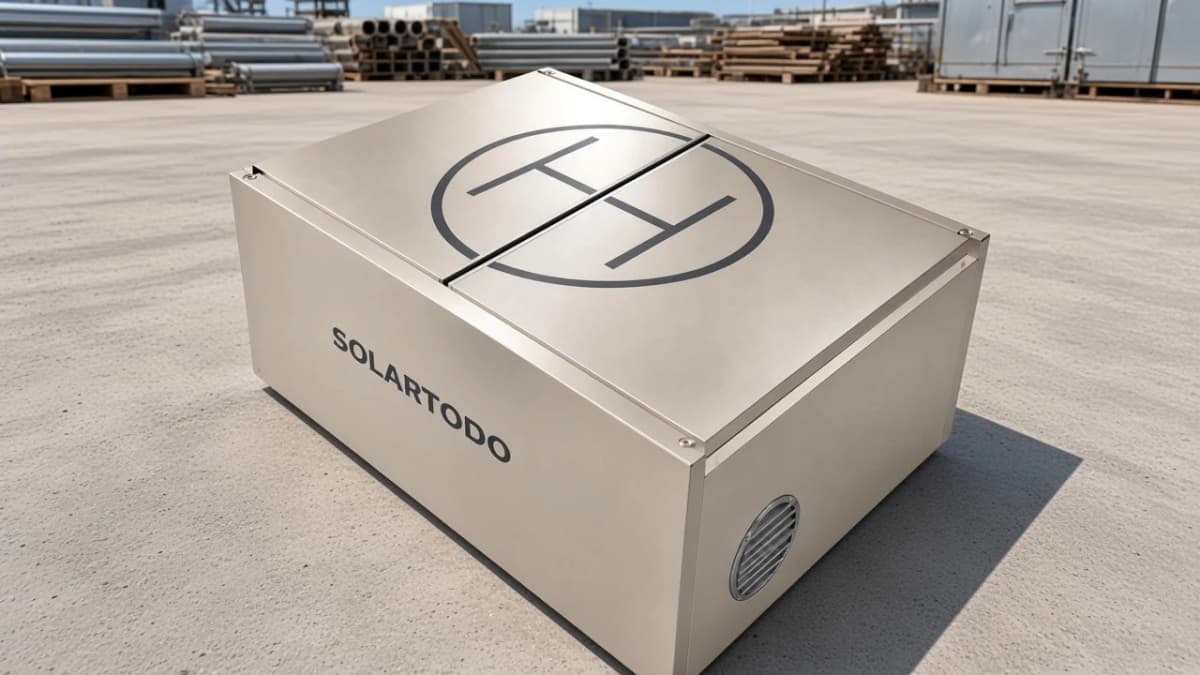
Cabinet size: 1200 × 1400 × 1000 mm. width × depth × height
Condition text is the Rev 1.3 English catalogue wording.
| Specification | Value | Condition |
|---|---|---|
| Cabinet size | 1200 × 1400 × 1000 mm | width × depth × height |
| Cabinet mass | approximately 145 kg | excludes the aircraft and battery |
| Clear opening | 1000 × 1000 mm | clear opening |
| Landing deck | 500 × 500 mm | alignment ±40 mm |
| Width with roof fully open | 1760 mm | width required with the roof fully open |
| Propeller tip circle | 841.2 mm | |
| Controlled width | 921.2 mm | prop tip circle plus ±40 mm |
| Nominal side clearance | 39.4 mm | one side, inside the opening |
| Battery bays | 4 | |
| Battery exchange time | not more than 150 s | from touchdown to AIRCRAFT READY; excludes time before the roof opens and after launch |
| Ingress protection when closed | IP65 | closed |
| In-cabinet charge channels | 3 | in-cabinet charging |
| Maximum per charge channel | 12.18 A / 800 W | maximum per channel |
| Charge window | 20% to 90% SOC | at 25 °C, at most 25 min |
| Battery charge temperature | +5 to +40 °C | hangar battery charging only |
| Matched battery modules in standard system | 4 total: 3 stored and one on aircraft | |
| Reserved reception bay | 1 before aircraft return | |
| Hangar battery-interface clearance envelope | 180 × 120 × 80 mm | maximum allocated space for the matched module and interface, not a statement of the module's measured outside dimensions |
| Cell arrangement | 6S rechargeable lithium battery | |
| Battery cycle rating | 400 cycles | |
| Continuous cell discharge rating | 4C | |
| Fast-charge rating | Up to 1.8C | when battery temperature and health permit |
| Minimum battery state of health for flight eligibility | 80% | |
| Maximum resting cell-voltage spread for eligibility | 30 mV | |
| AC supply | 220–240 V AC, 50/60 Hz, 16 A circuit | |
| Maximum input power | 3.2 kW | |
| Hangar operating temperature | −20 to +50 °C | |
| Relative humidity | 5–95% RH, non-condensing | |
| Local console | 10.1-inch industrial touchscreen | |
| Internal observation | 2 independent views: landing zone and transfer zone | |
| Local event history | 90 days | |
| Emergency-stop and access-interlock design basis | PL e / Category 4, ISO 13849-1:2023 | |
| Electrical design standard | IEC 60204-1 | |
| Enclosure classification standard | IEC 60529 |
One STT 1S MAX aircraft, one STT-HUB1101 cabinet, four aircraft batteries, and one STTBOT-S1 or STTBOT-T1.
STTBOT-S1 is approximately 880 mm and approximately 13 kg. STTBOT-T1 is 1,320 mm and approximately 35 kg. They are sold separately.
On its own 200 W wireless position. It does not enter the hangar battery bay. 200 W is not a full-charge time.
No. 54 min is the maximum forward flight time at 12 m/s, no wind, photo mode, obstacle action off, 100% to 0% SOC. Maximum flight time is not a guaranteed route duration.
No. It is not a street-light pole and it does not mount on a pole. The octagonal silicon pole and the cylindrical CIGS pole are two other products in this catalogue.