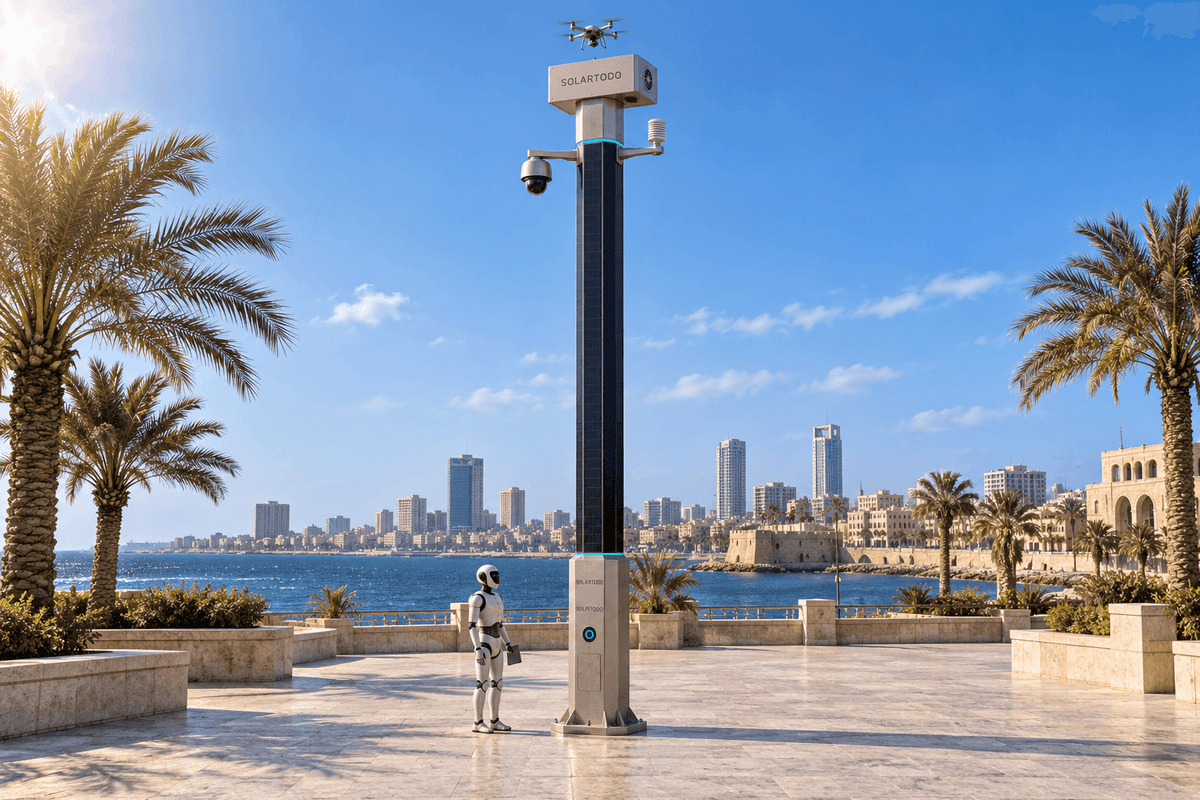
Tripoli coastal edge-node decision: SOLARTODO Sentinel City AI Pole configuration for off-grid patrol corridors
Summary
Tripoli’s 1.1M-plus capital core, 85% urbanized national context and 77.4% Libya electricity-access figure make off-grid edge nodes relevant for coastal security, port-edge patrol and municipal corridors. A typical 44-unit SOLARTODO Sentinel City AI Pole layout at ~40 m spacing would cover about 1.76 km, subject to survey.
Key Takeaways
- A typical 44-unit deployment at ~40 m spacing would create about 1.76 km of distributed sensing, drone-service and robot-support coverage.
- Tripoli’s capital-city population was listed at 1.126 million in 2015 by UN-Habitat, so procurement should assume dense urban interfaces.
- According to the World Bank (2024), Libya’s access to electricity was 77.4%, strengthening the case for battery-backed off-grid nodes.
- Each Sentinel pole should be specified with 5-20 kWh-class storage and 2.8-3.2 kWp on-pole PV nameplate, not grid dependence.
- Libya grid planning references 220/66/11 kV substations, so municipal works should coordinate with GECOL-style utility corridors even when the pole is off-grid.
- Tripoli’s coastal rainfall is generally under 400 mm/year, but salt air, dust and winter runoff still drive enclosure, drainage and cleaning requirements.
- The configuration should use anonymous vehicle count, crowd density, intrusion and perimeter awareness, with raw video processed locally on the pole.
- C-UAS response must remain non-lethal and human-authorized, limited to detection, tracking, coordination and soft aerial net-capture or deterrence.
Market Context for Tripoli
Tripoli needs edge infrastructure sized for a 1.126 million-person capital city, coastal corrosion, dust exposure and uneven utility reliability. According to UN-Habitat (2016), Tripoli’s capital-city population was 1.126 million in 2015, while Libya’s urbanization rate was 78.6% in 2014/2015. UN-Habitat’s Libya programme also notes that about 85% of Libya’s population now lives in urban areas, with Tripoli among the main coastal cities.
Tripoli is not an inland desert-only environment; it is a Mediterranean coastal capital exposed to marine humidity, saline air, winter rain events and Sahara-origin dust. According to the IFRC Libya Climate Fact Sheet (2023), Libya’s north is influenced by the Mediterranean while the south is shaped by the Sahara, and the Tripoli/Jifarah region receives among the country’s higher rainfall bands. Public climate summaries commonly place Tripoli below 400 mm/year rainfall, concentrated in cooler months, with dry summers and dust-prone shoulder seasons.
Grid context matters even for a fully off-grid pole because foundations, permits, road works and communication ducts often share municipal corridors. According to the World Bank Libya LCEP report (2018), Libyan network assets include 220/66/11 kV substation configurations. For a Sentinel City AI Pole deployment, that means civil teams should map buried utility routes and GECOL-related right-of-way constraints, while the pole’s own operations remain independent from site power.
Digital readiness is also relevant. According to ITU DataHub (2022), Libya had about 193 mobile-cellular subscriptions per 100 people, indicating a mobile-first communications environment. That does not guarantee reliable backhaul at every pole, but it supports a design in which local inference continues on-pole and only de-identified event/status metadata is transmitted when connectivity is available.
ITU states, “a smart sustainable city is an innovative city that uses information and communication technologies,” a useful framing for Tripoli’s edge-node procurement. The World Bank states, “addressing the risks posed by extreme climate events” can help Libya safeguard infrastructure and service delivery. Those two priorities point to the same technical answer: keep sensitive compute close to the sensor, reduce dependence on continuous upstream links, and harden the field node against coastal and dust conditions.
Recommended Technical Configuration
A typical 44-unit Tripoli configuration should prioritize autonomous edge operation, coastal hardening and corridor-level coverage over grid-tied power or lighting. The recommended product fit is the SOLARTODO Sentinel City AI Pole in Sky Hub pole form: a pure smart pole with no lighting system, no dependency on city power and no claim of unlimited solar self-sufficiency. It is appropriate for municipal perimeters, port-adjacent roads, critical facilities, campus-style districts and inspection corridors where a distributed physical-AI node is more useful than a passive pole.
A typical 44-unit deployment in this profile would consist of approximately 44 edge-node poles at about 40 m spacing. That spacing gives a planning corridor length of roughly 1.76 km before bends, setbacks, intersections, secure zones and heritage-street constraints are adjusted. In dense old-town approaches, spacing may tighten for line-of-sight and pedestrian interfaces; along wider coastal or port-edge roads, spacing may stretch only after radio, camera and drone-return checks.
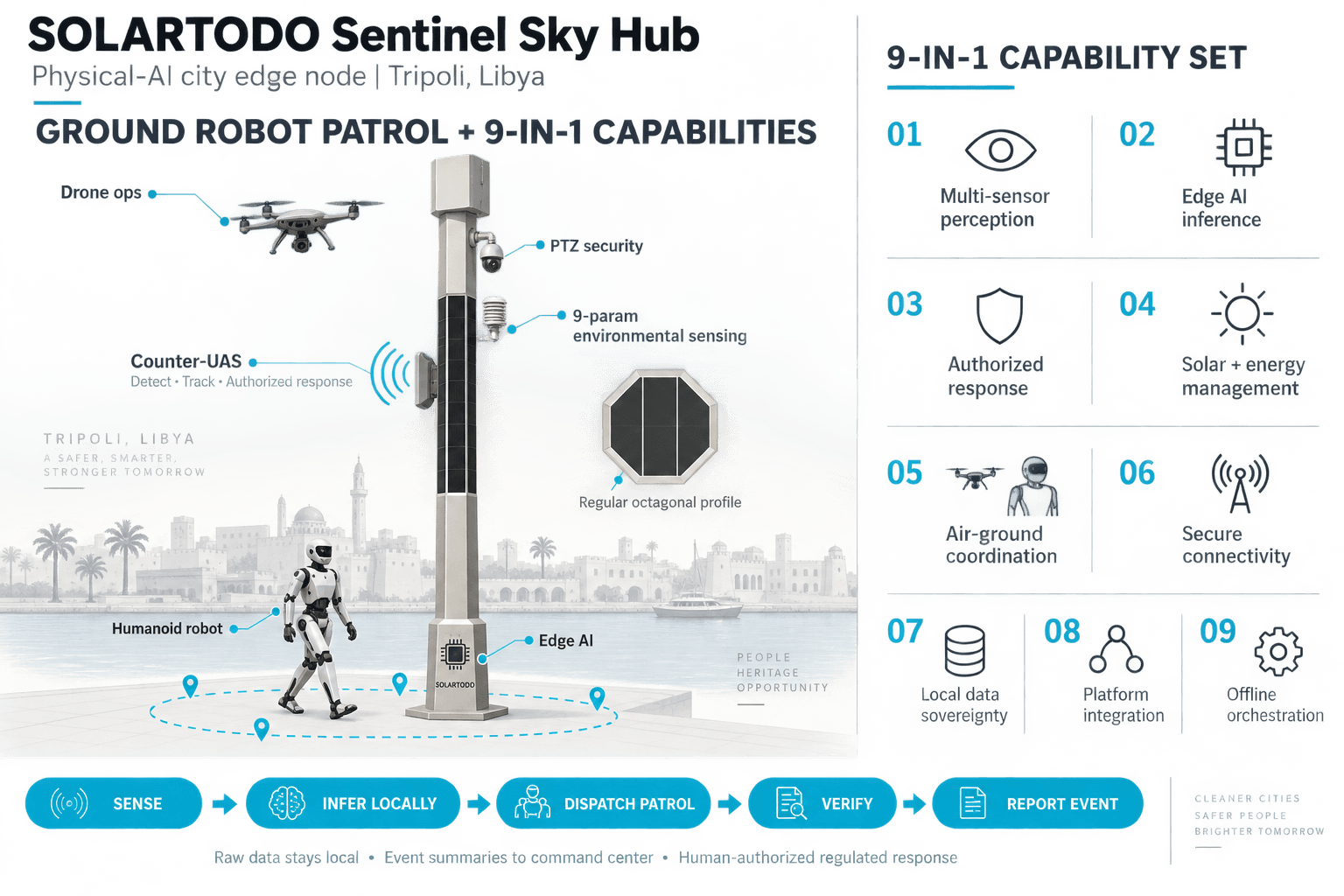
For Tripoli, the configuration should place local processing and operational continuity ahead of continuous raw-data transmission. Each pole should run local perception for anonymous vehicle counting, crowd density, intrusion and perimeter awareness. Raw video and sensor streams stay on the pole for local inference; only event summaries, health data, alarm status and de-identified operational metadata should leave the node. This is a PDPL-LGPD-oriented design posture, not a claim of legal certification.
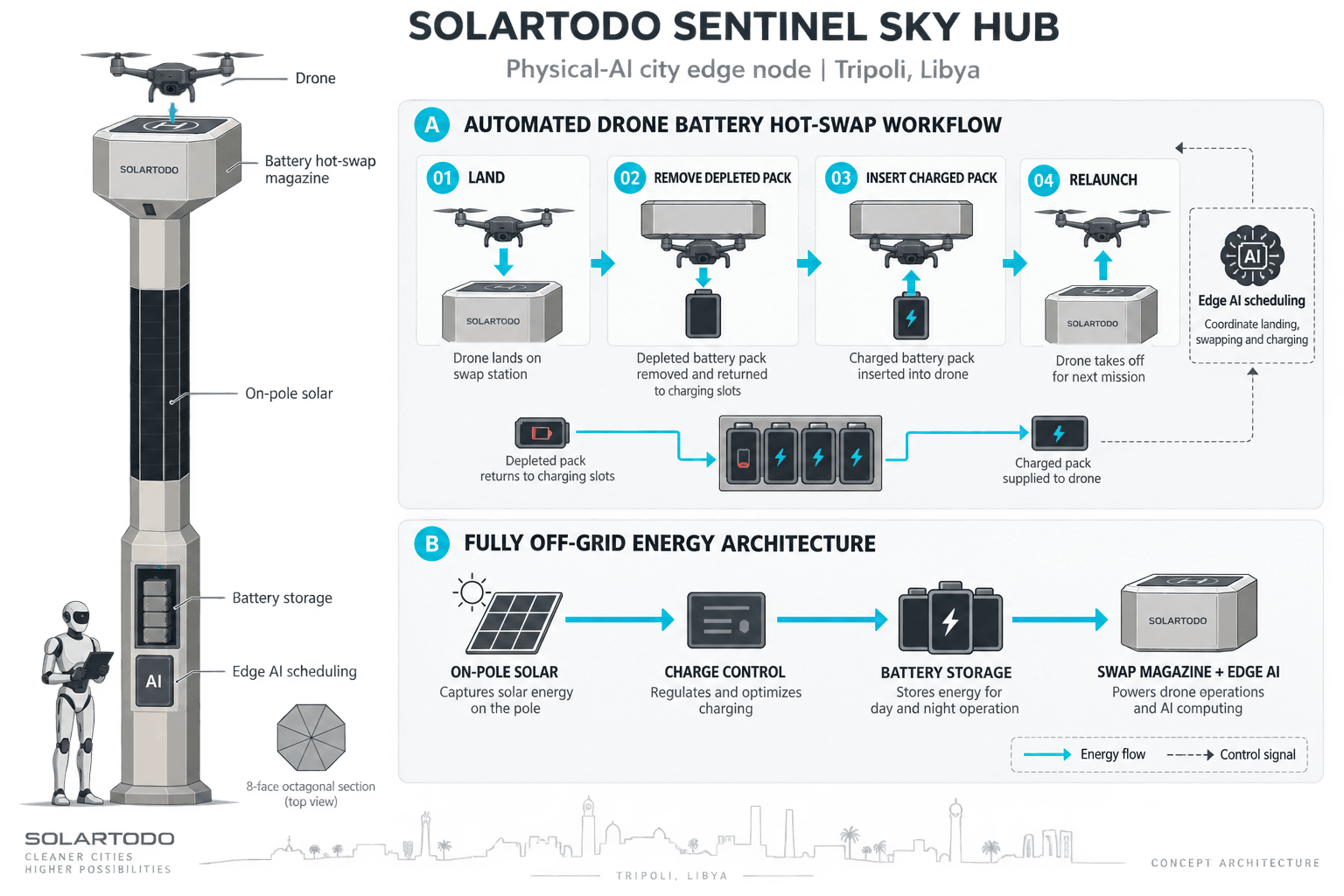
The drone-service layer should be specified for patrol, inspection, return, automated battery exchange and redeployment. The robot-service layer should support ground patrol, alarm response, inspection and return-to-base wireless charging. C-UAS coordination may include detection, tracking, command coordination and human-authorized soft aerial net-capture or close-approach deterrence. Radar should be treated only as an optional partner-sensor input, not as pole hardware.
Technical Specifications
A 44-node Tripoli deployment should specify each pole as a battery-backed off-grid physical-AI micro-station with 2.8-3.2 kWp PV nameplate and 5-20 kWh storage. Core specifications for the recommended SOLARTODO Sentinel City AI Pole configuration are:
- Quantity: approximately 44 units, project-based custom configuration, subject to engineering confirmation.
- Planning spacing: about 40 m between nodes, adjusted by site survey, turning radii, privacy masks and communications tests.
- Product class: pure smart pole / physical-AI urban edge node, with no lighting system.
- Energy architecture: fully off-grid battery-backed micro-station with on-pole solar replenishment and no city/site power dependency.
- Solar replenishment: 2.8-3.2 kWp nameplate, with realistic high-irradiance clear-sky output around 1.0-1.3 kW DC peak and about 7-10 kWh/day.
- Storage class: 5-20 kWh, selected by patrol frequency, drone swap cycles, robot duty cycle, communications load and reserve autonomy.
- Edge compute: Jetson-class module suitable for local inference, task scheduling and event filtering.
- Sensing: PTZ camera analytics for anonymous vehicle count, crowd density, intrusion and perimeter awareness.
- Environmental monitoring: wind speed, wind direction, temperature, humidity, atmospheric pressure, noise, PM10, PM2.5 and illuminance.
- Drone operations: autonomous launch, patrol, inspection, return, automated battery hot-swap, mission queueing and fleet health logging.
- Ground robot operations: patrol, alarm response, inspection, air-ground coordination and return-to-base wireless charging.
- C-UAS coordination: non-lethal detection, tracking and human-authorized response only; no jamming, hard-kill or autonomous attack.
- Data handling: raw video and sensor data processed locally on-pole; only de-identified event/status metadata leaves the site.
- Standards alignment: PV monitoring should reference IEC 61724-1; salt-mist exposure should consider IEC 61701; smart-city indicators should consider ITU-T Y.4903/L.1603.
Implementation Approach
A 44-unit Tripoli programme should move through 5 phases: survey, authority coordination, factory configuration, civil installation and commissioning. Phase 1 should confirm coordinates, corridor width, traffic movement, old-town street constraints, coastal exposure, drainage paths and communications availability. The output is a node-by-node layout, not a generic grid, because Tripoli mixes seafront roads, dense central streets, port-edge zones and municipal service corridors.
Phase 2 should coordinate with local municipal authorities, utility stakeholders and telecom operators. Even though the SOLARTODO Sentinel City AI Pole is off-grid, foundations must avoid buried power, water, telecom and drainage assets. Where the route crosses utility corridors associated with 220/66/11 kV or 11 kV distribution assets, civil works should follow local permit and safety procedures.
Phase 3 should configure the poles before shipment. For a project-based order, SOLARTODO would define storage size, sensor set, drone-service duty cycle, robot-service interface, communications fallback and command-view roles. Factory acceptance should test energy-management logic, local inference, mission queues, metadata export, environmental sensors and human-authorization controls for C-UAS response.
Phase 4 should stage installation in short corridor blocks rather than a citywide single mobilization. Typical field activities include foundation works, pole erection, battery/storage installation, sensor calibration, communications test, drone landing/service validation, robot charging validation and privacy-mask configuration. In Tripoli, salt air and dust should also drive maintenance access design and cleaning schedules.
Phase 5 should commission the common-operating-picture workflow. Operators should verify sensing, authorized assessment/response, edge-compute scheduling and field O&M in a single operational loop. Acceptance should be based on event accuracy, false-alarm review, metadata-only reporting, battery reserve, patrol cycle completion and clear human authorization logs.
Expected Performance & ROI
Expected value should be measured over 5-10 years using avoided trenching, reduced manual patrols, faster inspection cycles and lower data-backhaul risk. The strongest Tripoli business case is not selling power back to the grid; it is replacing scattered cabinets, temporary patrol workflows and vulnerable grid-powered devices with a local off-grid operations node. According to the World Bank (2024), Libya’s electricity access was 77.4%, so resilience and autonomy are legitimate procurement criteria.
Energy performance should be modelled conservatively. The on-pole PV layer is a replenishment source with roughly 7-10 kWh/day in a high-irradiance region under clear skies, while high-power drone and robot activities are buffered by storage. Duty cycles should prioritize critical patrol windows, scheduled inspections and alarm response rather than continuous high-power flight. In dusty periods, soiling checks and cleaning intervals should be included in O&M assumptions.
Operational ROI should be expressed as a range, not a fabricated payback claim. A practical model should compare the 44-node off-grid corridor against grid extension, trenching, cabinet power, manual patrol labor, truck rolls, incident-response delays and privacy/storage compliance costs. If the corridor requires only event metadata export instead of continuous raw video upload, backhaul cost and network dependency can fall materially, but exact savings require site tariffs and labor rates.
Results and Impact
A 44-unit Tripoli configuration would be expected to improve corridor awareness, inspection cadence and response coordination without claiming a completed deployment. For municipal buyers, the primary impact is a repeatable pattern: local AI filtering, autonomous air-ground operations, off-grid energy buffering and human-authorized response in one field node. For EPC partners, the impact is clearer scoping, because the product is not a lighting pole, not a telecom tower and not a grid-connected street cabinet.
The configuration also reduces privacy and data-governance exposure. Local processing keeps raw video and sensor data on the pole, while the command layer receives de-identified events, status and maintenance alerts. That design is better suited to public-sector review because it separates operational awareness from broad surveillance claims and avoids face or licence-plate recognition as active capabilities.
Comparison Table
Tripoli buyers should compare 3 options by autonomy, civil complexity, data exposure and operational coverage rather than by lighting output. The table below frames the SOLARTODO Sentinel City AI Pole against common alternatives used in security and municipal monitoring corridors.
| Criterion | SOLARTODO Sentinel City AI Pole | Grid-powered camera pole | Mobile patrol-only model |
|---|---|---|---|
| Typical Tripoli quantity | 44 units | 44 poles/cabinets | Variable patrol routes |
| Planning spacing | ~40 m | ~40-60 m | No fixed sensing grid |
| Energy source | Off-grid battery + on-pole PV replenishment | Utility power | Vehicle/personnel fuel or charging |
| Storage class | 5-20 kWh per node | Usually cabinet UPS only | Not applicable |
| Daily solar replenishment | ~7-10 kWh/day clear-sky | None unless separately added | None |
| Raw video handling | Stays on pole | Often centralized | Body/vehicle system dependent |
| Drone operations | Launch, return, hot-swap, redeploy | Usually separate system | Manual dispatch |
| Robot operations | Patrol and wireless charging support | Usually unsupported | Manual or separate robot dock |
| C-UAS posture | Non-lethal, human-authorized coordination | Detection-only if added | Human visual report |
| Grid trenching risk | Low | Medium to high | Low |
Pricing & Quotation
A Tripoli quotation should be based on 44 nodes, storage class, patrol duty cycle, shipping route, civil works and commissioning scope. SOLARTODO offers three pricing tiers for this product line: FOB Supply (equipment ex-works China), CIF Delivered (including ocean freight and insurance), and EPC Turnkey (fully installed, commissioned, with 1-year warranty). Volume discounts are available for large-scale deployments. Configure your system online for an instant estimate, or request a custom quotation from our engineering team at [email protected].
For technical scoping, start from the SOLARTODO solutions overview and define the operating corridor, required autonomy reserve, drone sortie frequency, robot patrol hours, metadata backhaul method and authority workflow. EPC pricing should not be compared only by pole count, because storage size, foundation design, coastal protection, commissioning depth and operator training materially affect total cost.
Frequently Asked Questions
Q1: Is the SOLARTODO Sentinel City AI Pole a smart streetlight? No. The SOLARTODO Sentinel City AI Pole is a pure smart pole and includes no lighting system. For Tripoli, its role is edge computing, sensing, environmental monitoring, drone service, robot service and human-authorized response coordination. Buyers should not specify LED output, lamp arms or illumination classes for this product line.
Q2: Why is Tripoli a strong fit for off-grid edge nodes? Tripoli combines a 1.126 million-person capital core, coastal salt exposure, dust, dense streets and uneven utility reliability. According to the World Bank (2024), Libya’s electricity access was 77.4%, so autonomous battery-backed nodes reduce dependence on site power. That matters for port-edge, municipal perimeter and critical-infrastructure corridors.
Q3: What does a 44-unit deployment cover at ~40 m spacing? At about 40 m spacing, 44 units provide roughly 1.76 km of planning coverage before field adjustments. Actual coverage depends on intersections, walls, road width, privacy masks, drone-return geometry and communications quality. SOLARTODO would treat 44 units as a configuration baseline, not a claim that a project has already been installed.
Q4: What energy configuration is recommended for Tripoli? Each pole should use battery-backed off-grid operation with 5-20 kWh-class storage and 2.8-3.2 kWp on-pole PV nameplate. The PV surface is a replenishment layer, typically around 7-10 kWh/day under clear high-irradiance conditions. It does not imply unlimited solar self-sufficiency, so duty-cycle scheduling remains important.
Q5: How long would procurement and installation typically take? A typical programme should be planned in 5 phases: survey, authority coordination, factory configuration, civil installation and commissioning. Timeline depends on permits, shipping route, foundation works, customs clearance and acceptance testing. For 44 units, corridor-by-corridor staging is usually safer than treating the whole city as one installation block.
Q6: What ROI or payback should an EPC evaluate? ROI should be modelled over 5-10 years using avoided trenching, reduced manual patrol labor, fewer truck rolls, faster inspection cycles and lower raw-video backhaul requirements. SOLARTODO should not promise a universal payback for Tripoli without local tariffs, labor rates, incident frequency and civil-cost data. The business case is operational resilience.
Q7: What maintenance is required in Tripoli’s coastal environment? Maintenance should include PV cleaning, dust inspection, seal checks, battery health review, drone magazine checks, robot charging validation and corrosion inspection. Coastal salt air and Sahara-origin dust justify scheduled cleaning and condition-based service. Environmental sensors for PM10, PM2.5, wind, humidity and temperature help tune maintenance intervals.
Q8: How does this compare with grid-powered camera poles? Grid-powered poles can be simpler for fixed CCTV, but they require power availability, trenching or cabinet infrastructure. The SOLARTODO Sentinel City AI Pole adds off-grid operation, edge inference, drone hot-swap, robot charging and metadata-only reporting. For Tripoli corridors with utility disruption or civil-work constraints, autonomy can outweigh lower upfront device complexity.
Q9: Does the system use face recognition or licence-plate recognition? No active face recognition or licence-plate recognition should be specified. The recommended Tripoli configuration uses anonymous vehicle count, crowd density, intrusion and perimeter awareness. Raw video stays on the pole for local processing, and only de-identified event or status metadata should leave the site for command review.
Q10: What is the C-UAS capability and who authorizes it? The C-UAS workflow is non-lethal and human-authorized. The pole can support detection, tracking, command coordination and dispatch of a friendly drone for soft aerial net-capture or close-approach deterrence. It must not be specified for shoot-down, jamming, hard-kill effects, autonomous attack or RF/GNSS denial.
Q11: What warranty and pricing model should buyers request? Buyers should request FOB Supply, CIF Delivered or EPC Turnkey scope, with the EPC option including installation, commissioning and a 1-year warranty as stated by SOLARTODO’s pricing paragraph. Warranty review should identify batteries, electronics, mechanical systems, drone-service parts and maintenance exclusions separately. Prices require a custom quotation, not generic article figures.
Q12: Which standards should be referenced during technical review? For PV monitoring, use IEC 61724-1; for salt-mist exposure, consider IEC 61701; for smart-city KPI framing, reference ITU-T Y.4903/L.1603. Libya grid-interface awareness should consider GECOL-style utility corridors and World Bank-documented 220/66/11 kV planning context, even though Sentinel nodes operate off-grid.
References
- UN-Habitat (2016): Libya urban indicators list Tripoli capital-city population at 1.126 million and national urbanization at 78.6%.
- UN-Habitat Libya (2023): Libya urban programme notes about 85% of the population lives in urban areas including Tripoli.
- World Bank (2024): Libya access to electricity reported at 77.4% of population.
- World Bank Libya LCEP (2018): Grid planning annex references Libyan 220/66/11 kV substation configurations.
- IFRC / World Bank CCKP (2023): Libya climate fact sheet describes Mediterranean northern climate, Sahara influence and Tripoli/Jifarah rainfall context.
- ITU DataHub (2022): Libya mobile-cellular subscriptions reported at about 193 per 100 people.
- IEC (2021): IEC 61724-1 defines terminology, equipment and methods for photovoltaic performance monitoring.
- ITU-T Y.4481 (2022): Smart sustainable city framework references ICT-enabled urban operation, service efficiency and data-platform concepts.
Equipment Deployed
- 44 x SOLARTODO Sentinel City AI Pole / Sky Hub off-grid physical-AI edge nodes
- 5-20 kWh-class battery storage per node, sized by drone/robot duty cycle
- 2.8-3.2 kWp on-pole PV nameplate per node for supplemental replenishment
- Jetson-class edge compute module for local inference and task scheduling
- PTZ sensing package for anonymous vehicle count, crowd density, intrusion and perimeter awareness
- Nine-parameter environmental monitoring: wind speed, wind direction, temperature, humidity, pressure, noise, PM10, PM2.5 and illuminance
- Autonomous drone operations package with launch, return, mission queueing and automated battery hot-swap
- Ground robot operations interface with patrol, alarm response and wireless return-to-base charging
- Human-authorized non-lethal C-UAS coordination workflow for detection, tracking and soft response
- Common-operating-picture command view exporting de-identified event/status metadata only