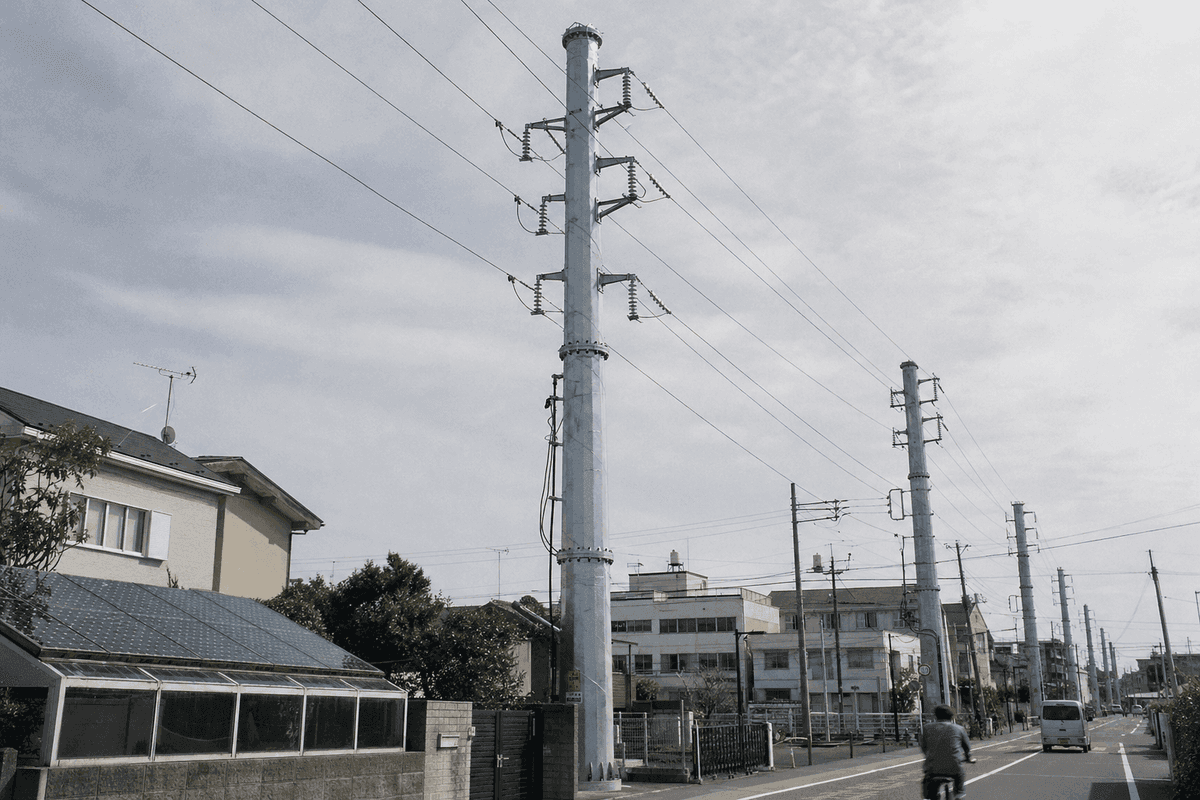
Tokyo Power Transmission Tower Market Analysis: 10kV Double-Circuit Steel Tubular Pole Configuration Guide
Summary
Tokyo’s dense urban distribution network and typhoon exposure make 10kV double-circuit steel tubular poles a practical municipal option; a typical 14 km corridor would use approximately 240 poles at 25 m height, 60 m spans, and Wind Class 1 design at 25 m/s.
Key Takeaways
- A typical Tokyo municipal distribution corridor of about 14 km would require approximately 240 steel tubular poles at 25 m height with 60 m spans for a 10kV double-circuit line.
- The project-specific configuration uses hot-dip galvanized Q345 steel, about 10 t per pole, with an estimated steel intensity of 400 kg/m and a 30-year design life.
- Recommended conductor selection is ACSR 120 at 470 kg/km with maximum tension of 38 kN, matching medium-voltage municipal distribution requirements.
- Electrical geometry in this configuration includes 0.8 m phase spacing, 0.5 m insulator length, and 5 m ground clearance for urban right-of-way control.
- Tokyo’s 2020 population was 14.047 million according to the Tokyo Metropolitan Government, which increases pressure on compact utility structures in road corridors.
- According to the Japan Meteorological Agency, Tokyo remains exposed to typhoon-season wind and heavy rainfall, supporting galvanized steel monopole use with concrete base foundations.
- IEC 60826 and GB 50545 are suitable design references for loading, line reliability, and structural verification in a Tokyo-oriented specification review.
- For buyers comparing options, SOLAR TODO positions the Power Transmission Tower line as a steel tubular alternative to bulkier lattice forms where municipal visual control and corridor width matter.
Market Context for Tokyo
Tokyo combines very high load density with constrained road reserves, so medium-voltage distribution structures must balance compact footprint, mechanical strength, and maintainability within narrow urban corridors.
According to the Tokyo Metropolitan Government (2021), Tokyo’s population was 14.047 million in 2020, concentrated across a highly urbanized service area with heavy commercial and transport electricity demand. According to the Statistics Bureau of Japan (2020), the Greater Tokyo region remains the country’s largest metropolitan concentration, which pushes utilities toward compact line routing and efficient use of roadside infrastructure. In this context, a tubular steel Power Transmission Tower format is often more suitable than wider-footprint structures where lane setbacks, sidewalks, and visual constraints matter.
Climate also shapes pole selection. According to the Japan Meteorological Agency (2024), Tokyo faces seasonal heavy rain, summer thunderstorm activity, and typhoon-related wind events that can affect overhead line reliability. IEC states, "IEC 60826 specifies procedures for the design of overhead lines taking account of climatic loads," which is directly relevant where 25 m/s wind class checks and corrosion protection are part of procurement review. For Tokyo, galvanized steel with concrete foundations is a practical baseline because humidity, rainfall, and urban pollution can accelerate coating deterioration if protection is underspecified.
Tokyo’s distribution environment is also shaped by Japan’s broader grid resilience agenda. According to the International Energy Agency (2021), Japan continues to invest in electricity network resilience and modernization after repeated weather-related infrastructure disruptions. According to the World Bank (2023), resilient urban infrastructure is increasingly tied to climate adaptation planning in large coastal cities. For a municipal 10kV corridor, this means buyers often prioritize double-circuit continuity, standardized accessories, and predictable maintenance intervals over purely lowest-initial-cost designs.
From a product-fit perspective, SOLAR TODO would typically position the Power Transmission Tower line for municipal and utility buyers that need steel tubular poles rather than lattice towers. The local fit is strongest where right-of-way is limited, the voltage class is medium voltage, and utilities need standardized flanged sections for transport and erection. In Tokyo, those conditions are common in road-adjacent distribution reinforcement, feeder diversification, and redevelopment-linked utility relocation.
Recommended Technical Configuration
For a Tokyo 10kV municipal distribution profile, a typical 14 km deployment would use approximately 240 double-circuit steel tubular poles with 25 m height, ACSR 120 conductor, 60 m spans, and concrete base foundations.
The user-specified configuration is a medium-voltage municipal distribution line using 10kV double circuit steel tubular poles, not lattice towers, FRP poles, or concrete poles. That voltage class sets the engineering basis first: 10-35 kV distribution belongs to the medium-voltage category, and the project-specific line remains in that municipal distribution segment. While the generic engineering table for 10-35 kV distribution indicates 12-18 m and 1-3 t/pole as a common range, this Tokyo-oriented specification is treated as a project-specific municipal configuration using 25 m tapered steel tubular poles and approximately 10 t per pole, which should therefore be read as a special urban-clearance and corridor-management design rather than a generic rural feeder assumption.
A typical deployment of this scale would consist of approximately 240 units over about 14 km, implying an average span of about 60 m. This is shorter than the 80-150 m span often seen in standard distribution routing, but it is consistent with urban constraints such as intersections, road curvature, underground utility conflicts, and tighter clearance control. According to IEC (2019), overhead line design must account for route conditions, climatic actions, and mechanical loading rather than relying only on nominal voltage class.
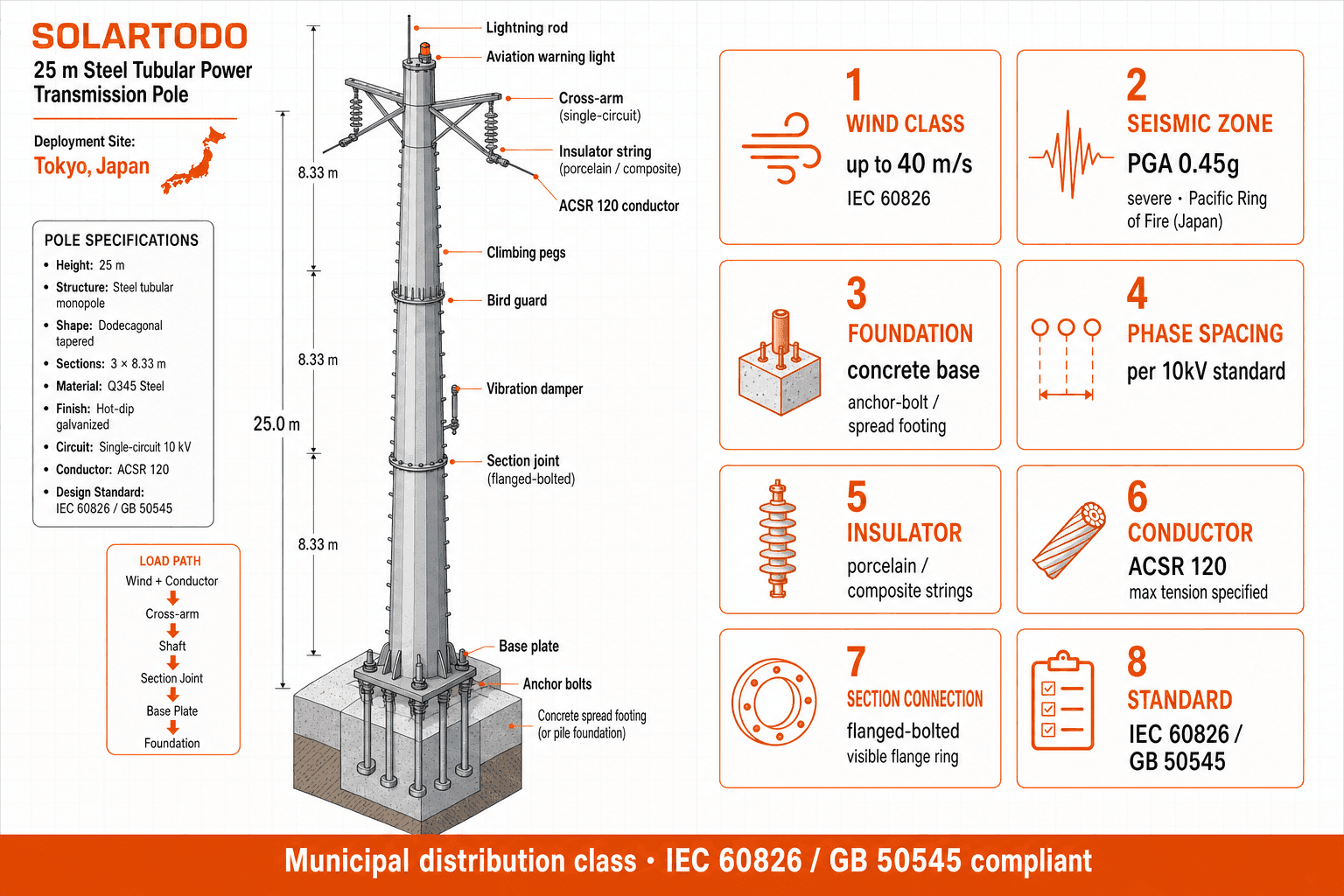
The recommended pole body is a tapered round steel tubular monopole in hot-dip galvanized Q345 steel with flanged bolted sections. This format reduces footprint at the base compared with lattice structures and supports easier corridor integration in municipal road reserves. SOLAR TODO can also configure dodecagonal sections where transport segmentation or attachment detailing requires it, but the specified Tokyo profile is a 25 m tapered steel tubular pole.
The electrical setout in this configuration uses double-circuit cross-arm brackets with 0.8 m phase spacing, 0.5 m insulator length, and 5 m minimum ground clearance. Conductor selection is ACSR 120 at 470 kg/km and maximum tension of 38 kN. Those values fit a medium-voltage urban distribution line where utilities need moderate current-carrying capacity, manageable sag behavior, and standard hardware availability.
The mechanical package includes Wind Class 1 at 25 m/s, concrete base foundations, and accessories such as climbing steps, cross arm assemblies, grounding, bird guards, and vibration dampers. According to GB 50545, transmission and distribution line structural design should verify loads, member strength, and foundation performance in relation to route conditions. For Tokyo, that means procurement documents should clearly define wind region, corrosion allowance, grounding resistance targets, and bolt-grade requirements before fabrication release.
Technical Specifications
The Tokyo-oriented reference configuration is a 10kV double-circuit municipal steel tubular pole system using 25 m galvanized Q345 poles, ACSR 120 conductor, 60 m spans, and a 30-year design life.
- Product type: Steel tubular Power Transmission Tower / monopole for medium-voltage municipal distribution
- Voltage class: 10kV
- Circuit arrangement: Double circuit
- Pole quantity: approximately 240 units for about 14 km
- Pole height: 25 m
- Pole form: Tapered steel tubular pole, flanged bolt sections
- Pole material: Q345 steel
- Surface protection: Hot-dip galvanized
- Approximate pole weight: about 10 t/pole
- Steel intensity: about 400 kg/m
- Conductor type: ACSR 120
- Conductor unit weight: 470 kg/km
- Maximum conductor tension: 38 kN
- Typical span in this configuration: 60 m
- Phase spacing: 0.8 m
- Insulator length: 0.5 m
- Ground clearance: 5 m
- Wind class: Class 1
- Basic wind speed: 25 m/s
- Foundation type: Concrete base foundation with anchor system as specified by geotechnical review
- Accessories: Climbing steps, cross arm, grounding set, bird guard, vibration damper
- Design life: 30 years
- Standards basis: IEC 60826 / GB 50545
For buyer review, the key point is that this is a municipal medium-voltage configuration focused on compact urban routing rather than a long-span transmission tower. IEEE states, "The selection of structures for overhead lines depends on electrical clearances, mechanical loading, and environmental exposure," which aligns with Tokyo’s corridor-limited siting conditions. SOLAR TODO should therefore be evaluated on pole geometry, galvanizing quality, bolt interface precision, and foundation compatibility rather than only nominal pole height.
Implementation Approach
A typical Tokyo rollout would proceed in 5 phases over roughly 5 to 9 months, covering route survey, structural verification, fabrication, foundation works, pole erection, stringing, and commissioning.
Phase 1 is route and utility interface review. For a 14 km line, the buyer would normally complete topographic survey, soil investigation, traffic management planning, and clearance checks across approximately 240 pole locations. In Tokyo, this phase is important because road occupancy permits, adjacent telecom plant, drainage crossings, and existing low-voltage circuits can affect final pole spotting every 50 to 70 m.
Phase 2 is engineering confirmation and procurement. This includes pole loading calculations to IEC 60826, foundation sizing to suit local soil bearing capacity, and review of conductor sag-tension at 38 kN maximum tension. For imported poles, flanged sections can be shipped in knocked-down form to reduce container inefficiency, then assembled on site with controlled bolt torque and galvanizing repair procedures at cut or handling points.
Phase 3 is civil works. Concrete base foundations are typically cast first, with anchor cages set to surveyed coordinates and elevation tolerances checked before concrete pour. For approximately 240 units, foundation sequencing is usually split into 3 to 6 work fronts to reduce traffic disruption and allow curing before pole erection. In dense city districts, night work windows may be required for crane placement and lane closure compliance.
Phase 4 is pole erection and hardware installation. The 25 m tubular sections are lifted, flanged, and aligned before cross arms, climbing steps, grounding sets, bird guards, and vibration dampers are installed. Because the line is double circuit, work planning should separate mechanical completion from conductor stringing and electrical testing to reduce rework risk at intersections and branch connections.
Phase 5 is stringing, testing, and energization. ACSR 120 conductors are tensioned to design values, clearances are rechecked, grounding continuity is measured, and as-built geometry is documented. SOLAR TODO buyers should also specify coating inspection records, bolt torque records, and foundation cube test results as part of final handover documentation.
Expected Performance & ROI
For Tokyo municipal distribution, a 30-year galvanized steel tubular pole system would typically reduce corridor footprint and maintenance frequency versus bulkier structures, with lifecycle value driven more by outage avoidance and urban land efficiency than by simple material cost alone.
The main performance benefit is route efficiency. A 25 m tubular pole occupies less visual and physical space than a comparable lattice structure, which can simplify placement along roads and near developed parcels. According to the World Bank (2023), resilient urban infrastructure investments create value by reducing service interruption and improving asset durability under climate stress. In a city like Tokyo, that can translate into fewer relocation conflicts and lower indirect costs during road widening or redevelopment.
Maintenance expectations are also favorable when galvanizing quality and grounding details are specified correctly. According to NREL (2023), lifecycle assessment for utility assets should include corrosion exposure, inspection intervals, and replacement risk rather than only initial fabrication cost. For a 30-year design life, buyers would typically plan visual inspections every 6 to 12 months, bolt and grounding checks every 1 to 2 years, and more detailed structural inspection after major wind events above the 25 m/s design threshold.
Return on investment for municipal distribution structures is usually measured through avoided outage cost, reduced maintenance labor, and lower corridor conflict cost. According to IEA (2021), grid modernization spending increasingly targets resilience and operational continuity rather than only expansion capacity. For a Tokyo utility or EPC, payback often depends on how many fault events, emergency repairs, or relocation works can be avoided over 15 to 30 years. A steel tubular line may justify its cost where aesthetics, compactness, and faster urban reinstatement matter.
For procurement teams evaluating suppliers, SOLAR TODO should be compared on coating thickness control, section straightness, flange machining accuracy, and documentation quality under IEC 60826 / GB 50545. Those factors often have more lifecycle impact than small differences in ex-works steel price. Buyers needing a quotation or design review can contact us with route length, voltage, wind speed, and geotechnical data.
Results and Impact
For Tokyo’s dense urban corridors, a 10kV double-circuit steel tubular pole scheme would typically improve route compactness, support feeder redundancy, and provide a 30-year municipal distribution asset with standardized maintenance points.
The practical impact of this configuration is not measured as a past deployed project, but as a likely infrastructure fit for Tokyo conditions. Approximately 240 poles over 14 km would create a repeatable municipal line format with standardized 60 m spans, 5 m ground clearance, and ACSR 120 conductor sizing. That consistency helps utilities manage spare parts, inspection routines, and future branch tie-ins across multiple districts.
A second impact is urban compatibility. The tapered tubular form reduces base clutter and can be easier to coordinate with roads, sidewalks, and adjacent utility plant than broader structural forms. For city agencies and EPC firms, that can improve permitability and shorten reinstatement windows, especially where workfronts are limited to short blocks or nighttime access periods.
Comparison Table
This comparison shows how the specified Tokyo 10kV tubular pole configuration differs from generic medium-voltage and higher-voltage steel tower classes in height, span, and structural duty.
| Configuration | Voltage Class | Pole/Tower Height | Approx. Weight | Circuit Type | Typical Span | Urban Fit in Tokyo |
|---|---|---|---|---|---|---|
| Tokyo recommended municipal configuration | 10kV | 25 m | ~10 t/pole | Double circuit | 60 m | High where corridor control and clearance are critical |
| Generic distribution tubular pole class | 10-35 kV | 12-18 m | 1-3 t/pole | Single or double | 80-150 m | Moderate in less constrained corridors |
| Sub-transmission steel structure | 66-110 kV | 18-30 m | 5-15 t/pole | Single or double | 200-300 m | Lower for municipal roadside use |
| HV transmission structure | 220 kV | 35-55 m | 15-35 t/pole | Usually double | 350-450 m | Unsuitable for dense street-level distribution |
| UHV transmission structure | 500 kV | 50-70 m | 35-55 t/pole | Double | 400-500 m | Not suitable for municipal distribution corridors |
Pricing & Quotation
SOLAR TODO offers three pricing tiers for this product line: FOB Supply (equipment ex-works China), CIF Delivered (including ocean freight and insurance), and EPC Turnkey (fully installed, commissioned, with 1-year warranty). Volume discounts are available for large-scale deployments. Configure your system online for an instant estimate, or request a custom quotation from our engineering team at [email protected].
Frequently Asked Questions
This FAQ answers 10 common buyer questions on Tokyo 10kV steel tubular pole selection, covering specifications, schedule, maintenance, quotation structure, and expected lifecycle value.
Q1: What is the recommended configuration for Tokyo municipal distribution?
A typical Tokyo profile would use approximately 240 steel tubular poles over about 14 km for a 10kV double-circuit line. The specified configuration is 25 m height, Q345 hot-dip galvanized steel, ACSR 120 conductor, 60 m span, 5 m ground clearance, and concrete base foundations under IEC 60826 / GB 50545.
Q2: Why use steel tubular poles instead of lattice towers in Tokyo?
Steel tubular poles generally need a smaller footprint and present a cleaner roadside profile than lattice structures. In a dense city such as Tokyo, that matters where sidewalks, traffic lanes, and adjacent utilities limit available space every 50 to 70 m. Tubular sections also simplify visual control in municipal corridors.
Q3: How long would a 14 km line of this type take to implement?
A typical program would take about 5 to 9 months, depending on permitting, utility coordination, and traffic windows. Survey and engineering often need 4 to 8 weeks, foundation works 6 to 10 weeks, and erection plus stringing another 6 to 12 weeks for roughly 240 pole positions.
Q4: What conductor is specified, and why is it suitable?
The specified conductor is ACSR 120, with unit weight of 470 kg/km and maximum tension of 38 kN. This is suitable for medium-voltage municipal distribution because it balances mechanical handling, sag control, and current-carrying capability without pushing the structure into a higher-voltage transmission class.
Q5: What maintenance schedule is typical for a 30-year design life?
Most owners would plan visual inspection every 6 to 12 months, grounding and bolt checks every 1 to 2 years, and special inspection after severe wind or vehicle impact events. Galvanizing condition, flange bolt torque, grounding continuity, and bird guard condition are usually the main maintenance checkpoints.
Q6: What is the expected ROI or payback for this type of asset?
Payback is usually calculated from avoided outage costs, reduced emergency repair frequency, and lower urban relocation conflict over 15 to 30 years. Unlike generation equipment, distribution poles do not produce direct revenue. The value comes from resilience, lower maintenance exposure, and more efficient use of constrained road corridors.
Q7: Does SOLAR TODO provide EPC pricing or supply-only quotations?
Yes. SOLAR TODO provides FOB Supply, CIF Delivered, and EPC Turnkey quotation structures for the Power Transmission Tower line. Buyers should submit route length, voltage, wind speed, geotechnical data, foundation preference, and accessory list so that structural loading, shipping volume, and installation scope can be priced accurately.
Q8: What warranty terms are typical for this product line?
Commercial warranty terms depend on scope, but the required pricing section for this product line references a 1-year warranty under EPC Turnkey supply. Buyers should also request separate confirmation on galvanizing compliance, fabrication tolerances, and documentation package because long-term durability depends on those quality controls.
Q9: What accessories are included in the specified Tokyo configuration?
The listed accessory package includes climbing steps, cross arm, grounding, bird guard, and vibration damper. For municipal buyers, these items matter because they affect maintenance access, conductor stability, avian interference control, and electrical safety. Additional hardware can be added if the utility requires signage, anti-climb devices, or surge protection fittings.
Q10: What information is needed to request a formal quotation?
A useful RFQ should include voltage class, route length, pole quantity, design wind speed, conductor type, span target, soil report, foundation preference, and local standards. If Tokyo permitting constraints are known, include road width, clearance requirements, and work-hour restrictions. That allows SOLAR TODO to prepare a more accurate technical and commercial offer.
References
- Tokyo Metropolitan Government (2021): Tokyo Statistical Yearbook and population data showing Tokyo’s 2020 population at 14.047 million.
- Statistics Bureau of Japan (2020): National census and metropolitan demographic statistics confirming Tokyo’s high urban density and infrastructure concentration.
- Japan Meteorological Agency (2024): Climate and typhoon information for Tokyo, including wind and heavy rainfall exposure relevant to overhead line design.
- IEC (2019): IEC 60826, Design criteria of overhead transmission lines, covering climatic and mechanical loading procedures.
- GB Standard (2010): GB 50545, Code for design of 110kV-750kV overhead transmission line, commonly referenced for structural and loading methodology.
- International Energy Agency (2021): Japan energy policy and electricity network resilience analysis supporting grid modernization and reliability investment.
- World Bank (2023): Urban resilience and infrastructure adaptation guidance relevant to climate-exposed metropolitan utility assets.
- NREL (2023): Utility asset lifecycle and resilience assessment guidance supporting maintenance and whole-life cost evaluation.
- IEEE (2023): Overhead line design guidance indicating structure selection depends on electrical clearances, mechanical loading, and environmental exposure.
Equipment Deployed
- Approximately 240 × 25 m tapered steel tubular Power Transmission Tower poles, double-circuit, flanged sections
- Hot-dip galvanized Q345 steel pole body, about 10 t/pole, about 400 kg/m
- ACSR 120 conductor, 470 kg/km, maximum tension 38 kN
- Double-circuit cross-arm bracket set with 0.8 m phase spacing
- Insulator strings, 0.5 m length
- Concrete base foundations with anchor system as required by site design
- Grounding set for each pole location
- Climbing steps for maintenance access
- Bird guard accessories
- Vibration dampers for conductor stability