Tegucigalpa Power Transmission Tower Market Analysis: 0.4kV 10m Steel Tubular Pole Configuration Guide
Summary
Tegucigalpa's 1.33M-person Central District would fit a 472-unit, 10m steel tubular pole configuration for about 14km of 0.4kV community distribution. The guide aligns ABC 50 conductors, 30m spans, 25m/s wind class, and GB 50061/IEC 60865 checks for procurement.
Key Takeaways
The recommended Tegucigalpa baseline is a 0.4kV, 14km low-voltage distribution line using approximately 472 steel tubular poles for community feeders.
- Approximately 472 units of 10m tapered steel tubular poles would support about 14km of low-voltage distribution at 30m span intervals.
- The voltage class is 0.4kV low-voltage single circuit, with ABC 50 conductor rated at 200kg/km and maximum tension of 8kN.
- Each Q345 hot-dip galvanized steel pole is approximately 2t, equivalent to 200kg/m, with a 25-year design life.
- The configuration uses 0.4m phase spacing, 4.5m ground clearance, and 0.1m insulator length for community distribution geometry.
- Tegucigalpa sits near 14.07, -87.19 at about 990m elevation, so routing must account for hillside access and segmented delivery.
- Wind class 1 at 25m/s is suitable for the specified low-voltage pole class when checked against IEC 60865 short-circuit effects.
- Accessories should include climbing pegs, cross arm, grounding, insulator pin, and anchor-bolt cage foundation for each pole location.
Market Context for Tegucigalpa
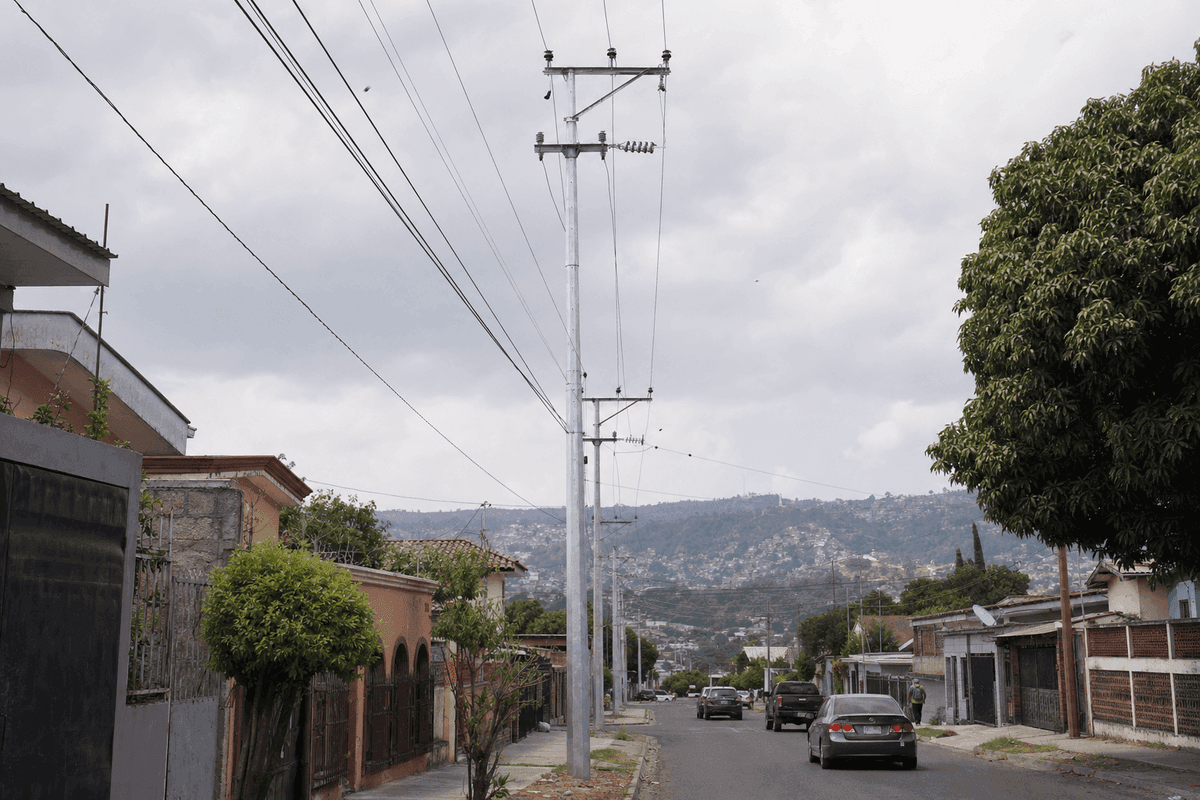
Tegucigalpa's Central District combines a 1,502km2 municipal area, a 2023 population above 1.32M, and hillside neighborhoods that favor compact pole logistics.
According to Honduras INE data summarized by CityPopulation (2023), the Central District has approximately 1,326,460 residents, making it Honduras' largest municipal electricity load center. The same municipal profile reports about 1,502km2 of administrative area, which means distribution planning must serve both dense urban barrios and outlying aldeas. For a SOLARTODO Power Transmission Tower configuration, this points toward a low-voltage community distribution class rather than a 35kV or 110kV feeder class.
According to the World Bank (2007), Honduras' urban electricity coverage was 94.4% while rural coverage was 44.8%, showing why peri-urban and community extensions remain materially different from downtown reinforcement. The World Bank also reported that losses were brought down to 21.2% after 2007 loss-reduction programs, with 3.5% in transmission and 17.7% in distribution. That distribution-loss profile supports compact, inspectable pole lines with grounded accessories and predictable conductor tension.
Tegucigalpa's climate also matters. According to public climate summaries for Tegucigalpa, the city has a tropical savanna climate, a May-to-October rainy season, and average annual rainy days near 107. Pole routes therefore need foundation staging, drainage inspection, and access planning before rainy-season excavation. The World Bank states, 'Transmission and sub-transmission investments keep being delayed due to financial constraints,' which reinforces the need for standardized equipment that can be procured, shipped, and installed in repeatable packages.
At national-grid scale, Honduras is connected to the Central American SIEPAC system. According to EPR/SIEPAC (2014), the regional interconnection uses a 1,790km, 230kV transmission line with 300MW transfer capacity. That high-voltage backbone is not the correct hardware class for this local guide; the Tegucigalpa recommendation here is a 0.4kV low-voltage rural/community distribution pole line using 10m steel tubular poles.
Recommended Technical Configuration
A typical 472-unit deployment in this Tegucigalpa profile would use 10m Q345 steel tubular poles for approximately 14km of 0.4kV single-circuit line.
The correct size class is low-voltage community distribution, not 10-35kV distribution and not 66-110kV sub-transmission. The project-specific configuration is 472 units x 10m tapered steel tubular pole for 0.4kV low-voltage distribution single circuit. Because the voltage is 0.4kV, the recommended height is 10m rather than the 12-18m used for 10-35kV feeders or the 18-30m used for 66-110kV lines.
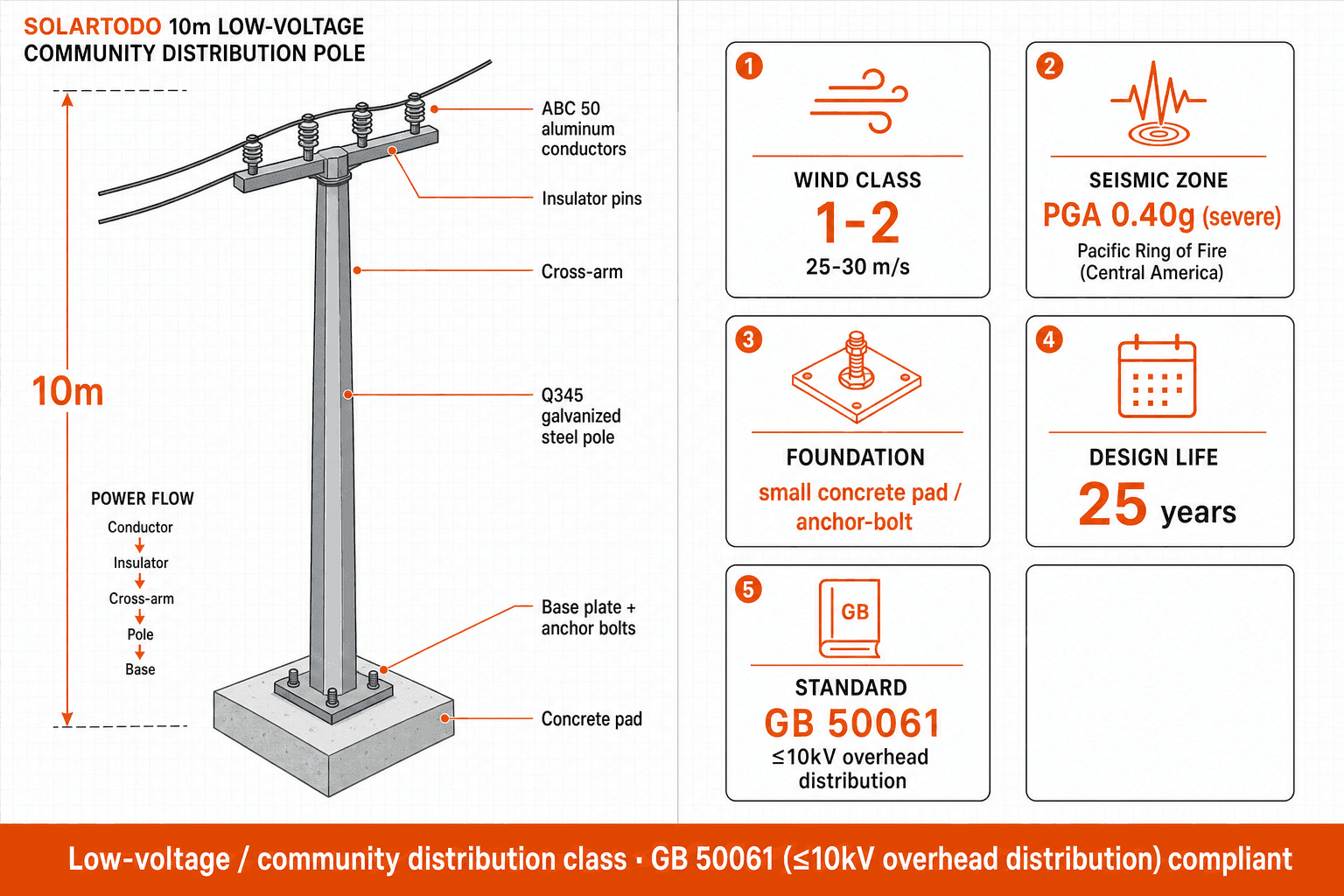
Each pole would be a tapered round or dodecagonal steel monopole, hot-dip galvanized Q345 steel, with flanged bolt sections where segmented delivery is required. The structure is not lattice, FRP, wood, or concrete. Cross-arm brackets, insulator pins, grounding hardware, and climbing pegs should be included as a matched accessory set so the EPC contractor does not substitute incompatible field hardware.
The conductor recommendation is ABC 50, with 200kg/km mass and maximum tension of 8kN. A 30m span gives about 33.3 spans per kilometer; over 14km this aligns with approximately 467 spans plus terminal, angle, and service positions, which is consistent with the specified 472-unit quantity. SOLARTODO should position this as a repeatable procurement configuration, while final staking, soil bearing checks, and service-drop interfaces remain site-specific.
Technical Specifications
The Tegucigalpa technical baseline is a 0.4kV, 10m, single-circuit steel tubular pole system with 30m spans and 25m/s wind design.
- Product form: Steel Tubular Transmission Pole, tapered round or dodecagonal steel monopole.
- Quantity and route: approximately 472 units for about 14km total line length.
- Voltage class: 0.4kV low-voltage rural/community distribution, single circuit.
- Pole height and weight: 10m height, approximately 2t/pole, 200kg/m.
- Steel and finish: Q345 hot-dip galvanized steel, with flanged bolt sections where required.
- Conductor: ABC 50, 200kg/km, maximum tension 8kN.
- Electrical geometry: 0.4m phase spacing, 4.5m ground clearance, 0.1m insulator length.
- Span and wind: 30m typical span, wind class 1 at 25m/s.
- Foundation: concrete anchor-bolt cage foundation, with local geotechnical verification.
- Accessories: climbing pegs, cross arm, grounding set, insulator pin, and matching fasteners.
- Standards basis: GB 50061 for overhead distribution lines at 10kV and below; IEC 60865 for short-circuit mechanical effects.
- Service life: 25-year design life under proper galvanizing inspection and foundation maintenance.
According to IEC (2011), IEC 60865 addresses calculation of short-circuit current effects, which is relevant to conductor support, bracket loads, and mechanical coordination. IEC states, 'prepares and publishes International Standards for all electrical, electronic and related technologies.' For procurement, this means the pole, grounding, bracket, conductor, and insulator package should be reviewed as one mechanical-electrical system rather than as separate commodities.
Implementation Approach
A practical Tegucigalpa rollout would divide 472 poles into survey, fabrication, CKD shipping, foundations, erection, stringing, and commissioning phases.
The first phase is route confirmation. Survey teams would validate 30m spans, road access, service-drop locations, turning points, drainage paths, and foundation offsets. This is especially important in Tegucigalpa because hillside roads and dense neighborhoods can restrict crane access, staging yards, and delivery windows.
The second phase is engineering freeze and procurement. SOLARTODO would prepare pole drawings, anchor-bolt cage dimensions, galvanizing requirements, cross-arm details, grounding hardware lists, and packing schedules. CKD shipping is appropriate when port-to-site logistics require smaller packages, while flanged sections reduce welding work in the field.
The third phase is civil work. Each pole position would receive an anchor-bolt cage foundation with concrete sized by soil bearing, overturning moment, and drainage risk. In rainy-season conditions, trenching and concrete curing should be sequenced by micro-zone so open excavations are not exposed across the whole 14km route.
The fourth phase is erection and commissioning. Crews would assemble pole sections, torque flange bolts, mount cross arms and insulator pins, install grounding, string ABC 50 conductors, verify sag and tension, and complete insulation and clearance checks. Commissioning should include grounding continuity, conductor tension records, visual galvanizing inspection, and as-built route documentation for future maintenance.
Expected Performance & ROI
Expected ROI should be modeled across 25 years using outage avoidance, lower inspection effort, standardized spares, and reduced rework on a 14km route.
This guide does not claim that a past SOLARTODO installation delivered specific savings in Tegucigalpa. Instead, the expected performance case is conditional: a galvanized steel tubular pole line would typically provide better dimensional consistency, less organic material degradation risk than wood, and easier accessory standardization than mixed legacy poles. For a 25-year design life, ROI should be assessed through lifecycle maintenance intervals, conductor reliability, and the cost of avoided emergency replacements.
According to the World Bank (2007), Honduras' distribution losses were 17.7% after loss-reduction work, compared with 3.5% in transmission. A low-voltage pole project cannot solve all commercial and technical losses by itself, but improved grounding, conductor organization, and standardized pole spacing help utilities inspect and manage feeders. In financial models, the main payback drivers are reduced field revisits, fewer improvised brackets, faster restoration after faults, and improved service regularity.
According to IEA country energy data summarized for 2022, oil represented 54.9% of Honduras' total energy supply, while modern renewables such as hydro, solar, and wind represented 12.9%. That energy mix makes end-use distribution efficiency important because losses and outages compound fuel exposure and system stress. For Tegucigalpa, the technical value of the 10m steel tubular pole configuration is not solar generation; it is repeatable low-voltage delivery hardware for dense and peri-urban loads.
Results and Impact
The expected impact is a standardized 14km low-voltage distribution corridor with approximately 472 galvanized poles and predictable 30m span geometry.
The primary result would be a more maintainable community distribution structure, not a claimed historic project outcome. With 4.5m ground clearance, 0.4m phase spacing, and ABC 50 conductor, the line would be configured for local service continuity while staying within the low-voltage class. The use of Q345 galvanized steel supports a 25-year design target, provided coating inspection, grounding checks, and foundation drainage are maintained.
Operationally, the biggest impact is standardization. A utility or EPC contractor can keep a repeatable bill of materials for poles, cross arms, insulator pins, anchor cages, and grounding sets. For SOLARTODO, the correct sales and engineering framing is advisory: the configuration is technically suitable for a Tegucigalpa low-voltage community distribution profile, subject to final survey and utility approval.
Comparison Table
This comparison separates the specified 0.4kV Tegucigalpa configuration from higher-voltage pole classes that would be overbuilt for this route.
| Configuration | Voltage class | Typical height | Typical weight | Span | Suitable use in Tegucigalpa |
|---|---|---|---|---|---|
| Recommended SOLARTODO low-voltage pole | 0.4kV | 10m | ~2t/pole | 30m | Community/rural low-voltage distribution over ~14km |
| Standard distribution pole class | 10-35kV | 12-18m | 1-3t/pole | 80-150m | Medium-voltage feeder, not the specified 0.4kV line |
| Sub-transmission steel pole | 66-110kV | 18-30m | 5-15t/pole | 200-300m | Utility sub-transmission corridors, not LV service |
| HV transmission monopole | 220kV | 35-55m | 15-35t/pole | 350-450m | Regional transmission, far above community distribution need |
| UHV transmission monopole | 500kV | 50-70m | 35-55t/pole | 400-500m | National backbone applications only |
The table is important because voltage must drive height, weight, and span. A 35kV pole should not be specified at 40m, and a 220kV pole should not be reduced to 15m. For the Tegucigalpa configuration, 0.4kV service, 10m height, 2t/pole mass, and 30m spans are internally consistent.
Pricing & Quotation
SOLARTODO offers three pricing tiers for this product line: FOB Supply (equipment ex-works China), CIF Delivered (including ocean freight and insurance), and EPC Turnkey (fully installed, commissioned, with 1-year warranty). Volume discounts are available for large-scale deployments. Configure your system online for an instant estimate, or request a custom quotation from our engineering team at [email protected].
Frequently Asked Questions
These 10 FAQs address Tegucigalpa pole specifications, installation, maintenance, ROI modeling, EPC scope, warranty, and comparison with higher-voltage structures.
Q1: What is the recommended Power Transmission Tower configuration for Tegucigalpa? The recommended configuration is approximately 472 units of 10m tapered steel tubular poles for a 0.4kV low-voltage single-circuit community distribution line. Each pole is hot-dip galvanized Q345 steel, weighs about 2t, uses ABC 50 conductor, and follows a 30m span basis across roughly 14km of route.
Q2: Why is the pole height 10m instead of 12-18m or 18-30m? The specified voltage is 0.4kV low voltage, so a 10m pole is appropriate for community distribution geometry. The 12-18m class applies to 10-35kV distribution, while 18-30m applies to 66-110kV sub-transmission. Using those taller classes here would add unnecessary steel, foundation size, and logistics burden.
Q3: What conductor and electrical clearances are used? The configuration uses ABC 50 conductor with 200kg/km mass and maximum tension of 8kN. The electrical geometry includes 0.4m phase spacing, 4.5m ground clearance, and 0.1m insulator length. Final clearances should be checked against utility requirements, road crossings, service drops, and local field conditions.
Q4: How long would installation typically take for 472 poles? A realistic schedule depends on permits, route access, crews, and rainy-season interruptions. For planning, the work is usually divided into survey, foundation construction, pole erection, conductor stringing, grounding, and commissioning. A 14km route can be phased by neighborhood so completed sections are inspected before the next segment begins.
Q5: What ROI factors should a utility or EPC buyer model? ROI should be modeled over the 25-year design life, focusing on reduced emergency replacements, standardized spare parts, inspection efficiency, and outage avoidance. Because no project price is stated here, payback should be calculated by the buyer using local labor rates, outage cost assumptions, loss-reduction targets, and maintenance intervals.
Q6: How does this compare with wood, concrete, or lattice structures? This recommendation is specifically a steel tubular monopole, not wood, concrete, FRP, or lattice. Compared with mixed legacy pole types, galvanized steel tubular poles provide consistent geometry, compact transport sections, predictable accessory mounting, and easier grounding integration. Lattice towers are more appropriate for higher-voltage corridors, not 0.4kV community distribution.
Q7: What maintenance is required over the 25-year design life? Maintenance should include visual galvanizing inspection, bolt torque checks, grounding continuity tests, foundation drainage review, conductor sag inspection, and accessory replacement where corrosion or mechanical damage appears. After major storms or slope movement, field crews should inspect anchor-bolt cages, cross arms, insulator pins, and conductor tension before restoring normal operation.
Q8: What is included in EPC Turnkey scope? EPC Turnkey typically includes installed and commissioned equipment with a 1-year warranty, subject to final contract scope. For this product line, the scope may cover engineering drawings, foundation construction, pole erection, cross-arm installation, grounding, conductor stringing, testing, commissioning records, and handover documents. Utility approvals and permits should be defined early.
Q9: Are prices included in this market analysis? No prices are included because the correct quotation depends on steel weight, shipping terms, foundation quantities, installation scope, and local site access. SOLARTODO provides FOB Supply, CIF Delivered, and EPC Turnkey quotation structures. Buyers can request a configuration review through the product page or contact channel before commercial terms are finalized.
Q10: Which standards should engineers reference before procurement? The baseline references GB 50061 for overhead distribution lines at 10kV and below, plus IEC 60865 for short-circuit mechanical effects. Engineers should also check local Honduran utility requirements, grounding rules, road-crossing clearances, and any municipal excavation permits. Final approval should come from the responsible utility or EPC engineer of record.
References
These 7 references support the Tegucigalpa market context, voltage-class selection, climate constraints, and low-voltage steel pole engineering basis.
- Honduras INE / CityPopulation (2023): Central District population and municipal area data for Tegucigalpa, including approximately 1.326M residents and 1,502km2. https://www.citypopulation.de/en/honduras/admin/
- World Bank (2007): Honduras Power Sector Issues and Options, including urban/rural electricity access and transmission/distribution loss context. https://documents.worldbank.org/
- EPR / SIEPAC (2014): Central American Electrical Interconnection System, 1,790km regional 230kV interconnection with 300MW transfer capacity. https://www.eprsiepac.com/
- IEC (2011): IEC 60865-1, Short-circuit currents - Calculation of effects, used for mechanical checks under short-circuit loading. https://webstore.iec.ch/
- IEEE (2023): IEEE C2 National Electrical Safety Code, reference framework for overhead electric supply and communication line safety practice. https://standards.ieee.org/products-programs/nesc/
- IEA (2022): Honduras country energy profile, including 54.9% oil share of total energy supply and 12.9% modern renewables share. https://www.iea.org/countries/honduras
- GB 50061 (2010): Code for design of overhead electrical power distribution lines at 66kV and below, referenced here for 10kV-and-below distribution design practice.
Equipment Deployed
- 472 units x 10m tapered Q345 hot-dip galvanized steel tubular pole
- 0.4kV low-voltage single-circuit distribution configuration
- ABC 50 conductor, 200kg/km, maximum tension 8kN
- 30m typical span, approximately 14km total line length
- Anchor-bolt cage concrete foundation per pole location
- Cross arm, insulator pin, grounding set, climbing pegs, and fasteners
- 0.4m phase spacing, 4.5m ground clearance, 0.1m insulator length
- Wind class 1 design basis at 25m/s with IEC 60865 mechanical checks