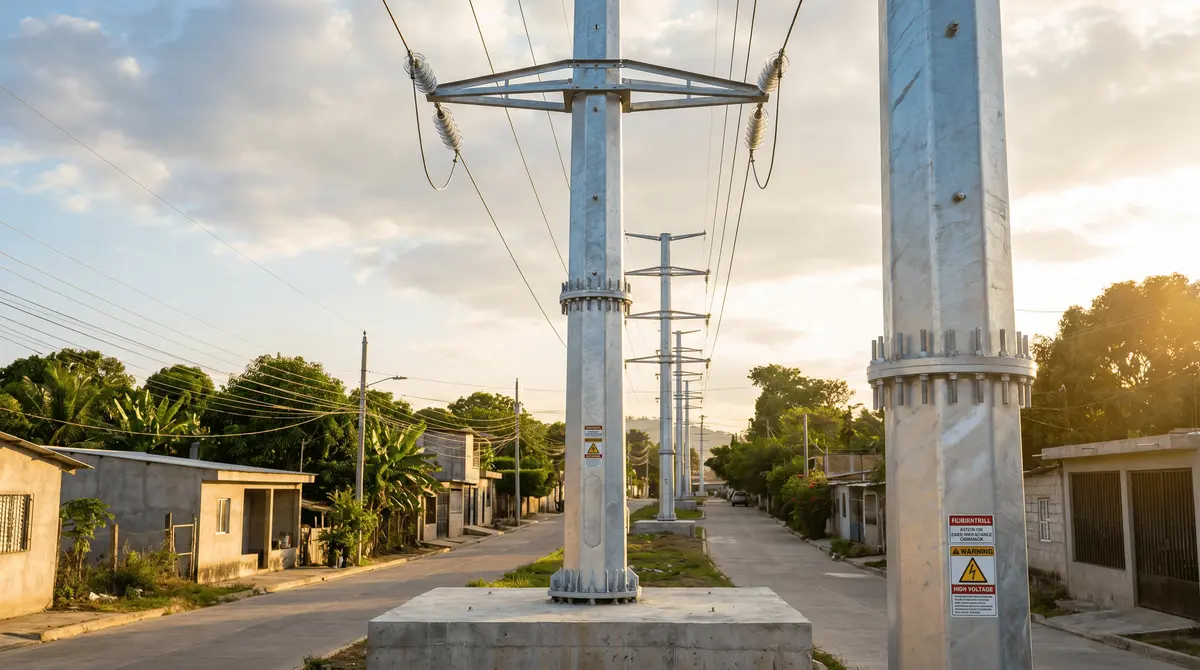
Tegucigalpa Power Transmission Tower Market Analysis: 10kV Municipal Distribution Configuration Guide
Summary
Tegucigalpa’s urban distribution profile supports a medium-voltage 10kV steel tubular pole solution using approximately 130 units across about 10km, with 25m galvanized Q345 poles, 80m spans, and Wind Class 3 design at 35m/s under IEC 60826 and GB 50545.
Key Takeaways
- Tegucigalpa sits at approximately 14.07, -87.19 and serves a large urban population, so a typical municipal feeder extension would require about 10km of 10kV line using approximately 130 poles at 80m span intervals.
- According to the World Bank (2023), Honduras remains focused on grid reliability and loss reduction, which supports medium-voltage distribution upgrades rather than oversized 66kV or 220kV structures in dense city corridors.
- A typical 10kV single-circuit configuration for this profile uses hot-dip galvanized Q345 tapered steel tubular poles, 25m overall pole length, ACSR 70 conductor, and 0.8m phase spacing.
- The provided project-specific configuration indicates about 10t per pole at roughly 400kg/m, with spread footing foundations, 5m ground clearance, 0.5m insulator length, and a 30-year design life.
- According to IEC 60826, wind loading is a primary design driver for overhead lines; for Tegucigalpa, Wind Class 3 at 35m/s is a reasonable design basis for municipal distribution corridors.
- Compared with concrete or lattice alternatives, a steel tubular Power Transmission Tower format reduces corridor width, simplifies urban transport logistics, and supports cleaner roadside aesthetics in municipal zones.
- SOLAR TODO’s power-tower product line fits this use case when buyers need medium-voltage municipal distribution poles with cross-arm brackets, grounding, bird guards, vibration dampers, and flanged steel fabrication.
- For procurement planning, buyers should align route survey, geotechnical review, anchor-bolt and footing design, and conductor stringing sequence before issuing an EPC or supply-only RFQ to SOLAR TODO.
Market Context for Tegucigalpa
Tegucigalpa’s distribution expansion need is driven by urban density, terrain constraints, and reliability pressure on medium-voltage feeders, making 10kV municipal line reinforcement more relevant than high-voltage transmission structures in city corridors.
Tegucigalpa is Honduras’s capital and principal administrative center, with a large metropolitan population concentrated in a mountainous basin at roughly 14.07 latitude and -87.19 longitude. According to the World Bank (2023), Honduras continues to face electricity sector challenges tied to losses, service quality, and network modernization. In practical terms, that pushes utilities and municipal planners toward targeted distribution reinforcement in urban and peri-urban areas rather than only bulk generation additions.
Climate and topography matter for pole selection. Tegucigalpa’s elevation and hillside development create route sections with uneven grades, constrained roadside access, and localized wind exposure. According to IEC 60826, overhead line design must account for wind, conductor tension, and structural reliability under site conditions. For a municipal distribution corridor in this setting, a steel tubular pole often fits better than a lattice tower because it occupies less ground area and is easier to place along roads, medians, and narrow easements.
Honduras’s power system planning also points toward distribution and sub-transmission reinforcement. According to the International Energy Agency (IEA) (2023), improving grid infrastructure is essential across Central America to absorb demand growth and reduce technical losses. In Tegucigalpa, that means medium-voltage line sections feeding neighborhoods, public services, and commercial loads often need compact structures with predictable installation sequences.
A city like Tegucigalpa does not automatically justify a 220kV or 500kV structure inside municipal streets. Based on the voltage-to-structure table, distribution-class networks from 10kV to 35kV normally align with 12m to 18m operational height and 1t to 3t per pole for standard distribution classes. However, the project-specific configuration supplied here calls for a 25m tapered steel tubular pole for a 10kV single-circuit line, which should be read as a site-specific municipal requirement driven by clearance, terrain, crossing conditions, or corridor geometry rather than a generic citywide norm.
According to IRENA (2022), Latin American grid upgrades increasingly prioritize resilient and modular infrastructure. That supports the use of sectional flanged steel poles because buyers can ship them in manageable segments, galvanize them for corrosion resistance, and assemble them in constrained urban staging areas. For Tegucigalpa, this is relevant where access roads, slope cuts, and dense neighborhoods limit crane positioning and storage space.
SOLAR TODO can therefore position its Power Transmission Tower line in Tegucigalpa as a technical fit for municipal distribution routes that need compact footprints, galvanized steel durability, and accessories suited to ACSR conductors and insulator strings. The strongest fit is not “largest possible tower,” but the correct 10kV distribution configuration for local route conditions.
Recommended Technical Configuration
For Tegucigalpa’s municipal distribution profile, a typical 10km feeder extension would use approximately 130 single-circuit steel tubular poles with 10kV rating, 80m average spans, and ACSR 70 conductor under 35m/s wind design.
Based on the supplied project-specific configuration, a typical deployment of this scale would consist of approximately 130 tapered steel tubular poles for a 10kV single-circuit overhead line. The total route length is about 10km, which aligns with an 80m span design when terminal, angle, and section poles are included. This is a medium-voltage municipal distribution application, not a high-voltage transmission backbone.
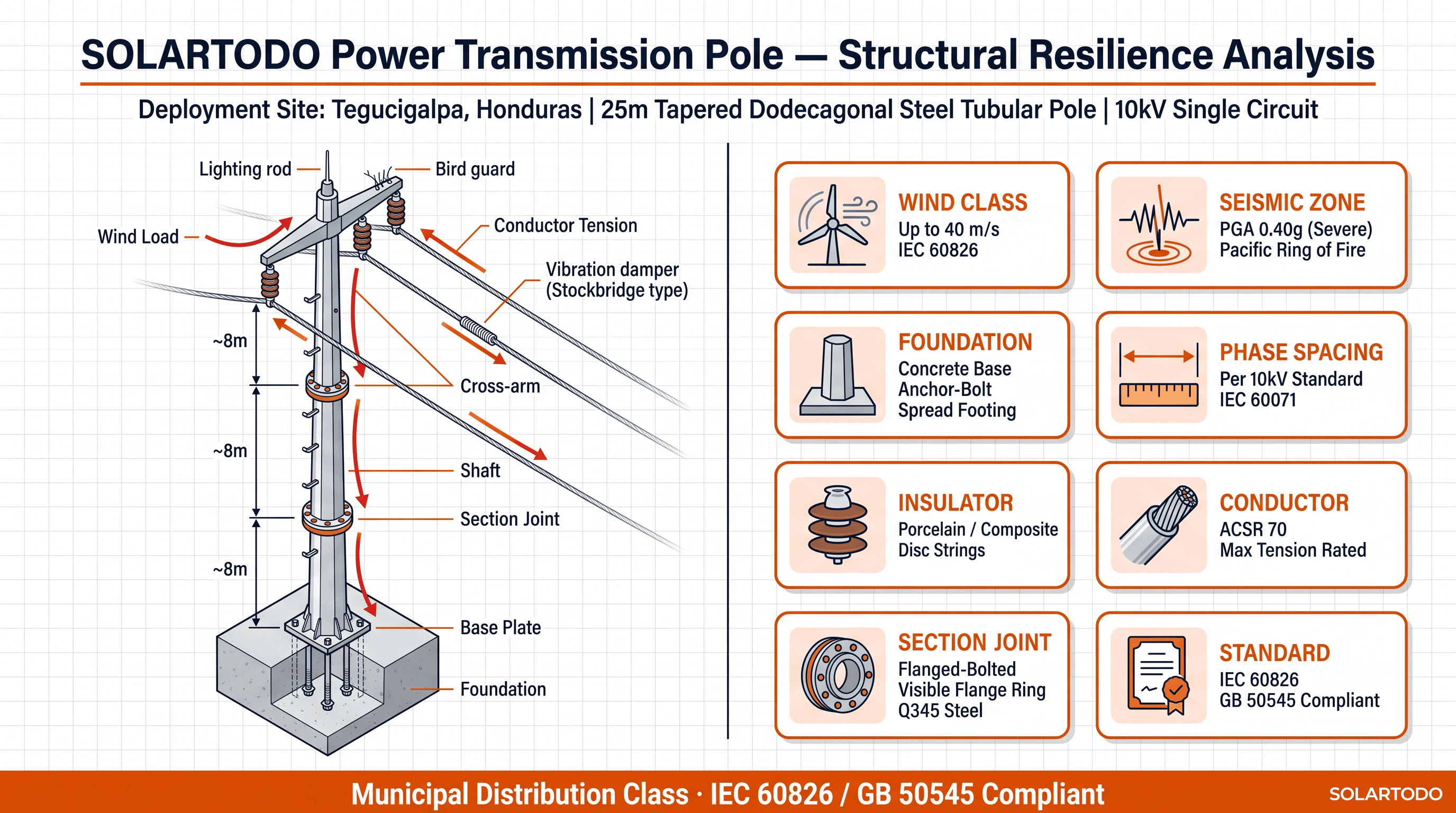
The recommended pole form is a tapered round steel monopole fabricated from hot-dip galvanized Q345 steel. The specified pole length is 25m, with an approximate mass of 10t per pole at about 400kg/m. While this weight exceeds the generic 10kV distribution table range, the configuration should be treated as a project-specific special structure for municipal clearance and route constraints, not as a standard low-height distribution pole.
The electrical arrangement is single circuit with phase spacing of 0.8m, ACSR 70 conductor, and insulator length of 0.5m. The ACSR 70 conductor is listed at 275kg/km with maximum tension of 22kN, which is suitable for short urban and peri-urban spans where mechanical loading must remain controlled. Ground clearance is specified at 5m, which is consistent with municipal road and pedestrian interface requirements when route profiling is done correctly.
For wind and civil design, the supplied basis is Wind Class 3 at 35m/s with spread footing foundations. According to IEC 60826, line reliability depends on matching wind load, conductor tension, and structural stiffness. In Tegucigalpa’s mixed urban terrain, spread footing can be appropriate where soil bearing capacity is verified and excavation access is practical, though final footing dimensions should always follow geotechnical review.
Accessories in the recommended package include climbing steps, cross arm, grounding, bird guard, and vibration damper. These details matter in municipal networks because maintenance crews need safe access, fault current must be managed through a low-resistance grounding path, and conductor vibration can shorten hardware life if dampers are omitted. SOLAR TODO should present this as a complete line-structure package rather than only a bare steel shaft.
For buyers evaluating options, the closest product reference is the SOLAR TODO Power Transmission Tower line. Route-specific engineering review can then refine pole schedule, angle locations, and foundation volumes before tender release. For project scoping or RFQ support, buyers can also contact us.
Technical Specifications
This Tegucigalpa configuration centers on a 10kV single-circuit steel tubular pole package with 25m pole length, 80m span, 35m/s wind design, and ACSR 70 conductor for approximately 10km of municipal distribution line.
- Product type: Steel tubular Power Transmission Tower / tapered steel monopole
- Application class: Medium-voltage municipal distribution
- Voltage class: 10kV
- Circuit arrangement: Single circuit
- Typical deployment scale: Approximately 130 units over about 10km
- Pole form: Tapered steel tubular pole, flanged bolt-section construction
- Pole material: Hot-dip galvanized Q345 steel
- Pole length: 25m
- Approximate pole mass: 10t per pole
- Linear steel mass reference: About 400kg/m
- Conductor type: ACSR 70
- Conductor mass: 275kg/km
- Maximum conductor tension: 22kN
- Phase spacing: 0.8m
- Insulator length: 0.5m
- Ground clearance: 5m
- Design span: 80m
- Wind class: Class 3
- Design wind speed: 35m/s
- Foundation type: Spread footing foundation
- Standard references: IEC 60826 / GB 50545
- Accessories: Climbing steps, cross arm, grounding set, bird guard, vibration damper
- Design life: 30 years
From a standards perspective, IEC 60826 covers loading and strength criteria for overhead lines, while GB 50545 is commonly referenced for transmission line structural design practice. According to IEC (2017), design loading should combine wind, conductor, and structural response rather than treating each element in isolation. That is especially important for 25m municipal poles carrying ACSR conductors in variable terrain.
Implementation Approach
A practical Tegucigalpa rollout would typically move through 5 phases: route survey, detailed design, factory fabrication, civil works, and stringing plus commissioning across about 10km of line.
Phase 1 is route confirmation. This includes topographic survey, utility conflict checks, and geotechnical sampling at representative pole sites. In a 10km urban or peri-urban corridor, planners should expect at least 130 structure points, with extra attention to angle poles, road crossings, and drainage channels. According to World Bank distribution upgrade guidance, early survey work reduces change orders and installation delays.
Phase 2 is detailed engineering. Pole loading schedules, foundation reactions, conductor sag-tension calculations, and grounding design should be finalized before steel release. For ACSR 70 at 22kN maximum tension and 80m span, the design team should verify sag under local temperature and wind combinations. This is also the stage to confirm 5m minimum ground clearance at the worst-case sag condition.
Phase 3 is fabrication and logistics. SOLAR TODO would typically supply flanged steel sections, galvanized after fabrication, with bolt sets, cross arms, and accessories packed by pole number. Sectional transport is useful in Tegucigalpa because urban access roads can limit trailer length and crane setup. According to IEC guidance and common utility practice, galvanizing quality and flange tolerance directly affect field assembly speed.
Phase 4 is civil construction. Spread footing excavation, reinforcement placement, anchor setting where required by design, concrete pouring, and curing all need to be sequenced by access constraints and weather windows. In hilly sections, temporary shoring and drainage control may be necessary. A municipal utility should not begin steel erection until footing strength reaches the specified curing threshold.
Phase 5 is erection, stringing, and commissioning. Poles are assembled section by section, plumbed, torqued, grounded, fitted with insulators and hardware, and then strung with ACSR 70 conductor. Final tests usually include continuity checks, grounding resistance verification, hardware inspection, and as-built survey. For a 10km line, field execution often runs in segments of 1km to 2km to keep traffic and outage management under control.
Expected Performance & ROI
For a 30-year municipal distribution asset, the main value drivers are lower outage risk, lower maintenance frequency than untreated steel alternatives, and lower corridor occupation than lattice structures, with payback tied to reliability and loss reduction rather than energy generation.
Expected performance begins with structural durability. Hot-dip galvanized Q345 steel, when fabricated and coated to standard, is commonly selected for service lives around 30 years in utility environments. According to NREL (2023), transmission and distribution asset economics are increasingly evaluated on lifecycle maintenance and resilience, not only first cost. For Tegucigalpa, that favors corrosion-protected steel poles with standardized hardware packages.
Electrical performance depends on conductor sizing and line condition. ACSR 70 is modest in capacity compared with ACSR 120 or ACSR 240, but it is often suitable for municipal feeders with shorter spans and moderate load density. The economic case improves when the line replaces overloaded or deteriorated structures, reduces forced outages, and supports better voltage regulation at the feeder edge. According to IEA (2023), grid modernization returns often come from reliability improvement and technical loss reduction rather than direct tariff gains alone.
Maintenance demand should remain moderate if vibration dampers, grounding, and bird protection are included from day one. Typical inspection cycles for galvanized steel distribution poles are annual visual checks plus periodic torque, corrosion, and earthing verification. According to IEEE guidance on overhead line maintenance practice, early detection of bolt loosening, coating damage, and insulator contamination can extend service life and reduce emergency repair cost.
For ROI framing, utilities and EPC buyers usually model a 3-part benefit stack:
- Reduced unplanned outage hours over 10km of feeder length
- Lower recurring maintenance than heavily patched legacy structures
- Better route utilization in narrow municipal corridors
A realistic payback period depends on outage frequency, labor cost, and the value assigned to service continuity. In municipal distribution, buyers often see stronger economics where the new line supports commercial districts, water pumping, public lighting, or feeder back-up links. SOLAR TODO should therefore present ROI as a reliability-and-lifecycle case, not as a generic capital-cost claim.
Results and Impact
For Tegucigalpa, a correctly specified 10kV steel tubular line can improve feeder reliability across about 10km while keeping structural footprint compact and maintenance planning predictable over a 30-year design life.
The practical impact of this configuration is network reinforcement where corridor width is limited and aesthetics matter more than in rural transmission routes. A tapered steel tubular profile uses less visual and physical space than a lattice tower, which can matter in municipal roads, mixed residential zones, and public-infrastructure corridors. According to IRENA (2022), resilient grid assets in urban areas should balance technical performance with land-use efficiency.
The second impact is execution control. A package of approximately 130 standardized poles with matching accessories simplifies procurement, inspection, and spare-parts planning. It also supports phased installation by feeder section, which is useful when outages must be scheduled around public services. For utilities in Tegucigalpa, that can reduce disruption during rehabilitation or network extension.
The third impact is asset standardization. Using one conductor family, one wind basis of 35m/s, one foundation concept, and one set of accessories reduces engineering variation. That usually lowers documentation burden and helps future maintenance teams. For buyers comparing alternatives, this is where SOLAR TODO’s product consistency can be a useful procurement advantage.
Comparison Table
This comparison shows why a 10kV single-circuit steel tubular pole package is usually the best fit for Tegucigalpa municipal feeders, while larger voltage classes should be reserved for different network functions.
| Parameter | Recommended Tegucigalpa Configuration | Standard 10-35kV Distribution Range | 66-110kV Sub-transmission Range |
|---|---|---|---|
| Network role | Municipal distribution | Distribution | Sub-transmission |
| Voltage class | 10kV | 10-35kV | 66-110kV |
| Circuit type | Single circuit | Single/double | Single/double |
| Typical line length in this guide | 10km | Project dependent | Project dependent |
| Pole quantity | Approx. 130 units | 8-12 poles/km typical | 4-5 poles/km typical |
| Span | 80m | 80-150m | 200-300m |
| Pole length used here | 25m | 12-18m typical | 18-30m |
| Pole mass used here | Approx. 10t | 1-3t typical | 5-15t |
| Conductor | ACSR 70 | ACSR family | ACSR family |
| Wind basis | 35m/s | Site specific | Site specific |
| Foundation | Spread footing | Concrete foundation | Concrete foundation |
| Urban corridor suitability | High | High | Moderate |
| Visual footprint | Low | Low | Higher than MV option |
Pricing & Quotation
SOLAR TODO offers three pricing tiers for this product line: FOB Supply (equipment ex-works China), CIF Delivered (including ocean freight and insurance), and EPC Turnkey (fully installed, commissioned, with 1-year warranty). Volume discounts are available for large-scale deployments. Configure your system online for an instant estimate, or request a custom quotation from our engineering team at [email protected].
Frequently Asked Questions
This FAQ answers 10 common buyer questions on 10kV steel tubular Power Transmission Tower configuration, delivery, maintenance, warranty, and EPC scope for Tegucigalpa-scale municipal distribution projects.
Q1: What is the recommended voltage class for this Tegucigalpa application?
For the profile described here, 10kV is the recommended class because the use case is municipal distribution over about 10km, not bulk sub-transmission. That aligns with neighborhood feeder extensions, public-service loads, and urban corridor reinforcement where compact structures and shorter 80m spans are more practical than larger 66kV or 220kV assets.
Q2: Why use a steel tubular pole instead of a lattice tower in Tegucigalpa?
A steel tubular pole takes less corridor width, usually looks cleaner in municipal areas, and is easier to place along roads and constrained rights-of-way. In a city with uneven terrain and dense roadside development, those factors can matter as much as structural capacity. It also simplifies hardware layout for a single-circuit 10kV feeder.
Q3: Is a 25m pole too tall for a 10kV line?
For generic 10kV distribution, the normal range is 12m to 18m. However, the supplied configuration specifies 25m, which can be justified for special route conditions such as terrain variation, crossing clearance, or municipal geometry. Buyers should treat it as a project-specific special structure, verified by route profile and sag-clearance calculations.
Q4: What conductor is specified in this configuration?
The specified conductor is ACSR 70, with a listed mass of 275kg/km and maximum tension of 22kN. This conductor is often suitable for medium-voltage municipal feeders where spans are relatively short and mechanical loading must remain controlled. Final conductor choice should still reflect current demand, voltage drop limits, and short-circuit requirements.
Q5: What foundation type is recommended?
The supplied basis calls for spread footing foundations. This is a practical option where soil bearing capacity is adequate and excavation access is manageable. Final footing dimensions should follow geotechnical review, groundwater conditions, and overturning calculations for the 25m pole, 35m/s wind load, conductor tension, and local terrain slope.
Q6: How long would a 130-pole, 10km project typically take?
A typical program may run about 4 to 8 months depending on survey completion, permitting, fabrication lead time, shipping, civil access, and outage windows. Factory production and galvanizing often consume several weeks, while civil works and stringing are usually staged in 1km to 2km segments to manage traffic and utility coordination.
Q7: What maintenance should buyers expect over 30 years?
Routine maintenance usually includes annual visual inspection, periodic bolt-torque checks, grounding resistance tests, and coating review at damaged areas. Insulators, bird guards, and vibration dampers should also be checked after major wind events. With hot-dip galvanizing and correct installation, maintenance demand is generally moderate compared with heavily repaired legacy structures.
Q8: What kind of ROI should a utility expect?
ROI is usually measured through fewer outages, lower emergency repair frequency, and improved feeder reliability rather than direct revenue generation. Payback can be attractive where the line supports commercial districts, municipal pumping, or critical public loads. Buyers should model savings from reduced fault response, lower maintenance labor, and avoided service interruptions over the 30-year life.
Q9: Does SOLAR TODO provide supply only or EPC support?
SOLAR TODO can support different commercial models, including equipment supply, delivered supply, and EPC turnkey scope depending on project needs. Buyers should define whether they need only steel poles and hardware, or a full package including foundations, erection, stringing, testing, and commissioning. Early scope clarity improves quotation accuracy.
Q10: What warranty and documentation should be requested?
Buyers should request material certificates for Q345 steel, galvanizing records, dimensional inspection reports, bolt and hardware schedules, foundation drawings, and installation manuals. For turnkey contracts, warranty coverage should also define the defect-liability period, excluded causes, and field response obligations. Documentation quality is as important as the steel itself for utility acceptance.
References
This guide draws on 7 authoritative sources covering Honduras grid context, overhead line design, and utility asset economics relevant to a 10kV municipal steel tubular pole application.
- World Bank (2023): Honduras energy sector data and grid reliability context, including electricity access, losses, and infrastructure modernization priorities.
- International Energy Agency (IEA) (2023): Latin America and Caribbean electricity system modernization needs, with emphasis on network reliability and distribution reinforcement.
- International Renewable Energy Agency (IRENA) (2022): Power system flexibility and resilient grid infrastructure planning in emerging electricity markets.
- IEC (2017): IEC 60826, Design criteria of overhead transmission lines, covering loading, strength, and reliability methods.
- GB Standard (2010): GB 50545, code framework used for transmission line structural design and loading checks.
- IEEE (2022): Utility overhead line maintenance and inspection guidance relevant to grounding, hardware checks, and lifecycle management.
- NREL (2023): Transmission and distribution investment analysis emphasizing resilience, lifecycle cost, and grid upgrade value.
Equipment Deployed
- 130 × tapered steel tubular Power Transmission Tower poles, 25m length, hot-dip galvanized Q345 steel
- Single-circuit 10kV line configuration
- Approx. 10t per pole, about 400kg/m steel mass reference
- ACSR 70 conductor, 275kg/km, max tension 22kN
- Cross arm brackets for conductor and insulator support
- Insulator set, 0.5m length
- Phase spacing: 0.8m
- Grounding set for each pole location
- Climbing steps for maintenance access
- Bird guards for avian protection
- Vibration dampers for conductor motion control
- Spread footing foundations
- Design wind class 3, 35m/s
- Ground clearance target: 5m
- Standards basis: IEC 60826 / GB 50545
- Design life: 30 years