Sydney Smart Streetlight Market Analysis: Ø219mm Flush-Integrated Pole Configuration Guide
Summary
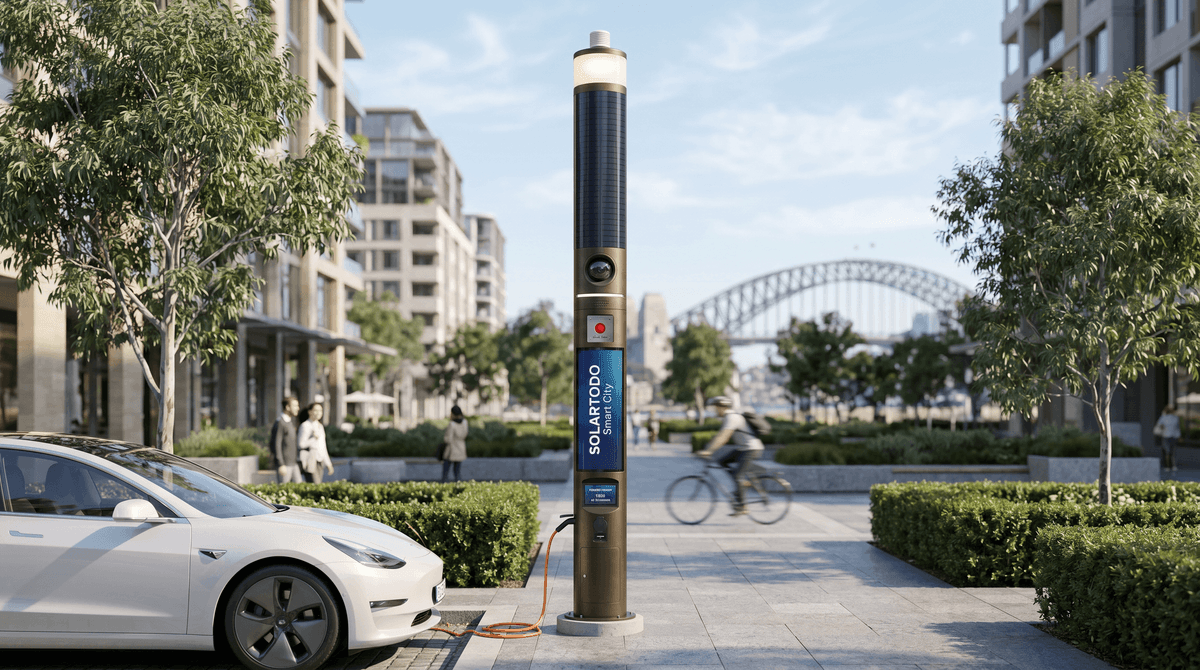
Sydney’s dense pedestrian corridors, EV uptake, and public-realm design controls favor a premium 8m smart streetlight class with flush-mounted hardware. For a 1.8 km urban corridor, a typical layout would use approximately 72 poles at 25 m spacing, each with 60 W ring lighting, 160 W CIGS wrap solar, and 7 kW dual-outlet charging.
Key Takeaways
- A typical 1.8 km Sydney civic-street deployment would use approximately 72 units at 25 m spacing, matching the specified urban density of 40 poles per km.
- The recommended form factor is an 8 m seamless cylindrical Ø219 mm pole with 5 mm wall thickness, which fits premium streetscape requirements better than arm-mounted octagonal poles.
- Each pole would carry a 60 W, 9,000 lm, 4,000 K top LED ring light, suitable for pedestrian-priority streets rather than highway lighting classes.
- The specified solar package is 360° wrapped CIGS thin-film at approximately 160 W over the 6.5 m to 7.3 m zone, with an internal 1,800 Wh LFP battery and MPPT.
- EV service is integrated as a flush 7 kW charger with Type 2 + Type 1 outlets, a practical match for Australia’s AC curbside charging use cases.
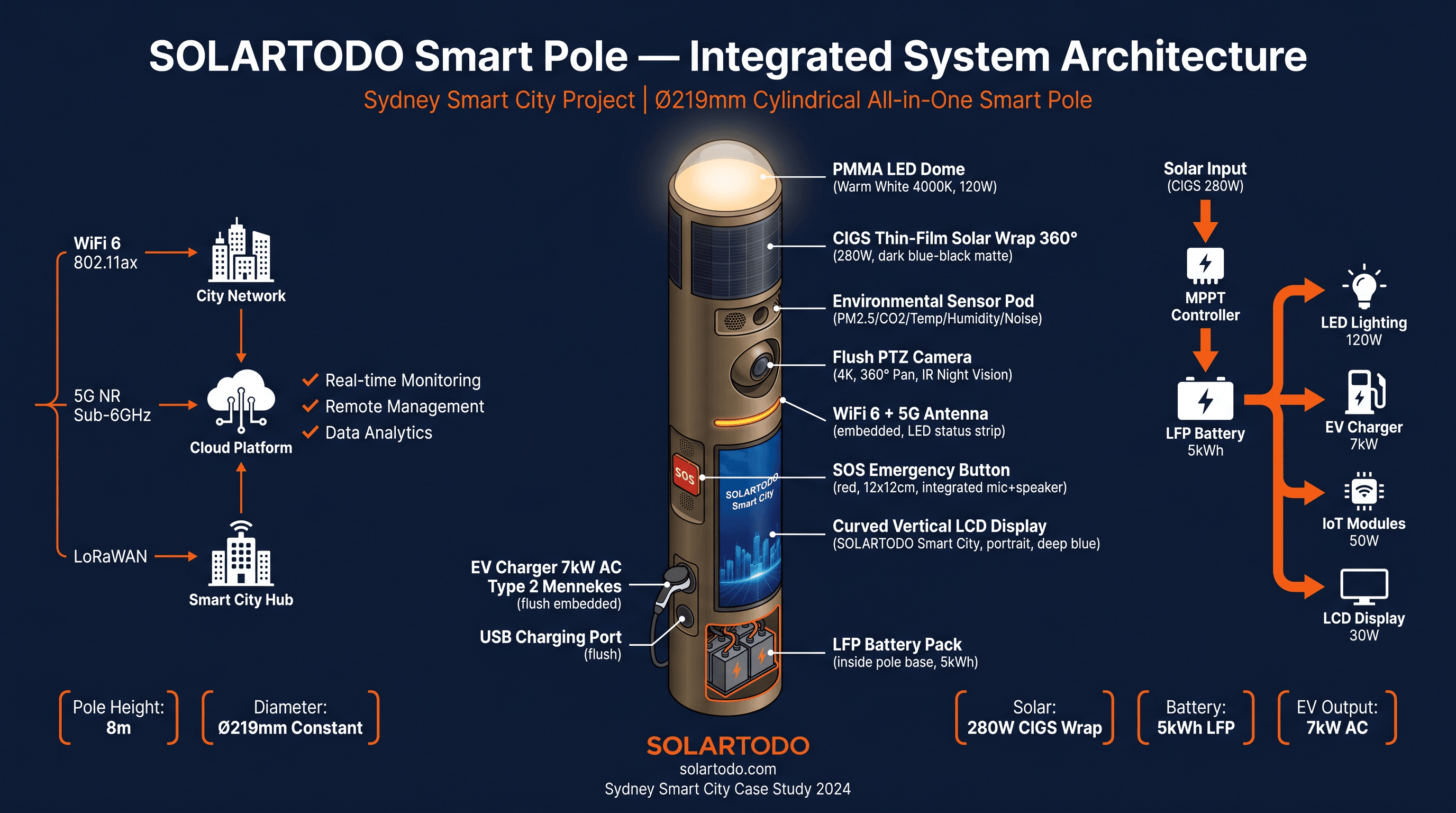
- Communications and safety functions remain embedded: 8 MP 180° fisheye camera, WiFi 6, flush SOS + dual-way intercom, and a 4-parameter environmental sensor.
- According to the Australian Bureau of Statistics (2023), Greater Sydney’s population exceeds 5.3 million, which supports high footfall and data-rich smart corridor applications.
- According to the City of Sydney (2023), the local government area targets net zero operations and expanded public EV support, making multi-function poles more relevant where streetscape clutter must be minimized.
Market Context for Sydney
Sydney combines a large metropolitan population, dense mixed-use precincts, and strict public-domain design expectations, which makes flush-integrated smart streetlights more suitable than conventional arm-and-box assemblies. According to the Australian Bureau of Statistics (2023), Greater Sydney has a population above 5.3 million, while the City of Sydney local government area supports some of the country’s highest pedestrian and visitor densities in compact urban streets.
This matters because the product fit in Sydney is not only about illumination in lux and watts; it is also about visual impact, footpath clearance, and multi-service consolidation within a narrow street reserve. According to the City of Sydney Public Domain Manual (latest public edition), street furniture in central precincts is expected to reduce clutter and maintain coordinated urban design outcomes. A monolithic Ø219 mm cylindrical smart streetlight aligns with that requirement better than poles carrying side arms, external speaker columns, or separate charger bollards.
Sydney’s climate also supports hybridized low-power auxiliary systems on public infrastructure. According to the Australian Government Bureau of Meteorology (2024), Sydney’s mean daily sunshine is strong enough for modest thin-film support generation, while coastal wind and salt exposure require corrosion-resistant steel finishing and enclosed electronics. For that reason, a hot-dip galvanized 5 mm wall pole with all modules flush to the cylinder skin is a better fit than exposed brackets or rigid solar panels.
Grid context also supports AC charging and connected devices. According to Ausgrid (2024), Sydney’s distribution network serves the greater metropolitan area with low-voltage urban supply suitable for public lighting and small AC charging loads where connection approvals are available. In practical terms, a 7 kW embedded AC charger is realistic for curbside opportunity charging, while the 160 W CIGS wrap and 1,800 Wh LFP battery mainly support resilience for sensors, communications, display, and emergency functions rather than full EV energy autonomy.
Two authority statements are relevant here. The International Energy Agency states, "Electric car sales kept rising strongly in 2023," underscoring the need for distributed urban charging points in major cities. The International Telecommunication Union states that smart sustainable cities depend on "the use of information and communication technologies" to improve urban services, which supports combining lighting, sensing, public safety, and WiFi in one pole.
For Sydney, the strongest use case is therefore not a highway mast and not a park bollard. It is a premium urban corridor smart streetlight for civic streets, waterfront promenades, mixed-use retail streets, university edges, and transport-adjacent pedestrian routes where 8 m height and 25 m spacing are appropriate.
Recommended Technical Configuration
For Sydney’s premium urban streets, the most suitable configuration is approximately 72 units of 8 m seamless Ø219 mm cylindrical smart streetlights over about 1.8 km, with every module flush-integrated and no side arms or external cabinets.
A typical 72-unit deployment of this scale would suit a central pedestrian-priority avenue, waterfront edge, innovation precinct, or transit-linked boulevard where visual consistency matters as much as lighting output. The specified spacing is 25 m, which falls inside the stated urban smart-pole density range of 25–50 m. At 72 poles, the covered length is approximately 1,800 m, assuming end-condition adjustments and intersection offsets.
The correct size class for this Sydney profile is the premium cylindrical smart streetlight rather than a 12 m traffic pole. The reason is straightforward: the project brief specifies city/urban street use, not highways, and Sydney public-domain applications often prioritize compact geometry, reduced protrusions, and lower visual bulk. An 8 m cylindrical pole with a 360° ring luminaire is consistent with pedestrian-scale lighting and streetscape-sensitive deployment.
SOLAR TODO’s recommended Sydney configuration should therefore keep the pole as one monolithic cylinder from top to bottom. The cylinder remains Ø219 mm all the way down, with no widened base, no charger pedestal, and no external equipment boxes. That matters in Sydney because footpath accessibility, maintenance access, and visual control are all easier when the hardware remains inside the pole envelope.
The charging specification also fits local use. Australia’s curbside AC charging environment is dominated by Type 2 compatibility, but mixed fleets still benefit from dual-outlet flexibility. A 7 kW embedded charger with Type 2 + Type 1 outlets is therefore a practical transitional arrangement for municipal or mixed-public use, especially in precincts where dwell times exceed 1 hour.
For data and public safety, the embedded package is appropriate for Sydney’s high-footfall zones. A flush 8 MP fisheye camera behind dome glass gives broad scene awareness without a projecting PTZ head. WiFi 6 supports local connectivity for public or managed access, while the 4-parameter environmental sensor provides temperature, humidity, wind speed, and noise data that can feed municipal dashboards.
SOLAR TODO should also keep the display function tightly controlled for civic acceptance. The specified 2,000 mm × approximately 170 mm curved LCD inset into the front face of the cylinder should display only "SOLARTODO Smart City" in stacked white sans-serif text on deep blue. That avoids the planning and public-realm complications that often come with ad-bearing displays in regulated Sydney streets.
Technical Specifications
The Sydney-recommended smart streetlight configuration is an 8 m premium cylindrical pole with 72-unit typical deployment scale, 25 m spacing, and IEC 60598 / GB/T 37024 compliance.
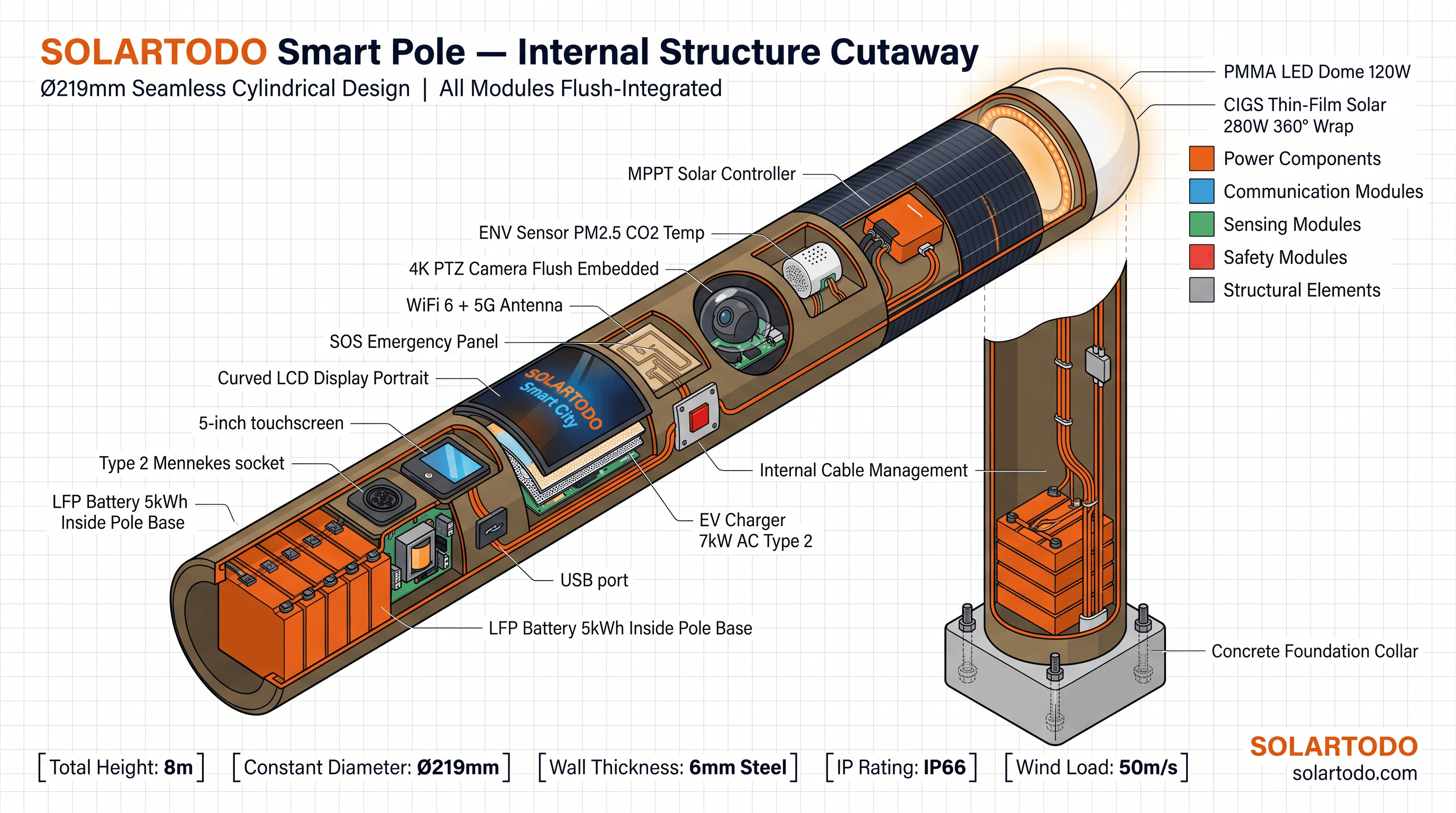
- Pole structure: 8 m seamless cylindrical pole, constant Ø219 mm top-to-bottom
- Wall thickness: 5 mm hot-dip galvanized steel
- Finish color: antique bronze RAL8011
- Pole geometry: one monolithic cylinder, no side arms, no luminaire outriggers, no external boxes
- Lighting: top-mounted embedded LED ring-light band, 360° glow
- LED rating: 60 W, 9,000 lm, 4,000 K
- Solar support: CIGS flexible thin-film cells wrapped 360° around the pole
- Solar placement: 6.5 m to 7.3 m pole height zone
- Solar capacity: approximately 160 W total
- Solar appearance: dark blue-black semi-transparent film laminated flush to pole skin
- Battery: internal LFP 1,800 Wh with MPPT charge control
- Environmental sensing: 4-parameter sensor for temperature, humidity, wind speed, and noise
- Sensor location: flush on dome top
- Camera: flush 180° panoramic fisheye, 8 MP, behind dome glass window
- Communications: embedded WiFi 6 with internal antenna, no external disc antenna
- Emergency interface: flush SOS button with dual-way audio intercom through pinhole grille
- EV charging: fully flush embedded 7 kW AC charger
- EV outlets: Type 2 + Type 1 with two flush flip-caps
- Charging accessory: 5 m coiled Type 2 cable
- User interface: flush touchscreen at 1.5 m mounting height
- Display: vertical curved LCD, 2,000 mm tall × approximately 170 mm wide, portrait orientation
- Display content restriction: text only, “SOLARTODO Smart City,” no ads, no video, no imagery
- USB charging: 2 × USB-A flush ports
- Spacing: 25 m typical
- Street class: urban/city street, not highway and not park path
- Standards: IEC 60598, GB/T 37024
In Sydney, these specifications fit best on premium streets where the municipality wants one pole to cover lighting, safety, communications, low-power sensing, and curbside charging without adding separate cabinets. According to IEC 60598, luminaires used in public lighting must satisfy electrical safety and mechanical requirements, which is relevant for a pole carrying both lighting and embedded electronics.
Implementation Approach
A practical Sydney rollout would proceed in 4 phases over roughly 20 to 32 weeks, starting with utility coordination and ending with software commissioning and acceptance testing.
Phase 1 is corridor definition, approvals, and utility review, typically 4 to 8 weeks. This includes confirming footpath widths, underground service conflicts, local lighting class targets, EV connection strategy, and council approval conditions. In Sydney, this stage is important because utility corridors are congested and public-domain changes often require review against streetscape manuals and accessibility rules.
Phase 2 is detailed design and procurement, typically 6 to 10 weeks. At this point, foundation loads, conduit entries, charger protection, communications backhaul, and display content restrictions are finalized. If imported as finished assemblies or CKD kits, shipping lead time and Australian compliance documentation should be locked before civil works start.
Phase 3 is civil and electrical installation, typically 6 to 10 weeks for approximately 72 units depending on staging windows. Typical works include footing excavation, anchor or direct-set preparation as specified, conduit pull-through, mains connection, and pole erection. Because the charger, battery, display, and communications hardware are internal, site crews handle fewer external subassemblies than they would with cabinet-based smart poles.
Phase 4 is software integration and commissioning, typically 2 to 4 weeks. This includes luminaire testing, charger activation, WiFi provisioning, camera stream verification, SOS/intercom checks, and dashboard integration for environmental data. A staged acceptance process is preferable, for example by commissioning 10 to 15 poles first, then releasing the remaining corridor after defect closeout.
From a maintenance perspective, Sydney operators would usually prefer front-access service zones and modular internal trays. That reduces the risk of exposed damage and simplifies cleaning in coastal or high-footfall environments. SOLAR TODO should provide asset tagging, wiring schedules, and replacement procedures for the LED ring, touchscreen, charger module, and battery pack.
Expected Performance & ROI
For Sydney urban corridors, the main return comes from asset consolidation, lower maintenance exposure, and added service value; a typical payback window would often fall in the 6 to 10 year range depending on charger utilization and telecom or civic-service monetization.
The 60 W LED ring light is efficient for pedestrian and local-street applications. Compared with legacy decorative fittings in the 120 W to 180 W range, a 60 W LED system can materially reduce lighting energy use, especially when paired with smart dimming. According to the U.S. Department of Energy (2022), LED street lighting commonly delivers substantial energy savings over legacy technologies, often above 50% depending on baseline fixture type and controls strategy.
The embedded 160 W CIGS wrap and 1,800 Wh LFP battery should be treated as auxiliary resilience rather than primary energy supply for EV charging. In Sydney conditions, this package can support sensor loads, communications, emergency interface standby, and part of display consumption during outages or low-load periods. According to NREL (2023), distributed storage paired with efficient controls improves resilience for critical low-power edge devices even when it does not fully offset larger intermittent loads.
The EV value case depends heavily on utilization. A 7 kW AC charger delivering 2 to 4 sessions per day can add meaningful public amenity and support decarbonization targets, but financial return varies by tariff, parking policy, and network charges. According to the IEA (2024), public charging availability remains a key bottleneck to EV adoption in dense cities, which means the non-financial strategic value may be as important as direct charger revenue.
Asset consolidation is often the strongest economic argument. Instead of one lighting pole, one camera mast, one WiFi post, one SOS column, one display support, and one charger pedestal, Sydney can combine these functions into a single 8 m cylinder. That can reduce trench interfaces, simplify streetscape approvals, and lower exposed maintenance points over a 10 to 15 year lifecycle.
A realistic ROI framework for Sydney should therefore include 5 lines: reduced lighting electricity, avoided separate street furniture CAPEX, lower vandalism exposure, EV charging revenue or service value, and data-service benefits from WiFi and environmental sensing. For many councils and developers, the avoided-clutter and planning advantages are decisive even when direct financial payback is moderate.
Comparison Table
For Sydney, the premium Ø219 mm cylindrical smart streetlight is better suited to design-sensitive urban corridors than standard modular poles because it keeps all major functions inside one 219 mm envelope.
| Metric | Recommended Sydney Configuration | Standard Modular Smart Pole | 12 m Grid Smart Pole |
|---|---|---|---|
| Pole type | Seamless cylindrical | Octagonal modular | 12 m octagonal with integrated charger cabinet |
| Height | 8 m | 6–12 m | 12 m |
| Diameter/profile | Constant Ø219 mm | Variable section | Larger traffic-pole class |
| Visual impact | Very low protrusion | Medium due to add-on modules | High for pedestrian streets |
| Lighting | 60 W ring light, 9,000 lm | 80–150 W arm/head type | 80–150 W traffic-class |
| Solar format | 160 W CIGS wrap flush to skin | Usually none or add-on | Grid-powered primary |
| Battery | 1,800 Wh LFP internal | Optional depending on config | Not primary feature |
| Camera | Flush 8 MP fisheye | External module common | External module common |
| WiFi | Internal antenna | External AP common | External AP common |
| EV charging | Flush 7 kW Type 2 + Type 1 | Usually add-on box/cabinet | Integrated lower cabinet |
| Best use in Sydney | Civic streets, waterfronts, premium retail | General municipal streets | Wide roads, traffic corridors |
| Streetscape clutter | Lowest | Medium | Highest |
Pricing & Quotation
SOLAR TODO offers three pricing tiers for this product line: FOB Supply (equipment ex-works China), CIF Delivered (including ocean freight and insurance), and EPC Turnkey (fully installed, commissioned, with 1-year warranty). Volume discounts are available for large-scale deployments. Configure your system online for an instant estimate, or request a custom quotation from our engineering team at [email protected].
For Sydney buyers, quotation accuracy usually depends on 5 inputs: pole quantity, charger activation scope, grid connection distance, civil foundation conditions, and software integration depth. A budgetary RFQ should also state whether the poles are for council land, private mixed-use development, or transport-adjacent public realm, because approvals and electrical interfaces differ.
Frequently Asked Questions
This FAQ answers 10 common Sydney procurement questions covering dimensions, charging, installation, maintenance, standards, ROI, and quotation structure for an 8 m premium smart streetlight deployment.
Q1: Is this smart streetlight suitable for Sydney streets or only for private developments?
Yes. The 8 m height, 25 m spacing, and 60 W ring-light format fit urban streets, waterfront promenades, campuses, and mixed-use precincts. Suitability still depends on local council approval, lighting-class targets, and utility connection conditions. The flush Ø219 mm form is especially useful where Sydney planners want minimal street clutter.
Q2: Why recommend the Ø219 mm cylindrical pole instead of a standard octagonal smart pole?
Sydney’s premium public-domain areas often prioritize visual control, pedestrian clearance, and reduced protrusions. The constant Ø219 mm cylinder keeps the charger, display, camera, WiFi, SOS, and battery inside one monolithic shell. That usually produces a cleaner result than modular poles with side arms, external boxes, or separate charging pedestals.
Q3: Can the 160 W wrapped CIGS solar film power the 7 kW EV charger by itself?
No. The 160 W CIGS wrap and 1,800 Wh LFP battery are better treated as support power for sensors, communications, standby functions, and resilience. The 7 kW charger is an AC grid-connected service. In Sydney, this hybrid arrangement is practical because it adds low-power backup without oversizing the pole structure.
Q4: What installation timeline is typical for approximately 72 units in Sydney?
A realistic program is about 20 to 32 weeks. Early stages include approvals, utility checks, and detailed design, often taking 10 to 18 weeks combined. Civil works, erection, wiring, and commissioning may take another 8 to 14 weeks depending on traffic management windows, trenching complexity, and software integration requirements.
Q5: What kind of ROI should councils or developers expect?
Payback commonly depends on charger utilization, avoided separate street-furniture costs, and reduced maintenance exposure. For Sydney, a blended payback of 6 to 10 years is a reasonable planning range for many urban corridors. The strongest value often comes from combining lighting, safety, connectivity, and charging into one asset rather than from electricity savings alone.
Q6: How does maintenance compare with conventional smart poles?
Maintenance is usually simpler in public-realm terms because there are fewer exposed parts. The ring light, charger interface, display, and electronics are integrated into the cylinder, which reduces damage risk from impact or vandalism. Operators should still schedule periodic cleaning, charger testing, battery health checks, and communications verification at least every 6 to 12 months.
Q7: What standards should be checked for Sydney procurement?
At minimum, buyers should verify IEC 60598 for luminaire safety and GB/T 37024 for smart-pole reference requirements in the supplied configuration. Local Australian electrical, civil, accessibility, and utility connection rules must also be checked before procurement. Final compliance scope depends on whether the project is municipal, campus, or private development.
Q8: Is the 60 W, 9,000 lm ring light enough for public streets?
For pedestrian-priority corridors, plazas, and local urban streets, 9,000 lm at 8 m can be appropriate when spacing is maintained around 25 m and lighting calculations confirm target lux and uniformity. It is not intended for highways or wide arterial roads. Those applications usually need taller poles and different optical distributions.
Q9: What information is needed to get an EPC quotation?
A useful RFQ should include corridor length, target quantity, site drawings, grid connection distance, charger activation scope, and any council design restrictions. It also helps to specify whether WiFi, camera retention, and emergency intercom will connect to an existing platform. Buyers can start with the product page or contact us for a custom review.
Q10: What warranty structure is typical for this product category?
Commercial terms vary by scope, but turnkey packages commonly include a 1-year system warranty as stated in the quotation section. Buyers should also request separate component warranty detail for the LED engine, charger module, display, battery, and communications electronics. For Sydney coastal areas, corrosion-protection terms should be clearly documented.
References
- Australian Bureau of Statistics (2023): Greater Sydney population statistics and regional demographic data used to assess urban density and service demand.
- City of Sydney (2023): Public domain and sustainability planning documents relevant to streetscape controls, net-zero objectives, and public EV infrastructure direction.
- Bureau of Meteorology (2024): Sydney climate data including sunshine and coastal weather conditions relevant to corrosion exposure and auxiliary solar performance.
- Ausgrid (2024): Distribution network information for metropolitan Sydney, relevant to low-voltage supply and public infrastructure connection context.
- International Energy Agency (2024): Global EV Outlook, including public charging growth and EV adoption trends affecting urban curbside charging demand.
- International Telecommunication Union (2022): Smart sustainable city guidance on ICT-enabled urban services, relevant to connected lighting, sensing, and public safety functions.
- IEC (2023): IEC 60598 luminaire safety requirements applicable to public lighting equipment.
- NREL (2023): Distributed energy and storage guidance relevant to resilience value for low-power edge devices and smart infrastructure.
- U.S. Department of Energy (2022): LED street-lighting energy savings benchmarks used for comparative ROI assumptions.
- GB/T 37024 (2018): Chinese smart multifunction pole reference standard cited for system architecture and integrated-pole design context.
Equipment Deployed
- 72 × 8 m seamless cylindrical smart streetlight poles, constant Ø219 mm, 5 mm wall, hot-dip galvanized steel, antique bronze RAL8011
- Integrated 360° LED ring-light band at pole top, 60 W, 9,000 lm, 4,000 K
- CIGS flexible thin-film solar wrap, approximately 160 W total, laminated flush around 6.5 m to 7.3 m pole section
- Internal LFP battery pack, 1,800 Wh, with MPPT charge controller
- Flush 4-parameter environmental sensor pod for temperature, humidity, wind speed, and noise
- Flush 8 MP 180° panoramic fisheye camera behind dome glass
- Embedded WiFi 6 module with internal antenna
- Flush SOS button with dual-way audio intercom through pinhole grille
- Embedded 7 kW AC EV charger with Type 2 + Type 1 outlets and two flush flip-caps
- 5 m coiled Type 2 charging cable
- Flush touchscreen at 1.5 m height
- Vertical curved LCD display, 2,000 mm × approximately 170 mm, text-only “SOLARTODO Smart City” content
- 2 × flush USB-A charging ports
- Smart controller and cloud-connected monitoring interface
- Foundations, conduits, and grid connection accessories sized for 25 m pole spacing