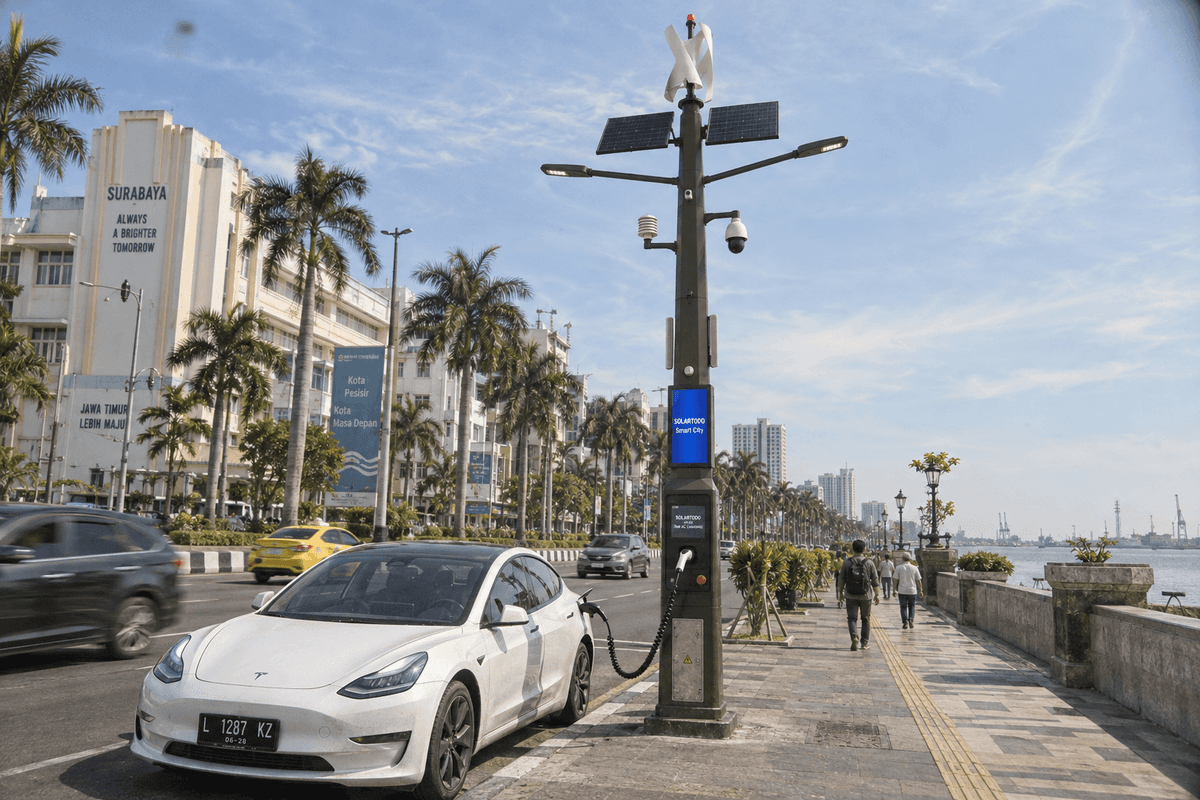
Surabaya Coastal Flood-and-Salt Smart Streetlight Fit: 137-Unit Hybrid Pole Configuration
Summary
Surabaya’s 3-6 m lowland elevation, 23.6-33.8 °C climate, and 2025 plan for 5,884 PJU points favor approximately 137 hybrid 13 m Smart Streetlight poles with 35 m spacing, 15 kWh LFP storage, 11 kW AC charging, and sealed coastal hardware.
Key Takeaways
- A typical 137-unit deployment at 35 m spacing would cover approximately 4.8 km of Surabaya urban corridors.
- Surabaya’s official geography lists 80% lowland terrain at 3-6 m elevation, making elevated cabinets and sealed bases important.
- The recommended SOLARTODO Smart Streetlight uses a 13 m octagonal tapered pole, base Ø45 cm to top Ø15 cm.
- Each pole carries 2×80 W LEDs at 150 lm/W and 4000 K, producing approximately 24,000 lm per pole.
- The hybrid package combines a 400 W Gorlov VAWT, 2×100 W mono panels, 15 kWh LFP battery, MPPT, and grid backup.
- Indonesia’s common distribution reference is 20 kV medium voltage stepped to 400/231 V low voltage under PLN practice.
- The integrated EV charger is 11 kW Type 2 AC with OCPP 1.6J, 5 m cable, E-stop, touchscreen, and USB-A ×2.
- According to Indonesia’s Ministry of Energy and Mineral Resources (2024), national electrification reached 99.78% in 2023.
Market Context for Surabaya
Surabaya’s smart-lighting decision is shaped by 31 districts, 33,306.30 ha of coastal lowland, and public PJU procurement rather than highway-scale lighting.
Surabaya is Indonesia’s second major urban economy and the capital of East Java, with a dense municipal street network serving residential kampungs, port logistics, commercial arterials, and waterfront routes. According to the Surabaya City Government (2026), the city covers 33,306.30 ha, has 31 districts, and borders the Madura Strait to the north and east. Its terrain is unusually relevant for pole design: 80% of the city is lowland at 3-6 m above sea level, while southern areas rise only to about 25-50 m.
The climate pushes outdoor equipment toward corrosion control, cable-gland sealing, and drainage-aware foundations. According to the Surabaya City Government (2026), the local temperature band is 23.6-33.8 °C, humidity ranges from 50% to 92%, and average rainfall is 165.3 mm with months above 200 mm in January-March and November-December. The city also reports average wind speed of 6.4 knots and maximum wind speed of 20.3 knots, which supports hybrid wind-solar design but does not remove the need for grid backup.
Streetlight procurement is also active, not hypothetical. According to the Surabaya City Government (2025), Pemkot Surabaya targeted 3,000 to 5,884 PJU units for 2025, with demand mapped through resident proposals, Musrenbang, infrastructure minutes, and local legislative inputs. Another Surabaya City Government infrastructure update in 2025 linked PJU investment to APBD financing, road widening, drainage works, and flood mitigation, which means Smart Streetlight planning should align with public works phasing rather than standalone gadget procurement.
Indonesia’s grid context is favorable for a hybrid smart pole that uses low-voltage service with grid backup. According to Indonesia’s Ministry of Energy and Mineral Resources (2024), electrification rose from 99.67% in 2022 to 99.78% in 2023, while electricity consumption reached 1,285 kWh per capita by October 2023. According to World Bank WDI (2026), Indonesia’s urban population share reached 58.75% in 2024 and 59.4% in 2025, reinforcing the need for multi-function assets that serve lighting, communications, safety, and curbside charging in the same right-of-way.
Recommended Technical Configuration
For Surabaya’s coastal arterial and neighborhood connector corridors, the best-fit SOLARTODO configuration is approximately 137 hybrid 13 m Smart Streetlight units.
The selected product fit is the SOLARTODO wind-solar hybrid octagonal steel Smart Streetlight, adjusted to the project-specific 13 m pole height. A typical 137-unit deployment at 35 m spacing would cover about 4.8 km, suitable for connected city corridors, waterfront roads, transit-adjacent streets, and district commercial streets. This is not a highway lighting mast and not a garden-lighting product; it sits in the urban street class where 25-50 m pole spacing and 30-50 poles per km are common sizing assumptions.
A Surabaya specification should prioritize sealed integration because coastal salt air, humid heat, and flood-prone lowland streets create maintenance risk at every external junction box. The lower 2.2 m of the pole is the EV charging cabinet itself, welded into one continuous steel structure rather than mounted as a separate roadside pillar. That integrated geometry reduces curb clutter in dense streets and limits exposed cable runs between lighting, EV charging, telecom, and sensor systems.
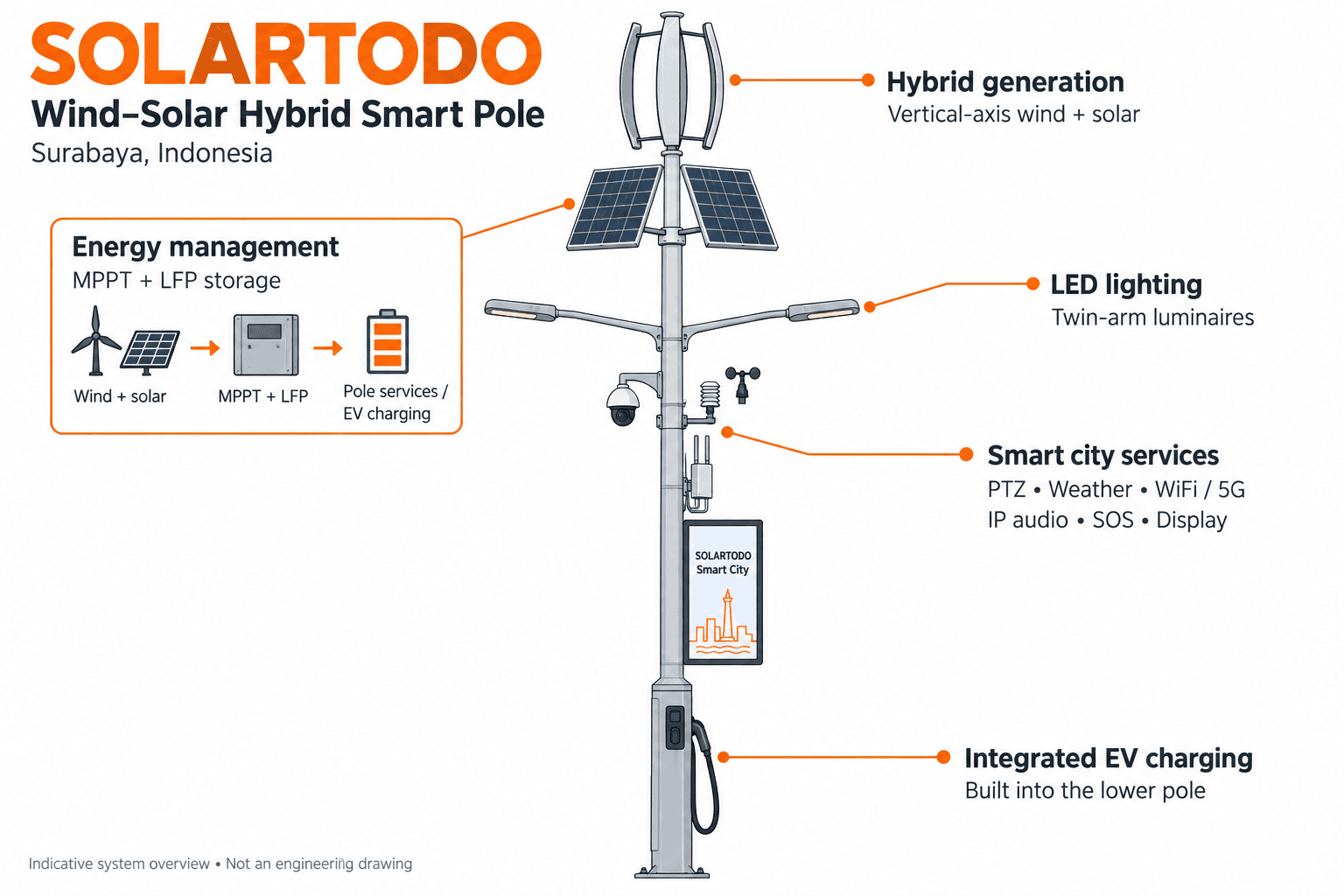
According to ITU (2016), a smart sustainable city uses ICT and other means to improve quality of life, operational efficiency, services, and competitiveness. ITU states, “A smart sustainable city is an innovative city that uses information and communication technologies,” which directly supports a pole platform carrying WiFi 6, 5G NR n78, PTZ video, environmental sensing, IP audio, SOS intercom, LED messaging, and lighting. For SOLARTODO, the pole is therefore an urban infrastructure node, not just a luminaire holder.
Technical Specifications
The recommended Surabaya unit is a 13 m hybrid Smart Streetlight with 160 W LED load, 600 W renewable input class, and 15 kWh LFP storage.
- Product: SOLARTODO Smart Streetlight for urban street corridors, product reference Smart Streetlight.
- Quantity and spacing: approximately 137 units at 35 m spacing, covering about 4.8 km depending on intersections and setbacks.
- Pole body: 13 m octagonal tapered steel smart pole, base Ø45 cm to top Ø15 cm, military green RAL6014 powder coat.
- Integrated structure: lower 2.2 m of pole is the 11 kW EV charging cabinet, seamlessly welded as one continuous steel structure.
- Wind system: Gorlov-type helical VAWT, 3 twisted white aluminum blades, Ø70×100 cm, 400 W, with red aviation LED.
- Solar system: 2×100 W monocrystalline deep-black panels on symmetric east-west A-frame brackets at 15° tilt.
- Battery and controls: 15 kWh LFP battery inside pole base with MPPT controller and backup grid tie.
- Lighting: twin symmetric 1.5 m arms with +8° upward tilt, 2×80 W LED, 150 lm/W, 4000 K.
- Camera: 15 cm mini white PTZ dome, 360° pan, 20× zoom, IR range 100 m, mounted on 40 cm L-bracket.
- Environmental sensing: 8-parameter top sensor for temperature, humidity, wind, pressure, noise, PM2.5, PM10, and illuminance.
- Public address: 1× IP audio column, Ø10×50 cm, 30 W/93 dB, TCP/IP networked vertical perforated tube flush against pole face.
- Emergency system: one-press SOS button, two-way audio intercom, and visual LED indicator.
- EV charging: integrated 11 kW single-gun AC charger, Type 2, IEC 62196-2 compatible, OCPP 1.6J, 5 m coiled cable, touchscreen, E-stop, maintenance door.
- Display: P4 vertical LED screen, 960×1920 mm portrait, above 5500 cd/m², showing only “SOLARTODO Smart City” in white sans-serif on deep blue.
- Communications: 5G NR n78 small cell, 4T4R MIMO, about 200 m coverage, flush mounted at 8.7 m with color-matched housing.
- Extra access: USB-A ×2, 5 V/2.4 A, on the integrated charging cabinet.
- Standards basis: IEC 60598, GB/T 37024, and IEC 62196-2.
IEC states, “IEC 60598-1:2020 specifies general requirements for luminaires,” including construction, marking, electrical safety, and photobiological considerations. For Indonesia, PLN practice commonly references 20 kV medium-voltage distribution and 400/231 V low-voltage transformer service; therefore, each pole should be planned as a low-voltage connected smart asset, not as a medium-voltage structure.
Implementation Approach
A 137-unit Surabaya rollout should be phased over survey, procurement, CKD logistics, foundations, erection, commissioning, and municipal acceptance.
The first phase should map lighting gaps, CCTV sightlines, EV charging access, fiber or 4G/5G backhaul, low-voltage tie points, drainage routes, and road authority boundaries. Because Surabaya’s 2025 PJU program uses citizen proposals and municipal planning channels, the route list should be reconciled with Dishub, DSDABM, and procurement documentation before bill-of-quantity freeze. For flood-sensitive areas, foundation top elevation, cabinet gasket height, and cable duct entries should be checked against local drainage drawings.
The second phase is technical submittal and procurement. A SOLARTODO package would typically ship as CKD or modular assemblies: pole shafts, welded cabinet sections, LED arms, VAWT assemblies, PV brackets, LFP battery packs, controllers, PTZ modules, display assemblies, and charging hardware. For Indonesia, installation drawings should reference the low-voltage connection point, earthing design, surge protection, OCPP networking, and site acceptance tests. Coastal corridors should add coating inspection, fastener material checks, and enclosure ingress protection review.
The third phase is civil and electrical installation. Foundations should be sequenced so trenching, ducts, grounding, and anchor cages are inspected before concrete pour. Pole erection then follows route-by-route with torque records, tilt checks, luminaire orientation, VAWT balance inspection, PV bracket angle confirmation, and cable insulation testing. Commissioning should verify lighting schedules, 5G radio alignment, WiFi AP reach, PTZ video latency, SOS call routing, IP audio broadcast, display content lock, EV charging transaction logs, and cloud controller status.
Expected Performance & ROI
A Surabaya hybrid pole can deliver about 24,000 lm, 15 kWh backup storage, and multi-service value from one 13 m streetscape footprint.
The lighting load is 160 W per pole, so 12-hour nightly operation requires about 1.92 kWh per pole before controller losses. The 15 kWh LFP battery gives strong resilience for lighting-only operation, while the 11 kW EV charger, display, small cell, and PTZ loads should be treated as grid-backed services. The 2×100 W PV and 400 W VAWT reduce auxiliary energy draw and improve resilience, but they should not be modeled as the sole energy source for full EV charging duty.
According to PNNL under the U.S. DOE GATEWAY program (2009), one LED streetlight demonstration measured 55% energy savings compared with the previous high-pressure sodium baseline, although illuminance conditions also changed. That benchmark is useful for replacement planning, but Surabaya buyers should model savings using actual existing lamp wattage, tariff class, dimming schedule, and maintenance truck costs. The stronger ROI case is usually multi-function consolidation: one foundation, one power connection, one controller, and one maintenance contract for lighting, safety, air-quality sensing, PA, communications, display, and EV charging.
A reasonable procurement evaluation should separate payback into energy, avoided duplicate poles, advertising or civic messaging value, telecom lease potential, charging revenue, and safety operations. Indonesia’s Ministry of Energy and Mineral Resources (2024) reported 1,285 kWh per capita consumption by October 2023 and a 2024 target of 1,408 kWh per capita, showing that urban electricity demand is still rising. For Surabaya, the hybrid pole is best justified where high pedestrian activity, curbside dwell time, and network coverage gaps overlap.
Comparison Table
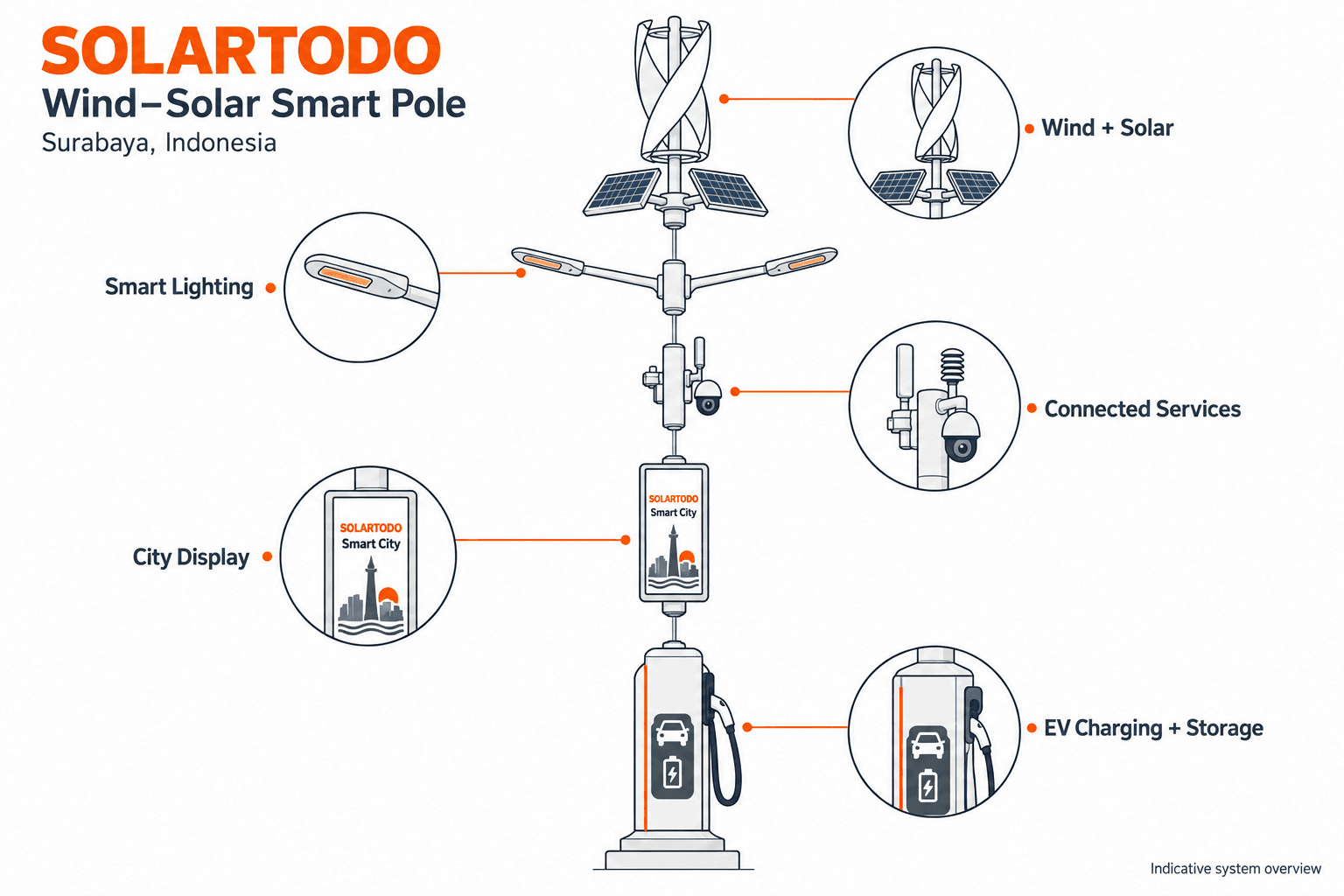
The Surabaya recommendation differs from standard poles by using one 13 m structure for lighting, EV charging, sensing, telecom, and public safety.
| Option | Best-fit corridor | Height / spacing | Power architecture | Urban functions | Surabaya fit |
|---|---|---|---|---|---|
| SOLARTODO hybrid 13 m Smart Streetlight | Coastal arterials, connectors, waterfront access | 13 m / 35 m | 400 W VAWT + 200 W PV + 15 kWh LFP + grid backup | LED, PTZ, 5G n78, EV 11 kW, SOS, PA, sensor, display | Highest fit for salt, flood, and multi-service corridors |
| Standard 6-12 m smart pole | Lower-speed streets and routine PJU upgrades | 6-12 m / 25-50 m | Grid only or modular solar assist | LED plus modular camera, WiFi, audio, sensor | Good for simpler procurement packages |
| Cylindrical CIGS smart pole | Premium civic districts | Ø180-400 mm / 25-40 m | Wrapped CIGS plus grid | Flush modules, premium streetscape, EV option | Strong visual fit but less aligned to specified hybrid VAWT package |
| Conventional PJU pole | Basic lighting replacement | 6-12 m / variable | Grid only | Lighting only | Lowest complexity but no smart-city consolidation |
Pricing & Quotation
For Surabaya procurement, pricing should be quoted by FOB, CIF, or EPC scope for approximately 137 units without publishing unit prices.
SOLARTODO offers three pricing tiers for this product line: FOB Supply (equipment ex-works China), CIF Delivered (including ocean freight and insurance), and EPC Turnkey (fully installed, commissioned, with 1-year warranty). Volume discounts are available for large-scale deployments. Configure your system online for an instant estimate, or request a custom quotation from our engineering team at [email protected].
For a Surabaya quotation, the buyer should define pole locations, cabinet orientation, PLN service availability, foundation soil assumptions, drainage constraints, OCPP backend requirements, SIM or fiber strategy, and acceptance testing format. EPC pricing should include civil works, grounding, traffic management, lifting equipment, commissioning, local permits, and training. For technical clarification, municipal teams and EPC partners can contact us with route drawings and desired service levels.
Frequently Asked Questions
Q1: Why is a hybrid 13 m Smart Streetlight recommended for Surabaya? The 13 m hybrid pole fits Surabaya because the city combines coastal exposure, dense streets, active PJU procurement, and lowland flood risk. At 35 m spacing, approximately 137 poles can cover about 4.8 km. The hybrid VAWT, 200 W PV, 15 kWh LFP battery, and grid backup support resilient lighting while keeping EV charging and telecom grid-backed.
Q2: Is this a documented SOLARTODO deployment in Surabaya? No. This article is a market analysis and technical configuration guide, not a fabricated case study. The 137-unit quantity is a recommended typical deployment scale based on the provided configuration and 35 m spacing. It should be read as an engineering proposal framework for Surabaya corridors, not as a claim that SOLARTODO has completed installation there.
Q3: What standards should be referenced for the Surabaya configuration? The technical basis should include IEC 60598 for luminaires, GB/T 37024 for smart streetlight system guidance, and IEC 62196-2 for the Type 2 AC charging interface. Indonesia-side electrical design should also respect PLN distribution practice, including common 20 kV medium-voltage and 400/231 V low-voltage service arrangements.
Q4: How long would installation typically take for 137 units? A typical 137-unit Smart Streetlight rollout would usually be staged by route section, not installed all at once. Engineering survey, submittals, CKD logistics, civil foundations, pole erection, and commissioning can run in parallel packages. Actual duration depends on permits, traffic windows, drainage work, utility tie-ins, and whether EV charging meters require separate approval.
Q5: How should ROI be calculated without publishing prices? ROI should combine energy savings, avoided duplicate poles, reduced maintenance visits, EV charging utilization, advertising or civic display value, telecom lease potential, and safety operations value. For Surabaya, the strongest case is infrastructure consolidation: one foundation and controller supporting LED lighting, PTZ, 5G, WiFi 6, SOS, PA, sensors, display, and 11 kW charging.
Q6: Does the 15 kWh battery power the EV charger? The 15 kWh LFP battery is best treated as resilience storage for lighting, controls, sensors, communications, and emergency functions. An 11 kW EV charger can consume the battery quickly under full charging load, so EV charging should be grid-backed. The hybrid renewable system offsets auxiliary loads and strengthens uptime rather than replacing utility service.
Q7: What maintenance issues matter most in Surabaya? The main maintenance concerns are salt-air corrosion, humidity, flood splash, clogged drainage around foundations, gasket aging, and exposed connector fatigue. A Surabaya maintenance plan should inspect coating integrity, anchor bolts, cabinet seals, surge protection, grounding resistance, VAWT balance, PV brackets, PTZ lens clarity, display brightness, OCPP logs, and SOS audio quality at scheduled intervals.
Q8: How does this compare with a standard PJU pole? A standard PJU pole mainly provides lighting, while the SOLARTODO Smart Streetlight combines 160 W LED lighting, 5G n78 small cell, PTZ camera, environmental sensor, IP audio, SOS intercom, LED display, USB outlets, and 11 kW AC charging. For Surabaya, this reduces streetscape clutter where road width, sidewalks, drainage channels, and utility corridors compete for space.
Q9: What information is needed for EPC pricing? An EPC quotation should include the route length, pole coordinates, soil and flood assumptions, existing PJU locations, available low-voltage tie points, metering requirements, EV charger backend, display content rules, telecom integration scope, traffic management needs, and acceptance-test checklist. With those inputs, SOLARTODO can separate FOB Supply, CIF Delivered, and EPC Turnkey scopes clearly.
Q10: What warranty structure is appropriate for this product line? The required SOLARTODO pricing paragraph states EPC Turnkey includes a 1-year warranty. Buyers can separately request extended coverage for LEDs, LFP battery, EV charger, controller, display, PTZ camera, and VAWT assemblies. For coastal Surabaya, warranty evaluation should pay close attention to coating system, cabinet sealing, lightning protection, and corrosion-related exclusions.
Q11: Can the LED display show local advertisements or public alerts? For the specified configuration in this article, the P4 vertical display content is strictly limited to “SOLARTODO Smart City” in white sans-serif on a deep blue background, with no other imagery. In a real procurement, any broader display use would need separate content policy, brightness controls, traffic-safety review, and municipal approval.
Q12: Why is the lower 2.2 m integrated charger important? The integrated charger matters because Surabaya streets often have constrained sidewalks, drainage edges, utilities, and street furniture. Making the lower 2.2 m of the pole itself the EV charging cabinet removes a separate pillar, shortens cable exposure, improves visual order, and simplifies foundation planning while preserving an 11 kW Type 2 AC charging interface.
References
- Surabaya City Government (2026): Official geography profile listing 33,306.30 ha, 31 districts, 3-6 m lowland elevation, Madura Strait boundaries, 23.6-33.8 °C temperature, 50-92% humidity, and 165.3 mm average rainfall.
- Surabaya City Government (2025): PJU program announcement targeting 3,000 to 5,884 public streetlighting units in 2025 through resident proposals, Musrenbang, infrastructure minutes, and Pokir inputs.
- Indonesia Ministry of Energy and Mineral Resources (2024): 2023 electrification ratio reached 99.78%, up from 99.67% in 2022, with electricity consumption at 1,285 kWh per capita by October 2023.
- World Bank World Development Indicators (2026): Indonesia urban population share reported at 58.75% in 2024 and 59.4% in 2025, based on UN World Urbanization Prospects methodology.
- PT PLN / SPLN D3.002-1 (2007): Distribution transformer specification covering 20 kV to 400 V and 231 V service classes commonly referenced in Indonesian distribution planning.
- IEC (2020): IEC 60598-1:2020, Luminaires - Part 1, general requirements and tests for luminaires operating from supply voltages up to 1,000 V.
- ITU (2016): ITU-T Y Supplement 37 definition for smart sustainable cities, developed with input from UNECE, UNFCCC, UNESCO, UN-Habitat, and other UN stakeholders.
- Pacific Northwest National Laboratory / U.S. DOE GATEWAY (2009): LED street lighting demonstration report documenting measured performance and 55% energy savings under the reported replacement conditions.
Equipment Deployed
- 137 units × 13m octagonal tapered steel Smart Streetlight pole, base Ø45cm to top Ø15cm, RAL6014 powder coat
- Integrated lower 2.2m pole-as-EV-charging cabinet, welded as one continuous structure
- Gorlov-type helical VAWT, Ø70×100cm, 400W, 3 twisted white aluminum blades, red aviation LED
- 2×100W monocrystalline deep-black solar panels on 15° symmetric east-west A-frame brackets
- 15kWh LFP battery inside pole base with MPPT controller and backup grid tie
- Twin 1.5m symmetric arms with +8° upward tilt and 2×80W LED, 150 lm/W, 4000K
- 15cm mini white PTZ dome camera, 360°, 20× zoom, IR 100m, 40cm L-bracket
- 8-parameter ENV sensor for temp, humidity, wind, pressure, noise, PM2.5, PM10, illuminance
- IP audio column Ø10×50cm, 30W/93dB, TCP/IP, flush color-matched aluminum tube
- One-press SOS button with two-way audio intercom and visual LED indicator
- Integrated 11kW single-gun AC charger, Type 2, OCPP 1.6J, 5m cable, touchscreen, E-stop
- P4 portrait LED display 960×1920mm, >5500 cd/m², fixed content: SOLARTODO Smart City
- 5G NR n78 small cell, 4T4R MIMO, approximately 200m coverage, flush at 8.7m
- USB-A ×2, 5V/2.4A, on charging cabinet