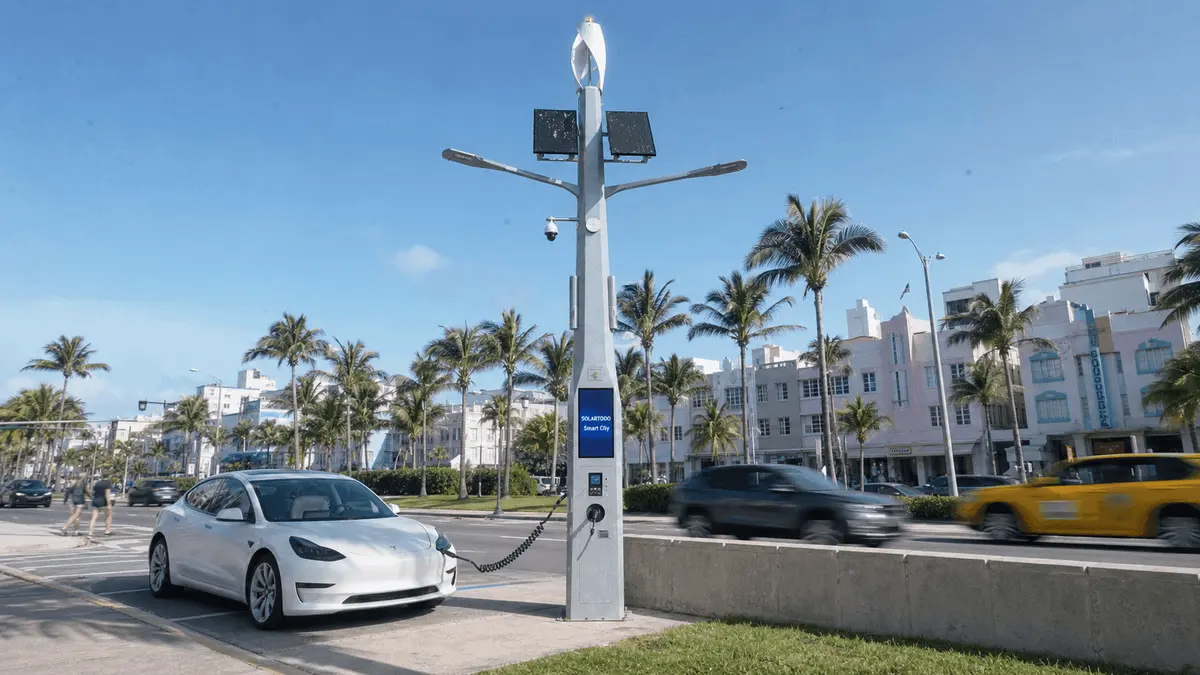
SOLARTODO Smart Streetlight Recommendation for San Juan, Puerto Rico
Summary
Answer Capsule: San Juan should model a 57-unit SOLARTODO Smart Streetlight corridor using 12 m hybrid poles at 32 m spacing, covering about 1.8 km with 10 kWh storage per pole.
This article is a market-analysis recommendation, not a completed deployment claim. The proposed SOLARTODO configuration fits dense coastal corridors where lighting, EV charging, public safety, environmental sensing, and telecom readiness must share limited curb space. According to U.S. Census Bureau QuickFacts (2025), San Juan had an estimated 329,737 residents, 153,632 households, 47.89 square miles of land, and 7,147.1 people per square mile in 2020.
Key Takeaways
Answer Capsule: The recommended San Juan deployment uses 57 integrated poles, 32 m spacing, 160 W LED lighting, 300 W solar input, and 11 kW AC charging per site.
- A 57-unit corridor at 32 m spacing covers about 1.8 km, equal to roughly 31 smart poles per kilometer before intersection and setback adjustments.
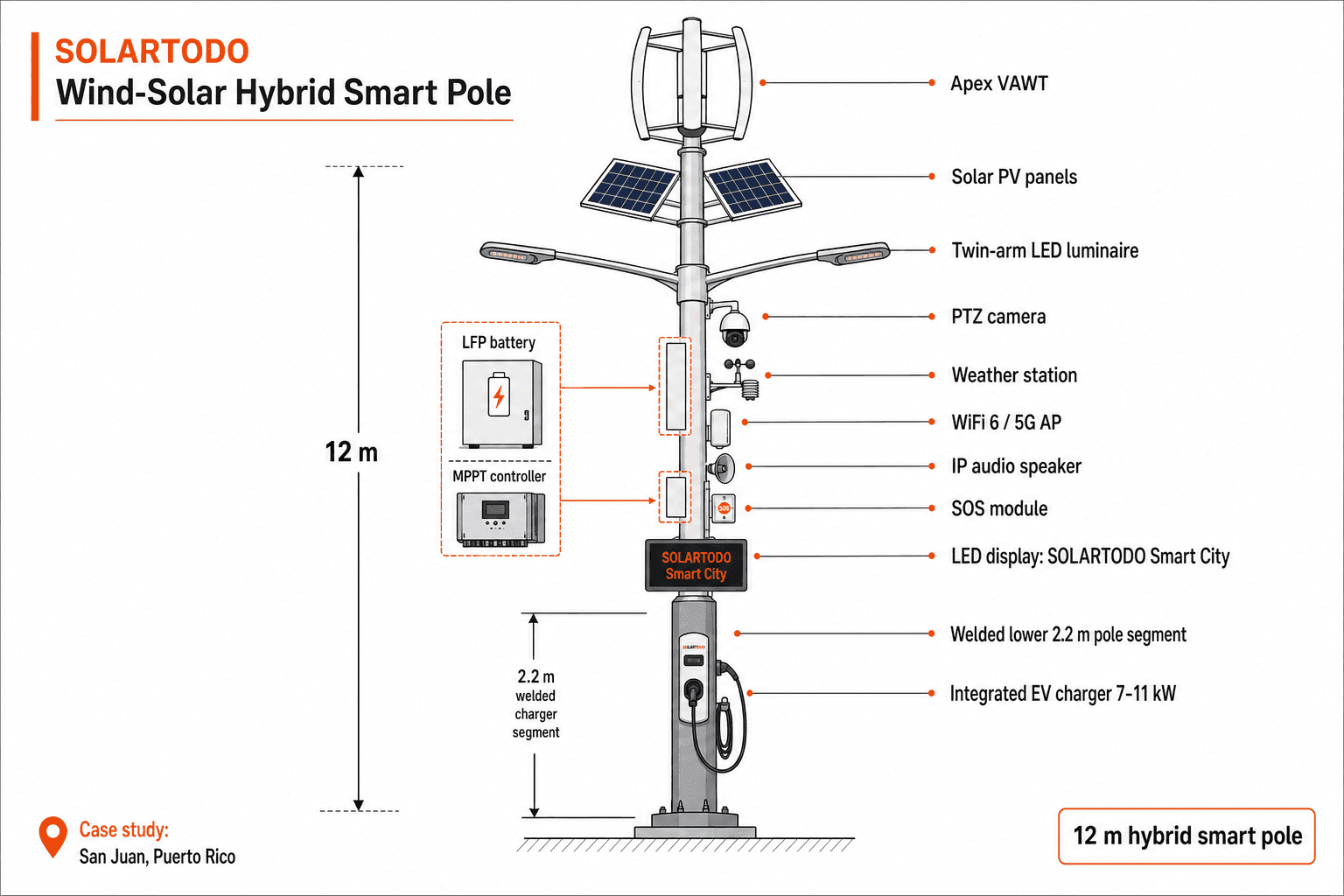
- Each 12 m octagonal tapered steel pole uses a 45 cm base diameter, 15 cm top diameter, hot-dip galvanized finish, and integrated cabinet space in the lower 2.2 m.
- Each pole combines 2 x 80 W LED luminaires at 4000K, producing about 24,000 rated lumens before optical and site utilization factors.
- Each hybrid power package includes 2 x 150 W monocrystalline solar panels, a 400 W Gorlov-type helical VAWT, MPPT control, 10 kWh LFP storage, and grid backup.
- Each integrated charger is specified as 11 kW AC, Type 2, single-gun, OCPP 1.6J, with a 5 m coiled cable, touchscreen, E-stop, and maintenance door.
- Public-safety hardware includes a 4 MP IR camera with 50 m night range, SOS alarm linkage, 30 W IP audio, and emergency broadcast triggering.
- Telecom readiness includes a flush 5G NR n78 small cell at 8.7 m, 4T4R MIMO, and approximately 200 m street-level coverage.
- According to NOAA National Hurricane Center (2018), Hurricane Maria reached Puerto Rico with about 135 kt winds, so wind-load and corrosion review must precede procurement.
Market Context for San Juan
Answer Capsule: San Juan’s 329,737 residents, 153,632 households, and 7,147.1 people per square mile support compact multi-function street infrastructure.
San Juan is Puerto Rico’s capital, a major port, tourism center, healthcare hub, and dense employment district. According to U.S. Census Bureau QuickFacts (2025), the municipality had 208,446 employees at employer establishments in 2023 and $7.39 billion in retail sales in 2022. That demand profile favors smart street assets in Hato Rey, Santurce, Condado, Old San Juan access roads, hospital districts, transit stops, and waterfront commercial zones.
The relevant application is an urban corridor, not a park path or highway mast. SOLARTODO should position the 12 m smart pole as a shared public-realm platform for lighting, EV top-up, camera coverage, environmental data, 5G readiness, public audio, and emergency response. A single integrated foundation and pole envelope reduces sidewalk conflict compared with separate light poles, charger pedestals, camera posts, and telecom cabinets.
Climate, Grid, and Standards Drivers
Answer Capsule: San Juan needs corrosion-resistant 12 m poles because coastal exposure, 56 inches of rain, and hurricane-region wind risk shape every specification.
According to NOAA/NWS San Juan climate resources (2021), San Juan’s tropical coastal climate requires equipment selected for heat, humidity, salt air, UV exposure, wind-driven rain, and storm recovery. According to NOAA National Hurricane Center (2018), Hurricane Maria caused island-wide power and communications disruption, including extensive utility-pole damage. For SOLARTODO, that means sealed electronics, hot-dip galvanized steel, serviceable access panels, corrosion-resistant fasteners, and foundations reviewed under applicable Puerto Rico wind and permitting requirements.
According to DOE/FEMA PR100 (2024), Puerto Rico’s energy planning target remains 100% renewable electricity by 2050. According to the U.S. Energy Information Administration (2024), Puerto Rico’s power system remains exposed to imported fuel and grid modernization constraints. Hybrid self-power with grid backup is therefore more appropriate than a lighting-only replacement program.
Recommended Technical Configuration
Answer Capsule: A 57-unit SOLARTODO hybrid_12m corridor should use 12 m steel poles, 32 m spacing, and integrated charging, sensing, lighting, storage, and telecom modules.
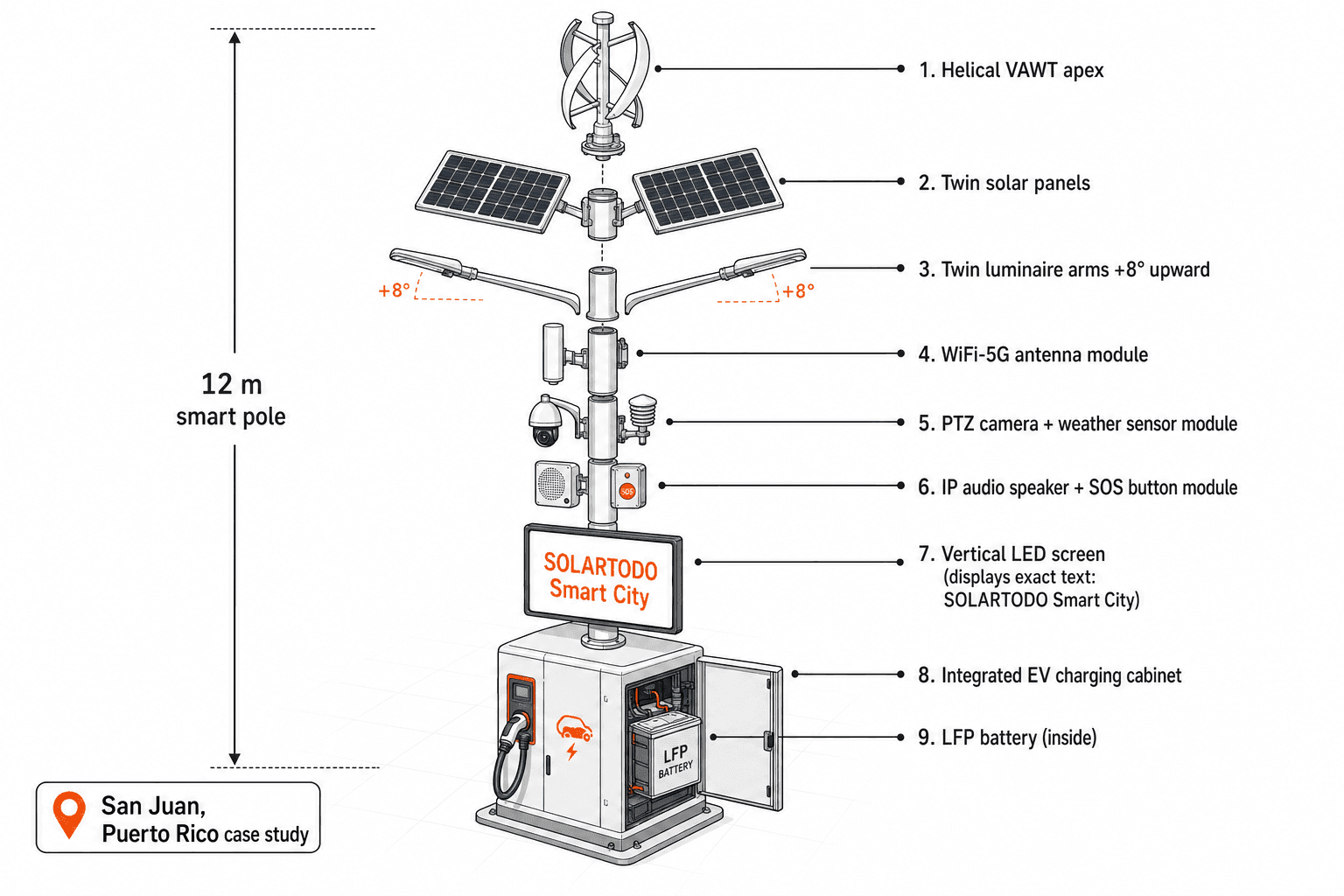
The recommended SOLARTODO form factor is a 12 m octagonal tapered steel pole with a silver-grey hot-dip galvanized finish. The lower 2.2 m operates as the integrated EV charging cabinet, not a detached roadside pillar. This layout reduces civil complexity, keeps maintenance access in one asset envelope, and preserves sidewalk clearance in dense San Juan corridors.
Each pole should carry a 400 W Gorlov-type helical vertical-axis wind turbine at the apex and 2 x 150 W monocrystalline solar panels on symmetric east-west A-frame brackets at 15 degrees. Energy storage should be a 10 kWh LFP battery in the pole base, managed by MPPT control and backed by a grid-tie interface. According to NREL PVWatts (2024), PVWatts estimates grid-connected photovoltaic energy production using site and system inputs, so final yield should be modeled before procurement.
Lighting should use twin 1.5 m symmetric arms with +8 degree upward tilt and 2 x 80 W LED luminaires at 150 lm/W and 4000K. Safety and civic modules should include a 4 MP bullet camera with 50 m IR range, an 8-parameter environmental sensor, SOS panic button, emergency broadcast trigger, and 30 W / 93 dB TCP/IP audio column. The telecom package should reserve space for a flush 5G NR n78 small cell at 8.7 m with 4T4R MIMO and about 200 m coverage.
Technical Specifications
Answer Capsule: The San Juan specification should combine 10 kWh LFP storage, 11 kW AC charging, 300 W solar, 400 W wind, and 24,000 rated lumens per pole.
| Module | Recommended specification | San Juan rationale |
|---|---|---|
| Pole structure | 12 m octagonal tapered steel, 45 cm base, 15 cm top | Urban corridor height with integrated cabinet capacity |
| Deployment scale | 57 units, 32 m spacing, about 1.8 km | Dense street coverage with repeatable civil layout |
| Lighting | 2 x 80 W LED, 4000K, 150 lm/W | Efficient white roadway and pedestrian illumination |
| Solar | 2 x 150 W monocrystalline panels | Distributed daytime generation on each pole |
| Wind | 400 W Gorlov-type helical VAWT | Supplemental generation during variable coastal wind |
| Battery | 10 kWh LFP in pole base | Resilient operation during grid interruptions |
| EV charging | 11 kW AC Type 2, OCPP 1.6J, 5 m cable | Managed curbside top-up without a separate pedestal |
| Security | 4 MP camera, 50 m IR, SOS linkage | Public-safety coverage for high-footfall corridors |
| Communications | 5G NR n78, 4T4R MIMO, about 200 m coverage | Small-cell readiness without extra monopoles |
| Media | P5 portrait LED display, 1280 x 2560 mm, >5000 cd/m2 | Civic messaging and limited advertising inventory |
According to IEC 60598 (2020), luminaire design should be reviewed against international safety and testing requirements for lighting equipment. According to IEC 62196-2 (2022), AC EV connectors require dimensional compatibility for pin and contact-tube accessories, supporting Type 2 interface planning. According to IRENA (2024), utility-scale solar PV LCOE fell 12% from 2022 to 2023, reinforcing the long-term case for distributed solar-assisted infrastructure.
Implementation Approach
Answer Capsule: A 57-pole San Juan corridor should be delivered in 4 phases: survey, utility coordination, installation, and commissioning across 8-14 weeks after permits.
Phase 1 should confirm corridor geometry, underground utilities, ADA sidewalk clearance, interconnection points, telecom backhaul, foundation conditions, and permitting requirements. Phase 2 should finalize shop drawings, wind-load calculations, charger metering, OCPP integration, corrosion details, and CKD logistics. Phase 3 should install foundations, erect poles, connect grid backup, and verify grounding, drainage, cabinet access, and display orientation.
Phase 4 should commission lighting schedules, battery controls, EV charging, camera views, IP audio, environmental sensors, 5G readiness, and remote telemetry. Acceptance testing should include night photometric checks, charger transaction tests, E-stop tests, OCPP session logs, camera IR verification, and emergency broadcast trials. SOLARTODO should provide as-built drawings, serial-number mapping, firmware records, and a maintenance schedule before handover.
Expected Performance and ROI
Answer Capsule: ROI depends on 57 shared foundations replacing multiple assets while each pole provides 160 W lighting, 11 kW charging, storage, sensing, and telecom value.
The strongest performance case is not lighting savings alone. Value comes from avoided duplicate civil works, reduced sidewalk equipment, LED efficiency, grid-resilient storage, managed EV charging, small-cell hosting potential, civic display inventory, and fewer separate maintenance contracts. According to IEA Global EV Outlook (2024), electric mobility analysis now tracks charging infrastructure, battery demand, grid impacts, and policy development, so San Juan should treat charging as part of a broader curbside energy system.
Preliminary ROI should model at least 6 variables: avoided pole and cabinet costs, LED energy reduction, charger utilization, telecom lease value, display revenue, and resilience value during outages. The 10 kWh battery should not be presented as unlimited autonomy; it is a managed buffer for lighting, controls, communication, and selected emergency loads. Final performance should be validated through solar-yield modeling, wind-resource checks, electrical interconnection review, and field commissioning data.
Comparison Table
Answer Capsule: Compared with 2-asset layouts, the SOLARTODO 12 m hybrid pole reduces footprint by combining lighting, charging, storage, sensing, and telecom in 1 structure.
| Option | Best fit | Main advantages | Main tradeoff |
|---|---|---|---|
| SOLARTODO hybrid 12 m smart streetlight | Dense coastal corridors, transit edges, plazas, hospital streets | 1 foundation, 11 kW charging, 10 kWh storage, 5G readiness, CCTV, audio, display | Higher upfront engineering and permitting complexity |
| Standard grid LED pole | Basic street relighting with limited digital services | Lower equipment cost and familiar maintenance model | Lower resilience and fewer monetizable services |
| Separate charger plus light pole | Sites with wide sidewalks or parking lots | Easier charger replacement and vendor separation | More trenching, more sidewalk footprint, more cabinets |
| Telecom small cell on separate monopole | Capacity-focused wireless upgrades | Strong RF specialization and carrier control | Adds visual clutter and separate permitting path |
Pricing and Quotation
Answer Capsule: SOLARTODO should quote 3 commercial tiers: FOB Supply, CIF Delivered, and EPC Turnkey for the 57-unit, 12 m San Juan configuration.
FOB Supply should include the pole structure, luminaires, solar panels, wind turbine, LFP battery, charger hardware, smart modules, display, and factory documentation ex-works China. CIF Delivered should add ocean freight, insurance, export packaging, and delivery to the agreed Puerto Rico port or logistics point. EPC Turnkey should include civil works, foundations, installation, electrical connection, commissioning, OCPP setup, training, and a 1-year warranty unless extended terms are negotiated.
Pricing should be engineered rather than guessed because San Juan costs depend on foundation design, wind certification, utility trenching, telecom backhaul, permit conditions, local labor, interconnection rules, and display approvals. Volume discounts can apply when procurement exceeds one 57-unit corridor or standardizes the same 12 m configuration across multiple districts. Use the SOLARTODO Smart Streetlight configurator for an initial estimate or request a custom quotation at [email protected].
Frequently Asked Questions
Answer Capsule: These 10 FAQs cover price, specifications, logistics, warranty, installation, standards, maintenance, telecom, ROI, and comparison for a 57-unit San Juan corridor.
1. How much would a 57-unit SOLARTODO Smart Streetlight corridor cost?
Final pricing requires an engineered quotation because civil work, wind-load certification, utility trenching, logistics, and permitting can materially change the installed price. SOLARTODO should provide three tiers: FOB Supply for equipment only, CIF Delivered for freight and insurance to Puerto Rico, and EPC Turnkey for installation and commissioning. A 57-unit order may qualify for volume pricing if the same 12 m configuration is standardized.
2. What is the recommended technical specification for San Juan?
The recommended unit is a 12 m hybrid smart pole with 2 x 80 W LED luminaires, 2 x 150 W solar panels, a 400 W helical VAWT, a 10 kWh LFP battery, and an 11 kW Type 2 AC charger. It also includes a 4 MP IR camera, 8-parameter environmental sensor, 30 W IP audio, SOS alarm, P5 portrait display, and 5G NR n78 readiness.
3. How many poles are needed for a typical urban corridor?
At 32 m spacing, 57 poles cover approximately 1.8 km of continuous corridor before final adjustments for intersections, driveways, setbacks, utility conflicts, and photometric requirements. That equals about 31 poles per kilometer. A final layout should be based on roadway width, mounting height, target lighting class, pedestrian crossings, camera sightlines, charger access, and foundation locations.
4. How long would deployment take after permits are approved?
A typical 57-unit corridor can be planned over 8-14 weeks after permits, logistics, and utility approvals are secured. The work usually proceeds through survey, foundation construction, pole erection, electrical connection, and commissioning. Schedule risk comes from underground utility conflicts, hurricane-season logistics, interconnection queues, telecom approvals, and site-specific civil changes discovered during excavation.
5. Is the EV charger a separate roadside pedestal?
No. The lower 2.2 m of the pole is designed as the integrated EV charging cabinet, so the charger is part of the same welded steel asset rather than a separate pillar. This matters in San Juan because sidewalk width is valuable. The integrated layout reduces equipment clutter, simplifies asset ownership, and keeps charger service access within one maintained structure.
6. Which standards should govern the design?
The luminaire package should be reviewed against IEC 60598, the AC charging interface against IEC 62196-2, and the smart pole architecture against GB/T 37024 or equivalent project requirements. OCPP 1.6J should govern charger communication. Puerto Rico-specific permitting, electrical code, coastal corrosion protection, foundation engineering, and hurricane wind-load review remain mandatory before procurement or installation.
7. What warranty and maintenance model should be requested?
For EPC Turnkey procurement, the baseline should include a 1-year warranty covering equipment defects, commissioning issues, and documented installation workmanship. Buyers should request optional extended coverage for batteries, displays, chargers, cameras, and wind turbines. Maintenance should include quarterly visual checks, annual electrical testing, camera cleaning, battery health review, charger diagnostics, firmware control, and corrosion inspection.
8. How does this compare with a standard LED streetlight?
A standard LED pole is cheaper and simpler, but it mainly solves illumination. The SOLARTODO hybrid pole adds 10 kWh storage, renewable generation, 11 kW charging, CCTV, environmental sensing, emergency audio, display capability, and 5G readiness in one footprint. For San Juan’s dense corridors, the integrated asset can reduce separate foundations and cabinets while improving resilience and service density.
9. Can the pole support telecom and public-safety applications?
Yes. The recommended configuration includes a flush 5G NR n78 small-cell position at 8.7 m with 4T4R MIMO and about 200 m target coverage, subject to carrier validation. Public-safety support includes a 4 MP IR camera, SOS alarm, IP audio, and emergency broadcast trigger. Final deployment should coordinate privacy rules, data retention, cybersecurity, and municipal operating procedures.
10. What should be checked before issuing a purchase order?
Before procurement, confirm photometric design, wind-load calculations, corrosion protection, foundation drawings, utility maps, interconnection approval, charger metering, OCPP platform compatibility, telecom backhaul, display permitting, and maintenance access. The buyer should also request factory acceptance criteria, spare-parts lists, firmware policy, battery warranty terms, logistics schedule, and commissioning documentation. These checks reduce change orders after equipment arrives.
References
Answer Capsule: The recommendation uses 8 cited sources covering San Juan demographics, Puerto Rico resilience, EV charging, solar modeling, renewable costs, and hurricane risk.
- U.S. Census Bureau QuickFacts: San Juan Municipio, Puerto Rico (2025).
- DOE/FEMA PR100: Puerto Rico Grid Resilience and Transitions to 100% Renewable Energy Study (2024).
- U.S. Energy Information Administration: Puerto Rico Energy Profile (2024).
- NOAA National Hurricane Center: Hurricane Maria Tropical Cyclone Report (2018).
- NOAA/NWS San Juan Climate Resources (2021).
- NREL PVWatts Calculator (2024).
- IEA Global EV Outlook 2024 (2024).
- IRENA Renewable Power Generation Costs in 2023 (2024).
- IEC Webstore: IEC 60598 Luminaires (2020).
- IEC Webstore: IEC 62196-2 Conductive Charging of Electric Vehicles (2022).
Equipment Deployed
- 57 units x 12m octagonal tapered steel Smart Streetlight, base Ø45cm to top Ø15cm
- Integrated lower 2.2m pole-as-EV-charging cabinet, welded as one continuous steel structure
- Gorlov-type helical VAWT, Ø70x100cm, 400W, 3 twisted white aluminum blades, red aviation LED
- 2 x 150W monocrystalline deep-black solar panels on symmetric east-west A-frame brackets at 15° tilt
- 10kWh LFP battery inside pole base with MPPT controller and backup grid tie
- Twin symmetric 1.5m luminaire arms with +8° upward tilt and 2 x 80W LED, 4000K, 150 lm/W
- 4MP bullet camera with IR 50m on 30cm short arm bracket
- 8-parameter environmental sensor for temp, humidity, wind, pressure, noise, PM2.5, PM10, and illuminance
- 30W/93dB TCP/IP IP audio column, Ø10x50cm, flush color-matched pole integration
- Integrated 11kW single-gun AC charger, Type 2, OCPP 1.6J, 5m coiled cable, touchscreen, E-stop, maintenance door
- P5 portrait LED display, 1280x2560mm, >5000 cd/m², content limited to “SOLARTODO Smart City”
- 5G NR n78 small cell, 4T4R MIMO, 200m coverage, flush at 8.7m on flat pole face