Recife Smart Streetlight Market Analysis: 170-Unit Hybrid 12m Configuration Guide for Coastal Urban Corridors
Summary
Recife’s hot-humid coastal climate, dense urban corridors, and growing EV and digital infrastructure make a 12m hybrid Smart Streetlight profile technically suitable. A typical 170-unit layout at 35m spacing covers about 5.95 km, using 400W wind, 2×200W solar, and 15kWh LFP storage per pole.
Key Takeaways
A Recife-ready Smart Streetlight configuration would typically use approximately 170 units over about 5.95 km at 35m spacing on urban arterial and collector roads.
- Recife sits near 8.05°S with high solar resource and marine corrosion exposure, so a 12m octagonal tapered steel pole with powder coating and hybrid backup is the practical class for main urban roads.
- A typical 170-unit deployment at 35m spacing would cover approximately 5,950m of corridor length, matching dense city avenues rather than highways or park paths.
- Each recommended pole would combine 1× 400W Gorlov-type helical VAWT, 2× 200W monocrystalline panels, and 1× 15kWh LFP battery with grid backup for resilience during cloudy and rainy periods.
- Lighting output is sized at 2× 80W LED luminaires at 150 lm/W and 4000K, giving 160W total LED load per pole with symmetric road coverage from 1.5m twin arms tilted +8°.
- The lower 2.2m of the structure should serve as the integrated EV charging cabinet, using 2× Type 2 connectors, 7kW dual-gun AC charging, and OCPP 1.6J compliance under IEC 62196-2.
- Digital infrastructure can be consolidated into one asset: 4MP IR 50m camera, 12-parameter environmental sensor, WiFi 6 + 5G gateway, LoRaWAN, IP audio column 30W/93dB, and 1000×2000mm P3 LED display.
- According to IEA (2024), electricity demand growth is increasing pressure on distribution efficiency, so hybrid poles with local storage can reduce outage exposure for public lighting and communications loads.
- According to IRENA (2024), distributed renewable-supported urban assets improve resilience where grid interruptions and peak tariffs matter, which is relevant for Recife’s mixed commercial and municipal corridors.
Market Context for Recife
Recife combines high urban density, coastal corrosion exposure, heavy rainfall, and strong digital-service demand, so smart poles in the 10-12m urban street class are a better fit than park lights or highway mast systems.
Recife is the capital of Pernambuco and anchors one of Northeast Brazil’s main metropolitan economies. According to IBGE (2022), the municipality has a population of roughly 1.49 million, while the broader metro area exceeds 4 million, which creates sustained demand for dense street lighting, public safety equipment, and curbside charging in mixed residential-commercial districts. That scale matters because a Smart Streetlight program is usually justified on corridors with repeated pedestrian activity, bus movement, and telecom demand rather than on isolated roads.
Climate is a major design input. According to Brazil’s INMET climate records and Recife municipal climate references, Recife has a tropical monsoon/coastal climate, with annual temperatures generally around 24-30°C and a pronounced rainy season. According to NASA POWER (2024), the Recife area typically receives average daily solar irradiation around 5 kWh/m²/day on a yearly basis, which supports meaningful PV contribution, but rainfall and salt-laden air mean a pure solar-only pole is less robust than a hybrid wind-solar-grid architecture. For that reason, the hybrid_12m class is the correct technical fit for this city profile.
Grid and urban infrastructure also support a connected smart-pole approach. In Brazil, urban public lighting and low-voltage service commonly interface with distribution systems stepped down from medium-voltage feeders such as 13.8kV classes, depending on concessionaire practice. According to ANEEL and utility planning norms used across Brazilian cities, public lighting modernization increasingly includes remote management, metering, and energy-efficiency controls. Recife’s dense avenue network and mixed-use waterfront districts make it practical to specify poles that combine lighting, surveillance, environmental sensing, WiFi, and EV charging in one right-of-way asset.
Telecom readiness is another local factor. According to Anatel (2024), Brazil continues expanding 4G and 5G coverage in major urban centers, and street furniture is increasingly used for densification where rooftop options are constrained. ITU states, "Smart sustainable cities use information and communication technologies to improve quality of life, efficiency of urban operation and services, and competitiveness." That definition aligns with Recife corridors where a single pole can support lighting, public safety, and wireless backhaul without adding multiple standalone cabinets.
A second authority point comes from IEA. IEA states, "Energy efficiency is the first fuel," which is directly relevant to replacing conventional lighting poles with 160W LED smart poles at 150 lm/W plus adaptive controls. In Recife, the business case is not only electricity reduction. It also includes fewer civil works, fewer separate street cabinets, and improved uptime for public-facing services.
Recommended Technical Configuration
For Recife’s coastal arterials and mixed-use corridors, the most suitable configuration is approximately 170 units of 12m hybrid Smart Streetlight poles with integrated EV charging, local battery storage, and grid backup.
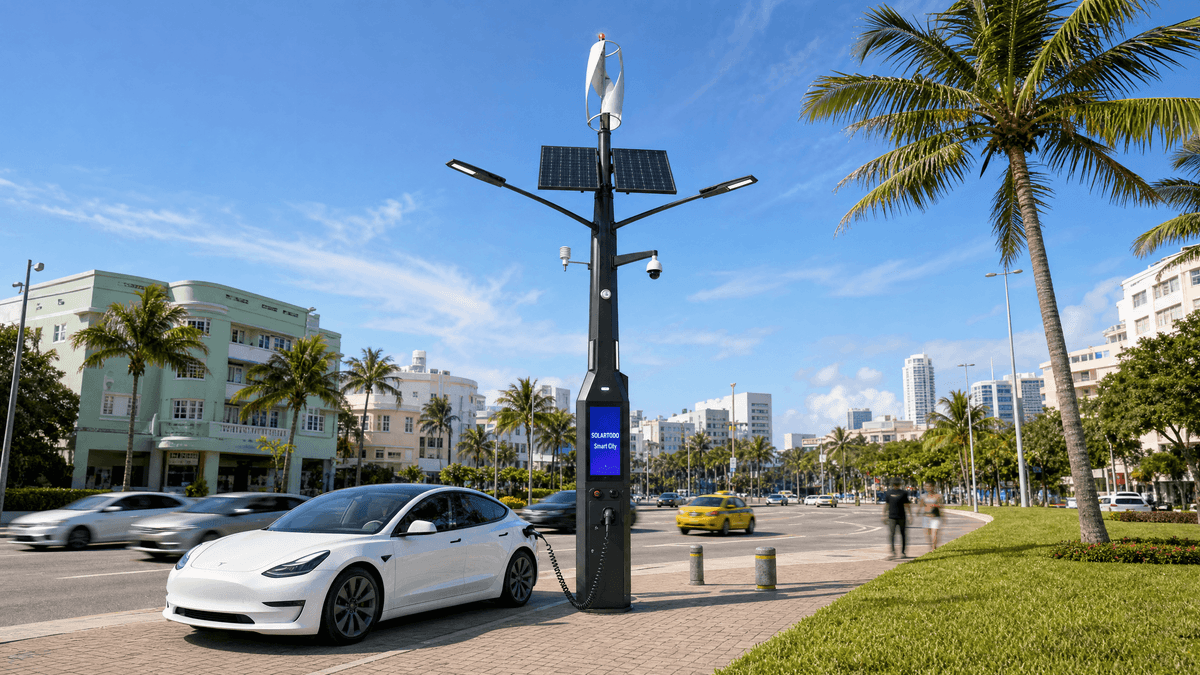
The recommended form factor is the SOLAR TODO 12m octagonal tapered steel hybrid Smart Streetlight, based on the provided [V:hybrid12] configuration. This pole class matches urban street applications with 25-50m spacing and is not intended for highways or parks. Recife’s avenue profile, bus corridors, and waterfront commercial roads typically require a mounting height that can carry dual luminaires, camera, display, and communications hardware without cluttering the footpath. A 12m structure gives enough separation between lighting optics, surveillance, and wireless equipment while preserving road geometry appropriate to city streets.
A typical 170-unit deployment of this scale would be planned for approximately 5.95 km of corridor using 35m spacing. That is a practical length for phased municipal upgrades on linked arterials, university districts, hospital access roads, or mixed retail corridors. The quantity should be read as a planning reference, not a claim of past installation. SOLAR TODO can use this configuration as a technical baseline for Recife tenders, concession models, or EPC scoping.
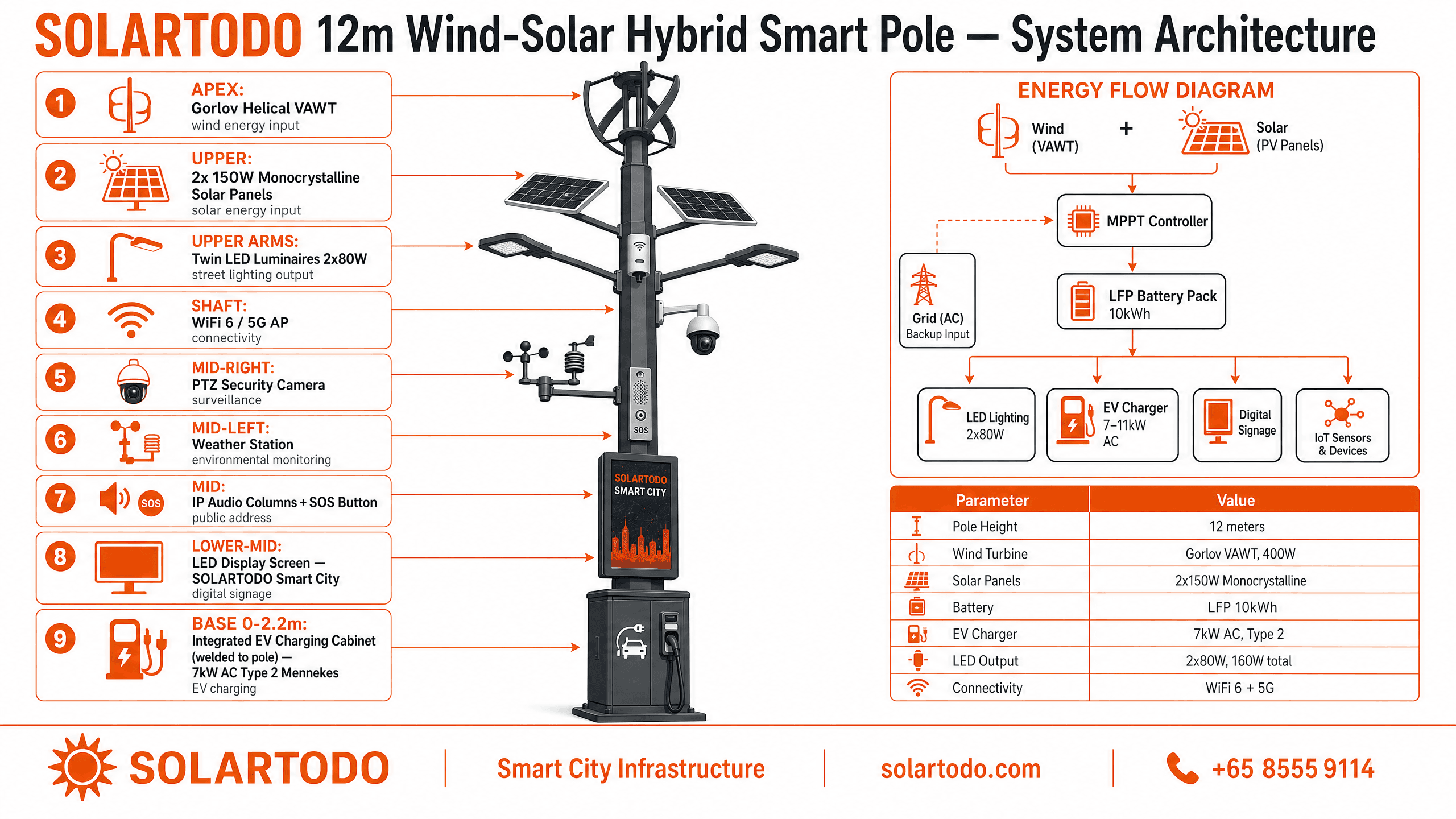
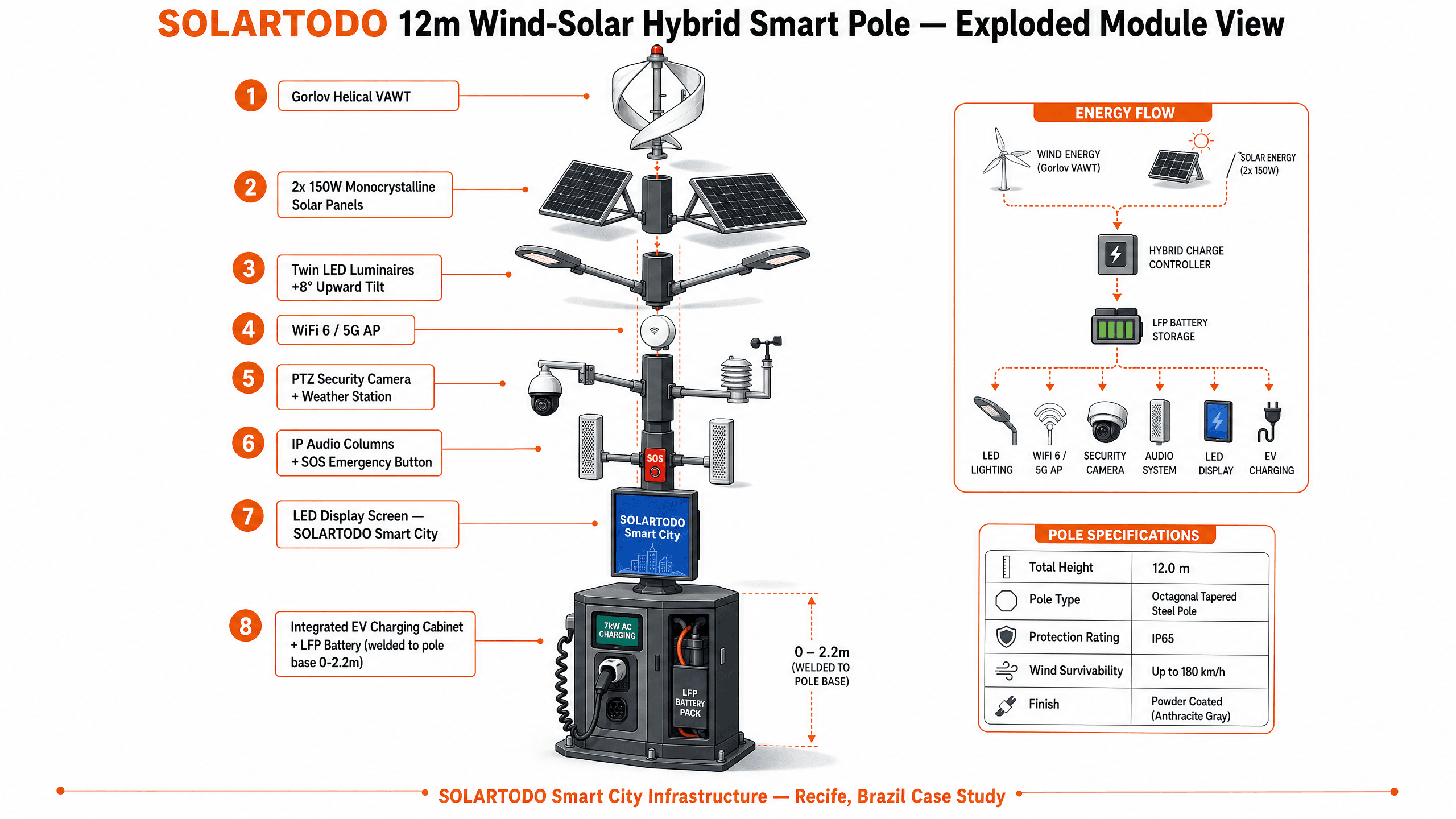
The hybrid power architecture is well matched to Recife because it combines three energy paths: 400W wind generation, 400W solar generation, and grid tie backup. Coastal wind patterns can contribute useful supplemental energy, especially during cloudy periods when solar yield drops. The 15kWh LFP battery inside the base helps maintain operation of lighting, communications, and safety systems during short outages or unstable feeder conditions. According to NREL (2023), lithium iron phosphate chemistry remains a strong choice for stationary urban applications due to thermal stability and cycle life advantages.
The EV charging requirement should remain integrated into the pole body rather than added as a separate pedestal. In this configuration, the lower 2.2m of the pole is the charging cabinet, welded as one continuous steel structure. That matters in Recife because sidewalks can be constrained, and separate cabinets add bollards, conduit crossings, and maintenance complexity. The specified 7kW dual-gun AC charger with 2× Type 2 connectors is appropriate for curbside destination charging rather than rapid fleet turnover.
Technical Specifications
The Recife specification should use the exact hybrid 12m integrated-pole architecture below, because the electrical, structural, and digital loads align with dense urban corridor requirements.
- Quantity for planning: approximately 170 units
- Pole height: 12m
- Pole shape: octagonal tapered steel, base Ø45cm → top Ø15cm
- Finish: charcoal RAL7021 powder coat
- Power architecture: wind-solar hybrid self-powered with backup grid tie
- Wind turbine: Gorlov-type helical VAWT, 3 twisted white aluminum blades, Ø70×100cm, 400W, with red aviation LED
- Solar array: 2× 200W monocrystalline deep-black panels on A-frame brackets at 15° tilt, symmetric east-west pair
- Battery: 15kWh LFP inside pole base with MPPT controller
- Luminaire arrangement: twin symmetric arms, each 1.5m, with +8° upward tilt
- LED lighting: 2× 80W LED, 150 lm/W, 4000K
- Camera: 4MP bullet camera with IR 50m on 30cm short arm bracket
- Top sensor: 12-parameter environmental sensor for meteorology, air quality, rain, and CO/NO2/O3
- Public address: 1× IP audio column, Ø10×50cm, 30W, 93dB, TCP/IP networked, flush-mounted against flat pole face
- Emergency system: one-press SOS button with camera linkage
- EV charging: integrated pole-as-charger, 7kW dual-gun AC, 2× Type 2, OCPP 1.6J, 5m coiled cable, touchscreen, E-stop, maintenance door
- Display: vertical P3 LED screen, 1000×2000mm portrait, >6000 cd/m², content restricted to “SOLARTODO Smart City” in white sans-serif on deep blue
- Communications: dual-mode WiFi 6 + 5G gateway with GbE uplink + LoRaWAN, flush-mounted at 8.7m
- User charging extras: Qi wireless phone charging pad + USB-A
- Recommended spacing: 35m
- Applicable standards: IEC 60598, GB/T 37024, IEC 62196-2
From an engineering compliance perspective, the lighting assembly should be checked against IEC 60598 for luminaire safety, the EV connector system against IEC 62196-2, and the overall pole and accessory load case against local structural wind calculations for coastal Brazil. Recife’s marine atmosphere also justifies close review of coating thickness, sealed cable entries, and maintenance intervals for exposed fasteners and speaker perforations.
Implementation Approach
A Recife rollout would typically proceed in 4 phases over roughly 6-12 months, depending on civil permits, utility approvals, and whether the project is procured as supply-only or EPC.
Phase 1 is corridor selection and utility interface. This usually takes 4-8 weeks and includes roadway classification, feeder availability, curbside parking analysis, and telecom backhaul review. Because each pole includes a 7kW dual-gun charger, the design team should verify local service capacity, charger diversity factor, and metering architecture. If a 170-unit corridor is split into zones, a practical approach is 3-5 installation lots to reduce traffic disruption.
Phase 2 is detailed design and factory documentation. This stage generally takes 6-10 weeks and should include foundation drawings, anchor-bolt schedules, communication topology, and content-control rules for the 1000×2000mm P3 display. For Recife, corrosion protection details should be reviewed early because salt exposure can shorten maintenance cycles if coating systems are underspecified. SOLAR TODO would normally align this stage with submittals for public-lighting, charger, and telecom approvals.
Phase 3 is civil works and pole installation. Typical urban foundations, conduits, and utility tie-ins can proceed in rolling sections of 300-800m. A 12m pole with integrated charging base reduces the number of separate plinths compared with stand-alone charger plus light pole layouts. Installation sequencing usually follows foundation curing, pole erection, luminaire mounting, communications activation, and charger commissioning. In dense Recife districts, night work windows may be preferable on busier corridors.
Phase 4 is systems commissioning and platform integration. This usually takes 2-4 weeks for a corridor-scale package and includes LED testing, camera focus, sensor calibration, OCPP charger checks, and network acceptance. The WiFi 6 + 5G + LoRaWAN stack should be validated for bandwidth, latency, and device registration before handover. A practical acceptance plan would also include rain-event checks for drainage, door sealing, and visibility of the SOS and charging interfaces.
Expected Performance & ROI
For Recife, a hybrid 12m Smart Streetlight can reasonably target 50-70% lighting energy reduction versus legacy sodium systems, plus added value from EV charging, telecom hosting, and reduced street-furniture duplication.
Lighting efficiency is the first measurable gain. If the baseline is a conventional 250W high-pressure sodium streetlight with ballast losses, replacement by 2×80W LED optics with smart controls can materially cut electricity use while improving uniformity and color rendering. According to IEA (2024), LED public lighting remains one of the fastest-return municipal efficiency upgrades. Depending on local burning hours and dimming schedules, Recife buyers could model a simple lighting-energy reduction in the 50-70% range.
The hybrid power package adds resilience rather than full off-grid independence. The total on-pole generation is 800W nameplate from wind plus solar, backed by 15kWh LFP storage and grid tie. In practice, that means critical loads such as communications, sensors, SOS, and a reduced lighting profile can continue through short disturbances. According to NREL (2023), distributed storage improves continuity for critical urban loads when paired with smart controls and prioritized load shedding.
EV charging economics depend more on utilization than on hardware rating. A 7kW dual-gun AC charger is best suited to destination parking dwell times of 1-4 hours, not high-turnover DC fast charging. In Recife, likely use cases include municipal fleets, beachfront parking, hospitals, campuses, and mixed retail streets. According to IEA Global EV Outlook (2024), public charging availability remains a key enabler of EV adoption, especially where home charging access is uneven.
For lifecycle cost, a combined pole can reduce duplication of foundations, trenching, and maintenance visits. One structure carrying lighting, camera, sensor, display, WiFi, and charger generally costs less to maintain than 3-5 separate assets spread across the same block face. Payback therefore usually comes from stacked value streams: energy savings, avoided separate infrastructure, digital service revenue, and lower outage exposure. For municipal or PPP models in Brazil, buyers often test scenarios in the 5-9 year range depending on charger utilization, telecom lease assumptions, and local electricity tariffs.
Results and Impact
For Recife corridors, the main impact of a 170-unit Smart Streetlight program would be denser service delivery across 5.95 km with fewer cabinets, fewer standalone poles, and better uptime for public-facing urban systems.
The practical result is asset consolidation. Instead of installing separate light poles, CCTV posts, environmental stations, WiFi nodes, emergency call boxes, and EV chargers, the city can specify one 12m roadside asset at 35m intervals. That reduces right-of-way clutter and simplifies maintenance routing. In districts where footpath width is constrained, the integrated 2.2m charger-in-pole design is especially useful.
A second impact is data visibility. With a 12-parameter sensor, 4MP IR camera, and connected gateway on each pole, Recife operators could monitor lighting status, environmental conditions, and selected public-safety events from one platform. According to ITU (2023), interoperable urban digital infrastructure improves operational efficiency when city systems share communications and data layers. That is the strongest non-energy argument for this product class.
A third impact is resilience. The combination of 400W wind, 400W solar, 15kWh LFP, and grid backup means lighting and communications are less exposed to short feeder interruptions. In a coastal city with heavy rain events, that resilience can matter as much as pure energy savings. SOLAR TODO should therefore position this Recife configuration as a corridor infrastructure package rather than only a lighting upgrade.
Comparison Table
For Recife, the hybrid 12m configuration offers a better balance of resilience and function than a standard grid-only pole, while avoiding the under-height limitations of smaller park-class products.
| Configuration | Recommended use in Recife | Height | Power architecture | Lighting load | EV charging | Communications | Best fit assessment |
|---|---|---|---|---|---|---|---|
| SOLAR TODO Hybrid 12m | Coastal arterials, mixed-use avenues, waterfront corridors | 12m | 400W wind + 2×200W solar + 15kWh LFP + grid backup | 2×80W LED | Integrated 7kW dual-gun AC | WiFi 6 + 5G + LoRaWAN | Best overall fit |
| Standard grid-powered smart pole | Dense streets with stable grid and no resilience requirement | 6-12m | Grid only | 80-150W typical | Optional | Optional | Lower resilience |
| Cylindrical premium solar-wrapped pole | Landmark districts with premium architectural brief | Ø219 monolithic | CIGS wrapped solar + embedded modules | Varies | Embedded | Embedded | Higher design premium |
| Small garden/park light class | Parks and pedestrian paths only | 6-8m | Usually lower-load | Lower | Usually none | Limited | Not suitable for Recife arterials |
Pricing & Quotation
SOLAR TODO offers three pricing tiers for this product line: FOB Supply (equipment ex-works China), CIF Delivered (including ocean freight and insurance), and EPC Turnkey (fully installed, commissioned, with 1-year warranty). Volume discounts are available for large-scale deployments. Configure your system online for an instant estimate, or request a custom quotation from our engineering team at [email protected].
For Recife buyers, quotation quality depends on 5 variables: corridor length, foundation conditions, utility interconnection scope, telecom backhaul, and display/content control requirements. A budgetary request should therefore include pole spacing, pavement type, charger metering preference, and whether the project is supply-only or full EPC. For product details, see the Smart Streetlight product page or contact us for a Recife-specific technical review.
Frequently Asked Questions
This FAQ answers the main Recife procurement questions covering 12m pole specs, 170-unit planning scale, ROI, installation, maintenance, warranty, and EPC scope in concise technical terms.
Q1: Why is the 12m hybrid Smart Streetlight the recommended class for Recife?
Recife’s arterial roads need more mounting height than park lighting, and its coastal climate benefits from backup generation and storage. A 12m pole supports dual 80W luminaires, camera, display, sensors, and communications at one location. The hybrid package also adds resilience during rain-related grid disturbances.
Q2: What corridor length does a 170-unit layout cover?
At the specified 35m spacing, approximately 170 units cover about 5,950m, or 5.95 km. That is a useful planning scale for one continuous urban corridor or several linked district segments. Final quantity would still depend on intersections, setback constraints, and parking-bay geometry.
Q3: Is this pole fully off-grid?
No. The recommended Recife configuration is hybrid, not purely off-grid. Each pole uses 400W wind, 2×200W solar, and 15kWh LFP storage, but it also includes grid backup. That architecture is more suitable for a dense coastal city where uptime matters more than complete energy independence.
Q4: How does the integrated EV charger differ from a separate charger pedestal?
In this design, the lower 2.2m of the pole is the charger cabinet itself, welded into one steel body. That reduces sidewalk clutter, avoids a second foundation, and simplifies conduit routing. The charger is rated at 7kW dual-gun AC with 2× Type 2 connectors and OCPP 1.6J compatibility.
Q5: What installation timeline is typical for a project of this size?
A corridor-scale package of around 170 poles would often require 6-12 months from survey to commissioning. The range depends on permitting, utility approvals, and civil complexity. Factory production and documentation may take 6-10 weeks, while field works are usually phased in sections to reduce traffic disruption.
Q6: What payback period should Recife buyers model?
A realistic model often falls in the 5-9 year range, but it depends on electricity tariffs, charger utilization, maintenance savings, and any telecom or advertising income. The strongest business case usually combines 50-70% lighting energy reduction with avoided cost from replacing multiple standalone roadside assets.
Q7: What maintenance workload should be expected?
Routine maintenance is usually scheduled every 6-12 months in coastal environments. Recife’s salt air means buyers should inspect coating condition, door seals, speaker perforations, charger cables, and fasteners more frequently than in inland cities. Battery, MPPT, and communications diagnostics can be monitored remotely through the control platform.
Q8: How does this compare with a standard grid-only smart pole?
A standard grid-only pole can be simpler where feeder reliability is excellent and resilience is not a priority. The Recife hybrid option adds 800W of local generation and 15kWh of storage, which improves continuity for lighting, sensors, and communications. That usually justifies the added complexity on key public corridors.
Q9: Is EPC available, or is this supply-only?
Both approaches are possible. SOLAR TODO can quote FOB Supply, CIF Delivered, or EPC Turnkey depending on the buyer’s contracting model. For Recife, EPC scope should clearly define civil works, grid interconnection, charger testing, network commissioning, and local authority acceptance responsibilities before procurement starts.
Q10: What warranty terms should buyers request?
The required quotation paragraph specifies 1-year warranty for EPC Turnkey scope. Buyers may still request separate component warranty schedules for LEDs, battery, charger, display, and communications hardware. In practice, warranty review should also define corrosion exclusions, maintenance obligations, and response times for critical charger or lighting faults.
Q11: Are the displays suitable for municipal information or advertising?
Technically yes, because the specification includes a 1000×2000mm P3 vertical LED display with brightness above 6000 cd/m². In this configured version, however, content is restricted to “SOLARTODO Smart City” in white sans-serif on deep blue. Any broader content policy would need separate approval and software control rules.
Q12: What standards are most relevant to this specification?
The core standards in this configuration are IEC 60598 for luminaires, GB/T 37024 for smart pole reference compliance, and IEC 62196-2 for EV connector compatibility. Recife buyers should also request local structural checks for coastal wind loading, foundation design, and utility interconnection compliance under Brazilian practice.
References
This Recife guide is based on public city, energy, telecom, and standards sources, combined with the specified SOLAR TODO hybrid 12m product configuration.
- IBGE (2022): Recife municipal population data from the Brazilian Institute of Geography and Statistics, used to size urban corridor demand and service density.
- ANEEL (2023): Brazilian electricity regulation and public-lighting framework references relevant to urban distribution and municipal lighting modernization.
- Anatel (2024): Brazil telecom coverage and 4G/5G expansion references relevant to smart-pole communications hosting.
- NASA POWER (2024): Solar resource data for coordinates near -8.05, -34.87, indicating average annual solar potential of roughly 5 kWh/m²/day class.
- IEA (2024): Energy efficiency and Global EV Outlook references supporting LED savings potential and the importance of public charging availability.
- IRENA (2024): Distributed energy and urban resilience references supporting hybrid renewable-backed public infrastructure.
- NREL (2023): Stationary battery and distributed energy integration references supporting LFP storage selection for urban assets.
- IEC (2023): IEC 60598 luminaire safety requirements and IEC 62196-2 EV connector requirements applicable to this configuration.
- ITU (2023): Smart sustainable city framework describing the role of ICT in improving urban services and operational efficiency.
Equipment Deployed
- 12m octagonal tapered steel Smart Streetlight pole, base Ø45cm to top Ø15cm, charcoal RAL7021 powder coat
- Integrated lower 2.2m EV charging cabinet welded as one continuous steel structure
- Gorlov-type helical VAWT, 3 twisted white aluminum blades, Ø70×100cm, 400W, red aviation LED
- 2× 200W deep-black monocrystalline solar panels on A-frame brackets at 15° tilt, east-west symmetric pair
- 15kWh LFP battery inside pole base with MPPT controller and grid backup tie
- Twin 1.5m symmetric lighting arms with +8° upward tilt
- 2× 80W LED luminaires, 150 lm/W, 4000K
- 4MP bullet camera with IR 50m on 30cm short arm bracket
- 12-parameter environmental sensor for meteorology, air quality, rain, CO, NO2, and O3
- IP audio column speaker Ø10×50cm, 30W, 93dB, TCP/IP networked, flush-mounted
- One-press SOS button with camera linkage
- Integrated 7kW dual-gun AC charger, 2× Type 2, OCPP 1.6J, 5m coiled cable, touchscreen, E-stop
- P3 vertical LED display 1000×2000mm portrait, >6000 cd/m²
- Dual-mode WiFi 6 + 5G gateway with GbE uplink and LoRaWAN, flush-mounted at 8.7m
- Qi wireless phone charging pad and USB-A outlet