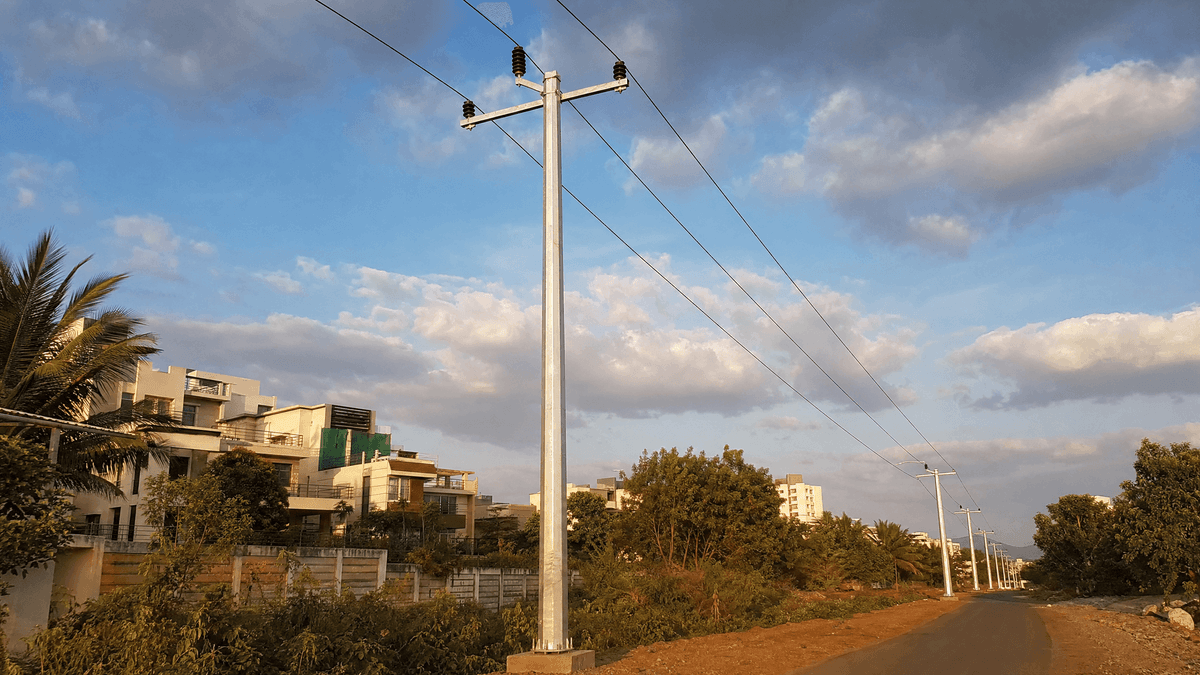
Pune Power Transmission Tower Market Analysis: 10kV Rural Distribution Configuration Guide
Summary
Pune’s mixed urban-rural grid profile supports continued 10kV feeder expansion, where a typical 7 km community distribution line would use approximately 222 steel tubular poles at 10 m height, 30 m spans, and 25 m/s wind class for local reliability upgrades.
Key Takeaways
- Pune district’s large rural interface and fast load growth make 10kV community distribution a practical fit for feeder extensions using approximately 222 poles over 7 km.
- The recommended pole set for this profile is 10 m tapered steel tubular monopoles, single circuit, with Q345 hot-dip galvanized steel and about 2 t per pole.
- Electrical configuration in this guide uses ACSR 50 conductor, 0.8 m phase spacing, 16 kN maximum tension, and 0.5 m insulator length for short-span local distribution.
- Civil design is aligned to 30 m span length, 5 m ground clearance, concrete base foundations, and wind class 1 at 25 m/s for typical rural/community conditions.
- Applicable standards include GB 50061 for overhead distribution up to 10 kV and IEC 60865 for short-circuit force considerations in overhead line hardware selection.
- For Pune’s local access roads and village-edge routes, a flanged steel tubular pole layout typically reduces right-of-way complexity compared with lattice structures on the same 7 km alignment.
- A typical procurement and build schedule for approximately 222 units would often be 12-20 weeks, depending on foundation curing, utility approvals, and monsoon timing.
- SOLAR TODO should be evaluated here as a technical supplier for 10kV steel tubular distribution structures, not as a claimed past installer in Pune; project-specific design should still be checked against utility drawings and local codes.
Market Context for Pune
Pune’s distribution demand profile combines dense urban load with a large peri-urban and rural service area, making short-span 10kV overhead networks relevant for community electrification, agricultural loads, and village-edge feeder reinforcement. According to the Government of India Census (2011), Pune district had a population above 9.4 million, while Pune city itself exceeded 3.1 million, showing the scale of both municipal and surrounding distribution demand. According to Maharashtra State Electricity Distribution Co. Ltd. (MSEDCL), the utility serves one of India’s largest distribution footprints, including rural and semi-urban feeders where overhead line extensions remain common.
Pune also faces climate and terrain conditions that affect pole selection. According to the India Meteorological Department (IMD) climate normals, Pune has a monsoon season with concentrated rainfall from June to September, which increases foundation planning sensitivity and access constraints during construction. According to the World Bank Climate Change Knowledge Portal (2021), Maharashtra is exposed to seasonal rainfall variability and heat stress, which supports the use of galvanized steel structures with predictable maintenance cycles and corrosion protection.
For voltage class selection, the correct starting point is the service requirement rather than pole height alone. This guide is based on a 10kV low-voltage distribution single-circuit rural/community application using 10 m tapered steel tubular poles. That sits within the broader distribution category governed by lower-voltage overhead design practice, although the generic engineering table for 10-35 kV distribution normally points to 12-18 m poles, 1-3 t/pole, and 80-150 m spans for standard utility distribution corridors. In Pune, a shorter 10 m pole and 30 m span can still be relevant where the route is local, access-constrained, and intended for low-height community distribution rather than long-span main feeder work.
According to the International Energy Agency (IEA) (2023), India’s electricity demand growth remains among the fastest globally, which increases pressure on last-mile and medium-voltage distribution infrastructure. According to IRENA (2023), distribution strengthening is a core requirement for reliable power delivery in fast-growing regional economies. In Pune district, that means practical demand for compact steel pole lines that can support village roads, community clusters, pump loads, and local service connections without the footprint of lattice towers.
The local fit also depends on corridor geometry. A steel tubular pole is often preferred where roads are narrow, turning radii are limited, and the visual or land-use impact of a four-leg lattice structure is harder to manage. SOLAR TODO’s Power Transmission Tower line, when applied as a steel tubular distribution pole solution, fits this requirement because a flanged monopole structure can be transported in sections, erected with smaller crews, and used on concrete foundations with anchor detailing suited to repetitive 30 m spans.
Recommended Technical Configuration
For Pune’s peri-urban and rural community distribution profile, a typical 7 km deployment would use approximately 222 single-circuit 10 m steel tubular poles with ACSR 50 conductor, 30 m spans, and concrete base foundations. This is a compact local-distribution configuration rather than a long-span sub-transmission design.
The recommended configuration starts with the user-specified electrical duty: 10kV low-voltage distribution, single circuit. Because this is a community distribution application with 30 m spans and 5 m ground clearance, the design emphasis is on route density, safety at crossings, and simple maintenance access rather than maximizing span length. A typical 222-unit deployment of this scale would be suitable for village roads, community service corridors, and short feeder branches where terrain or clearance constraints favor more frequent supports.
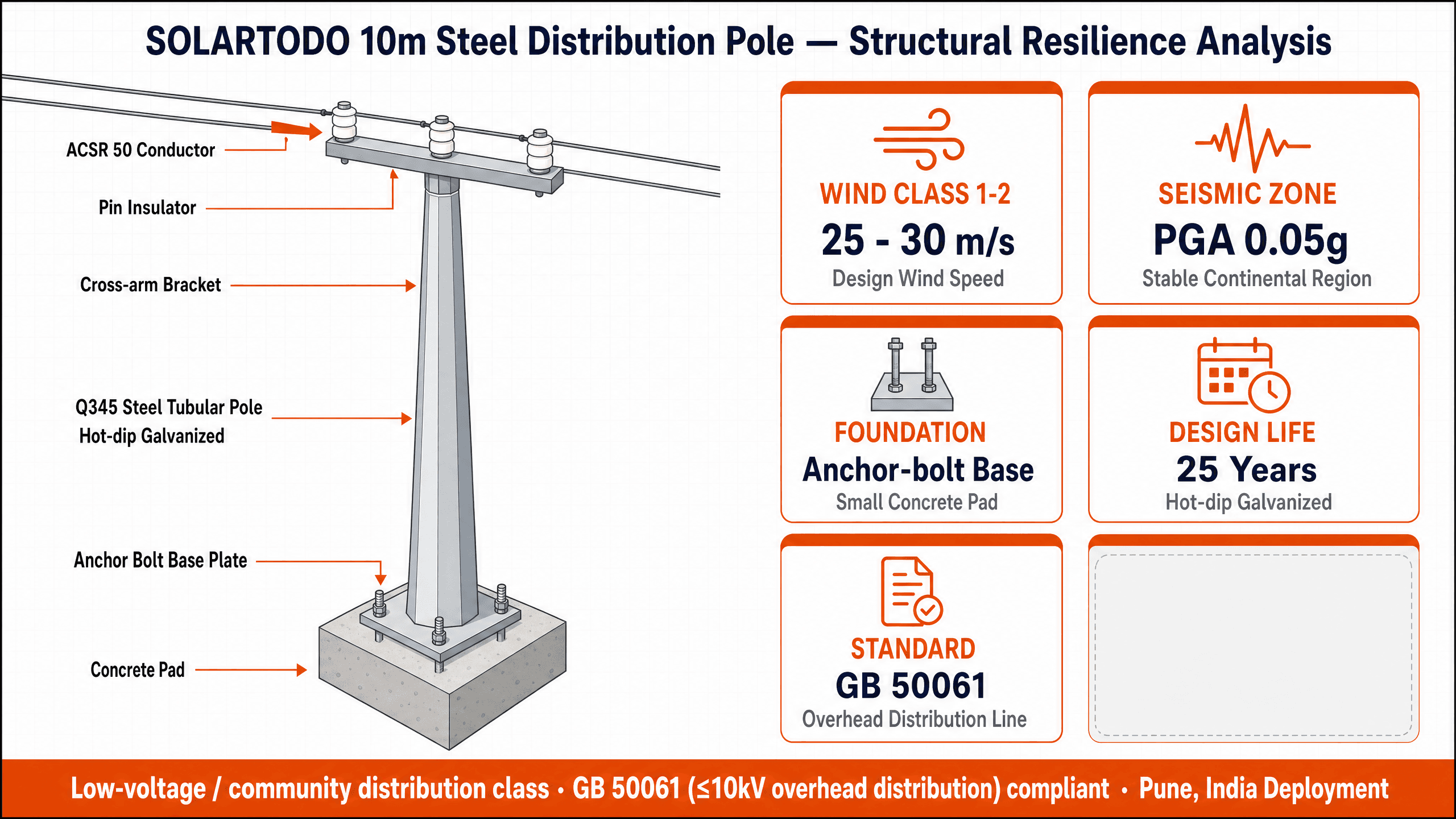
The pole body should be a tapered steel tubular monopole fabricated from Q345 steel and protected by hot-dip galvanizing. The specified mass is about 2 t per pole, equivalent to roughly 200 kg/m over a 10 m structure. That weight level is consistent with a heavy-duty local distribution pole including cross-arm hardware, climbing pegs, grounding, and the base interface required for repeated field installation.
Conductor selection in this guide is ACSR 50, with a stated line weight of 200 kg/km and maximum tension of 16 kN. This is lighter than the broader ACSR family options in the standard product range such as ACSR-70, ACSR-120, ACSR-240, and ACSR-400, but it suits short-span community distribution where mechanical loading is moderate and circuit capacity is aligned to local service demand. The 0.8 m phase spacing and 0.5 m insulator length are also consistent with compact 10kV line geometry.
A practical planning note for Pune is monsoon sequencing. Foundations for approximately 222 poles are best scheduled around rainfall windows because repeated excavation and concrete work along a 7 km route can slow materially during heavy rain. According to IMD seasonal data, June-September conditions in Maharashtra often justify a phased schedule with foundation works completed before peak monsoon and erection plus stringing concentrated in drier weeks.
For buyers comparing vendors, SOLAR TODO should be assessed on material traceability, galvanizing thickness control, fabrication tolerances, and drawing support for utility review. For this product class, the key commercial comparison is not only pole price; it is also whether the supplier can deliver anchor templates, section flange tolerances, grounding accessories, and installation documentation for a 25-year design life.
Technical Specifications
This Pune configuration centers on a 10kV single-circuit line using 10 m galvanized steel tubular poles, 30 m spans, and approximately 222 units across 7 km for rural or community distribution.
- Product type: Steel tubular Power Transmission Tower / tapered monopole pole
- Application class: Low-voltage rural / community distribution
- System voltage: 10kV
- Circuit arrangement: Single circuit
- Pole height: 10 m
- Pole form: Tapered steel tubular pole, flanged/sectional steel construction
- Pole material: Q345 steel
- Surface protection: Hot-dip galvanized
- Approximate pole weight: 2 t/pole
- Unit linear mass reference: 200 kg/m
- Conductor type: ACSR 50
- Conductor weight: 200 kg/km
- Maximum conductor tension: 16 kN
- Phase spacing: 0.8 m
- Insulator length: 0.5 m
- Ground clearance: 5 m
- Typical span in this configuration: 30 m
- Total line length: Approximately 7 km
- Estimated quantity: Approximately 222 poles
- Wind class: Class 1, 25 m/s
- Foundation type: Concrete base foundation
- Accessories: Climbing pegs, cross arm, grounding set, insulator pin
- Design life: 25 years
- Primary standards: GB 50061 for overhead distribution up to 10kV; IEC 60865 for electromechanical short-circuit considerations
According to IEC (2011), short-circuit mechanical effects must be considered in conductor support and hardware selection, which is why insulator pins, cross-arms, and conductor tension values should be checked as a complete set rather than as separate items. IEEE guidance similarly treats structure, conductor, and hardware loading as one system during line design.
"IEC states, 'This part of IEC 60865 provides procedures for calculation of the effects of short-circuit currents,'" which is directly relevant to selecting insulators, fittings, and support geometry for a 10kV overhead line. "The World Bank notes that 'reliable electricity supply is essential for economic activity and service delivery,'" reinforcing why local distribution reinforcement matters in districts such as Pune.
Implementation Approach
A typical Pune rollout for approximately 222 steel tubular poles would proceed in 5 phases over roughly 12-20 weeks, with monsoon timing and utility approvals being the main schedule variables.
The first phase is route survey and utility design review. For a 7 km line, this usually includes centerline marking, crossing identification, soil checks for each pole location, and confirmation of 30 m average spans. In village-edge corridors, survey teams should verify road setbacks, tree conflicts, and service drop points because a compact 10 m pole profile depends on accurate local clearance control.
The second phase is detailed fabrication and logistics planning. Steel poles in Q345 should be fabricated with flange tolerances matched to the erection method and galvanized after machining and welding inspection. For a 222-unit package, buyers generally request mill certificates, galvanizing records, bolt schedules, and packing lists by route segment so field crews can stage poles efficiently.
The third phase is civil work. Each location requires excavation, rebar or anchor detailing as specified, and a concrete base foundation sized to local soil bearing conditions and the 25 m/s wind class. In Pune’s wet season, foundation quality control matters because water ingress, soft shoulders, and inconsistent curing can create long-term alignment issues even on a relatively short 10 m support structure.
The fourth phase is erection and line hardware installation. Poles are set, aligned, and fixed before fitting cross arms, insulator pins, grounding, and climbing pegs. Because the conductor is ACSR 50 with 16 kN maximum tension, stringing crews should use tensioning methods suited to short-span distribution work and check sag against the 5 m minimum ground clearance requirement.
The fifth phase is testing and energization. This generally includes foundation inspection, verticality checks, galvanizing damage touch-up, grounding continuity tests, and final conductor clearance verification. SOLAR TODO can support this stage with fabrication documents and technical submittals, while the local EPC or utility team completes statutory inspection and commissioning.
Expected Performance & ROI
For a 7 km 10kV community line in Pune, the main return comes from lower outage risk, easier maintenance access, and reduced right-of-way complexity rather than from generation revenue, with a typical design life of 25 years.
In this product class, ROI should be evaluated as avoided service interruption, lower replacement frequency than untreated wood or aging light poles, and faster access for maintenance crews. According to the World Bank (2023), distribution reliability has direct economic value for local commerce, water pumping, and community services. According to IEA (2023), grid strengthening remains a prerequisite for reliable electrification as demand expands, which supports capital spending on durable overhead structures.
For lifecycle planning, hot-dip galvanized steel usually offers a predictable corrosion management profile over 20-25 years when coating quality and site conditions are properly matched. According to NREL (2022), lifecycle cost comparisons in energy infrastructure should include maintenance intervals, replacement risk, and outage cost, not only first-cost procurement. In Pune’s mixed urban-rural climate, that means the value case often improves when steel poles reduce recurrent repairs after rain exposure, vehicle contact, or hardware fatigue.
A realistic financial model for a buyer would include at least 4 elements: structure supply, civil works, conductor and accessories, and outage-related operating savings. Payback can vary widely by feeder criticality, but community distribution upgrades often justify themselves faster where voltage drop, service interruptions, or overloaded legacy supports are already creating repeated maintenance visits. For this reason, SOLAR TODO should be compared not only on unit supply cost but on coating life, fabrication accuracy, and completeness of the delivered hardware package.
Results and Impact
A properly specified 10kV steel tubular pole line in Pune would typically improve local feeder resilience across 7 km while simplifying maintenance through standardized 10 m supports, 30 m spans, and repeatable concrete foundations.
The expected impact is operational rather than promotional. A route using approximately 222 galvanized poles can create a uniform support standard for community distribution, making spare-part planning and inspection routines easier. In practical terms, utilities and EPC contractors benefit from repeatable pole geometry, known conductor tension limits of 16 kN, and a 25-year design target that supports longer asset planning cycles.
For village-edge and peri-urban areas, the compact footprint of a steel tubular pole also helps where road width or land-use sensitivity limits larger structures. Compared with lattice forms, a monopole layout often needs less ground area at each support point, which can reduce local objections and simplify roadside installation sequencing. That advantage is especially relevant in Pune’s mixed settlement pattern, where a route may pass from open land into denser community frontage within the same 7 km corridor.
Comparison Table
This comparison shows why Pune’s 10kV community-distribution profile aligns with a 10 m steel tubular pole package rather than a taller sub-transmission or long-span design.
| Parameter | Pune Recommended Configuration | Standard 10-35 kV Distribution Range | 66-110 kV Sub-Transmission Range |
|---|---|---|---|
| Voltage class | 10kV | 10-35 kV | 66-110 kV |
| Pole/tower type | Tapered steel tubular pole | Steel tubular pole | Steel tubular pole |
| Circuit | Single circuit | Single or double | Single or double |
| Height | 10 m | 12-18 m typical | 18-30 m |
| Weight per support | ~2 t | 1-3 t/pole | 5-15 t/pole |
| Span | 30 m | 80-150 m typical | 200-300 m |
| Line length in this guide | ~7 km | Project-dependent | Project-dependent |
| Estimated quantity | ~222 poles | 8-12 poles/km typical at standard spans | 4-5 poles/km |
| Conductor | ACSR 50 | ACSR family by load | Larger ACSR classes typical |
| Wind class | 25 m/s | Project-specific | Project-specific |
| Foundation | Concrete base | Concrete/anchor cage | Larger concrete foundation |
| Best use case | Rural/community distribution | Utility distribution feeders | Regional sub-transmission |
Pricing & Quotation
SOLAR TODO offers three pricing tiers for this product line: FOB Supply (equipment ex-works China), CIF Delivered (including ocean freight and insurance), and EPC Turnkey (fully installed, commissioned, with 1-year warranty). Volume discounts are available for large-scale deployments. Configure your system online for an instant estimate, or request a custom quotation from our engineering team at [email protected].
For Pune buyers, the quotation should clearly separate pole steelwork, galvanizing, conductor, accessories, foundation scope, and erection services. A useful RFQ for approximately 222 units should also specify route length of 7 km, 30 m spans, 10kV duty, and whether logistics stop at port delivery or continue to site. Buyers comparing SOLAR TODO with other vendors should request section drawings, steel grade certificates, and galvanizing specifications together with the commercial offer.
Frequently Asked Questions
A Pune buyer evaluating a 10kV steel tubular line usually needs clarity on pole specs, installation timing, maintenance cycles, EPC scope, and how SOLAR TODO structures compare with lattice alternatives.
Q1: What is the recommended pole configuration for Pune in this guide?
The recommended setup is a 10kV single-circuit rural/community distribution line using approximately 222 tapered steel tubular poles, each 10 m high and about 2 t in weight. The route length is around 7 km, with 30 m spans, 5 m ground clearance, and concrete base foundations.
Q2: Why use steel tubular poles instead of lattice towers for this Pune profile?
For a local 10kV community line, steel tubular poles usually occupy less ground area and fit roadside or village-edge corridors better than lattice structures. On a 7 km route with 222 positions, that smaller footprint can simplify permitting, access, and visual acceptance while keeping hardware standardized.
Q3: What conductor is assumed in this technical guide?
This configuration uses ACSR 50 conductor with a stated weight of 200 kg/km and maximum tension of 16 kN. That conductor suits short 30 m spans and compact 10kV line geometry. Final conductor selection should still be checked against load current, fault level, and local utility design criteria.
Q4: How long would a project of about 222 poles typically take?
A typical schedule is 12-20 weeks, assuming drawings are approved early and monsoon disruption is limited. The main steps are survey, fabrication, foundation works, pole erection, conductor stringing, and commissioning. Heavy rain in Pune can extend civil works because repeated concrete foundations need controlled curing and site access.
Q5: What maintenance should be expected over a 25-year life?
Routine maintenance usually includes annual visual inspections, grounding checks, bolt re-tightening where needed, and galvanizing damage repair at any exposed points. For a 25-year design life, utilities often schedule more detailed structural reviews every 3-5 years, especially after storms, vehicle impacts, or repeated conductor re-tensioning.
Q6: What are the main ROI drivers for this type of line?
The return is usually driven by lower outage frequency, fewer emergency pole replacements, and easier maintenance access across the 7 km corridor. Unlike generation assets, the value comes from reliability and operating savings. Payback depends on feeder criticality, but lines serving pumps, community loads, or weak legacy supports tend to justify upgrades sooner.
Q7: Does SOLAR TODO provide EPC or supply-only options?
Yes. SOLAR TODO offers FOB Supply, CIF Delivered, and EPC Turnkey quotation structures for the power-tower product line. Buyers in Pune should define whether they need only steel poles and accessories, or a full package including foundations, erection, stringing, testing, and commissioning support. Use contact us for project-specific scope review.
Q8: What standards are relevant for this configuration?
This guide references GB 50061 for overhead distribution up to 10kV and IEC 60865 for short-circuit force considerations affecting conductor supports and fittings. Local utility requirements in Maharashtra should also be checked before procurement, especially for clearances, grounding details, and approved hardware lists.
Q9: What warranty terms should buyers ask for?
Warranty terms vary by contract structure, but buyers should request clear coverage for fabrication defects, galvanizing quality, missing accessories, and transport damage. For EPC packages, the standard commercial structure in this article includes a 1-year warranty. For supply-only contracts, warranty scope should be tied to inspection and storage conditions.
Q10: Can this product be adapted for different wind or soil conditions in Pune district?
Yes. The baseline here is wind class 1 at 25 m/s with a concrete base foundation, but foundation dimensions and pole checks should be adjusted to actual geotechnical and exposure conditions. Open agricultural land, embankments, and waterlogged soils may require revised base sizing or reinforcement even with the same 10 m pole geometry.
References
- Government of India Census (2011): Pune city and district population data used to frame urban-rural distribution demand context.
- Maharashtra State Electricity Distribution Co. Ltd. (MSEDCL) (2023): Utility service profile and distribution network role across urban, semi-urban, and rural Maharashtra.
- India Meteorological Department (IMD) (2023): Pune and Maharashtra seasonal rainfall patterns relevant to foundation scheduling and construction windows.
- World Bank (2021): Climate Change Knowledge Portal data for Maharashtra, including rainfall variability and climate exposure affecting infrastructure planning.
- International Energy Agency (IEA) (2023): India electricity demand growth and the need for grid and distribution reinforcement.
- International Renewable Energy Agency (IRENA) (2023): Power system and distribution strengthening as a requirement for reliable electricity access and growth.
- IEC (2011): IEC 60865, short-circuit currents—calculation of effects, relevant to mechanical loading on conductors and support hardware.
- National Renewable Energy Laboratory (NREL) (2022): Lifecycle cost assessment principles for infrastructure assets, including maintenance and replacement considerations.
For product details, see SOLAR TODO Power Transmission Tower or contact us for a project-specific review.
Equipment Deployed
- Approximately 222 × 10 m tapered steel tubular poles, Q345 hot-dip galvanized, single-circuit, about 2 t/pole
- ACSR 50 conductor, 200 kg/km, maximum tension 16 kN
- Cross arm assembly for 10kV single-circuit distribution
- Insulator pin set with 0.5 m insulator length
- Grounding set for each pole location
- Climbing pegs for maintenance access
- Concrete base foundation set for wind class 1, 25 m/s
- Bolts, flanges, and installation hardware for sectional steel pole assembly