Panama City Solar PV System Market Analysis: 9.1MW Utility Configuration Guide for 4.5 kWh/m²/day Irradiance
Summary
Panama City’s utility-scale solar profile supports a recommended 9.1MW ground-mount Solar PV System using 14,676 HJT 620W modules, single-axis tracking, and a 1.15 DC/AC ratio, with modeled annual generation of about 16,065,991 kWh under 4.5 kWh/m²/day irradiance.
Key Takeaways
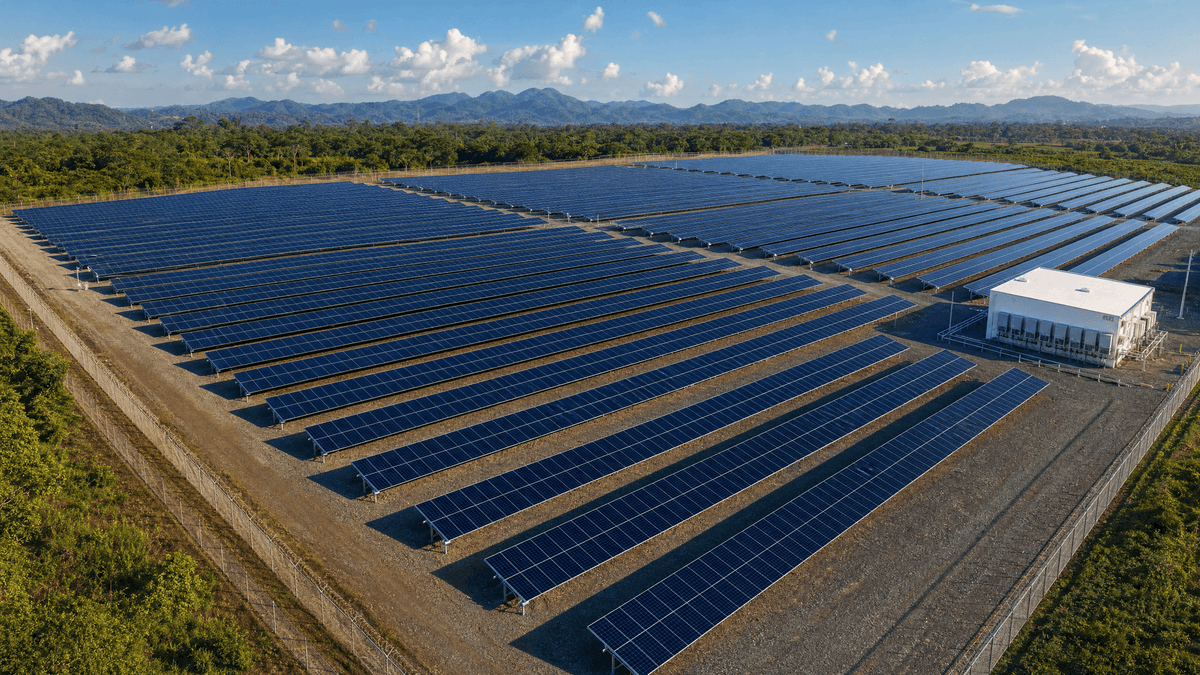
A Panama City utility-scale Solar PV System in the 5-50MW class would typically fit a 9.1MW ground-mount layout because the specified design uses 14,676 HJT panels at 620W each for 9.098MW DC.
- Panama City sits near 8.98°N, -79.52°W, and the recommended design basis uses 4.5 kWh/m²/day solar irradiance with single-axis tracking for about 25% higher yield than fixed-tilt layouts.
- A typical utility configuration for this market profile would use 14,676 × 620W HJT modules, reaching 9.098MW DC with 26% module efficiency and 0.3%/year degradation.
- The specified plant architecture uses central inverters with 98% CEC efficiency, a DC/AC ratio of 1.15, and 35kV step-up interconnection, which matches the 5-50MW utility-small design class.
- With total modeled system losses of about 14%—including 2% soiling, 3% shading, 2% mismatch, 3% wiring, and 3% availability—annual output is approximately 16,065,991 kWh.
- The recommended tracker geometry is 30° tilt on a single-axis tracking ground-mount structure, which is suitable for utility-scale open land near Panama City where land-use and substation access permit.
- Expected environmental benefit is about 6,748 tons of CO₂ reduction per year, equivalent to roughly 303,660 trees, assuming the stated generation and grid displacement factor.
- Warranty coverage in this configuration is 25 years for panels and 5 years for central inverters, with an overall project life of 30 years under IEC 61215 and IEC 61730 compliance.
- For Panama City buyers comparing options, SOLAR TODO should generally position this as a utility-scale Solar PV System, not a rooftop C&I package, because 9.1MW exceeds the 500kW-5MW industrial range.
Market Context for Panama City
Panama City’s electricity demand profile, urban concentration, and transmission access make utility-scale solar more relevant than small rooftop-only strategies when the target is multi-gigawatt-hour annual generation.
Panama City is the country’s largest urban center and the anchor of the Panamá province economy. According to the World Bank (2023), Panama remains one of Latin America’s more urbanized economies, with urban population above 68% of the national total. According to the International Trade Administration (2024), Panama’s population is about 4.5 million, with economic activity concentrated around Panama City, logistics, commerce, and services. That concentration matters because grid-connected generation near major load centers can reduce dependence on thermal peaking during high-demand periods.
Solar resource is commercially usable in the Panama City region, even though the isthmus has a humid tropical climate and a pronounced rainy season. According to the World Bank Global Solar Atlas (2024), much of Panama records photovoltaic potential in the range that supports utility-scale deployment, and this guide uses the project-specific basis of 4.5 kWh/m²/day irradiance. According to IRENA (2023), solar PV remains one of the lowest-cost new-build generation technologies in many markets, especially where daytime commercial demand aligns with solar output.
Grid integration is the key technical filter. Panama’s national transmission backbone is operated by ETESA, and utility-scale generators commonly interconnect through medium- or high-voltage substations depending on plant size and location. According to ETESA planning documents and grid maps, 230kV and 115kV transmission corridors structure bulk power movement, while distribution and sub-transmission networks support local evacuation. For a 9.1MW solar plant, the practical recommendation is usually a 35kV collection and step-up arrangement before substation delivery, which aligns with the product architecture rule for the 5-50MW utility-small class.
Climate also affects mechanical and O&M assumptions. Panama City receives substantial rainfall, high humidity, and seasonal cloud cover, so system design should price in losses rather than assume dry-climate performance. In this configuration, total losses are modeled at about 14%, including 2% soiling and 3% availability. According to NREL (2024), realistic loss accounting is essential because energy models that omit wiring, mismatch, and downtime can materially overstate first-year yield.
For land use, a utility-scale plant of 9.1MW would generally require open land outside dense urban districts, with access roads, drainage planning, and proximity to a suitable interconnection point. Panama City proper is land-constrained, so a market-appropriate recommendation would usually target the greater metropolitan periphery or industrial-adjacent land parcels rather than central urban rooftops. SOLAR TODO should therefore frame this offer as a utility power asset for Panama City load support, not as a city-center rooftop package.
Two authority statements help define the compliance baseline. IEC states, "IEC 61215 specifies the requirements for the design qualification and type approval of terrestrial photovoltaic modules suitable for long-term operation in general open-air climates." IEC also states, "IEC 61730 addresses the fundamental construction requirements for photovoltaic modules in order to provide safe electrical and mechanical operation." Those two standards are directly relevant to the specified HJT module package.
Recommended Technical Configuration
For Panama City’s load concentration and grid structure, the technically correct fit is a 5-50MW utility-small Solar PV System, and the specified 9.1MW design sits squarely inside that class.
A typical deployment of this scale in the Panama City market would consist of approximately 14,676 HJT photovoltaic modules, each rated at 620W, for a total DC capacity of 9.098MW. Because the project-specific configuration already defines single-axis tracking, 30° tilt, and central inverter architecture, the recommendation should remain utility-grade and avoid string-only C&I layouts. This is important because a 9.1MW plant requires coordinated DC collection, inverter blocks, step-up transformation, and substation-level protection.
The recommended array uses single-axis tracking, which is modeled here to increase yield by about 25% relative to a fixed structure under the same irradiance basis. In Panama’s tropical profile, tracking can improve morning and afternoon capture, especially when commercial and municipal demand extends across daylight hours. According to NREL (2023), tracker systems often improve annual energy production materially in suitable solar resource zones, but the gain depends on diffuse fraction, terrain, and row spacing. For this guide, the specified uplift remains 25% because that is the project design basis.
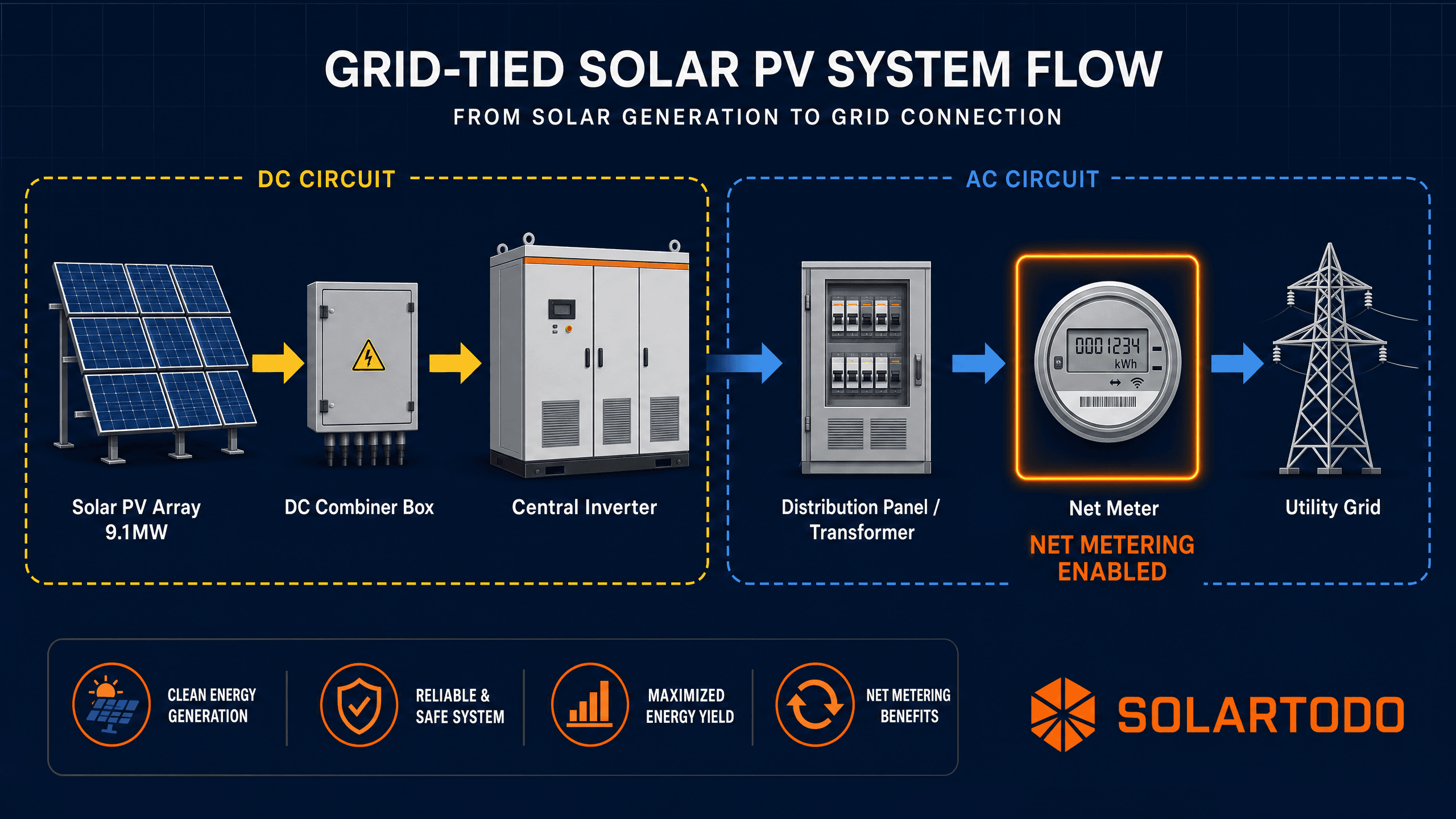
On the inverter side, the specified configuration uses central inverters with 98% CEC efficiency and a 5-year warranty. For a DC/AC ratio of 1.15, the implied AC capacity is about 7.91MW, which is consistent with utility-scale clipping management and land-use optimization. A central inverter architecture is appropriate here because the project belongs to the utility class above 5MW; using a small commercial string-inverter topology would be a mismatch for procurement, SCADA, and maintenance planning.
Interconnection should typically step from low-voltage inverter output to 35kV for collection and grid delivery. This recommendation follows the product architecture guidance for 5-50MW, which specifies inverters + 35kV step-up + grid sub-station. In Panama City, the final point of interconnection would still depend on ETESA or local utility studies, short-circuit capacity, and available feeder headroom. SOLAR TODO should therefore present 35kV as the baseline engineering assumption pending utility approval.
Site design should also account for drainage, corrosion exposure, and maintenance access. Panama’s humidity and rainfall make galvanized steel support structures, cable routing discipline, and inverter pad elevation important. A typical utility layout at 9.1MW would also include perimeter fencing, internal service roads, weather stations, SCADA, protection relays, and revenue metering. According to IEA PVPS (2023), balance-of-system quality strongly affects actual plant availability over a 25-30 year operating horizon.
For buyers reviewing alternatives, SOLAR TODO can position this configuration as a better fit than a rooftop commercial system when annual energy demand exceeds 10 GWh and available land plus interconnection support utility-scale economics. For buyers with smaller loads below 5MW, a C&I rooftop or carport design would usually be more appropriate. The size class matters because inverter architecture, transformer sizing, and permitting all change once the project passes the 5MW threshold.
Technical Specifications
The specified Panama City utility configuration is a 9.1MW ground-mount Solar PV System with 14,676 HJT 620W modules, 30° single-axis tracking, 14% modeled losses, and annual output of about 16.07GWh.
- System type: Grid-tied utility-scale ground-mount Solar PV System
- Recommended size class: 5-50MW utility small
- Installed DC capacity: 9.098MW from 14,676 × 620W HJT modules
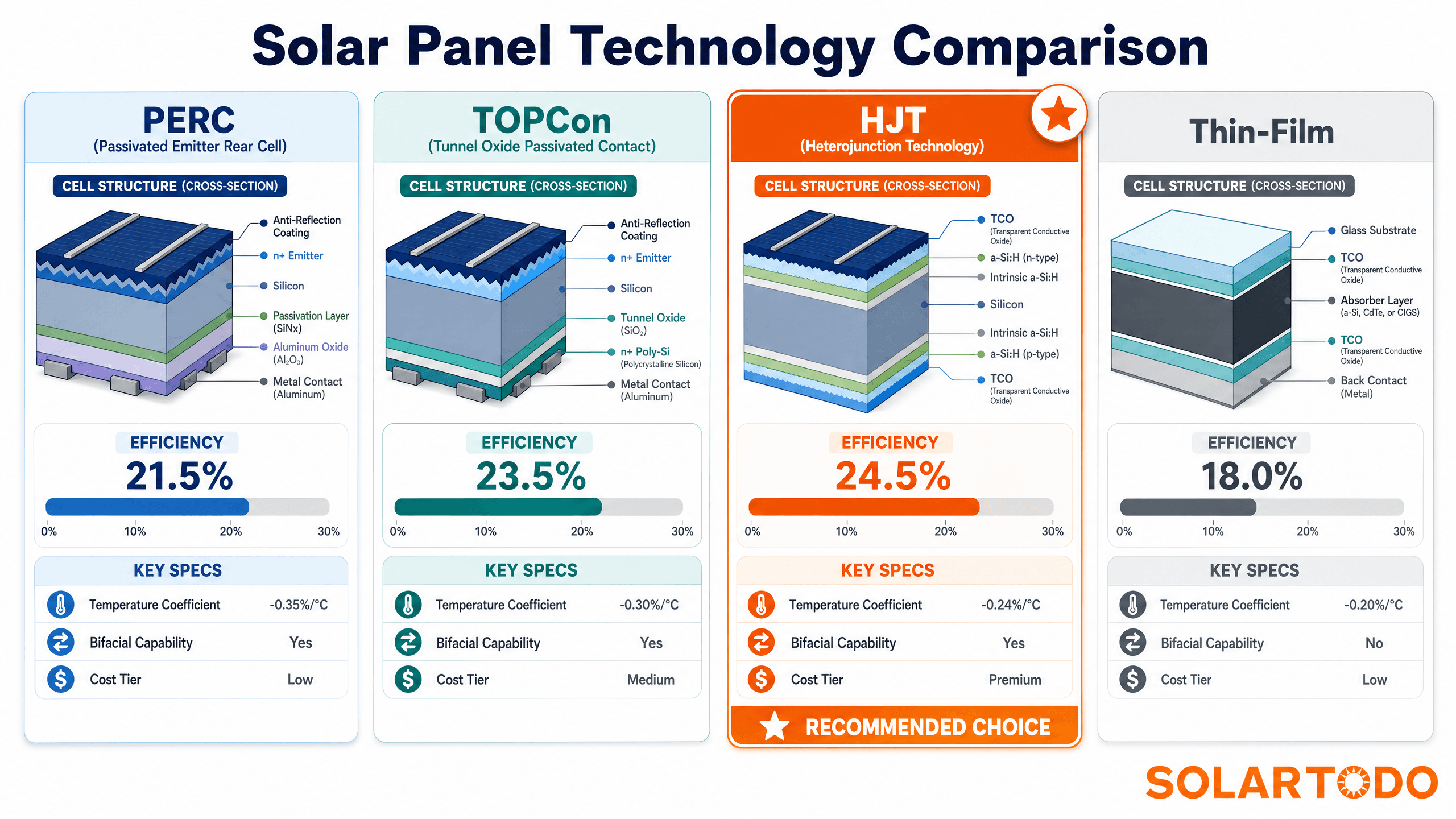
- Module technology: HJT, 26% efficiency
- Module degradation: 0.3%/year
- Panel warranty: 25 years
- Inverter architecture: Central inverter
- Inverter efficiency: 98% CEC efficiency
- Inverter warranty: 5 years
- Mounting type: Ground-mount, single-axis tracking
- Tracker performance assumption: +25% yield versus fixed-tilt baseline
- Array tilt: 30°
- DC/AC ratio: 1.15
- Approximate AC capacity: 7.91MW
- Irradiance basis: 4.5 kWh/m²/day
- Modeled system losses: ~14% total
- Loss breakdown: 2% soiling + 3% shading + 2% mismatch + 3% wiring + 3% availability
- Annual energy yield: ~16,065,991 kWh
- Estimated CO₂ reduction: ~6,748 tons/year
- Tree-equivalent impact: ~303,660 trees
- Project life: 30 years
- Grid connection recommendation: LV collection to 35kV step-up and grid sub-station
- Applicable standards: IEC 61215, IEC 61730
Implementation Approach
A Panama City utility-scale Solar PV System of 9.1MW would typically be implemented in 5 phases over roughly 8-14 months, depending on permitting, land readiness, and utility interconnection lead times.
Phase 1 is feasibility and grid study. This usually includes topographic survey, geotechnical review, solar resource validation, drainage study, and preliminary interconnection screening at 35kV. For a 9.1MW plant, developers should expect utility review of feeder capacity, fault levels, and protection coordination. According to the World Bank (2023), grid connection procedures and permitting timelines remain material schedule drivers across emerging-market infrastructure projects.
Phase 2 is detailed engineering and procurement. At this stage, the bill of materials is locked around 14,676 modules, central inverter blocks, trackers, combiner systems, transformers, SCADA, and protection panels. Procurement should also specify IEC documentation, factory test certificates, and warranty terms of 25 years for modules and 5 years for inverters. SOLAR TODO would typically support buyers here with technical submittals through the product page and commercial coordination through contact us.
Phase 3 is civil works and site preparation. Utility-scale ground-mount projects in tropical climates need grading, drainage channels, equipment pads, internal roads, and pile or foundation installation. In the Panama City region, rainfall management is not optional because standing water can affect access roads, cable trenches, and inverter pads within the first 12 months of operation. Designs should therefore include stormwater control and corrosion-resistant hardware.
Phase 4 is mechanical and electrical installation. Tracker rows, module mounting, DC cabling, central inverter stations, transformers, and the 35kV interconnection package are installed in sequence. Quality checks should include torque verification, insulation resistance, IV curve testing, grounding continuity, and protection relay settings. According to IEEE guidance used across utility practice, commissioning documentation should verify equipment settings before energization to reduce nuisance trips and availability loss.
Phase 5 is commissioning and O&M handover. This includes SCADA verification, performance ratio checks, tracker calibration, meter sealing, and utility witness testing. For a 9.1MW plant, the owner should also establish preventive maintenance intervals, spare parts strategy, and vegetation management plans. According to IEA PVPS (2023), long-term plant performance depends as much on O&M discipline as on module nameplate ratings.
Expected Performance & ROI
Under the stated 4.5 kWh/m²/day irradiance and 14% total losses, the 9.1MW configuration is expected to generate about 16,065,991 kWh per year with a 30-year operating horizon.
The first-year energy estimate of 16,065,991 kWh is the main commercial anchor for Panama City buyers. That level of output can support utility offtake, private wire supply for industrial loads, or a hybrid merchant/PPA structure, depending on local regulation. With 0.3%/year module degradation, energy production remains comparatively stable over the long term relative to older PV technologies with higher annual decline rates.
ROI depends on land cost, interconnection distance, financing, tax treatment, and offtake tariff, so a single payback number would be misleading without a project model. Still, according to IRENA (2023), utility-scale solar continues to show strong lifecycle economics because fuel cost is effectively 0 after commissioning, and O&M is usually low relative to thermal generation. For Panama City buyers, the largest ROI variables are usually connection scope at 35kV, tracker maintenance strategy, and curtailment risk.
A useful benchmark is capacity factor implied by annual generation. Using about 7.91MW AC and 16.07GWh/year, the effective AC-side capacity factor is roughly 23%, which is a reasonable modeled range for a tracker-based tropical utility plant under the stated assumptions. According to NREL (2024), buyers should compare modeled yield using consistent weather files, loss assumptions, and DC/AC ratios rather than headline MW alone.
Environmental performance is also material for public tenders and ESG reporting. The stated annual displacement of about 6,748 tons of CO₂ can support decarbonization reporting for utilities, ports, logistics operators, and industrial offtakers in the Panama City area. For organizations with Scope 2 targets, annual renewable generation above 16GWh is large enough to matter at board level, especially in energy-intensive facilities.
For maintenance, buyers should budget for tracker inspection, vegetation control, module cleaning, inverter service, thermography, and spare parts. In Panama’s humid environment, connector integrity and corrosion checks should be scheduled at least annually, with more frequent visual inspections in the rainy season. SOLAR TODO should emphasize that lifecycle value depends on availability staying close to the modeled 97% assumption implied by the 3% availability loss factor.
Results and Impact
For Panama City demand support, a 9.1MW Solar PV System would typically deliver around 16.07GWh annually, reduce grid emissions by about 6,748 tons of CO₂ per year, and create a 30-year renewable generation asset tied to 35kV interconnection.
The main infrastructure challenge in Panama City is not whether solar works; it is how to add meaningful daytime generation near a dense urban and logistics economy without relying only on small rooftop systems. A utility-scale 9.1MW configuration answers that by placing generation in the correct size class, with 35kV evacuation, central inverters, and tracker-based yield improvement. That makes it suitable for utility procurement, private offtake, or industrial decarbonization programs where annual energy demand exceeds 10GWh.
From a technical standpoint, the specified design balances energy density and bankability. 26% HJT modules, 98% CEC inverter efficiency, 0.3%/year degradation, and 25-year module warranty terms support long-life operation. For Panama City buyers comparing proposals, this is the level of detail needed to evaluate whether a Solar PV System is correctly sized and correctly configured, rather than simply low on headline capex. SOLAR TODO should keep that framing consistent across bid documents and advisory discussions.
Comparison Table
For Panama City buyers, the most useful comparison is between the recommended 9.1MW utility configuration and smaller commercial alternatives that use different inverter and interconnection architectures.
| Metric | Recommended Utility Solar PV System | Mid Commercial Alternative | C&I / Industrial Alternative |
|---|---|---|---|
| Size class | 5-50MW | 100-500kW | 500kW-5MW |
| Example capacity | 9.1MW DC | 300kW DC | 3MW DC |
| Mounting | Ground-mount tracker | Rooftop or ground fixed | Large rooftop or land |
| Module count basis | 14,676 × 620W | ~484 × 620W | ~4,839 × 620W |
| Inverter type | Central inverter | String or small central | Multiple inverters |
| DC/AC ratio | 1.15 | 1.05-1.15 typical | 1.10-1.20 typical |
| Grid interface | LV to 35kV step-up + substation | LV service connection | LV to 10/35kV step-up |
| Annual yield basis in this guide | 16,065,991 kWh | Site-specific | Site-specific |
| Best fit in Panama City | Utility supply / large offtake | Small facility loads | Industrial campuses |
| Warranty profile in this specified design | 25-year panel / 5-year inverter | Varies by OEM | Varies by OEM |
Pricing & Quotation
SOLAR TODO offers three pricing tiers for this product line: FOB Supply (equipment ex-works China), CIF Delivered (including ocean freight and insurance), and EPC Turnkey (fully installed, commissioned, with 1-year warranty). Volume discounts are available for large-scale deployments. Configure your system online for an instant estimate, or request a custom quotation from our engineering team at [email protected].
Frequently Asked Questions
This FAQ answers the main technical, commercial, and delivery questions Panama City buyers ask when evaluating a 9.1MW utility-scale Solar PV System.
Q1: Is 9.1MW the right size class for Panama City?
Yes, for utility or very large private offtake, 9.1MW fits the 5-50MW utility-small class. It is too large for normal rooftop commercial architecture and should use ground-mount layout, central inverters, and 35kV step-up interconnection. That structure matches Panama City’s need for multi-gigawatt-hour annual generation rather than small behind-the-meter savings only.
Q2: What are the core module specifications in this configuration?
The specified design uses 14,676 HJT modules, each rated at 620W with 26% efficiency and 0.3%/year degradation. Total DC capacity is 9.098MW. Module warranty is 25 years, and the compliance baseline is IEC 61215 and IEC 61730, which are standard references for long-term PV performance and safety.
Q3: Why use central inverters instead of string inverters?
At 9.1MW, central inverters are usually more appropriate because they simplify block design, utility interconnection, and maintenance planning at scale. The specified central inverter has 98% CEC efficiency and a 5-year warranty. For smaller systems below 5MW, multiple string inverters may still be practical, but this project size belongs in utility architecture.
Q4: How much electricity can this system generate each year?
Using the stated irradiance of 4.5 kWh/m²/day, single-axis tracking, and 14% total system losses, annual output is modeled at about 16,065,991 kWh. Actual generation will still depend on final site conditions, curtailment, and weather variability. Buyers should request a full energy model with loss tree and weather-file basis before final procurement.
Q5: What is the expected deployment timeline?
A typical timeline for a 9.1MW utility plant is about 8-14 months from feasibility to commissioning. Grid studies, land readiness, and permitting often control the schedule more than module delivery does. In Panama City, interconnection review, drainage design, and rainy-season construction planning can each add several weeks if not addressed early.
Q6: What maintenance does a utility-scale Solar PV System need?
Typical O&M includes tracker inspection, vegetation control, module cleaning, thermography, inverter service, cable checks, and revenue-meter verification. In Panama’s humid climate, corrosion inspection and drainage management are important. The design already assumes about 3% availability loss, so maintenance planning should aim to keep real availability close to 97% or better.
Q7: What payback period should buyers expect?
Payback cannot be stated accurately without tariff, financing, land cost, tax treatment, and interconnection scope. For Panama City, the biggest commercial drivers are usually the offtake price per kWh, distance to the 35kV connection point, and whether the project uses a PPA or self-consumption structure. A bankable model should include 30-year energy output and 0.3%/year degradation.
Q8: How does single-axis tracking affect performance?
In this specified configuration, single-axis tracking is modeled to improve yield by about 25% compared with a fixed-tilt baseline. That can be valuable in Panama because it increases energy capture across more daylight hours. The tradeoff is higher mechanical complexity, so buyers should review actuator maintenance, spare parts, and wind stow logic during procurement.
Q9: What warranties apply to this system?
The specified warranty profile is 25 years for panels and 5 years for central inverters. Buyers should also request warranty terms for trackers, transformers, combiner equipment, and SCADA components because total plant reliability depends on the full balance of system. Warranty documents should clearly define exclusions, response times, and performance claim procedures.
Q10: Can this system support ESG or decarbonization targets?
Yes. Based on the stated annual generation, the configuration is expected to reduce emissions by about 6,748 tons of CO₂ per year, equivalent to roughly 303,660 trees. For Panama City logistics, port-adjacent, and industrial operators, that scale can materially support Scope 2 reduction targets and renewable electricity reporting across a 30-year asset life.
References
- World Bank (2023): Panama urbanization and macro infrastructure indicators used to frame electricity demand concentration near Panama City.
- International Trade Administration (2024): Panama country commercial overview noting population scale, logistics concentration, and infrastructure investment context.
- World Bank Global Solar Atlas (2024): Solar resource mapping and photovoltaic potential data relevant to Panama and the Panama City region.
- IRENA (2023): Renewable Power Generation Costs and market evidence showing utility-scale solar PV remains cost-competitive in many regions.
- NREL (2024): PV performance modeling guidance and loss accounting practices for utility-scale solar energy estimates.
- IEA PVPS (2023): Operational performance and O&M guidance for PV power plants over long asset lives.
- IEC (2021): IEC 61215 photovoltaic module design qualification and type approval requirements.
- IEC (2023): IEC 61730 photovoltaic module safety qualification requirements.
- ETESA (latest available planning documents): Panama transmission network and system planning references relevant to substation and interconnection screening.
Equipment Deployed
- 14,676 × HJT photovoltaic modules, 620W each, 26% efficiency, 0.3%/yr degradation
- Ground-mount single-axis tracking structure, 30° tilt, modeled +25% yield
- Central inverter system, 98% CEC efficiency, 5-year warranty
- DC collection and combiner infrastructure for 9.098MW DC plant architecture
- LV to 35kV step-up transformer and grid sub-station interconnection package
- SCADA, revenue metering, protection relays, and monitoring equipment
- AC distribution equipment and plant-level switchgear
- Grounding, lightning protection, and balance-of-system cabling
- Perimeter fencing, access roads, and drainage-support civil works
- 25-year panel warranty documentation and IEC 61215 / IEC 61730 compliance package