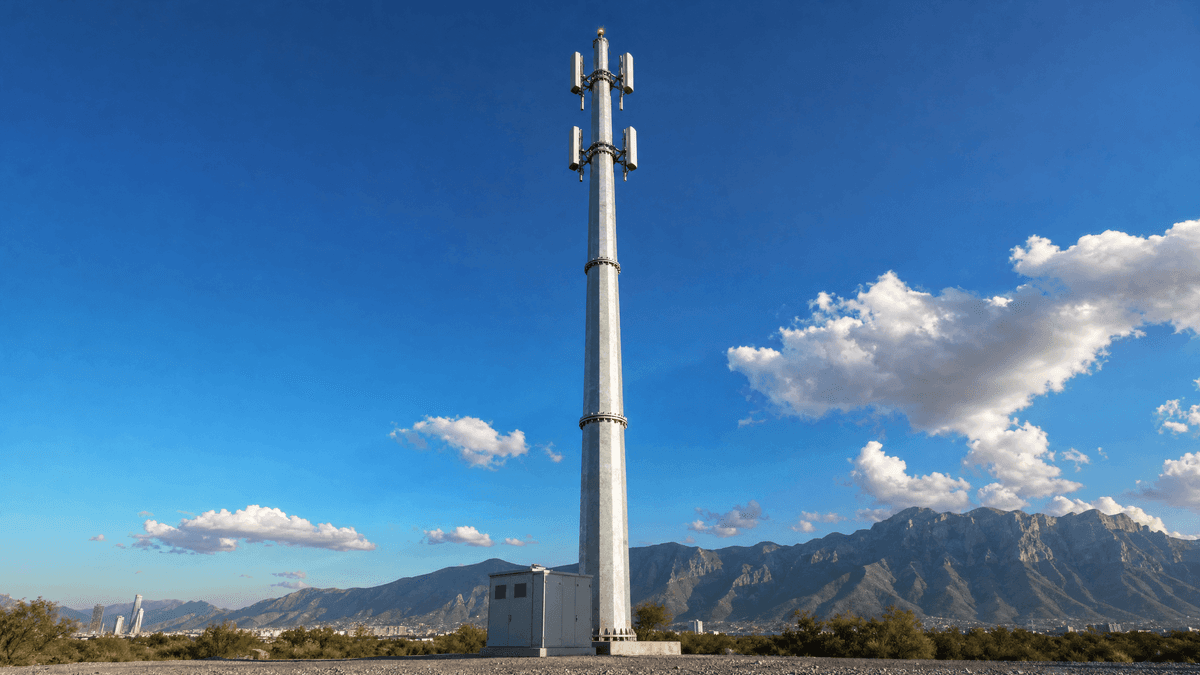
Monterrey Telecom Tower Market Analysis: 30m Steel Monopole Configuration for Regional Macro Coverage
Summary
Monterrey’s metro area exceeds 5 million residents, while Mexico’s mobile broadband base is above 110 million connections; for suburban and peri-urban coverage, a typical 16-unit plan would fit 30m steel monopoles, 40 m/s wind class, and pile foundations under TIA-222-H.
Key Takeaways
- Monterrey’s metropolitan population is approximately 5.3 million, which supports continued demand for macro-cell densification across residential, industrial, and highway corridors according to INEGI (2020).
- Mexico records more than 110 million mobile broadband subscriptions, indicating sustained need for 4G/5G backhaul and coverage infrastructure according to the World Bank (2023) and IFT (2024).
- For Monterrey’s suburban and regional macro profile, the correct telecom tower size class is 25-35m, matching a 30m monopole with about 15t steel weight per tower.
- A typical 16-unit deployment of this scale would use 30m tapered hot-dip galvanized Q345 steel monopoles with 6 panel antennas and 2 microwave dishes per tower.
- The specified wind rating is Class 1 at 40 m/s with factor 1.0 under TIA-222-H, which aligns with a lower extreme-wind inland profile than Mexico’s cyclone-prone coastal zones.
- Pile foundations are the recommended base solution where variable urban fill, industrial soils, or narrow rights-of-way limit large pad excavation; this configuration is specified for all 16 units.
- CKD sectional shipping can reduce transport volume by about 60-70%, which is relevant for port-to-inland logistics into Nuevo León and staged site delivery.
- A standard production window for approximately 16 units is 30-45 days, while the design life is 30 years with galvanization, grounding, lightning protection, and annual structural inspection.
Market Context for Monterrey
Monterrey combines a metro population of roughly 5.3 million with one of Mexico’s strongest industrial logistics corridors, making 30m macro telecom towers relevant for coverage continuity, microwave backhaul, and enterprise traffic concentration. According to INEGI (2020), the Monterrey metropolitan area is among the country’s largest urban regions, and according to the World Bank (2023), Mexico has mobile cellular subscriptions above 90 per 100 people and mobile broadband connections above 110 million.
This matters because tower selection in Monterrey is not only a population question; it is also a terrain, zoning, and transport question. The city sits near 25.67, -100.32 at the foothills of the Sierra Madre Oriental, with dense urban districts, industrial parks, ring roads, and peri-urban expansion corridors that often require line-of-sight backhaul over mixed building heights. For that reason, a steel monopole in the 25-35m class is usually a better fit than a shorter urban infill pole when the goal is wider sector coverage plus microwave support.
According to the Instituto Federal de Telecomunicaciones, or IFT (2024), mobile data demand in Mexico continues to rise with broader 4G usage and ongoing 5G rollout in major cities. Monterrey is a priority market because it concentrates manufacturing, logistics, universities, and cross-border business traffic within a relatively compact but infrastructure-intensive footprint. A tower designed for 6 panel antennas and 2 microwave dishes matches this profile better than a rural single-tier arrangement.
Climate and wind loading also shape the recommended specification. Monterrey has hot summers, periodic intense rainfall, and thunderstorm activity, but it is inland and does not face the same cyclone exposure as Gulf or Pacific coastal sites. Based on this inland exposure profile, Wind Class 1 at 40 m/s under TIA-222-H is a practical baseline for many non-coastal locations, subject to final site-specific wind verification and geotechnical review.
According to TIA (2022), telecommunications structures should be designed using site-specific wind, ice, topographic, and exposure conditions rather than generic assumptions. TIA states, "This Standard provides minimum requirements for antenna supporting structures and antennas." That matters in Monterrey because industrial estates, elevated road corridors, and hillside-adjacent parcels can change exposure category and overturning demand even within a 10-15 km radius.
The local construction environment also supports sectional steel monopoles rather than bulky welded one-piece transport. Nuevo León’s industrial base can handle crane access, anchor cage placement, and concrete work, but urban permits and transport windows still reward compact logistics. A CKD tower package that reduces shipping volume by 60-70% is therefore commercially relevant for Monterrey procurement teams comparing inland freight efficiency and site staging.
Recommended Technical Configuration
For Monterrey’s suburban, industrial-edge, and highway-linked coverage profile, a 30m steel monopole in the 25-35m size class is the most technically consistent choice for a typical 16-unit macro deployment. This height fits the product engineering table, supports 2-3 platforms, and is suitable for 6-9 panel antennas with microwave loading in residential and peri-urban service areas.
A typical 16-unit deployment of this scale would consist of SOLAR TODO Telecom Tower monopoles fabricated as tapered steel tubes rather than lattice towers. The specified configuration is 16 units × 30m tapered steel monopole tower, hot-dip galvanized Q345 steel, with a tower weight of approximately 15t per unit using the 500 kg/m engineering rule. That weight is internally consistent with telecom monopole practice and avoids the common market error of overstating steel tonnage.
For antenna loading, the required configuration is 6× panel antenna + 2× microwave dish per tower. This is a backhaul-focused suburban arrangement and is well suited to Monterrey where enterprise parks, arterial roads, and low-rise residential districts often need both sector coverage and point-to-point or ring backhaul resilience. In practical terms, this loadout supports macro radio layers while preserving tower-top utility for microwave routing across obstructed corridors.
The foundation type specified for this configuration is pile foundation. That is a reasonable recommendation in Monterrey where some sites may include variable fill, industrially modified ground, constrained footprints, or differential bearing conditions that make deep load transfer preferable to large shallow pads. Final pile depth and reinforcement would still depend on geotechnical boreholes, groundwater conditions, and overturning calculations under TIA-222-H and GB/T 50233.
The structural and accessory package should include climbing ladder, cable tray, aircraft warning light, grounding system, lightning rod, 3 antenna platforms, and safety cage. For design life, 30 years is the target with low corrosion-zone assumptions, which aligns with inland galvanized steel service conditions if coating thickness, drainage details, and annual inspection are maintained. SOLAR TODO should be evaluated here as a telecom structure supplier rather than as a generic steel fabricator, because antenna load path, flange tolerance, and platform geometry matter as much as raw steel grade.
According to ITU (2023), expanding broadband infrastructure depends on both radio access and transmission readiness, not only subscriber demand. ITU states, "Meaningful connectivity requires more than coverage alone." In Monterrey, that supports the use of 2 microwave dishes per monopole where fiber is incomplete, delayed, or reserved for priority corridors.
Technical Specifications
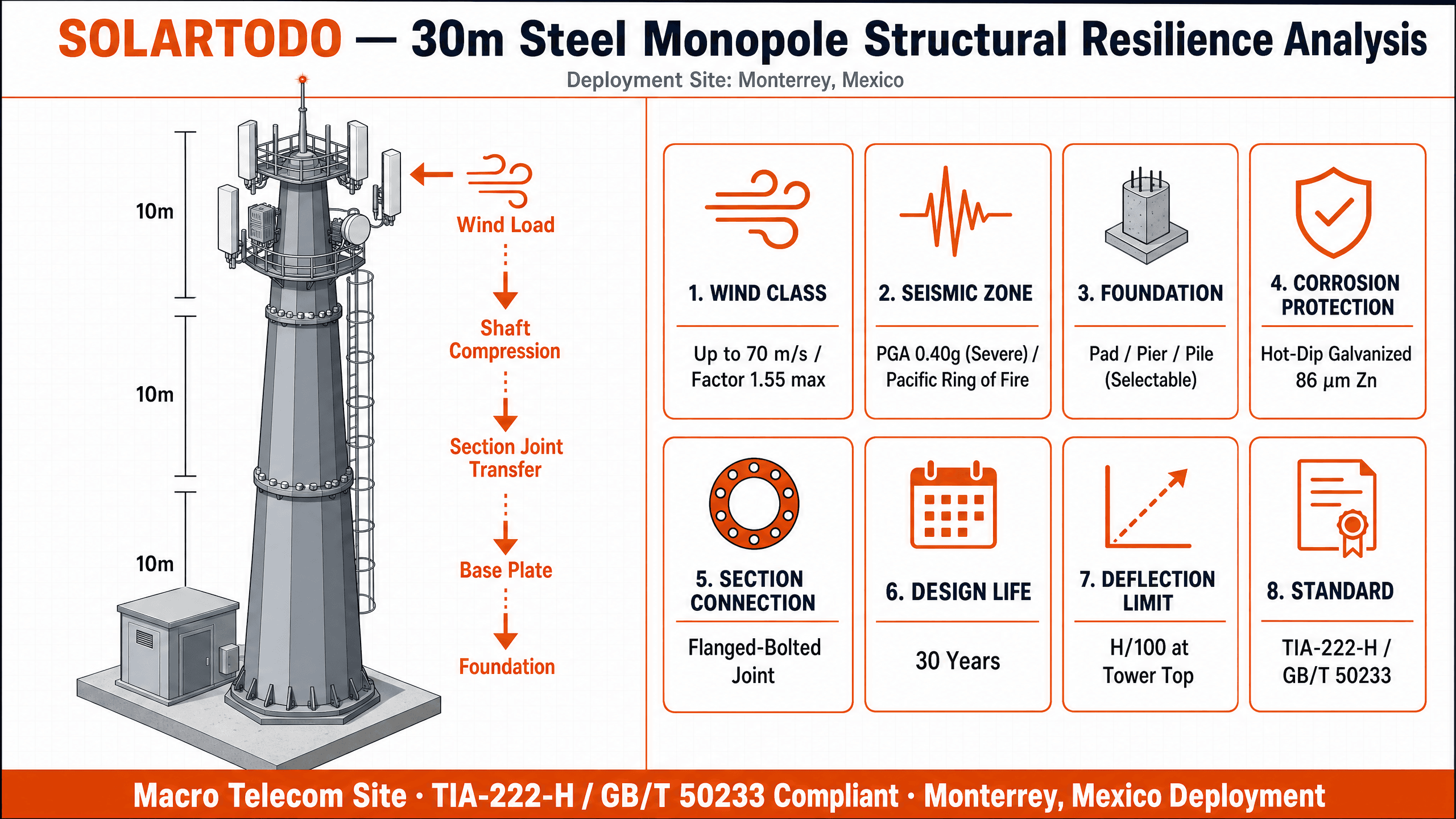
The specified Monterrey configuration is a 16-unit, 30m, 15t-per-tower steel monopole package with 6 panel antennas, 2 microwave dishes, pile foundations, and 30-year design life under TIA-222-H and GB/T 50233.
- Product type: SOLAR TODO Telecom Tower, steel monopole tower
- Deployment scale: approximately 16 units
- Tower height: 30m
- Size class match: 25-35m | suburban/residential | 2 platforms typical in standard table; this project-specific configuration uses 3 antenna platforms for higher operational flexibility
- Tower form: tapered steel monopole, sectional bolt-on design
- Steel grade: hot-dip galvanized Q345 steel
- Tower weight: approximately 15t per tower
- Weight rule check: 30m × 500 kg/m = 15,000 kg, consistent with telecom monopole design practice
- Pole class: regional macro / high-coverage tower
- Antenna load: 6× panel antenna + 2× microwave dish
- Wind class: Class 1
- Basic wind speed: 40 m/s
- Wind factor: 1.0
- Corrosion zone: low
- Foundation type: pile foundation
- Connection style: flanged sectional connection for transportable 30m sections
- Accessories: climbing ladder, cable tray, aircraft warning light, grounding system, lightning rod, 3 antenna platforms, safety cage
- Design life: 30 years
- Shipping mode: CKD, with 60-70% volume reduction versus fully assembled transport
- Production lead time: 30-45 days
- Applicable standards: TIA-222-H / GB/T 50233
According to IEC (2021), lightning protection and grounding performance must be coordinated with local earthing conditions and equipment sensitivity. For Monterrey sites with thunderstorm exposure, the specified lightning rod and grounding system should be treated as mandatory electrical protection items, not optional accessories.
Implementation Approach
A 16-unit Monterrey telecom tower program would typically move through 5 phases over roughly 12-24 weeks, depending on permit lead times, geotechnical access, and utility coordination. The standard sequence is site survey, structural and soil design, factory production, CKD logistics, then foundation and erection followed by antenna and transmission integration.
Phase 1 is site validation. Each site should receive topographic survey, borehole or dynamic probing, access-path review, and RF line-of-sight confirmation for the 2 microwave dishes. In Monterrey, this step is important because a 30m monopole can be structurally adequate yet still require azimuth or platform changes if nearby warehouses, ridgelines, or future building envelopes affect the backhaul path.
Phase 2 is engineering and permitting. This includes TIA-222-H structural calculations, foundation design for pile loads, grounding layout, aviation light review where required, and municipal permitting. According to the World Bank (2020), infrastructure delivery risk in Latin America often comes less from fabrication than from approvals and site readiness, so procurement teams should allow contingency for local permit sequencing.
Phase 3 is fabrication and logistics. For the specified configuration, production is typically 30-45 days. SOLAR TODO can supply the towers in CKD form, reducing shipping volume by 60-70%, which helps container utilization and inland trucking into Nuevo León. For 16 units at approximately 15t each, total structural steel is about 240t excluding foundation steel and concrete.
Phase 4 is civil work and erection. Pile foundations are installed first, then anchor systems, base flange alignment, grounding, and concrete curing verification. Tower sections are then erected by crane, flange bolts torqued to specification, verticality checked, and ladders, safety cage, cable tray, and 3 antenna platforms installed before RF equipment loading.
Phase 5 is commissioning and acceptance. This includes grounding resistance testing, bolt re-torque, galvanization touch-up where permitted, aviation light verification, antenna mounting inspection, and as-built documentation. According to IEEE (2023), grounding and lightning coordination are basic reliability requirements for telecom assets exposed to repeated surge events.
Expected Performance & ROI
A 30m monopole with 6 panel antennas and 2 microwave dishes can improve coverage continuity across suburban and industrial-edge zones while reducing dependence on rooftop lease variability and short-pole line-of-sight limitations. In Monterrey, the value case usually comes from wider service radius, improved backhaul resilience, and lower long-term maintenance complexity compared with multi-landlord rooftop portfolios.
From an operational perspective, monopoles often reduce visual footprint and simplify access versus lattice structures, especially on constrained parcels. A 30-year design life with hot-dip galvanization and low-corrosion assumptions can support lower lifecycle structural maintenance if annual inspections are performed and bolt, coating, and grounding issues are corrected early. According to NREL (2023), lifecycle cost planning should include preventive maintenance because deferred inspection increases total asset cost over time.
Sample deployment scenario (illustrative): if a carrier or tower company uses approximately 16 macro sites to close suburban coverage gaps and extend microwave backhaul, the ROI window often depends on tenancy, lease terms, and avoided rooftop renegotiation rather than on steel cost alone. In many Latin American tower portfolios, payback can fall in the roughly 4-8 year range when one anchor tenant is secured early and a second tenant is added later, but the exact result depends on land lease, power availability, and spectrum utilization. This is a market benchmark discussion, not a claim about a specific Monterrey project.
Maintenance planning is straightforward. A typical annual program includes 1 structural inspection, 1 grounding test cycle, 1 aviation light verification cycle, and post-storm checks after major wind or lightning events. For 16 towers, operators should budget for periodic bolt torque verification, coating inspection, cable tray checks, and microwave mount alignment review every 12 months.
Results and Impact
For Monterrey, the main impact of a 16-unit 30m monopole program would be broader macro coverage, stronger microwave backhaul optionality, and more predictable structural performance over a 30-year asset horizon. The configuration is especially relevant where industrial parks, ring roads, and suburban growth zones need taller support than rooftop poles but do not justify 40-45m highway-class structures.
The practical result is a balanced tower class: tall enough for regional macro and high-coverage use, but still within the 25-35m size class that keeps steel mass near 15t and transport manageable in CKD form. For buyers comparing alternatives, SOLAR TODO Telecom Tower packages should be assessed on section design, galvanization quality, flange accuracy, and standards compliance, not only nominal height.
Comparison Table
A 30m, 16-unit monopole package is the best fit for Monterrey when the requirement combines suburban macro coverage, 2 microwave dishes, and moderate inland wind loading at 40 m/s.
| Option | Height | Size class match | Typical load | Approx. steel weight | Foundation tendency | Fit for Monterrey |
|---|---|---|---|---|---|---|
| Short urban infill pole | 20-25m | 15-25m urban infill | 3-6 panels | 10-12.5t | Pad/pier | Too short for many microwave paths |
| Recommended SOLAR TODO Telecom Tower | 30m | 25-35m suburban/residential | 6 panels + 2 microwave dishes | 15t | Pile | Best balance for suburban macro + backhaul |
| Taller peri-urban tower | 35m | 35-45m highway/peri-urban | 6-9 panels + 1-2 microwave | 17.5t | Pier/pile | Useful where terrain blockage is severe |
| Rural wide-coverage tower | 45m | 45-55m rural/wide coverage | 9-12 panels | 22.5t | Pile | Usually excessive for Monterrey urban edge parcels |
Pricing & Quotation
SOLAR TODO offers three pricing tiers for this product line: FOB Supply (equipment ex-works China), CIF Delivered (including ocean freight and insurance), and EPC Turnkey (fully installed, commissioned, with 1-year warranty). Volume discounts are available for large-scale deployments. Configure your system online for an instant estimate, or request a custom quotation from our engineering team at [email protected].
For Monterrey buyers, quotation accuracy depends on 4 variables: geotechnical data, municipal permit scope, antenna loading confirmation, and inland logistics from port to site. To compare offers correctly, request the tower GA drawing, foundation assumptions, galvanization specification, bolt grade, and standards list for each bid. Buyers can also review the Telecom Tower product page or contact us for project-specific documentation.
Frequently Asked Questions
A Monterrey telecom tower buyer usually needs answers on height, foundations, lead time, maintenance, ROI, warranty scope, and whether a 30m monopole is enough for 2 microwave dishes.
Q1: Why is 30m the recommended height for Monterrey instead of 25m or 40m?
A 30m height fits the 25-35m suburban/residential size class and matches the specified load of 6 panels plus 2 microwave dishes. In Monterrey, this gives better line-of-sight over low-rise development and industrial edges than 25m, while avoiding the extra steel, permitting complexity, and visual impact that often come with 40m structures.
Q2: Why use a monopole instead of a lattice tower in this market analysis?
The required product line is a steel monopole, and it suits Monterrey’s constrained urban and suburban parcels well. A monopole usually needs a smaller footprint, presents a simpler visual profile, and is easier to permit in built-up districts. For a 30m macro site with 6 panels and 2 microwave dishes, it is a practical structural format.
Q3: Is Wind Class 1 at 40 m/s enough for Monterrey?
For many inland Monterrey sites, 40 m/s under TIA-222-H is a reasonable baseline because the city is not in a coastal cyclone zone. However, final wind design must still be site-specific. Exposure category, topography, and hillside acceleration can change loads, so the structural engineer should verify local conditions before final approval.
Q4: Why are pile foundations specified for all 16 units?
Pile foundations are useful where site footprints are tight, surface soils are variable, or industrial fill reduces confidence in shallow bearing layers. Monterrey has mixed urban ground conditions, so piles can improve overturning resistance and settlement control for a 30m tower. Final pile diameter, depth, and reinforcement still depend on geotechnical testing.
Q5: What is the expected production and delivery timeline?
The specified production window is 30-45 days for the tower package. Total project duration is usually longer because survey, geotechnical work, permits, freight, civil works, and commissioning add time. For a 16-unit program, a realistic planning window is often 12-24 weeks, depending on permit sequencing and whether sites are released in parallel.
Q6: How much maintenance does a 30m telecom monopole need?
Maintenance is moderate and predictable. Operators typically perform 1 annual structural inspection, grounding tests, aviation light checks, and post-storm reviews. The main items are bolt torque, galvanization condition, ladder and platform integrity, cable tray condition, and microwave mount alignment. With routine inspection, a 30-year design life is achievable in a low-corrosion inland environment.
Q7: What kind of ROI or payback is typical for this tower class?
Payback depends on tenancy, lease terms, spectrum use, and whether the tower replaces rooftop leases or closes coverage gaps. As a market benchmark, macro telecom towers often target a roughly 4-8 year payback window when tenant loading improves over time. This is not a Monterrey project claim; it is a planning range used for early-stage evaluation.
Q8: Does the quotation include EPC and installation options?
Yes. The required quotation structure includes FOB Supply, CIF Delivered, and EPC Turnkey. Buyers should compare not only transport and installation scope, but also what the EPC package includes for foundation works, crane use, grounding tests, commissioning, and warranty. Scope clarity matters more than headline cost when comparing telecom tower bids.
Q9: What warranty terms should buyers expect?
The pricing section specifies EPC Turnkey with a 1-year warranty. Buyers should confirm whether the warranty covers structural fabrication defects, galvanization issues, missing accessories, erection defects, and commissioning-related faults. It is also useful to ask for excluded items such as third-party RF equipment, civil delays, or lightning damage beyond design assumptions.
Q10: Can this 30m tower support future tenant additions?
Possibly, but only if reserve capacity is included in the original structural design. The current specified load is 6 panel antennas plus 2 microwave dishes with 3 platforms. Any future tenant, heavier antenna, or larger dish should be checked through a structural amendment under TIA-222-H, including wind area, torsion, and foundation reserve calculations.
References
- INEGI (2020): Population and Housing Census data showing Monterrey metropolitan area scale and urban concentration in Nuevo León.
- Instituto Federal de Telecomunicaciones, IFT (2024): Mexico telecom market and mobile service indicators relevant to 4G/5G network expansion.
- World Bank (2023): World Development Indicators for Mexico mobile cellular subscriptions and digital connectivity benchmarks.
- TIA (2022): TIA-222-H, Structural Standard for Antenna Supporting Structures, Antennas and Small Wind Turbine Support Structures.
- IEC (2021): IEC guidance and related electrical protection principles for grounding, lightning protection, and equipment safety coordination.
- ITU (2023): Connectivity and broadband infrastructure guidance emphasizing transmission readiness and meaningful connectivity.
- IEEE (2023): Telecom site grounding and surge protection practice relevant to structural and electrical reliability.
- NREL (2023): Asset lifecycle and preventive maintenance guidance relevant to long-life infrastructure cost planning.
Equipment Deployed
- 16 × 30m tapered steel monopole Telecom Tower
- Hot-dip galvanized Q345 steel structure, approximately 15t per tower
- Wind Class 1 design, 40 m/s basic wind speed, factor 1.0
- Antenna load per tower: 6 × panel antenna + 2 × microwave dish
- Pile foundation system for each tower
- 3 antenna platforms per tower
- Climbing ladder and safety cage
- Cable tray system
- Aircraft warning light
- Grounding system and lightning rod
- Flanged sectional connection, CKD shipping with 60-70% volume reduction
- Design life: 30 years
- Standards: TIA-222-H / GB/T 50233
Further Reading
- Monterrey, Mexico Telecom Tower Deployment: 12×45m Steel Monopoles for 6 Panel Antennas and 2 Microwave Dishes
- Ankara Telecom Tower Market Analysis: 30m Steel Monopole Configuration for Urban Macro Coverage
- Sofia Telecom Tower Market Analysis: 35m Steel Monopole Configuration Guide for Urban Macro Coverage
- Monterrey, Mexico Telecom Tower Deployment: 12×45m Steel Monopoles for 6 Panel Antennas and 2 Microwave Dishes
- Ankara Telecom Tower Market Analysis: 30m Steel Monopole Configuration for Urban Macro Coverage