Mombasa Smart Agriculture Monitoring Market Analysis: 163-Hectare NB-IoT Configuration Guide
Summary
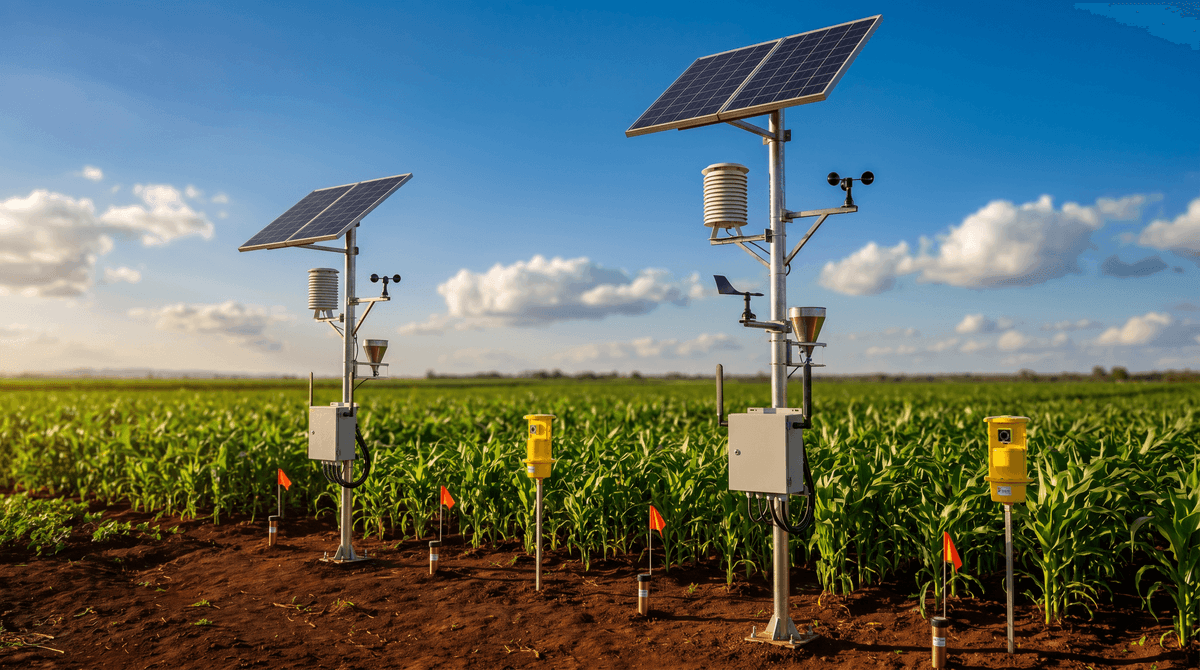
Mombasa’s warm coastal climate, bimodal rainfall, and fragmented peri-urban farming make a 163-hectare Smart Agriculture Monitoring deployment best suited to a medium-class layout: 2 weather stations, 17 soil probes, 11 AI pest cameras, and NB-IoT connectivity with solar-powered field nodes.
Key Takeaways
- A typical 163-hectare deployment in Mombasa fits the medium farm class (100-500 ha) and would use 2× 7-sensor weather stations plus 17× 7-parameter soil sensors.
- Based on the provided coverage model, 11× HD AI pest cameras at 3 ha per unit and 4× rodent smart traps provide practical surveillance density across high-risk crop zones.
- For disease pressure in humid coastal conditions, 2× spore capture units with AI microscopy are a suitable baseline for fungal early warning.
- The recommended communications layer is NB-IoT at 20-250 kbps, which matches low-bandwidth sensor payloads and carrier-backed coverage better than 4G video-heavy architecture for this scale.
- All field nodes can run on 30 W solar panels with 150 Wh batteries, supporting 10 W loads and reducing dependence on unstable edge-of-farm power access.
- Expected agronomic uplift from the specified stack is +3% from weather data, +8% from soil monitoring, +5% from pest monitoring, and +7% from disease alerts when paired with timely farm operations.
- The specified sensing stack aligns with WMO weather observation practice and ISO 11461 soil quality methodology, which matters for procurement review and agronomic data consistency.
- For buyers comparing options, SOLAR TODO should be assessed as a sensor-network and decision-support system, not as a generic weather station package, because the configuration combines 32+ field devices across climate, soil, pest, disease, and rodent monitoring.
Market Context for Mombasa
Mombasa’s agricultural monitoring demand is shaped by coastal heat, seasonal rainfall, and peri-urban land pressure, with county-scale farming requiring compact off-grid sensor networks rather than oversized large-estate architectures.
Mombasa County is Kenya’s smallest county by land area at about 229.7 km², but it supports intensive peri-urban and surrounding agricultural activity linked to food supply chains, horticulture, and livestock movement across the coastal corridor. According to the Kenya National Bureau of Statistics (2019), Mombasa County had a population of 1,208,333, which increases pressure on food logistics, water efficiency, and crop productivity near urban markets. For monitoring-system design, this means farms are often distributed, infrastructure access can be uneven, and compact telemetry layouts are more practical than heavy control-room architectures.
Climate is the second major design driver. According to the World Bank Climate Change Knowledge Portal (2021), Kenya’s coast experiences relatively high temperatures year-round, with mean temperatures commonly around 24°C to 31°C in lowland coastal zones. The Kenya Meteorological Department describes the coast as having a bimodal rainfall pattern, with long rains typically from March to May and short rains around October to December. In field terms, that combination raises the value of continuous weather logging, leaf wetness or disease-risk interpretation, and soil EC/pH tracking where irrigation and salinity management matter.
Humidity and disease pressure are especially relevant in Mombasa. According to FAO (2020), digital agriculture tools improve input efficiency and response timing when climate variability and pest pressure are high. Coastal environments are also more likely to require early fungal warning because warm, moist conditions can accelerate spore activity and crop disease spread within 24-72 hours after favorable weather windows. That is why a Mombasa recommendation should include disease sensing, not only weather and soil nodes.
Connectivity conditions also support carrier-based telemetry. According to the Communications Authority of Kenya (2023), Kenya’s mobile penetration remains above 100% by SIM subscriptions, and 3G/4G population coverage is extensive in urban and peri-urban corridors. For a 163-hectare farm profile, NB-IoT is a practical fit because sensor payloads are small, battery draw is lower than 4G video systems, and the architecture avoids the extra gateway layer required by LoRaWAN in some layouts. SOLAR TODO can therefore position NB-IoT as the default recommendation where carrier signal tests confirm acceptable field strength.
Recommended Technical Configuration
For a 163-hectare Mombasa farm profile, the recommended layout is a medium-class Smart Agriculture Monitoring system with approximately 36 field devices using NB-IoT and small solar power kits.
The product size table places 100-500 hectares in the medium category, which normally calls for 2-3 weather stations, 15-25 soil sensors, 2-3 pest units, 1-2 disease units, and a LoRaWAN backbone. However, the project-specific configuration provided here is more crop-protection intensive than the baseline medium template, which is reasonable in Mombasa’s humid coastal environment. A typical deployment of this scale would therefore consist of:
- approximately 2 units of 7-sensor weather station
- approximately 17 units of 7-parameter soil sensor
- approximately 11 units of HD camera trap with AI species identification
- approximately 2 units of spore capture with AI microscopy identification
- approximately 4 units of smart rodent trap with activity sensor
- NB-IoT communications for all nodes
- 30 W solar panel + 150 Wh battery small power kits across the field network
- basic cloud platform with dashboard, SMS alerts, and 30-day history
This configuration is technically coherent for 163 hectares. The 2 weather stations provide redundancy and microclimate contrast across coastal wind exposure, low-lying moisture zones, or different crop blocks. The 17 soil probes spread across irrigation sectors, soil texture changes, and root-zone management areas at 15-30 cm depth. The 11 AI pest cameras, each covering about 3 hectares, support targeted scouting rather than blanket overdeployment.
Disease monitoring should not be trimmed out in Mombasa. Two spore capture units create a practical early-warning layer for fungal pressure where humidity, rainfall transitions, and dense canopy conditions interact. The 4 rodent traps add another risk-control layer for high-value crops and storage-adjacent areas. SOLAR TODO should present this as a balanced monitoring stack: climate, root zone, insect pressure, disease pressure, and rodent activity in one cloud view.
According to the International Telecommunication Union (2020), LPWAN technologies such as NB-IoT are suitable for low-throughput agricultural sensing because they trade bandwidth for coverage stability and power efficiency. For this reason, NB-IoT is more appropriate here than a 4G LTE architecture, which is better reserved for large estates with heavier video traffic and control-room requirements. In Mombasa’s carrier-served corridor, a pre-install survey should verify RSSI and packet success before final node placement.
Technical Specifications
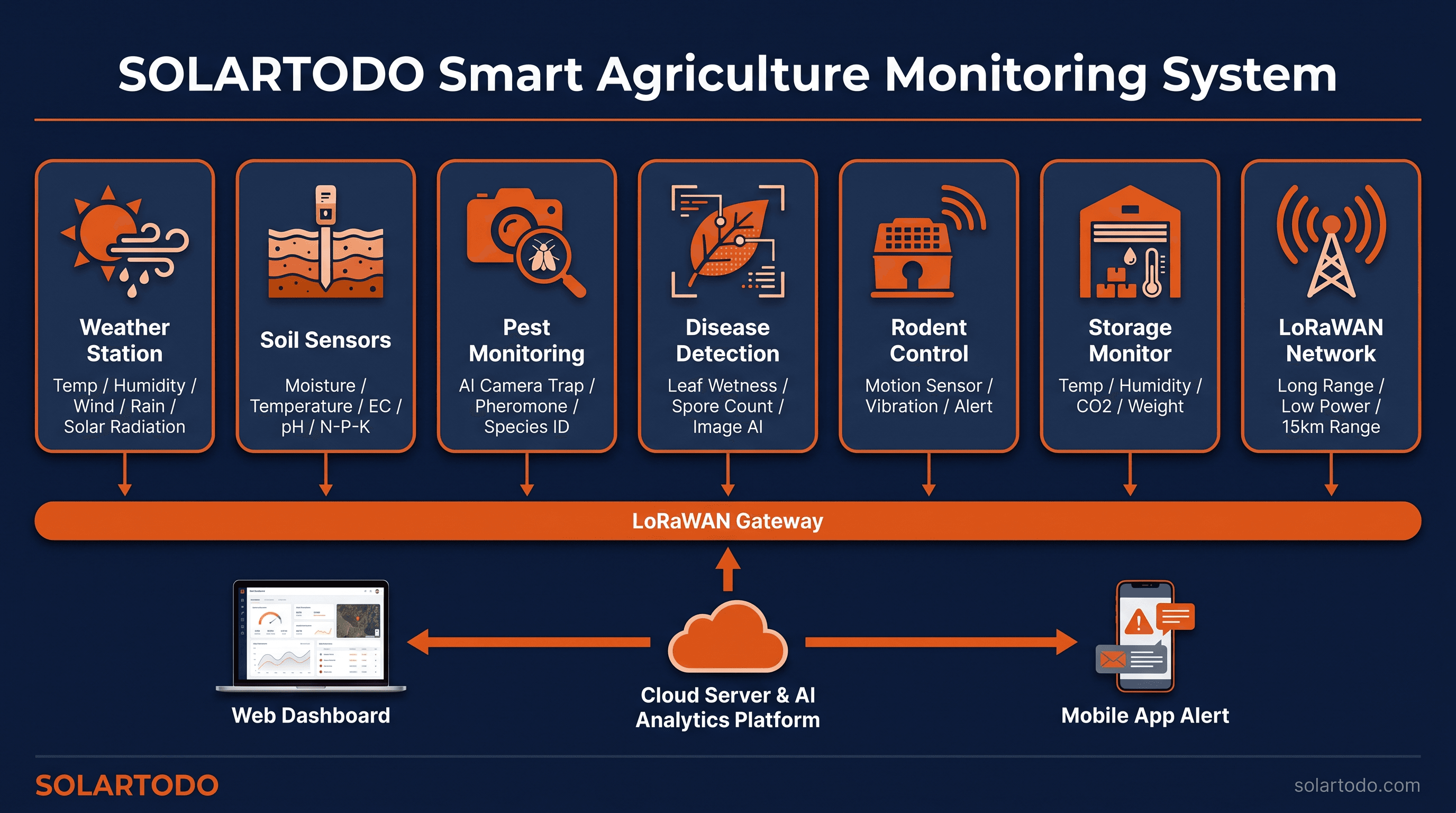
The specified Mombasa configuration uses 2 weather stations, 17 soil sensors, 11 AI pest cameras, 2 disease monitors, 4 rodent traps, NB-IoT communications, and 30 W/150 Wh solar kits under WMO and ISO 11461 data practices.
Core system specification
- Farm size class: 163 hectares, aligned to medium deployment class (100-500 ha)
- Weather monitoring: 2× Standard 7-sensor stations
- Parameters: temperature, humidity, rainfall, wind speed, wind direction, pressure, solar radiation
- Accuracy: ±0.3°C, ±2% RH
- Soil monitoring: 17× 7-parameter sensors
- Parameters: moisture, temperature, EC, pH, NPK
- Installation depth: 15-30 cm
- Pest monitoring: 11× HD camera trap with AI species identification
- Coverage: 3 hectares per unit
- Disease monitoring: 2× spore capture + AI microscopy identification
- Rodent monitoring: 4× smart trap + activity sensor
- Communications: NB-IoT, 20-250 kbps, carrier network
- Power: 30 W solar panel + 150 Wh battery, supports 10 W load
- Platform tier: basic, including dashboard, SMS alerts, and 30-day history
- Power mode: all solar-powered, off-grid capable
- Standards basis: WMO weather observation practice; ISO 11461 soil quality approach
Why these specifications fit Mombasa
- 2 weather stations are justified where coastal wind and rainfall variation can differ across 163 hectares.
- 17 soil nodes fall within the realistic medium-class density of 15-25 sensors and avoid the over-spec problem of excessive probe counts.
- 11 pest cameras reflect the provided crop-protection requirement, even though the generic medium template starts lower.
- NB-IoT avoids dependence on a separate LoRaWAN gateway and is suitable for low-data sensor packets under 250 kbps.
- 30 W / 150 Wh solar kits are adequate for low-power sensing nodes when load stays near 10 W and shading is controlled.
According to WMO (2021), weather observations should be standardized so data remains comparable across stations and seasons. ISO states in ISO 11461 that soil quality measurements require controlled sampling and interpretation methods, which is important when pH, EC, and nutrient data are used for irrigation or fertilization decisions. SOLAR TODO should therefore specify calibration intervals and placement protocols in the procurement scope, not only hardware counts.
Implementation Approach
A typical Mombasa rollout would take 4 phases over roughly 6-10 weeks, starting with field zoning and carrier testing, then moving to mounting, sensor placement, platform setup, and agronomy alert calibration.
Phase 1 is site survey and zoning. The farm should be divided into management blocks based on crop type, irrigation lines, topography, and known pest or disease hotspots. For 163 hectares, that usually means 8-15 monitoring zones, each tagged for soil texture, drainage behavior, and operational priority. NB-IoT signal testing should be completed before final pole or mast positions are fixed.
Phase 2 is hardware deployment. Weather stations should be installed in representative open areas away from obstructions, with mast height and siting checked against WMO exposure guidance. Soil probes should be placed at 15-30 cm in root-zone locations, not at field edges or wheel tracks. Pest cameras, spore samplers, and rodent traps should be concentrated in entry corridors, humid canopy areas, and historically affected blocks.
Phase 3 is platform commissioning. Each node is registered to the cloud dashboard, SMS thresholds are set, and baseline data is collected for at least 7-14 days before agronomic rules are finalized. Typical alert logic includes rainfall accumulation, high-humidity disease windows, abnormal EC trends, and pest count thresholds by species. SOLAR TODO should advise buyers to require device naming, GIS mapping, and alarm escalation logic in the commissioning checklist.
Phase 4 is operational tuning. During the first 30 days, false alarms, weak-signal locations, and sensor drift issues are corrected. Maintenance staff should be trained on cleaning optics, checking solar charging, validating battery voltage, and cross-checking field observations against dashboard alerts. According to FAO (2020), digital agriculture systems create more value when data is tied to actionable field routines rather than passive dashboards.
Expected Performance & ROI
For Mombasa’s coastal farm conditions, the specified monitoring stack can reasonably target combined agronomic gains of 3% in weather-led decisions, 8% in soil management, 5% in pest response, and 7% in disease control, subject to farm execution quality.
The expected performance values provided for this configuration are:
- Weather-informed yield improvement: +3%
- Soil-monitoring yield improvement: +8%
- Pest-monitoring yield improvement: +5%
- Disease-monitoring yield improvement: +7%
These percentages should not be added mechanically into a single headline number, because agronomic effects overlap. A better procurement view is to treat them as improvement levers that reduce avoidable losses in irrigation timing, nutrient balance, scouting delays, and disease response windows. According to the World Bank (2019), digital agriculture improves decision quality where climate variability and information gaps affect farm productivity. According to FAO (2022), data-driven farm management can reduce input waste and improve resilience, especially in water-constrained and pest-exposed systems.
A practical ROI model for Mombasa should focus on four savings lines: reduced scouting labor, lower avoidable pesticide use, fewer irrigation errors, and better timing of intervention after weather or disease alerts. Payback period depends on crop value per hectare, loss history, and how quickly managers respond to alerts. For higher-value horticulture, a monitoring network of this density may justify itself faster than in low-margin broadacre systems. SOLAR TODO should therefore present ROI as a farm-specific model, not a universal fixed payback claim.
Two authority statements are useful here. The FAO states, "Digital technologies can improve the efficiency, inclusiveness, resilience and sustainability of agrifood systems." The International Telecommunication Union states, "IoT technologies can support precision agriculture through continuous monitoring of environmental and crop conditions." Those two points summarize why Mombasa buyers should evaluate this system as operational infrastructure, not optional instrumentation.
Results and Impact
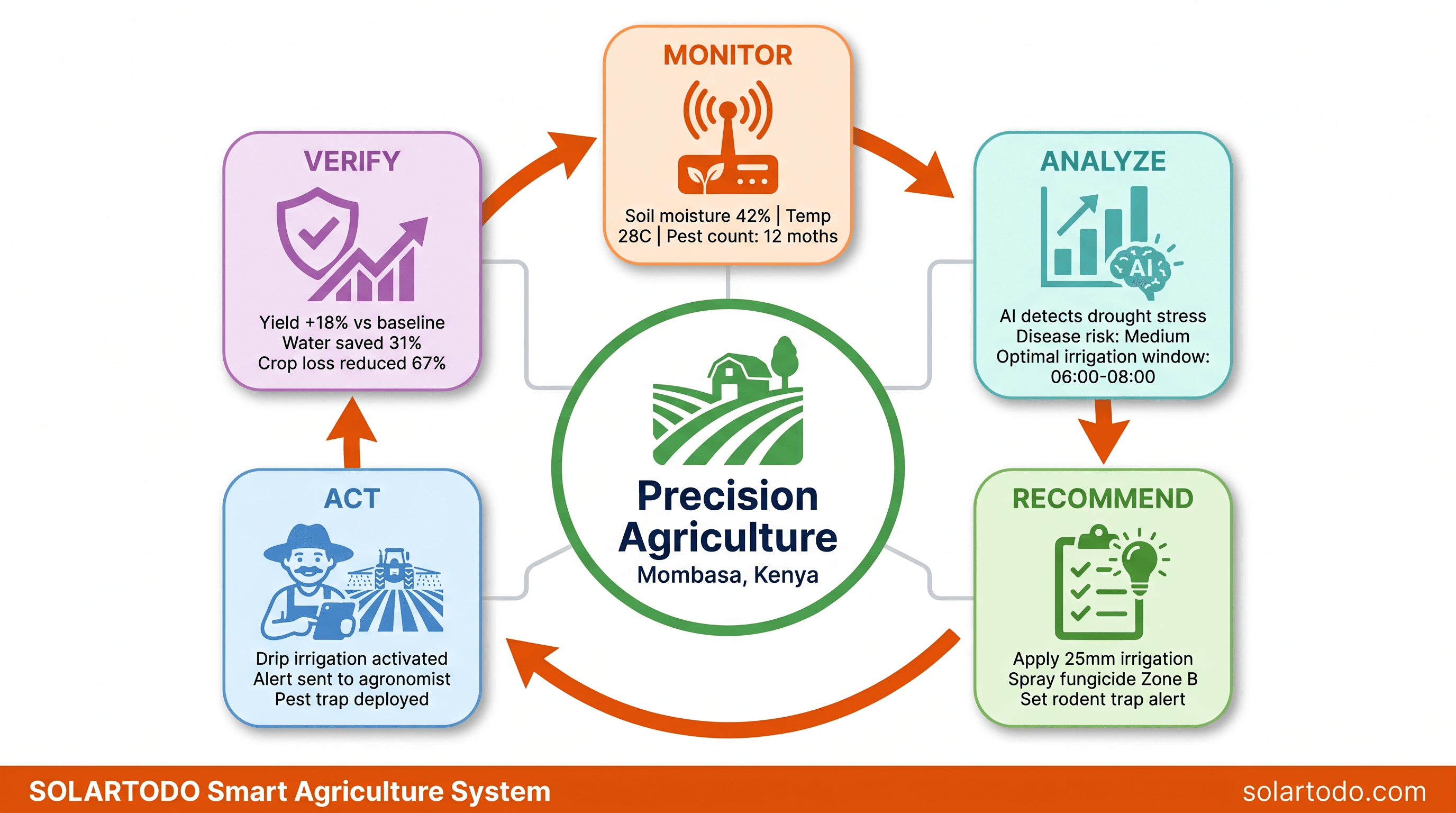
For a 163-hectare Mombasa site, the main impact of Smart Agriculture Monitoring is faster field decisions across weather, soil, pest, and disease events using approximately 36 solar-powered sensing devices and SMS-based alerts.
In operational terms, the system helps managers move from periodic manual checks to near-continuous visibility. That matters in coastal Kenya because rain events, humidity spikes, and pest movement can change materially within 1-3 days. The basic platform tier is intentionally simple, with dashboard access, SMS alerts, and 30-day history, which suits farms that need action prompts more than complex analytics.
The broader result is better agronomic timing. Irrigation can be adjusted using soil moisture and EC patterns, crop protection teams can inspect blocks flagged by AI pest counts, and disease response can start earlier when spore activity and weather conditions align. For Mombasa, that timing advantage is often more valuable than adding more hardware beyond the realistic medium-class range.
Comparison Table
This comparison shows why the specified 163-hectare NB-IoT design is better aligned with Mombasa than either an underspecified basic setup or an oversized large-estate architecture.
| Configuration Option | Farm Scale Fit | Weather Stations | Soil Sensors | Pest Monitoring | Disease Monitoring | Communications | Power Kit | Best Use Case |
|---|---|---|---|---|---|---|---|---|
| Basic small-farm layout | <30 ha | 1 | 5-8 | 1 unit | 0-1 unit | LoRaWAN | 30 W / 150 Wh | Small plots, limited zoning |
| Recommended Mombasa layout | 163 ha | 2 | 17 | 11 HD AI cameras | 2 spore + AI units | NB-IoT 20-250 kbps | 30 W / 150 Wh | Medium coastal farm with high pest/disease pressure |
| Large-estate architecture | 1000+ ha | 5+ | 50+ | 5+ units | Multi-disease | 4G mesh | Mixed small/medium kits | Large plantations with control room |
Pricing & Quotation
SOLAR TODO offers three pricing tiers for this product line: FOB Supply (equipment ex-works China), CIF Delivered (including ocean freight and insurance), and EPC Turnkey (fully installed, commissioned, with 1-year warranty). Volume discounts are available for large-scale deployments. Configure your system online for an instant estimate, or request a custom quotation from our engineering team at [email protected].
Frequently Asked Questions
This FAQ answers the main procurement questions for a 163-hectare Mombasa Smart Agriculture Monitoring system, including specifications, installation, maintenance, warranty scope, and quotation method.
Q1: What system size is appropriate for 163 hectares in Mombasa?
A 163-hectare site fits the medium deployment class. For the specified configuration, a practical layout is 2 weather stations, 17 soil sensors, 11 AI pest cameras, 2 disease monitors, and 4 rodent traps. That density is high enough for zoning and early warning without drifting into unrealistic over-specification.
Q2: Why is NB-IoT recommended instead of LoRaWAN or 4G LTE?
NB-IoT fits low-bandwidth agricultural telemetry at 20-250 kbps and uses carrier infrastructure, which can reduce on-site networking complexity. LoRaWAN is also valid, but it needs gateway planning. 4G LTE is better when continuous video throughput is required; for this 163-hectare sensor-led layout, NB-IoT is usually more efficient.
Q3: What exactly do the 7-sensor weather stations measure?
Each standard weather station measures temperature, humidity, rainfall, wind speed, wind direction, pressure, and solar radiation. The stated accuracy is ±0.3°C and ±2% RH. For Mombasa, those parameters support irrigation timing, disease-risk interpretation, and better understanding of coastal wind and rainfall variation across crop blocks.
Q4: How are the soil sensors configured?
The specified soil sensors are 7-parameter units installed at 15-30 cm depth. They monitor moisture, temperature, EC, pH, and NPK indicators. This mix is useful in coastal agriculture because salinity, nutrient balance, and root-zone moisture can change quickly under irrigation, rainfall events, and variable soil texture.
Q5: How long would installation typically take?
A project of this scale would usually require about 6-10 weeks from survey to commissioning, depending on import logistics, site access, and crop conditions. Hardware mounting may take 1-2 weeks, while calibration, platform setup, and alarm tuning often need another 2-4 weeks to stabilize field performance.
Q6: What maintenance is required after commissioning?
Most maintenance is routine and light. Weather sensors need periodic cleaning and inspection, camera lenses need dust and salt-film removal, solar charging status should be checked, and soil probes should be validated against field conditions. A monthly inspection cycle and a deeper quarterly calibration review are common for systems with 30+ field devices.
Q7: What payback period should buyers expect?
There is no single payback figure that fits every farm. ROI depends on crop value, baseline losses, labor cost, irrigation intensity, and how quickly teams respond to alerts. In higher-value horticulture, payback can be materially faster because even a 3-8% improvement in avoidable losses may have strong revenue impact.
Q8: Does the system include disease monitoring, or only pest alerts?
Yes. This configuration includes 2 spore capture devices with AI microscopy identification, not just insect monitoring. That matters in Mombasa because humidity and rainfall transitions can raise fungal risk. Disease monitoring adds a separate warning layer that supports earlier fungicide decisions or field inspection scheduling.
Q9: What warranty and service scope should be requested in quotations?
Buyers should ask for a clear hardware warranty term, commissioning scope, spare-parts list, and support response time. The quotation section here references a 1-year warranty for EPC turnkey supply. It is also advisable to request sensor calibration procedures, replacement lead times, and cloud-account handover terms in writing.
Q10: Can this system run fully off-grid?
Yes. The specified design uses 30 W solar panels with 150 Wh batteries for all field nodes and supports 10 W loads. That makes the network suitable for farms where utility access is weak or unavailable at monitoring points. Shading analysis and battery health checks remain important for reliable uptime.
Q11: How does this compare with a cheaper weather-station-only package?
A weather-only package gives climate visibility but misses root-zone, pest, disease, and rodent signals. On a 163-hectare coastal farm, that is usually too narrow. The recommended SOLAR TODO configuration creates a broader decision layer, which is why it is better evaluated against avoided loss and labor efficiency, not sensor count alone.
Q12: Where can buyers request a formal configuration review?
Buyers can review the product at Smart Agriculture Monitoring and submit technical requirements through contact us. For Mombasa, it is best to share crop type, irrigation method, farm map, and mobile signal conditions so SOLAR TODO can refine node spacing and alarm logic.
References
- Kenya National Bureau of Statistics (2019): 2019 Kenya Population and Housing Census; Mombasa County population reported at 1,208,333.
- World Bank Climate Change Knowledge Portal (2021): Kenya climate profile; coastal zones commonly experience mean temperatures around 24°C-31°C and variable rainfall patterns.
- Kenya Meteorological Department (2023): Seasonal rainfall outlooks and coastal climate notes for Kenya’s coast, including long and short rain seasons.
- Communications Authority of Kenya (2023): Sector statistics on mobile subscriptions and network coverage relevant to NB-IoT and cellular telemetry feasibility.
- FAO (2020): Digital technologies in agriculture improve decision-making, input efficiency, and resilience in agrifood systems.
- International Telecommunication Union (2020): IoT and smart agriculture guidance supporting low-power wide-area connectivity for environmental monitoring.
- WMO (2021): Guide to Instruments and Methods of Observation; standardized weather observation practice for station siting and data quality.
- ISO (1995): ISO 11461 Soil quality — Determination of soil water content as a volume fraction using coring method; reference framework for soil measurement practice.
Equipment Deployed
- 2× Standard 7-sensor weather station: temperature/humidity/rainfall/wind speed/wind direction/pressure/solar radiation, ±0.3°C ±2%RH
- 17× 7-parameter soil sensor: moisture/temperature/EC/pH/NPK, installation depth 15-30 cm
- 11× HD camera trap with AI species identification, 3 ha coverage per unit
- 2× disease monitor: spore capture + AI microscopy identification
- 4× smart rodent trap with activity sensor
- NB-IoT communication nodes, 20-250 kbps, carrier network
- Solar power kit for each node: 30 W panel + 150 Wh battery, supports 10 W load
- Basic cloud platform: dashboard + SMS alerts + 30-day history
- All field devices solar-powered and off-grid capable
- Standards basis: WMO and ISO 11461