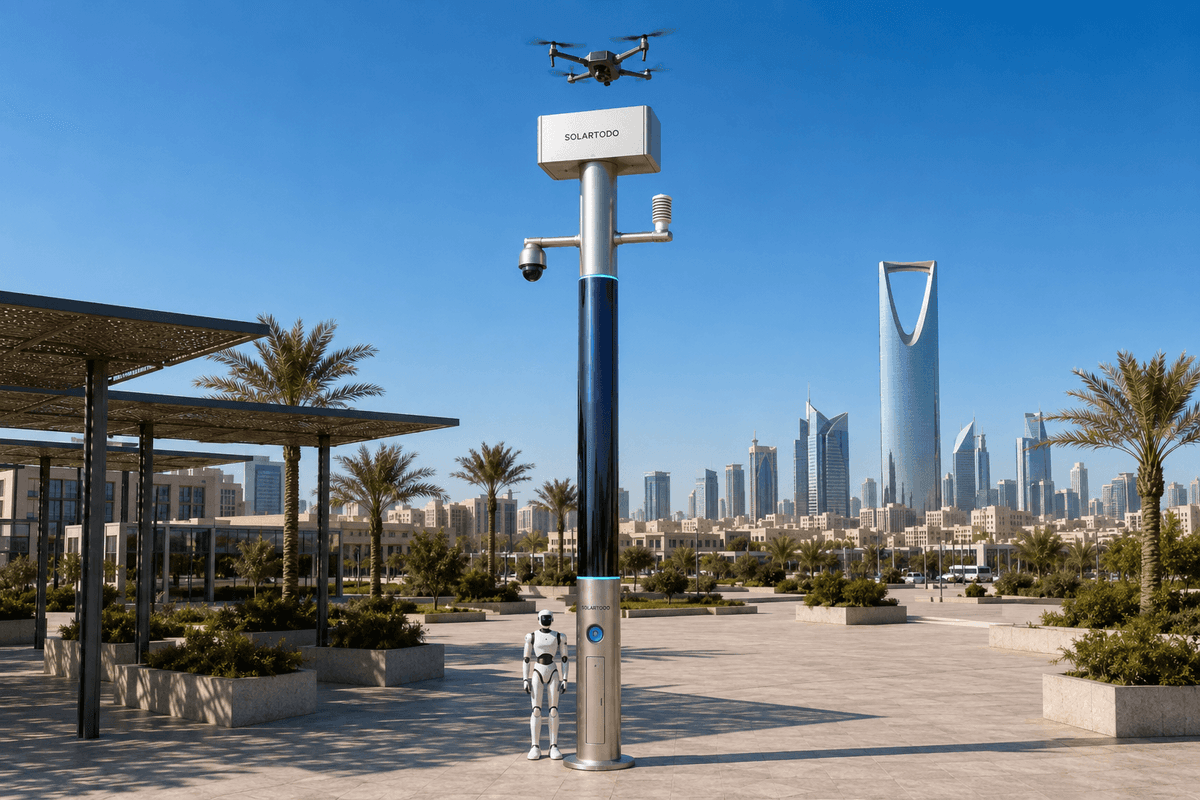
A City AI Pole is a non-lighting, off-grid physical-AI edge node that combines sensing, edge compute, battery-backed solar replenishment, drone operations and ground-robot support in one urban pole. In this proposed Mexico City deployment, SOLARTODO Sentinel Sky Hub units protect a CBD campus perimeter during holiday fire-response operations while keeping raw data processed locally.
Incident Context
The proposed deployment is framed as an incident-review exercise for a Mexico City central business district campus perimeter during a holiday period, when crowds, deliveries, temporary decorations and closed offices can all change the risk profile. The buyer stakeholder is a police-led urban security and emergency-response team responsible for perimeter awareness, incident coordination and evidence handoff across a mixed-use campus near high-density commercial streets.
The primary city task is environmental fire-response support, not general surveillance. During holidays, a small smoke source, overheated electrical cabinet, blocked service lane or unauthorized after-hours entry can escalate before a staffed facilities team reaches the perimeter. The operational pain point is network outage: if fiber, cellular backhaul or an upstream command platform is degraded, the city still needs the perimeter node to detect, classify, dispatch local assets and preserve an incident record.
SOLARTODO Sentinel Sky Hub is positioned here as a pure smart pole and physical-AI edge node, not a lighting asset. The pole has no lighting system and is designed as a fully off-grid micro-station with on-pole battery storage and 360-degree wrapped flexible CIGS thin-film solar replenishment. The energy layer supports autonomy, but it is not presented as unlimited solar independence. The solar wrap is a supplemental replenishment layer, while high-power drone and ground-robot work is buffered by battery storage and scheduled by duty cycle.
For this incident-review configuration, the availability KPI is the main evaluation lens. The police stakeholder would evaluate whether the node can keep the local loop alive when connectivity is interrupted: sensing, assessment, edge-compute scheduling, field action and record creation. The target is operational continuity at the campus perimeter during degraded communications, with de-identified status metadata synchronized when a link is available.
Deployment Configuration
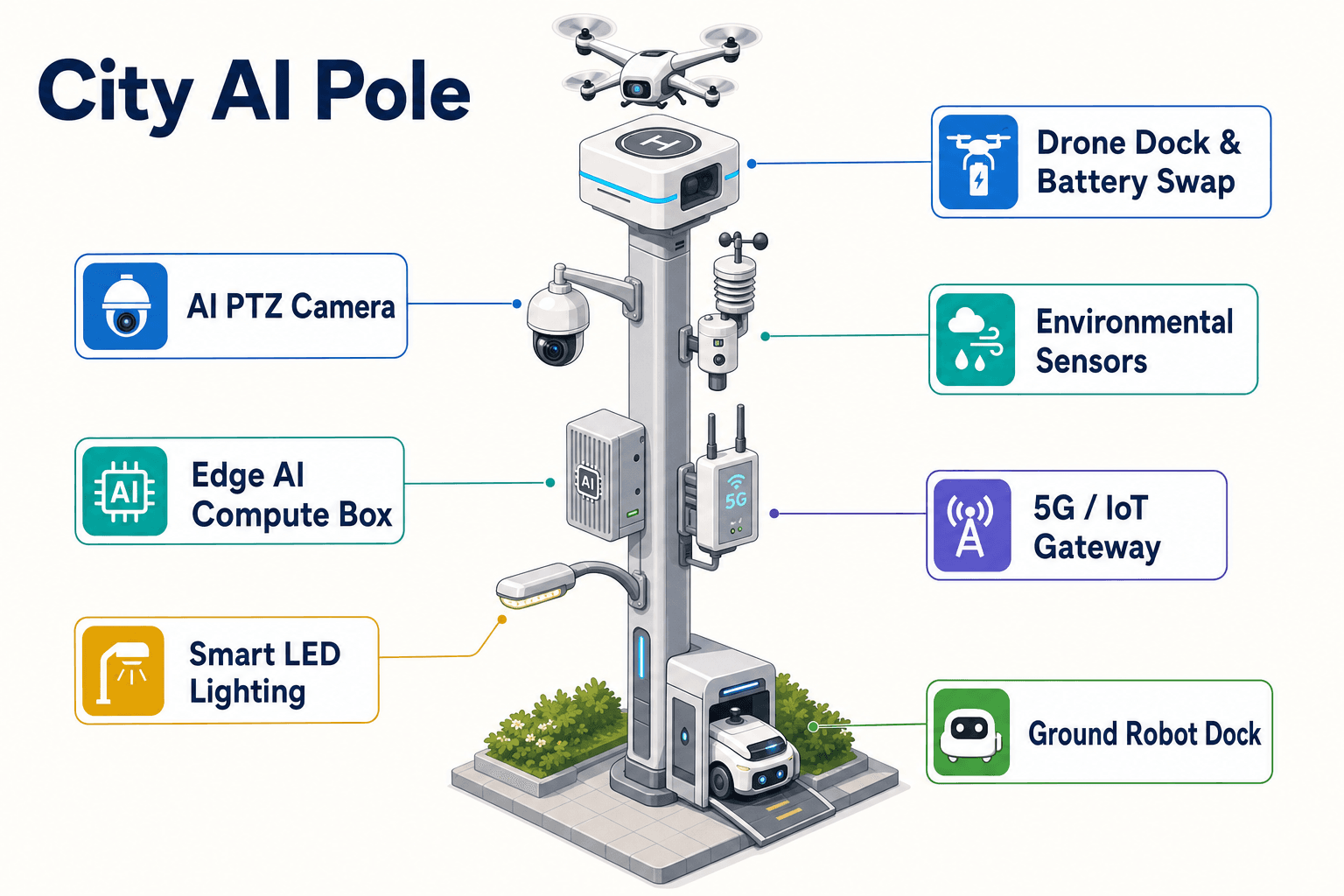
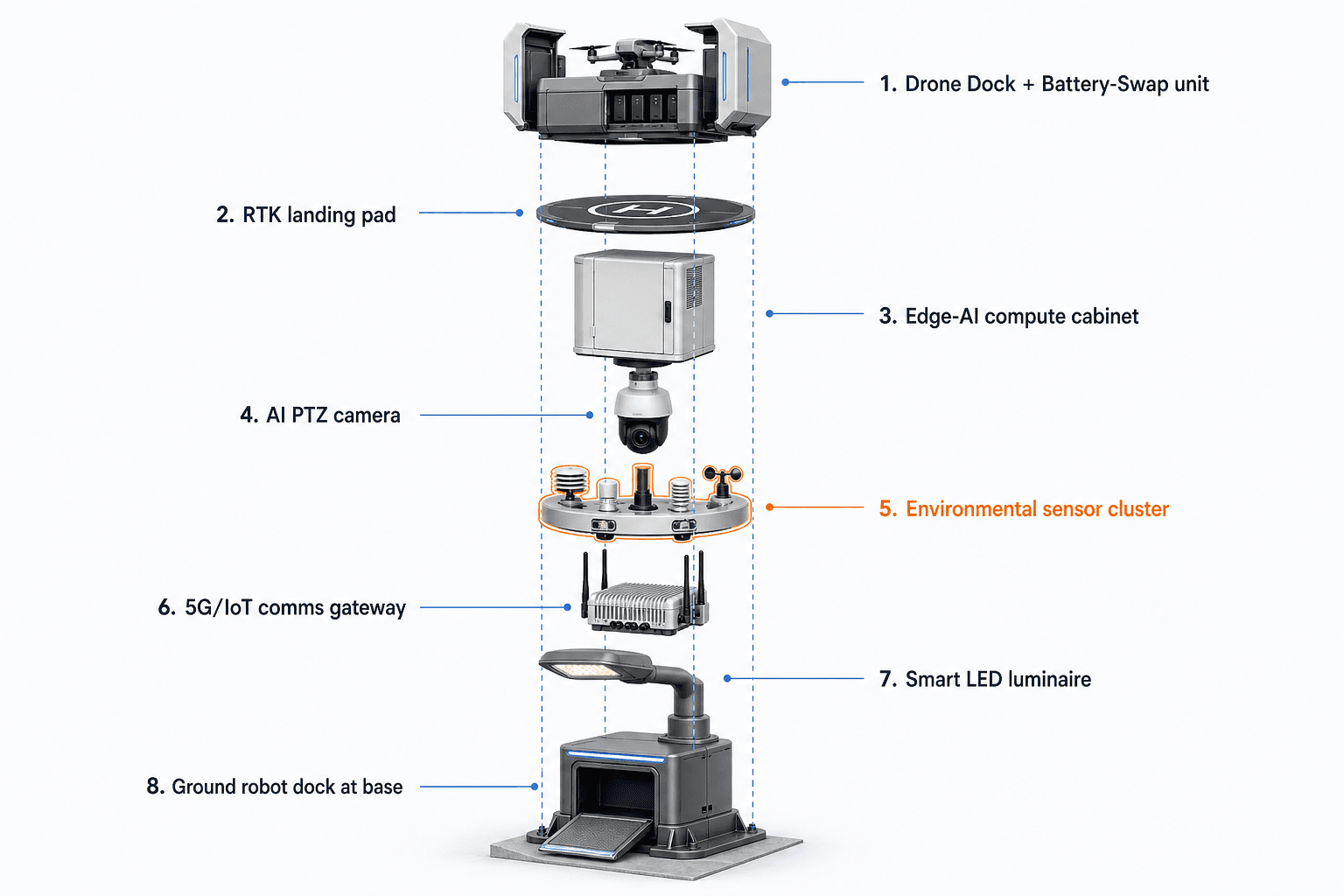
The proposed Sky Hub configuration places the physical-AI node at perimeter decision points: service gates, loading approaches, pedestrian choke points, open plazas near building entrances and utility-room access corridors. The node hosts local perception, environmental sensors, drone operations management, a drone battery hot-swap magazine, ground-robot wireless charging and a common-operating-picture view for human authorization.
The environmental monitoring package is treated as a fire-response input set. Wind speed, wind direction, temperature, humidity, atmospheric pressure, noise, PM10, PM2.5 and illuminance help distinguish normal holiday activity from a perimeter anomaly. For example, a PM spike combined with a thermal-context alert, unusual noise and wind direction can change the response priority before a human operator authorizes a field action.
The edge AI compute cabinet is Jetson-class, Orin- or Thor-class, and schedules local inference on the pole. Raw video and sensor streams stay on the pole for local processing. Only de-identified event and status metadata may leave the node. This PDPL/LGPD-oriented posture is important for a police-led deployment because it reduces unnecessary data movement while preserving incident traceability for authorized review.
Drone operations are included for rapid overhead inspection, but the module focus in this case is ground-robot operations. A humanoid or service robot can leave the pole base, patrol the perimeter, verify an alarm, inspect access points, coordinate with the drone from ground level and return for wireless charging. In a network outage, the robot becomes a local response extension rather than a remote-controlled endpoint waiting on cloud connectivity.
Counter-UAS coordination is limited to non-lethal, human-authorized mitigation. The pole can detect and track an unauthorized drone using its own sensing and optional partner-sensor inputs, then command the node's friendly drone for soft aerial net-capture or close-approach deterrence after authorization. Radar is not built into the pole and is treated only as an optional partner-sensor input if the campus perimeter requires it.
Holiday Fire-Response Review
The incident-review scenario begins during a holiday evening when a CBD campus perimeter has reduced facilities staffing and higher pedestrian movement nearby. A network outage affects normal remote monitoring, but the Sky Hub node continues operating locally from battery-backed off-grid power. The PTZ camera and environmental sensors detect an abnormal combination: elevated particulate readings, a localized intrusion pattern near a service access point and a noise signature consistent with forced access or equipment disturbance.
The node does not need to upload raw video to make the first decision. Local perception classifies the event as a perimeter fire-response concern, not merely a security alert, and places it in the task queue. The common-operating-picture view presents the event summary, confidence level, environmental readings, wind direction and asset status. A human operator authorizes a ground-robot inspection because ground-level verification is safer and more informative than sending personnel into an uncertain perimeter area first.
The robot leaves the pole base and moves to the service corridor. It checks for visible smoke, blocked access, heat-adjacent conditions, open utility doors and obstacles that could slow responders. If an overhead view is needed, the node schedules the friendly drone for a short inspection sortie. The battery hot-swap magazine allows a landed drone to receive a charged pack through automated rear-service exchange and relaunch for another task without an operator standing at the pole.
The core operational loop follows sensing, authorized assessment and response, edge-compute scheduling, then field operations and maintenance. The police stakeholder sees this as one common-operating-picture workflow rather than separate camera, robot, drone and sensor systems. The incident record contains de-identified metadata, timestamps, asset actions, environmental readings and operator authorization points. Raw video and raw sensor streams remain on the pole unless handled under separate authorized site procedures.
Availability is evaluated by whether the local loop continued to function during degraded connectivity. The target planning question is practical: did the perimeter retain enough local autonomy to identify the event, support a human decision, dispatch the ground robot, coordinate a drone if needed, preserve the record and synchronize status metadata when the network returned?
Energy and Availability
Sky Hub is designed as a fully off-grid node with no dependency on grid, city or site power. The physical pole body carries about 15 square meters of 360-degree wrapped flexible CIGS thin-film over a vertical body roughly 8 meters tall and 0.6 meters wide. The nameplate range is about 2.4 to 2.7 kWp, but the useful clear-sky output must be interpreted honestly because a vertical cylinder collects direct sun mainly on its sun-facing projection, not across the full wrap at once.
In a high-irradiance reference region, realistic clear-sky output is roughly 0.8 to 1.1 kW DC peak, typically peaking in the mid-morning or afternoon rather than at noon, with about 6 to 9 kWh per day. Mexico City conditions would require final engineering confirmation for shading, altitude, seasonal sun path, rain patterns, air quality and surrounding building geometry. The planning model should treat the CIGS layer as replenishment for a battery-backed micro-station, not as a guarantee of continuous high-power operation.
The availability KPI is therefore managed by energy scheduling as much as by compute design. Patrol frequency, drone sortie duration, robot route length, sensor duty cycle and edge-inference workload are planned against a 5 to 20 kWh-class storage envelope. During a holiday incident period, the node can prioritize the fire-response queue, defer lower-priority inspection routes and reserve energy for ground-robot return, drone recovery and evidence record preservation.
This is where the physical-AI pole differs from a conventional connected device. The node is not simply waiting for backhaul. It is running local perception, maintaining asset state, managing charge and swap logic, and deciding which workload receives energy and compute under human-authorized rules. For a police-led CBD perimeter, that makes availability measurable as local operational continuity, not just network uptime.
Buyer Evaluation
For a police stakeholder, the proposed deployment should be evaluated through incident-readiness exercises rather than broad claims. A useful acceptance review would include a holiday schedule, a controlled network-outage window, a perimeter anomaly, environmental fire-response triggers, a ground-robot verification task, optional drone inspection and delayed metadata synchronization. The goal is to confirm that the node supports the command workflow when the normal communications path is not fully available.
The most important buyer questions are operational. Can the ground robot return to the pole base and recharge without manual intervention? Can the drone task queue respect battery and safety constraints? Can local inference operate without sending raw video off the pole? Can the common-operating-picture screen show the authorized decision trail clearly enough for police supervisors, facilities responders and emergency coordinators to understand what happened?
The proposed KPI framing avoids unsupported achieved-result claims. Availability targets should be set before field engineering, then validated through staged exercises. Planning inputs can include target patrol cadence, target metadata synchronization behavior, target number of consecutive drone sorties enabled by the battery magazine, and target duration of local operation under reduced network conditions. Final values should be confirmed against the exact campus perimeter, shading profile, safety rules, radio environment and response doctrine.
A credible Mexico City case study should therefore position SOLARTODO Sentinel Sky Hub as a mature in-service physical-AI edge-node pole applied to a proposed CBD campus-perimeter deployment. The value is not a generic smart-city pitch. It is a specific local operations model: keep the fire-response perimeter loop available during a holiday network outage, process sensitive data on the pole, dispatch a ground robot first when that is the safest field action, and preserve a clear human-authorized incident record.
System Configuration
| Parameter | Configuration |
|---|---|
| Pole form | SOLARTODO Sentinel Sky Hub pure smart pole; non-lighting, fully off-grid physical-AI edge node |
| Energy system | ~15 m2 360-degree flexible CIGS wrap, ~2.4-2.7 kWp nameplate, 5-20 kWh-class battery storage |
| Edge AI compute | Jetson-class Orin- or Thor-class on-pole inference and workload scheduling cabinet |
| Sensing package | AI PTZ camera plus wind speed, wind direction, temperature, humidity, pressure, noise, PM10, PM2.5 and illuminance |
| Ground-robot module | Humanoid or service robot patrol workflow with pole-base wireless charging and alarm-response tasking |
| Drone module | Autonomous sortie management with launch, patrol, return, automated multi-bay battery hot-swap and mission logs |
| Data handling | Raw video and sensor data processed locally; only de-identified event and status metadata may leave the pole |
How It Works
- On-pole environmental sensors and PTZ perception flag a fire-response anomaly at the campus perimeter.
- Edge AI classifies the event locally and adds environmental context, asset state and confidence scoring.
- A human operator reviews the common-operating-picture view and authorizes a ground-robot inspection.
- The robot verifies conditions at ground level and the node schedules a drone sortie only if overhead review is needed.
- The pole records authorization, asset actions and de-identified event metadata while raw data stays on the pole.
- When connectivity returns, status metadata and mission logs synchronize to the authorized command system.
Planning Assumptions (Indicative)
Illustrative planning inputs a buyer can recompute — target metrics, not achieved results. Subject to final engineering confirmation.
| Metric | Planning assumption | Indicative value |
|---|---|---|
| Availability planning | Campus perimeter requires local incident handling during a planned network-outage exercise | ~1 degraded-connectivity drill per quarter |
| Ground patrol substitution | Ground robot handles routine holiday perimeter verification routes before personnel are dispatched | ~10-20 target patrol loops per week |
| Drone continuity | Multi-bay hot-swap supports several consecutive inspection sorties when overhead confirmation is authorized | ~3-5 target sorties per incident window |
| Environmental triage | PM, noise, wind and visual-perception signals are fused locally before an operator authorizes response | ~4-6 signal types reviewed per alert |
| Data minimization | Incident review uses local processing and de-identified metadata instead of routine raw video transfer | ~100% target local raw-data processing |
Deployed Equipment
- SOLARTODO Sentinel Sky Hub off-grid pole body
- Flexible 360-degree CIGS solar replenishment layer
- Battery-backed on-pole energy storage cabinet
- AI PTZ camera with local perception
- Nine-parameter environmental sensor array
- Jetson-class edge AI compute module
- Autonomous drone dock with multi-bay battery hot-swap magazine
- Ground robot wireless charging base
Frequently Asked Questions
Is Sky Hub a smart streetlight for Mexico City streets?
No. SOLARTODO Sentinel Sky Hub is a pure smart pole and physical-AI urban edge node with no lighting system. In this proposed Mexico City case, it is configured for CBD campus-perimeter fire-response support, local sensing, drone operations, ground-robot patrol and edge processing rather than street lighting.
How does the pole keep working during a network outage?
The node is designed to run the critical loop locally. Sensors, local perception, edge AI scheduling, robot tasking, drone state management and incident record creation remain on the pole. If backhaul is degraded, raw data still stays local and de-identified event or status metadata can synchronize later when authorized connectivity is restored.
What role does the ground robot play in the fire-response scenario?
The ground robot is the first field-verification asset in this configuration. It can patrol the campus perimeter, inspect a service corridor, check access points, verify smoke-adjacent conditions, coordinate with an overhead drone if authorized and return to the pole base for wireless charging. This reduces unnecessary human exposure during uncertain early-stage incidents.
Does the solar wrap make the pole endlessly self-sufficient?
No. The 360-degree flexible CIGS layer is a supplemental replenishment layer for a fully off-grid, battery-backed micro-station. A vertical cylindrical body does not harvest direct sun across the entire wrap at once. High-power drone and robot tasks must be scheduled against storage, weather, shading and duty-cycle assumptions.
What data leaves the pole in this proposed configuration?
The operating principle is local processing first. Raw video and sensor data stay on the pole for local inference and incident review under authorized procedures. Only de-identified event metadata, asset status, mission logs and operational summaries may leave the node, supporting a PDPL/LGPD-oriented data-minimization posture.
Can the pole respond to unauthorized drones near the campus perimeter?
Yes, within strict limits. The node can detect and track an unauthorized drone and, after human authorization, coordinate its own friendly drone for non-lethal soft aerial net-capture or close-approach deterrence. The workflow excludes autonomous attack, destructive action and signal denial. Radar, if used, is only an optional partner-sensor input.
What should the police stakeholder measure during evaluation?
The main KPI is availability of the local incident loop during degraded connectivity. The evaluation should test whether the node detects the anomaly, supports a human decision, dispatches the ground robot, coordinates a drone when needed, records the authorization trail and synchronizes de-identified metadata after the network returns.
Explore Further
- City AI Pole / smart streetlight product line
- More smart-city deployment cases
- Talk to our engineering team
Planning a similar physical-AI deployment for streets, campuses or public spaces? Request an engineering consultation