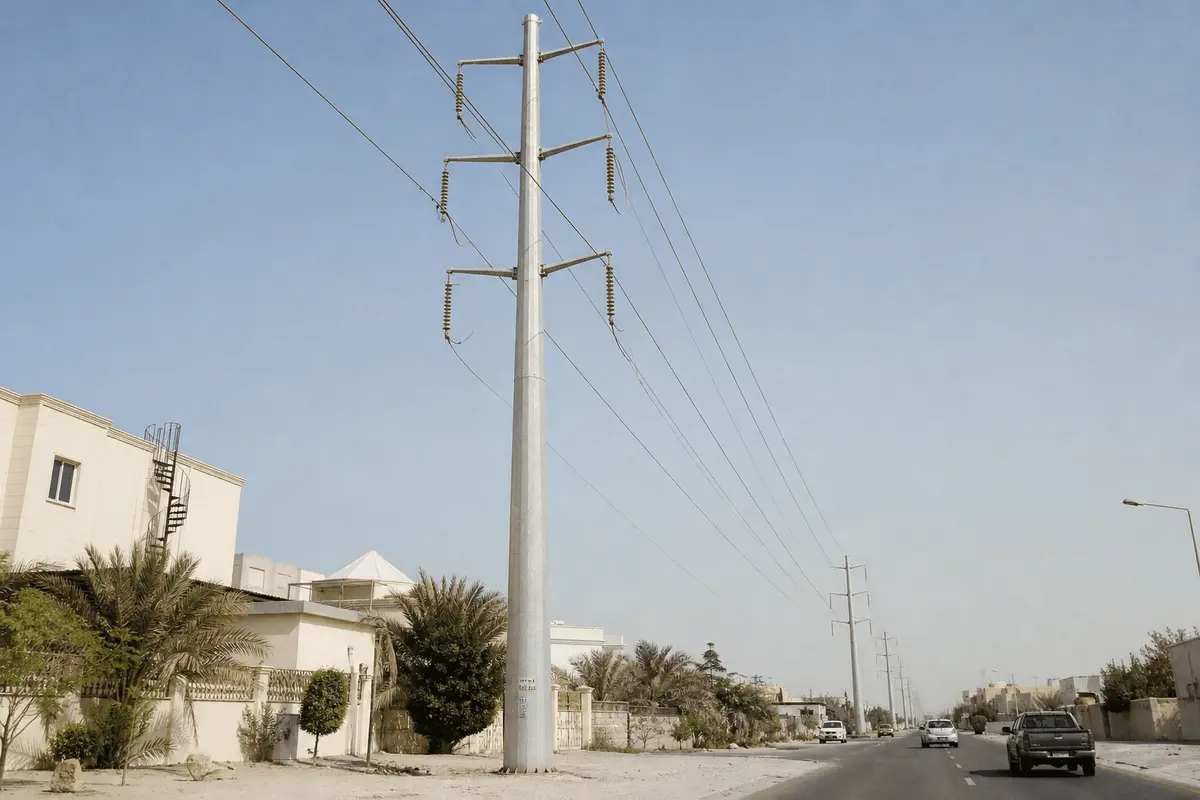
Manama 110kV Coastal Backbone Decision: Power Transmission Tower Configuration for Salt-Air Corridors
Summary
Manama’s 110kV coastal backbone fit favors approximately 22 galvanized steel tubular poles over 4km, with 200m spans, 40m/s wind design, and EWA’s 420MVA 66kV expansion context shaping utility-grade procurement.
Key Takeaways
For Manama, a 22-unit, 110kV double-circuit Power Transmission Tower package should be treated as a coastal high-voltage backbone configuration, not a generic distribution pole order.
- A typical deployment of this scale would use approximately 22 units across a 4km line, with 200m design spans and double-circuit 110kV geometry.
- The specified pole is a 40m tapered Q345 steel tubular monopole, calculated at about 40t/pole from the 1000kg/m double-circuit loading basis.
- According to EWA (2026), Bahrain is adding nine 66kV substations and approximately 420MVA of firm capacity, supporting stronger sub-transmission corridors around growth zones.
- According to the World Bank (2025), Bahrain’s population reached about 1.60 million in 2025 on only about 800sq km, increasing corridor-density pressure near Manama.
- Manama’s coastal exposure requires hot-dip galvanizing, sealed flanges, grounding, bird guards, vibration dampers, and inspection planning for salt, humidity, and dust.
- The recommended conductor package is ACSR 240 at 920kg/km with maximum tension of 70kN, 4m phase spacing, 6m ground clearance, and 1.5m insulators.
- The applicable design references are IEC 60826, GB 50545, and DL/T 5092, with IEEE 738 used for conductor temperature and ampacity calculations.
Market Context for Manama
Manama’s transmission need is defined by a dense coastal capital, low-lying terrain, salty marine air, and Bahrain’s active 66kV network expansion program.
Manama sits on Bahrain’s northern coast at approximately 26.23 latitude and 50.59 longitude, with dense commercial, residential, port, and government activity compressed into a small island grid. According to the Bahrain Ministry of Information (2025), Bahrain Island accounts for about 80% of the kingdom’s land area and the country is linked to Saudi Arabia by the 25km King Fahd Causeway. That logistics link helps regional supply movement, but Manama’s old-town streets, waterfront reclamation areas, and utility-congested corridors make long lattice structures less practical than compact steel monopoles.
Climate is not a footnote for transmission design in Manama. According to Bahrain’s Meteorological Directorate (2026), Bahrain has average annual rainfall of about 71mm, with rain concentrated from October to May and occasional intense events. The same public climate context identifies summer heat and humidity as defining conditions; the Ministry of Information reports Bahrain’s average annual temperature range at 20-35°C and humidity at 30-85%. UNEP Copenhagen Climate Centre (2025) also notes that Bahrain’s hot desert climate often exceeds 40°C, creating a thermal-rating issue for bare overhead conductors.
Grid context points toward sub-transmission and high-voltage corridor reinforcement rather than isolated small distribution poles. According to EWA (2026), Bahrain’s transmission development initiative will establish nine new 66kV substations with associated 66kV feeders and communication cabling, adding approximately 420MVA of firm capacity over 2026-2028. EWA states, “to address the rising electricity demand,” it is enhancing transmission network capacity. For Manama, that means compact high-voltage structures must interface with existing urban substations, road corridors, and coastal utility reservations.
Public procurement also matters. Bahrain’s Tender Board records EWA procurement for 230V, 50Hz street-lighting modernization equipment and 11kV underground cable supply, showing a formal utility procurement environment with EDD specifications, local/GCC supplier competition, and technical evaluation before award. For a SOLARTODO Power Transmission Tower, the practical market question is therefore not whether Manama needs stronger poles; it is which steel monopole configuration can satisfy clearance, corrosion, conductor, wind, and foundation constraints without consuming excessive urban right-of-way.
Recommended Technical Configuration
A Manama 110kV backbone package would use approximately 22 double-circuit steel tubular poles over 4km, with utility approval for the 40m special-height specification.
The recommended configuration follows the provided project-specific backbone class: 22 units of 40m tapered steel tubular Power Transmission Tower for a 110kV double-circuit overhead line. This is not a past SOLARTODO deployment claim; it is a technical recommendation for a typical line of this scale in Manama’s coastal transmission profile. The monopole form is preferable where land, streets, and road reserves are constrained, because a flanged steel tube occupies less ground footprint than a lattice tower and allows cleaner alignment around urban utilities.
The hard engineering reference table places standard 66-110kV sub-transmission poles at 18-30m height, 5-15t/pole, 200-300m spans, and 4-5 poles/km. The specified Manama configuration intentionally exceeds the usual 66-110kV height and mass envelope because it is defined as a high-voltage transmission backbone: 40m height, 1000kg/m steel loading, and approximately 40t/pole. That exception should be approved by the utility design reviewer against route-specific clearance, road crossing, coastal wind, and foundation data before procurement.
A typical 22-unit deployment of this scale would use hot-dip galvanized Q345 steel, flanged bolt sections, concrete spread footing foundations, and an anchor-cage system sized after geotechnical testing. Phase spacing should be 4m with 6m ground clearance, using ACSR 240 conductor at 920kg/km and maximum tension of 70kN. SOLARTODO would configure climbing steps, cross arms, grounding, bird guards, and vibration dampers as part of the tower package, while final sag-tension and earthing studies remain route-specific.
Technical Specifications
The Manama specification is a 110kV double-circuit galvanized steel monopole system with 22 poles, 40m height, 40t/pole mass, and 200m spans.
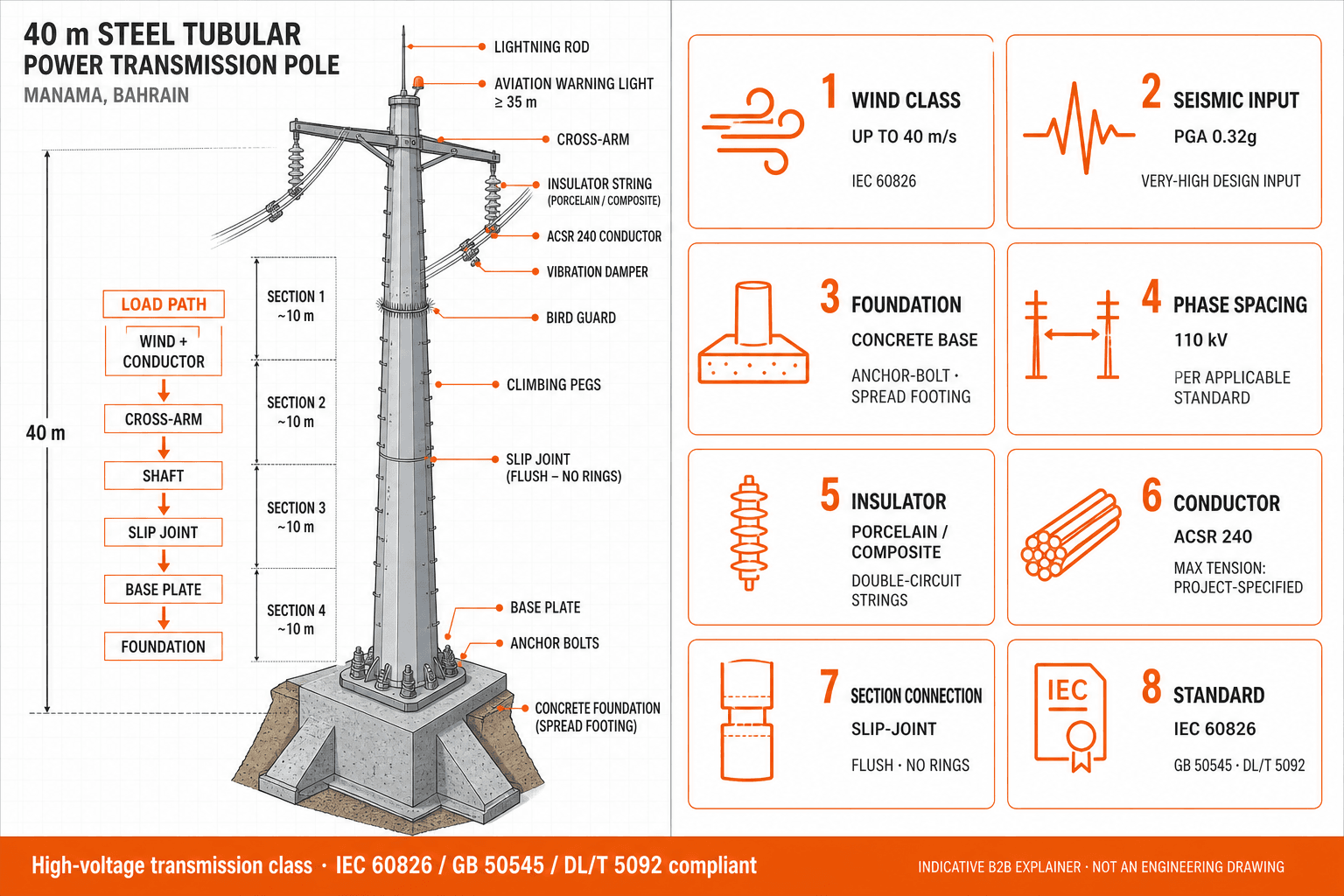
Core Pole And Electrical Package
- Product: SOLARTODO Power Transmission Tower, steel tubular transmission pole.
- Form: tapered round or dodecagonal steel monopole, not lattice, FRP, wood, or concrete.
- Quantity: approximately 22 units for a typical 4km corridor.
- Voltage class: 110kV double circuit, high-voltage transmission backbone.
- Pole height: 40m project-specific special-height configuration.
- Weight: approximately 40t/pole, based on 1000kg/m double-circuit loading.
- Steel: hot-dip galvanized Q345 steel, with Q420 available where calculation requires higher yield strength.
- Sections: flanged bolt sections for CKD shipment and site assembly.
- Foundation: spread footing foundation with concrete and anchor cage.
- Conductor: ACSR 240, 920kg/km, maximum tension 70kN.
- Phase spacing: 4m.
- Ground clearance: 6m.
- Insulator length: 1.5m.
- Span: 200m.
- Wind class: Class 4, 40m/s.
- Accessories: climbing steps, cross arm, grounding, bird guard, and vibration damper.
- Design life: 30 years.
- Standards: IEC 60826, GB 50545, DL/T 5092, with IEEE 738 for conductor thermal rating.
Standards Fit
According to IEC (2017), IEC 60826 applies to overhead lines of 45kV and above and uses reliability-based loading and strength principles. IEC states, “loading and strength requirements” are derived from reliability-based design principles. For Manama, that makes the 40m/s wind class, coastal corrosion allowance, and route-specific climatic inputs part of the formal design basis rather than optional accessories.
According to IEEE (2023), IEEE 738 provides a numerical method relating bare overhead conductor temperature to current and weather conditions. IEEE states, “weather conditions” are part of current-temperature calculation. In Manama’s summer heat, this matters because ACSR 240 ampacity should not be assumed from catalog values alone; it should be verified against local ambient temperature, solar heating, wind speed, conductor emissivity, and allowable operating temperature.
Implementation Approach
A Manama 110kV steel tubular pole project would normally move through 5 controlled phases: route validation, procurement, foundations, erection, and commissioning.
The first phase is route and interface validation. The EPC team would verify alignment with EWA/EDD requirements, road reserves, coastal setback constraints, underground services, access for cranes, and outage windows. Soil investigation should confirm bearing capacity, groundwater depth, chloride exposure, and flood sensitivity before finalizing spread footing dimensions.
The second phase is engineering and procurement. SOLARTODO would prepare drawings for the 40m galvanized Q345 monopole, cross-arm brackets, conductor attachment points, anchor cage, climbing steps, grounding, bird guard, and vibration damper package. Manufacturing should include galvanizing thickness checks, weld inspection, bolt traceability, and trial fit-up for flanged sections before CKD packing.
The third phase is logistics into Bahrain and site staging around Manama’s road network. The King Fahd Causeway improves GCC land access, but oversized pole sections still need route permits, nighttime transport planning, and staging areas outside dense old-town streets. For waterfront and reclaimed areas, corrosion-protected storage and short laydown periods reduce coating damage before erection.
The fourth phase covers foundations and pole erection. A typical sequence is excavation, blinding, anchor cage placement, reinforcement, concrete pour, curing, monopole section lifting, flange bolting, and torque recording. After tower erection, conductor stringing and sag-tension verification should be completed before energization.
The fifth phase is testing and commissioning. Ground resistance, bolt torque, galvanizing touch-up, insulator condition, conductor clearance, vibration damper position, and phase identification should be verified. Final handover should include as-built drawings, factory certificates, foundation records, and a 30-year inspection plan aligned with Bahrain’s coastal exposure.
Expected Performance & ROI
A 22-pole, 4km Manama backbone can reduce right-of-way pressure while supporting 110kV double-circuit capacity over a 30-year design life.
Performance should be judged by reliability, footprint, constructability, and lifecycle maintenance rather than by a fabricated payback claim. A double-circuit 110kV monopole line allows two circuits on one structure family, improving corridor utilization where Manama faces coastal land scarcity and dense road interfaces. Compared with wider lattice structures, the tubular monopole foundation footprint can simplify alignment near substations, port roads, and municipal infrastructure.
ROI for transmission structures normally appears as avoided corridor acquisition, fewer alignment conflicts, reduced outage exposure, and lower corrosion-related maintenance. According to World Bank (2025), Bahrain’s population was about 1.60 million in 2025, and the country’s land area is about 800sq km, giving utilities little tolerance for inefficient infrastructure footprints. According to the U.S. Commercial Service (2025), Bahrain targets 280MW of renewable electricity by 2025 and 710MW by 2035, which increases the value of robust grid corridors connecting generation, substations, and urban loads.
For lifecycle planning, a reasonable commercial analysis would compare the higher upfront mass of the 40m, 40t/pole specification against fewer route conflicts, higher clearance margins, and lower risk of midlife structural replacement. Maintenance should assume annual visual inspection, post-storm checks after severe wind or flooding, five-year torque and grounding audits, and coating repair where salt or handling damage is visible. SOLARTODO’s engineering team can adapt the specification after a route drawing, soil report, and utility clearance matrix are provided through contact us.
Results and Impact
The expected impact is a compact 110kV double-circuit corridor with 22 galvanized poles, 200m spans, and 30-year service planning for coastal Manama.
For Manama, the most important result is not a claimed project outcome; it is a procurement-ready configuration that answers local constraints. The 40m tapered steel tubular pole supports 4m phase spacing and 6m ground clearance while preserving a narrow monopole footprint. The hot-dip galvanized Q345 steel specification directly addresses salt air, dust, humidity, and heat exposure common to Bahrain’s northern coast.
The grid impact is a backbone-ready structure set compatible with high-voltage transmission planning. According to EWA (2026), Bahrain’s nine new 66kV substations and 420MVA firm-capacity addition are intended to serve domestic, commercial, housing, and industrial load growth. A 110kV double-circuit Power Transmission Tower package can complement that direction where the route requires higher voltage transfer and resilient coastal structure design.
Comparison Table
The recommended Manama configuration is heavier and taller than the standard 66-110kV envelope, so utility review should confirm why the 40m backbone class is justified.
| Parameter | Standard 66-110kV class | Manama recommended backbone configuration | Engineering implication |
|---|---|---|---|
| Voltage | 66-110kV | 110kV double circuit | Correct sub-transmission/high-voltage class |
| Height | 18-30m typical | 40m project-specific | Requires clearance and route justification |
| Weight | 5-15t/pole typical | ~40t/pole | Heavy backbone monopole, larger foundation |
| Span | 200-300m | 200m | Within class span range |
| Pole density | 4-5 poles/km | ~5.5 poles/km | Driven by 22 poles over ~4km |
| Conductor | ACSR family | ACSR 240, 920kg/km | Suitable mid-heavy conductor selection |
| Wind basis | Route-specific | 40m/s wind class 4 | Appropriate for exposed coastal corridors |
| Design life | Utility-specific | 30 years | Requires planned coating and grounding inspections |
Pricing & Quotation
SOLARTODO structures Manama quotations in 3 commercial scopes: FOB Supply, CIF Delivered, and EPC Turnkey, with no public price claim made here.
SOLARTODO offers three pricing tiers for this product line: FOB Supply (equipment ex-works China), CIF Delivered (including ocean freight and insurance), and EPC Turnkey (fully installed, commissioned, with 1-year warranty). Volume discounts are available for large-scale deployments. Configure your system online for an instant estimate, or request a custom quotation from our engineering team at [email protected].
Frequently Asked Questions
These 10 answers summarize Manama’s 110kV Power Transmission Tower configuration, including 22 poles, 40m height, ACSR 240 conductor, and 40m/s wind design.
Q1: What Power Transmission Tower configuration fits Manama’s 110kV coastal backbone profile? A typical Manama configuration would use approximately 22 tapered steel tubular monopoles for a 4km, 110kV double-circuit line. The provided specification is 40m height, about 40t/pole, hot-dip galvanized Q345 steel, 200m spans, ACSR 240 conductor, 4m phase spacing, 6m ground clearance, and 40m/s wind design.
Q2: Why use steel tubular monopoles instead of lattice towers in Manama? Steel tubular monopoles fit tighter urban and coastal corridors because they use a smaller ground footprint than lattice towers. In Manama, that helps around road reserves, substations, port access routes, and dense older streets. The 40m monopole also supports double-circuit 110kV geometry while simplifying visual profile and section-based CKD logistics.
Q3: Is a 40m pole normal for 110kV lines? The standard 66-110kV reference envelope is 18-30m and 5-15t/pole, but the project-specific Manama backbone specification is 40m and about 40t/pole. That should be treated as a special-height high-voltage backbone design requiring route-specific approval for clearance, road crossings, wind exposure, foundation loads, and utility interface requirements.
Q4: What deployment timeline should an EPC planner expect? For a 22-pole, 4km 110kV corridor, a practical schedule often runs in phases: 4-8 weeks for survey and design, 6-10 weeks for fabrication and galvanizing, 3-6 weeks for shipping and customs, then staged foundation, erection, stringing, and commissioning. Outage windows and road permits can extend timing in central Manama.
Q5: What ROI factors matter for this type of transmission pole? ROI should focus on avoided right-of-way cost, fewer route conflicts, double-circuit capacity on one structure line, lower outage risk, and 30-year service planning. In Manama, compact monopoles may reduce negotiation complexity in coastal and urban corridors. Payback is normally project-specific and should be modeled against land, outage, maintenance, and capacity constraints.
Q6: How should maintenance be planned in Bahrain’s coastal environment? Maintenance should include annual visual inspections, post-storm checks, grounding tests, corrosion inspections, and bolt torque audits. Salt air, humidity, dust, and occasional intense rainfall mean galvanizing damage should be repaired quickly. Bird guards and vibration dampers should be checked during scheduled line patrols, especially on exposed coastal spans.
Q7: Which standards should the design package reference? The design package should reference IEC 60826 for overhead transmission line loading and reliability principles, GB 50545 and DL/T 5092 for transmission structure design practice, and IEEE 738 for conductor current-temperature calculations. Local EWA/EDD requirements, route permits, and Bahrain electrical regulations should govern final approval before procurement or erection.
Q8: Does SOLARTODO include installation accessories with the tower package? The recommended SOLARTODO package includes cross arms, climbing steps, grounding, bird guards, vibration dampers, flanged bolt sections, and anchor-cage foundation components. Final bill of materials should be checked against the route profile, conductor tension, insulator string design, foundation report, and EWA interface requirements before manufacturing release.
Q9: How is EPC pricing handled without listing prices publicly? SOLARTODO provides quotations under FOB Supply, CIF Delivered, and EPC Turnkey scopes. Public articles should not list fixed prices because steel weight, galvanizing, freight, foundation volume, crane access, local permits, and outage constraints vary by route. A 22-pole Manama estimate requires drawings, soil data, delivery terms, and installation responsibility.
Q10: What warranty expectation is reasonable for a Manama tower package? The article’s commercial scope references a 1-year EPC Turnkey warranty, while the structural design life is 30 years. These are different concepts: warranty covers defined defects and installation scope, while design life depends on correct engineering, coating protection, foundation quality, loading assumptions, inspections, and maintenance in Bahrain’s coastal conditions.
References
The 7 references below ground the Manama analysis in public Bahrain infrastructure data, international standards, and climate context rather than fabricated deployment claims.
- EWA (2026): Establishment of nine new 66kV substations, associated feeders, and approximately 420MVA firm capacity under Bahrain’s transmission development initiative.
- Bahrain Meteorological Directorate (2026): Bahrain rainfall averages about 71mm annually, with rainfall season generally from October to May.
- Bahrain Ministry of Information (2025): Bahrain is a 33-island archipelago; Bahrain Island accounts for about 80% of land area, and climate averages 20-35°C with 30-85% humidity.
- World Bank (2025): Bahrain population reached about 1.60 million in 2025, with land area around 800sq km.
- IEC (2017): IEC 60826:2017, Design criteria of overhead transmission lines, applies reliability-based loading and strength requirements to overhead lines of 45kV and above.
- IEEE (2023): IEEE 738-2023, Standard for Calculating the Current-Temperature Relationship of Bare Overhead Conductors.
- U.S. Commercial Service (2025): Bahrain renewable energy targets require about 280MW by 2025 and 710MW by 2035, increasing future grid integration requirements.
Equipment Deployed
- 22 units x 40m tapered Q345 hot-dip galvanized steel tubular monopole for 110kV double-circuit line
- ACSR 240 conductor, 920kg/km, maximum tension 70kN
- Flanged bolt sections with cross arms, climbing steps, grounding, bird guard, and vibration damper
- Spread footing foundation with concrete anchor cage
- Phase spacing 4m, ground clearance 6m, insulator length 1.5m
- Wind class 4 design basis, 40m/s
- Typical span 200m over approximately 4km total line length
- Design life 30 years; standards IEC 60826, GB 50545, DL/T 5092