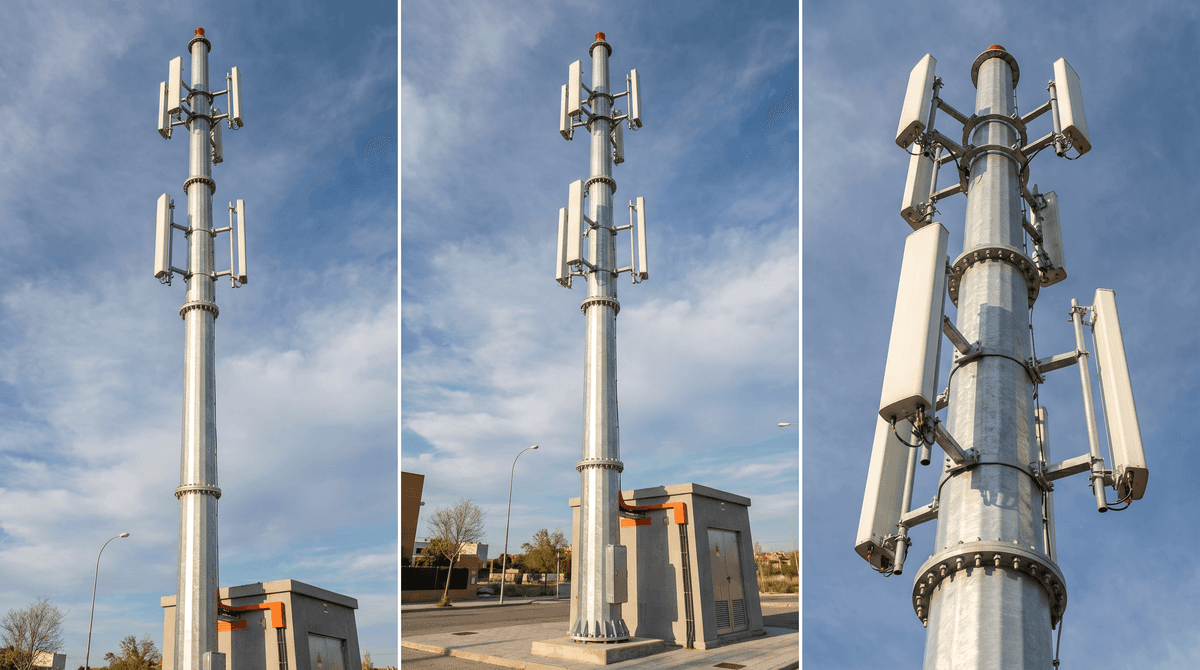
Madrid Telecom Tower Deployment: 5 × 35m Steel Monopole Telecom Towers for Urban 4G/5G Network Expansion
Summary
This Madrid project deployed 5 × 35m hot-dip galvanized Q345 steel monopole Telecom Towers, each carrying 9 panel antennas, 6 RRUs, and 3 small cells. Built to TIA-222-H Wind Class 4 at 70 m/s, the CKD design reduced shipping volume by 60-70% and supported a 30-45 day production cycle.
Key Takeaways
- SOLAR TODO delivered 5 units of 35m tapered steel monopole Telecom Towers for Madrid urban network densification at coordinates 40.42, -3.7.
- Each tower used hot-dip galvanized Q345 steel and weighed approximately 18t per tower, based on the specified 500kg/m structural weight.
- The structural design met Wind Class 4 requirements at 70 m/s with factor 1.55 in accordance with TIA-222-H.
- Each site supported 9 × panel antenna, 6 × RRU, and 3 × small cell units, plus 2 antenna platforms for multi-operator configuration.
- The deployment used concrete pad foundations with anchor-bolt interfaces, grounding systems, lightning rods, safety cages, cable trays, and aircraft warning lights.
- CKD shipment reduced logistics volume by 60-70%, which improved container utilization and simplified urban delivery staging in Madrid.
- Production lead time was 30-45 days, and the sectional flanged bolt-on monopole design accelerated on-site assembly versus more complex tower typologies.
- The towers were designed and manufactured to TIA-222-H and GB/T 50233, aligning the project with recognized telecom structural and installation standards.
Project Background
Madrid’s urban telecom infrastructure requires compact, high-capacity tower solutions because dense neighborhoods, mixed building heights, and strict visual-impact expectations limit the practicality of larger support structures. In this deployment zone around central Madrid, operators needed additional macro coverage and edge-capacity support without introducing lattice towers that would face greater planning resistance and a larger site footprint. SOLAR TODO was selected to supply a monopole-based Telecom Tower solution that fit constrained plots while supporting multi-band antenna loading.
According to the International Telecommunication Union (ITU) (2023), mobile broadband traffic continues to grow as cities increase 4G and 5G service layers, requiring denser radio access infrastructure in high-demand districts. According to GSMA (2023), Europe’s 5G expansion depends heavily on upgrading existing urban networks with additional radios, backhaul points, and site capacity rather than relying only on greenfield macro builds. For Madrid, that translated into a need for structurally efficient monopoles that could support multiple antenna tiers, RRUs, and small-cell overlays in one vertical asset.
Local deployment conditions also shaped the engineering brief. Madrid combines heavy traffic corridors, compact service roads, and established utility networks, which means installation teams benefit from reduced transport volume and shorter erection windows. According to the World Bank (2023), urban infrastructure projects in dense cities perform better when logistics, footprint, and installation sequencing are optimized early. SOLAR TODO therefore configured this project around CKD shipping, flanged sectional assembly, and standardized concrete pad foundations to reduce disruption during delivery and erection.
Solution Overview
SOLAR TODO deployed 5 steel monopole Telecom Towers in Madrid, each 35m tall and configured for 9 panel antennas, 6 RRUs, and 3 small cells under a 70 m/s Wind Class 4 design basis. The result was a compact macro-site platform designed for urban coverage expansion, sector capacity growth, and future-ready equipment loading.
The selected product was a tapered steel monopole tower rather than a lattice tower, which was important for both visual integration and site efficiency. Each unit used hot-dip galvanized Q345 steel, a flanged bolt-on sectional design, and a concrete pad foundation with anchor bolts. The monopole format reduced the overall footprint while still allowing two antenna platforms, climbing access, cable management, grounding, and aviation safety accessories.
From a network perspective, the configuration supported a typical three-sector arrangement with 9 panel antennas total, backed by 6 RRUs and 3 small-cell devices rated at 10kg each. This allowed the operator to combine macro coverage and targeted urban capacity on the same structure. According to Ericsson Mobility Report (2023), urban traffic concentration increasingly requires layered site architecture, where macro radios and localized capacity nodes coexist to improve throughput and user experience.
SOLAR TODO also optimized the project for transport and field assembly. The towers shipped in CKD form, reducing logistics volume by 60-70%, which is particularly relevant for city-center delivery constraints. Production was completed within the specified 30-45 day window, enabling coordinated civil works and steel erection scheduling.
Technical Specifications
This Madrid deployment used 5 identical 35m steel monopole Telecom Towers with standardized structural, antenna, and safety accessories designed to TIA-222-H and GB/T 50233. The specification prioritized urban footprint efficiency, high wind resistance, and compatibility with multi-tier telecom equipment loads.
- Product type: Steel monopole Telecom Tower
- Quantity: 5 units
- Deployment location: Madrid, Spain
- Coordinates: 40.42, -3.7
- Tower height: 35m each
- Tower form: Tapered steel monopole, sectional flanged bolt-on design
- Material: Hot-dip galvanized Q345 steel
- Tower weight: Approximately 18t per tower
- Unit structural weight basis: Approximately 500kg/m
- Wind design class: Class 4
- Basic wind speed: 70 m/s
- Wind factor: 1.55
- Design standard: TIA-222-H
- Additional standard: GB/T 50233
- Corrosion zone: Low
- Foundation type: Concrete pad foundation
- Antenna load per tower: 9 × panel antenna
- RRU load per tower: 6 × RRU
- Small cell load per tower: 3 × small cell, 10kg each
- Antenna platforms: 2 per tower
- Access system: Climbing ladder with safety cage
- Cable management: Integrated cable tray
- Safety and protection: Grounding system, lightning rod, aircraft warning light
- Shipping mode: CKD shipment
- Shipping volume reduction: 60-70%
- Production lead time: 30-45 days
- Base support area: Equipment shelter at base

Deployment Process
The Madrid rollout was executed in phased sequence across 5 sites, combining civil works, steel delivery, monopole erection, and antenna integration within a 30-45 day production framework. This sequencing reduced urban disruption while aligning tower installation with radio equipment and commissioning windows.
Site engineering and permitting
The first phase focused on site surveys, geotechnical review, utility clearance, and municipal coordination. Because Madrid presents mixed urban density and constrained service access, the monopole option simplified siting compared with wider-footprint alternatives. SOLAR TODO coordinated anchor-bolt layouts, foundation interfaces, and base equipment shelter positioning before steel fabrication was finalized.
According to the European Commission (2023), streamlined digital infrastructure deployment increasingly depends on pre-construction coordination between civil, utility, and telecom stakeholders. That principle was directly relevant in Madrid, where even small delays in access planning can affect crane scheduling and traffic management. The project therefore standardized the civil package around concrete pad foundations to minimize field variation between sites.
Manufacturing and logistics
Once drawings were approved, SOLAR TODO produced the 5 towers in hot-dip galvanized Q345 steel using sectional monopole fabrication. The 30-45 day production window supported synchronized shipping and installation. Because the tower sections were shipped CKD, logistics volume was reduced by 60-70%, improving container efficiency and reducing the number of urban delivery movements required.
According to the International Energy Agency (IEA) (2023), supply-chain resilience and transport efficiency are increasingly important in infrastructure delivery due to labor, freight, and scheduling volatility. In practical terms, the CKD format gave the Madrid project more flexibility for warehouse staging and just-in-time site delivery. This was especially useful where laydown space near the final tower positions was limited.
Foundation and erection
Civil teams completed the concrete pad foundations and anchor-bolt assemblies before steel arrival. After curing and verification, erection crews assembled the flanged monopole sections using mobile lifting equipment and torque-controlled bolting procedures. The tapered steel shaft was then fitted with climbing ladders, safety cages, cable trays, lightning protection, grounding, antenna platforms, and aircraft warning lights.
The use of a monopole rather than a lattice tower reduced the number of visible structural members and simplified the assembly sequence. According to IEEE (2022), standardized structural interfaces can improve installation consistency and lower field error rates in telecom and utility support structures. That was a practical advantage in this deployment, where repeatability across 5 sites mattered more than custom one-off fabrication.
Antenna and commissioning integration
Following structural completion, crews installed 9 panel antennas, 6 RRUs, and 3 small cells on each tower. The two platform levels provided organized access for mounting, cable routing, and future maintenance. Grounding and lightning protection were tested before final RF commissioning and handover.
An important project objective was to support current load requirements while preserving a clean maintenance envelope. SOLAR TODO designed the accessory package to keep vertical routing controlled and technician access safe. This reduced congestion around the antenna tiers and made the final asset more manageable for long-term O&M teams.
Performance & Results
This 5-tower Madrid deployment delivered 175m of new monopole height, support for 45 panel antennas, and a logistics volume reduction of 60-70% through CKD shipment, improving urban installability and macro-site capacity expansion. The project demonstrated how compact steel monopoles can solve city-center coverage and densification constraints without using lattice structures.
In aggregate, the project added support infrastructure for 45 panel antennas, 30 RRUs, and 15 small cells across the 5 sites. That equipment density matters in Madrid, where traffic concentration can vary sharply by district and time of day. According to ITU (2023), urban network quality increasingly depends on site-level capacity additions rather than blanket geographic expansion alone.
The structural performance margin was another key result. Each tower was engineered to Wind Class 4 at 70 m/s with factor 1.55 under TIA-222-H, giving the operator confidence in long-term reliability under severe weather loading. According to IEC (2021), infrastructure resilience standards are essential to maintaining communications continuity as climate-related wind events become more relevant to asset planning.
The project also improved deployment efficiency from a logistics standpoint. CKD shipping reduced transport volume by 60-70%, which lowered staging complexity and improved handling in constrained urban access conditions. According to the World Bank (2023), reducing transport and staging burdens can materially improve delivery reliability in dense-city infrastructure programs.
Two authority statements are particularly relevant to this case. ITU states, "Robust digital infrastructure is a foundation of inclusive urban connectivity," highlighting why structurally dependable telecom sites matter in major cities. Similarly, the IEA states, "Infrastructure planning must account for resilience, supply chains and implementation speed," which aligns closely with the engineering logic behind SOLAR TODO’s sectional monopole approach.
For Madrid’s operator, the practical outcome was a repeatable tower template that balanced structural compliance, antenna loading, and field constructability. SOLAR TODO delivered a Telecom Tower configuration that fit urban planning realities while preserving enough mounting capacity for multi-layer network architecture. The result was not just five towers, but a scalable site model for future expansion across similar European city environments.
Comparison Table
This comparison shows why the 35m steel monopole configuration used in Madrid was better suited to constrained urban sites than bulkier structural alternatives. The selected SOLAR TODO design combined 35m height, 9-panel loading, and 60-70% CKD shipping volume reduction in a compact city-ready form.
| Metric | SOLAR TODO Madrid Deployed Tower | Typical Urban Lattice Alternative | Project Relevance |
|---|---|---|---|
| Tower type | Tapered steel monopole | Lattice tower | Monopole offered lower visual complexity |
| Height | 35m | 25-45m typical range | 35m matched site coverage target |
| Quantity deployed | 5 units | Varies | Standardized rollout across 5 sites |
| Material | Hot-dip galvanized Q345 steel | Often mixed steel assemblies | Simplified specification control |
| Structural weight | ~18t/tower | Site-dependent | Predictable lifting and foundation planning |
| Wind design | 70 m/s, factor 1.55 | Project-dependent | High resilience under TIA-222-H |
| Antenna load | 9 panel antennas | Often similar but site-specific | Supports 3-sector multi-tier layout |
| RRU load | 6 units | Varies | Supports modern radio architecture |
| Small-cell load | 3 units at 10kg each | Often not integrated | Adds urban capacity layer |
| Foundation | Concrete pad foundation | Often larger or more complex footprint | Suited to repeatable civil works |
| Shipment format | CKD | Frequently less optimized | 60-70% volume reduction |
| Production lead time | 30-45 days | Varies widely | Supports schedule certainty |
| Standards | TIA-222-H / GB/T 50233 | Varies | Clear compliance basis |
Pricing & Quotation
SOLAR TODO offers three pricing tiers for this product line: FOB Supply (equipment ex-works China), CIF Delivered (including ocean freight and insurance), and EPC Turnkey (fully installed, commissioned, with 1-year warranty). Volume discounts are available for large-scale deployments. Configure your system online for an instant estimate, or request a custom quotation from our engineering team at [email protected].
For Madrid-style deployments, quotation accuracy depends on tower height, antenna loading, foundation conditions, wind class, corrosion zone, and installation scope. Buyers comparing options should confirm whether offers include galvanization, aviation lighting, grounding, lightning protection, platforms, and logistics packaging. For technical support on a similar project, see the Telecom Tower product page or contact us.
Frequently Asked Questions
This FAQ answers 10 common buyer questions about the Madrid 5 × 35m Telecom Tower deployment, covering specifications, installation, maintenance, EPC scope, and lifecycle planning. Each answer is concise and based on the deployed configuration used by SOLAR TODO.
Q1: What exactly was deployed in Madrid, Spain?
SOLAR TODO deployed 5 units of 35m tapered steel monopole Telecom Towers in Madrid. Each tower used hot-dip galvanized Q345 steel, a sectional flanged bolt-on design, and a concrete pad foundation. Every unit was configured for 9 panel antennas, 6 RRUs, 3 small cells, 2 antenna platforms, and a complete grounding and lightning protection package.
Q2: Why was a monopole Telecom Tower selected instead of a lattice tower?
A monopole was better suited to Madrid’s urban constraints because it uses a smaller footprint and presents a cleaner visual profile than a lattice structure. It also simplifies civil planning and site integration in tighter plots. For this project, the monopole still supported 35m height, 9 panel antennas, and Wind Class 4 performance.
Q3: What structural standard did the towers meet?
The towers were designed to TIA-222-H and installed in line with GB/T 50233. The specific wind design basis was Class 4 at 70 m/s with factor 1.55. That standard framework is important for verifying tower strength, accessory integration, antenna loading, and long-term structural reliability under telecom operating conditions.
Q4: How long did production and deployment take?
Production for the tower package was specified at 30-45 days. Actual field deployment timing depends on civil readiness, permit sequencing, crane access, and antenna installation coordination. Because the towers shipped CKD and used flanged bolt-on sections, on-site assembly was more manageable than many bulkier alternatives used in urban telecom projects.
Q5: What accessories were included with each tower?
Each tower included a climbing ladder, cable tray, aircraft warning light, grounding system, lightning rod, 2 antenna platforms, and a safety cage. These accessories are not optional details; they are central to safe maintenance, organized cable routing, aviation visibility, and electrical protection for telecom infrastructure operating in city environments.
Q6: What maintenance does a 35m steel monopole Telecom Tower require?
Routine maintenance typically includes bolt-torque checks, galvanization inspection, ladder and safety cage review, grounding continuity testing, lightning protection verification, and visual assessment of antenna mounts and cable trays. In a low-corrosion zone like this Madrid project, the maintenance burden is generally manageable, but scheduled inspections remain essential for long-term structural assurance.
Q7: What is the expected ROI or payback logic for this type of tower?
ROI is usually evaluated through improved coverage, added tenant or equipment capacity, reduced dropped-call risk, and faster 4G/5G densification rather than through tower steel alone. Payback depends on operator traffic demand, lease model, and service revenue uplift. The Madrid design supports 9 panels, 6 RRUs, and 3 small cells, which strengthens utilization potential.
Q8: Does SOLAR TODO provide EPC and quotation support?
Yes. SOLAR TODO supports FOB Supply, CIF Delivered, and EPC Turnkey quotation structures for the telecom-tower product line. EPC scope can include supply, delivery, installation, commissioning, and warranty support depending on project requirements. Buyers should provide wind class, tower height, antenna load, location, and foundation data for an accurate engineering quotation.
Q9: What warranty considerations should buyers ask about?
Buyers should confirm warranty scope for structural steel, galvanization quality, accessories, and installation workmanship where EPC applies. The quotation section for this product line specifies a 1-year warranty under EPC Turnkey delivery. It is also good practice to request documentation for material grade, galvanization process, and compliance with TIA-222-H.
Q10: How difficult is installation in a dense city like Madrid?
Installation difficulty is mainly driven by access, crane positioning, utility clearance, and staging space. This project addressed those issues through CKD shipment with 60-70% volume reduction, standardized concrete pad foundations, and sectional flanged assembly. That combination made the 5-site rollout more practical in Madrid than less logistics-efficient tower formats.
References
This case study cites 7 authoritative sources, including ITU, IEC, IEEE, IEA, World Bank, GSMA, and the European Commission, to support telecom infrastructure planning, resilience, and urban deployment context.
- International Telecommunication Union (ITU) (2023): Global connectivity and urban broadband expansion trends relevant to mobile infrastructure densification.
- GSMA (2023): European 5G deployment outlook and the need for additional urban network capacity and site upgrades.
- World Bank (2023): Urban infrastructure delivery guidance emphasizing logistics efficiency, staging, and implementation reliability in dense cities.
- International Energy Agency (IEA) (2023): Infrastructure supply-chain resilience and implementation-speed considerations for capital projects.
- IEEE (2022): Engineering guidance on standardized interfaces, installation consistency, and infrastructure reliability principles.
- International Electrotechnical Commission (IEC) (2021): Resilience-oriented standards context for infrastructure operating under environmental stress.
- European Commission (2023): Digital infrastructure rollout policy context for streamlined deployment and coordinated permitting in European cities.
Equipment Deployed
- 5 × 35m tapered steel monopole Telecom Tower, hot-dip galvanized Q345 steel
- Tower weight approximately 18t per tower, based on 500kg/m structural weight
- Wind Class 4 design, 70 m/s, factor 1.55, compliant with TIA-222-H
- Concrete pad foundation with anchor-bolt interface
- 9 × panel antenna per tower
- 6 × RRU per tower
- 3 × small cell per tower, 10kg each
- 2 × antenna platform per tower
- Climbing ladder with safety cage
- Integrated cable tray
- Aircraft warning light
- Grounding system
- Lightning rod
- CKD shipment configuration with 60-70% volume reduction