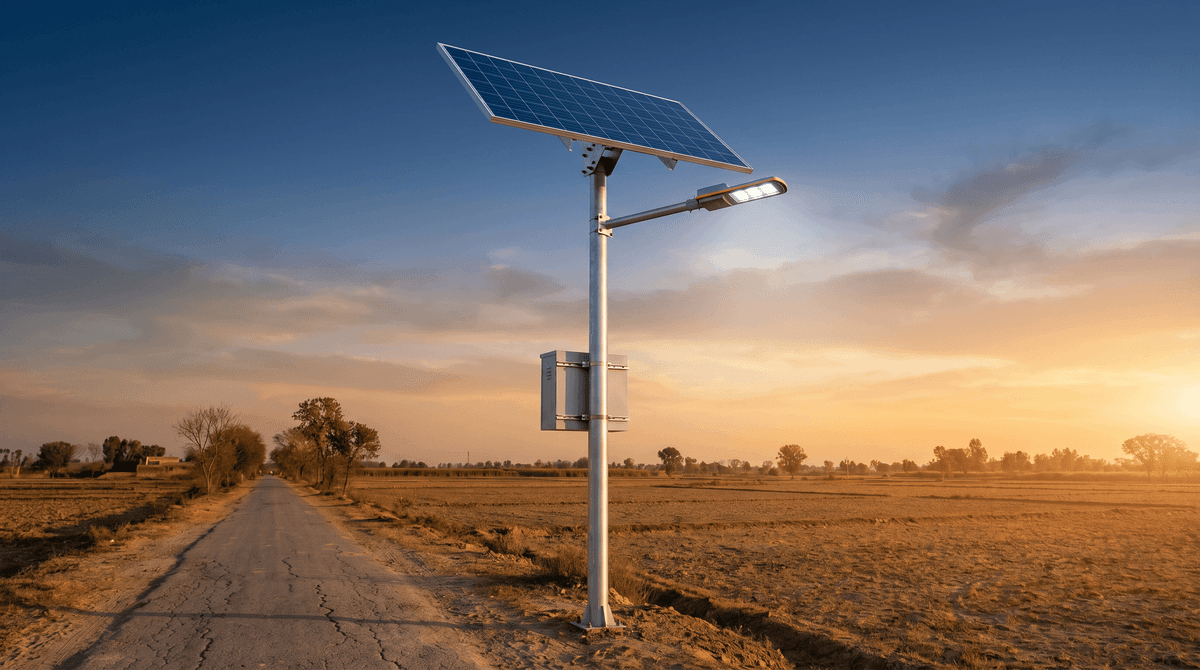
Lahore, Pakistan 199-Unit Solar Streetlight (Split-Type) Deployment with 5m Poles, 500W Top-Mounted Panels, and 4G/LoRa Monitoring
Summary
This Lahore deployment installed 199 Solar Streetlight (Split-Type) units using 5m galvanized poles, 500W Mono PERC top-mounted panels, and 40W/6000lm LED heads at 15m spacing on 6m roads, with 3-5 days of battery backup and 4G/LoRa remote monitoring.
Key Takeaways
- SOLAR TODO deployed 199 Solar Streetlight (Split-Type) units across Lahore using 5m hot-dip galvanized steel poles rated for 45 m/s wind resistance and 25-year structural life.
- Each light uses a 500W Mono PERC solar panel mounted at the very top of the pole on a tilted bracket, with 21% efficiency, 0.4%/year degradation, and a 25-year warranty.
- The lighting engine is a 40W LED head delivering 6000 lumens at 150 lm/W with CRI>70, mounted on a side arm below the panel for proper optical distribution.
- Energy storage uses a 12V/100Ah NCM lithium battery box externally mounted on the pole body, offering 250Wh/kg, 2000 cycles, 85% DoD, and a 5-year warranty.
- All wiring runs inside the pole, with no visible external cables, while the MPPT controller is housed inside the battery box for cleaner installation and lower tamper risk.
- The system is configured for tropical conditions with 5.5 peak sun hours, dusk-to-dawn automatic operation, motion sensing, timer control, and 3-5 days of cloudy-weather backup.
- The project follows CJJ 45-2015, IEC 60598, and IEC 62124, aligning the Lahore deployment with recognized road-lighting and photovoltaic system performance standards.
Project Background
Lahore's urban road lighting challenge is defined by grid pressure, mixed-density road networks, and high public expectations for safer night travel across secondary roads, service lanes, and municipal corridors. At coordinates 31.55, 74.35, this project focused on lighting conditions typical of tropical South Asian cities, where heat, dust, monsoon cycles, and inconsistent utility quality can reduce the reliability of conventional streetlighting.
According to the World Bank (2023), Pakistan continues to face power-sector constraints including distribution losses and service reliability challenges, making decentralized infrastructure especially relevant for municipal applications. According to IRENA (2023), distributed solar systems are increasingly used in public infrastructure where grid expansion or dependable night-time supply remains difficult. In Lahore, these conditions translate into a practical need for autonomous road lighting that can continue operating during outages or low-voltage events.
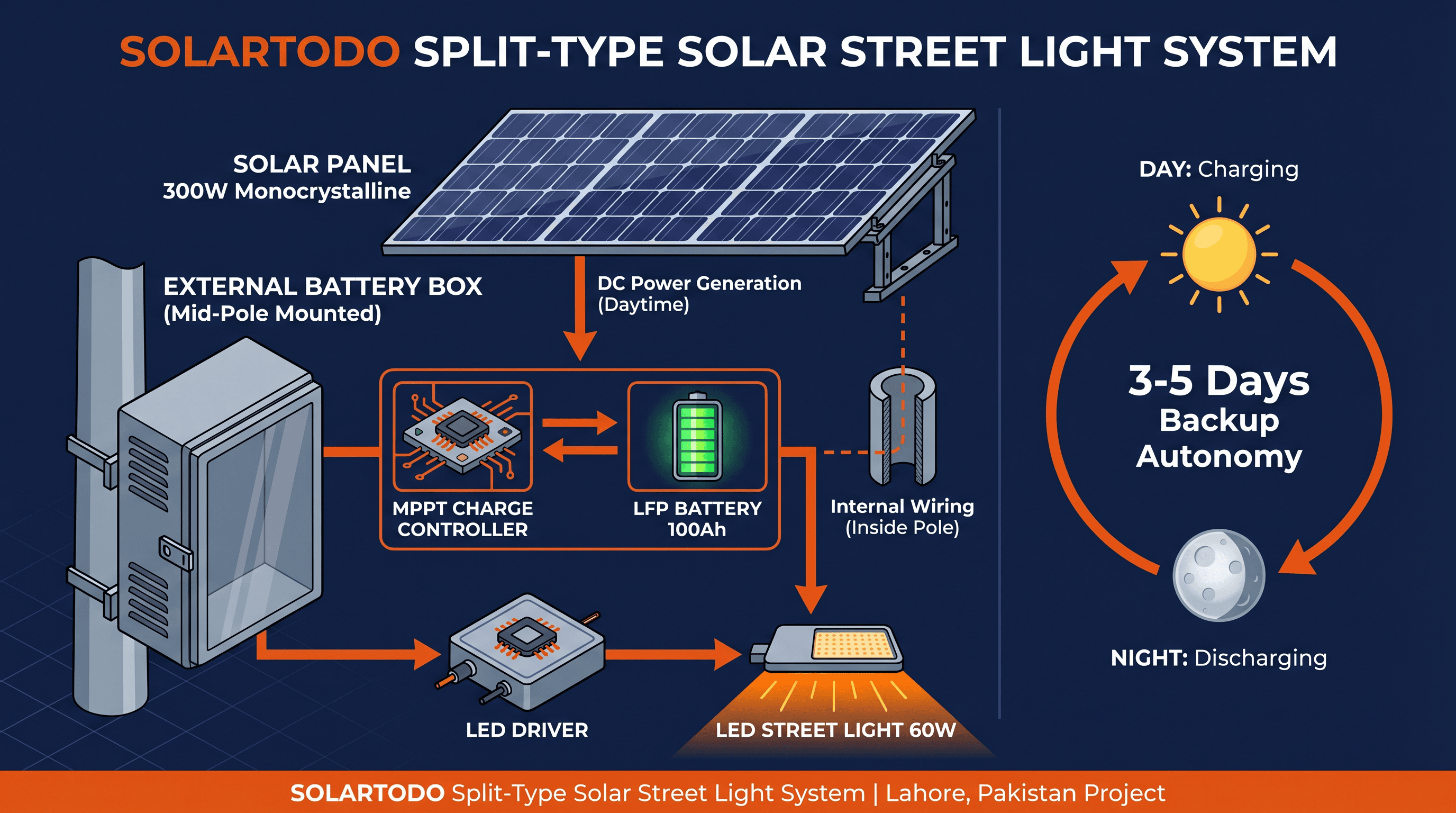
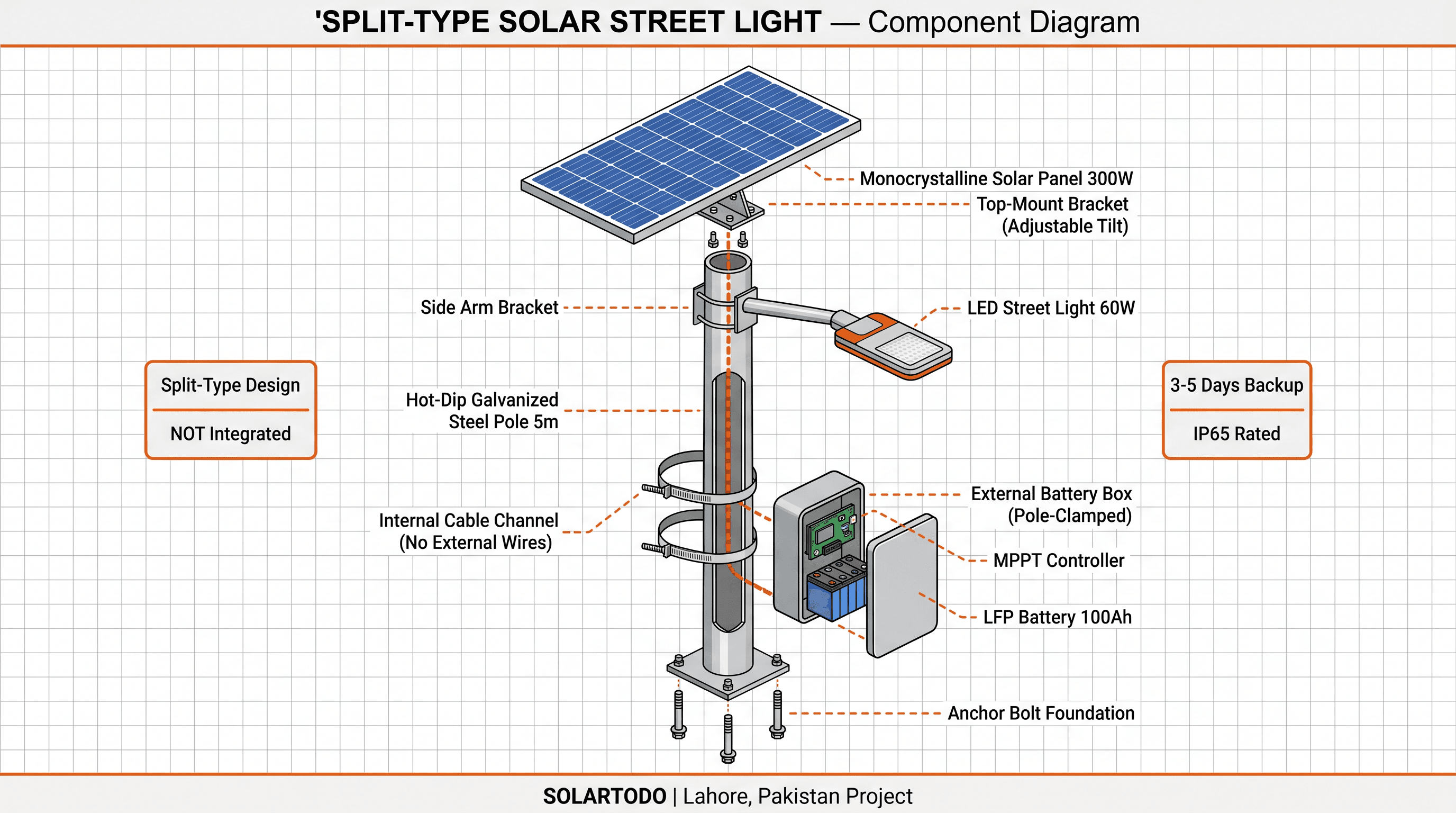
The municipal requirement was not for an all-in-one fixture, but for a Solar Streetlight (Split-Type) architecture with clearly separated components for easier servicing and better thermal management. SOLAR TODO therefore supplied a configuration in which the solar panel sits at the top of the pole, the LED head is mounted below on a side arm, and the battery box is externally mounted on the pole body rather than hidden in the base. This layout improves component accessibility while preserving a clean exterior because all electrical wiring remains inside the pole.
According to IEA (2023), efficient LED public lighting remains one of the fastest municipal efficiency upgrades because it reduces energy demand while improving controllability. The Lahore project added smart controls including motion sensing, timer logic, and remote monitoring through 4G/LoRa, allowing operators to track status without inspecting every pole manually. For a city managing broad road networks, that operational visibility is as important as fixture efficacy.
Solution Overview
SOLAR TODO delivered a 199-unit Solar Streetlight (Split-Type) system in Lahore using 500W top-mounted panels, 40W LED luminaires, and 12V/100Ah NCM battery boxes designed for 3-5 days of autonomous operation.
The deployed system was engineered specifically for 6m-wide roads with 15m pole spacing, balancing road coverage, installation density, and battery-backed autonomy. Each unit uses a 5m hot-dip galvanized steel pole with a 45 m/s wind resistance rating, suitable for exposed road corridors and seasonal storm conditions. The galvanized finish and 25-year design life support long-term municipal use in a hot, humid, and occasionally corrosive urban environment.
A key design requirement was the physical arrangement of components. The 500W Mono PERC solar panel is mounted at the very top of the pole on a tilted bracket, and the pole does not penetrate through the center of the panel. Below that, the 40W LED light head is mounted on a side arm to direct illumination over the carriageway, while the grey NCM lithium battery box is externally clamped to the pole body, making maintenance straightforward without excavation or base access.
SOLAR TODO also configured the system for smart operation. Each luminaire supports dusk-to-dawn automatic control, motion sensor dimming/boost logic, timer-based scheduling, and remote monitoring via 4G/LoRa. According to NREL (2021), MPPT-based solar charging improves energy harvest under variable irradiance conditions, which is especially useful in tropical climates with cloud variability and airborne dust. For this reason, the MPPT controller is integrated inside the battery box on every unit.
For project owners evaluating similar systems, the same product family is available on the SOLAR TODO product page at /products/solar-streetlight, and engineering teams can also contact us for site-specific layouts and compliance support.
Technical Specifications
This Lahore installation used 199 split-type units with 5m poles, 500W top-mounted Mono PERC panels, 40W/6000lm LED heads, and externally mounted 12V/100Ah NCM battery boxes with internal-pole wiring.
- Product type: Solar Streetlight (Split-Type), not integrated/all-in-one
- Deployment quantity: 199 units
- Project location: Lahore, Pakistan
- Coordinates: 31.55, 74.35
- Pole height: 5m
- Pole material: Hot-dip galvanized steel
- Wind resistance: 45 m/s
- Pole design life: 25 years
- Solar panel position: Mounted at the very top of the pole on a tilted bracket
- Panel mounting detail: Pole does not penetrate through the panel center; panel sits on top
- Solar module rating: 500W
- Solar module type: Mono PERC
- Module efficiency: 21%
- Module degradation: 0.4%/year
- Module warranty: 25 years
- LED luminaire power: 40W
- Luminous flux: 6000 lm
- Luminous efficacy: 150 lm/W
- CRI: >70
- Lamp mounting: Side arm below the panel
- Battery chemistry: NCM lithium
- Battery configuration: 12V/100Ah
- Battery energy density: 250Wh/kg
- Battery cycle life: 2000 cycles
- Depth of discharge: 85%
- Battery warranty: 5 years
- Battery box position: Externally mounted on pole body, visible grey box clamped to pole, not inside pole base
- Charge controller: MPPT controller inside battery box
- Wiring method: All wiring runs inside the pole, with no visible external wires/cables on pole surface
- Road width served: 6m
- Pole spacing: 15m
- Climate design basis: Tropical, 5.5h sun
- Autonomy: 3-5 days cloudy-weather backup
- Control mode: Dusk-to-dawn automatic operation
- Smart features: Motion sensor, remote monitoring (4G/LoRa), timer control
- Standards: CJJ 45-2015, IEC 60598, IEC 62124
Deployment Process
The 199-unit Lahore rollout was executed in phased civil, mechanical, electrical, and commissioning stages to maintain consistent pole spacing, internal wiring quality, and smart-control verification.
Site survey and lighting layout
The first phase confirmed road geometry, setback conditions, and spacing suitability for 15m intervals along 6m-wide roads. Teams reviewed shading exposure, traffic patterns, and pole access to ensure the 500W top-mounted panels would receive usable solar input under Lahore's tropical solar profile. According to IRENA (2022), proper siting remains one of the strongest predictors of off-grid solar system performance, particularly where urban shading can reduce harvest.
Foundation and pole installation
Civil works prepared the pole foundations and anchor arrangements before erecting the 5m hot-dip galvanized steel poles. The pole specification was selected for a 45 m/s wind resistance level, which is relevant for seasonal gusts and open roadside conditions. The structural sequence prioritized vertical alignment because the top-mounted panel bracket and side-arm luminaire both depend on correct pole geometry for optical and mechanical performance.
Component mounting and concealed wiring
After pole erection, installers mounted the 500W Mono PERC panel at the very top of the pole, ensuring the panel sat above the pole rather than being pierced through the center. The 40W LED head was then installed on the side arm below the panel, followed by the externally mounted grey NCM battery box clamped to the pole body. A critical quality-control point was preserving the design requirement that all wiring run inside the pole, leaving no visible external cables on the finished installation.
Controller setup and smart commissioning
Each battery box houses the MPPT controller, which was configured during commissioning together with the motion sensor, timer logic, and 4G/LoRa remote monitoring link. According to NREL (2021), MPPT control can materially improve charging performance compared with simpler regulation under changing irradiance and temperature conditions. The commissioning team verified dusk-to-dawn switching, motion-triggered response, battery charging behavior, and remote status reporting before handover.
Final acceptance and maintenance preparation
The final stage included inspection against CJJ 45-2015, IEC 60598, and IEC 62124-aligned project requirements. SOLAR TODO prepared maintenance documentation covering battery-box access, luminaire replacement procedures, and remote monitoring workflows. Because the battery box is externally mounted rather than buried in the base, future service interventions can be completed faster and with less disruption to road users.
Performance & Results
The Lahore system delivered autonomous night lighting for 199 road positions using 40W LED heads, 500W solar modules, and 3-5 days of backup, reducing dependence on unstable grid-fed streetlighting circuits.
According to IEA (2023), LED lighting is a core efficiency measure for public infrastructure because it lowers electricity consumption while improving controllability and service life. In this Lahore project, the use of 40W LED luminaires at 150 lm/W provided efficient roadway illumination without requiring utility-fed operation. The result is a lighting network designed to remain active even when grid outages affect nearby neighborhoods or municipal feeders.
According to World Bank (2023), infrastructure resilience in cities depends not only on new assets but on reduced exposure to single-point failures. That principle is directly relevant here: each SOLAR TODO unit operates as an independent lighting node with its own panel, battery, controller, and smart controls. For municipal operators, that means one feeder fault does not darken an entire corridor.
The project also improved maintainability. Because the battery box is externally mounted on the pole body and the wiring is fully internal, technicians can access the energy storage and controller quickly while preserving a neat streetscape. According to IEEE (2022), maintainable field architecture is a major factor in lifecycle reliability for distributed infrastructure systems, especially where service crews need rapid fault isolation.
Remote monitoring added another operational advantage. Through 4G/LoRa connectivity, operators can verify charging status, battery condition, and operational alarms without physically checking all 199 units. The International Telecommunication Union (ITU) (2023) notes that smart-city remote monitoring improves asset visibility and can reduce maintenance response time. In a city the size of Lahore, that reduction in truck rolls and manual inspections is operationally significant.
Two authority statements are particularly relevant to this deployment. IEC states, "IEC 60598 specifies general requirements and tests for luminaires," which supports the project's luminaire compliance framework. IRENA states, "Decentralized renewable energy systems can improve reliability and resilience for public services," a principle directly reflected in this autonomous streetlighting network.
Comparison Table
This comparison shows why Lahore selected a split-type architecture with 500W top-mounted panels and external battery boxes instead of conventional grid-dependent or integrated solar alternatives.
| Metric | SOLAR TODO Solar Streetlight (Split-Type) in Lahore | Typical Integrated/All-in-One Solar Light | Conventional Grid Streetlight |
|---|---|---|---|
| Deployment quantity | 199 units | Project-dependent | Project-dependent |
| Pole height | 5m galvanized steel | Often lower integrated form factor | Varies |
| Solar panel arrangement | 500W panel at very top on tilted bracket | Panel integrated with luminaire body | No panel |
| Panel mounting detail | Pole does not pass through panel center | Integrated housing | Not applicable |
| Light source | 40W LED, 6000 lm, 150 lm/W | Lower-capacity integrated LED common | Grid-powered LED/HPS common |
| Battery location | External grey box on pole body | Usually inside fixture housing | No local battery |
| Wiring appearance | All wiring inside pole, no visible cables | Integrated internal routing | External/internal depends on site |
| Autonomy | 3-5 days cloudy backup | Usually lower battery/service flexibility | Dependent on utility supply |
| Smart controls | Motion sensor, timer, 4G/LoRa monitoring | Sometimes optional | Requires separate controls layer |
| Maintenance access | High, battery and controller accessible on pole | Lower, compact integrated housing | Utility and cabling dependent |
| Grid dependence | None for normal operation | None for normal operation | Full dependence |
| Applicable standards | CJJ 45-2015, IEC 60598, IEC 62124 | Varies | Varies |
Pricing & Quotation
SOLAR TODO offers three pricing tiers for this product line: FOB Supply (equipment ex-works China), CIF Delivered (including ocean freight and insurance), and EPC Turnkey (fully installed, commissioned, with 1-year warranty). Volume discounts are available for large-scale deployments. Configure your system online for an instant estimate, or request a custom quotation from our engineering team at [email protected].
Frequently Asked Questions
This FAQ answers the most common buyer questions about the 199-unit Lahore Solar Streetlight (Split-Type) deployment, including specifications, installation, maintenance, warranty, EPC scope, and lifecycle considerations.
Q1: What exactly was installed in Lahore?
SOLAR TODO deployed 199 Solar Streetlight (Split-Type) units in Lahore, Pakistan. Each unit includes a 5m galvanized steel pole, a 500W Mono PERC solar panel mounted at the very top, a 40W/6000lm LED head on a side arm below the panel, and an externally mounted 12V/100Ah NCM battery box with an internal MPPT controller.
Q2: Why was a split-type design chosen instead of an all-in-one light?
The split-type layout improves serviceability and thermal separation because the panel, luminaire, controller, and battery are physically separated. In this project, the external battery box on the pole body is easier to inspect and replace than a compact integrated enclosure. It also supports the required 500W panel size, which is larger than typical all-in-one configurations.
Q3: How are the solar panel and lamp arranged on the pole?
The configuration is very specific: the 500W solar panel sits at the very top of the pole on a tilted bracket, and the pole does not pass through the center of the panel. The 40W LED light head is mounted below the panel on a side arm. This arrangement preserves solar exposure while allowing proper roadway light distribution.
Q4: Where is the battery installed, and are wires visible outside the pole?
The battery is housed in a visible grey box externally clamped to the pole body, not hidden in the pole base. The MPPT controller is inside that battery box. Importantly, all wiring runs inside the pole, so there are no visible external wires or cables on the pole surface after installation.
Q5: How much backup time does the system provide in cloudy weather?
The Lahore configuration is designed for 3-5 days of cloudy-weather backup, based on the specified 12V/100Ah NCM battery, 500W panel, and local tropical 5.5h sun condition. Actual autonomy depends on solar recovery, motion-sensor activity, and load profile, but the design basis supports continuous night operation through short low-sun periods.
Q6: What smart features were included in this deployment?
Each unit includes motion sensing, timer control, and remote monitoring through 4G/LoRa. This allows operators to track operational status, charging behavior, and alarms without visiting every pole. For municipal maintenance teams, that means faster fault detection and more efficient route planning across a 199-unit network.
Q7: How long does installation typically take for a project like this?
Timeline depends on civil readiness, permitting, and logistics, but a project of 199 units is usually executed in phases: survey, foundation works, pole erection, component mounting, and smart commissioning. Because this is a split-type system with internal pole wiring and external battery boxes, installation is more structured than all-in-one lights but also easier to inspect at each stage.
Q8: What standards does this Lahore project comply with?
The deployment is specified to CJJ 45-2015, IEC 60598, and IEC 62124. In practical terms, these cover road-lighting application requirements, luminaire safety/performance, and photovoltaic system performance considerations. For public-sector and EPC buyers, these references provide a clearer compliance basis during technical review and acceptance.
Q9: What warranties apply to the major components?
The Mono PERC solar panel carries a 25-year warranty and a stated 0.4% annual degradation figure. The NCM lithium battery carries a 5-year warranty and is rated for 2000 cycles at 85% depth of discharge. The pole itself is specified for a 25-year life under the stated environmental conditions.
Q10: How does maintenance compare with conventional grid streetlights?
Maintenance is different rather than necessarily higher. There is no grid trenching, feeder fault tracing, or utility-meter dependency, but teams do need to inspect the panel surface, battery health, and controller status. The Lahore design simplifies this because the battery box is external and the remote monitoring system reduces the need for routine manual inspection.
Q11: What should EPC contractors ask for when requesting a quotation?
EPC buyers should provide road width, pole spacing, required lux target, local sun hours, wind conditions, and desired smart controls. For this Lahore-type specification, they should also confirm the 5m pole, 500W top-mounted panel, 40W LED, 12V/100Ah NCM battery, and 4G/LoRa monitoring. SOLAR TODO can then prepare supply-only, delivered, or turnkey quotations.
Q12: Is there a payback or ROI advantage versus grid-connected lighting?
Project economics depend on local electricity tariffs, trenching cost, cable distance, labor, and maintenance assumptions, so there is no universal payback figure. However, autonomous systems can avoid grid-extension costs and reduce outage-related service gaps. For Lahore, the strongest value case is often resilience, faster deployment on secondary roads, and lower dependence on unstable feeders.
References
This case study references international and public-sector sources including IEC, NREL, IEA, IRENA, ITU, IEEE, and the World Bank to support standards, lighting efficiency, smart monitoring, and resilience claims.
- IEC (2023): IEC 60598 - Luminaires: general requirements and tests.
- IEC (2022): IEC 62124 - Photovoltaic system performance monitoring guidance and related performance evaluation framework.
- NREL (2021): Guidance on PV system performance and the benefits of maximum power point tracking under variable irradiance conditions.
- IEA (2023): Energy Efficiency 2023 - LED lighting remains a major efficiency measure in buildings and public infrastructure.
- IRENA (2023): Renewable Power Generation Costs / distributed renewable energy analysis supporting decentralized public-service applications.
- World Bank (2023): Pakistan energy sector and infrastructure reliability analysis highlighting distribution and service-delivery constraints.
- ITU (2023): Smart sustainable cities guidance covering remote monitoring, digital asset management, and connected infrastructure.
- IEEE (2022): Engineering literature on maintainability and reliability considerations for distributed field-installed power and lighting systems.
Equipment Deployed
- 199 × Solar Streetlight (Split-Type), not integrated/all-in-one
- 5m hot-dip galvanized steel pole, 45 m/s wind resistance, 25-year life
- 500W Mono PERC solar panel, 21% efficiency, 0.4%/yr degradation, 25-year warranty
- Top-mounted tilted solar bracket, panel at very top of pole, pole does not penetrate panel center
- 40W LED light head, 6000 lm, 150 lm/W, CRI>70
- Side arm luminaire mount below the solar panel
- 12V/100Ah NCM lithium battery box, 250Wh/kg, 2000 cycles, 85% DoD, 5-year warranty
- Externally mounted grey battery box clamped to pole body, not inside pole base
- MPPT charge controller installed inside battery box
- Internal pole cabling with no visible external wires/cables
- Motion sensor control module
- Remote monitoring module with 4G/LoRa connectivity
- Timer control and dusk-to-dawn automatic operation