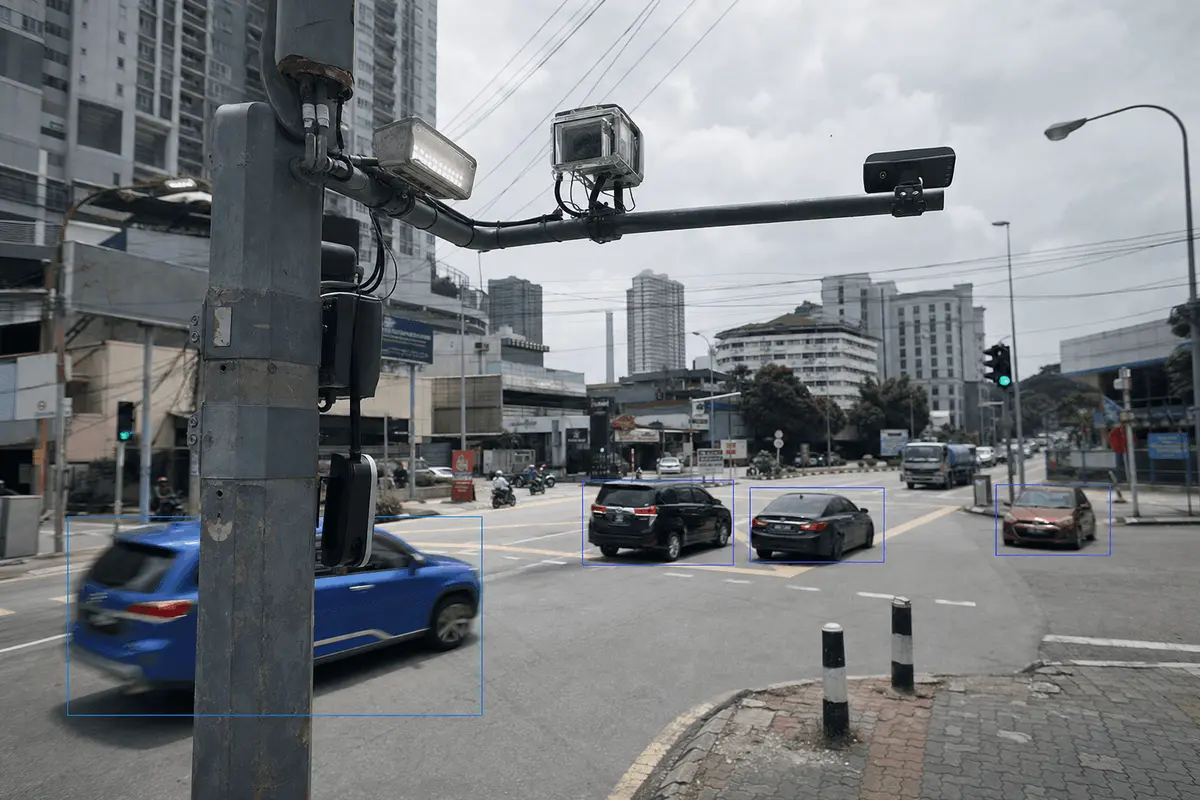
Kuala Lumpur Smart Traffic System Market Analysis: 29-Intersection 6m L-Arm Configuration Guide
Summary
Kuala Lumpur’s dense urban road network, 1.98 million city population, and year-round heavy rainfall support a recommended Smart Traffic System layout of approximately 29 intersections using 6m L-arm poles, 5G/fiber backhaul, and 45-type AI detection with sub-50ms edge response.
Key Takeaways
A 29-intersection Kuala Lumpur deployment profile would typically use 29 intersections × 6m dark-grey hot-dip galvanized L-arm steel poles with integrated sensing and signaling.
- Kuala Lumpur City Hall reports 1.98 million residents in the city proper, which supports high junction monitoring density on arterial corridors and CBD approaches.
- According to Malaysia’s Department of Statistics, Greater Kuala Lumpur exceeds 8 million population, increasing peak-hour pressure on signalized intersections and bus-priority routes.
- A typical configuration for this profile uses 6m L-arm poles, not 8m or 10m, because dense urban junctions require compact mast geometry and lower visual obstruction.
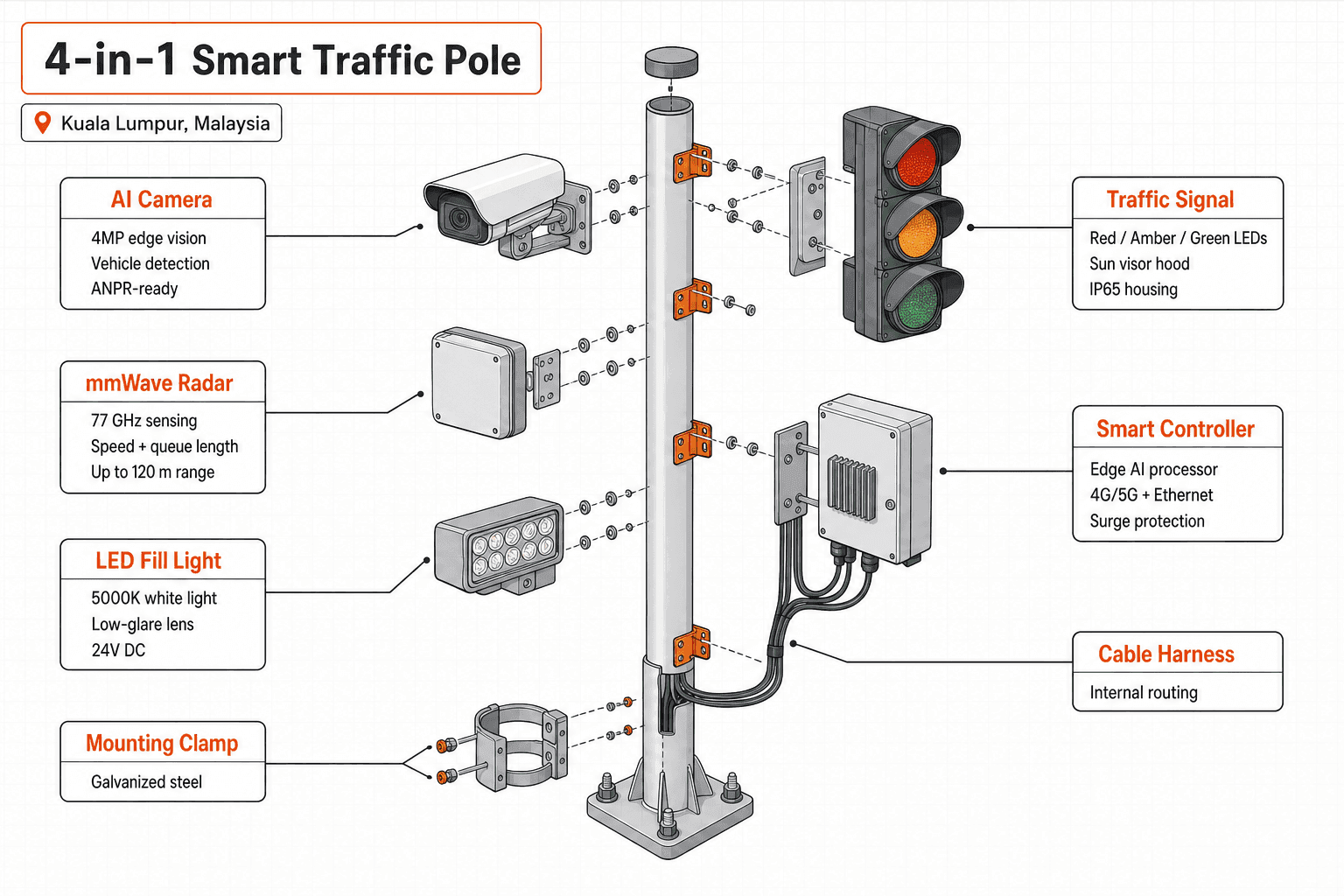
- Each pole combines 4 modules: 4K AI camera, 77GHz mmWave radar, LED fill light, and LED signal head, reducing separate roadside hardware counts.
- Edge processing on NVIDIA Jetson supports 45+ detection types, 98% detection accuracy, and <50ms response, which is suitable for adaptive signal timing and emergency priority logic.
- Backhaul should support 5G and fiber to a central TrafficGPT platform, allowing natural-language traffic queries and corridor-level management across 29 intersections.
- Standards alignment should include NTCIP for traffic device communications and GB 25280 for signal equipment consistency, with local civil and electrical works checked against Malaysian authority requirements.
- For a Kuala Lumpur EPC profile, a phased rollout of 29 intersections would typically be commissioned in 3 phases, limiting lane closure risk during monsoon periods that often exceed 2,400mm annual rainfall.
Market Context for Kuala Lumpur
Kuala Lumpur is a high-density urban traffic environment where a 29-intersection intelligent control package can address congestion, incident detection, and priority signaling more effectively than isolated camera-only upgrades.
Kuala Lumpur has a resident population of about 1.98 million, according to Kuala Lumpur City Hall, while the wider metropolitan area is much larger and generates heavy daily commuting flows into the city core. According to the Department of Statistics Malaysia (2024), the Klang Valley remains the country’s dominant urban and economic cluster, which means arterial corridors, mixed-use junctions, and transit-adjacent intersections carry high directional variability. For a Smart Traffic System, that matters because fixed-time signals often underperform when turning volumes, bus arrivals, and incident conditions change every 5 to 15 minutes.
Climate is another design driver. According to the Malaysian Meteorological Department, Kuala Lumpur experiences tropical rainfall patterns with annual precipitation commonly above 2,400mm and frequent short-duration high-intensity storms. That supports using radar-plus-camera sensing rather than camera-only detection, because 77GHz mmWave radar continues vehicle tracking in glare, spray, and low-visibility conditions where optical confidence can drop. A 6m mounting height is also practical in urban streets because it keeps maintenance access simpler than 10m gantry-class structures while preserving line-of-sight over multiple lanes.
Telecom and digital infrastructure are favorable for centralized traffic analytics. According to the Malaysian Communications and Multimedia Commission (MCMC) (2024), 4G population coverage is near-universal and 5G rollout in major urban centers has progressed rapidly under Digital Nasional Berhad. That means Kuala Lumpur can support a hybrid 5G/fiber communications design, with fiber on primary corridors and 5G fallback or interim connectivity on junctions awaiting civil duct access. For SOLARTODO, this is the right context for an edge-plus-center architecture rather than a standalone local controller only.
Policy direction also supports intelligent transport systems. According to Kuala Lumpur Structure Plan and broader Malaysia digital-city initiatives, the city continues to prioritize public transport integration, traffic efficiency, and safer road operations. The World Bank (2023) notes that congestion in fast-growing metropolitan regions reduces productivity and raises logistics costs, especially where junction delay compounds over short urban trips. A Smart Traffic System in Kuala Lumpur should therefore be evaluated as transport infrastructure, not only as signal hardware.
Two authority statements are relevant here. The International Telecommunication Union states, "Smart sustainable cities use information and communication technologies to improve quality of life, efficiency of urban operation and services, and competitiveness." The International Energy Agency states, "Digitalisation can make transport systems safer, more efficient and more sustainable." Both points fit Kuala Lumpur’s need for measurable corridor control with real-time data rather than manual timing revisions every few months.
Recommended Technical Configuration
For Kuala Lumpur’s compact urban intersections, a typical 29-intersection deployment would use 6m L-arm poles with integrated AI sensing, radar detection, LED signaling, and 5G/fiber backhaul to a central TrafficGPT platform.
Based on the provided project-specific configuration, the recommended profile is 29 intersections × 6m L-arm steel pole in dark grey, hot-dip galvanized finish. This is the correct size class because the product line defines 6m, 8m, and 10m variants, and Kuala Lumpur’s CBD and secondary arterial intersections generally favor lower mast heights for municipal streets rather than highway gantries. The 6m option supports signal visibility, radar field coverage, and camera analytics without the larger foundation footprint of a 10m to 12m highway structure.
A typical deployment of this scale would consist of approximately 29 intersection control points, each equipped with a 4-in-1 smart traffic pole integrating a 4K AI camera, 77GHz mmWave radar, LED fill light, and LED signal head. Edge processing should run on NVIDIA Jetson, enabling 45-type detection, adaptive signal control, emergency vehicle priority, and wrong-way alert functions at the pole level. The specified 98% detection accuracy and <50ms response are suitable for local decision support before data is passed upstream.
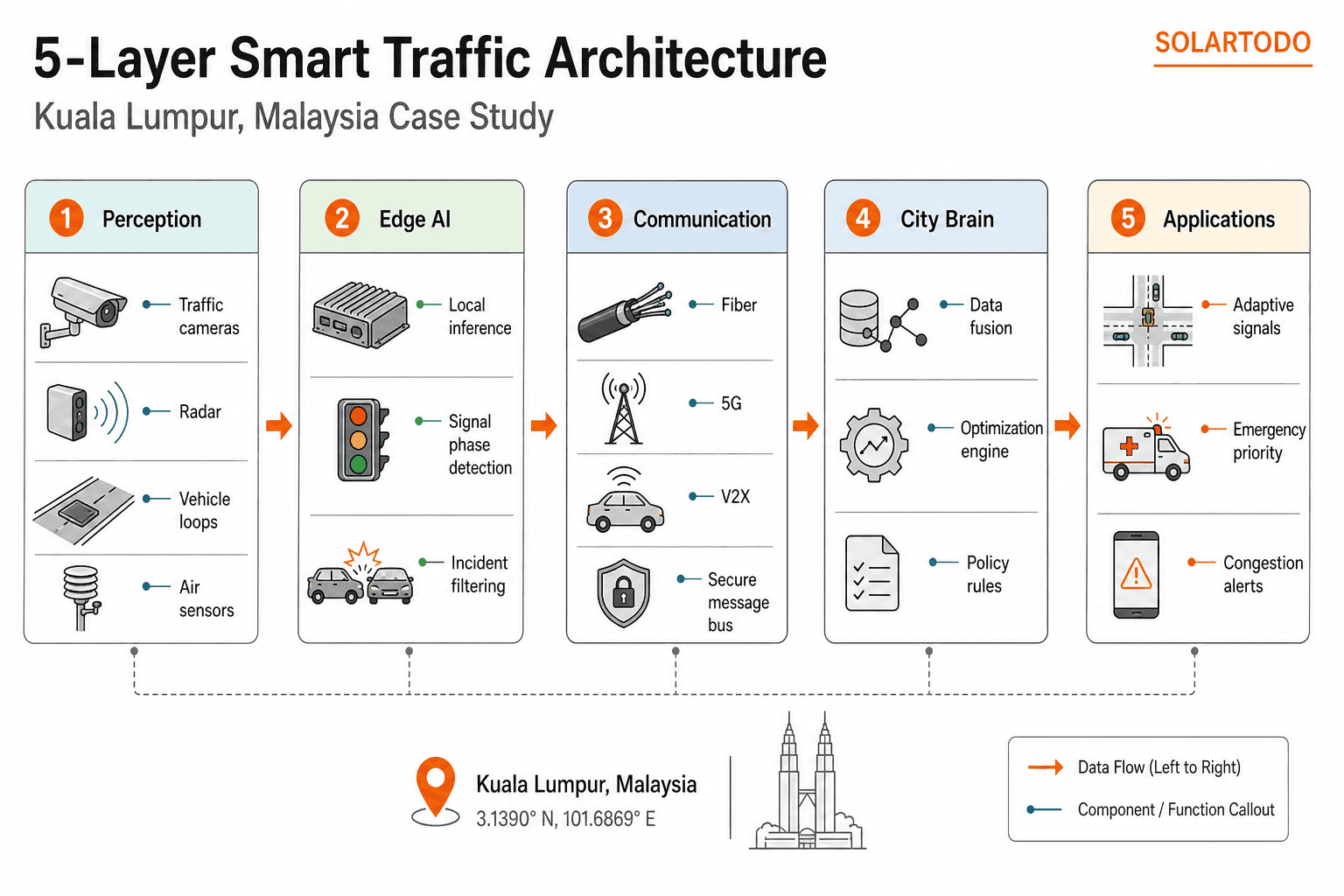
For communications, the recommended architecture is a 5-layer stack: Perception → Edge AI → Comm (5G/fiber) → City Brain (TrafficGPT) → Apps. In Kuala Lumpur, this matters because some intersections will have direct municipal or utility duct access for fiber, while others may depend first on carrier 5G. A mixed backhaul design reduces rollout delay across 29 intersections and allows corridor activation before all civil works are complete. SOLARTODO’s Smart Traffic System fits this model because the sensing and edge logic remain local even when central bandwidth varies.
The cooperation model specified here is EPC turnkey, which is usually the most suitable structure for city traffic packages involving civil works, controller integration, utility coordination, and staged commissioning. BOT can fit revenue-linked smart city assets, but traffic signals are often budgeted as municipal capex or transport infrastructure. For Kuala Lumpur, EPC also simplifies interface risk across foundations, pole erection, signal integration, communications, and platform acceptance.
Readers evaluating corridor-level rollout can review the product scope on the Smart Traffic System page or contact us for intersection drawings, controller interfaces, and quotation inputs. SOLARTODO should be assessed here as a configuration and supply partner for urban ITS infrastructure, not as a claimed past installer in Kuala Lumpur.
Technical Specifications
The recommended Kuala Lumpur specification is a 29-intersection EPC configuration using 6m L-arm galvanized steel poles, 4-in-1 sensing, NVIDIA Jetson edge AI, and NTCIP/GB 25280 communications and signal compliance.
- Deployment scale: approximately 29 intersections
- Pole type: L-arm steel pole
- Pole height: 6m
- Pole finish: dark grey, hot-dip galvanized
- Integrated modules per pole: 4K AI camera + 77GHz mmWave radar + LED fill light + LED signal head
- AI edge hardware: NVIDIA Jetson
- Detection capability: 45-type detection
- Detection accuracy: 98%
- Response latency: <50ms
- Core functions: adaptive signal control, emergency vehicle priority, wrong-way alert
- Backhaul: 5G/fiber
- Central platform: TrafficGPT with natural-language queries
- Cooperation model: EPC turnkey
- Signal/device standards: NTCIP, GB 25280
From an engineering standpoint, the 6m pole height is appropriate for urban signal heads and roadside sensing where lane groups are moderate and mast-arm overreach is limited. According to NTCIP guidance, standardized communications reduce controller and field-device interoperability risk, especially when adaptive logic and central software are introduced across more than 20 intersections. Hot-dip galvanizing is also relevant in Kuala Lumpur’s humid conditions because corrosion resistance directly affects lifecycle cost over 10 to 15 years.
A radar-plus-camera stack is stronger than camera-only layouts in tropical cities. According to the IEA (2023), digital transport systems perform better when data continuity is maintained during variable operating conditions. In practical terms, 77GHz mmWave radar supports speed, presence, and trajectory tracking in rain events, while the 4K AI camera provides classification detail for 45 detection types including mixed traffic, pedestrian activity, queue presence, and event anomalies.
Implementation Approach
A 29-intersection Kuala Lumpur rollout would typically be executed in 3 phases over roughly 6 to 9 months, with civil, electrical, communications, and software acceptance managed under one EPC package.
Phase 1 is survey and design. This usually includes topographic checks, utility conflict review, signal visibility study, and communications planning for all 29 intersections. In Kuala Lumpur, this stage should also verify drainage conditions because foundation design and cabinet placement can be affected by intense rainfall and roadside ponding. A practical design package would define pole orientation, arm outreach, radar aiming, camera field-of-view, and fiber/5G topology before procurement starts.
Phase 2 is procurement and factory integration. For a 29-intersection package, the EPC contractor would typically consolidate poles, signal heads, edge AI units, radar modules, and communications equipment into a single bill of materials. Factory acceptance testing should verify <50ms edge response, 98% detection logic, NTCIP communications, and TrafficGPT data mapping before shipment. This stage is where SOLARTODO equipment compatibility, controller protocol mapping, and enclosure configuration should be locked.
Phase 3 is civil works and staged commissioning. Foundations, anchor bolts, conduits, cabinets, and backhaul links would usually be completed corridor by corridor to reduce lane occupation. On busy Kuala Lumpur roads, night work windows of 4 to 6 hours are often more realistic than daytime closures. After erection, each intersection should undergo calibration for stop-line detection, wrong-way rule logic, emergency vehicle priority, and adaptive phase tuning.
A sensible acceptance plan would include 72-hour burn-in testing per corridor and 30-day performance observation after live activation. According to IEEE traffic systems practice, commissioning should verify not only device uptime but also event accuracy, timestamp integrity, and fail-safe signal behavior. For municipal buyers, this is the point where EPC scope needs to be explicit: foundations, controllers, cabinets, fiber patching, software licenses, and training should all be listed line by line.
Expected Performance & ROI
For a 29-intersection Kuala Lumpur profile, the expected value comes from delay reduction, fewer field devices, faster incident response, and lower maintenance dispatches rather than from one single headline metric.
Adaptive signal systems can produce measurable corridor benefits when detection quality is high. According to the U.S. Federal Highway Administration, adaptive signal control technologies often reduce travel time by more than 10%, with some corridors achieving larger improvements depending on baseline congestion. In Kuala Lumpur, where intersection saturation can change quickly during rain, school peaks, and event traffic, the combination of 45-type detection and <50ms edge response supports faster phase adjustments than manual retiming cycles.
Maintenance economics also favor integrated poles. A conventional junction may require separate camera posts, radar brackets, signal poles, fill lights, and communication mounts. A 4-in-1 pole reduces hardware interfaces and can lower inspection points by roughly 25% to 40%, depending on existing roadside clutter. According to IRENA (2023), digital infrastructure projects gain lifecycle value when asset monitoring and predictive maintenance are built into the operating model rather than treated as afterthoughts.
For ROI, municipal buyers usually look at avoided delay, reduced incident exposure, and O&M savings over 5 to 10 years. A typical EPC buyer might model payback in 3 to 6 years if the corridor has high daily vehicle throughput, recurring queue spillback, and expensive manual traffic management. The exact figure depends on labor cost, communications leasing, civil complexity, and whether the city already has a traffic management center. SOLARTODO should therefore quote both capex and annual O&M assumptions, not only hardware cost.
Results and Impact
For Kuala Lumpur, a 29-intersection Smart Traffic System would typically target 10%+ travel-time improvement, sub-minute incident awareness, and stronger wet-weather detection resilience through radar-plus-camera sensing.
The first expected impact is better signal timing under variable demand. With 45 detection types and <50ms local response, intersections can react to queue formation, turning imbalance, pedestrian calls, and emergency vehicle approach faster than fixed-time plans. The second impact is data quality. A central TrafficGPT layer allows operators to query conditions across 29 intersections in natural language, which can shorten troubleshooting and reporting cycles.
The third impact is operational standardization. Using the same 6m L-arm form factor, the same NVIDIA Jetson edge platform, and the same NTCIP communications model across all sites makes spare parts, training, and firmware management easier. For Kuala Lumpur, that consistency matters because mixed legacy devices often increase maintenance time and slow fault isolation.
Comparison Table
For Kuala Lumpur, a 6m integrated Smart Traffic System pole is generally a better fit than separate roadside devices or taller gantry-class structures at standard urban intersections.
| Configuration Option | Recommended Use in Kuala Lumpur | Pole Height | Sensing Stack | Response | Backhaul | Civil Complexity | Operational Notes |
|---|---|---|---|---|---|---|---|
| SOLARTODO Smart Traffic System, 6m L-arm | Standard urban intersections, CBD approaches, secondary arterials | 6m | 4K AI camera + 77GHz radar + LED fill light + LED signal | <50ms | 5G/fiber | Medium | Best fit for the specified 29-intersection profile |
| 8m integrated pole | Wider junctions with larger signal sightline needs | 8m | Similar integrated stack | <50ms if same edge hardware | 5G/fiber | Medium-high | Useful where lane groups are wider, but not necessary for most compact KL junctions |
| 10m/12m highway gantry-class pole | Expressways, large interchanges, multi-lane ramps | 10-12m | Camera/radar with larger coverage envelope | <50ms if same edge hardware | Fiber preferred | High | Better for highway geometry, excessive for many city intersections |
| Conventional separate devices | Legacy retrofit with fragmented assets | Varies | Separate camera, radar, signal, light | Varies | Varies | High | More brackets, more poles, more maintenance points |
Pricing & Quotation
SOLARTODO offers three pricing tiers for this product line: FOB Supply (equipment ex-works China), CIF Delivered (including ocean freight and insurance), and EPC Turnkey (fully installed, commissioned, with 1-year warranty). Volume discounts are available for large-scale deployments. Configure your system online for an instant estimate, or request a custom quotation from our engineering team at [email protected].
Frequently Asked Questions
A Kuala Lumpur Smart Traffic System buyer typically asks about pole height, detection accuracy, EPC scope, maintenance intervals, and ROI over a 3 to 6 year operating horizon.
Q1: Why is 6m the recommended pole height for Kuala Lumpur instead of 8m or 10m?
For standard Kuala Lumpur urban intersections, 6m is usually sufficient for signal visibility, radar coverage, and camera analytics without the larger foundation and visual impact of 8m to 10m structures. Taller poles are more suitable for wide expressway ramps or gantry-style applications, not compact city junctions.
Q2: What exactly is integrated into each Smart Traffic System pole?
Each pole combines 4 modules: a 4K AI camera, 77GHz mmWave radar, LED fill light, and LED signal head. The edge processor is NVIDIA Jetson, which supports 45-type detection, adaptive signal control, emergency vehicle priority, and wrong-way alert in one roadside assembly.
Q3: How accurate is the detection system in heavy rain?
The specified performance is 98% detection accuracy with <50ms response, but actual field performance depends on calibration, lane geometry, and maintenance. In Kuala Lumpur’s high-rainfall climate, the 77GHz radar is important because it maintains presence and speed tracking when camera visibility is reduced by spray or glare.
Q4: How long would a 29-intersection EPC rollout typically take?
A typical 29-intersection package would take about 6 to 9 months including survey, design, procurement, civil works, communications, and staged commissioning. If fiber ducts already exist on most corridors, the schedule may be shorter. Monsoon-season trenching and traffic management approvals can extend the timeline.
Q5: What communications architecture is recommended for Kuala Lumpur?
A hybrid 5G/fiber architecture is usually the best fit. Fiber should serve high-priority corridors and central nodes, while 5G can support interim links or locations where duct access is delayed. This reduces rollout bottlenecks and still allows the TrafficGPT platform to aggregate data from all 29 intersections.
Q6: What is the expected ROI or payback period?
Municipal ROI is usually modeled through reduced delay, lower incident response time, and fewer maintenance dispatches rather than direct revenue. For a busy urban corridor, payback is often assessed in the 3 to 6 year range, depending on civil cost, communications fees, and the value assigned to travel-time savings.
Q7: What maintenance does the system require each year?
A practical O&M plan includes 2 to 4 inspections per year, lens cleaning, radar alignment checks, cabinet checks, firmware updates, and signal head verification. Kuala Lumpur’s humidity and rainfall make enclosure sealing and corrosion inspection important. Integrated poles usually reduce maintenance points compared with separate roadside devices.
Q8: How does this compare with a camera-only smart intersection upgrade?
Camera-only systems can work in fair weather, but Kuala Lumpur’s rainfall profile makes radar support valuable. The 77GHz mmWave radar improves detection continuity in low visibility, while the 4K camera adds classification detail. Together they provide more stable adaptive control than optical sensing alone during wet conditions.
Q9: What is usually included in EPC turnkey pricing?
EPC turnkey typically includes poles, integrated sensing modules, signal heads, edge AI hardware, foundations, cabinets, wiring, communications integration, installation, testing, and commissioning. Buyers should confirm whether fiber trenching, traffic management permits, controller replacement, and software licenses are included, because those items can change total project cost materially.
Q10: What warranty should buyers expect?
The standard paragraph for this product line specifies 1-year warranty under EPC Turnkey. For public-sector procurement, buyers often request optional extended support covering spare parts, remote diagnostics, and software maintenance for 3 to 5 years. Warranty terms should clearly separate hardware defects from accidental damage and third-party network faults.
References
- Kuala Lumpur City Hall (DBKL) (2024): City profile and population data for Kuala Lumpur, approximately 1.98 million residents.
- Department of Statistics Malaysia (2024): Greater Kuala Lumpur / Klang Valley demographic and urbanization statistics used for traffic demand context.
- Malaysian Meteorological Department (2024): Kuala Lumpur rainfall and tropical climate data, with annual precipitation commonly above 2,400mm.
- Malaysian Communications and Multimedia Commission (MCMC) (2024): National mobile broadband and 5G coverage data relevant to 5G/fiber backhaul planning.
- International Telecommunication Union (ITU) (2022): Smart sustainable city framework and ICT role in urban service efficiency.
- International Energy Agency (IEA) (2023): Digitalisation in transport systems and the role of data in safety and operational efficiency.
- U.S. Federal Highway Administration (FHWA) (2023): Adaptive Signal Control Technologies guidance, including travel-time improvement benchmarks often exceeding 10%.
- NTCIP (latest applicable edition): National Transportation Communications for Intelligent Transportation System Protocol for interoperable traffic device communications.
- GB 25280 (latest applicable edition): Traffic signal-related equipment standard referenced for product compliance alignment.
Equipment Deployed
- 29 intersections × 6m L-arm steel pole, dark grey, hot-dip galvanized
- 4-in-1 Smart Traffic System pole assembly
- 4K AI camera, 98% detection accuracy, <50ms response
- 77GHz mmWave radar for all-weather vehicle detection
- LED fill light integrated on pole
- LED signal head integrated on pole
- NVIDIA Jetson edge AI processor
- 45-type detection software package
- Adaptive signal control function
- Emergency vehicle priority function
- Wrong-way alert function
- 5G/fiber backhaul connection
- TrafficGPT central platform with natural-language queries
- NTCIP communication compliance
- GB 25280 signal equipment compliance
- EPC turnkey delivery model