Kinshasa Smart Streetlight Market Analysis: 10m Multi-Function Pole Configuration Guide for Urban Corridors
Summary
Kinshasa’s urban corridors would typically suit an approximately 230-unit, 10m smart streetlight deployment at 28m spacing, combining 2×80W LED lighting, 11kW Type 2 EV charging, and 5G n78 small cells. According to the World Bank (2024) and ITU (2023), rapid urban growth and digital access gaps make multi-function poles relevant for road lighting, public safety, and telecom densification.
Key Takeaways
- A typical Kinshasa arterial-road package would use approximately 230 units of 10m octagonal tapered steel poles at 28m spacing, covering roughly 6.4 km of corridor.
- Each pole would combine 2×80W LED luminaires at 150 lm/W and 4000K, giving 160W total fixture load with twin 1.5m arms tilted +8°.
- The recommended EV format is an integrated 11kW single-gun AC charger with Type 2 connector, OCPP 1.6J, 5m coiled cable, and 8-inch touchscreen at 1.5m height.
- Public-safety hardware would include 1× 4MP bullet camera with IR 50m, 1× SOS button, and 2× IP audio columns rated 30W/93dB each.
- Environmental monitoring would use a 12-parameter sensor covering meteorology, air quality, rain, and CO/NO2/O3, which is broader than the standard 8-in-1 package.
- Telecom-ready configuration would place a 5G NR n78 small cell at 8.7m, using 4T4R MIMO and an estimated 200m coverage radius in dense streets.
- The LED display format specified here is a P5 portrait screen, 1280×2560mm, above 5000 cd/m², with content restricted to “SOLARTODO Smart City” text only.
- Based on IEA and World Bank urban-infrastructure benchmarks, a multi-function pole can reduce separate civil works by consolidating lighting, surveillance, telecom, and charging into 1 steel structure rather than 4 standalone assets.
Market Context for Kinshasa
Kinshasa, with a metropolitan population above 17 million and fast annual growth, needs dense urban infrastructure that fits constrained road reserves and uneven utility service levels. According to the World Bank (2024), the Democratic Republic of the Congo remains one of the least electrified large countries in Sub-Saharan Africa, while UN-Habitat (2024) notes that Kinshasa is among Africa’s fastest-growing megacities, increasing pressure on roads, lighting, and public-service access.
For smart streetlight planning, the relevant point is not only population size but corridor intensity. According to the African Development Bank (2023), Kinshasa faces major transport bottlenecks and requires continued investment in urban mobility and public-space safety. A 10m city-street pole class fits this profile better than 6-8m garden lighting because arterial and collector roads need higher mounting height, wider beam spread, and room for telecom and safety modules.
Power quality and utility availability also shape the recommended configuration. According to the World Bank (2024), electricity access and reliability in DRC remain constrained, so any smart streetlight package in Kinshasa should tolerate variable urban supply while still using standard AC 220/380V municipal distribution where available. This makes the grid-powered integrated smart streetlight suitable for priority urban corridors, busier intersections, and commercial districts with existing LV service access.
Telecom demand is another driver. According to ITU (2023), mobile broadband remains the primary access path in many African cities, and densification through smaller urban radio sites is increasingly important where macro towers cannot solve street-level capacity. For Kinshasa, a pole that supports 5G NR n78, lighting, surveillance, and public communication on one structure can reduce rooftop dependency and shorten municipal permitting steps.
Climate matters for materials and enclosure design. According to Climate-Data.org (2024), Kinshasa has a tropical wet-and-dry climate with annual temperatures generally around 25-27°C and a pronounced rainy season. That means the pole, charger compartment, display, camera housing, and audio units should be specified with corrosion protection, sealed cable routing, and maintenance access suitable for moisture and dust exposure over a 10-15 year municipal asset cycle.
Two authority statements are especially relevant here. The IEA states, "Access to electricity is a prerequisite for economic development," which directly supports prioritizing smart streetlight corridors where lighting and charging share one powered asset. ITU states, "Meaningful connectivity requires not only coverage, but quality of service and affordability," which supports adding 5G small-cell-ready infrastructure to urban poles instead of treating lighting and telecom as separate programs.
Recommended Technical Configuration
A typical Kinshasa deployment of this scale would consist of approximately 230 integrated smart streetlights over about 6.4 km, using 10m steel poles with AC 220/380V supply and 28m spacing. This configuration matches dense urban corridors better than highway poles because it combines lighting, surveillance, telecom, public address, and EV charging within a city-street footprint.
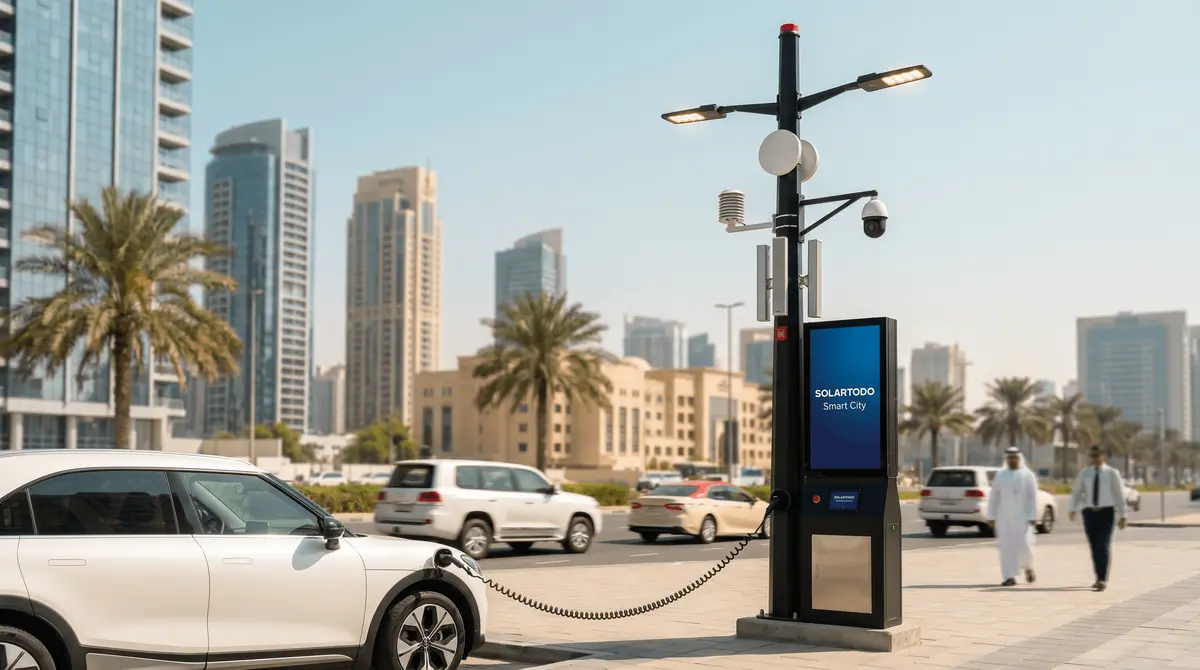
The most suitable variant for this brief is a customized grid-powered Smart Streetlight based on the SOLAR TODO city-street platform, not the park-scale or highway-scale classes. The specified pole is 10m octagonal tapered steel, with base diameter 45cm and top diameter 15cm, finished in black RAL9005 powder coat. For Kinshasa, this size gives enough mounting elevation for twin-arm lighting and a 5G small cell at 8.7m, while keeping the structure practical for city foundations and maintenance access.
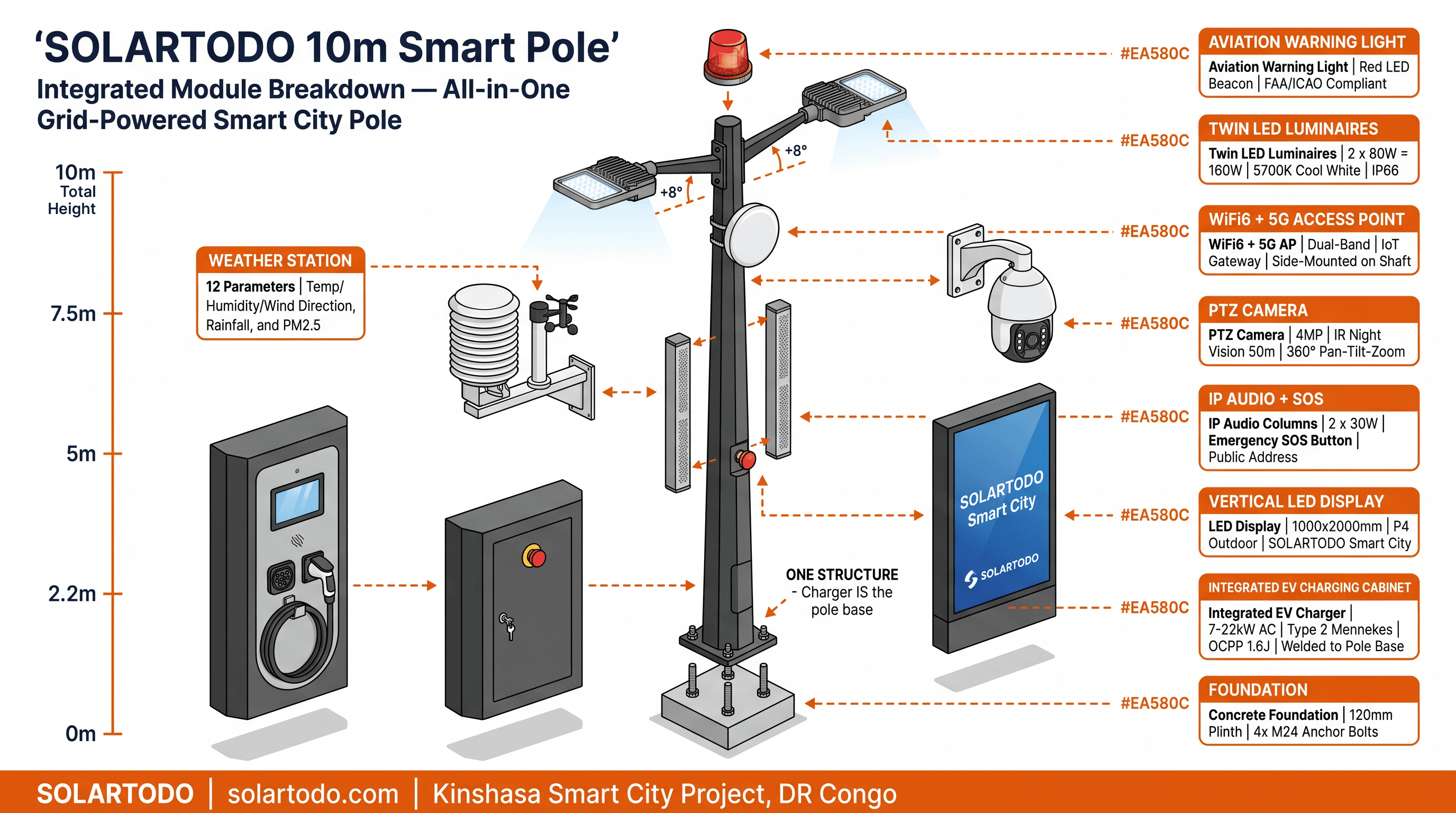
A typical 230-unit deployment in this profile would use the lower 2.2m of each pole as the EV charging cabinet. This is a critical design point: the charger is not a separate pedestal beside the pole. It is welded into the pole body as one continuous steel structure, which reduces sidewalk clutter, lowers the number of concrete foundations from 2 to 1 per location, and simplifies cable routing from service entry to charger and upper accessories.
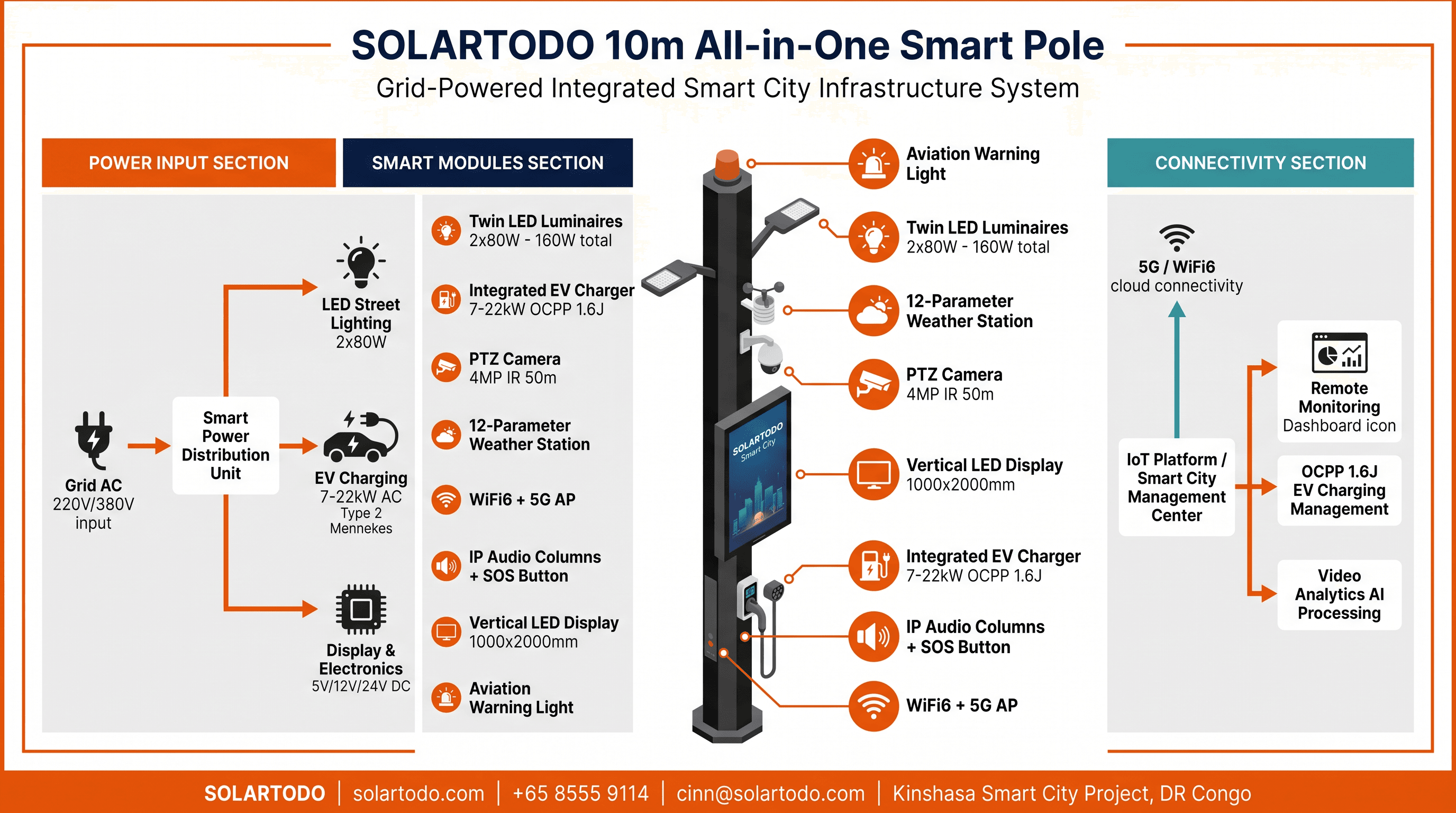
Lighting output is configured for urban carriageways and mixed pedestrian edges. Each pole carries 2×80W SOLAR TODO LED luminaires on twin symmetric 1.5m arms with +8° upward tilt, delivering 150 lm/W at 4000K. That equals 160W total LED load and approximately 24,000 lumens per pole before optical losses, which is appropriate for city streets where uniformity and lateral spread matter more than extreme throw distance.
For public safety and operations, the recommended package adds a 4MP bullet camera with IR 50m on a 30cm short-arm bracket, a one-press SOS button with camera linkage, and 2× IP audio columns sized Ø10×50cm, rated 30W/93dB each. This matters in Kinshasa because police visibility, emergency reporting, and public announcements often need to be located at road level rather than only at intersections or major buildings.
Environmental data collection is stronger than a basic smart-lighting package. The top-mounted 12-parameter environmental sensor covers full meteorology, air quality, rain, and CO/NO2/O3. According to the World Health Organization (2022), urban air pollution remains a major health risk across growing cities, so corridor-based sensing can support traffic management, public alerts, and environmental compliance programs.
The telecom layer uses a 5G NR n78 small cell with 4T4R MIMO and estimated 200m coverage mounted at 8.7m. In practical planning terms, this does not replace macro towers; it supplements them on high-demand streets, transit nodes, and commercial fronts. SOLAR TODO’s Smart Streetlight format is useful here because the shaft geometry and accessory positions can be standardized across a corridor, which is important for repeatable RF installation and municipal approval.
For branding and public information, the specified LED display is a P5 vertical screen sized 1280×2560mm in portrait format with brightness above 5000 cd/m². In this configuration, content is restricted to “SOLARTODO Smart City” text in white sans-serif on deep blue, with no other imagery. That restriction should be maintained in tender documents so the display function remains compliant with the specified scope.
Readers comparing options can review the broader Smart Streetlight product line or contact us for corridor-specific loading, foundation, and communications planning.
Technical Specifications
The recommended Kinshasa configuration uses a 10m steel smart streetlight with 160W LED load, 11kW integrated AC charging, and 5G n78 equipment on one pole body. All major components should be specified to IEC 60598, GB/T 37024, and IEC 62196-2 compliance points listed below.
- Deployment scale: approximately 230 units for a typical corridor package
- Pole height: 10m
- Pole form: octagonal tapered steel smart pole
- Pole diameter: Ø45cm base → Ø15cm top
- Finish: black RAL9005 powder coat
- Power supply: grid-powered AC 220/380V
- Integrated charger structure: lower 2.2m of pole body is the EV charging cabinet, welded as one continuous steel structure
- Lighting arm layout: twin symmetric arms, 1.5m each, +8° upward tilt
- LED luminaires: 2× 80W SOLARTODO LED, 150 lm/W, 4000K
- Total LED power per pole: 160W
- Approximate raw luminous flux: 24,000 lm per pole
- Camera: 4MP bullet camera, IR 50m, mounted on 30cm short-arm bracket
- Environmental sensor: 12-parameter unit for meteorology, air quality, rain, CO/NO2/O3
- Public address: 2× IP audio columns, Ø10×50cm, 30W/93dB, TCP/IP networked, side-clamp type
- Emergency system: one-press SOS button with camera linkage
- EV charging: 11kW single-gun AC charger, Type 2, OCPP 1.6J
- Charging cable: 5m coiled Type 2 cable
- User interface: 8-inch touchscreen at 1.5m height
- Safety control: red mushroom emergency stop
- Maintenance access: stainless maintenance door
- LED display: P5 portrait screen, 1280×2560mm, >5000 cd/m²
- Display content scope: “SOLARTODO Smart City” text only, white sans-serif on deep blue
- Telecom module: 5G NR n78 small cell, 4T4R MIMO, mounted at 8.7m
- Small-cell coverage: approximately 200m in dense urban conditions
- Spacing: 28m typical interval
- Applicable standards: IEC 60598, GB/T 37024, IEC 62196-2
Implementation Approach
A typical Kinshasa rollout would be executed in 4 phases over roughly 5-9 months for 230 poles, depending on utility approvals and civil access. The main sequence is corridor survey, detailed design, factory fabrication, shipment, foundations, erection, energization, and systems commissioning.
Phase 1 is corridor definition and utility mapping. For a 6.4 km route, planners would confirm right-of-way width, feeder access points, transformer capacity, and telecom backhaul options every 200-400m. Pole loading checks should include the 10m shaft, twin 1.5m arms, display wind area, and 5G attachment elevation so that the structural package remains consistent across the route.
Phase 2 is fabrication and pre-assembly. The integrated charger section should be manufactured as part of the pole shell, with the lower 2.2m welded into the upper shaft as one body. This is important because field-bolted charger cabinets often increase alignment errors, cable exposure, and vandalism risk compared with a monolithic steel form.
Phase 3 is civil works and electrical installation. Typical practice would include one reinforced foundation per pole, underground conduit, earthing, and AC service connection at 220/380V. Because the charger, lighting, camera, audio, SOS, display, and small cell share one asset, trenching and utility crossings can be lower than a layout using separate light poles, CCTV masts, charging pedestals, and telecom columns.
Phase 4 is commissioning and acceptance testing. Each pole should be checked for LED switching, charger handshake under OCPP 1.6J, camera stream quality, SOS linkage, audio output at 30W, display readability above 5000 cd/m², and small-cell power and backhaul status. A corridor-level acceptance plan should also verify spacing at 28m, nighttime uniformity, and maintenance-door access.
Expected Performance & ROI
A 230-pole Kinshasa corridor would typically deliver about 5.5 million raw lumens, 230 EV charging points at 11kW each, and 230 distributed safety nodes on one civil platform. The business case is usually strongest where municipalities or developers value reduced duplicated infrastructure and phased digital-service revenue, not lighting alone.
From a lighting perspective, each pole provides approximately 24,000 lumens, so 230 poles yield about 5.52 million lumens of installed output. According to the U.S. Department of Energy (2023), LED street lighting can substantially reduce energy use versus legacy HID systems, often in the 50% or greater range depending on baseline fixture type and controls. In Kinshasa, the exact savings would depend on whether the comparison baseline is sodium vapor, metal halide, or poorly maintained fluorescent systems.
From a civil-works perspective, consolidation is a major value driver. Instead of installing up to 4 separate assets per location—streetlight, charging pedestal, CCTV/support mast, and telecom pole—a single integrated smart streetlight can use 1 foundation and 1 service drop. According to the World Bank (2020), urban infrastructure projects in developing cities often face high coordination costs, so reducing interfaces can improve schedule certainty as much as direct capex.
For EV charging economics, the 11kW AC format is best suited to curbside dwell times rather than rapid-turnover charging. If a charger delivered an average of 20-40 kWh/day through mixed usage, utilization could support corridor electrification for municipal fleets, taxis, or commercial vehicles, but payback depends heavily on tariff policy, occupancy, and payment collection. A realistic procurement model in Kinshasa should therefore evaluate lighting ROI, telecom lease potential, and charging utilization together rather than isolating one component.
Telecom leasing can materially improve total return. Small-cell revenue assumptions vary by operator density and power/backhaul responsibility, but even one lease per pole cluster can offset maintenance and connectivity costs across the corridor. According to GSMA (2024), mobile data demand in Sub-Saharan Africa continues to grow strongly, which supports selective densification on urban streets where macro coverage exists but capacity is limited.
Lifecycle planning should use a 10-15 year structural horizon, 5-8 year battery-free charger electronics refresh expectation, and shorter replacement cycles for display modules or communications hardware if service requirements change. For municipal buyers, the practical ROI window is often 4-8 years when savings from lower energy use, reduced duplicated civil works, and telecom or charging income are combined. Exact payback should be modeled from local tariff, utilization, and lease assumptions rather than generic vendor claims.
Results and Impact
For Kinshasa, the practical impact of a 230-unit smart streetlight corridor would be 6.4 km of denser urban service coverage with 160W LED lighting, 11kW curbside charging, and 200m-class telecom nodes. The main benefit is asset consolidation: one pole can support lighting, safety, communications, and public information where road space is limited.
The expected urban outcome is better corridor visibility, faster incident reporting, and simpler infrastructure governance. A municipality or developer would manage approximately 230 unified assets instead of several disconnected systems spread across lighting, security, telecom, and charging contractors. For procurement teams, that can simplify maintenance planning, spares strategy, and right-of-way control while keeping the design aligned with IEC 60598 and IEC 62196-2 references.
Comparison Table
The table below compares the recommended Kinshasa configuration against a conventional separated-asset approach using similar corridor length and service scope. Values are indicative for planning and should be confirmed by local design calculations and utility conditions.
| Metric | Recommended SOLAR TODO Smart Streetlight | Conventional Separate Assets |
|---|---|---|
| Corridor length | Approx. 6.4 km | Approx. 6.4 km |
| Pole count / primary structures | 230 integrated poles | 230 light poles + separate charger pedestals + separate CCTV/telecom supports |
| Pole height | 10m | 8-10m light poles plus other mast heights |
| Spacing | 28m | 25-35m for lights, separate spacing for other assets |
| LED load per location | 2×80W = 160W | Usually 120-180W lighting only |
| EV charging | 11kW integrated Type 2 | Separate pedestal charger required |
| Camera | 4MP, IR 50m | Separate CCTV pole or building mount |
| Public audio | 2×30W/93dB IP columns | Usually separate PA installation |
| Environmental sensing | 12-parameter top sensor | Often not included |
| Telecom support | 5G NR n78, 4T4R, 200m | Separate small-cell street furniture |
| Foundations per location | 1 | Often 2-4 combined |
| Maintenance interfaces | Single integrated asset | Multiple vendors and enclosures |
| Standards basis | IEC 60598, GB/T 37024, IEC 62196-2 | Mixed by subsystem |
Pricing & Quotation
SOLAR TODO offers three pricing tiers for this product line: FOB Supply (equipment ex-works China), CIF Delivered (including ocean freight and insurance), and EPC Turnkey (fully installed, commissioned, with 1-year warranty). Volume discounts are available for large-scale deployments. Configure your system online for an instant estimate, or request a custom quotation from our engineering team at [email protected].
Frequently Asked Questions
This FAQ answers the main buyer questions on 10m poles, 11kW charging, 5G support, installation timing, and lifecycle cost for a 230-unit Kinshasa corridor. Each answer reflects the specified configuration rather than an invented past deployment.
Q1: What pole type is recommended for Kinshasa urban corridors?
A 10m octagonal tapered steel pole is the best fit for the specified Kinshasa profile because it supports twin 1.5m lighting arms, a 5G small cell at 8.7m, and an integrated charger in the lower 2.2m. It suits city streets better than 6-8m park poles and avoids the excess height and cost of highway-class structures.
Q2: Is the EV charger a separate cabinet beside the pole?
No. In this configuration, the lower 2.2m of the pole body is the 11kW AC charger cabinet itself. It is welded to the upper shaft as one continuous steel structure, not installed as a separate pedestal. That reduces sidewalk clutter, lowers civil complexity, and keeps cable routing inside one enclosure.
Q3: What are the main lighting specifications?
Each pole uses 2×80W SOLARTODO LED luminaires on twin symmetric 1.5m arms with +8° upward tilt. The LEDs are rated at 150 lm/W and 4000K, giving about 24,000 lumens per pole before optical losses. This is appropriate for city corridors that need balanced road and sidewalk illumination.
Q4: How many poles would a typical Kinshasa corridor require?
At the specified 28m spacing, a typical 230-unit package would cover about 6.4 km of urban corridor. Actual quantity can shift with intersection density, setbacks, bus stops, and utility conflicts. Procurement teams should confirm exact count through route survey, photometric layout, and power-connection planning.
Q5: How long would installation usually take?
For approximately 230 poles, a realistic program is about 5-9 months from survey to commissioning, assuming utility approvals and import logistics move normally. The schedule usually includes 3-6 weeks for design review, 6-10 weeks for fabrication, and the balance for shipping, foundations, erection, and systems testing.
Q6: What communications equipment does this smart streetlight support?
The specified package includes a 5G NR n78 small cell with 4T4R MIMO mounted at 8.7m, with estimated 200m coverage in dense street conditions. It also supports TCP/IP-connected audio, camera backhaul, and charger communications via OCPP 1.6J. Final network design depends on operator spectrum, fiber, and power policy.
Q7: What maintenance should buyers expect?
Routine maintenance typically includes quarterly visual inspection, semiannual charger and emergency-stop testing, lens and display cleaning, and annual electrical checks for earthing and cable terminations. LED modules often run for many years, but cameras, screens, and telecom hardware may need earlier service cycles. The integrated design simplifies access because major systems share one asset.
Q8: What is the expected ROI or payback period?
A practical payback range is often 4-8 years when lighting energy savings, reduced duplicated civil works, and telecom or charging income are combined. If the project relies on lighting savings alone, payback is usually longer. Local tariff, charger utilization, and operator lease terms should be modeled before issuing a final procurement decision.
Q9: How does this compare with a standard light pole plus separate charger?
An integrated smart streetlight usually needs 1 foundation and 1 coordinated service connection per location, while a separated layout can require 2-4 assets and more trenching. The tradeoff is higher unit complexity in one pole. For constrained sidewalks or medians, the integrated approach is often easier to permit and maintain.
Q10: Does SOLAR TODO provide EPC pricing or only equipment supply?
SOLAR TODO offers FOB Supply, CIF Delivered, and EPC Turnkey quotation structures for the Smart Streetlight line. Final scope should define whether civil works, utility connection, commissioning, and network integration are included. Buyers with local contractors often request split quotations so imported equipment and local installation can be evaluated separately.
Q11: What warranty terms are typical for this product line?
Warranty depends on the quotation scope, but the required pricing paragraph specifies 1-year warranty for EPC Turnkey delivery. Buyers should also request component-level warranty schedules for LED drivers, display modules, charger electronics, camera assemblies, and corrosion protection finish. For municipal tenders, spare-parts lists for 2-5 years are also advisable.
Q12: Which standards matter most for this configuration?
The core references in this brief are IEC 60598 for luminaires, GB/T 37024 for smart poles, and IEC 62196-2 for the Type 2 charging interface. Depending on local approval, buyers may also add electrical installation, earthing, and telecom compliance requirements. Tender documents should clearly separate mandatory standards from preferred test reports.
References
- World Bank (2024): DRC country data and energy-access indicators showing persistent electricity access and infrastructure gaps relevant to urban corridor planning.
- UN-Habitat (2024): Urbanization analysis identifying Kinshasa as one of Africa’s fastest-growing metropolitan areas, increasing pressure on roads and public services.
- African Development Bank (2023): Urban transport and infrastructure investment assessments for DRC, highlighting mobility and service-delivery constraints in major cities.
- ITU (2023): Mobile broadband and connectivity reporting indicating the importance of densified digital infrastructure and service quality in developing urban markets.
- International Energy Agency (IEA) (2023): Africa energy access analysis; the IEA states, "Access to electricity is a prerequisite for economic development."
- World Health Organization (2022): Air quality and urban health guidance supporting the use of multi-parameter environmental monitoring in dense cities.
- IEC (2023): IEC 60598 luminaires standard and IEC 62196-2 conductive charging interface standard applicable to smart streetlight and EV charging configurations.
- GSMA (2024): Sub-Saharan Africa mobile industry outlook showing sustained mobile data growth and the need for urban network densification.
- Climate-Data.org (2024): Kinshasa climate profile indicating tropical wet-and-dry conditions relevant to enclosure protection and corrosion-control planning.
- U.S. Department of Energy (2023): LED street-lighting performance guidance showing substantial energy savings versus legacy HID systems.
Equipment Deployed
- 10m octagonal tapered steel smart pole, base Ø45cm to top Ø15cm, black RAL9005 powder coat
- Integrated lower 2.2m pole-as-charger cabinet, welded as one continuous steel structure
- AC 220/380V grid-powered electrical configuration
- Twin symmetric 1.5m lighting arms with +8° upward tilt
- 2×80W SOLARTODO LED luminaires, 150 lm/W, 4000K
- 4MP bullet camera with IR 50m on 30cm short-arm bracket
- 12-parameter environmental sensor with meteorology, air quality, rain, CO, NO2, and O3
- 2× IP audio columns, Ø10×50cm, 30W/93dB, TCP/IP networked
- One-press SOS emergency button with camera linkage
- 11kW single-gun AC EV charger, Type 2, OCPP 1.6J
- 5m coiled Type 2 charging cable
- 8-inch touchscreen mounted at 1.5m height
- Red mushroom emergency stop
- Stainless maintenance door
- P5 vertical LED display, 1280×2560mm portrait, >5000 cd/m²
- 5G NR n78 small cell, 4T4R MIMO, mounted at 8.7m, approx. 200m coverage