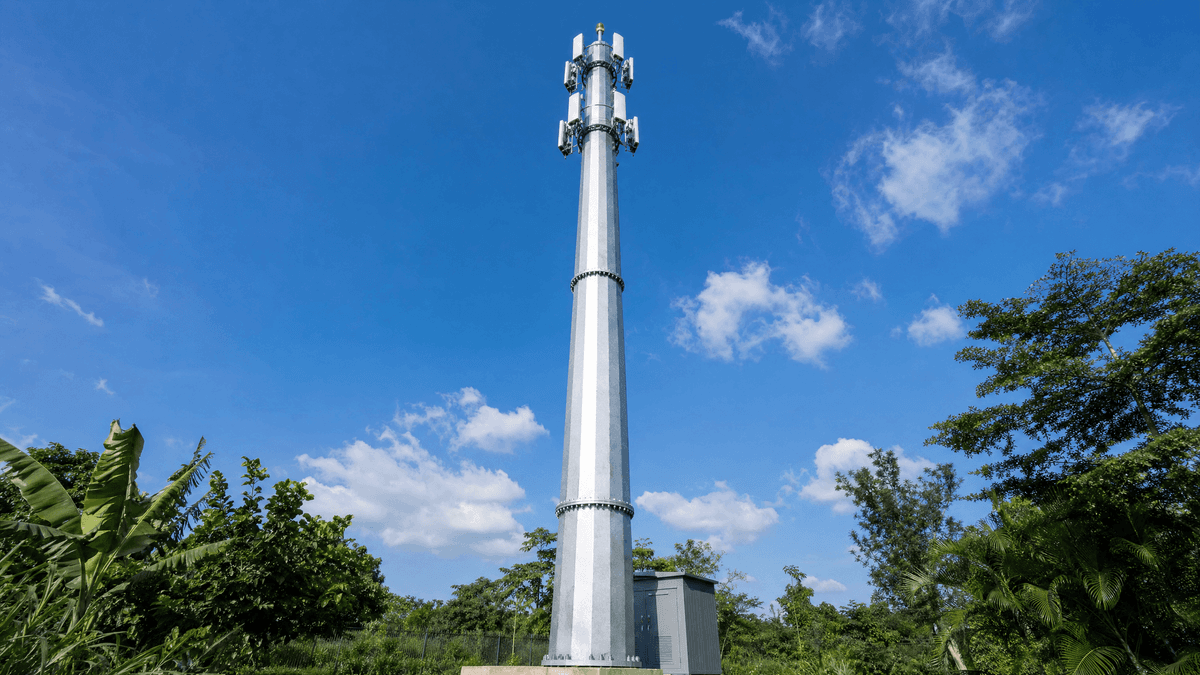
Kampala Telecom Tower Market Analysis: 35m Monopole Configuration Guide for Regional Macro Coverage
Summary
Kampala’s dense urban core, heavy mobile-data demand, and Uganda’s humid bi-modal rainfall pattern point to a 35m steel monopole class for macro coverage and microwave backhaul. A typical city-scale package would use approximately 16 units, 50 m/s wind design, and about 18t steel per tower under TIA-222-H and GB/T 50233.
Key Takeaways
- Kampala’s urban agglomeration exceeds 4 million people, which supports continued macro-site densification and backhaul reinforcement for 4G/5G traffic growth, according to the Uganda Bureau of Statistics (2024).
- Uganda had 38.6 million mobile cellular subscriptions in 2023, according to the World Bank (2024), indicating sustained tower demand beyond rooftop infill alone.
- For Kampala’s mixed urban-peri-urban profile, the correct telecom size class is 25-35m to 35-45m, with this guide recommending 35m as a balanced regional macro height.
- A typical approximately 16-unit deployment would use 35m tapered steel monopoles, Q345 hot-dip galvanized steel, and concrete pad foundations for repeatable civil work.
- The specified loading in this guide is 6× panel antennas + 2× microwave dishes, which fits a backhaul-focused macro site better than a dense urban hotspot loadout.
- Wind design should be set at Class 2: 50 m/s, factor 1.15 under TIA-222-H, while corrosion protection should assume a high-corrosion zone because Kampala has annual rainfall around 1,200-1,300 mm.
- Steel mass should remain near 18t per 35m tower, consistent with the stated engineering rule of roughly 500 kg/m × height and the 15-22t / 25-35m telecom tower band.
- CKD sectional shipping can reduce logistics volume by 60-70%, which matters for inland transport from Mombasa corridor routes into central Uganda and for phased warehousing in Kampala.
Market Context for Kampala
Kampala’s telecom tower requirement is shaped by high user density, uneven line-of-sight conditions, and a wet tropical climate that raises corrosion and maintenance demands. According to the Uganda Bureau of Statistics (2024), the Kampala Capital City Authority area has a daytime population far above its resident base, while the Greater Kampala Metropolitan Area exceeds 4 million people, concentrating mobile traffic in a relatively small footprint.
According to the World Bank (2024), Uganda recorded 38.6 million mobile cellular subscriptions in 2023, and internet use has continued to rise as smartphone adoption expands. That subscription count does not mean one tower per subscriber, but it does indicate persistent pressure on operators to improve site spacing, microwave backhaul resilience, and sector capacity in urban districts such as Central Division, Nakawa, Kawempe, Rubaga, and Makindye.
Climate matters as much as demand. According to the World Bank Climate Change Knowledge Portal (2021), Kampala receives roughly 1,200-1,300 mm of annual rainfall with two rainy seasons, and average temperatures remain near 21-23°C through much of the year. For telecom steelwork, that profile supports a high-corrosion assumption, hot-dip galvanizing, and careful grounding design because wet soil conditions can change earthing performance over a 30-year design life.
Topography also affects tower selection. Kampala’s elevation is about 1,190 m above sea level, with rolling hills and dense low-rise to mid-rise development rather than a uniform flat grid. In this setting, a 35m monopole often gives a better balance than a 25m urban infill pole because it can support macro radio coverage plus microwave backhaul without moving into the heavier 40-45m class that raises foundation and transport demands.
Uganda’s digital infrastructure plans also support continued macro-site investment. According to the Uganda Communications Commission (2023), broadband expansion and quality-of-service improvement remain core sector priorities, while the National Broadband Policy continues to emphasize wider access and stronger transmission infrastructure. For Kampala, that points to a mix of rooftop infill and ground-based monopoles, especially where operators need cleaner microwave paths and lower visual clutter than lattice towers.
Two authority statements are especially relevant. The ITU states, "Infrastructure sharing can reduce costs and accelerate broadband deployment," which is directly applicable to Kampala where land access and urban permitting can slow new builds. The GSMA states, "Backhaul remains a critical enabler of mobile broadband quality," which supports configurations that include 2 microwave dishes rather than antenna-only layouts in congested metro corridors.
For buyers comparing forms, monopoles fit Kampala’s urban acceptance profile better than lattice structures in many districts because they use a smaller footprint, simpler visual form, and faster sectional erection. SOLAR TODO’s Telecom Tower line therefore fits the city’s need for compact macro infrastructure where 35m height, 2 platforms, and microwave support are more important than extreme rural height.
Recommended Technical Configuration
A typical Kampala macro-backhaul deployment of this profile would consist of approximately 16 units of 35m tapered steel monopole towers with 6 panel antennas and 2 microwave dishes per site. This configuration aligns with the suburban/residential to peri-urban boundary class and is suitable for high-coverage urban edges, arterial roads, and district-level aggregation points.
The selected height is 35m, which sits at the top of the 25-35m size class and close to the lower end of the 35-45m highway/peri-urban class. That is a practical choice for Kampala because many sites need more than rooftop infill height but do not always justify 40-45m structures. At 35m, the tower can carry 2 antenna platforms, maintain a moderate steel mass near 18t, and support microwave dishes for backhaul-focused layouts.
The exact recommended package in this guide is as follows:
- Approximately 16 units
- 35m tapered steel monopole tower
- Hot-dip galvanized Q345 steel
- Wind Class 2: 50 m/s, factor 1.15
- High-corrosion zone protection assumption
- Antenna load: 6× panel antenna + 2× microwave dish
- Concrete pad foundation
- 2 antenna platforms
- Accessories: climbing ladder, cable tray, aircraft warning light, grounding system, lightning rod, safety cage
- Design life: 30 years
- Pole class: regional macro / high-coverage tower
- CKD shipping with 60-70% volume reduction
- Production lead time: 30-45 days
- Standards: TIA-222-H / GB/T 50233
Why this loadout instead of the urban 6-panel + 1-dish + RRU set? Kampala has several corridors where microwave remains relevant for rapid backhaul deployment or redundancy, especially where fiber availability, right-of-way, or restoration time is uncertain. A 2-dish arrangement suits ring, spur, or aggregation links better than a single-dish urban rooftop profile.
Why not 40m or 45m? First, a 35m tower at roughly 18t is still within a manageable transport and crane envelope for urban Uganda. Second, additional 5-10m height often increases foundation demand and permitting sensitivity without a proportional gain in dense districts where clutter, zoning, and RF planning limit practical coverage gains. SOLAR TODO’s recommended Telecom Tower configuration is therefore a balanced macro option rather than an overbuilt structure.
For procurement teams, the most important point is fit between city conditions and tower class. Kampala’s profile suggests that a 35m monopole is not a generic default; it is a targeted recommendation for macro coverage plus microwave backhaul in a humid, high-demand capital market.
Technical Specifications
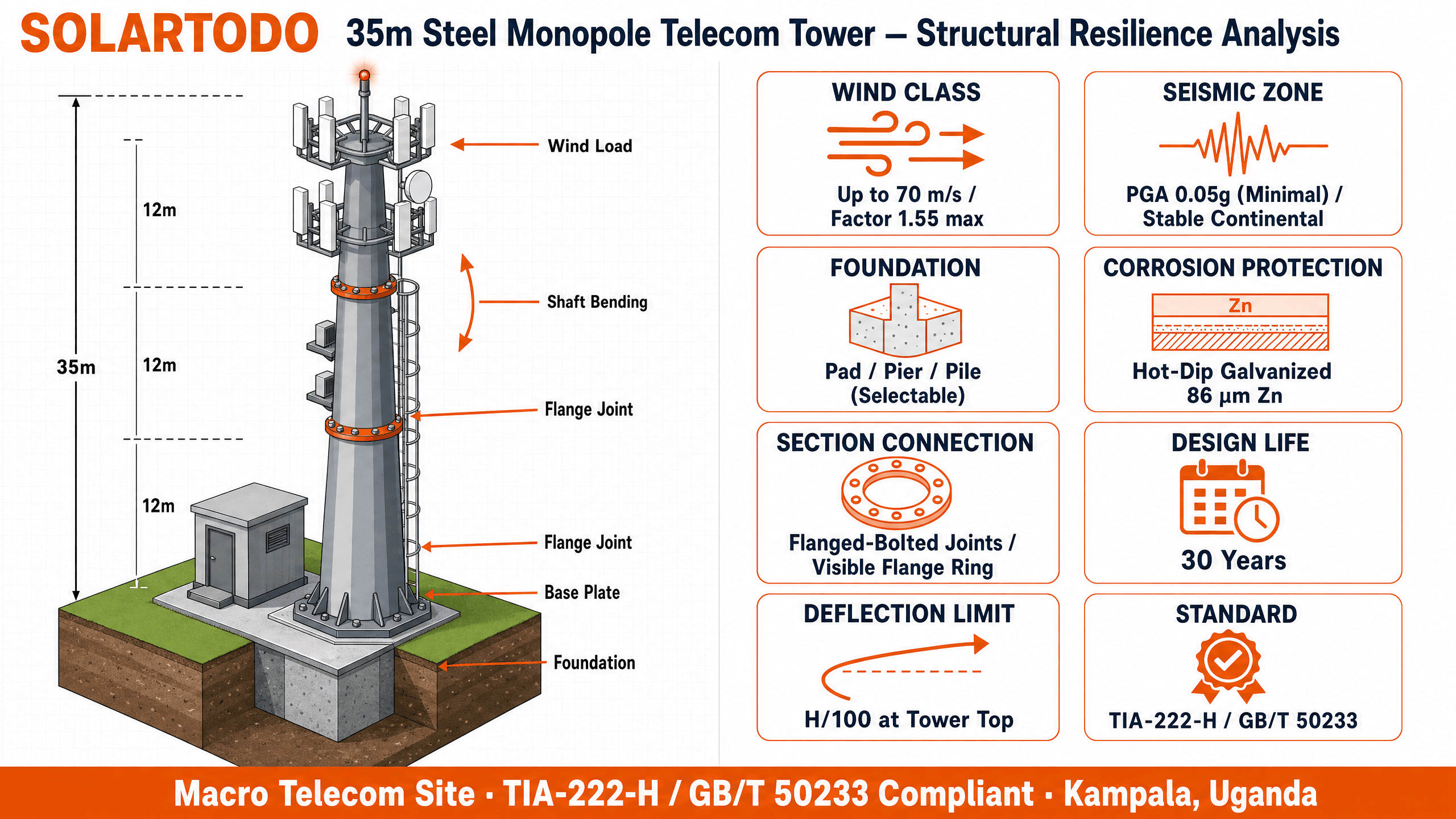
The specified Kampala Telecom Tower configuration is a 35m, approximately 18t, Q345 galvanized monopole with 2 platforms and 6 panel antennas plus 2 microwave dishes, designed to TIA-222-H for 50 m/s wind. This sits within the telecom engineering rule of about 500 kg/m and matches the 25-35m suburban/residential class while extending toward peri-urban macro use.
Core tower structure
- Product type: Steel Telecom Tower monopole
- Tower form: Tapered steel monopole, round or octagonal tubular form depending section design
- Height: 35m
- Sectional connection: Flanged bolt-on sectional design
- Steel grade: Q345 hot-dip galvanized steel
- Approximate tower weight: 18t per tower
- Design life: 30 years
- Pole class: Regional macro / high-coverage tower
Antenna and platform loading
- Antenna load: 6× panel antennas + 2× microwave dishes
- Platform count: 2 antenna platforms
- Application profile: Suburban/residential to peri-urban macro coverage
- Suitable use case: Backhaul-focused suburban and urban-edge telecom site
Environmental and structural design
- Wind class: Class 2
- Basic wind speed: 50 m/s
- Wind load factor: 1.15
- Corrosion zone: High
- Foundation type: Concrete pad foundation
- Standards: TIA-222-H / GB/T 50233
Site accessories
- Climbing ladder
- Cable tray
- Aircraft warning light
- Grounding system
- Lightning rod
- Safety cage
Logistics and manufacturing
- Shipping mode: CKD sectional shipment
- Logistics benefit: 60-70% volume reduction compared with fully assembled transport
- Production time: 30-45 days
According to TIA (2022), telecom support structures should be checked for wind, ice where applicable, serviceability, and appurtenance loading using site-specific criteria. According to China’s GB/T 50233 standard, tower construction quality control must cover verticality, bolt tightening, corrosion protection, and foundation acceptance before commissioning.
Implementation Approach
A typical Kampala Telecom Tower rollout would proceed in 5 phases over roughly 12-20 weeks for a 16-unit batch, depending on permitting, geotechnical conditions, and inland logistics. The most efficient sequence is site survey, detailed design, factory production, CKD shipment, and then civil-plus-erection works by clustered zones.
1) Site screening and permitting
The first step is RF and land screening for each of the approximately 16 locations. In Kampala, this usually includes setback review, aviation-light requirements, and utility conflict checks within a radius of 30-50m around each plot. Where microwave dishes are included, line-of-sight verification is needed before final azimuth and platform orientation are fixed.
2) Geotechnical review and foundation confirmation
Although this guide specifies a concrete pad foundation, each site should still receive a soil review before final rebar and footing dimensions are released. Kampala soils vary from lateritic layers to softer wet-season conditions, and groundwater behavior can shift excavation planning by 1-2 weeks. For a 35m, 18t monopole, foundation accuracy is critical because flange alignment affects full-height plumb tolerance.
3) Fabrication and galvanizing
SOLAR TODO would typically schedule production in 30-45 days once approved drawings, loading schedules, and accessory lists are confirmed. Hot-dip galvanizing should be checked for coating consistency because Kampala’s high-humidity environment can accelerate corrosion at weld transitions, ladder brackets, and cable tray interfaces if finishing quality is uneven.
4) CKD shipping and inland delivery
Sectional CKD packing reduces shipping volume by 60-70%, which lowers container count and improves inland handling from East African port corridors. For Kampala buyers, this matters because sectional monopoles can be unloaded with smaller yard equipment and staged by erection sequence, reducing temporary storage congestion on constrained urban plots.
5) Civil works, erection, and commissioning
Concrete pad foundations should cure to the specified strength before tower erection begins. A typical sequence is anchor setting, lower-section placement, flange assembly, upper-section lift, accessory installation, grounding, and then antenna and microwave mounting. Final acceptance should include bolt torque checks, verticality measurement, earthing resistance test, aircraft light verification, and lightning protection continuity.
Expected Performance & ROI
A 35m Kampala monopole with 6 panels and 2 microwave dishes would typically improve macro coverage continuity and backhaul flexibility while keeping steel mass near 18t and design life at 30 years. The financial case usually depends more on faster service activation, lower lease complexity, and reduced outage risk than on tower capex alone.
From a network perspective, a 35m monopole can support wider cell overlap and cleaner microwave clearance than a 25m infill structure, especially across hilly districts and arterial corridors. According to the GSMA (2023), mobile network quality is strongly linked to both spectrum and backhaul availability, so adding 2 microwave dishes can be economically justified where fiber restoration or trenching remains uncertain.
From a lifecycle perspective, monopoles often reduce urban land take and visual objections compared with lattice towers. According to the World Bank (2023), infrastructure bottlenecks in African cities often increase project costs through delay rather than through materials alone. A smaller footprint and CKD delivery therefore have indirect ROI value because they can shorten site readiness and reduce logistics friction.
Maintenance is also part of the return calculation. A galvanized 35m steel monopole with periodic inspection every 6-12 months can remain serviceable for 30 years if coating damage, bolt loosening, grounding degradation, and platform corrosion are corrected early. According to NREL (2023), preventive maintenance generally lowers lifecycle cost compared with corrective maintenance on critical field infrastructure, a principle that applies to telecom support structures as well as energy assets.
For payback, tower economics vary by tenancy, lease structure, and operator revenue assumptions, so a universal number would be misleading. In practice, buyers often evaluate ROI through 4 metrics: time to service activation, avoided fiber delay, tenancy potential, and annual maintenance per site. In Kampala, a 35m macro monopole tends to make the most sense where 2-dish backhaul support can accelerate launch or improve resilience in high-traffic districts.
Results and Impact
For Kampala, a 16-unit, 35m monopole program would typically create measurable gains in macro coverage reach, backhaul path options, and urban site standardization under a 30-year asset life. The strongest impact is usually operational: fewer bespoke structures, repeatable concrete pad foundations, and one tower class that supports 6 panels plus 2 microwave dishes across multiple districts.
The city-level benefit is not only more coverage. Standardizing around one 35m monopole specification can simplify spare parts, galvanizing inspection criteria, erection training, and future tenant upgrades. For procurement teams, that means lower specification drift across sites. For network planners, it means a clearer template for regional macro coverage where rooftop access is limited or microwave redundancy is required.
SOLAR TODO positions this Telecom Tower class as a practical fit for Kampala because it combines compact monopole geometry, CKD shipment efficiency, and a loading profile that matches macro radio plus backhaul needs. Buyers needing project-specific drawings can review the Telecom Tower product page or contact us for site-specific configuration support.
Comparison Table
The table below compares the recommended 35m Kampala Telecom Tower against nearby telecom tower classes so buyers can match height, loading, and civil complexity to network objectives.
| Parameter | 30m Monopole | Recommended 35m Monopole | 40m Monopole |
|---|---|---|---|
| Typical application | Urban/suburban macro | Regional macro / high coverage | Peri-urban / highway macro |
| Height | 30m | 35m | 40m |
| Approx. steel weight | 15t | 18t | 20t |
| Size class fit | 25-35m | 25-35m upper band | 35-45m lower band |
| Platform count | 2 | 2 | 2-3 |
| Antenna profile | 6 panels + 1 dish | 6 panels + 2 dishes | 6-9 panels + 1-2 dishes |
| Wind class example | 50 m/s | 50 m/s | 50-60 m/s |
| Foundation tendency | Pad/pier | Concrete pad | Larger pad or pier |
| Urban visual impact | Moderate | Moderate | Higher |
| Inland logistics | Easier | Balanced | Heavier handling |
| Typical fit for Kampala | Good for infill | Best balance for macro + backhaul | Best for select edge sites |
Pricing & Quotation
SOLAR TODO offers three pricing tiers for this product line: FOB Supply (equipment ex-works China), CIF Delivered (including ocean freight and insurance), and EPC Turnkey (fully installed, commissioned, with 1-year warranty). Volume discounts are available for large-scale deployments. Configure your system online for an instant estimate, or request a custom quotation from our engineering team at [email protected].
Frequently Asked Questions
This FAQ answers 10 common buyer questions on 35m monopole selection, installation, maintenance, ROI, warranty scope, and quotation structure for Kampala-type telecom tower projects.
Q1: Why is 35m recommended for Kampala instead of 25m or 45m? A 35m monopole is a middle-ground option. It gives more clearance for macro coverage and microwave paths than a 25m infill pole, but avoids the heavier civil and transport burden of a 45m tower. For Kampala’s hills, dense districts, and mixed urban-peri-urban topology, 35m is often the most efficient regional macro height.
Q2: What exact tower configuration is recommended in this guide? The recommended configuration is approximately 16 units of 35m tapered steel monopole towers in hot-dip galvanized Q345 steel. Each tower is designed for Wind Class 2 at 50 m/s, uses a concrete pad foundation, carries 6 panel antennas plus 2 microwave dishes, and includes 2 platforms, ladder, cable tray, aircraft light, grounding, lightning rod, and safety cage.
Q3: Does this product fit Kampala’s climate and corrosion conditions? Yes. Kampala’s annual rainfall of roughly 1,200-1,300 mm and persistent humidity support a high-corrosion design assumption. That is why this guide specifies hot-dip galvanizing, grounding, and periodic inspection. For a 30-year design life, coating condition, flange protection, and ladder attachment points should be checked every 6-12 months.
Q4: How long would a typical 16-unit project take? A typical 16-unit program may take about 12-20 weeks from design confirmation to commissioning, depending on permits, geotechnical review, and inland logistics. Factory production is usually 30-45 days. Civil works and erection then proceed by cluster, with concrete curing and final RF equipment installation controlling the site-by-site schedule.
Q5: What is the expected service life and maintenance requirement? The design life is 30 years. In practice, that requires planned maintenance rather than reactive repair. Buyers should budget for inspection every 6-12 months covering galvanizing condition, bolt torque, grounding resistance, ladder and platform corrosion, warning light function, and lightning protection continuity. Early correction usually reduces lifecycle cost.
Q6: How does a monopole compare with a lattice telecom tower in Kampala? A monopole usually has a smaller footprint and lower visual impact, which can help in dense urban districts. It is also faster to stage in CKD sections. A lattice tower may carry heavier loads at some heights, but for a 35m macro site with 6 panels and 2 dishes, a monopole is often the cleaner urban choice.
Q7: Can this tower support 4G today and 5G later? Yes, subject to final loading verification. A 35m monopole with 2 platforms and a 6-panel plus 2-dish profile can support current macro radio needs and future equipment changes if appurtenance weights, wind sail area, and mount geometry remain within the approved structural envelope under TIA-222-H checks.
Q8: What affects ROI or payback for a Kampala telecom tower project? ROI depends on tenancy, lease terms, traffic growth, and whether microwave backhaul avoids fiber delay or outage costs. In Kampala, buyers usually evaluate payback through time to service activation, potential for co-location, avoided transmission bottlenecks, and annual maintenance. The business case is stronger where one tower can solve both coverage and backhaul constraints.
Q9: What is included in EPC quotation scope versus supply-only scope? FOB usually covers tower steelwork, platforms, and accessories at ex-works terms. CIF adds ocean freight and insurance. EPC Turnkey typically includes civil works, erection, installation, commissioning, and a 1-year warranty. Final scope should clearly state whether antennas, microwave equipment, power systems, fencing, and site shelter are included or excluded.
Q10: What warranty and quality documents should buyers request? Buyers should request material certificates for Q345 steel, galvanizing records, fabrication drawings, bolt specifications, foundation drawings, and inspection documents tied to TIA-222-H and GB/T 50233. Warranty terms vary by scope, but EPC packages commonly include 1 year on supplied and installed works, with longer performance expectations tied to proper maintenance.
References
This guide uses public telecom, climate, and standards sources to align Kampala market conditions with a 35m monopole specification and a 16-unit planning scenario.
- Uganda Bureau of Statistics (2024): Population and urbanization updates for Kampala and the Greater Kampala Metropolitan Area.
- World Bank (2024): World Development Indicators, Uganda mobile cellular subscriptions, approximately 38.6 million in 2023.
- World Bank Climate Change Knowledge Portal (2021): Uganda/Kampala climate profile, including annual rainfall around 1,200-1,300 mm and average temperature ranges.
- Uganda Communications Commission (2023): Sector reports and broadband policy references on telecom infrastructure expansion and service quality.
- TIA (2022): TIA-222-H, structural standard for antenna supporting structures and antennas.
- GB/T 50233 (latest applicable edition): Code for construction and acceptance of communication tower and mast works.
- GSMA (2023): Mobile infrastructure and backhaul guidance relevant to broadband quality and site planning.
- ITU (2023): Broadband infrastructure policy guidance, including infrastructure sharing and network expansion principles.
- NREL (2023): Asset maintenance and lifecycle management principles applicable to long-life field infrastructure.
Equipment Deployed
- 16 × 35m tapered steel monopole Telecom Tower, flanged bolt-on sectional design
- Hot-dip galvanized Q345 steel structure, approximately 18t per tower
- Wind Class 2 design: 50 m/s basic wind speed, factor 1.15
- Antenna loading per tower: 6 × panel antenna + 2 × microwave dish
- Concrete pad foundation for each tower site
- 2 × antenna platforms per tower
- Climbing ladder with safety cage
- Cable tray system
- Aircraft warning light
- Grounding system
- Lightning rod
- 30-year design life package
- CKD shipment format with 60-70% volume reduction
- Compliance set: TIA-222-H / GB/T 50233