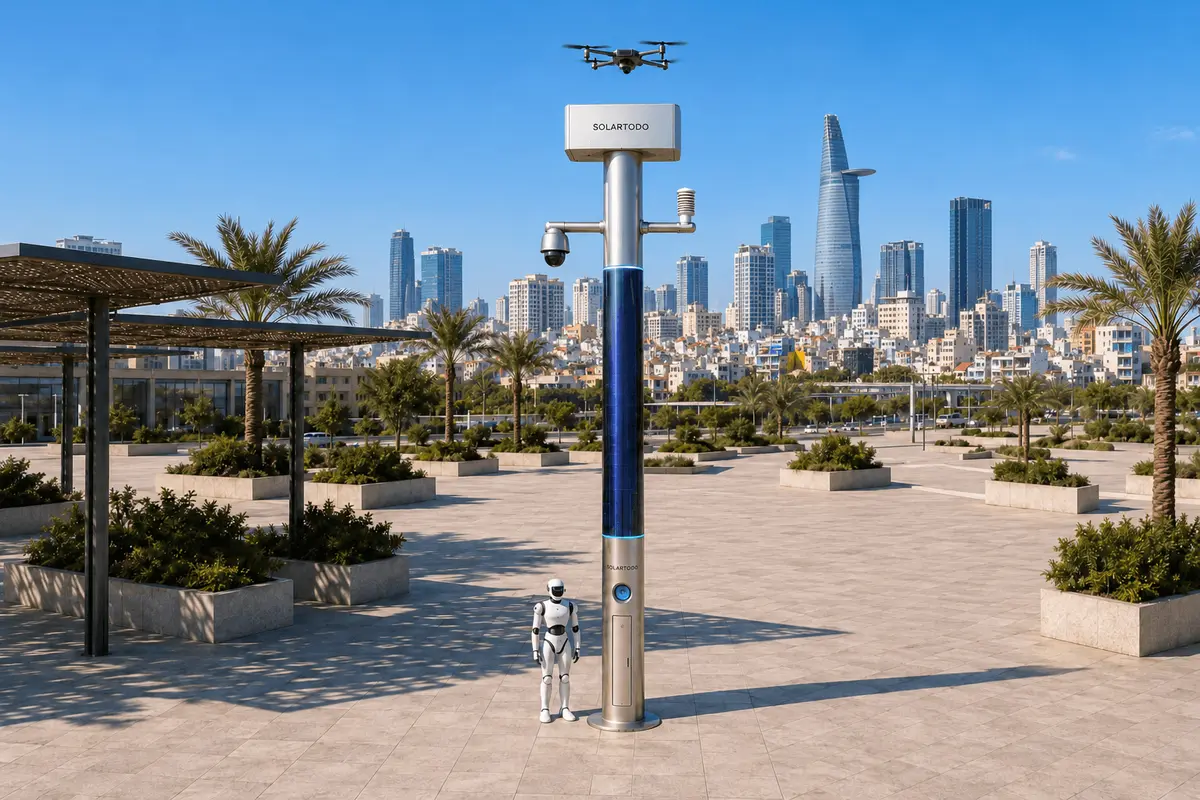
A City AI Pole is a non-lighting physical-AI urban edge node combining sensing, local computing, autonomous drone operations and ground robot support. SOLARTODO Sentinel’s Sky Hub form runs OTATODO at the edge using battery storage and on-pole solar replenishment. This proposed Ho Chi Minh City configuration supports water-authority campus-perimeter security within an industrial park after storm damage.
1. Procurement brief: restore security coordination after storm damage
For a water authority responsible for an industrial-park campus in Ho Chi Minh City, the procurement task is to restore coordinated perimeter oversight after storm damage. The illustrative setting includes a treatment compound, pumping assets, service gates and maintenance access routes. Typhoon-season readiness provides the purchasing trigger: the authority needs a repeatable way to assess damaged boundaries, distinguish maintenance activity from intrusion and dispatch the appropriate team while recovery work continues.
This case proposes post-disaster infill using SOLARTODO Sentinel physical-AI edge nodes in the flagship Sky Hub pole form. It does not describe a named customer installation or report achieved results. Sentinel is presented as an established, in-service product; the Ho Chi Minh City placement, configuration and operating targets remain proposed and subject to final engineering confirmation. The procurement category is city-ai-pole, with edge computing, autonomous drone operations and ground robot operations supporting the security task.
The central problem is departmental separation. Security may record a fence alarm, water operations may know that contractors are repairing a valve enclosure, and maintenance may hold the access authorization. Without a shared incident record, each department can initiate a separate check. Recovery conditions make that fragmentation especially costly: an apparently unsecured gate could be an authorized work entrance, a damaged barrier or an intrusion route.
The purchasing objective is therefore lower operating effort per resolved perimeter incident, supported by traceable decisions. Proposed evaluation measures include duplicate dispatches, staff minutes spent reconciling reports, avoidable inspection visits and maintenance effort. None is an achieved saving. The authority should compare these measures against its own documented baseline before accepting an operating-cost case.
2. Configuration decision: make the PTZ camera the shared observation point
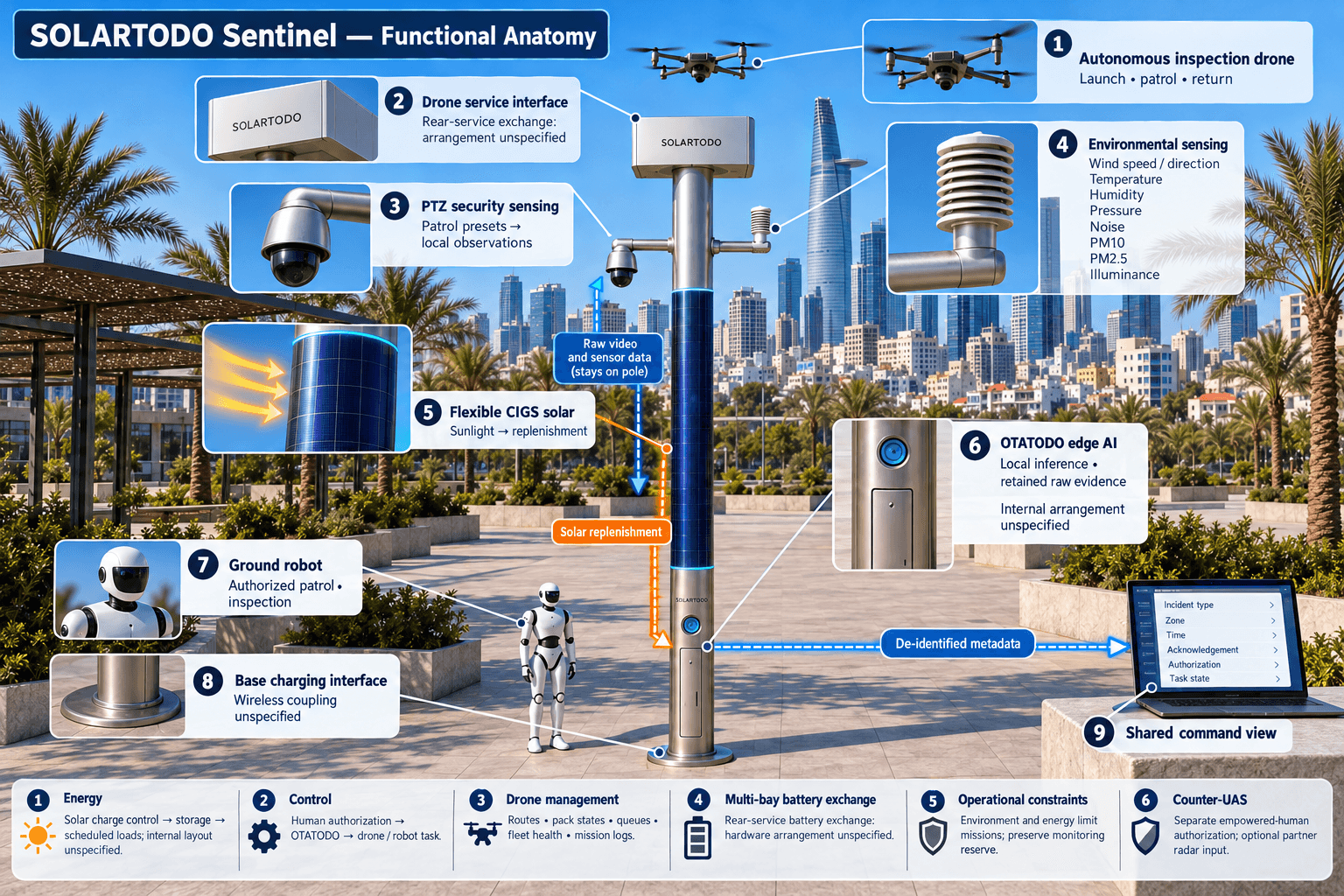
The PTZ camera is the primary security module in this configuration. Its patrol presets would cover surveyed gates, fence transitions and approaches to water assets. Local perception supports anonymous vehicle count, crowd density, intrusion and perimeter awareness. Camera positions and exclusion zones should reflect actual sightlines, vegetation, temporary recovery works and neighboring premises. The proposal does not assume that one elevated camera can see through buildings, heavy rain or obstructions.
OTATODO runs on an on-pole edge AI module, processing camera observations locally and scheduling workloads alongside energy and mission priorities. Raw video and raw sensor data stay on the pole. The shared command view receives only de-identified event and status metadata, such as incident type, zone, time, acknowledgement and task state. Authorized staff can review retained evidence locally under the authority’s access and retention rules.
Sentinel’s nine integrated capabilities serve this operating model: a pure non-lighting intelligent pole; autonomous drone operations; automated drone battery hot-swap; drone operations management; ground robot operations; PTZ security sensing; nine-parameter environmental monitoring; edge AI computing; and human-authorized counter-UAS coordination. The pole contains no lighting system. It is fully off-grid, using battery storage and its own solar replenishment without grid, city or site power.
The environmental package measures wind speed, wind direction, temperature, humidity, atmospheric pressure, noise, PM10, PM2.5 and illuminance. These readings help operators interpret conditions and inform task scheduling; illuminance measurement does not imply lighting hardware. For procurement, the PTZ camera should remain the acceptance anchor: can its locally generated events give security, water operations and maintenance a sufficiently clear, shared basis for deciding who acts next?
3. Operating decision: turn separate alerts into one authorized response
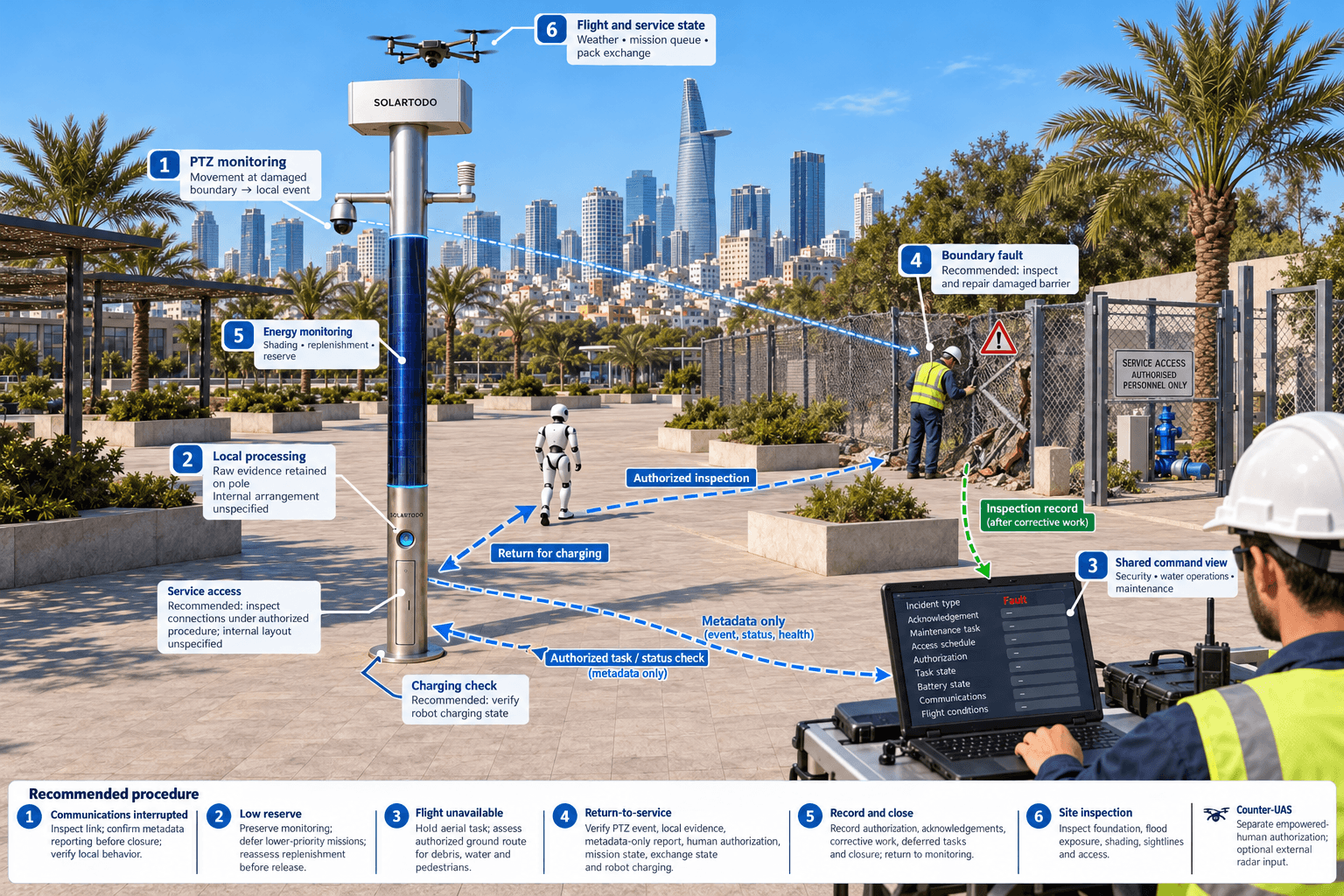
Consider an illustrative perimeter event during recovery work: the camera flags movement through a damaged boundary near a restricted service approach. The edge module associates the observation with a configured zone and creates a de-identified event. In the common-operating-picture command view, security checks the event against maintenance task status and the water-operations access schedule. The responsible human then authorizes a response, requests clarification or closes an explained event.
This implements one continuous loop: sensing, authorized assessment and response, edge-compute scheduling, then field operations and maintenance. A common incident identifier connects the initial observation, departmental acknowledgements, authorization, dispatched task and closure record. Departmental responsibilities remain distinct, but their decisions become visible within the same operational context. That is the mechanism for reducing duplicate work; a dashboard alone does not create savings.
For a suitable aerial inspection, the node supports drone launch, regional patrol, inspection, return and task redeployment without an operator physically stationed at the pole. Drone operations management handles route planning, the charging and swapping state machine, task queues, fleet health and mission logs. After landing, a multi-bay battery magazine performs an automated rear-service exchange, replacing the depleted pack with a charged pack. Multiple bays support consecutive sorties, within energy, weather and operational limits.
A service or humanoid robot can undertake authorized ground patrol, alarm response and inspection, coordinate with the aerial task and return to the pole base for wireless charging. Routes require confirmation against debris, standing water, surface conditions and pedestrian activity. If an unauthorized drone is detected and tracked, counter-UAS coordination remains a separate authorization decision: an empowered human may command the friendly drone to perform soft aerial net-capture or close-approach deterrence. This is non-lethal mitigation. Radar is not built into the pole; any radar contribution would be an optional partner-sensor input.
4. Engineering decision: size off-grid duty cycles for recovery conditions
Post-disaster infill must be engineered around the available site rather than assumed infrastructure. Proposed pole positions should be surveyed for foundation stability, flood exposure, maintenance access, camera visibility, solar shading and safe drone and robot operating space. At a Ho Chi Minh City water campus, the authority should explicitly examine whether recovery vehicles, temporary storage or repaired structures could obstruct observation and access. Structural and environmental suitability require final engineering confirmation.
The cylindrical configuration carries approximately 15 square metres of flexible CIGS thin-film solar wrapped through 360 degrees around a roughly 8-metre-tall, 0.6-metre-wide body. Its nameplate capacity is approximately 2.4–2.7 kWp. That rating must not be treated as continuous field output. Direct sunlight reaches the cylinder’s sun-facing projection, rather than illuminating the entire wrapped surface equally.
For context, realistic clear-sky output in a high-irradiance region such as Saudi Arabia is approximately 0.8–1.1 kW DC peak and around 6–9 kWh per day. Peaks occur around mid-morning or afternoon rather than necessarily at noon. Those figures are reference conditions, not a Ho Chi Minh City generation forecast. Local shading, seasonal cloud, rainfall and the final installation geometry require a site-specific energy assessment.
Solar provides supplemental replenishment within a fully off-grid, battery-backed micro-station. Storage in the 5–20 kWh class buffers loads; it does not create energy or guarantee uninterrupted high-power activity. The procurement specification should require a duty-cycle budget covering PTZ sensing, compute, communications, drone pack charging and robot charging. OTATODO scheduling should preserve the agreed monitoring reserve and defer lower-priority missions when necessary. Recovery procedures must address prolonged poor generation without assuming any grid, city or site power connection.
5. Commercial decision: accept evidence of operating value, not headline savings
The water authority should procure an operational outcome with explicit departmental ownership. Security owns perimeter assessment and incident escalation; water operations identifies asset criticality and access constraints; maintenance owns physical inspection and corrective work. Procurement should require these responsibilities to appear in event routing, acknowledgement and closure procedures. The common command view should expose unresolved handoffs so that departmental silos cannot simply reappear inside a new interface.
Evaluation should compare similar incident categories and record staff effort consistently. A routine contractor-access query should not be compared with a storm-damaged boundary requiring physical repair. Useful measures include reconciliation minutes per incident, duplicate visits per period, scheduled inspection effort and time spent reviewing incomplete records. The illustrative calculations supplied with this case are planning arithmetic only. They establish a method the buyer can recompute, not a forecast of savings or evidence of local performance.
Acceptance should include witnessed PTZ event generation, on-pole evidence review, metadata-only reporting, human authorization, mission scheduling, battery exchange and robot charging. Tests should also examine interrupted communications, low storage reserve and unavailable flight conditions. The objective is to establish what continues locally, what waits for authorization and how deferred tasks are recorded. No assumed detection rate, latency, coverage area or deployment quantity substitutes for this site-specific evidence.
Data governance belongs in the same procurement package. Sentinel is designed for local processing and uses a PDPL-LGPD-oriented approach; that wording is not certification or a determination of Vietnamese legal compliance. The authority should review applicable Vietnamese requirements, access permissions, retention periods and audit responsibilities before acceptance. A credible purchasing decision would rest on verified engineering suitability and measured operating effort. This proposed case claims neither a completed Ho Chi Minh City rollout nor achieved cost reductions.
System Configuration
| Parameter | Configuration |
|---|---|
| Node form | Sky Hub pure smart pole; approximately 8 m tall cylindrical body, approximately 0.6 m wide; no lighting system |
| PTZ security sensing | Locally processed PTZ patrol presets for anonymous vehicle count, crowd density, intrusion and perimeter awareness |
| Edge compute and data | On-pole AI inference module running OTATODO; raw video and sensor data retained on-pole; de-identified metadata reporting only |
| Off-grid energy | Approximately 15 m² of 360° wrapped flexible CIGS, 2.4–2.7 kWp nameplate, with 5–20 kWh-class storage; final sizing subject to engineering |
| Air and ground operations | Autonomous drone launch and return, multi-bay rear-service battery exchange, mission management and robot-base wireless charging |
| Environmental sensing | Wind speed and direction, temperature, humidity, atmospheric pressure, noise, PM10, PM2.5 and illuminance |
| Command coordination | Shared incident identifiers, departmental task states, human authorization and non-lethal counter-UAS coordination |
How It Works
- The on-pole PTZ camera flags movement in a configured campus-perimeter zone.
- Edge AI processes the observation locally and issues de-identified event metadata.
- Security checks maintenance and water-operations task states in the shared command view.
- An authorized human approves the appropriate inspection or response.
- OTATODO schedules the drone or robot task within weather, access and energy limits.
- The incident record captures authorization, task status and closure while raw evidence stays on-pole.
Planning Assumptions (Indicative)
Illustrative planning inputs a buyer can recompute — target metrics, not achieved results. Subject to final engineering confirmation.
| Metric | Planning assumption | Indicative value |
|---|---|---|
| Incident reconciliation effort | ILLUSTRATIVE ONLY: compare 20 incidents per month at 15 minutes of reconciliation with a target of 10 minutes; validate against observed staff records. | 20 × (15 − 10) = 100 staff-minutes per month of hypothetical avoided effort |
| Duplicate inspection effort | ILLUSTRATIVE ONLY: evaluate avoiding 4 duplicate visits per month, with 2 staff spending 30 minutes per visit; no reduction is assumed achieved. | 4 × 2 × 30 = 240 staff-minutes per month of potential avoided duplicate work |
| Routine review workload | ILLUSTRATIVE ONLY: budget 2 review sessions per week for 4 weeks, with 2 staff attending each 30-minute session. | 2 × 4 × 2 × 30 = 480 staff-minutes of planned evaluation effort |
| Preventive maintenance workload | ILLUSTRATIVE ONLY: budget 2 monthly maintenance visits, each requiring 2 staff for 60 minutes; replace with the engineered service schedule. | 2 × 2 × 60 = 240 staff-minutes per month of planned maintenance effort |
Deployed Equipment
- Sky Hub non-lighting cylindrical pole assembly with flexible CIGS wrap
- Battery storage assembly with energy management and solar charge control
- PTZ camera with on-pole perception and local evidence storage
- Edge AI compute cabinet running OTATODO
- Autonomous inspection drone with multi-bay rear-service battery-exchange equipment
- Service or humanoid robot with base wireless-charging position
- Nine-parameter environmental sensor assembly
- Communications equipment for de-identified event and status metadata
Frequently Asked Questions
Is this an actual completed Ho Chi Minh City customer deployment?
This article presents a proposed, illustrative configuration for a water-authority campus in an industrial park. It does not identify a customer, claim a completed local installation or report achieved results. Sentinel is an in-service product, while this location-specific configuration requires site surveys, engineering confirmation and buyer acceptance.
How does the PTZ module help reduce departmental operating effort?
The PTZ module generates locally processed perimeter events that can share an incident identifier with maintenance and water-operations tasks. Staff can check whether observed activity is authorized before dispatching another team. Any reduction in reconciliation time or duplicate visits must be measured against the authority’s baseline rather than assumed.
Can the pole operate without an external power connection?
Yes. The proposed architecture is fully off-grid, combining on-pole CIGS solar replenishment with battery storage and scheduled workloads. Solar availability and storage capacity limit the sustainable duty cycle. Engineering must budget monitoring, compute, communications and vehicle charging together, including reserve policies for periods of poor generation.
Does the common command view receive raw camera footage?
No. Raw video and sensor data stay on the pole for local processing and controlled local review. Only de-identified event and status metadata may leave it. The shared command view coordinates incident state, responsibilities and authorization without requiring raw footage transmission. Access and retention rules remain procurement requirements.
How are repeated drone sorties and robot operations supported?
A landed drone receives a charged pack through an automated rear-service exchange using a multi-bay battery magazine. Mission management coordinates routes, battery states, queues and fleet health. The ground robot returns to the pole base for wireless charging. Repeated tasks remain bounded by available energy, weather, safe routes and operating authorization.
What authority is required for counter-UAS action?
Detection and tracking do not grant permission to intervene. An empowered human must authorize any non-lethal response, including commanding the node’s friendly drone for soft aerial net-capture or close-approach deterrence. The buyer must establish applicable permissions and procedures. Radar is not pole hardware and is only an optional partner-sensor input.
What should the water authority verify before procurement acceptance?
The authority should witness local PTZ processing, metadata-only reporting, shared incident handling, authorization controls and energy-aware task scheduling. It should also examine foundation and flood suitability, maintenance access, flight constraints and robot routes. Local-processing design and PDPL-LGPD-oriented language do not establish certification or compliance with Vietnamese requirements.
Explore Further
- City AI Pole / smart streetlight product line
- More smart-city deployment cases
- Talk to our engineering team
Planning a similar physical-AI deployment for streets, campuses or public spaces? Request an engineering consultation