Ho Chi Minh City Power Transmission Tower Market Analysis: 10kV Double-Circuit Steel Tubular Pole Configuration Guide
Summary
Ho Chi Minh City’s dense urban load growth, coastal wind exposure, and medium-voltage distribution needs point to a 10kV double-circuit steel tubular pole class using 18m poles, 80m spans, and approximately 280 units for a 22km municipal line profile.
Key Takeaways
A typical Ho Chi Minh City municipal distribution corridor of about 22km would require approximately 280 steel tubular poles at an 80m span, matching medium-voltage urban routing constraints.
- Ho Chi Minh City’s recommended class for this use case is 10kV distribution, which fits the 12-18m height band defined for distribution lines under the engineering table.
- A typical deployment of this scale would use approximately 280 units × 18m tapered steel tubular poles for a double-circuit municipal distribution line over about 22km.
- The specified conductor is ACSR 70, rated here at 275kg/km with maximum tension 22kN, suitable for short urban spans of 80m.
- Pole material should be hot-dip galvanized Q345 steel, with a design basis aligned to IEC 60826 and GB 50545, and a target design life of 30 years.
- Ho Chi Minh City’s coastal and monsoon exposure supports a wind class 4 (40m/s) design basis, which is relevant for open road corridors and river-adjacent sections.
- Electrical geometry in this configuration uses 0.8m phase spacing, 0.5m insulator length, and 5m ground clearance for medium-voltage municipal distribution applications.
- Standard accessories for this pole class would include climbing steps, cross arm, grounding, bird guard, and vibration damper, reducing O&M interruptions over a 30-year service period.
- SOLAR TODO’s Power Transmission Tower product page and contact us channel are the right entry points for route loading checks, foundation review, and quotation alignment.
Market Context for Ho Chi Minh City
Ho Chi Minh City is Vietnam’s largest urban economy, and its power distribution network must handle high load density, constrained road reserves, and flood-prone coastal conditions around coordinates 10.82, 106.63. According to the General Statistics Office of Vietnam (2023), Ho Chi Minh City has a population above 9 million, creating sustained pressure on medium-voltage feeders, ring networks, and municipal distribution reinforcement. According to the World Bank (2022), Vietnam’s urbanization rate exceeds 39%, and major metropolitan areas account for a disproportionate share of electricity demand growth.
The city’s climate matters as much as its load profile. According to the Vietnam National Centre for Hydro-Meteorological Forecasting (2023), southern Vietnam experiences a tropical monsoon pattern with a wet season that typically runs from May to November, with frequent heavy rainfall and localized flooding. For steel support structures, that means corrosion protection, drainage-aware foundation design, and wind loading checks are not optional. A galvanized steel tubular pole is often a better fit than wider-footprint structures where road medians, sidewalks, or canal-side corridors limit available land.
Grid architecture also supports the use of compact monopole-type distribution structures. According to EVN and Southern Power Corporation planning documents, Vietnam’s urban distribution systems commonly use 22kV and 10kV legacy or municipal networks alongside higher-voltage transmission and sub-transmission layers. For a municipal distribution corridor of the type defined in this guide, the correct engineering class is 10-35kV distribution, which under the required table maps to 12-18m height, 1-3 t/pole nominal class range, 80-150m span, and 8-12 poles/km as the baseline voltage-first selection rule.
This matters because Ho Chi Minh City does not need a 35-55m transmission structure for a municipal 10kV route. The proper choice is the compact distribution class, then the detailed pole design is adjusted for local wind, accessories, and double-circuit loading. SOLAR TODO should therefore position this product in Ho Chi Minh City as a medium-voltage municipal distribution support, not as a 110kV or 220kV transmission tower substitute.
According to IEA (2023), Southeast Asia’s electricity demand is expected to keep rising through 2030, driven by urban cooling load, transport electrification, and industrial demand. In Ho Chi Minh City, that trend supports ongoing feeder reinforcement, line refurbishment, and replacement of bulky or aging support structures with steel tubular poles that occupy less corridor width and simplify urban construction sequencing.
[IEC] states, "The purpose of loading and strength standards is to provide a consistent basis for the design of overhead lines," which is exactly why IEC 60826 is relevant for a city with mixed urban, river, and coastal exposure. [IRENA] states, "Grid infrastructure is a prerequisite for reliable and affordable power supply," a point that applies directly to medium-voltage reinforcement in fast-growing cities such as Ho Chi Minh City.
Recommended Technical Configuration
For Ho Chi Minh City’s medium-voltage municipal distribution profile, a typical 22km line would use approximately 280 units of 18m 10kV double-circuit hot-dip galvanized steel tubular poles with 80m spans, ACSR 70 conductor, and 40m/s wind design.
The recommended configuration starts with voltage class selection. Because this is a 10kV municipal distribution application, the valid engineering band is 10-35kV, which corresponds to 12-18m pole height and 80-150m span. The project-specific configuration uses the upper end of that height band at 18m, which is appropriate where double-circuit routing, road crossings, and clearance management require added geometry margin.
A typical deployment of this scale would consist of approximately 280 units × 18m tapered steel tubular poles over about 22km. At an 80m span, this quantity aligns with dense urban routing, angle points, dead-end sections, and reserve poles for line terminations. The line type is 10kV double circuit, which is suitable where municipalities want more feeder capacity or redundancy without widening the corridor.
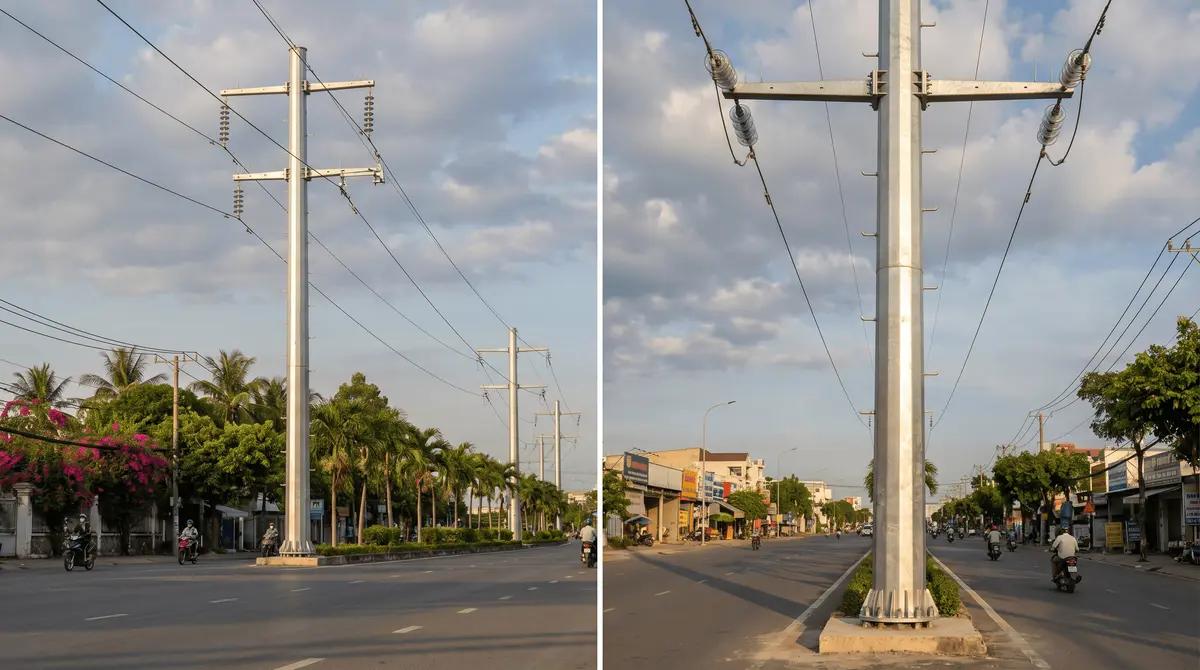
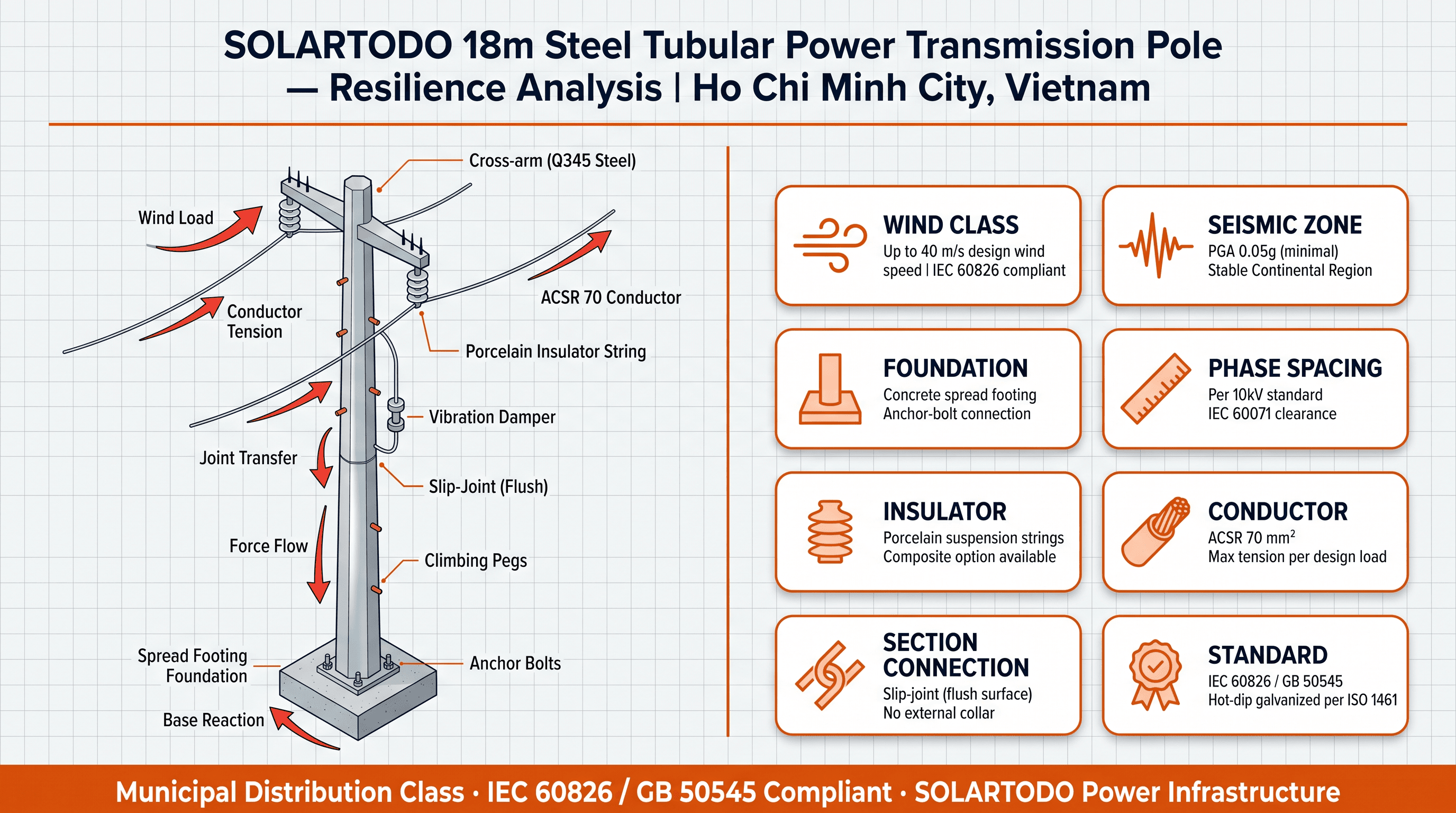
The specified pole form is a tapered steel tubular monopole, not lattice, FRP, wood, or concrete. Material is Q345 steel with hot-dip galvanizing, and the structure uses flanged bolt sections with cross-arm brackets for insulator strings and ACSR conductors. For Ho Chi Minh City, this form reduces footprint at street edges and supports cleaner routing near roads, canals, and mixed-use districts.
Conductor selection is ACSR 70, listed here at 275kg/km and 22kN maximum tension. That is a practical fit for 80m distribution spans in a municipal environment where compact geometry matters more than bulk transfer capacity. Phase spacing is 0.8m, insulator length is 0.5m, and minimum ground clearance is 5m, which are consistent with medium-voltage municipal distribution design intent.
Wind basis is class 4, 40m/s, which is a sensible design point for a coastal metropolitan area exposed to seasonal storms and open-corridor gusts. Foundation type is a concrete base foundation with anchor cage logic typical of steel monopole construction. SOLAR TODO can use this configuration as the baseline submittal package for Ho Chi Minh City tenders, then refine embedment, rebar schedule, and base reactions after route survey and geotechnical review.
Technical Specifications
The recommended Ho Chi Minh City configuration is a 10kV double-circuit 18m steel tubular pole system with 80m spans, ACSR 70 conductor, 40m/s wind class, and a 30-year design life under IEC 60826 and GB 50545.
- Product type: Power Transmission Tower in steel tubular monopole form for medium-voltage municipal distribution
- Voltage class: 10kV double circuit
- Pole height: 18m
- Engineering table fit: 10-35kV distribution | 12-18m height | span 80-150m
- Pole quantity for this line profile: approximately 280 units
- Total route length: about 22km
- Average design span: 80m
- Pole body form: tapered round steel tubular pole
- Material: Q345 steel
- Surface protection: hot-dip galvanized
- Approximate pole weight: ~7t/pole
- Linear weight reference: 400kg/m
- Circuit arrangement: double circuit
- Conductor type: ACSR 70
- Conductor mass: 275kg/km
- Maximum conductor tension: 22kN
- Phase spacing: 0.8m
- Insulator length: 0.5m
- Minimum ground clearance: 5m
- Wind class: Class 4, 40m/s
- Foundation type: concrete base foundation
- Accessories: climbing steps, cross arm, grounding, bird guard, vibration damper
- Design life: 30 years
- Applicable standards: IEC 60826 / GB 50545
These values should be read as a recommended municipal distribution package for Ho Chi Minh City, not as a record of a completed installation. According to IEC (2017), overhead line design must consider wind, conductor tension, and structural reliability together, which is why the 40m/s wind basis and 22kN conductor tension should be checked as one system. According to EN 50341 guidance widely referenced in overhead line practice, route-specific loading and clearance verification remain mandatory before fabrication release.
Implementation Approach
A typical Ho Chi Minh City rollout would proceed in 5 stages over roughly 5-8 months for a 22km, 280-pole municipal line, depending on right-of-way access, foundation curing, and utility outage windows.
Stage 1 is route survey and design validation. This usually takes 3-6 weeks and includes topographic survey, utility conflict mapping, geotechnical sampling, and pole spotting at about 80m intervals. In a city with drainage canals, dense road crossings, and buried services, the survey phase is where span adjustments and angle pole loads are finalized.
Stage 2 is detailed engineering and procurement. This often takes 4-8 weeks for shop drawings, galvanizing schedules, anchor cage detailing, and conductor hardware review. SOLAR TODO would typically prepare pole loading calculations to IEC 60826 and confirm foundation reactions for each structure family, especially terminal and angle poles where loads exceed tangent conditions.
Stage 3 is foundation construction. For a concrete base foundation, civil works usually require 2-4 weeks per workfront, with curing periods often set at 14-28 days depending on mix design and local specification. In Ho Chi Minh City, groundwater and soft-soil pockets can affect excavation support and dewatering requirements, so foundation sequencing should follow geotechnical zoning rather than a simple linear route plan.
Stage 4 is pole erection and line stringing. A crew can often erect 6-12 poles per day in accessible urban sections, while constrained road corridors may reduce that rate. Conductor stringing with ACSR 70 and installation of insulators, bird guards, dampers, and grounding kits should be coordinated with traffic management and planned outage windows.
Stage 5 is testing and commissioning. This generally takes 1-2 weeks for continuity checks, grounding resistance measurement, bolt torque verification, sag-tension confirmation, and final as-built review. According to IEEE guidance on utility asset management, structured commissioning reduces early-life failure risk and improves maintenance planning over the first 12-24 months.
Expected Performance & ROI
For a 10kV urban distribution line in Ho Chi Minh City, steel tubular poles can reduce corridor footprint, lower repainting needs through galvanizing, and support a 30-year lifecycle with predictable inspection intervals.
The main economic case is not energy generation but network reliability, urban land efficiency, and lower maintenance burden versus bulkier support options. According to World Bank power sector studies (2021-2023), distribution reliability improvements in urban networks often produce strong indirect returns through lower outage costs, reduced traffic disruption, and fewer emergency repairs. In practical terms, a 30-year galvanized steel asset can shift spending from reactive replacement to scheduled inspection and hardware renewal.
A realistic lifecycle review would compare steel tubular poles against alternatives on installation footprint, corrosion protection, outage frequency, and access cost. Hot-dip galvanizing typically reduces recurrent surface treatment needs over the first 10-15 years, subject to environmental severity and coating thickness. In a humid coastal city, this matters because O&M truck rolls and lane closures carry significant hidden cost beyond material replacement.
For municipal buyers, expected payback is usually evaluated through avoided outage cost and reduced maintenance rather than direct revenue. A typical medium-voltage line replacement may show a practical payback window of 6-10 years when frequent repairs, pole deterioration, and traffic management costs are high, though exact economics depend on outage history and local labor rates. SOLAR TODO should present ROI as a lifecycle-cost model, not a universal promise.
According to NREL (2022), utility asset decisions should be based on total cost of ownership over the service life rather than first cost alone. According to IRENA (2023), grid modernization investments improve system resilience and reduce technical and economic losses when matched to local network conditions.
Results and Impact
For Ho Chi Minh City, the strongest expected impact is a more compact 10kV corridor using approximately 280 galvanized 18m poles over 22km, with better maintainability and a 30-year service target.
From a network planning perspective, the double-circuit layout supports higher feeder density within the same corridor width. That can be useful in districts where road reserve is limited and new underground conversion is not yet economical. With 80m spans, the structure set remains compatible with urban access while keeping pole count within a practical range for municipal O&M teams.
From an asset-management perspective, steel tubular poles also simplify inspection. Surface condition, bolt torque, grounding continuity, and attachment hardware can be checked with standardized procedures, and accessories such as vibration dampers and bird guards are straightforward to replace. SOLAR TODO can therefore position this product for utilities and EPC firms that need predictable maintenance over 30 years in a humid coastal environment.
Comparison Table
For Ho Chi Minh City’s municipal distribution use case, the 10kV 18m double-circuit steel tubular pole is the correct fit, while 110kV and 220kV classes are physically larger and economically unnecessary for this corridor profile.
| Parameter | Recommended HCMC Configuration | 110kV Sub-Transmission Class | 220kV Transmission Class |
|---|---|---|---|
| Typical use | Municipal distribution | Sub-transmission | HV transmission |
| Voltage class | 10kV | 66-110kV | 220kV |
| Valid height band | 12-18m | 18-30m | 35-55m |
| Selected height example | 18m | 24m | 40m |
| Circuit arrangement | Double circuit | Single or double | Usually double |
| Typical span | 80-150m | 200-300m | 350-450m |
| Selected span example | 80m | 250m | 400m |
| Typical poles/km | 8-12 | 4-5 | 2-3 |
| Fit for dense urban streets | High | Medium | Low |
| Corridor footprint | Compact | Larger | Much larger |
| Suitable for this HCMC profile | Yes | No | No |
Pricing & Quotation
SOLAR TODO offers three pricing tiers for this product line: FOB Supply (equipment ex-works China), CIF Delivered (including ocean freight and insurance), and EPC Turnkey (fully installed, commissioned, with 1-year warranty). Volume discounts are available for large-scale deployments. Configure your system online for an instant estimate, or request a custom quotation from our engineering team at [email protected].
Frequently Asked Questions
This FAQ answers the most common buyer questions on 10kV steel tubular poles in Ho Chi Minh City, including specs, timeline, maintenance, warranty scope, and quotation method for approximately 280-unit municipal distribution projects.
Q1: What pole type is recommended for Ho Chi Minh City in this guide? A tapered steel tubular monopole in Q345 hot-dip galvanized steel is the recommended type. The analyzed configuration is 18m, 10kV, and double circuit for municipal distribution. This form suits urban corridors because it uses a smaller footprint than lattice structures and supports accessories such as cross arms, climbing steps, grounding, and bird guards.
Q2: Why is 10kV selected instead of 110kV or 220kV? The city profile here is a medium-voltage municipal distribution corridor, not a sub-transmission or bulk transmission line. Under the engineering table, 10-35kV maps to 12-18m height and 80-150m span. A 110kV or 220kV structure would be larger than necessary, with higher foundation demand and poorer fit for dense road corridors.
Q3: How many poles would a 22km line typically require? At a nominal 80m span, a line of about 22km would use approximately 280 poles after allowing for route geometry, terminations, and angle locations. Straight-line math alone is not enough in urban projects. Final quantity depends on crossings, setbacks, dead-end sections, and whether some spans need shortening for clearance or utility conflicts.
Q4: What conductor is matched to this recommended configuration? The specified conductor is ACSR 70, with a listed mass of 275kg/km and 22kN maximum tension. For a 10kV line at 80m spans, this is a practical municipal distribution choice. It balances conductor weight, mechanical loading, and installation simplicity without pushing the structure into a higher voltage or larger span class.
Q5: What is the expected project timeline for supply and installation? A typical schedule is about 5-8 months from survey to commissioning for a 22km route, though permit and outage windows can extend that. Survey and design may take 3-6 weeks, procurement 4-8 weeks, foundation and curing 4-8 weeks, and erection plus stringing another 4-8 weeks depending on access and traffic controls.
Q6: What maintenance is usually required over 30 years? Routine maintenance usually includes annual or biennial visual inspection, grounding checks, fastener torque verification, and accessory replacement as needed. In coastal humidity, galvanizing condition should be reviewed carefully after the first 3-5 years and then at planned intervals. Dampers, bird guards, and insulator hardware are consumable items compared with the main steel shaft.
Q7: What payback period should utilities expect? Payback is usually assessed through avoided outage cost, lower emergency repair frequency, and reduced corridor disruption rather than direct revenue. For medium-voltage replacement projects, a practical planning range is often 6-10 years, but this depends on baseline failure rates, labor cost, and traffic-management expense. SOLAR TODO should quote lifecycle cost, not a single generic ROI number.
Q8: How does a steel tubular pole compare with lattice or concrete in urban streets? A steel tubular pole generally uses less horizontal space and presents a cleaner fit in constrained road corridors. Concrete can be heavier to handle, while lattice structures require a broader footprint and are less convenient near sidewalks or medians. For 10kV municipal lines, an 18m galvanized tubular pole is often the more practical urban option.
Q9: What does EPC pricing usually include? EPC scope normally includes detailed engineering, fabrication, galvanizing, shipment, civil works, erection, conductor stringing, grounding, testing, and commissioning. Final scope should clearly state whether traffic management, utility shutdown coordination, and geotechnical investigation are included. Buyers should also confirm if warranty starts at delivery, mechanical completion, or energized handover.
Q10: What warranty terms are typical for this product line? Commercial terms vary by contract, but the required quotation section states 1-year warranty for EPC Turnkey scope. Buyers should also ask for separate clarification on galvanizing quality, structural fabrication tolerances, and excluded wear items. Warranty language should reference inspection records, loading assumptions, and compliance with IEC 60826 and project drawings.
References
- General Statistics Office of Vietnam (2023): Population and urban statistics for Ho Chi Minh City and national urban growth indicators.
- World Bank (2022): Vietnam urbanization, infrastructure demand, and power-sector development context.
- International Energy Agency (IEA) (2023): Southeast Asia electricity demand growth outlook and grid investment needs.
- International Renewable Energy Agency (IRENA) (2023): Grid infrastructure and resilience investment guidance relevant to urban power systems.
- IEC (2017): IEC 60826 design criteria for overhead transmission lines, including loading and strength requirements.
- GB Standard (2010): GB 50545 code for design of overhead transmission line structures and related engineering practice.
- Vietnam National Centre for Hydro-Meteorological Forecasting (2023): Southern Vietnam seasonal wind and rainfall conditions relevant to line design.
- NREL (2022): Utility asset management and lifecycle cost evaluation principles for grid infrastructure.
- EN 50341 Committee Guidance (latest applicable edition): Overhead electrical line design framework used as reference in line routing and clearance practice.
- EVN / Southern Power Corporation planning materials (recent public planning documents): Medium-voltage distribution network development context in southern Vietnam.
Equipment Deployed
- 18m tapered steel tubular pole, 10kV double circuit, hot-dip galvanized Q345 steel
- Approximately 280 units for about 22km line length
- ACSR 70 conductor, 275kg/km, maximum tension 22kN
- Cross arm brackets for double-circuit insulator arrangement
- Insulators with 0.5m string length
- Concrete base foundation with anchor cage logic
- Climbing steps for maintenance access
- Grounding set for each pole location
- Bird guard accessory set
- Vibration damper set for conductor protection
- Phase spacing configured at 0.8m
- Minimum ground clearance designed at 5m
- Wind class 4 structural basis, 40m/s
- Design standards: IEC 60826 and GB 50545
- 30-year design life package for municipal distribution use