Davao SOLARTODO Sentinel City AI Pole Market Analysis: 44-Node Coastal Edge Configuration Guide
Summary
The recommended Davao configuration uses approximately 44 SOLARTODO Sentinel City AI Pole nodes at 35 m spacing, serving a 1.85 million-person coastal city across 2,443.61 km2 with 5-20 kWh storage per node.
Key Takeaways
A 44-node Davao Sentinel layout would create about 1.54 km of high-density edge coverage at 35 m intervals for coastal and urban-perimeter monitoring.
- Approximately 44 SOLARTODO Sentinel City AI Pole nodes would be specified for a project-based Davao configuration, subject to survey, permitting and engineering confirmation.
- Each node is fully off-grid, combining 2.8-3.2 kWp on-pole PV replenishment with 5-20 kWh-class battery storage for scheduled drone and robot duty cycles.
- Clear-sky replenishment should be modeled at roughly 1.0-1.3 kW DC peak and about 7-10 kWh/day, not as unlimited solar self-sufficiency.
- The 35 m spacing implies about 1,505 m between the first and last node, excluding site-specific offsets, setbacks, turns and no-build zones.
- Davao's 2024 population is about 1,848,947, making event filtering and local processing important for high-volume transport, port and perimeter zones.
- The recommended workflow keeps raw video and sensor data on the pole; only de-identified event and status metadata should leave the site.
- A realistic delivery plan should allow 12-20 weeks from engineering survey to commissioning for approximately 44 custom edge-node poles.
Market Context for Davao
Davao's 1.85 million residents, 2,443.61 km2 land area and Davao Gulf coastline make it a strong fit for distributed city-edge sensing rather than centralized cameras alone.
According to the Philippine Statistics Authority (2025), Davao City recorded about 1,848,947 residents in the 2024 Census of Population. According to the Philippine Standard Geographic Code dataset (2024), the city covers 2,443.61 km2 and is organized into 182 barangays. Those numbers point to a geography where centralized cameras alone can struggle to cover ports, airport corridors, bridges, dense commercial districts and upland approaches.
According to the World Bank (2024), the Philippines urban-population indicator is tracked across 1960-2024 under the UN World Urbanization Prospects methodology. ITU states, "cities today accounting for over 70 per cent of global greenhouse gas emissions" and also 60-80 per cent of global energy consumption. That context favors edge nodes that filter events locally and avoid unnecessary high-bandwidth backhaul.
Davao's operational environment is humid, coastal and rainfall-exposed. According to PAGASA (2024), Philippine climate services include rainfall advisories, tropical-cyclone bulletins and localized weather monitoring, so pole siting should account for wind exposure, drainage, corrosion control and access during heavy rain. The SOLARTODO Sentinel City AI Pole is a technical fit where municipalities, campuses, ports and industrial parks need autonomous inspection without moving raw video off site. See SOLARTODO solutions or contact us for engineering review.
Recommended Technical Configuration
A typical Davao configuration of this scale would use approximately 44 SOLARTODO Sentinel poles with 35 m spacing, local inference and off-grid battery buffering.
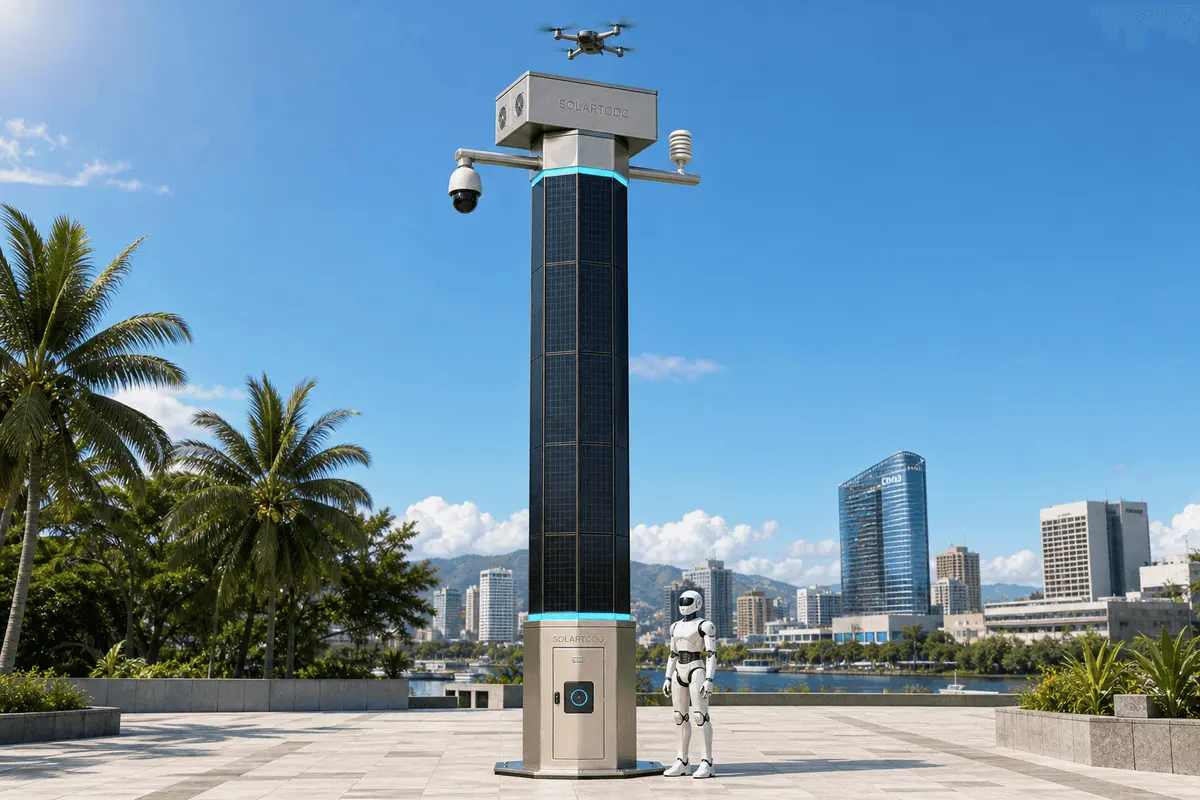
The recommended size class is the Sky Hub pole-form SOLARTODO Sentinel configuration: a non-lighting city AI pole designed for sensing, edge compute, drone operations and ground-robot service. It should not be specified as a streetlight, because the product is a pure smart pole with no lighting system. The selected spacing of about 35 m is appropriate for a linear coastal perimeter, industrial boundary, port access road, campus spine or controlled district corridor.
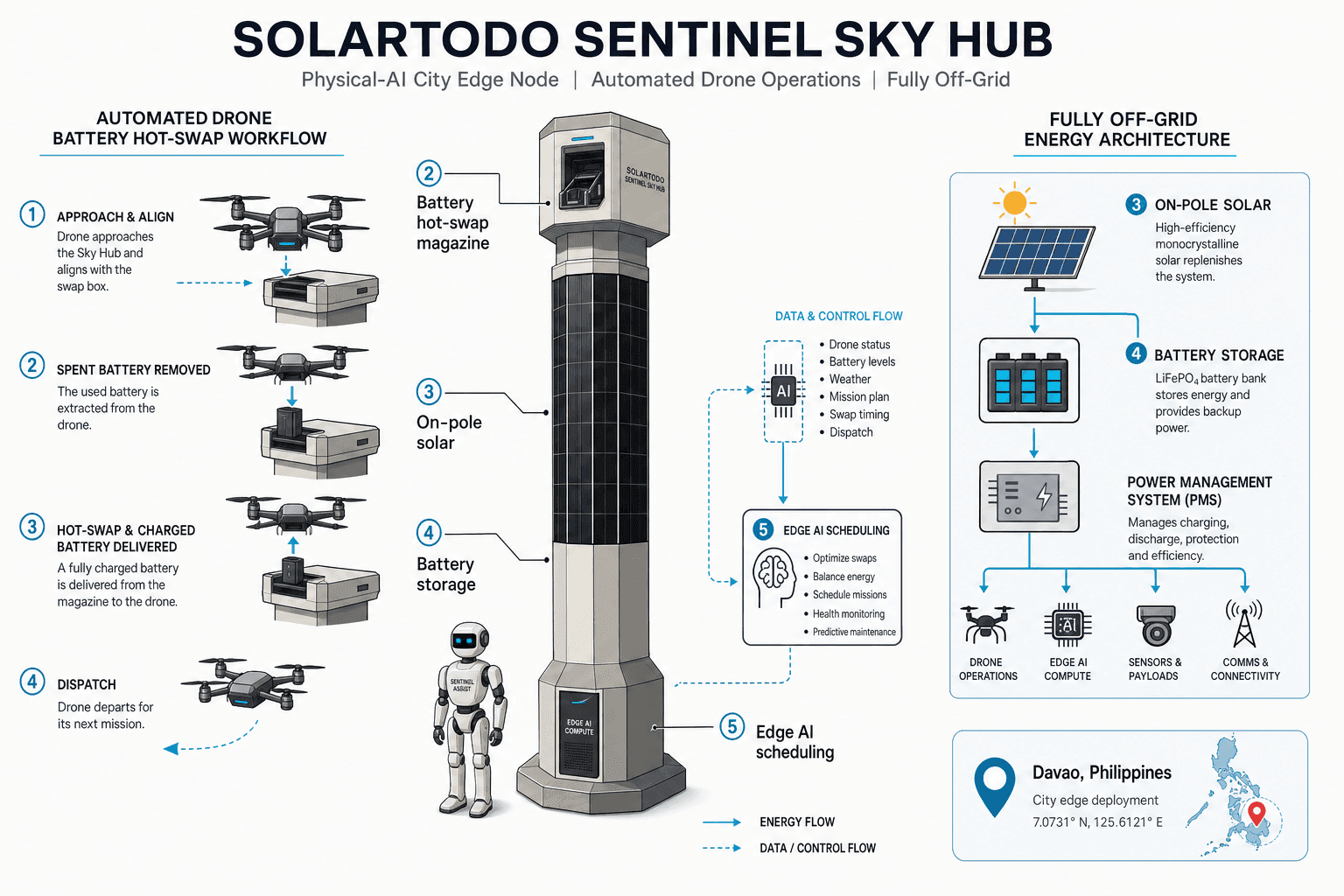
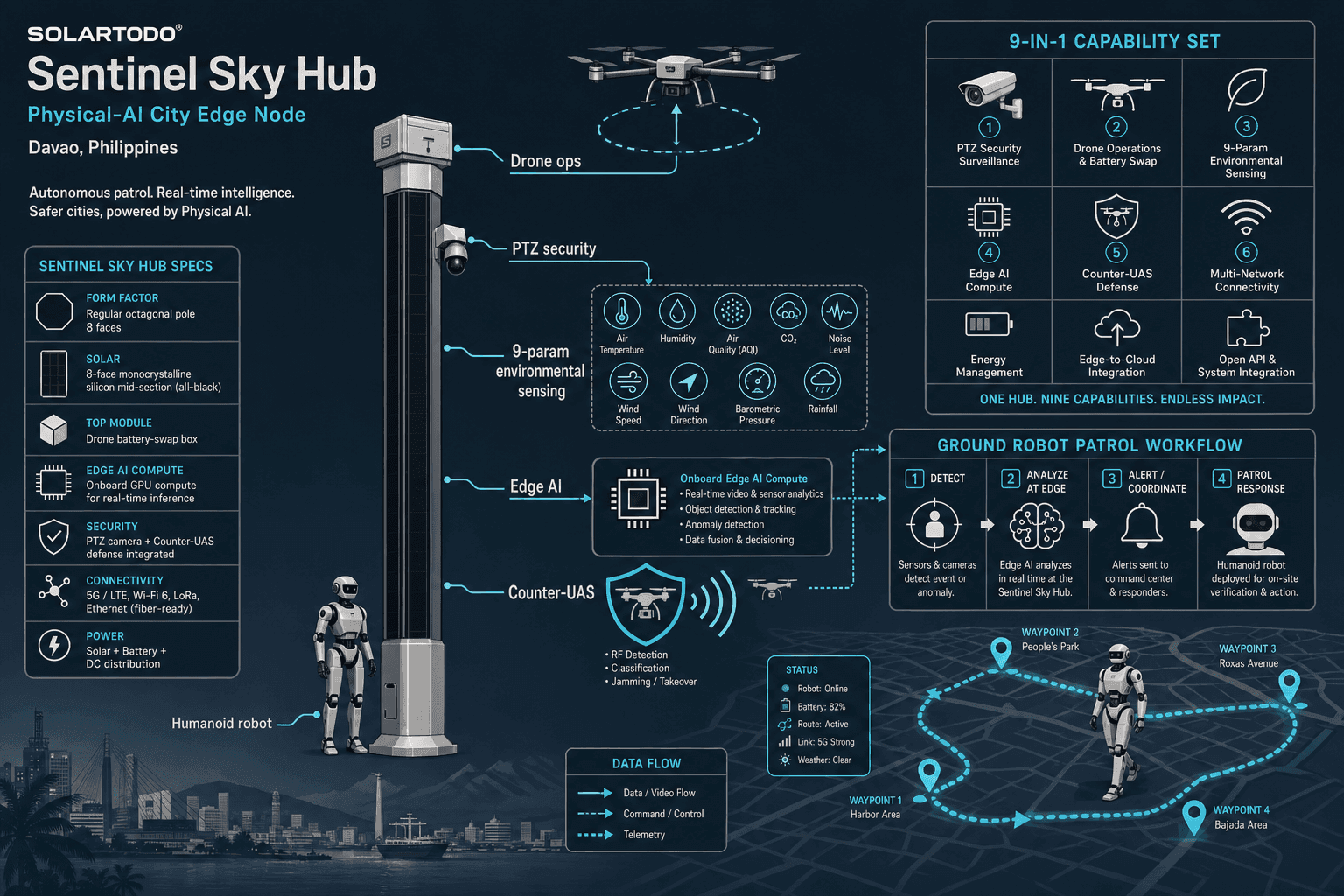
A typical 44-node deployment in this profile would consist of approximately 44 Sentinel edge-node poles, each operating as an off-grid micro-station. The baseline package would include anonymous vehicle counts, crowd-density estimation, intrusion and perimeter awareness; a nine-parameter environmental station; drone launch, return, service and battery exchange; ground-robot wireless charging; and a common operating picture for human-authorized response. Counter-UAS coordination should be specified only as non-lethal detection, tracking and command coordination, with soft aerial net-capture or close-approach deterrence after human authorization. Radar, if needed, is an optional partner-sensor input, not pole hardware.
Technical Specifications
The Davao technical baseline should specify 44 off-grid Sentinel nodes, 5-20 kWh storage, 7-10 kWh/day clear-sky replenishment and local-only raw-data processing.
- Product line: SOLARTODO Sentinel City AI Pole, Sky Hub pole-form configuration, pure smart pole with no lighting system.
- Quantity basis: approximately 44 edge-node poles across Davao at about 35 m spacing, subject to site survey and engineering confirmation.
- Energy system: fully off-grid micro-station with on-pole solar replenishment and battery storage; no city, site or grid power dependency should be assumed.
- PV replenishment: 2.8-3.2 kWp nameplate, modeled at roughly 1.0-1.3 kW DC clear-sky peak and about 7-10 kWh/day in high-irradiance conditions.
- Storage class: 5-20 kWh battery buffer per node, sized by drone sortie frequency, robot patrol duration, backhaul duty cycle and local climate margin.
- Edge compute: Jetson-class local inference module for video analytics, workload scheduling and event filtering.
- Data architecture: raw video and sensor data stay on the pole; only de-identified event and status metadata may leave the site.
- Sensing package: PTZ camera analytics for anonymous vehicle count, crowd density, intrusion and perimeter awareness, without face recognition or licence-plate recognition as active capabilities.
- Environmental monitoring: wind speed, wind direction, temperature, humidity, atmospheric pressure, noise, PM10, PM2.5 and illuminance.
- Standards basis: IEC 60529 enclosure planning, IEC 62443-oriented OT security design, ITU-T smart-city architecture alignment and local Philippine permitting review.
NREL states, "Estimates the energy production of grid-connected photovoltaic" systems; for this off-grid pole, that modeling should be used only as a planning input, not a guarantee. According to IEC (2013/2024), IP-code enclosure planning and IEC 62443-oriented cybersecurity are relevant because city edge nodes combine sensing, compute, OT control states and maintenance access.
Implementation Approach
A 44-node Davao program would typically move through 5 phases: survey, engineering, CKD logistics, civil works and commissioned edge operations.
The first phase is a corridor and risk survey. Engineers would mark each proposed 35 m node location, verify no-build zones, confirm drainage, check underground utilities and classify each site by wind exposure, access control and communications availability. This phase should also define whether the 44 poles form one linear chain, multiple short perimeters or a mixed city-district grid.
The second phase is technical design and factory configuration. SOLARTODO would map each node to battery class, drone service duty cycle, robot return zone, environmental sensor package, edge-compute workload and COP integration. The third phase covers CKD logistics and local installation readiness: foundations, anchor systems, staging space, lifting access, customs documentation and safety controls. Commissioning then validates mechanical installation, energy behavior, communications, local inference, operator roles and acceptance tests.
Expected Performance & ROI
Expected Davao performance should be measured by 44-node event coverage, reduced manual patrol hours, 7-10 kWh/day replenishment and faster verified response.
The main ROI mechanism is operational substitution, not electricity resale. A configured Sentinel node can reduce repeated manual inspection rounds, shorten event verification time and provide persistent environmental telemetry where grid power or high-bandwidth fiber may be difficult. For Davao, the 44-node configuration would be most valuable along coastal perimeters, port approaches, logistics zones, campuses or industrial parks.
Payback should be modeled after SOLARTODO receives patrol schedule, incident-response baseline, communications cost, security staffing pattern and maintenance route data. Without site-specific CAPEX and OPEX, a fixed payback claim would be misleading. A 10-year model should compare labor hours avoided, patrol vehicle kilometers avoided, downtime reduction, avoided temporary-power works and reduced backhaul bandwidth from local inference. Because raw video stays on the pole, data-transfer cost and privacy exposure can both be lower than cloud-first camera architectures.
Results and Impact
The expected impact of 44 Davao Sentinel nodes is a local-processing edge layer with 44 autonomous inspection points and no raw-video upload requirement.
For buyers, the practical result is a distributed operating layer rather than a conventional camera-only network. Each pole can collect, process, filter and classify events locally, then send de-identified event metadata to the command interface. Human-in-the-loop authorization remains required for counter-UAS response, and the system should be configured around local policy, site authority and national aviation rules.
A Davao installation plan should also recognize limits. On-pole solar replenishment is supplemental and weather-dependent, so heavy drone or robot workloads must be scheduled against storage state of charge. The correct engineering question is whether the battery, replenishment curve and duty cycle support the required service level.
Comparison Table
This 44-node Davao comparison shows why Sentinel differs from 44 camera poles, 44 grid-fed smart poles and manual patrol-only operations.
| Option | Typical 44-node Davao Fit | Power Model | Data Model | Inspection Capability | Key Limitation |
|---|---|---|---|---|---|
| SOLARTODO Sentinel City AI Pole | 44 autonomous edge nodes at about 35 m spacing | Fully off-grid, 5-20 kWh storage, 7-10 kWh/day clear-sky replenishment | Raw data stays on pole; metadata leaves | Drone service, robot charging, sensing and COP workflow | Requires duty-cycle engineering |
| Conventional camera pole | 44 fixed camera points | Usually grid or site power | Often raw or high-bitrate video backhaul | Visual monitoring only | Higher bandwidth and limited field action |
| Grid-fed smart pole | 44 connected utility points | Site/grid power | Depends on platform | Sensors possible, usually no autonomous drone service | Civil power works and outage exposure |
| Manual patrol baseline | Variable routes, often fewer than 44 checkpoints | Vehicle and labor dependent | Human reports | Flexible but intermittent | Slower verification and recurring labor cost |
Pricing & Quotation
For 44 Davao Sentinel nodes, SOLARTODO quotes 3 commercial scopes because freight, installation, commissioning, warranty and local civil works change by site.
SOLARTODO offers three pricing tiers for this product line: FOB Supply (equipment ex-works China), CIF Delivered (including ocean freight and insurance), and EPC Turnkey (fully installed, commissioned, with 1-year warranty). Volume discounts are available for large-scale deployments. Configure your system online for an instant estimate, or request a custom quotation from our engineering team at [email protected].
Frequently Asked Questions
These 10 FAQ answers clarify the 44-node Davao configuration, including storage, installation timing, ROI, maintenance, comparison, EPC scope, warranty and commissioning.
Q1: Is the SOLARTODO Sentinel City AI Pole a smart streetlight? No. The SOLARTODO Sentinel City AI Pole is a pure smart pole with no lighting system. In Davao, it should be specified as a city-edge AI node for sensing, local compute, drone service, ground-robot support and off-grid operation. It should not be described as a streetlight, lamp pole or lighting retrofit.
Q2: What technical specification is recommended for Davao? A typical Davao configuration would use approximately 44 Sky Hub pole-form Sentinel nodes at about 35 m spacing. Each node should include 5-20 kWh-class storage, 2.8-3.2 kWp on-pole PV replenishment, Jetson-class local compute, environmental sensing, PTZ perception analytics, drone service management and ground-robot wireless charging, subject to engineering confirmation.
Q3: How long would a 44-node deployment normally take? A realistic implementation window is about 12-20 weeks after site access, depending on permitting, foundations, shipping route and commissioning complexity. Survey and engineering may take 2-4 weeks, factory configuration and logistics 4-8 weeks, civil works 3-5 weeks and commissioning 1-3 weeks for a prepared corridor.
Q4: How is ROI or payback calculated? Payback should be calculated from Davao-specific operating data, not from a generic claim. The model compares capital cost, maintenance, communications and battery replacement against reduced patrol hours, fewer vehicle kilometers, faster event verification and lower video-backhaul cost. SOLARTODO should prepare this model after receiving route length, staffing and service-level assumptions.
Q5: What maintenance does the system require? Maintenance typically includes PV-surface cleaning, battery health checks, mechanical inspection, sensor calibration, drone-service checks, robot charging verification, software updates and enclosure inspection. In a humid coastal environment, corrosion review and gasket inspection should be scheduled carefully. A 44-node system should use both periodic field visits and remote health monitoring.
Q6: How does Sentinel compare with camera-only poles? Camera-only poles mainly capture video and often depend on backhaul or control-room review. Sentinel adds local AI inference, environmental monitoring, drone operations, robot charging and event metadata generation at each pole. The main advantage is field action and bandwidth reduction; the main constraint is that drone and robot duty cycles must be engineered.
Q7: Does the system upload raw video to the cloud? No. The recommended architecture keeps raw video and sensor data on the pole for local processing. Only de-identified event metadata, alarms, system health and status messages should leave the site. This supports PDPL-LGPD-oriented data handling, but it should not be described as certified compliant without a separate legal and technical audit.
Q8: What does EPC Turnkey include? EPC Turnkey normally means the supplied equipment is installed, commissioned and handed over with a 1-year warranty under the quoted scope. For Davao, the EPC boundary should identify foundations, lifting, communications, operator training, acceptance tests, spare parts and local permits. Site exclusions should be listed before contract signing.
Q9: What warranty should buyers expect? The pricing paragraph specifies EPC Turnkey with a 1-year warranty. Buyers should request separate warranty schedules for batteries, compute modules, sensors, drone-service components and structural parts, because each subsystem has different operating conditions. Warranty response times should also be matched to Davao's site access and service-level requirements.
Q10: Can counter-UAS functions operate autonomously? Detection and tracking can support automated awareness, but mitigation must be non-lethal and human-authorized. The system may coordinate a friendly drone for soft aerial net-capture or close-approach deterrence where legally permitted. It should not be specified for jamming, hard-kill actions, autonomous attack or any destructive response.
References
These 7 references support Davao market sizing, 44-node configuration logic, smart-city architecture, climate planning, enclosure security and solar-replenishment assumptions for engineering review.
- Philippine Statistics Authority (2025): 2024 Census of Population counts, including Davao City's reported 1,848,947 residents and national 112,729,484 population.
- Philippine Statistics Authority / PSGC (2024): Philippine Standard Geographic Code administrative data for Davao City, including 2,443.61 km2 land area and 182 barangays.
- ITU (2015): Smart Sustainable Cities definition and city-resource context; ITU notes cities account for over 70% of global GHG emissions and 60-80% of energy consumption.
- World Bank (2024): Urban population indicator for the Philippines based on UN World Urbanization Prospects methodology.
- PAGASA (2024): Climate and weather services covering rainfall advisories, tropical-cyclone bulletins and localized weather-risk planning.
- IEC (2013/2024): IEC 60529 enclosure protection and IEC 62443 industrial automation and control-system cybersecurity standards for edge-node planning.
- NREL (2024): PVWatts modeling guidance for photovoltaic energy-production estimates and uncertainty-aware solar-resource planning.
Equipment Deployed
- Approximately 44 SOLARTODO Sentinel City AI Pole Sky Hub pole-form edge nodes
- 5-20 kWh-class battery storage per node, sized by duty cycle
- 2.8-3.2 kWp on-pole PV replenishment with 1.0-1.3 kW DC clear-sky peak planning output
- Jetson-class edge AI compute for local inference and workload scheduling
- PTZ sensing package for anonymous vehicle count, crowd density, intrusion and perimeter awareness
- Nine-parameter environmental monitoring: wind speed, wind direction, temperature, humidity, pressure, noise, PM10, PM2.5 and illuminance
- Automated drone operations module with battery hot-swap and mission management
- Ground-robot wireless charging and patrol coordination interface
- Human-authorized, non-lethal counter-UAS coordination workflow