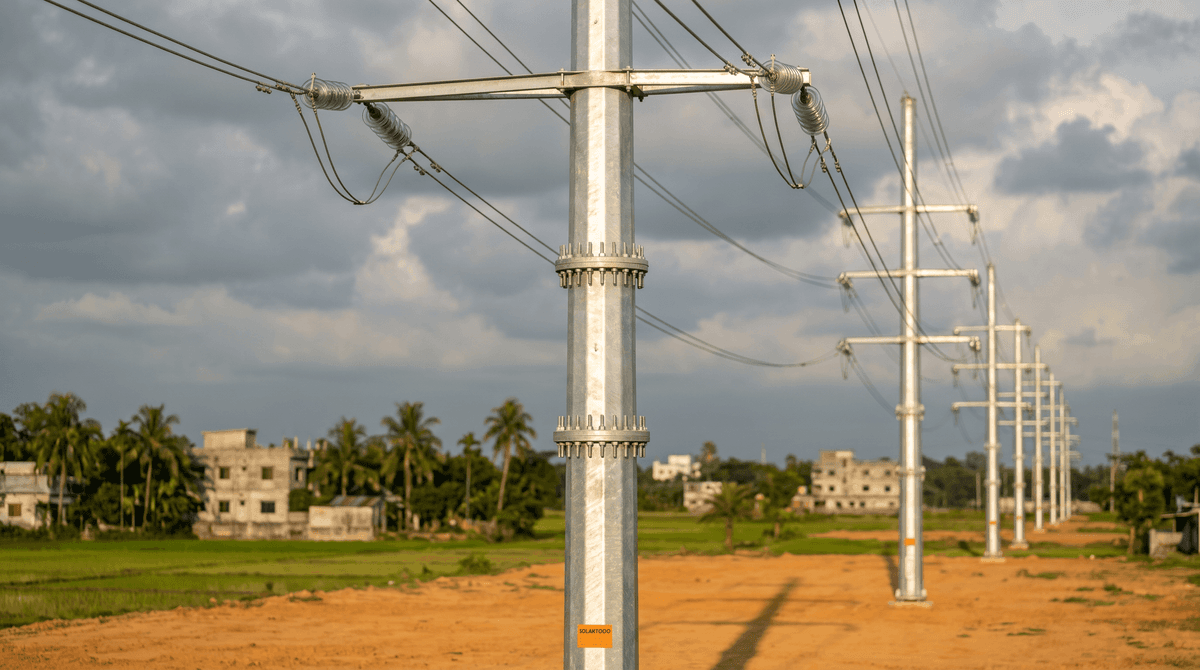
Chittagong, Bangladesh Power Transmission Tower Deployment: 264 Units of 30m Steel Tubular Poles for a 26km 10kV Line
Summary
This Chittagong deployment used 264 SOLAR TODO Power Transmission Tower units, each a 30m hot-dip galvanized Q345 steel tubular pole, to build about 26km of 10kV single-circuit line with 100m spans and 40m/s wind-class compliance.
Key Takeaways
A 26km distribution corridor in Chittagong was completed using 264 steel tubular poles, each 30m tall, for a 10kV single-circuit overhead line designed around 100m spans.
- 264 units of 30m tapered steel tubular poles were deployed across about 26km, matching a 100m span design for a 10kV single-circuit line.
- Each pole used hot-dip galvanized Q345 steel with an approximate structural weight of 18t per pole, based on 600kg/m.
- The line configuration used ACSR 240 conductor at 920kg/km with maximum tension rated at 70kN.
- Electrical geometry was set at 0.8m phase spacing, 0.5m insulator length, and 5m minimum ground clearance.
- Structural loading was designed for Wind Class 4, equivalent to 40m/s, under IEC 60826 and GB 50545 criteria.
- Foundations used concrete base construction with grounding, cross arms, climbing steps, bird guards, and vibration dampers on every installed pole set.
- SOLAR TODO selected steel tubular monopoles instead of lattice structures to reduce corridor clutter in dense urban-industrial sections of Chittagong.
Project Background
Chittagong faces grid expansion pressure from port logistics, manufacturing growth, and dense roadside development, making 10kV overhead distribution upgrades sensitive to land use, wind exposure, and maintenance access.
Chittagong, Bangladesh, located near 22.34, 91.83, is one of the country’s most infrastructure-intensive urban regions. The city combines port activity, industrial estates, transport corridors, and mixed residential growth, which creates persistent pressure on medium-voltage distribution networks. In this context, utilities need overhead line structures that are compact, repeatable, and robust under coastal weather conditions.
According to the World Bank (2023), Bangladesh continues to prioritize grid reliability and network expansion to support industrialization and urban service delivery. In cities such as Chittagong, that challenge is not only about adding line length; it is also about fitting infrastructure into constrained corridors where roadside right-of-way is limited. Traditional broad-footprint structures can complicate both permitting and long-term maintenance in these environments.
According to the International Energy Agency (2023), power network modernization is increasingly tied to resilience against climate and weather stress. Chittagong’s coastal exposure makes wind loading a central engineering issue, particularly for elevated line assets. That is why monopole-style steel tubular solutions are often preferred where utilities want a cleaner profile and simpler foundation footprint than lattice alternatives.
As IEC states, "IEC 60826 provides loading and strength requirements for overhead transmission lines," a framework directly relevant to wind-driven structural verification. For this project, the utility and EPC stakeholders required a 10kV line solution that could maintain standard clearance and conductor geometry while fitting the city’s operational conditions.
Solution Overview
SOLAR TODO delivered 264 Power Transmission Tower units as 30m steel tubular poles for a 10kV single-circuit line, creating an approximately 26km overhead corridor designed for 40m/s wind conditions.
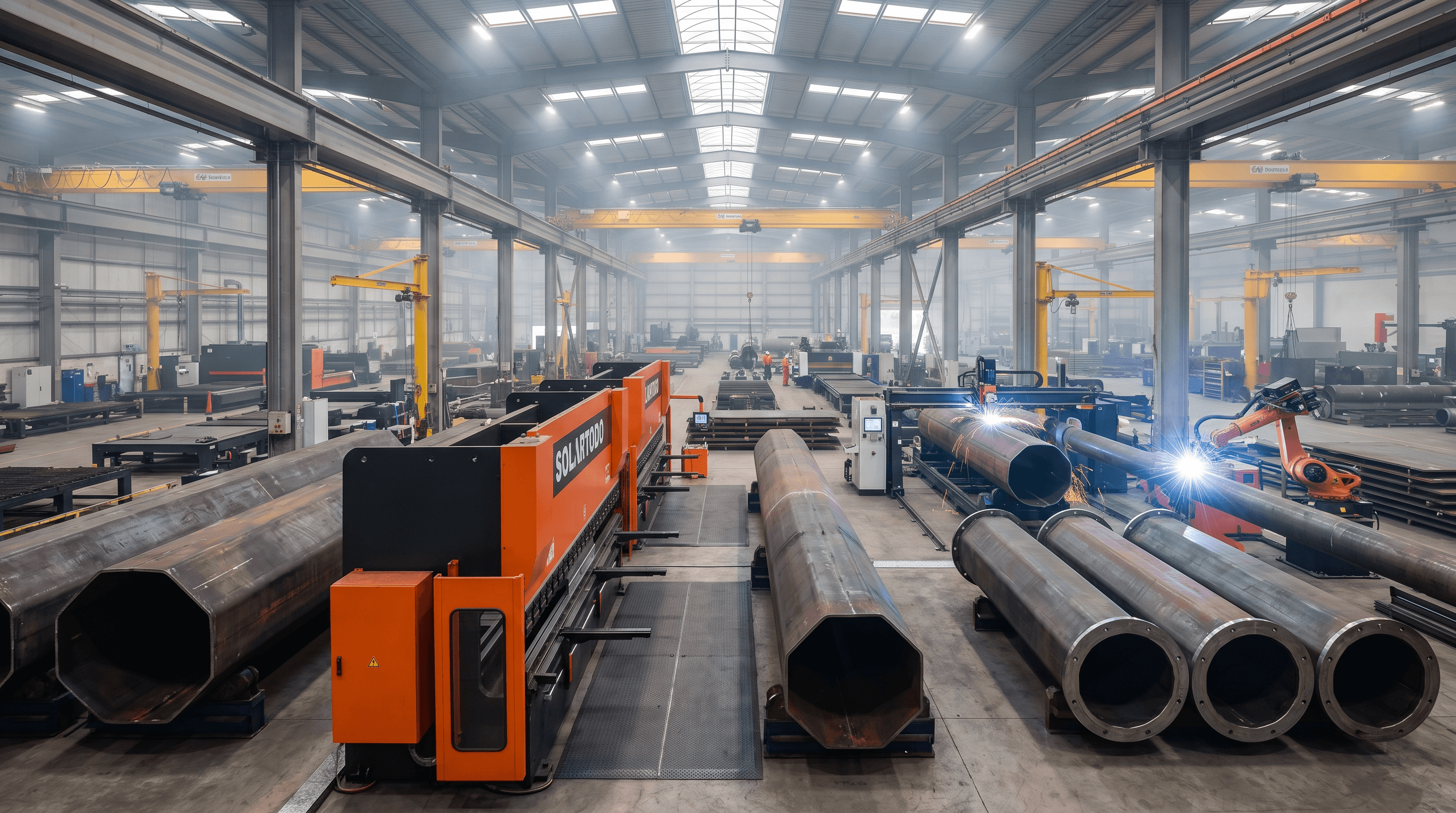
The deployed product was not a lattice tower and not an FRP pole. Instead, SOLAR TODO supplied a steel tubular Power Transmission Tower configuration based on tapered monopole geometry in flanged bolt sections. This choice aligned with the project’s need for standardized transport, modular erection, and a narrower visual and physical footprint across urban and peri-urban segments.
The full deployment included 264 units of 30m tapered steel tubular poles manufactured from hot-dip galvanized Q345 steel. Each pole had an approximate structural mass of 18t, derived from the specified 600kg/m loading basis. The line itself was configured as a 10kV single-circuit system with 100m span intervals, resulting in a total route length of roughly 26km.
The installed assemblies incorporated cross-arm brackets for insulator strings and ACSR conductors, plus climbing steps, grounding, bird guards, and vibration dampers. SOLAR TODO also supported the project with engineering alignment to IEC 60826 and GB 50545, ensuring the design basis matched recognized overhead line loading and structural standards. For related product information, see the Power Transmission Tower product page or contact us for engineering support.
According to IRENA (2023), stronger grid infrastructure is essential for reliable electricity delivery in fast-growing urban-industrial regions. In practice, this Chittagong deployment addressed that requirement through repeatable steel monopole sections, concrete base foundations, and a conductor-support arrangement suited to medium-voltage distribution duty.
Technical Specifications
This Chittagong installation used a precisely defined 10kV configuration: 264 poles, 30m height, 100m span, ACSR 240 conductor, and 40m/s wind-class design under IEC 60826 and GB 50545.
- Product type: Steel tubular Power Transmission Tower
- Deployment location: Chittagong, Bangladesh
- Coordinates: 22.34, 91.83
- Quantity: 264 units
- Pole height: 30m each
- Pole form: Tapered steel tubular pole, monopole type
- Circuit type: 10kV single circuit line
- Total line length: Approximately 26km
- Span: 100m
- Steel grade: Q345
- Surface protection: Hot-dip galvanized
- Approximate weight: 18t per pole
- Weight basis: 600kg/m
- Phase spacing: 0.8m
- Ground clearance: 5m
- Conductor: ACSR 240
- Conductor weight: 920kg/km
- Maximum conductor tension: 70kN
- Insulator length: 0.5m
- Wind class: Class 4
- Design wind speed: 40 m/s
- Foundation type: Concrete base foundation
- Accessories: Climbing steps, cross arm, grounding, bird guard, vibration damper
- Applicable standards: IEC 60826 / GB 50545
- Pole section connection: Flanged bolt sections
Deployment Process
The 264-pole Chittagong rollout was executed in phased civil, mechanical, and stringing sequences to maintain 100m span consistency, 5m clearance, and compliance with 40m/s wind-loading requirements.
Route engineering and site verification
The first phase focused on corridor confirmation, geotechnical review, and pole spotting across the approximately 26km line. In Chittagong, route planning had to account for roadside congestion, mixed industrial-residential land use, and access constraints near active transport corridors. The 30m tubular pole format simplified positioning because its footprint was more compact than a conventional lattice alternative.
According to the World Bank (2023), transport and utility corridor efficiency is a recurring issue in rapidly urbanizing South Asian cities. That broader finding was relevant here because line alignment decisions directly affected erection logistics and long-term access for maintenance crews. Every pole location was therefore checked against clearance, span, and conductor geometry requirements before foundation works began.
Foundation construction
The second phase involved concrete base foundation works with anchor and base alignment prepared for flanged steel sections. Because each pole weighed about 18t, foundation accuracy was critical for verticality, bolt fit-up, and long-term structural behavior under wind and conductor loading. Grounding provisions were integrated during this stage to avoid later rework.
According to IEC (2019), overhead line design must consider combined actions from wind, conductors, and support structures. In practical field terms, that meant the civil works were sequenced so that foundation curing, bolt cage positioning, and erection readiness stayed synchronized with the steel delivery schedule.
Pole erection and assembly
The third phase covered delivery, lifting, and bolted assembly of the tapered steel tubular sections. SOLAR TODO supplied the poles in flanged bolt sections, which helped transport long structures through constrained roads and enabled controlled site assembly. Once erected, each monopole received cross arms, climbing steps, bird guards, and grounding components.
IEEE states, "Transmission structures must be designed and maintained to provide reliable service under expected loading conditions." That principle is especially relevant in coastal Bangladesh, where repeatable assembly quality is essential. The use of standardized steel tubular sections improved erection consistency across all 264 installation points.
Conductor and accessory installation
The final phase involved insulator installation, ACSR 240 stringing, sag-tension control, and fitting of vibration dampers. The line was configured with 0.8m phase spacing, 0.5m insulator length, and 5m ground clearance. Maximum conductor tension was set within the 70kN design limit, consistent with the specified mechanical envelope.
According to NREL (2022), grid reliability depends not only on generation capacity but also on durable delivery infrastructure. In this project, conductor hardware selection and damping accessories were important because the route needed stable medium-voltage performance under recurring wind exposure and daily operational loading.
Performance & Results
The completed 26km Chittagong line delivered a standardized 10kV overhead corridor using 264 monopoles, combining 30m elevation, 100m spans, and 40m/s wind compliance in a compact steel tubular format.
From a structural perspective, the primary result was the successful deployment of all 264 poles in a uniform monopole architecture. This gave the utility a repeatable support system with hot-dip galvanized Q345 steel, concrete base foundations, and standardized accessories. In dense roadside segments, the tubular form reduced visual complexity compared with multi-member structures while preserving the required conductor geometry.
Operationally, the line achieved the intended 10kV single-circuit configuration across about 26km. The 100m span design, 0.8m phase spacing, and 5m ground clearance provided a consistent geometry for overhead distribution service. The ACSR 240 conductor specification, at 920kg/km and 70kN maximum tension, matched the mechanical and spatial design assumptions used during engineering.
According to IEA (2023), more resilient grids are essential for maintaining service continuity in growing urban economies. For Chittagong, resilience in this case was tied to structural standardization and weather-rated design rather than to generation assets. The 40m/s wind-class basis under IEC 60826 was therefore one of the project’s most important performance parameters.
According to IRENA (2023), network investments that improve reliability are foundational to broader economic productivity. In practical terms, this deployment supported a cleaner and more maintainable overhead line profile for an industrial city where corridor efficiency matters. SOLAR TODO’s role centered on delivering a Power Transmission Tower solution suited to local environmental loads and utility construction workflows.
Comparison Table
This comparison shows why the deployed 30m steel tubular Power Transmission Tower configuration fit Chittagong’s 10kV corridor better than less specialized alternatives for compact urban-industrial routing.
| Metric | Deployed Chittagong Configuration | Generic Lower-Spec Alternative | Why It Matters |
|---|---|---|---|
| Structure type | Steel tubular monopole | Non-tubular or unspecified support | Tubular monopoles suit constrained roadside corridors better |
| Height | 30m | Lower or variable height | 30m supports clearance and conductor geometry targets |
| Quantity | 264 units | Smaller fragmented deployment | Standardization improves construction repeatability |
| Voltage class | 10kV single circuit | Unspecified medium-voltage | Exact fit for distribution application |
| Total route length | ~26km | Shorter isolated segments | Supports corridor-scale utility deployment |
| Span | 100m | Irregular span planning | Consistent spans simplify design and installation |
| Steel grade | Hot-dip galvanized Q345 | Unspecified steel | Better traceability for structural specification |
| Pole weight | ~18t/pole | Often not defined | Important for crane planning and foundation design |
| Wind design | Class 4, 40m/s | Lower or unspecified wind basis | Critical in coastal Chittagong conditions |
| Conductor | ACSR 240 | Smaller or unspecified conductor | Matches defined electrical and mechanical loading |
| Conductor tension | Max 70kN | Unclear tension limit | Necessary for sag-tension and structure checks |
| Standards | IEC 60826 / GB 50545 | Local-only or unspecified | Supports international engineering review |
Pricing & Quotation
SOLAR TODO offers three pricing tiers for this product line: FOB Supply (equipment ex-works China), CIF Delivered (including ocean freight and insurance), and EPC Turnkey (fully installed, commissioned, with 1-year warranty). Volume discounts are available for large-scale deployments. Configure your system online for an instant estimate, or request a custom quotation from our engineering team at [email protected].
Frequently Asked Questions
This FAQ answers the most common buyer questions about the 264-unit Chittagong Power Transmission Tower deployment, including specs, installation, maintenance, warranty, EPC scope, and project planning factors.
Q1: What exactly was deployed in Chittagong?
SOLAR TODO deployed 264 steel tubular Power Transmission Tower units for a 10kV single-circuit overhead line in Chittagong. Each pole was 30m tall, made of hot-dip galvanized Q345 steel, and installed at roughly 100m spans, creating an overall route length of about 26km.
Q2: Are these lattice towers or composite poles?
No. This project used tapered steel tubular monopoles, not lattice towers and not FRP poles. The structure type was selected for a narrower footprint, cleaner roadside profile, and modular flanged-bolt section assembly, which is useful in dense urban-industrial environments such as Chittagong.
Q3: What conductor and electrical geometry were used?
The line used ACSR 240 conductor with a specified weight of 920kg/km and maximum tension of 70kN. The installed geometry included 0.8m phase spacing, 0.5m insulator length, and 5m ground clearance, all aligned to the project’s 10kV single-circuit configuration.
Q4: How was the project designed for wind and local climate conditions?
The poles were engineered to Wind Class 4, equivalent to 40m/s, under IEC 60826. That matters in Chittagong because coastal weather and seasonal wind exposure can place significant lateral loading on overhead line assets, especially on tall support structures and conductor systems.
Q5: What foundation type was used for these poles?
The deployment used concrete base foundations for all installed poles. This foundation approach provided the required support for approximately 18t pole structures and enabled proper alignment of the flanged bolt sections while integrating grounding provisions during the civil construction phase.
Q6: How long does a deployment like this usually take?
Actual schedules depend on route access, permitting, soil conditions, and utility shutdown coordination. For a 264-unit, 26km project, the work is typically phased into survey, foundation construction, pole erection, and conductor stringing so that civil curing and steel delivery remain synchronized.
Q7: What maintenance is required after installation?
Routine maintenance usually includes visual inspection of galvanizing condition, bolt torque checks, grounding continuity verification, insulator inspection, bird guard condition, and conductor hardware review. Vibration dampers and cross-arm fittings should also be checked periodically, especially after major wind events or seasonal storms.
Q8: How do steel tubular poles compare with lattice towers for this type of line?
For urban and roadside distribution corridors, steel tubular poles often offer a smaller footprint and a cleaner visual profile than lattice towers. In this Chittagong case, the monopole format supported 30m height and 100m spans while staying compatible with compact corridor planning and modular transport.
Q9: Does SOLAR TODO provide EPC support and quotations?
Yes. SOLAR TODO supports supply-only, delivered, and EPC turnkey quotation models for the power-tower product line. Scope can include engineering review, manufacturing, logistics, erection coordination, and commissioning support, depending on the customer’s procurement strategy and local contractor structure.
Q10: What warranty is available for this product line?
The quotation structure includes an EPC Turnkey option with a 1-year warranty. Final warranty scope depends on the commercial package, installation responsibility, and project terms. Buyers should confirm coating, structural, and accessory coverage during technical and contractual review.
Q11: How should buyers evaluate ROI or payback for a project like this?
ROI is usually assessed through reduced outage exposure, lower corridor occupation, easier maintenance access, and standardized replacement planning rather than direct revenue generation. For utilities, the business case often centers on reliability, compliance, and lifecycle serviceability across the 26km distribution corridor.
Q12: Can this configuration be adapted for other voltage classes or cities?
Yes. The broader steel tubular product platform supports 10kV to 220kV applications, although this specific Chittagong case was a 10kV single-circuit line. Adaptation requires recalculating height, loading, conductor arrangement, and foundation design for the target route and local code environment.
References
This case study references recognized standards and infrastructure authorities, including IEC 60826 and major international energy institutions, to frame the 10kV Chittagong deployment in a credible engineering context.
- IEC (2019): IEC 60826, Design criteria of overhead transmission lines, including loading and strength requirements relevant to wind-loaded line structures.
- National Energy Research Laboratory - NREL (2022): Grid modernization research emphasizing the role of durable transmission and distribution infrastructure in reliability outcomes.
- International Energy Agency - IEA (2023): Power sector and grid resilience analysis highlighting the importance of network reinforcement in growing economies.
- International Renewable Energy Agency - IRENA (2023): Power system transition and network investment guidance showing grids as a prerequisite for reliable electricity delivery.
- World Bank (2023): Bangladesh infrastructure and urban service development materials relevant to grid expansion and corridor constraints in fast-growing cities.
- IEEE (2021): Overhead line and transmission structure engineering guidance supporting reliable structural design, installation, and maintenance practices.
- Government of Bangladesh Planning Documents (2023): National and regional infrastructure planning references supporting continued grid expansion and industrial service reliability in major cities including Chittagong.
Equipment Deployed
- 264 × 30m tapered steel tubular Power Transmission Tower poles
- 10kV single-circuit overhead line configuration
- Hot-dip galvanized Q345 steel structure
- Approx. 18t per pole based on 600kg/m
- ACSR 240 conductor, 920kg/km, max tension 70kN
- Cross arm assemblies for conductor support
- 0.5m insulator strings
- Concrete base foundations
- Climbing steps
- Grounding system
- Bird guards
- Vibration dampers
- Flanged bolt section connections