
261-Unit Casablanca Solar Streetlight (Split-Type) Deployment with 12m Poles and 910W TOPCon Panels
Summary
This Casablanca project deployed 261 SOLAR TODO Solar Streetlight (Split-Type) units using 12m poles, 910W mono TOPCon panels, and 80W/12,000 lm LEDs at 35m spacing, delivering dusk-to-dawn lighting with 3-5 days of backup in desert conditions.
Key Takeaways
- SOLAR TODO deployed 261 Solar Streetlight (Split-Type) units across a 10m-wide roadway in Casablanca, Morocco at 35m pole spacing.
- Each system uses a 12m hot-dip galvanized steel pole rated to 45 m/s wind resistance with a 25-year design life.
- The solar generator is a 910W mono TOPCon panel mounted at the very top of the pole on a tilted bracket, with 23% efficiency, 0.3%/yr degradation, and a 30-year warranty.
- Lighting is provided by an 80W LED head mounted on a side arm below the panel, producing 12,000 lumens at 150 lm/W with CRI >70.
- Energy storage uses an externally mounted 12V/200Ah NCM lithium battery box with 250Wh/kg energy density, 2,000 cycles, 85% DoD, and a 5-year warranty.
- The MPPT controller is installed inside the battery box, while all wiring runs inside the pole, leaving no visible external cables on the pole surface.
- Smart controls combine motion sensing for 30% energy saving and dimming control for 15% saving, alongside dusk-to-dawn automatic operation.
- The system was configured for Casablanca’s desert climate with 6.5 peak sun hours and provides 3-5 days of cloudy-weather autonomy under CJJ 45-2015, IEC 60598, and IEC 62124 compliance.
Project Background
Casablanca required a 261-unit off-grid lighting deployment that could withstand 45 m/s wind, maintain 3-5 days of autonomy, and reduce dependence on grid extension along a 10m-wide roadway.
Casablanca is Morocco’s largest economic hub, and its road infrastructure faces a familiar urban challenge: lighting reliability must be maintained despite expansion pressure, coastal exposure, and the need for predictable municipal operating performance. In peripheral and newly developed corridors, extending conventional cabling can slow project schedules and complicate maintenance planning. In this project area, the requirement was not simply illumination, but a durable roadway lighting asset with controlled installation quality and minimal visible external components.
The city’s Atlantic location also creates a demanding environment for outdoor steel and electrical equipment. Wind loading, corrosion resistance, and long service life matter as much as lumen output. According to the World Bank (2022), resilient urban infrastructure is increasingly a priority across MENA cities facing rapid growth and climate stress. According to IEA (2023), public lighting remains one of the most visible municipal energy and service-quality assets, making reliability and lifecycle planning central to city deployment decisions.
For Casablanca, the design brief therefore centered on a split-type solar configuration rather than an integrated all-in-one format. The client required a top-mounted high-capacity solar panel, a side-arm LED luminaire below the panel, and an externally mounted battery box fixed to the pole body for easier inspection and replacement access. SOLAR TODO delivered the project around those exact requirements, using the Solar Streetlight (Split-Type) platform configured for desert sun conditions at coordinates 33.57, -7.59.
According to NREL (2021), solar resource quality directly affects off-grid lighting system sizing and autonomy planning. With approximately 6.5 sun hours in the project climate profile, the site supported a high-output solar streetlighting design while still requiring battery backup for cloudy periods and nighttime continuity.
Solution Overview
SOLAR TODO installed 261 split-type solar streetlights with 12m poles, 910W top-mounted TOPCon panels, 80W LED luminaires, and 12V/200Ah external battery boxes for dusk-to-dawn operation.
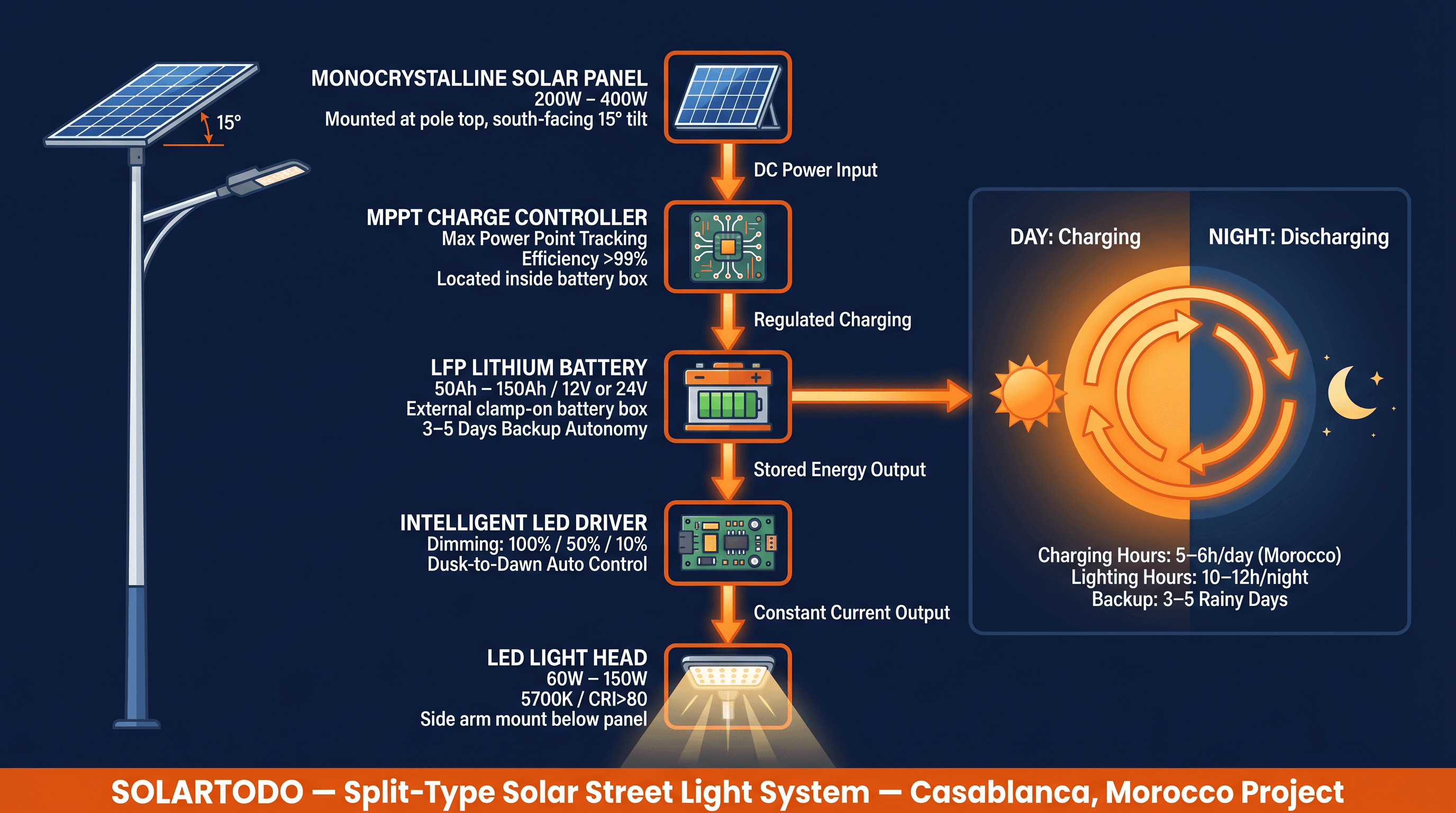
The deployed system was a true split-type architecture, not an all-in-one fixture. Each pole carries the solar panel at the very top on a tilted bracket, with the pole not penetrating through the center of the panel. Below that, an 80W LED light head is fixed on a side arm, creating the intended roadway distribution geometry while preserving clear solar exposure at the top of the structure.
The battery system is equally important to the physical design. Instead of hiding the battery in the pole base, SOLAR TODO used a visible grey NCM lithium battery box externally clamped to the pole body. This arrangement simplifies routine access, keeps the controller and battery assembly in one maintainable enclosure, and aligns with the project’s specified installation method. The MPPT charge controller is housed inside that battery box, while all electrical wiring is routed internally through the pole so that no external cables are visible on the surface.
The lighting layout was optimized for a 10m road width with 35m spacing between poles. Smart operation includes motion sensing and dimming control, combining lighting quality with lower nightly energy consumption. According to IRENA (2023), smart controls are a key performance multiplier in public lighting because they reduce unnecessary operating hours at full output while preserving safety and visibility.
SOLAR TODO selected this configuration to address four practical requirements at once:
- High solar harvesting from a 910W top-mounted mono TOPCon panel
- Stable roadway illumination from an 80W, 12,000 lm LED head
- Accessible storage and control through an external 12V/200Ah battery box
- Cleaner field installation through fully internal pole wiring
As IEC states, "luminaire safety requirements must be verified against defined construction and performance criteria" under IEC 60598. Likewise, IEC states that IEC 62124 provides a framework for assessing photovoltaic system performance under realistic operating conditions. Those standards informed the project’s compliance pathway alongside CJJ 45-2015.
Technical Specifications
This Casablanca installation used 261 identical split-type units with 12m galvanized poles, 910W TOPCon panels, 80W LEDs, and 12V/200Ah external NCM battery boxes with internal pole wiring.
- Product type: SOLAR TODO Solar Streetlight (Split-Type), not integrated/all-in-one
- Deployment quantity: 261 units
- Project location: Casablanca, Morocco (33.57, -7.59)
- Pole height: 12m
- Pole material: Hot-dip galvanized steel
- Pole wind resistance: 45 m/s
- Pole design life: 25 years
- Solar panel position: Mounted at the very top of the pole on a tilted bracket
- Panel mounting detail: Pole does not penetrate through panel center; panel sits on top
- Solar panel rating: 910W
- Panel type: Monocrystalline TOPCon
- Panel efficiency: 23%
- Panel degradation: 0.3% per year
- Panel warranty: 30 years
- LED luminaire power: 80W
- LED luminous flux: 12,000 lm
- LED efficacy: 150 lm/W
- Color rendering: CRI >70
- Luminaire position: On side arm below the panel
- Battery chemistry: NCM lithium
- Battery configuration: 12V/200Ah
- Battery mounting: Externally mounted on pole body as a visible grey clamped box, not inside pole base
- Battery energy density: 250Wh/kg
- Battery cycle life: 2,000 cycles
- Battery depth of discharge: 85% DoD
- Battery warranty: 5 years
- Controller type: MPPT charge controller inside battery box
- Wiring: All wiring runs inside the pole; no visible external wires/cables
- Road width served: 10m
- Pole spacing: 35m
- Smart controls: Motion sensor with 30% energy saving and dimming control with 15% saving
- Autonomy: 3-5 days cloudy-weather backup
- Operating mode: Dusk-to-dawn automatic control
- Climate zone: Desert, with 6.5h sun
- Applicable standards: CJJ 45-2015 / IEC 60598 / IEC 62124
Deployment Process
The 261-unit Casablanca rollout was executed in phased civil, pole, electrical, and commissioning stages to maintain alignment, internal wiring integrity, and consistent 35m spacing.
The project began with route verification and foundation marking along the 10m-wide roadway. Because spacing was fixed at 35m, the site team first validated pole positions against road geometry, sightline requirements, and side-arm orientation. This step was especially important in Casablanca, where roadway interfaces, utility crossings, and future urban expansion can affect final pole placement.
Next came foundation and pole installation. The 12m hot-dip galvanized steel poles were erected with attention to verticality, bracket alignment, and wind-resistance requirements. The 45 m/s wind design rating was a critical selection factor for a coastal Moroccan city, where seasonal gusts and exposed corridors can place higher loads on tall lighting structures.
The solar assembly phase followed a strict mechanical sequence. Each 910W mono TOPCon panel was mounted at the very top of the pole on a tilted bracket, with no center penetration by the pole. The LED head was then fixed on a side arm below the panel to preserve the specified split-type geometry. This arrangement separates solar collection from lighting distribution, which improves serviceability and avoids the compact packaging constraints of integrated fixtures.
Battery and control installation came next. The grey NCM lithium battery box was externally clamped to the pole body at the designated height, making it visible and accessible for future inspection. The MPPT controller was installed inside the battery box, and all interconnections were routed internally through the pole. That internal-cable approach reduced tamper exposure, improved appearance, and met the project requirement for no visible external wiring.
Commissioning focused on nighttime operation logic and smart control behavior. Each unit was tested for dusk-to-dawn automatic switching, charge-controller response, battery charging status, motion sensor triggering, and dimming profile execution. According to IEEE (2020), commissioning and verification are essential in outdoor smart lighting systems because controls performance can significantly affect actual field energy consumption.
SOLAR TODO coordinated the deployment as a repeatable field process rather than a custom one-off installation. That matters in municipal and EPC contexts because standardization reduces rework, simplifies spare-parts planning, and improves quality consistency across large batches. For engineering support on similar deployments, municipalities and contractors can contact us for route planning and configuration review.
Performance & Results
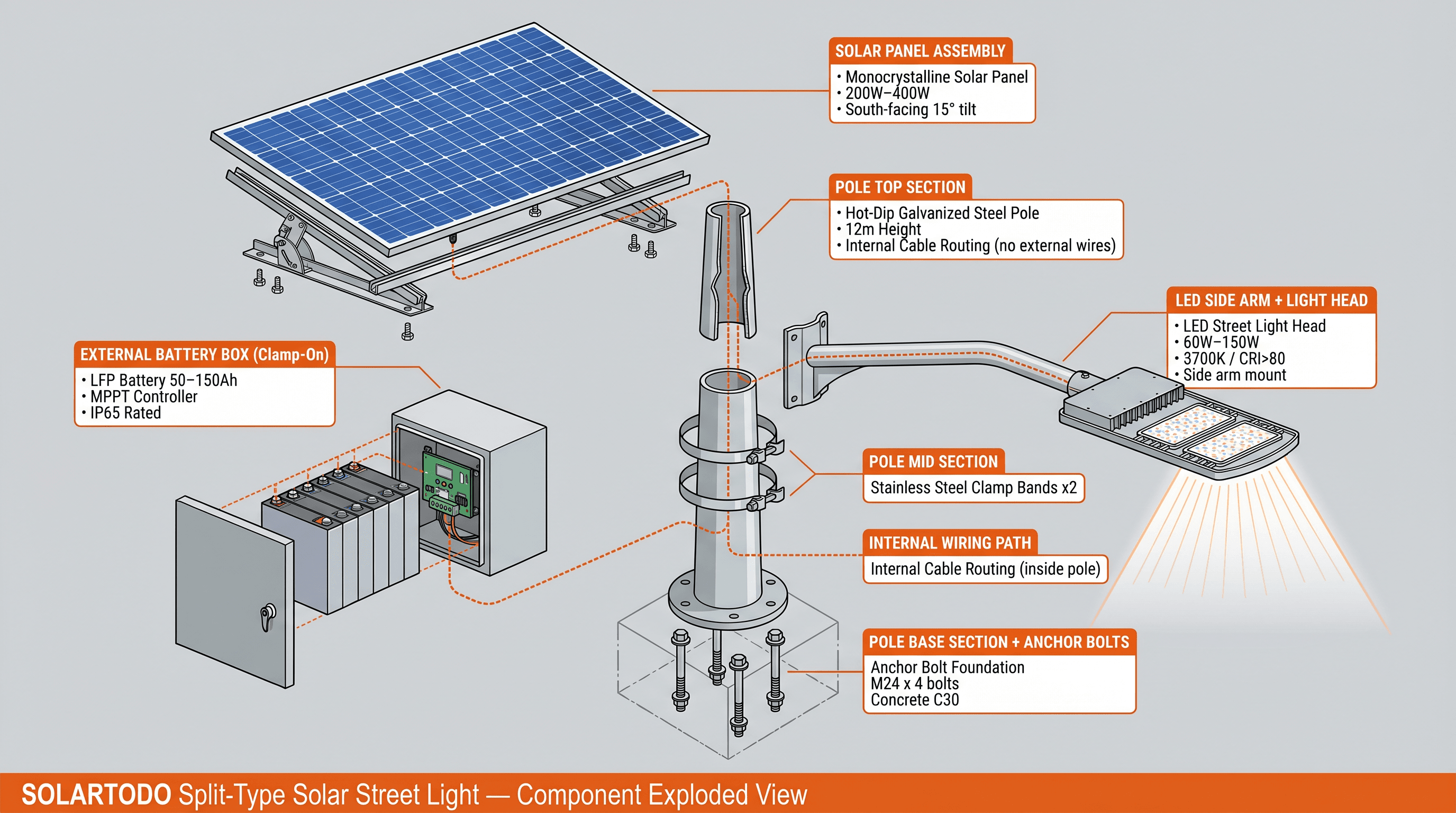
The installed system delivered 12,000-lumen lighting per pole, 3-5 days of autonomy, and modeled control-based savings of 30% from motion sensing plus 15% from dimming control.
The most immediate result was reliable dusk-to-dawn roadway illumination across the full deployment corridor. Each 80W luminaire provides 12,000 lumens at 150 lm/W, which is a strong fit for the 12m mounting height and 35m spacing used on this 10m-wide road. In practical terms, the project achieved a consistent lighting platform without trenching-based grid dependency at each pole position.
The energy system was sized for Casablanca’s desert climate profile of 6.5 sun hours, using a 910W TOPCon panel and a 12V/200Ah NCM battery. That combination supports 3-5 days of cloudy-weather backup, which is critical for service continuity during lower-irradiance periods. According to NREL (2021), battery autonomy and solar oversizing are core design levers in off-grid lighting reliability, especially where uninterrupted night operation is required.
Smart controls improved operational efficiency beyond static dusk-to-dawn switching. The motion sensor function contributes 30% energy saving, while dimming control adds another 15% saving. According to IRENA (2023), digital controls are one of the fastest ways to improve public-lighting efficiency because they align output with actual nighttime demand rather than fixed full-power operation.
Durability was another major outcome. The poles are rated for 45 m/s wind resistance and a 25-year life, while the TOPCon panels carry a 30-year warranty with 0.3% annual degradation. According to IEA (2023), long-life infrastructure components are increasingly important in municipal procurement because replacement cycles and maintenance intervals strongly influence total lifecycle value.
The project also improved maintainability through physical configuration choices. The externally mounted battery box makes inspection faster than below-grade or concealed arrangements, and internal pole wiring removes the common problem of exposed cable deterioration. BloombergNEF (2023) notes that battery technology and system architecture both influence long-term field performance, not just cell chemistry alone.
For Casablanca, the result was a streetlighting asset that balanced structural durability, service access, clean installation aesthetics, and nighttime reliability. SOLAR TODO used a product-led engineering approach here: the value came from correct mechanical layout, correct battery accessibility, and correct control integration, not from oversimplified all-in-one packaging.
Comparison Table
This comparison shows why the deployed 261-unit split-type system was better suited to Casablanca’s 12m roadway application than lower-capacity or integrated alternatives.
| Metric | Casablanca Deployed System | Lower-Capacity Split-Type Alternative | Integrated/All-in-One Alternative |
|---|---|---|---|
| Product architecture | Split-type | Split-type | Integrated |
| Quantity | 261 units | Project-dependent | Project-dependent |
| Pole height | 12m | 6-8m typical | 6-8m typical |
| Solar panel | 910W mono TOPCon | 60-200W typical | Lower integrated panel area |
| Panel position | Very top of pole on tilted bracket | Top/side variant | Integrated with luminaire body |
| LED power | 80W | 30-60W typical | 30-80W typical |
| Luminous flux | 12,000 lm | Lower output | Application-dependent |
| Battery type | 12V/200Ah NCM lithium | Smaller battery bank | Integrated battery compartment |
| Battery mounting | External pole-mounted box | External or base-mounted | Inside fixture body |
| Wiring | Internal pole routing, no visible cables | Varies | Internal fixture wiring |
| Road width served | 10m | Narrower roads typical | Narrower roads typical |
| Pole spacing | 35m | Usually shorter spacing | Usually shorter spacing |
| Wind resistance | 45 m/s | Depends on pole | Depends on integrated structure |
| Backup autonomy | 3-5 days | Lower to moderate | Often lower at high output |
| Smart controls | Motion sensor + dimming | Optional | Optional |
| Standards | CJJ 45-2015 / IEC 60598 / IEC 62124 | Varies | Varies |
Pricing & Quotation
SOLAR TODO offers three pricing tiers for this product line: FOB Supply (equipment ex-works China), CIF Delivered (including ocean freight and insurance), and EPC Turnkey (fully installed, commissioned, with 1-year warranty). Volume discounts are available for large-scale deployments. Configure your system online for an instant estimate, or request a custom quotation from our engineering team at [email protected].
Frequently Asked Questions
This FAQ answers the most common technical, EPC, warranty, installation, and lifecycle questions about the 261-unit Casablanca Solar Streetlight (Split-Type) deployment.
Q1: What exactly was deployed in Casablanca? A total of 261 SOLAR TODO Solar Streetlight (Split-Type) units were installed in Casablanca, Morocco. Each unit uses a 12m hot-dip galvanized steel pole, a 910W mono TOPCon panel at the top, an 80W LED head below the panel, and an externally mounted 12V/200Ah NCM lithium battery box.
Q2: Is this an all-in-one solar street light? No. This project used a true split-type solar streetlight, not an integrated or all-in-one product. The solar panel sits at the very top of the pole on a tilted bracket, the LED head is mounted below on a side arm, and the battery is housed in an external box clamped to the pole body.
Q3: Why was a split-type configuration selected for Casablanca? The split-type layout suits higher mounting heights and larger solar modules better than integrated fixtures. In this case, the 12m pole height, 910W panel size, and externally mounted 12V/200Ah battery made split architecture the practical choice for roadway lighting performance, maintenance access, and structural layout.
Q4: How long does this system operate during cloudy weather? The configured system provides 3-5 days of cloudy-weather backup. That autonomy comes from the combination of Casablanca’s 6.5 sun-hour climate design basis, the 910W solar panel, the MPPT controller, and the 12V/200Ah NCM lithium battery sized for dusk-to-dawn operation.
Q5: What smart features are included, and what do they save? The project includes both motion sensing and dimming control. The motion sensor function is configured for 30% energy saving, while dimming control contributes an additional 15% saving. Together, these features reduce unnecessary nighttime output while maintaining lighting availability when vehicles or pedestrians are detected.
Q6: How is the battery installed and maintained? The battery is not hidden in the pole base. It is housed in a visible grey external battery box clamped to the pole body, which improves inspection and replacement access. The MPPT controller is installed inside the same battery box, and all cabling is routed internally through the pole.
Q7: What standards does this Casablanca project comply with? The deployed system was specified to CJJ 45-2015, IEC 60598, and IEC 62124. These standards cover road-lighting application requirements, luminaire safety, and photovoltaic system performance assessment. For municipal and EPC buyers, this standards alignment supports technical review, procurement consistency, and acceptance testing.
Q8: What is the expected service life of the main components? The pole is designed for a 25-year life and rated for 45 m/s wind resistance. The mono TOPCon panel carries a 30-year warranty with 0.3% annual degradation. The NCM lithium battery has a 5-year warranty, 2,000 cycles, and is configured for 85% depth of discharge.
Q9: How long does installation typically take for a project of this size? Actual timeline depends on civil works, logistics, and site readiness, but a 261-unit project is typically executed in phases: foundations, pole erection, panel and luminaire mounting, battery/controller installation, and commissioning. The repeatable split-type design helps EPC teams standardize installation and accelerate quality control across the route.
Q10: How does this compare with conventional grid-powered street lighting? This deployment avoids the need for pole-by-pole grid connection and trench-based electrical distribution along the route. It also provides autonomous operation with 3-5 days of backup. For corridors where grid extension is slow or disruptive, split-type solar streetlights can simplify rollout while maintaining roadway lighting performance.
Q11: Can SOLAR TODO provide EPC pricing and custom quotations? Yes. SOLAR TODO supports FOB Supply, CIF Delivered, and EPC Turnkey quotation models for this product line. Final pricing depends on quantity, destination, civil scope, and commissioning requirements. Buyers can use the online configurator or send project drawings and BOQ details through the contact page for a tailored quotation.
Q12: What should EPC contractors verify during installation? Contractors should verify foundation alignment, 35m spacing, side-arm orientation, top-panel bracket angle, battery box clamping, controller settings, and internal cable routing. It is also important to confirm that no external wires are visible, the pole does not penetrate the panel center, and dusk-to-dawn plus smart-control functions work correctly.
References
- NREL (2021): Photovoltaic system performance and solar resource assessment guidance relevant to off-grid system sizing and autonomy planning.
- IEC (2023): IEC 60598 luminaire safety requirements for construction, testing, and performance of lighting equipment.
- IEC (2021): IEC 62124 guidance for photovoltaic system performance evaluation under real operating conditions.
- IEA (2023): Energy efficiency and infrastructure lifecycle planning guidance relevant to municipal lighting modernization.
- IRENA (2023): Public lighting efficiency and smart-control benefits in urban energy transition projects.
- IEEE (2020): Smart outdoor lighting system integration and commissioning practices for controls-enabled deployments.
- World Bank (2022): Urban resilience and infrastructure reliability priorities across growing MENA cities, including climate-adapted public assets.
- BloombergNEF (2023): Battery technology and system architecture trends affecting field performance and lifecycle considerations.
Equipment Deployed
- 261 × SOLAR TODO Solar Streetlight (Split-Type)
- 12m hot-dip galvanized steel pole, 45 m/s wind resistance, 25-year life
- 910W monocrystalline TOPCon solar panel, 23% efficiency, 0.3%/yr degradation, 30-year warranty
- Top-of-pole tilted panel bracket; pole does not penetrate panel center
- 80W LED light head, 12,000 lm, 150 lm/W, CRI >70
- Side arm mounting below solar panel
- 12V/200Ah NCM lithium battery box, 250Wh/kg, 2,000 cycles, 85% DoD, 5-year warranty
- Externally mounted grey battery box clamped to pole body
- MPPT charge controller inside battery box
- Internal pole wiring with no visible external cables
- Motion sensor control with 30% energy saving
- Dimming control with 15% energy saving
- Dusk-to-dawn automatic control
- 3-5 days cloudy-weather backup