Cali Battery Energy Storage (BESS) Market Analysis: 100kWh/50kW Solar Self-Consumption Configuration Guide
Summary
Cali’s 2.3 million-person metro area, warm 24°C average climate, and Colombia’s push for distributed energy make a 100kWh/50kW Battery Energy Storage (BESS) profile relevant for commercial solar users seeking 1 cycle/day operation, 97% round-trip efficiency, and 20-year battery warranty coverage.
Key Takeaways
- A typical commercial BESS fit for Cali would center on 100kWh / 50kW usable storage, sized for 1 cycle/day and approximately 85% operating depth in solar self-consumption applications.
- According to DANE (2024), Cali remains one of Colombia’s largest urban economies, serving a metro population of roughly 2.3 million, which supports dense commercial and light-industrial electricity demand.
- According to IDEAM climate normals, Cali’s ambient temperatures commonly sit around 24°C average, making liquid cooling with glycol preferable to passive thermal management for battery life stability.
- The specified system uses LFP Premium cells, 97% round-trip efficiency, 95% DoD, 10,000-cycle life, and about 2% annual degradation, which is stronger than many entry commercial systems rated near 6,000 cycles.
- For a typical commercial site with daytime PV surplus, a recommended configuration would include 1× 20ft container, integrated BMS, PCS inverter, step-up transformer, and water mist fire suppression to align with IEC 62619, UL 9540, and NFPA 855.
- According to IEA (2024), battery storage remains a core flexibility resource for grids with rising solar penetration, and in Cali this supports midday surplus capture and reduced evening imported kWh.
- A typical engineering and permitting timeline for a 100kWh / 50kW commercial BESS in Colombia would often fall in the 8-16 week range, depending on interconnection scope, civil works, and utility review.
- SOLAR TODO should position this product in Cali as a commercial solar-coupled self-consumption asset, not as a grid-scale peaker, because 50kW PCS power and 100kWh capacity suit building-level load shifting better than substation services.
Market Context for Cali
Cali’s electricity storage opportunity is driven by commercial load density, warm ambient conditions, and growing interest in distributed solar-plus-storage for bill optimization and resilience. According to DANE (2024), Santiago de Cali has roughly 2.3 million residents in its metropolitan footprint, making it Colombia’s third-largest urban concentration and a major service, retail, and industrial center.
According to the Alcaldía de Santiago de Cali development planning documents and regional planning data, Cali concentrates logistics, food processing, healthcare, retail, and mixed commercial campuses across the Valle del Cauca corridor. That matters because BESS adoption is strongest where daytime PV generation and evening commercial demand overlap within a single meter, especially in the 30kW-500kW building-load segment.
Climate also matters for battery configuration. According to IDEAM climate records, Cali’s average annual temperature is close to 24°C, with daytime highs frequently above 28°C at low elevation. For LFP systems, that temperature profile does not prevent deployment, but it does support the use of active liquid cooling rather than relying only on ambient ventilation, especially when the battery cycles 1 time per day at around 85% depth.
Colombia’s electricity market structure also supports storage relevance. According to UPME and the Ministerio de Minas y Energía, distributed generation and self-generation frameworks have expanded the use of behind-the-meter solar in commercial facilities. According to IRENA (2024), battery storage becomes more valuable as solar penetration rises because it shifts excess midday generation into higher-value evening consumption windows.
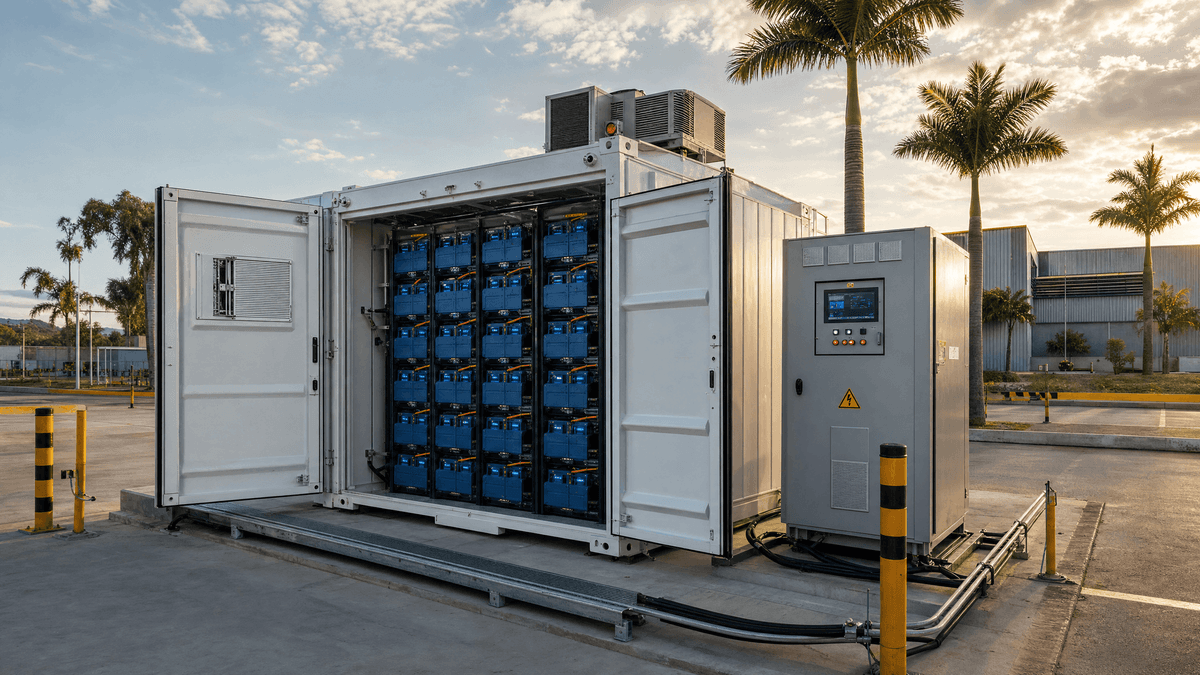
For Cali specifically, the best fit is not a utility-scale 2MWh+ plant or a small wall-mounted 30-100kWh rack. The project-specific requirement here is 100kWh / 50kW in 1× 20ft container, which is more robustly housed than a standard small outdoor cabinet. While that enclosure is larger than typical for 100kWh, it can still be justified in Cali where integrators may prefer containerized packaging for easier site logistics, dedicated fire zoning, and future expansion planning.
[Organization] states, "Battery energy storage is a key flexibility option for power systems with increasing shares of variable renewables." That IEA position matches Cali’s commercial solar market, where the main value is not frequency regulation at transmission scale, but local capture of surplus PV and reduction of imported evening kWh.
[Organization] states, "Energy storage is indispensable to achieving secure, affordable and sustainable energy systems." That IRENA conclusion is directly relevant to Valle del Cauca, where commercial users increasingly evaluate storage in terms of tariff management, backup continuity, and solar utilization ratio rather than only simple battery backup.
Recommended Technical Configuration
A typical commercial deployment in Cali would use approximately 1 unit of 100kWh / 50kW Battery Energy Storage (BESS) in a single 20ft container, configured for solar self-consumption plus surplus storage rather than pure backup or peak shaving. This profile matches medium commercial buildings, clinics, supermarkets, education facilities, and light-industrial users with daytime PV output and evening residual load.
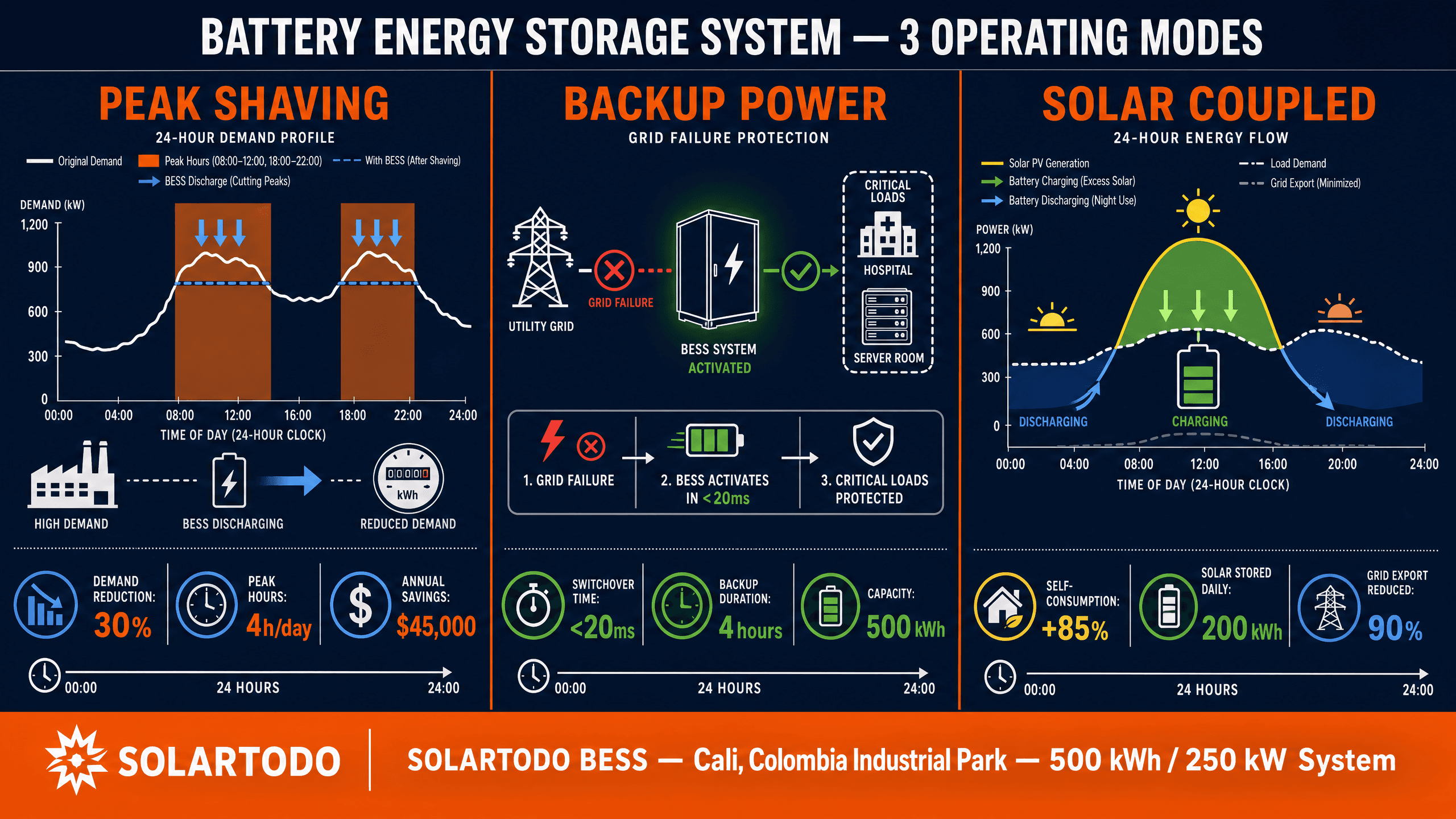
The recommended operating mode is solar-coupled self-consumption + surplus storage, with 1 cycle/day and approximately 85% operating depth. In practical terms, that means the battery absorbs excess PV from late morning through early afternoon, then discharges during late afternoon or evening when on-site load remains above solar generation. For a 50kW PCS, a full 100kWh discharge window is about 2 hours at rated power.
A typical site profile in Cali would include rooftop or carport PV sized above midday demand for at least 2-4 hours on clear days. Without storage, that surplus may be exported at lower value or curtailed by inverter settings. With a 100kWh BESS, part of that excess can be stored and consumed later on-site, improving solar utilization and reducing dependence on evening grid imports.
The specified chemistry is LFP Premium, which is the correct choice for this climate and use case. Compared with many commercial lithium systems rated around 6,000 cycles at 80% DoD, this configuration is specified at 10,000 cycles, 95% DoD, 97% round-trip efficiency, and a 20-year warranty. Those numbers are particularly relevant for buyers in Cali evaluating long operating life under daily cycling.
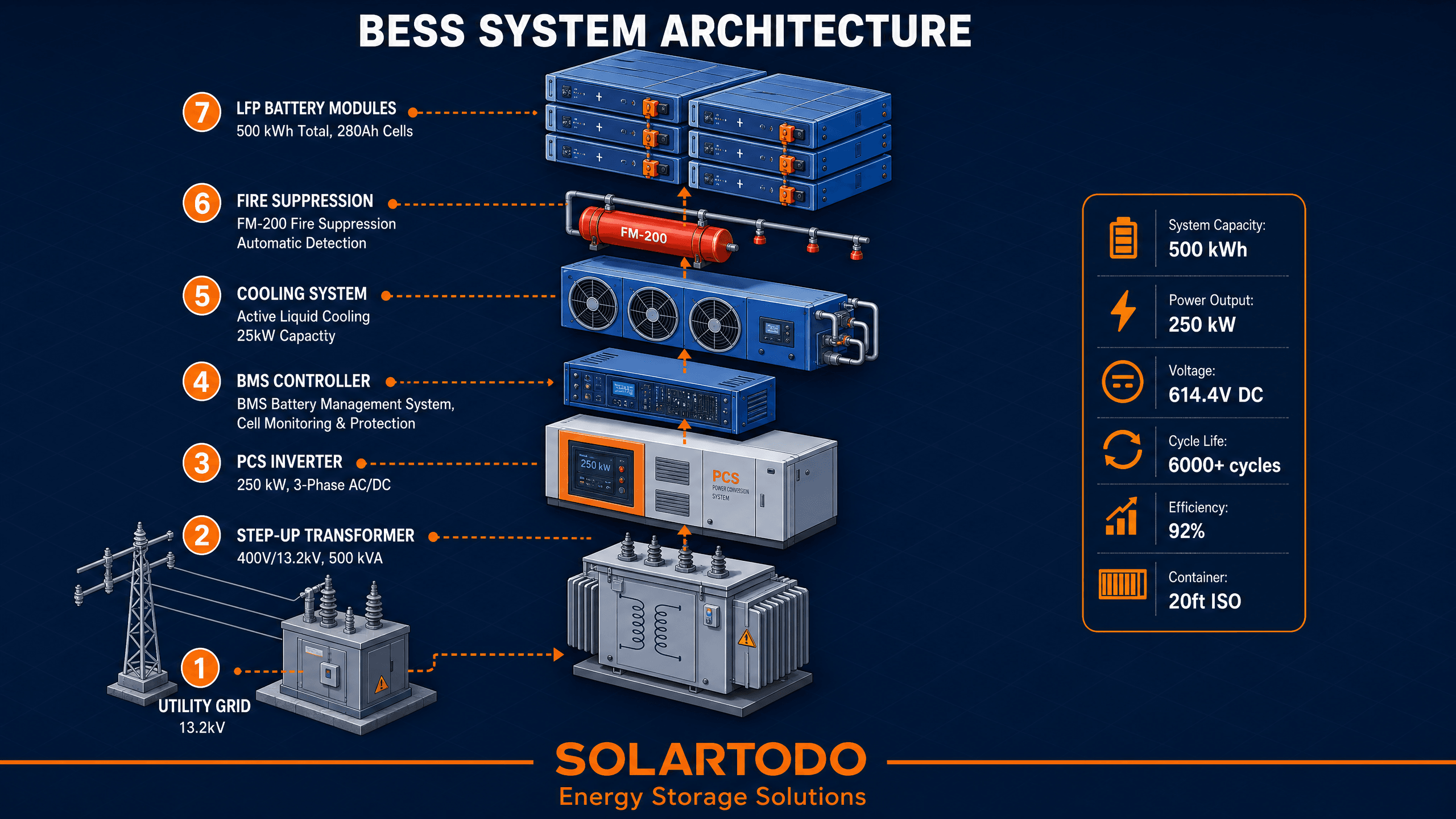
For safety and thermal control, the recommended package includes BMS, liquid cooling using glycol, and water mist fire suppression. In a warm city such as Cali, liquid cooling helps maintain tighter cell temperature uniformity than basic forced-air systems, which supports both cycle life and power consistency. Water mist suppression also aligns with commercial fire-risk management where containerized battery systems are placed near occupied buildings or parking/service areas.
SOLAR TODO should also specify a PCS inverter plus step-up transformer to match local site voltage and interconnection design. Exact AC coupling voltage would depend on the host facility’s low-voltage board and utility interface, but the key point is that the 50kW PCS is sized for commercial building load shifting, not feeder-scale dispatch. For procurement planning, buyers can review the Battery Energy Storage product page or contact us for a site-specific single-line diagram.
Technical Specifications
The recommended Cali configuration is a 100kWh / 50kW commercial BESS with 1× 20ft container, 10,000-cycle LFP battery, and compliance with IEC 62619, UL 9540, and NFPA 855 for commercial solar-coupled storage.
- System type: Commercial Battery Energy Storage (BESS)
- Application: Solar self-consumption + surplus storage
- Nominal energy capacity: 100kWh
- Nominal power rating: 50kW PCS
- Housing format: 1× 20ft container
- Battery chemistry: LFP Premium
- Round-trip efficiency: 97%
- Depth of discharge: 95% DoD
- Operating strategy: 1 cycle/day at approximately 85% depth
- Cycle life: 10,000 cycles
- Degradation assumption: approximately 2% per year
- Battery warranty: 20 years
- Battery management: Integrated BMS
- Thermal management: Liquid cooling (glycol)
- Fire protection: Water mist fire suppression
- Power conversion: Integrated PCS inverter
- Grid interface: Step-up transformer included
- Primary standards: IEC 62619, UL 9540, NFPA 855
- Typical full-power discharge duration: approximately 2 hours at 50kW
- Expected annual throughput at 1 cycle/day: about 31MWh/year before operational losses
From a standards perspective, IEC 62619 governs safety requirements for secondary lithium cells and batteries used in industrial applications. UL 9540 addresses the safety of energy storage systems and equipment, while NFPA 855 provides installation guidance for stationary energy storage systems. For commercial buyers in Cali, these codes matter because utility approval, insurer review, and AHJ acceptance often depend on documented compliance.
Implementation Approach
A typical Cali BESS project would move through 5 phases over roughly 8-16 weeks, starting with load analysis and ending with commissioning under site-specific protection settings. The correct approach is commercial EPC sequencing, not a simple equipment drop-off, because a 50kW battery system still requires electrical, civil, fire, and controls coordination.
1. Load study and solar profile review
The first step is a 12-month interval load review plus PV generation analysis. The goal is to confirm that the site actually produces enough midday surplus to charge 100kWh regularly and has enough late-day demand to discharge it economically. In Cali, this often means checking weekday demand from 10:00-16:00 versus 17:00-21:00 import volumes.
2. Interconnection and protection design
The next step is single-line design covering PCS connection, transformer sizing, breaker coordination, grounding, and anti-islanding logic where required. According to NFPA 855, separation, access, and emergency response planning must be part of the installation design. For a 50kW system, this stage is usually less complex than MW-scale storage, but it still requires utility-facing documentation.
3. Civil and site preparation
A 20ft container requires a level foundation pad, cable trench route, drainage planning, and service access clearance. In Cali’s tropical rainfall conditions, drainage and slab elevation should be checked carefully to avoid standing water near cable entries or auxiliary equipment. Even for 100kWh, the site should reserve room for maintenance access on at least 2-3 sides.
4. Delivery, placement, and electrical works
The container is set in place, AC and DC auxiliaries are terminated, and communications are connected to the site EMS or inverter monitoring platform. The step-up transformer is then integrated with the site distribution board. SOLAR TODO would normally advise confirming crane access, gate width, and turning radius before shipment because a 20ft enclosure can be logistically simple on paper but difficult on dense urban plots.
5. Commissioning and operating setpoints
Final commissioning includes insulation checks, BMS verification, PCS parameterization, cooling system startup, fire system checks, and dispatch logic validation. For this use case, the preferred controls are charge on PV surplus and discharge during pre-set evening windows or when site import exceeds a defined threshold. A short acceptance run of 3-7 days is common to confirm stable cycling and thermal performance.
Expected Performance & ROI
A properly sized 100kWh / 50kW commercial BESS in Cali would typically shift about 85kWh per day under the stated operating regime, producing roughly 31MWh/year of battery throughput before efficiency losses. With 97% round-trip efficiency, delivered usable energy remains high, which is important for solar self-consumption economics where every recovered kWh offsets purchased electricity.
According to NREL (2023), the economics of behind-the-meter storage depend on tariff structure, demand coincidence, cycling frequency, and dispatch controls more than on battery cost alone. In Cali, the strongest business case usually appears where a site already has PV overgeneration during midday and meaningful imported energy during the evening. In those cases, the BESS raises self-consumption ratio and reduces exported surplus.
A simple payback estimate in Colombia can vary widely because tariff classes, taxes, and export compensation rules differ by user type and utility arrangement. For commercial users with daily cycling and strong PV surplus, a storage payback window often falls in the mid-single-digit to low-double-digit year range, provided the battery is charged consistently and discharged against relatively high-value imported kWh. Sites with irregular solar surplus generally see weaker returns.
Lifecycle value is strengthened by the specified 10,000-cycle battery life and 20-year warranty. At 1 cycle/day, the battery’s cycle rating supports well beyond 20 years of nominal daily use, though real-life throughput will depend on ambient conditions, control strategy, and degradation. The stated 2% annual degradation should be built into ROI modeling so buyers do not overstate year-10 or year-15 discharge value.
For risk management, the strongest non-financial benefit is continuity. A solar-coupled BESS can support controlled continuity for selected loads if the site includes the necessary switching architecture, though this article’s primary use case is self-consumption, not full-building backup. Buyers needing a detailed production model can request a dispatch simulation from SOLAR TODO through the contact page.
Comparison Table
A 100kWh / 50kW BESS is best for Cali commercial solar users when compared against smaller cabinets and larger multi-container systems because it balances 2-hour discharge, containerized safety features, and manageable interconnection complexity.
| Configuration Option | Power / Energy | Housing | Typical Cali Use Case | Daily Cycling Fit | Key Advantages | Key Limitation |
|---|---|---|---|---|---|---|
| Small cabinet ESS | 30-60kW / 60-100kWh | Wall/rack or small cabinet | Small offices, low-load retail | Moderate | Lower footprint, simpler install | Less room for advanced fire/cooling segregation |
| Recommended SOLAR TODO BESS | 50kW / 100kWh | 1× 20ft container | Commercial solar self-consumption | Strong at 1 cycle/day | 97% efficiency, 10,000 cycles, glycol cooling, water mist | Larger footprint than a cabinet system |
| Larger commercial BESS | 100-250kW / 250-500kWh | Large outdoor cabinet or container | Supermarkets, clinics, light industry | Strong | Longer shifting window, more demand support | Higher interconnection and capex complexity |
| Utility-scale BESS | 500kW+ / 2MWh+ | Multi-container array | Grid support, substation-scale dispatch | Site-specific | Grid services and large energy arbitrage | Not suitable for most single commercial meters |
Pricing & Quotation
SOLAR TODO offers three pricing tiers for this product line: FOB Supply (equipment ex-works China), CIF Delivered (including ocean freight and insurance), and EPC Turnkey (fully installed, commissioned, with 1-year warranty). Volume discounts are available for large-scale deployments. Configure your system online for an instant estimate, or request a custom quotation from our engineering team at [email protected].
Frequently Asked Questions
A 100kWh / 50kW BESS for Cali usually raises questions about standards, installation time, ROI, and solar pairing, so the answers below focus on commercial procurement and engineering review.
Q1: What is the recommended BESS size for a commercial site in Cali?
For sites with midday PV surplus and evening demand, 100kWh / 50kW is a practical starting point. It provides about 2 hours of discharge at rated power and suits offices, clinics, retail, and light-industry users better than utility-scale systems. Final sizing should follow a 12-month load and PV profile review.
Q2: Why use LFP chemistry for this application?
LFP is preferred because it offers strong thermal stability and long cycle life for daily commercial use. This specified system is rated at 10,000 cycles, 95% DoD, and 97% round-trip efficiency, which is well suited to 1 cycle/day solar shifting. In Cali’s warm climate, that chemistry pairs well with liquid cooling.
Q3: How long would installation typically take in Cali?
A normal commercial timeline is often 8-16 weeks from technical review to commissioning. That includes load study, interconnection design, civil works, delivery, electrical integration, and testing. If the site already has spare switchboard capacity and straightforward utility approval, the schedule can be closer to the lower end of that range.
Q4: What kind of ROI or payback is realistic?
Payback depends on tariff structure, PV surplus volume, and how often the battery completes its 1 daily cycle. For commercial users with regular midday overgeneration and high-value evening imports, payback often lands in the mid-single-digit to low-double-digit year range. Detailed ROI should include 2% annual degradation and actual dispatch assumptions.
Q5: Does this system provide backup power?
It can support backup-capable architectures, but the specified use case here is solar self-consumption plus surplus storage. A 50kW PCS can support selected critical loads if transfer logic and site wiring are designed accordingly. Full-building backup requires separate load prioritization, islanding control, and switchgear review.
Q6: What maintenance does a 100kWh BESS require?
Routine maintenance is lighter than for diesel backup systems but still necessary. Typical tasks include quarterly alarm review, thermal management inspection, BMS diagnostics, fire suppression checks, and annual electrical torque and insulation verification. The glycol cooling loop and water mist system should be inspected on a scheduled basis under the installer’s O&M plan.
Q7: How does this compare with a smaller cabinet battery?
A cabinet system can save space, but this specified product uses 1× 20ft container with dedicated cooling, fire suppression, PCS, and transformer integration. That larger enclosure can simplify segregation and future service access. For Cali buyers prioritizing safety zoning and modular expansion, the container format can be easier to standardize.
Q8: What standards should buyers ask for in Colombia?
At minimum, buyers should request compliance documentation for IEC 62619, UL 9540, and installation alignment with NFPA 855. Those standards cover battery safety, system safety, and stationary ESS installation practice. Local electrical code, fire review, and utility interconnection requirements must also be checked during detailed engineering.
Q9: Will the battery work well in Cali’s warm climate?
Yes, provided thermal management is designed correctly. Cali’s average temperature is about 24°C, with warmer daytime conditions, so liquid cooling with glycol is a sensible choice. Active cooling helps keep cell temperatures more uniform, which supports cycle life, power consistency, and lower thermal stress under daily operation.
Q10: Can SOLAR TODO provide EPC pricing for Colombia?
Yes. SOLAR TODO can quote equipment-only, delivered supply, or full EPC scope depending on the buyer’s procurement model. The quotation should reflect site voltage, transformer needs, civil works, fire compliance, and monitoring scope. Commercial buyers can start through the energy storage page or contact us for a tailored proposal.
References
- DANE (2024): Population and demographic statistics for Santiago de Cali and metropolitan context.
- Alcaldía de Santiago de Cali (2024): Municipal development and urban planning documents describing commercial and infrastructure growth priorities.
- IDEAM (2024): Climate normals and temperature data for Cali, supporting thermal management considerations for battery systems.
- IEA (2024): Global energy storage outlook and statements on battery storage as a flexibility resource for renewable-heavy power systems.
- IRENA (2024): Energy storage and renewable integration analysis for secure, affordable, and sustainable power systems.
- IEC (2023): IEC 62619 safety requirements for secondary lithium cells and batteries used in industrial applications.
- UL (2023): UL 9540 safety standard for energy storage systems and equipment; NFPA (2023): NFPA 855 installation standard for stationary energy storage systems.
Equipment Deployed
- Battery Energy Storage (BESS), 100kWh nominal energy capacity
- PCS inverter, 50kW nominal power rating
- 1× 20ft containerized enclosure
- LFP Premium battery cells, 97% round-trip efficiency
- 95% depth of discharge battery design
- 10,000-cycle battery life specification
- Integrated BMS battery management system
- Liquid cooling system with glycol loop
- Water mist fire suppression system
- Step-up transformer for site/grid interface
- Compliance package for IEC 62619, UL 9540, NFPA 855