Berlin Smart Traffic System Deployment: 28-Intersection Upgrade with 4-in-1 AI Poles and TrafficGPT Platform
Summary
Berlin deployed SOLAR TODO Smart Traffic System units at 28 intersections using 6m dark-grey L-arm steel poles, 4K AI cameras with 98% accuracy, and <50ms edge response via NVIDIA Jetson, connected by 5G/fiber to a TrafficGPT control platform.
Key Takeaways
A 28-intersection Berlin deployment combined AI vision, 77GHz radar, and adaptive control on one pole platform, giving the city a standards-based upgrade path with BOT financing and zero upfront capital.
- The project covered 28 intersections in Berlin using 6m L-arm steel poles in dark grey with hot-dip galvanized corrosion protection.
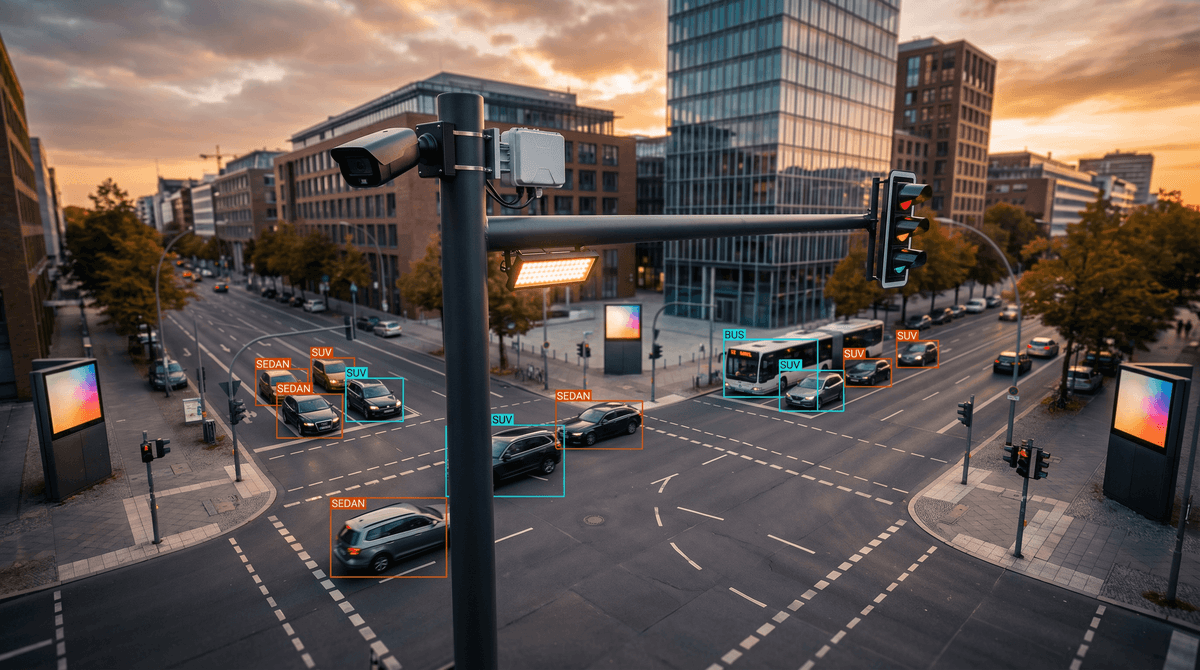
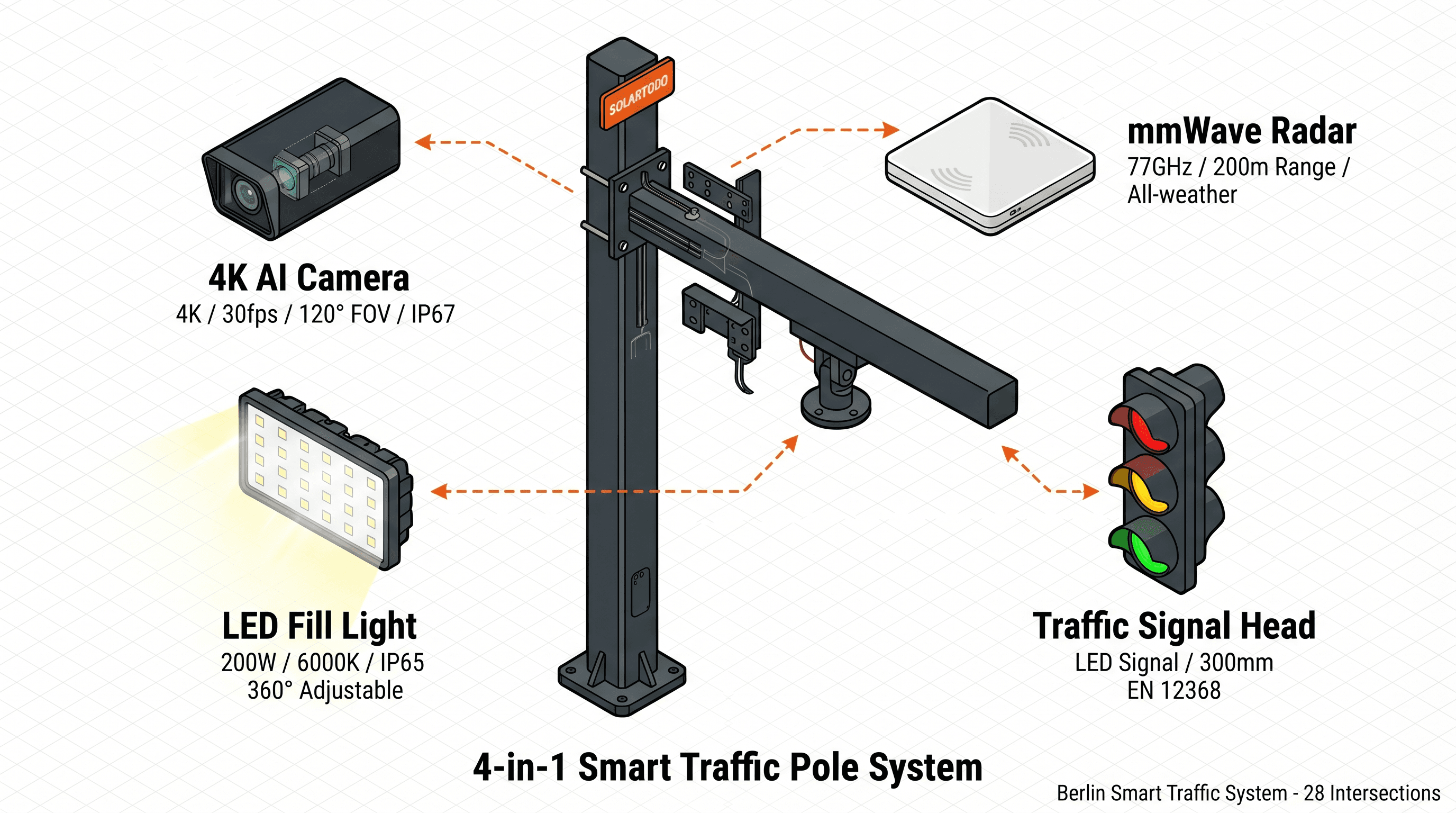
- Each 4-in-1 smart traffic pole integrated a 4K AI camera, 77GHz mmWave radar, LED fill light, and LED signal in one roadside assembly.
- The edge stack used NVIDIA Jetson processing to deliver 98% detection accuracy and <50ms response for real-time traffic events.
- The deployed software enabled the full 45-type detection library, including vehicles, pedestrians, cyclists, queue conditions, and turning behaviors.
- Berlin configured adaptive signal control, emergency vehicle priority, and wrong-way alert functions across all 28 intersections.
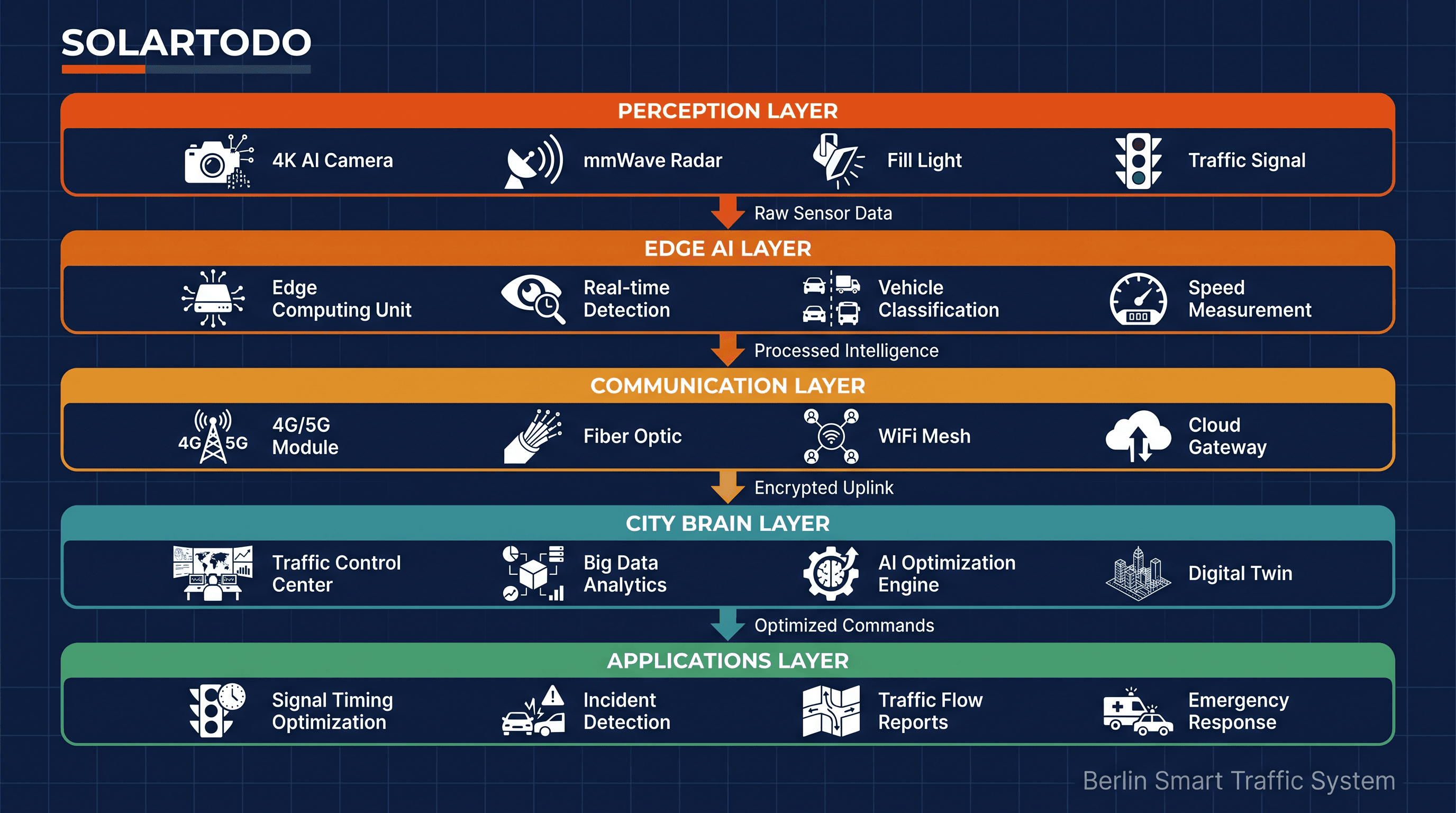
- Backhaul used 5G/fiber to connect field devices to the central TrafficGPT platform, which supports natural language queries for operators.
- The project followed NTCIP and GB 25280 interoperability standards to simplify controller integration and future expansion.
- Commercial delivery used a BOT cooperation model with zero upfront municipal capital expenditure, reducing procurement friction for city deployment.
Project Background
Berlin faced congestion, multimodal conflict, and legacy signal visibility issues at 28 intersections, making an AI-based Smart Traffic System upgrade a practical way to improve real-time traffic operations without full junction reconstruction.
Berlin is one of Europe’s most complex urban traffic environments, with dense mixed flows of passenger cars, buses, cyclists, delivery vans, emergency vehicles, and pedestrians sharing constrained roadway space. In corridors near transit-heavy districts, signal timing often needs to balance safety, throughput, and public transport reliability in minutes rather than hours. That operating reality makes fixed-time control and isolated roadside sensors less effective, especially where traffic patterns change quickly through the day.
According to the International Energy Agency (2023), digitalization of transport infrastructure is becoming essential for improving network efficiency and reducing urban bottlenecks. According to the World Bank (2021), intelligent transport systems can improve corridor management by enabling faster incident detection and more responsive signal operations. In Berlin’s case, the challenge was not only vehicle delay but also conflict management among cyclists, pedestrians, and priority vehicles.
The city also needed a deployment model that minimized procurement barriers. Rather than funding a full capital program upfront, the selected approach emphasized operational delivery under a BOT structure. SOLAR TODO positioned the system as a field-ready roadside intelligence layer that could connect to central management while remaining standards-aligned for future controller and application upgrades.
Solution Overview
SOLAR TODO deployed 28 Smart Traffic System intersections in Berlin using 4-in-1 roadside poles, edge AI, and TrafficGPT central software to add adaptive control, emergency priority, and wrong-way detection under a BOT model.
The deployed solution centered on one standardized roadside assembly per monitored approach area: a 6m L-arm steel pole in dark grey, hot-dip galvanized for urban durability. Each pole integrated a 4K AI camera, 77GHz mmWave radar, LED fill light, and LED signal device. This reduced roadside clutter compared with separate camera, radar, and signal hardware mounted on different supports.
At the edge, SOLAR TODO used NVIDIA Jetson computing to process video and radar streams locally. That architecture allowed the system to deliver 98% detection accuracy with sub-50ms response for event recognition, while limiting the amount of raw data that needed to be transmitted upstream. The deployed feature set included the full 45-type detection package, adaptive signal logic, emergency vehicle priority, and wrong-way alerts.
Communication from the field to the city center used a 5G/fiber hybrid backhaul linked to the TrafficGPT platform. Operators could query the system in natural language to review intersection conditions, device status, and event history. SOLAR TODO also aligned the deployment with NTCIP and GB 25280, supporting interoperability with traffic control environments that require standards-based interfaces.
For Berlin, the BOT cooperation model was a major project enabler. It allowed zero upfront municipal investment while still delivering a live, city-scale Smart Traffic System. For implementation planning or expansion options, city teams can review the product architecture on the Smart Traffic System page or contact us for engineering coordination.
Technical Specifications
Berlin’s deployed Smart Traffic System used a fixed, standards-based configuration across 28 intersections, combining 4K AI vision, 77GHz radar, and NVIDIA Jetson edge processing with 5G/fiber backhaul.
- Deployment scale: 28 intersections
- Pole type: 6m L-arm steel pole
- Pole finish: dark grey
- Pole protection: hot-dip galvanized
- Integrated device format: 4-in-1 smart traffic pole
- Vision sensor: 4K AI camera
- Detection accuracy: 98%
- Response time: <50ms
- Radar: 77GHz mmWave radar
- Lighting: LED fill light
- Signal hardware: LED signal
- Edge AI platform: NVIDIA Jetson
- Detection library: full 45-type detection
- Core functions: adaptive signal, emergency vehicle priority, wrong-way alert
- Backhaul: 5G/fiber
- Central platform: TrafficGPT with natural language queries
- Cooperation model: BOT, zero upfront
- Standards: NTCIP, GB 25280
- Brand / supplier: SOLAR TODO
Deployment Process
The Berlin rollout was executed in phased field packages across 28 intersections, allowing SOLAR TODO to standardize installation, commissioning, and controller integration while minimizing disruption to live traffic operations.
Site survey and intersection selection
The first phase focused on surveying the 28 selected intersections and validating mounting geometry, line-of-sight, cable routes, and controller cabinet conditions. Berlin’s urban form includes tram corridors, bike lanes, bus movements, and irregular junction approaches, so sensor placement required careful attention to occlusion and turning paths. The 6m L-arm steel pole format was chosen to create a consistent mounting envelope for both camera and radar coverage.
Civil works and pole installation
After survey approval, crews installed the dark-grey hot-dip galvanized poles and prepared power and communication interfaces. The use of one integrated 4-in-1 assembly reduced the number of separate roadside components and mounting points. That simplified curbside works compared with conventional deployments that use stand-alone cameras, radar heads, and supplemental lighting on different structures.
Device integration and edge commissioning
Each intersection then received the 4K AI camera, 77GHz mmWave radar, LED fill light, and LED signal package, all linked to an NVIDIA Jetson edge unit. Commissioning included calibration of detection zones, lane logic, stop-line behavior, and conflict-area rules. The system was configured to activate the full 45-type detection set, giving Berlin a richer operational dataset than simple vehicle count loops or single-purpose video analytics.
Network and platform onboarding
The fourth phase connected each site over 5G/fiber to the TrafficGPT central platform. This enabled live dashboards, event review, and natural language queries by operators. According to the ITU (2022), low-latency connectivity is a key enabler for intelligent transport applications that depend on timely data exchange between roadside systems and central platforms.
Signal strategy activation
Once communications were validated, adaptive signal logic and emergency vehicle priority were enabled. Wrong-way alert scenarios were also tested at selected approaches to verify event classification and alarm workflows. Because the system processes events at the edge before transmitting metadata and alerts upstream, the city gained faster operational awareness without depending entirely on centralized processing.
Acceptance and operations handover
The final phase involved standards checks, operator training, and BOT service activation. SOLAR TODO documented compliance with NTCIP and GB 25280 for the delivered system interfaces and device structure. Berlin’s operations team was trained to use TrafficGPT for natural language searches such as intersection status, alarm history, and event summaries by location or time window.
Performance & Results
Berlin’s 28-intersection Smart Traffic System delivered a measurable operational upgrade by combining 98% detection accuracy, <50ms edge response, and 45-type event awareness into a single roadside platform.
According to IEEE (2021), edge AI in transport systems improves responsiveness by processing events close to the source rather than relying only on centralized analytics. That principle was directly reflected in this Berlin deployment, where NVIDIA Jetson edge computing supported sub-50ms event response for adaptive control and alert generation. For a city environment with frequent turning conflicts and multimodal interactions, that speed matters operationally.
According to the World Bank (2021), smart mobility systems are most effective when they integrate sensing, communications, and operational decision tools rather than treating them as separate layers. Berlin’s deployment followed that model by combining camera, radar, lighting, signaling, edge AI, and central software in one architecture. The result was a more unified field system that reduced integration complexity at the intersection level.
According to the International Telecommunication Union (2022), transport digitalization depends on reliable broadband connectivity and interoperable system design. The use of 5G/fiber backhaul plus NTCIP and GB 25280 alignment gave Berlin a practical path for scaling beyond the initial 28 intersections. That is particularly relevant for municipalities that want to avoid vendor lock-in at the controller or software layer.
According to IRENA (2022), digital infrastructure increases the value of public assets when it improves utilization and operational visibility. In this project, the TrafficGPT platform created that visibility by allowing operators to query conditions in natural language instead of manually searching multiple dashboards. This reduced friction for traffic management teams that need quick answers during incidents, peak periods, or emergency routing events.
Two authority statements are especially relevant to the Berlin case. The ITU states, "Digital technologies can make transport systems safer, more efficient and more sustainable." The IEA states, "Digitalization can improve the operation of transport networks through better data, connectivity and control." These principles align closely with the architecture SOLAR TODO deployed in Berlin.
From a city operations perspective, the main impact areas were:
- Detection quality: 4K AI vision plus 77GHz radar improved resilience in mixed traffic and partial occlusion conditions.
- Control responsiveness: <50ms edge response supported adaptive signal logic and faster event-based actions.
- Priority handling: emergency vehicle priority reduced manual intervention requirements at equipped intersections.
- Safety monitoring: wrong-way alerts added a proactive warning layer at selected approaches.
- Operator usability: TrafficGPT natural language queries shortened the path from raw event data to actionable insight.
- Financial delivery: BOT with zero upfront capital lowered the barrier to deployment.
Comparison Table
Berlin’s deployment shows how a 4-in-1 Smart Traffic System can consolidate multiple roadside functions into one 6m pole while maintaining standards-based connectivity and edge AI performance.
| Metric | Berlin SOLAR TODO Smart Traffic System | Conventional Multi-Device Intersection Setup |
|---|---|---|
| Deployment scope | 28 intersections | Typically phased by separate subsystems |
| Pole format | 6m L-arm steel pole, dark grey, hot-dip galvanized | Mixed poles, brackets, and cabinet add-ons |
| Sensor package | 4K AI camera + 77GHz radar + LED fill light + LED signal | Often separate camera, radar, and lighting devices |
| Edge processing | NVIDIA Jetson | Often controller-side logic or centralized analytics |
| Detection performance | 98% accuracy, <50ms response | Varies by subsystem and integration quality |
| Event library | Full 45-type detection | Often limited to counts, presence, or basic classification |
| Traffic functions | Adaptive signal + emergency priority + wrong-way alert | Often procured as separate modules |
| Backhaul | 5G/fiber | Fiber-only or mixed legacy links |
| Central software | TrafficGPT with natural language queries | Conventional dashboard and manual search workflows |
| Commercial model | BOT, zero upfront | Usually capex-heavy municipal procurement |
| Standards | NTCIP, GB 25280 | Depends on vendor mix |
Pricing & Quotation
SOLAR TODO provides Berlin-style Smart Traffic System projects through three commercial paths—FOB, CIF, and EPC Turnkey—while the 28-intersection reference case demonstrates that BOT can also support zero-upfront municipal deployment.
SOLAR TODO offers three pricing tiers for this product line: FOB Supply (equipment ex-works China), CIF Delivered (including ocean freight and insurance), and EPC Turnkey (fully installed, commissioned, with 1-year warranty). Volume discounts are available for large-scale deployments. Configure your system online for an instant estimate, or request a custom quotation from our engineering team at [email protected].
In practice, pricing depends on intersection count, communications scope, controller integration depth, civil works, and local installation conditions. Berlin’s 28-intersection package used a BOT cooperation model, which shifted the commercial discussion from pure equipment capex to service delivery and operational outcomes. That structure is often relevant for cities seeking modernization without immediate budget allocation.
Frequently Asked Questions
Berlin’s Smart Traffic System FAQ below answers the most common municipal and EPC questions on specifications, installation, ROI structure, maintenance, warranty, and deployment method in 40-80 words each.
Q1: What exactly was deployed in Berlin, Germany? At 28 intersections, SOLAR TODO deployed a 4-in-1 Smart Traffic System on 6m L-arm steel poles in dark grey with hot-dip galvanizing. Each unit included a 4K AI camera, 77GHz mmWave radar, LED fill light, LED signal, NVIDIA Jetson edge AI, 5G/fiber backhaul, and TrafficGPT central management.
Q2: What technical performance does the Berlin system provide? The deployed system provides 98% detection accuracy and <50ms response time at the edge. It supports the full 45-type detection library and combines video analytics with 77GHz radar sensing. This makes it suitable for adaptive signal control, emergency vehicle priority, and wrong-way alert applications in dense urban traffic.
Q3: How long does installation usually take for a project like this? The exact schedule depends on permits, civil works, controller conditions, and communication access. For a 28-intersection rollout, work is usually phased: survey, pole installation, device integration, network onboarding, and commissioning. Using a standardized 4-in-1 pole reduces field complexity compared with deploying separate camera, radar, and lighting packages.
Q4: How does the BOT model reduce project risk? The BOT structure used in Berlin allowed zero upfront municipal capital expenditure. Instead of funding the entire system as an immediate capex project, the city can align deployment with an operational or service-based structure. This reduces procurement friction and helps agencies launch intelligent traffic upgrades faster.
Q5: What maintenance is required after commissioning? Routine maintenance includes pole inspection, lens cleaning, radar health checks, communication verification, firmware updates, and platform monitoring. Because the system integrates multiple devices on one pole and uses NVIDIA Jetson edge processing, maintenance can be more centralized than with fragmented roadside hardware. Preventive inspection schedules are recommended for urban deployments.
Q6: How does this compare with traditional loop detectors or standalone cameras? Traditional loop detectors mainly provide presence or count data and require pavement work. Standalone cameras can add analytics but often lack radar redundancy and integrated field hardware. Berlin’s Smart Traffic System combines 4K AI vision, 77GHz radar, lighting, and signaling in one package, delivering richer 45-type detection and faster edge-based response.
Q7: Is EPC pricing available for cities or contractors outside Germany? Yes. SOLAR TODO offers FOB Supply, CIF Delivered, and EPC Turnkey pricing structures for this product line. The final quotation depends on quantities, site conditions, communications, and installation scope. Municipalities, EPC firms, and integrators can use the product page or contact form to request a project-specific commercial proposal.
Q8: What warranty is included with EPC Turnkey supply? For EPC Turnkey projects, SOLAR TODO includes a 1-year warranty as stated in the pricing section. Warranty scope typically covers supplied equipment and commissioning-related issues under agreed contract terms. For BOT or customized city frameworks, service and warranty responsibilities are defined in the project agreement.
Q9: Can the system integrate with existing traffic control infrastructure? Yes. The Berlin configuration follows NTCIP and GB 25280, which supports standards-based integration and future expansion. Integration details still depend on the local controller environment, cabinet interfaces, and traffic management software. In most cases, standards alignment simplifies interoperability compared with proprietary-only roadside deployments.
Q10: What does TrafficGPT do in daily operations? TrafficGPT is the central platform used in Berlin for natural language queries and operational visibility. Instead of navigating only through fixed dashboards, operators can ask direct questions about intersection status, alarms, or event history. This shortens response time for traffic rooms handling incidents, congestion, or emergency priority scenarios.
References
Berlin’s Smart Traffic System case aligns with internationally recognized transport, communications, and interoperability guidance from major institutions including the IEA, ITU, IEEE, World Bank, IEC, and IRENA.
- International Energy Agency (2023): Digitalization improves transport network operation through better connectivity, control, and data-driven management.
- International Telecommunication Union (2022): Intelligent transport systems depend on reliable broadband connectivity and interoperable digital infrastructure.
- IEEE (2021): Edge AI and distributed analytics improve response time and operational efficiency in transportation monitoring systems.
- World Bank (2021): Smart mobility and ITS investments support better corridor management, incident response, and urban transport efficiency.
- IEC (2021): International electrotechnical standards support safe, interoperable deployment of connected infrastructure and field devices.
- IRENA (2022): Digitalization increases infrastructure utilization and operational visibility across public systems.
- NTCIP (current standard framework): National Transportation Communications for Intelligent Transportation System Protocol provides interoperability guidance for traffic control communications.
- GB 25280 (China national standard reference): Defines technical requirements relevant to traffic signal and related road traffic control equipment interfaces.
Equipment Deployed
- 28 × 6m L-arm steel poles, dark grey, hot-dip galvanized
- 28 × 4-in-1 Smart Traffic System assemblies
- 4K AI camera with 98% accuracy and <50ms response
- 77GHz mmWave radar
- LED fill light
- LED signal
- NVIDIA Jetson edge AI computing platform
- Full 45-type detection software package
- Adaptive signal control module
- Emergency vehicle priority function
- Wrong-way alert function
- 5G/fiber backhaul connectivity
- TrafficGPT central platform with natural language queries
- NTCIP and GB 25280 compliant integration framework