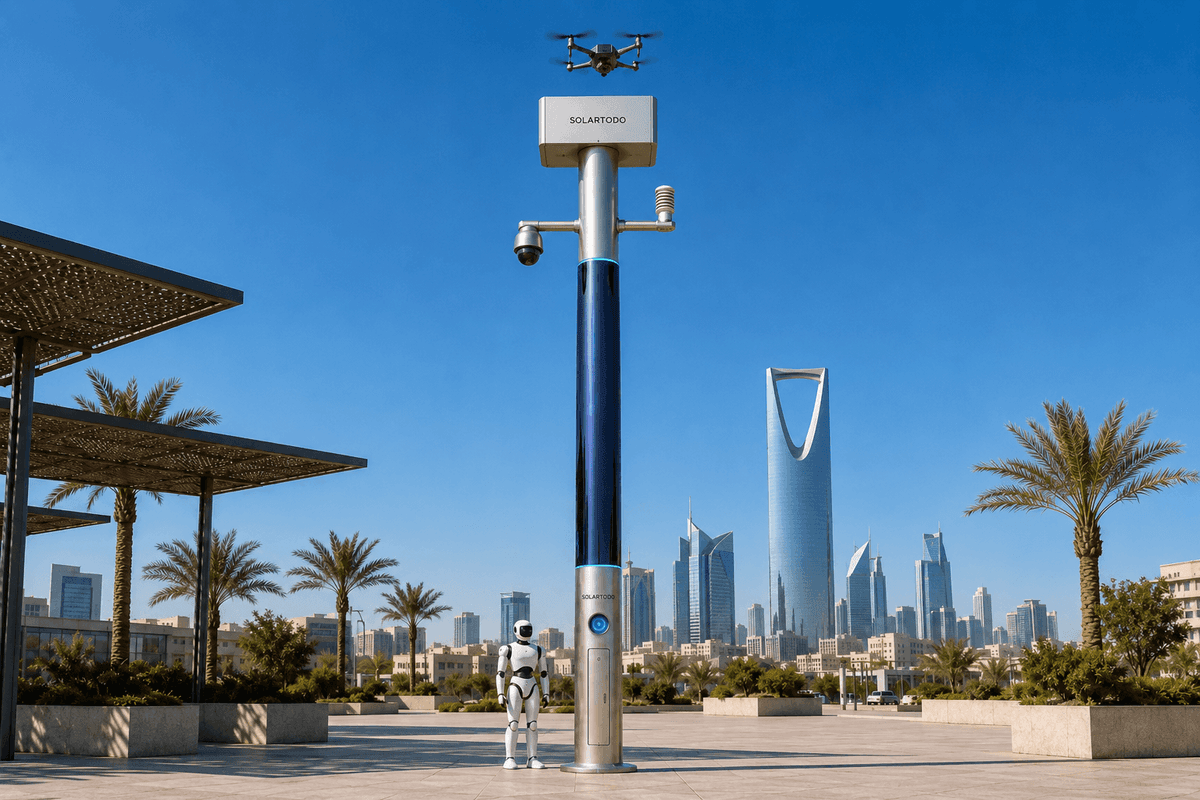
A City AI Pole is a non-lighting physical-AI edge node that places sensing, edge compute, autonomous drone operations, ground robot support, communications resilience and off-grid energy storage into one urban pole form. In Bangkok, SOLARTODO Sentinel Sky Hub is proposed as a port border-watch node for police-led monitoring when network outages limit conventional patrol visibility.
1. Bangkok Port Task And Cross-Department Operating Context
Bangkok’s port and river-linked logistics zones combine freight movement, worker access, tourist traffic, event surges and water-edge perimeter risk in a compact urban environment. During major sports-event periods, police and supporting city departments often need more frequent perimeter checks without adding a permanent patrol team to every quay, gate, service road or restricted edge. The operational problem is not general smart-city decoration; it is a practical border-watch task around a port archetype, where the stakeholder is police, the primary field asset is an autonomous drone, and the hardest failure mode is a network outage at the exact moment when the command room needs continuity.
The proposed SOLARTODO Sentinel Sky Hub configuration is a single-pilot deployment mode: one police-controlled operating cell, anchored by one off-grid Sky Hub node, is used to validate procedures for a defined port boundary segment before any wider procurement decision. “Single-pilot” here refers to the operating model and procurement stage, not to an immature feature set. The node is treated as an in-service product configured for a Bangkok use case, subject to final engineering confirmation on siting, duty cycle, spectrum planning, and local permitting.
The cross-department pattern is straightforward. Police define the border-watch rules, escalation thresholds and human authorization path. Port security defines access zones, gate calendars, vessel-side restrictions and maintenance windows. Emergency management receives de-identified incident metadata and common-operating-picture alerts. IT and data-governance teams review retention, network routing and local-processing controls. Facilities teams approve physical placement, drainage, wind exposure, corrosion protection and battery service access. This keeps the city task ahead of the equipment list: the purpose is to reduce manual patrol burden while preserving human authority over any response.
2. Why The Pain Point Is Communications Continuity, Not More Cameras
For port police operations, a network outage changes the value of every device at the edge. Conventional cameras and remote-connected sensors become less useful when their primary function depends on streaming raw feeds to a distant server. During a sports-event week, cellular congestion, temporary road closures, venue-related traffic control and higher public movement can make this worse. The border-watch team still needs to know whether a restricted pier edge, fence line, parking spillover area or service entrance has changed state, even if upstream connectivity is degraded.
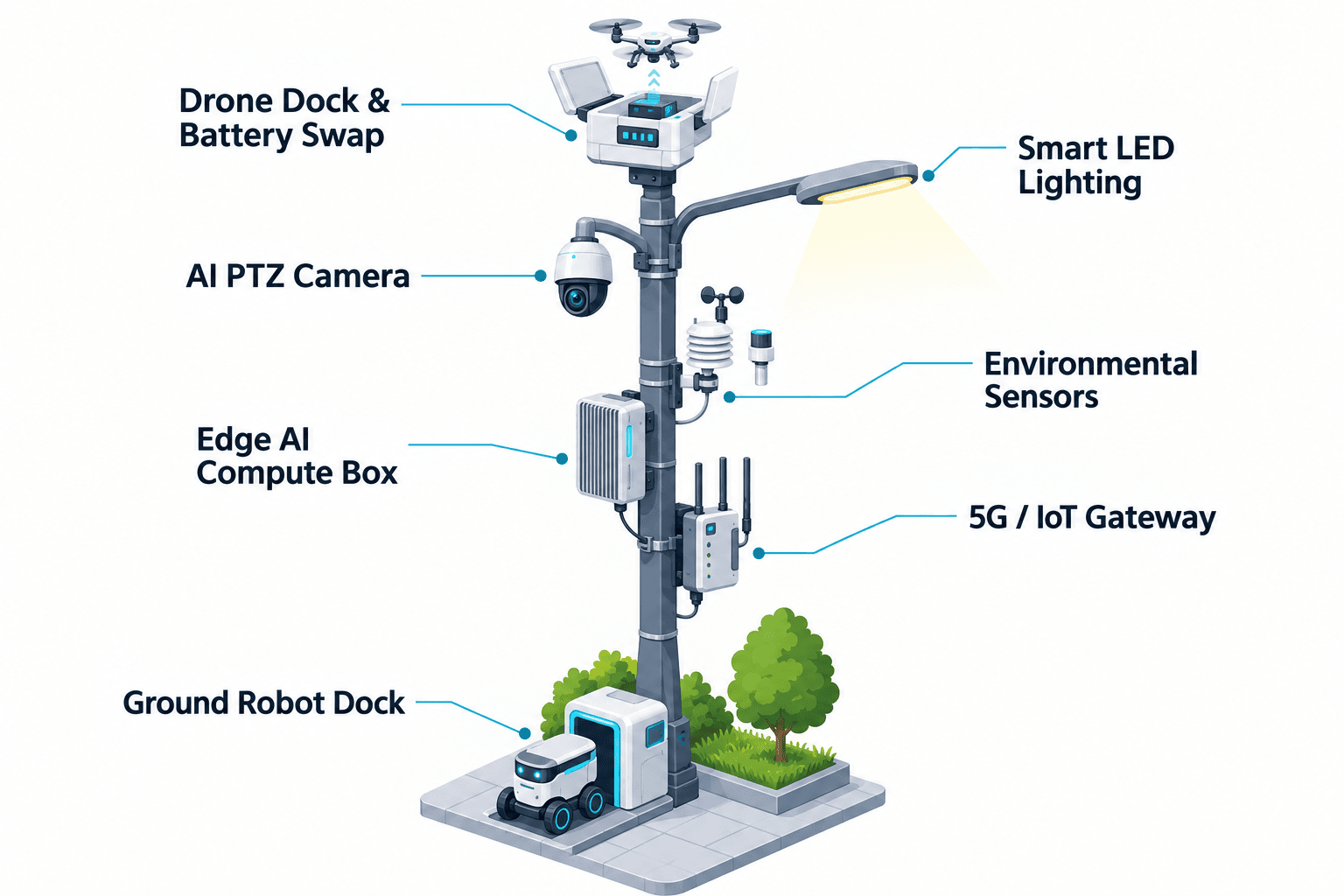
The Sentinel Sky Hub approach shifts the communications burden. Raw video and sensor data stay on the pole and are processed locally by a Jetson-class edge AI compute module. Only de-identified event and status metadata may leave the node. If the wide-area link is weak, the node continues sensing, scoring, queuing missions and maintaining local logs. The command view receives smaller messages when connectivity allows, while the pole remains useful as a local decision-support station rather than becoming a blind camera mast.
The module focus for Bangkok is therefore comms resilience: local inference, event compression, store-and-forward logs, mission state continuity, task queueing, and status synchronization into a common-operating-picture view. This supports the operating loop of sensing, authorized assessment and response, edge-compute scheduling, and field operations and maintenance. The police desk does not need continuous raw-feed backhaul to know that the node has detected an intrusion-class event, dispatched a drone patrol route, recorded the sortie state, and returned a concise status package for review.
This is also why Sky Hub is specified as fully off-grid. The pole does not depend on grid, city or site power. It uses battery storage and 360-degree-wrapped flexible CIGS thin-film solar replenishment on the pole body. The solar layer is supplemental, not an unlimited power claim. For an approximately 8 m tall, 0.6 m-wide cylindrical body with about 15 m² of wrap, the nameplate area is roughly 2.4-2.7 kWp, while realistic clear-sky output in a high-irradiance region is closer to 0.8-1.1 kW DC peak and about 6-9 kWh per day. Bangkok engineering would recalculate local yield, shading and monsoon conditions; high-power drone and robot tasks are buffered by 5-20 kWh-class storage and scheduled by duty cycle.
3. Drone-Led Border-Watch Workflow For A Police Buyer
The proposed Bangkok port use case starts with a police-defined patrol grid: restricted edge, gate approach, fence line, cargo-adjacent corridor and event-week crowd overflow boundary. The Sky Hub node hosts a PTZ camera with local perception for anonymous vehicle count, crowd density, intrusion and perimeter awareness. It does not need to identify faces or read licence plates as an active deployed capability. The goal is to establish whether the border condition has changed, whether the change requires a drone view, and whether a human-authorized response is appropriate.
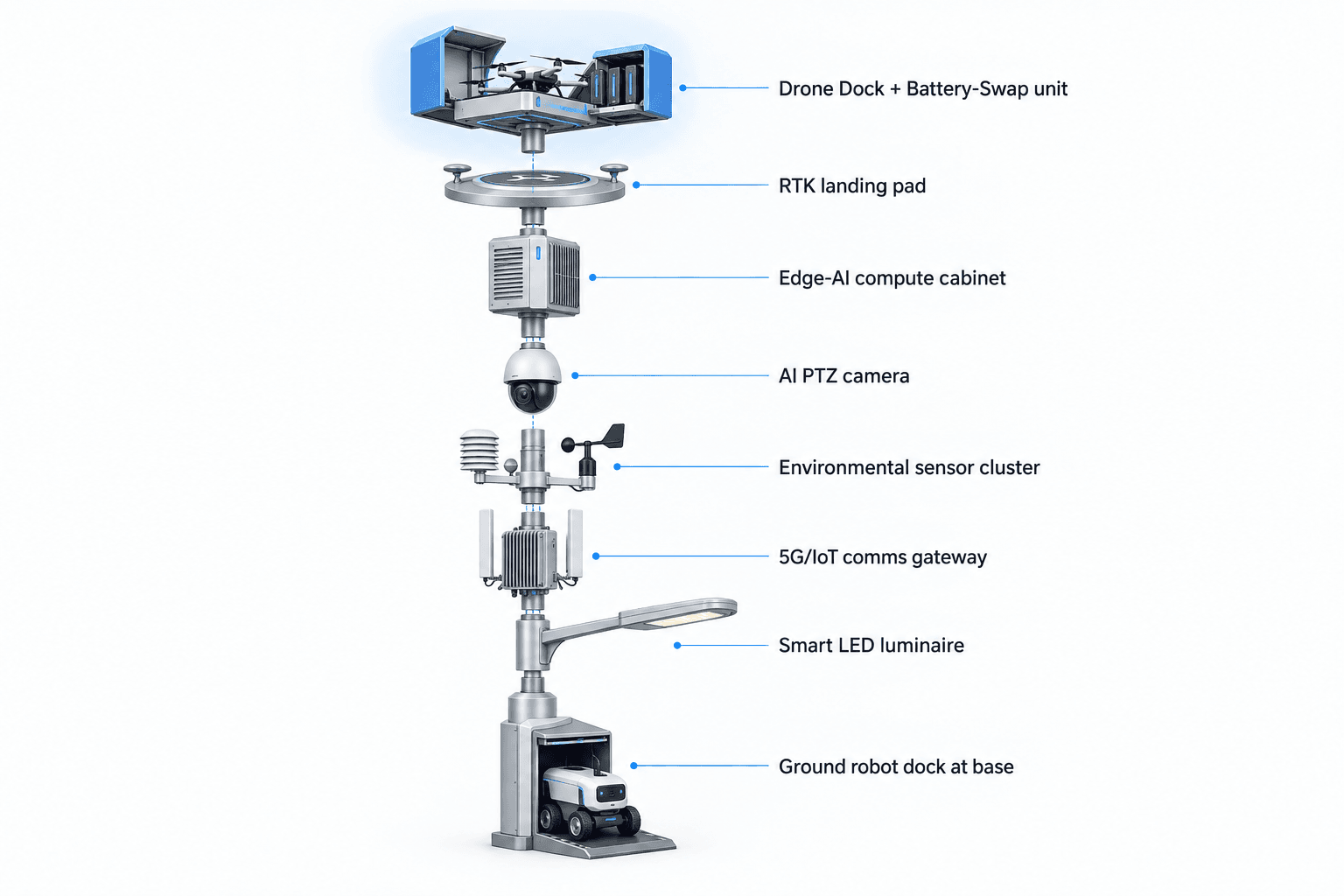
When the edge AI scores an anomaly, the COP command view presents the event type, location sector, confidence band, recent sensor context, battery state, communications state and recommended task options. A police operator authorizes the next step. The drone can launch from the node, fly a regional patrol, inspect the area, return, and be redeployed for another task without an operator standing at the site. After landing, a rear-service multi-bay battery magazine performs automated battery hot-swap, replacing the depleted pack with a charged pack so multiple consecutive sorties can be scheduled if storage and weather conditions allow.
Drone operations management is part of the same workflow: route planning, charge and swap state machine, task queueing, fleet health and mission logs. The point is labor replacement at the patrol-task level, not replacement of police authority. For planning, the buyer can evaluate how many repetitive night boundary walks, static observation periods, or vehicle loops can be shifted to autonomous drone sorties and exception-based human review. The KPI should be framed as target patrol-hours avoided per week, target manual inspection rounds automated, and target number of event-week anomaly checks completed without adding a second on-site team.
Ground robot operations remain available for conditions where a low-speed ground look is more useful than aerial inspection, such as service-road verification, equipment cabinet checks, or coordination after a drone has marked an area for closer review. A humanoid or service robot can patrol, respond to alarms, inspect, coordinate with the aerial view, and return to the pole base for wireless charging. In this Bangkok case, the primary topic remains drone border-watch; the robot is a second field asset for tasks that benefit from ground-level presence.
4. Human-Authorized C-UAS Coordination And Data Governance
Port areas near event routes can face unauthorized small-drone activity, whether accidental, curious or malicious. The proposed Sentinel Sky Hub configuration supports non-lethal, human-authorized counter-UAS coordination. The pole may detect and track an unauthorized drone through its own sensing and, where available, optional partner-sensor inputs. Radar is not built into the pole; if radar is part of the final site design, it is treated as an external or partner input integrated into the COP.
The authorized response remains bounded. The pole can command its own friendly drone to perform soft aerial net-capture or close-approach deterrence after human approval. It is not a weapons system, not a hard-kill system, and not an autonomous attack workflow. This is important for police buyers because the policy decision must be explicit: detection and tracking are operational awareness; any mitigation must be authorized, logged and proportionate to the risk.
Data governance follows the same local-first logic. Raw video and sensor data stay on the pole for local processing. Metadata that may leave the pole is de-identified event or status information: event class, sector, timestamp, device state, task state, battery state, communications state and maintenance alerts. The configuration is PDPL/LGPD-oriented because it is designed around local processing and minimization, but final compliance language, retention periods and audit controls require legal and engineering confirmation by the buyer.
The cross-department command view is therefore not a giant video wall by default. It is a COP for operational decisions: what was sensed, what was assessed, who authorized response, what the drone or robot did, what evidence was recorded locally, what metadata was synchronized, and what maintenance action is required. For Bangkok police and port stakeholders, that creates a defensible chain from detection to decision to action to record, while keeping raw data movement narrow.
5. Evaluation KPIs For A Proposed Bangkok Single-Pilot Deployment
The proposed KPI framing is labor-replacement planning, not claimed achieved results. Before field work, the buyer should define the manual patrol baseline: how many night rounds, gate-edge checks, restricted-zone walks and event-week spot inspections currently require police or contracted security time. The single-pilot operating cell can then compare target automation against that baseline without inventing coverage area, detection rate, latency or savings claims.
Useful evaluation metrics include target manual patrols automated per week, target exception-only reviews handled from the police desk, target drone sorties supported per shift, target percentage of event logs stored locally during outage windows, target maintenance visits avoided through battery and system health telemetry, and target number of cross-department incident records completed from one COP workflow. These numbers are buyer inputs to be recomputed after final siting and duty-cycle design.
For Bangkok, seasonal sports-event pressure makes the evaluation timely. A port zone does not pause because a tournament or public event increases city movement. The proposed Sky Hub configuration gives police a way to maintain a border-watch rhythm when traffic control, crowds and communications stress are all higher than normal. It also gives port operators a structured method to coordinate with police without turning every sensor into a raw-feed export. The result is a realistic deployment discussion: one off-grid physical-AI city edge node, configured for drone-first border-watch, local processing, communications continuity and human-authorized response.
System Configuration
| Parameter | Configuration |
|---|---|
| Deployment category | city-ai-pole / physical-AI urban edge node for port border-watch; pure non-lighting pole |
| Energy system | fully off-grid battery-backed micro-station with 360° wrapped flexible CIGS solar replenishment; storage sized in the 5-20 kWh class subject to duty cycle |
| Edge AI compute | Jetson-class on-pole inference and workload scheduling cabinet; raw video and sensor data processed locally |
| Drone operations | autonomous launch, patrol, inspection, return, task redeployment, and rear-service multi-bay battery hot-swap |
| Comms focus | local event processing, store-and-forward mission logs, de-identified status metadata sync, COP continuity during network outage |
| Security sensing | AI PTZ camera for anonymous vehicle count, crowd density, intrusion and perimeter awareness |
| Environmental monitoring | wind speed, wind direction, temperature, humidity, atmospheric pressure, noise, PM10, PM2.5 and illuminance |
How It Works
- On-pole camera and environmental sensors flag a port-boundary anomaly locally.
- Edge AI classifies the event and scores intrusion, crowd-density or unauthorized-drone relevance.
- COP presents de-identified metadata, node status and recommended drone task for police authorization.
- Authorized drone sortie inspects the sector, returns, and enters automated battery hot-swap if needed.
- Event record, mission log, comms state and maintenance status are stored locally and synchronized when available.
Planning Assumptions (Indicative)
Illustrative planning inputs a buyer can recompute — target metrics, not achieved results. Subject to final engineering confirmation.
| Metric | Planning assumption | Indicative value |
|---|---|---|
| Inspection labor | drone patrol replaces repetitive manual boundary checks during event-week night shifts | ~10-20 patrol rounds/week targeted for automation |
| Operator model | single police approval desk supervises exception-based alerts instead of continuous on-site observation | ~1 authorized operator per operating cell |
| Outage resilience | local logs and de-identified metadata queue during degraded network windows | ~1 shift of mission-state continuity targeted |
| Drone sortie planning | battery hot-swap magazine supports consecutive patrol tasks within storage and weather limits | ~3-6 sortie cycles/day as planning input |
| Manual escalation | only scored anomalies and authorized response tasks require human field follow-up | ~50-70% of routine checks targeted for remote review |
Deployed Equipment
- SOLARTODO Sentinel Sky Hub pure smart pole body
- Battery-backed off-grid energy cabinet
- 360° wrapped flexible CIGS thin-film solar replenishment layer
- AI PTZ camera and local perception module
- Jetson-class edge AI compute module
- Autonomous drone launch, landing and battery hot-swap assembly
- Ground robot wireless charging base
- COP command-view software interface
Frequently Asked Questions
Is Sky Hub a lighting product for Bangkok port roads?
No. The proposed Bangkok configuration treats Sky Hub as a pure non-lighting physical-AI edge node. Its purpose is to host sensing, compute, drone operations, robot support, communications continuity and off-grid energy storage for port border-watch tasks. It should be evaluated as urban edge infrastructure, not as a lighting upgrade.
How does the node keep working during a network outage?
The design places inference, mission-state handling and event logging on the pole. Raw video and sensor data stay local, while only de-identified event and status metadata may leave the node. If the wide-area link degrades, the node can continue detecting, scoring, queueing missions and storing logs until synchronization is available.
What makes the Bangkok use case police-relevant rather than only port-security relevant?
The scenario involves border-watch decisions, human authorization, escalation records and potential unauthorized-drone coordination, all of which require police governance. Port teams provide access-zone knowledge and operating calendars, while police define response thresholds, authorization rules and evidence-handling expectations through the common-operating-picture workflow.
Does the proposed configuration claim automatic identification of people or vehicles?
No. The sensing scope is limited to local perception for anonymous vehicle count, crowd density, intrusion and perimeter awareness. The article does not claim active face recognition or licence-plate recognition. This keeps the deployment aligned with a data-minimization posture and with local-processing design principles.
Can the off-grid solar wrap power unlimited drone and robot activity?
No. The wrapped CIGS layer is a supplemental replenishment layer for a battery-backed off-grid micro-station. A vertical cylindrical wrap does not produce its full nameplate output at all times. High-power drone and robot tasks must be buffered by storage and scheduled by duty cycle after final Bangkok irradiance, shading and weather analysis.
How is counter-UAS handled in this configuration?
The node can support detection, tracking and command coordination for a friendly drone response, but mitigation is non-lethal and human-authorized only. Allowed responses include soft aerial net-capture or close-approach deterrence after approval. Radar, if used, is an optional partner-sensor input rather than built-in pole hardware.
Explore Further
- City AI Pole / smart streetlight product line
- More smart-city deployment cases
- Talk to our engineering team
Planning a similar physical-AI deployment for streets, campuses or public spaces? Request an engineering consultation