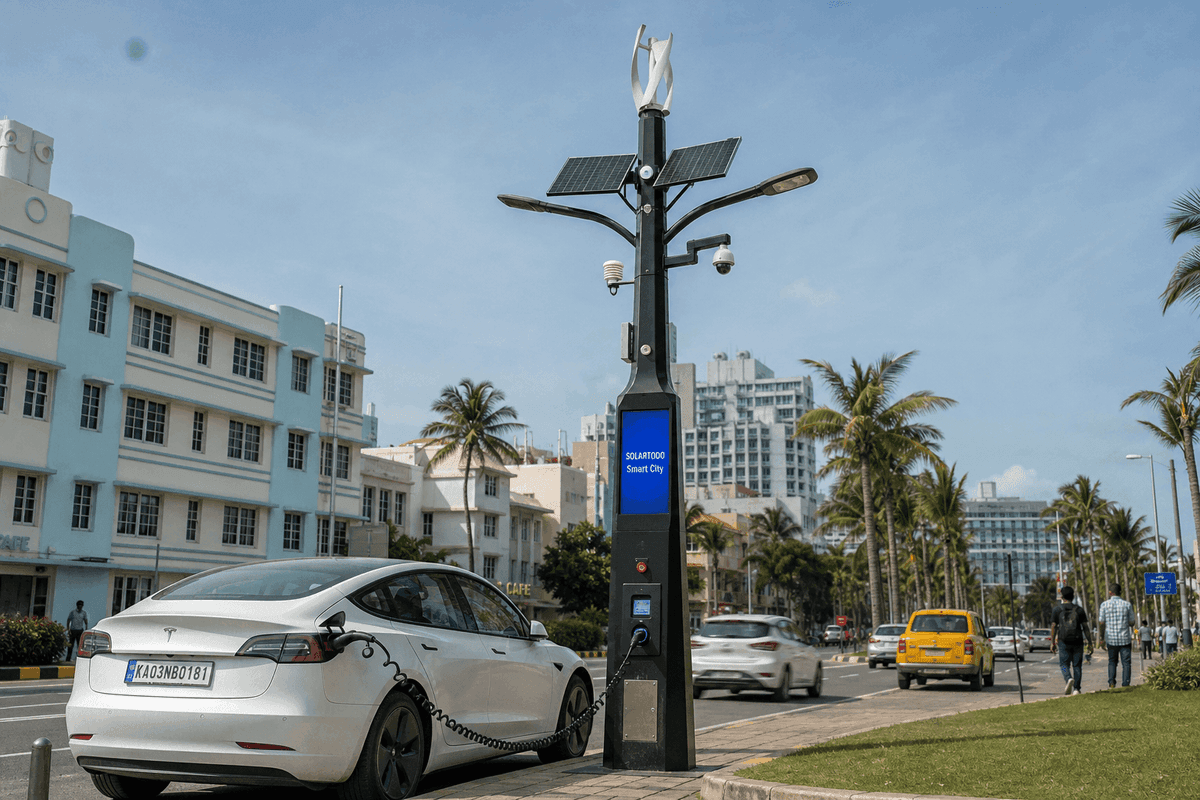
Bangalore Smart Streetlight Market Analysis: 103-Unit Hybrid 9m Configuration Guide for Urban Streets
Summary
Bangalore’s dense arterial streets, year-round EV growth, and moderate solar resource support a typical 103-unit smart streetlight corridor at 32 m spacing. A recommended fit is a 9 m hybrid pole with 2×80 W LED lighting, 10 kWh LFP storage, and integrated 7 kW AC charging.
Key Takeaways
- A typical Bangalore corridor of this scale would use approximately 103 smart streetlights at 32 m spacing, covering about 3.3 km of urban street frontage.
- The recommended pole class is 9 m octagonal tapered steel with base diameter 45 cm and top diameter 15 cm, suitable for city roads rather than highways.
- Each unit would combine 2×200 W monocrystalline panels, a 500 W Darrieus H-type VAWT, and a 10 kWh LFP battery with MPPT and grid backup.
- Lighting output would come from twin 1.5 m arms with +8° tilt and 2×80 W LED luminaires rated at 150 lm/W and 4000 K.
- The lower 2.2 m of the pole would function as the EV charging cabinet, housing a 7 kW single-gun AC charger with Type 2 connector and OCPP 1.6J.
- Public-safety and smart-city payloads would include an 8 MP 180° fisheye camera, 8-parameter environmental sensor, 30 W IP audio column, and one-press SOS button.
- Connectivity would include a flush-mounted WiFi 6 access point at 8.7 m, supporting up to 256 devices and 1.8 Gbps peak throughput.
- According to MNRE (2024), India’s public EV charging network continues to expand, making charger-integrated street furniture more relevant on mixed-use Bangalore streets.
Market Context for Bangalore
Bangalore’s urban road network, EV adoption trend, and mixed commercial-residential density make multifunction street poles more relevant on collector and arterial roads than single-purpose lighting columns. According to the World Population Review (2024), Bangalore’s population is about 14 million, which increases pressure on curbside lighting, communications, and public-safety infrastructure within limited right-of-way.
According to the Government of Karnataka’s Economic Survey (2023-24), Bengaluru Urban remains the state’s largest economic concentration, with high daily commuter flows and strong electricity demand from services, IT parks, retail, and mixed-use transport corridors. That matters because a smart streetlight in Bangalore is not only a lighting asset; it often needs to support surveillance, WiFi access, emergency communication, and EV charging within a 25-50 m spacing pattern.
Climate also supports a hybrid self-powered configuration. According to NREL’s solar resource datasets and the World Bank Global Solar Atlas (2024), southern India, including Bangalore, generally receives around 4.5-5.5 kWh/m²/day of global horizontal irradiation. Bangalore’s elevation of roughly 900 m and moderate wind conditions do not justify wind-only systems, but they do support a hybrid pole where a 500 W VAWT supplements 400 W of PV and reduces battery cycling during monsoon variability.
Grid resilience is another local factor. According to BESCOM planning documents and Karnataka power distribution updates, Bangalore’s urban distribution network includes 11 kV feeders stepping down to low-voltage service in dense neighborhoods. For this reason, a city-street smart pole should not be treated like a highway mast or a utility transmission structure. The correct size class is an urban street smart pole in the 9-12 m range, with integrated low-voltage loads and optional grid tie rather than a tall traffic or power-line pole.
Telecom density also supports the business case. According to TRAI (2024), India’s broadband and wireless subscriber base remains one of the world’s largest, and dense urban centers such as Bangalore continue to require street-level WiFi offload and edge device mounting points. A smart streetlight with WiFi 6, IP audio, and camera payloads can reduce the need for separate cabinets and separate poles on already constrained sidewalks.
Two authority statements are relevant here. The International Energy Agency states, "Electric car sales continued to break records in 2023," highlighting the need for distributed charging in cities. IEC states, "IEC 60598 specifies general requirements for luminaires," which is directly relevant for municipal lighting procurement and compliance review.
SOLAR TODO therefore fits Bangalore best as a multifunction urban street asset rather than a decorative pole or a highway high-mast solution. On streets with mixed pedestrian, retail, and curbside parking activity, a charger-integrated Smart Streetlight can consolidate 6 to 8 functions into one 9 m structure.
Recommended Technical Configuration
For Bangalore’s mixed-use urban streets, a typical 103-unit deployment would use a 9 m hybrid Smart Streetlight with integrated EV charging, surveillance, environmental sensing, WiFi 6, public address, and a vertical LED information screen. This configuration matches city-road spacing of 32 m and avoids the oversizing, foundation cost, and visual bulk associated with 12 m+ highway poles.
A typical 103-unit deployment of this scale would consist of the following SOLAR TODO configuration:
- Approximately 103 units of 9 m octagonal tapered steel smart pole
- Base diameter 45 cm to top diameter 15 cm
- Black RAL9005 powder-coated finish
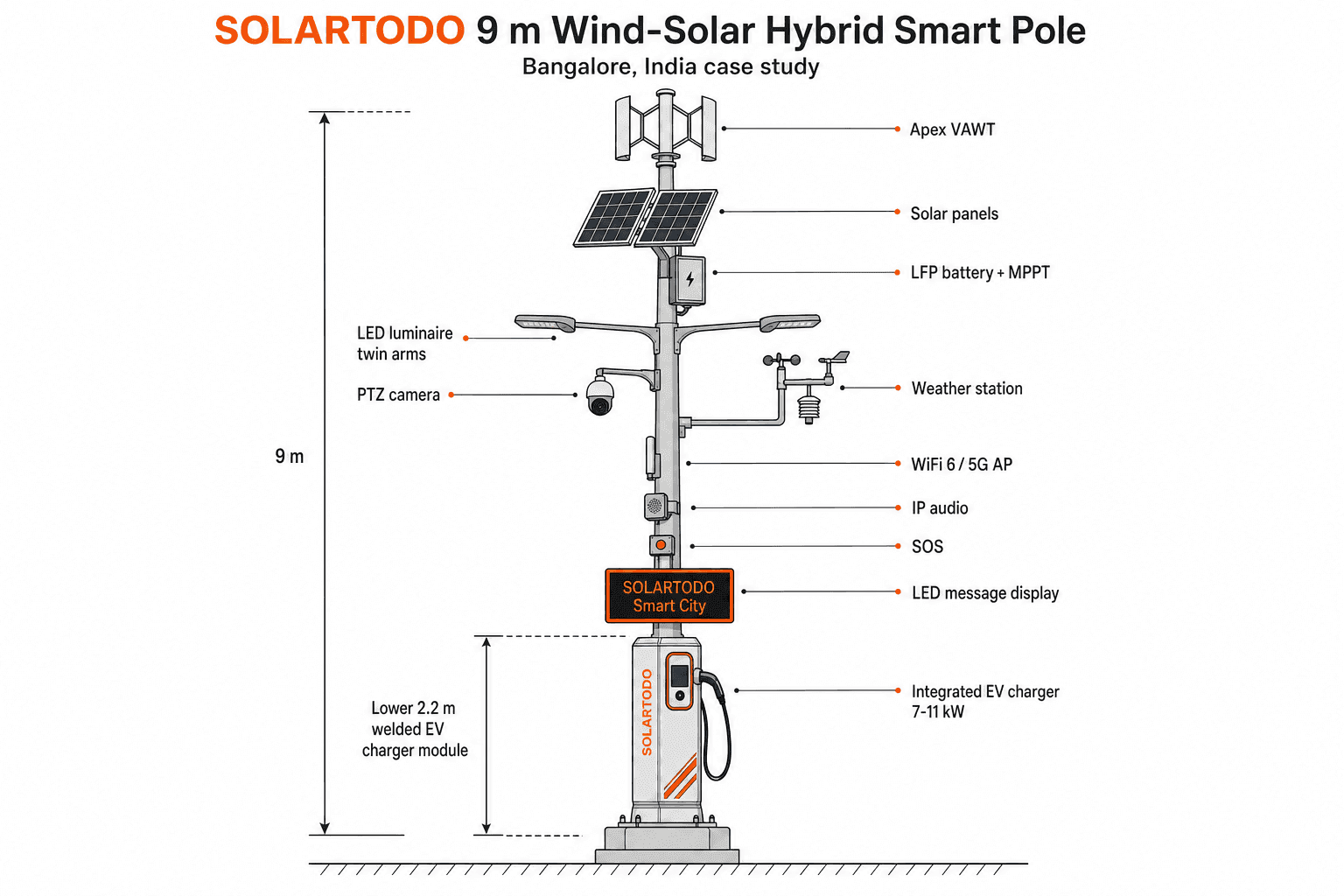
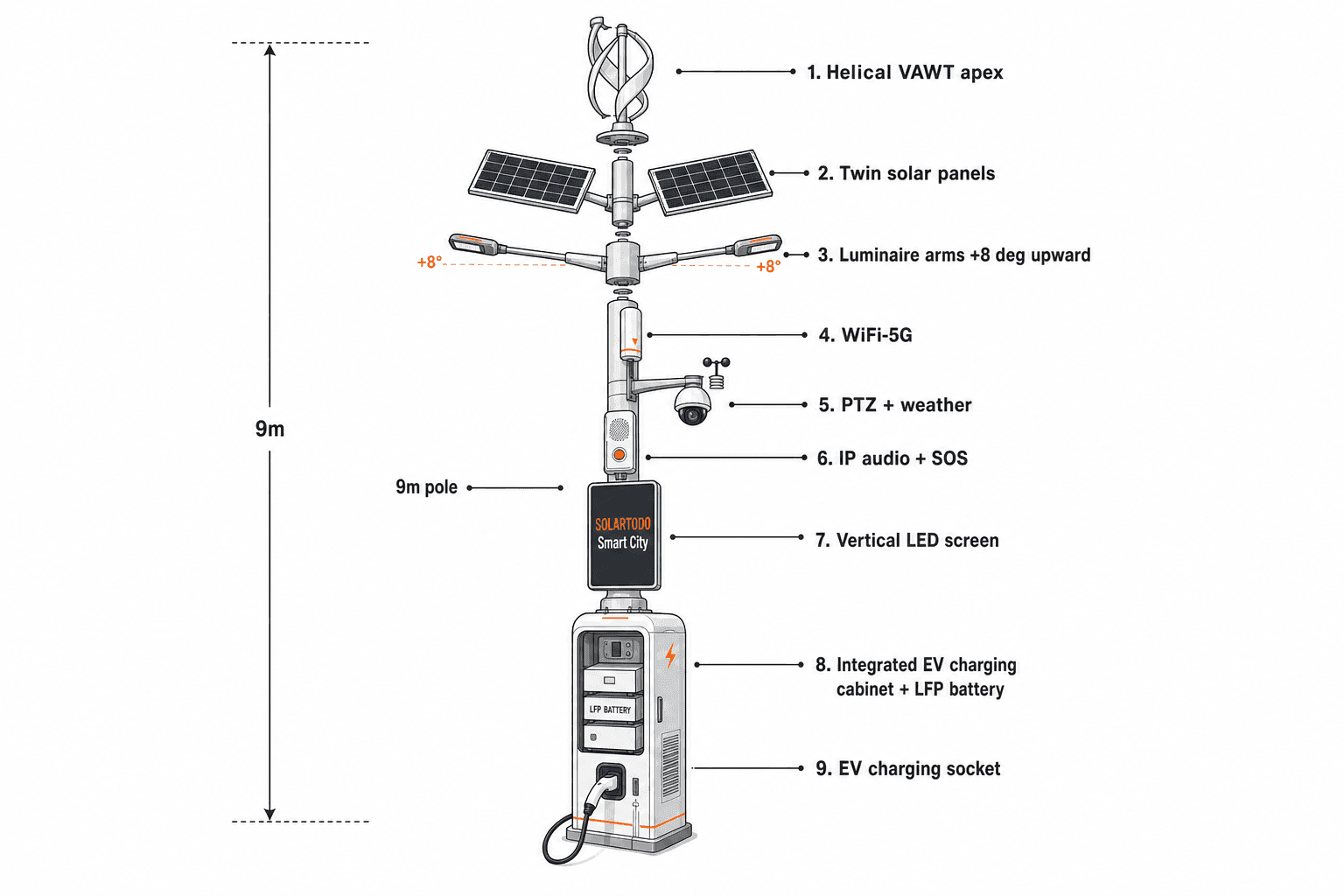
- Lower 2.2 m of the pole functioning as the EV charging cabinet, welded as one continuous steel structure rather than a separate pedestal
- Hybrid power package with 1× 500 W Darrieus H-type VAWT and 2× 200 W monocrystalline panels at 15° tilt
- 10 kWh LFP battery in the base with MPPT controller and backup grid tie
- Twin 1.5 m lighting arms with +8° upward tilt and 2× 80 W LED luminaires
- 8 MP fisheye 180° panoramic camera flush-mounted on the pole body
- 8-parameter environmental sensor at the top
- 30 W IP audio column and one-press SOS button with camera linkage
- 7 kW AC Type 2 charger with OCPP 1.6J, 5 m coiled cable, touchscreen, E-stop, and maintenance door
- P4 vertical LED display measuring 960×1920 mm with fixed branding content
- Flush-mounted WiFi 6 access point at 8.7 m supporting 256 devices and 1.8 Gbps
- Qi wireless phone charging pad and USB-A convenience outlet
This is the right size class because Bangalore’s target application is urban street lighting with smart-city payloads at 30-50 poles per km, not park lighting at 6-8 m and not highway lighting above 12 m. The 32 m spacing aligns with the stated city-street range and supports even illumination with 2×80 W luminaires on twin arms.
From a procurement standpoint, SOLAR TODO should be specified as a Smart Streetlight package under luminaire, low-voltage EV charging, communications, and smart-city equipment standards. The key standards in this configuration are IEC 60598 for luminaires, GB/T 37024 for smart poles, and IEC 62196-2 for the Type 2 EV interface.
Technical Specifications
The recommended Bangalore specification is a 9 m hybrid Smart Streetlight with 103-unit corridor scaling, 400 W PV, 500 W VAWT input, 10 kWh LFP storage, and integrated 7 kW AC charging in the lower 2.2 m pole body.
- Pole structure: 9 m octagonal tapered steel smart pole
- Pole geometry: base diameter 45 cm, top diameter 15 cm
- Finish: black RAL9005 powder coat
- Pole-charger design: lower 2.2 m of pole is the EV charging cabinet; one welded steel structure, not a separate pillar
- Wind turbine: Darrieus H-type VAWT, 3 straight vertical blades, 80 cm diameter × 110 cm height, 500 W, red aviation LED
- Solar module set: 2× 200 W monocrystalline deep-black panels
- Solar mounting: A-frame brackets, symmetric east-west pair, 15° tilt
- Battery: 10 kWh LFP battery inside pole base
- Charge control: MPPT controller with backup grid tie
- LED lighting: twin symmetric arms, each 1.5 m, +8° upward tilt
- Luminaire rating: 2× 80 W LED, 150 lm/W, 4000 K
- Camera: 8 MP fisheye, 180° panoramic, flush-mounted on pole body
- Environmental sensor: 8 parameters including temperature, humidity, wind, pressure, noise, PM2.5, PM10, and illuminance
- Public address: 1× IP audio column, 10 cm diameter × 50 cm length, 30 W, 93 dB, TCP/IP networked
- Emergency system: one-press SOS button with camera linkage
- EV charging: integrated 7 kW single-gun AC charger, Type 2, OCPP 1.6J
- Charger accessories: 5 m coiled cable, touchscreen, emergency stop, maintenance door
- LED display: P4 vertical screen, 960×1920 mm portrait, brightness above 5500 cd/m²
- Display content: fixed text "SOLARTODO Smart City" in white sans-serif on deep blue
- Wireless connectivity: WiFi 6 AP, 802.11ax, 256 devices, 1.8 Gbps
- WiFi mounting height: 8.7 m, flush on flat pole face with color-matched housing
- User convenience: Qi wireless phone charging pad plus USB-A
- Pole spacing: 32 m typical
- Applicable standards: IEC 60598, GB/T 37024, IEC 62196-2
Implementation Approach
A 103-unit Bangalore rollout would typically be executed in 4 phases over roughly 16-28 weeks, depending on utility approvals, civil permits, and imported component lead times. The sequence usually starts with corridor survey and load study, then moves to foundation works, pole erection, electrical termination, and final software commissioning.
Phase 1 is design, permitting, and utility coordination. For a 3.3 km corridor at 32 m spacing, the owner would typically confirm right-of-way width, curbside parking behavior, drainage conflicts, and BESCOM low-voltage interconnection requirements. If EV charging is activated on all 103 poles, the connected load could reach 721 kW at full simultaneous use, so diversity assumptions and feeder capacity checks are necessary.
Phase 2 is factory fabrication and pre-assembly. The 9 m octagonal steel poles, charger compartments, LED arms, WiFi housings, and flush-mounted accessories should be fabricated as matched assemblies to reduce field rework. For imported supply, buyers often choose CKD or semi-knocked-down logistics to balance freight cost against site labor and customs handling.
Phase 3 is civil and electrical installation. Typical works include foundation excavation, anchor placement, conduit routing, earthing, battery installation, and mounting of the wind-solar package and smart payloads. Because the lower 2.2 m is an integrated charger body, the foundation and cable entry details should be finalized before pole delivery, not improvised on site.
Phase 4 is commissioning and platform integration. This includes LED photometric aiming, EV charger OCPP testing, WiFi validation, camera stream checks, SOS trigger logic, IP audio testing, and environmental sensor calibration. A practical acceptance plan would verify at least 100% of safety circuits and 10-20% sample inspection of communications uptime during the first 7-14 days.
SOLAR TODO should also be evaluated for maintenance access at street level. Flush-mounted devices reduce side-arm clutter, but the maintenance door, cable routing, and battery extraction path still need a service envelope of about 0.8-1.2 m around the base in dense sidewalks.
Expected Performance & ROI
For Bangalore, a 103-unit hybrid Smart Streetlight corridor would typically deliver lighting, public-safety, and curbside charging from one asset line, reducing separate pole counts and lowering civil clutter across about 3.3 km of roadway. The strongest ROI usually comes from avoided trenching for separate systems, lower municipal energy use from LED conversion, and monetizable EV charging or digital display value.
According to the U.S. Department of Energy (2023), LED street lighting can reduce energy use by 50% or more compared with legacy lighting technologies, depending on baseline lamp type and controls. In this configuration, each pole uses 160 W of LED load from 2×80 W luminaires, and smart scheduling can further reduce nightly consumption during low-traffic periods. If dimming trims average runtime load by 20-30%, annual lighting energy demand falls materially even before hybrid generation is counted.
Battery-backed hybrid input also improves resilience. With 400 W of PV, 500 W of VAWT support, and 10 kWh LFP storage per pole, essential functions such as lighting, camera, SOS, and communications can continue during short grid interruptions. According to IRENA (2023), distributed renewable-plus-storage systems improve service continuity for public infrastructure where grid reliability and peak demand constraints are concerns.
The EV charging element changes the economics. A 7 kW AC charger is not a fast charger, but it fits curbside dwell times on commercial and mixed-use streets. According to the IEA (2024), normal-power AC charging remains a major share of urban charging infrastructure because it aligns with lower capex and easier grid connection than DC fast charging.
Sample deployment scenario (illustrative): if 103 poles are installed and only 20-30% of chargers achieve regular utilization, the owner could still create a distributed charging network without adding 103 separate charger pedestals. Payback would depend on local tariffs, charger utilization, advertising policy, and whether the project values avoided CCTV, PA, WiFi, and sensor infrastructure in the financial model. In most municipal or campus-style evaluations, blended payback is often assessed over 5-9 years rather than on lighting energy alone.
Operations cost should also be lower than a fragmented streetscape system. One pole carrying lighting, camera, WiFi, SOS, audio, sensor, and charging means fewer foundations, fewer cabinets, and fewer utility interfaces. For Bangalore roads with constrained sidewalks and heavy utility congestion, that consolidation is often more important than the renewable contribution by itself.
Comparison Table
A 9 m hybrid Smart Streetlight with integrated charging is the best fit for Bangalore urban corridors because it combines 160 W lighting, 10 kWh storage, and 7 kW EV charging in one street-scale asset.
| Metric | Recommended Bangalore Configuration | Conventional LED Street Pole | Separate Pole + Separate EV Charger |
|---|---|---|---|
| Pole height | 9 m | 9 m | 9 m pole + standalone charger |
| Pole spacing | 32 m | 30-40 m | 30-40 m |
| Lighting load | 2×80 W LED = 160 W | 1×90-150 W typical | 1×90-150 W typical |
| Renewable input | 500 W VAWT + 2×200 W PV | None | Usually none |
| Battery storage | 10 kWh LFP | None | Charger may need separate backup |
| EV charging | Integrated 7 kW AC Type 2 | Not included | 7 kW pedestal or wallbox |
| Surveillance | 8 MP 180° fisheye | Optional external camera | Separate camera pole often needed |
| Public safety | SOS + 30 W IP audio | Usually absent | Separate emergency column needed |
| Connectivity | WiFi 6, 256 devices, 1.8 Gbps | Rare | Separate AP/cabinet often needed |
| Display | P4 960×1920 mm, >5500 cd/m² | None | Separate signage asset |
| Civil footprint | One foundation | One foundation | Two foundations or added cabinet |
| Standards focus | IEC 60598, IEC 62196-2, GB/T 37024 | IEC 60598 | IEC 60598 + IEC 62196-2 |
Pricing & Quotation
SOLAR TODO offers three pricing tiers for this product line: FOB Supply (equipment ex-works China), CIF Delivered (including ocean freight and insurance), and EPC Turnkey (fully installed, commissioned, with 1-year warranty). Volume discounts are available for large-scale deployments. Configure your system online for an instant estimate, or request a custom quotation from our engineering team at [email protected].
For Bangalore tenders, buyers should request quotations in at least 3 scopes: equipment-only, delivered-to-site, and installed with commissioning. It is also practical to ask SOLAR TODO for option lines covering charger backend integration, pole foundation drawings, and spare parts for 2-5% of the 103-unit quantity.
Frequently Asked Questions
A Bangalore Smart Streetlight project of about 103 units would typically be specified around a 9 m hybrid pole, 32 m spacing, and a 7 kW integrated charger, with final scope depending on utility and right-of-way conditions.
Q1: Why is a 9 m Smart Streetlight recommended for Bangalore instead of a 6 m or 12 m pole?
A 9 m pole fits Bangalore’s urban street profile better than a 6 m garden-light class or a 12 m highway class. At 32 m spacing, twin 80 W luminaires can cover collector and mixed-use roads effectively while still leaving room for camera, WiFi, sensor, and charger functions without excessive structural bulk.
Q2: What exactly is integrated about the EV charger in this configuration?
The lower 2.2 m of the pole is the EV charging cabinet itself, welded into one continuous steel structure. It is not a separate charger pedestal bolted beside the pole. That reduces sidewalk clutter, simplifies streetscape appearance, and can lower the number of foundations and visible cabinets required along the corridor.
Q3: How much renewable generation does each pole include?
Each pole includes 2×200 W monocrystalline solar panels, giving 400 W PV total, plus a 500 W Darrieus H-type vertical-axis wind turbine. The hybrid package charges a 10 kWh LFP battery through an MPPT controller and can also connect to the grid for backup when renewable input is insufficient.
Q4: How long would a 103-unit deployment typically take in Bangalore?
A practical schedule is about 16-28 weeks, depending on permit approvals, utility coordination, and shipping mode. Design review and civil approvals may take 4-8 weeks, fabrication 6-10 weeks, and field installation plus commissioning another 6-10 weeks for a 3.3 km corridor with 103 poles.
Q5: What is the expected ROI or payback period?
Payback depends on local electricity tariffs, charger utilization, advertising policy, and whether the owner values avoided CCTV, WiFi, SOS, and PA infrastructure. For municipal or campus models, blended payback is often reviewed over 5-9 years. Lighting energy savings alone usually do not capture the full value of the multifunction pole.
Q6: How does this compare with installing separate streetlights and separate EV chargers?
An integrated Smart Streetlight can reduce civil footprint by combining lighting, charging, surveillance, communications, and emergency functions in one 9 m asset. Separate systems often require an extra charger pedestal, extra conduit runs, and sometimes an additional camera or communications pole, which increases sidewalk congestion and coordination complexity.
Q7: What maintenance plan is typical for this type of smart pole?
A common plan includes quarterly inspection of charger, camera lens, audio unit, and cable seals; semiannual cleaning of solar modules and display surfaces; and annual checks of battery health, earthing, firmware, and structural fasteners. The VAWT should also be inspected for blade condition, balance, and aviation light operation at least once per year.
Q8: What standards should Bangalore buyers include in the tender?
At minimum, the tender should reference IEC 60598 for luminaires, IEC 62196-2 for the Type 2 EV charging interface, and GB/T 37024 for smart pole functionality. Buyers may also add local electrical safety, earthing, and utility interconnection requirements from BESCOM and applicable Indian standards for installation practice.
Q9: Does the WiFi 6 access point replace a mobile network small cell?
No. The WiFi 6 unit supports local broadband access with up to 256 devices and 1.8 Gbps peak throughput, but it is not the same as a licensed cellular small cell. On Bangalore streets, it can complement mobile coverage, offload data traffic, and support public or enterprise connectivity without replacing telecom operator infrastructure.
Q10: What should be included in an EPC quotation request?
The request should list pole quantity, spacing, road type, foundation assumptions, charger backend requirement, display policy, and grid tie scope. It should also specify whether the buyer wants equipment only, delivered supply, or full installation. For this product, buyers can review the Smart Streetlight product page or contact us for a project-specific bill of materials.
References
- World Population Review (2024): Bangalore population estimates used for urban infrastructure demand context.
- Government of Karnataka Economic Survey (2023-24): Bengaluru Urban economic concentration and infrastructure demand indicators.
- World Bank Global Solar Atlas (2024): Solar resource data for Karnataka and Bangalore region, generally around 4.5-5.5 kWh/m²/day.
- NREL (2024): Solar resource assessment datasets relevant to system yield and hybrid street infrastructure planning.
- BESCOM (2024): Urban electricity distribution and service context for Bengaluru low-voltage and feeder planning.
- IEA (2024): Global EV Outlook; urban charging growth and AC charging relevance in city networks.
- IEC (2023): IEC 60598 luminaire safety requirements and IEC 62196-2 EV conductive charging interface requirements.
Equipment Deployed
- 103× 9 m octagonal tapered steel Smart Streetlight poles, base Ø45 cm to top Ø15 cm, black RAL9005 powder coat
- Integrated pole-as-charger body with lower 2.2 m functioning as welded EV charging cabinet
- 103× Darrieus H-type VAWT, 3 straight vertical blades, Ø80×110 cm, 500 W, red aviation LED
- 206× 200 W monocrystalline deep-black solar panels on A-frame brackets, 15° tilt, east-west symmetric pair
- 103× 10 kWh LFP battery packs inside pole base with MPPT controller and backup grid tie
- 103× twin 1.5 m lighting arms with +8° tilt and 2×80 W LED luminaires, 150 lm/W, 4000 K
- 103× 8 MP fisheye 180° panoramic cameras, flush-mounted on pole body
- 103× 8-parameter environmental sensors for temperature, humidity, wind, pressure, noise, PM2.5, PM10, illuminance
- 103× IP audio columns, Ø10×50 cm, 30 W, 93 dB, TCP/IP networked
- 103× one-press SOS buttons with camera linkage
- 103× integrated 7 kW single-gun AC EV chargers, Type 2, OCPP 1.6J, 5 m coiled cable, touchscreen, E-stop
- 103× P4 vertical LED displays, 960×1920 mm portrait, >5500 cd/m²
- 103× WiFi 6 access points, 802.11ax, 256 devices, 1.8 Gbps, flush-mounted at 8.7 m
- 103× Qi wireless phone charging pads with USB-A outlets