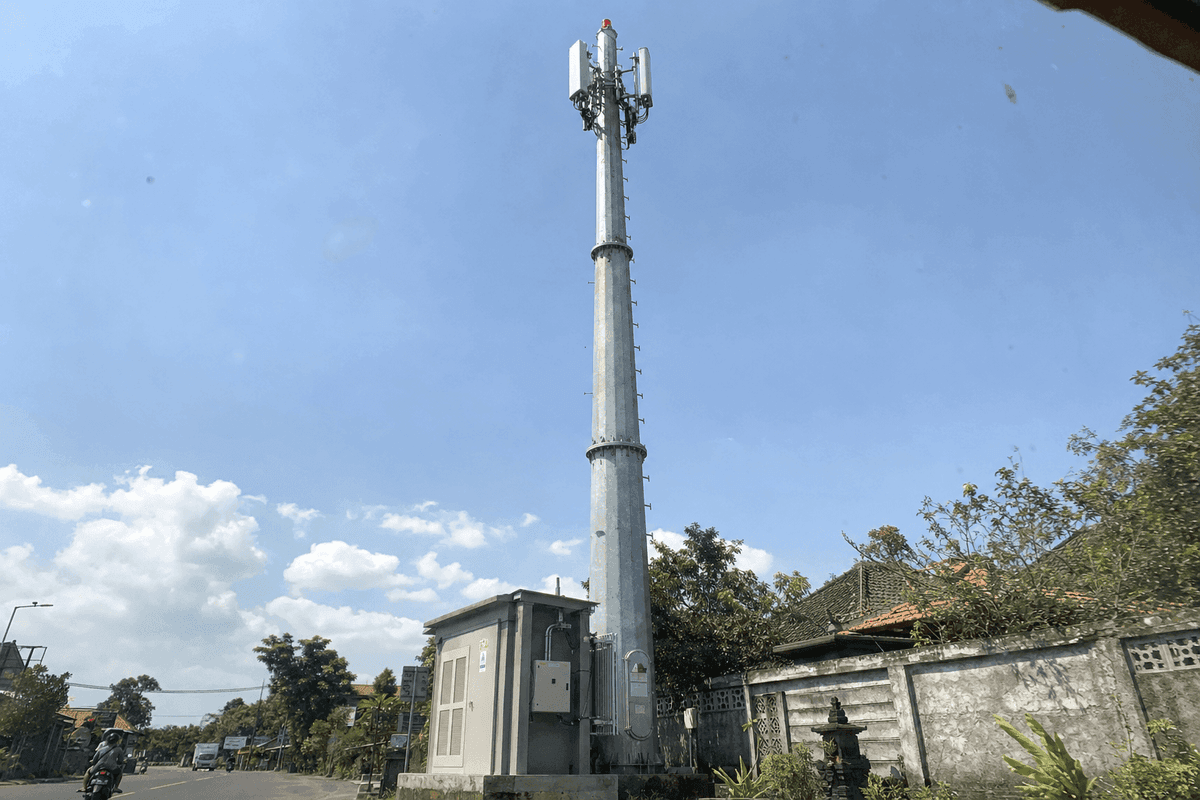
Bali Telecom Tower Market Analysis: 25m Urban Macro Steel Monopole Configuration Guide
Summary
Bali's coastal telecom demand suits approximately 34 units of 25m Q345 steel monopoles, each about 9t, rated 50m/s wind for 30-year urban macro service with 3 panels, 1 microwave dish, RRU and small cell per site.
Key Takeaways
For Bali, a 25m urban macro monopole profile fits a 34-unit network infill plan across dense coastal and tourism corridors.
- Approximately 34 units of 25m tapered steel monopoles would support an island-scale urban macro infill program.
- Each tower is approximately 9t, within the 15-25m urban infill class of 8-15t per tower.
- Wind class 2 uses 50m/s basic wind speed and a 1.15 factor under TIA-222-H methodology.
- Each site would carry 3 panel antennas, 1 microwave dish, RRU equipment and 1 small cell.
- Hot-dip galvanized Q345 steel and medium corrosion detailing support a 30-year design life.
- CKD sectional shipping can reduce transport volume by 60-70% for Bali port and road handling.
- Production planning should allow 30-45 days before shipment, then foundations, erection and commissioning.
Market Context for Bali
Bali's 4.46 million residents, 6.95 million 2025 foreign arrivals and coastal humidity make 25m galvanized monopoles a practical telecom densification asset.
According to BPS (2025), Bali Province had an estimated mid-2024 population of 4,461,260 across about 5,780 km2, creating density above 770 people per km2. Denpasar and the Sarbagita urban area concentrate service demand, while beaches, airport roads and hotel districts add strong visitor mobility peaks. According to Bali tourism statistics reported for 2025, foreign arrivals reached 6,948,754, up 9.72% from 2024.
According to ITU (2025), global internet use reached about 6 billion people, while 5G subscriptions reached roughly 3 billion and covered 55% of the world's population. ITU states, "everyone should have the opportunity to benefit from being online," which is relevant to an island economy where mobile access supports navigation, logistics, hospitality and emergency response. According to World Bank telecom indicators, Indonesia has sustained more than 120 mobile-cellular subscriptions per 100 people in recent data series, indicating multi-SIM and device-dense behavior. For Bali, that pattern points toward capacity densification rather than basic coverage alone.
Bali is also a marine and tropical environment, not a dry inland telecom market. According to World Bank climate profiles for Indonesia, tropical heat, seasonal rainfall and coastal exposure increase corrosion risk for outdoor assets. Coastal sites therefore need hot-dip galvanizing, sealed cable routing and reliable grounding.
Recommended Technical Configuration
A typical 34-unit deployment in Bali would use 25m tapered steel monopoles in the 15-25m urban infill size class.
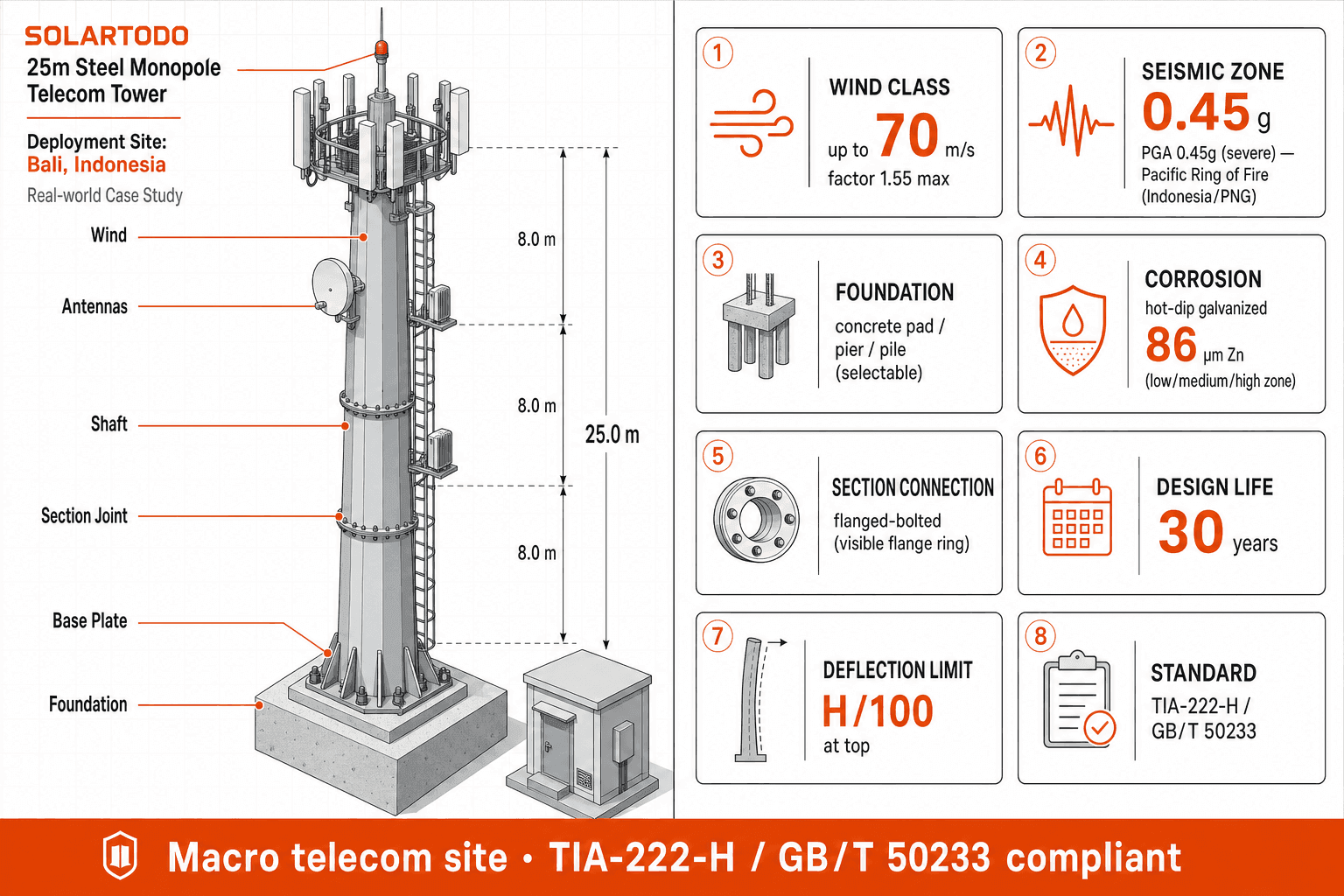
The recommended SOLARTODO configuration is approximately 34 units of 25m tapered round or octagonal steel monopole tower, configured as urban macro sites at the upper edge of the 15-25m class. This size class is defined for rooftop or urban infill applications with 1 platform, 3-6 panel antennas and 8-15t per tower. The project-specific configuration uses approximately 9t per tower, or about 350kg/m, which remains inside the 8-15t class and should be verified during final structural calculation. SOLARTODO should present this as a Telecom Tower configuration, not as a solar-power product.
A typical N-unit deployment of this scale would use hot-dip galvanized Q345 steel sections with flanged bolt-on connections for predictable assembly. The antenna load should be planned as 3 panel antennas, 1 microwave dish, RRU equipment and 1 small cell per tower. The 25m height is enough for many coastal and suburban urban macro sites without the heavier visual impact of 35-45m highway/peri-urban towers. Final siting should check aviation lighting, setback, lease boundary, access road and RF azimuth constraints.
The foundation recommendation is a concrete drilled pier foundation, selected for 25m height, compact urban sites and variable near-coastal soils. Geotechnical work should confirm bearing capacity, groundwater level, chloride exposure and settlement risk before cage fabrication. Accessories should include a climbing ladder, cable tray, aircraft warning light, grounding system, lightning rod, 3 antenna platforms and safety cage. These details support maintenance access and 30-year structural service planning.
Technical Specifications
The Bali telecom tower specification centers on 25m Q345 steel, 50m/s wind class 2, drilled pier foundations and 30-year service life.
- Product form: Steel Telecom Tower, tapered round or octagonal monopole, not lattice, not FRP and not joint-use.
- Quantity basis: approximately 34 units for a typical Bali urban macro infill package.
- Height: 25m, from the SOLARTODO 25/30/35/40/45m height range.
- Size class: 15-25m rooftop/urban infill, with 1 platform and 3-6 panel antennas in the engineering table.
- Project platforms: 3 antenna platforms, subject to final wind and mounting checks.
- Tower weight: approximately 9t per tower, within the 8-15t range for the 15-25m class.
- Material: hot-dip galvanized Q345 steel, with Q420 reviewed only if final loading requires higher strength.
- Wind class: class 2, 50m/s basic wind speed, factor 1.15, checked under TIA-222-H.
- Antenna load: 3 panel antennas, 1 microwave dish, RRU package and 1 small cell per site.
- Foundation: concrete drilled pier foundation with anchor bolt template and geotechnical coordination.
- Connection and shipping: flanged bolt-on sectional design, CKD packed for 60-70% volume reduction.
- Accessories: climbing ladder, cable tray, aircraft warning light, grounding system, lightning rod and safety cage.
- Production cycle: 30-45 days after approved drawings, subject to galvanizing and inspection hold points.
- Standards basis: TIA-222-H for antenna supporting structures and GB/T 50233 for steel construction discipline.
TIA describes TIA-222 as the "Structural Standard for Antenna Supporting Structures and Antennas," so wind, antenna projected area, appurtenance load and serviceability checks should be documented before fabrication. GB/T 50233 adds construction-quality discipline for steel structural work, including handling and erection control. For Bali, the most important engineering check is corrosion protection, foundation stiffness and access safety over 30 years.
Implementation Approach
A Bali rollout of approximately 34 monopoles would normally move through 5 phases: survey, design, CKD production, foundations and commissioning.
The first phase is desktop planning and field survey. Site engineers would confirm candidate locations, lease boundaries, aviation-light requirements, truck access and radio objectives for each 25m tower. RF teams would classify each pole for coverage, hotel-zone capacity or microwave backhaul. The structural package then converts those requirements into tower drawings, antenna schedules, foundation reactions and grounding details.
The second phase is design approval and procurement. SOLARTODO would prepare general arrangement drawings, section drawings, flange details, anchor bolt details, galvanizing specifications and CKD packing lists. Client review should check wind class 2, medium corrosion assumptions, 3 platform requirements and the antenna load case. Once drawings are frozen, production would typically require 30-45 days, including forming, welding, trial assembly, galvanizing and inspection.
The third phase is logistics, foundations and erection. CKD shipping reduces packed volume by 60-70%, which helps containers move through port handling and narrow urban roads. Civil crews would drill pier foundations, place rebar cages and anchor bolt templates, pour concrete and verify curing strength before erection. Tower sections would then be lifted, aligned, bolted, torque-checked and equipped with platforms, ladder, cable tray, grounding and lightning protection.
Commissioning would add panels, microwave dish, RRU and small cell equipment, followed by sweep tests, grounding resistance checks, microwave alignment and acceptance records. This is a recommended implementation model, not a claim that SOLARTODO completed a past Bali deployment.
Expected Performance & ROI
A 25m, 34-unit Bali monopole plan would be evaluated on coverage fill, backhaul resilience, 30-year life and 3-7 year payback scenarios.
Expected performance should be measured against RF and infrastructure KPIs, not only tower count. A 25m urban macro site can improve outdoor coverage continuity across 4G/5G corridors and provide microwave backhaul where fiber routes are congested or delayed. The antenna configuration, 3 panels plus 1 microwave dish, RRU and small cell, gives operators a balanced site for sector coverage, local capacity and backhaul redundancy. In dense tourist areas, the most valuable outcome is often reduced congestion during evening and holiday peaks.
According to GSMA market analysis, mobile networks remain a primary access layer for many emerging-market users. According to ITU (2025), 5G population coverage reached 55% globally, but coverage alone does not guarantee quality where user density spikes. Bali's airport, beaches, ports, hotels and event venues create these spikes in predictable zones. That makes a 25m monopole program suitable for capacity-layer planning rather than rural-only expansion.
ROI should be modeled conditionally because site rental, tenant count, civil cost and backhaul availability vary by location. A typical telecom infrastructure model may evaluate a 3-7 year payback period where each tower supports 1-3 tenants, avoids temporary capacity solutions and extends service life to 30 years. Maintenance planning should include annual bolt inspection, grounding test, coating inspection, platform safety inspection and post-storm visual checks. SOLARTODO can support configuration review through contact us, while final financial return should use local lease terms and operator assumptions.
Comparison Table
The recommended 25m Bali monopole differs from taller suburban and highway classes by weight, visual footprint, foundation demand and antenna loading.
| Option | Height class | Best-fit application | Typical antenna load | Tower weight range | Bali fit |
|---|---|---|---|---|---|
| Recommended steel monopole | 25m | Urban macro / coastal infill | 3 panels + 1 microwave + RRU + small cell | ~9t specified, 8-15t class | Best fit for compact tourism corridors |
| 30m steel monopole | 25-35m | Suburban / residential | 6-9 panels | 15-22t | Useful where trees or low-rise buildings limit clearance |
| 40m steel monopole | 35-45m | Highway / peri-urban | 6-9 panels + 1-2 microwave dishes | 22-30t | Better for bypass roads and lower-density edges |
| 45m steel monopole | 35-45m boundary | Rural or wide-area edge | 6-9 panels + microwave backhaul | 22-30t or higher by final design | Often too visually heavy for urban Bali |
| Lattice tower alternative | 30-60m typical | Rural wide coverage | High multi-tenant capacity | Site-specific | Not recommended where visual footprint is constrained |
Pricing & Quotation
SOLARTODO structures quotations around 3 commercial scopes while keeping final cost dependent on drawings, quantity, freight route and installation scope.
SOLARTODO offers three pricing tiers for this product line: FOB Supply (equipment ex-works China), CIF Delivered (including ocean freight and insurance), and EPC Turnkey (fully installed, commissioned, with 1-year warranty). Volume discounts are available for large-scale deployments. Configure your system online for an instant estimate, or request a custom quotation from our engineering team at [email protected].
For a Bali configuration review, the quotation package should include 25m drawings, 34-unit quantity, wind class 2 assumptions, accessories, CKD packing and foundation boundary. EPC scope should define whether geotechnical investigation, civil works, craneage, RF equipment installation and regulatory submissions are included. This article intentionally avoids numeric prices because final costs depend on site access, soil conditions, freight timing and operator specifications.
Frequently Asked Questions
These 8 FAQs cover 25m specifications, timeline, ROI, maintenance, comparison, EPC pricing, warranty and installation checks.
Q1: What telecom tower type is recommended for Bali? A 25m tapered steel monopole is recommended for this Bali profile. The configuration uses hot-dip galvanized Q345 steel, flanged sectional construction and approximately 9t per tower. It is not a lattice tower, FRP pole or joint-use pole. The design targets urban macro and coastal infill locations where visual footprint, corrosion resistance and installation access matter.
Q2: Why is the 25m height class suitable compared with taller towers? The 25m height sits at the upper end of the 15-25m urban infill class, appropriate for tourism corridors, low-rise coastal districts and compact operator sites. Taller 35-45m towers can serve highways or peri-urban areas, but they bring higher weight, larger foundations and greater visual impact than many Bali locations require.
Q3: How long would production and deployment take? Production should allow 30-45 days after drawing approval, including steel forming, welding, trial assembly, galvanizing and inspection. Site deployment depends on permitting, geotechnical testing, foundation curing and crane access. Civil works and tower erection should be batched so foundations are ready before CKD tower sections reach Bali.
Q4: What ROI or payback period is realistic? A typical telecom infrastructure payback model may use a 3-7 year range, depending on tenant count, rental structure, backhaul cost and avoided congestion losses. The tower has a 30-year design life, so ROI should include long-term tenancy, lower replacement frequency and reduced temporary capacity measures during seasonal tourism peaks.
Q5: What maintenance is required in Bali's coastal climate? Maintenance should include annual bolt torque checks, galvanizing inspection, grounding resistance testing, ladder and platform safety inspection, and visual review after major storms. Coastal humidity and airborne salts make cable entries, anchor bolts and exposed fasteners critical points. Nearshore sites may require stricter coating and sealing details.
Q6: What is included in an EPC turnkey quotation? An EPC turnkey scope normally includes engineering, procurement, delivery, civil foundation works, tower erection, accessory installation, grounding, inspection and commissioning support. The scope should state whether RF equipment, geotechnical surveys, permits, craneage and operator integration are included. SOLARTODO defines EPC Turnkey as fully installed, commissioned and covered by a 1-year warranty.
Q7: What warranty and design life should buyers expect? The specified design life is 30 years for the tower structure when designed, installed and maintained under the stated wind and corrosion assumptions. The pricing scope references a 1-year warranty for EPC Turnkey work. Buyers should separate structural design life from workmanship warranty, coating warranty, accessory warranty and radio equipment warranty.
Q8: What installation checks are most important before commissioning? Key checks include anchor bolt alignment, foundation concrete strength, flange bolt torque, verticality, grounding resistance, lightning protection continuity, aircraft warning light operation and cable tray routing. RF commissioning should verify antenna azimuth, microwave alignment, feeder or jumper condition and RRU installation. These checks create a documented handover package.
References
These 7 references support Bali demographics, tourism demand, climate risk, telecom demand indicators and the structural standards used for 25m monopoles.
- BPS Statistics Indonesia (2025): Provinsi Bali Dalam Angka 2025 reports Bali's mid-2024 population estimate and provincial administrative statistics, https://bali.bps.go.id.
- Bali Provincial Tourism Office / BPS (2026): 2025 foreign tourist arrivals to Bali reached 6,948,754, a 9.72% increase from 2024.
- ITU (2025): Facts and Figures 2025 estimates 6 billion internet users, 3 billion 5G subscriptions and 55% global 5G population coverage, https://www.itu.int.
- World Bank (2024): World Development Indicators record Indonesia mobile-cellular subscriptions above 120 per 100 people in recent data series, https://data.worldbank.org.
- World Bank Climate Change Knowledge Portal (2024): Indonesia climate profile identifies tropical heat, rainfall and coastal climate exposure, https://climateknowledgeportal.worldbank.org.
- Telecommunications Industry Association (2023): ANSI/TIA-222-H Structural Standard for Antenna Supporting Structures, Antennas, and Small Wind Turbine Support Structures.
- GB/T 50233 (2014): Standard for construction and acceptance of steel structures in power and communication infrastructure practice, used here as a construction-quality reference.
Equipment Deployed
- 34 units x 25m tapered steel monopole Telecom Tower
- Hot-dip galvanized Q345 steel, approximately 9t per tower
- Wind class 2 design: 50m/s basic wind speed, 1.15 factor
- Antenna load per tower: 3 panel antennas + 1 microwave dish + RRU + small cell
- Concrete drilled pier foundation with anchor bolt template
- Accessories: climbing ladder, cable tray, aircraft warning light, grounding system, lightning rod, 3 antenna platforms and safety cage
- CKD sectional shipping package with 60-70% volume reduction
- Standards basis: TIA-222-H / GB/T 50233, 30-year design life