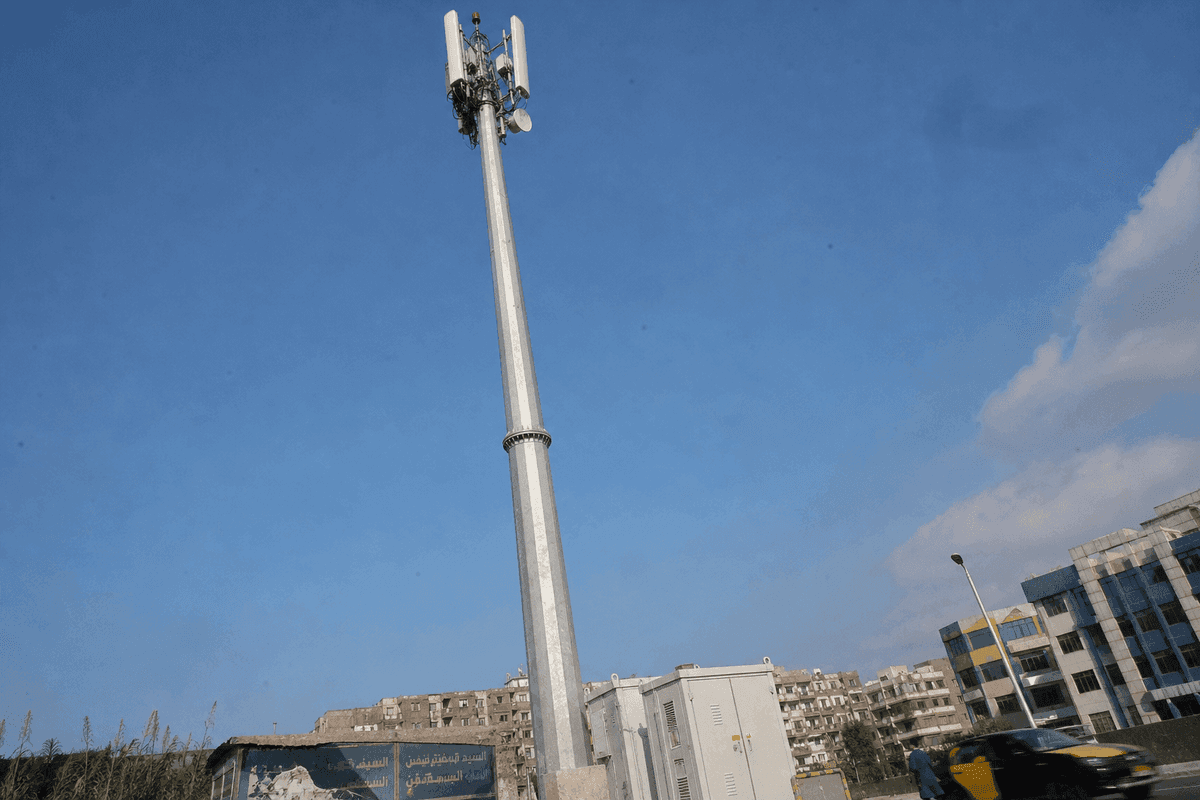
Alexandria Telecom Tower Market Analysis: 73-Unit 20m Urban Macro Configuration Guide
Summary
Alexandria’s 5.6 million residents, 70 km Mediterranean coastline, and Egypt’s 106.2 million mobile subscriptions support a recommended 73-unit, 20m SOLARTODO Telecom Tower plan for urban macro coverage.
Key Takeaways
This Alexandria Telecom Tower guide recommends a 73-unit, 20m urban macro configuration using 7t Q345 steel monopoles and Wind Class 1 design.
- A typical deployment of this scale would use approximately 73 units of 20m tapered steel monopole towers for urban macro coverage.
- Each SOLARTODO tower would weigh approximately 7t, equal to about 350 kg/m for this 20m compact urban class.
- The recommended antenna load is 3 panel antennas, 1 microwave dish, 1 RRU set, and 1 small-cell package per tower.
- Wind Class 1 design uses a 40 m/s basic wind speed and factor 1.0 under TIA-222-H structural logic.
- Concrete drilled pier foundations are recommended for constrained streets, coastal soils, and repeatable 20m tower erection.
- CKD shipping can reduce logistics volume by approximately 60-70%, supporting port-based delivery through Alexandria.
- Production lead time is typically 30-45 days, with phased civil works and commissioning scheduled after foundation curing.
- The SOLARTODO configuration uses Q345 hot-dip galvanized steel, medium corrosion protection, and a 30-year design life.
Market Context for Alexandria
Alexandria’s coastal telecom market combines 5.6 million residents, port logistics, industrial districts, and 5G densification pressure along Egypt’s Mediterranean corridor.
Alexandria is Egypt’s second-largest urban governorate and a strategic port city on the Mediterranean. CAPMAS-reported public summaries list Alexandria Governorate at approximately 5,599,387 residents in January 2024, while the governorate extends roughly 70 km along the coast. That linear geography creates a different radio-planning problem than inland cities: coverage must follow dense residential strips, port areas, industrial districts, highways, and coastal tourism zones.
According to MCIT-reported public telecom statistics summarized in 2024, Egypt reached about 106.2 million mobile subscriptions by December 2023, and mobile internet subscriptions grew 77.9% from 39 million in 2019 to 69.4 million in 2022. According to DataReportal (2024), Egypt had about 82.0 million internet users and 72.2% internet penetration in early 2024. For Alexandria, those figures imply sustained demand for macro sites that can carry 4G densification today and 5G overlay planning as spectrum and handset adoption expand.
According to Egypt’s ICT regulatory announcements in 2024, Telecom Egypt, Vodafone Egypt, Orange Egypt, and e& Egypt moved into 5G licensing phases, creating a stronger need for structurally predictable monopoles in dense urban districts. ITU states, “IMT-2020 systems are mobile systems that include the new capabilities of IMT that go beyond those of IMT-Advanced.” That matters because 5G planning is not only a radio upgrade; it changes tower loading, fiber/backhaul requirements, and site acquisition economics.
Alexandria’s coastal exposure also affects the tower specification. The Mediterranean environment introduces humidity, salt-laden air, and periodic winter storms, so hot-dip galvanizing and grounding are not optional details. ISO states, “ISO 1461 specifies the general properties of coatings and test methods for coatings applied by dipping fabricated iron and steel articles in molten zinc.” For SOLARTODO, this supports a medium corrosion-zone specification using hot-dip galvanized Q345 steel and a 30-year design-life target.
Recommended Technical Configuration
A typical 73-unit Alexandria deployment would use 20m tapered steel monopoles with drilled pier foundations, 3 antenna platforms, and coastal corrosion protection.
The recommended product is the SOLARTODO Telecom Tower: a tapered steel monopole tower, not a lattice tower, FRP pole, or joint-use utility pole. For Alexandria’s dense coastal districts, a 20m urban macro site is appropriate where rooftop permissions, street setbacks, and visual profile constrain taller suburban towers. This places the tower in the 15-25m size class, generally used for rooftop or urban infill applications with 1 platform and 3-6 panel antennas; however, this project-specific configuration requires 3 antenna platforms to separate panel, microwave, RRU, and small-cell equipment.
A typical deployment in this profile would consist of approximately 73 units of 20m tapered round or octagonal steel monopole towers. Each unit would use Q345 hot-dip galvanized steel, flanged bolt-on sections, concrete drilled pier foundations, and CKD export packing. The recommended equipment set per tower includes 3 panel antennas, 1 microwave dish, RRU equipment, and a small-cell package, giving operators a practical balance between macro coverage and local capacity infill.
The 20m height is lower than SOLARTODO’s standard 25/30/35/40/45m auto-rotated range, so it should be treated as a compact urban macro adaptation rather than a rural coverage tower. The engineering weight is approximately 7t per tower, or 350 kg/m, which is suitable for this specified 20m urban class. For higher towers in the standard table, SOLARTODO’s telecom monopoles follow the conservative rule of approximately 500 kg/m by height.
Technical Specifications
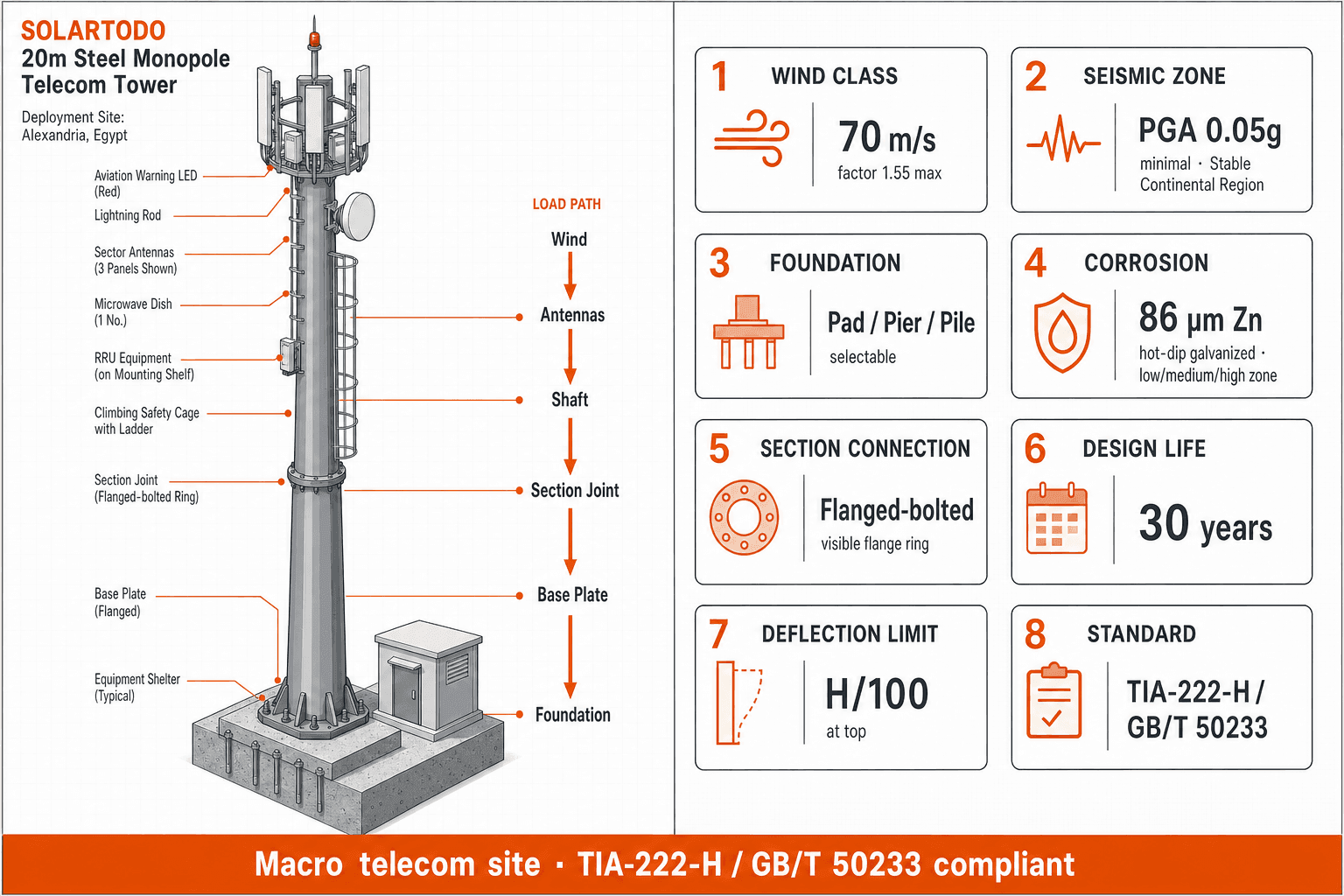
The Alexandria technical fit is a 20m, 7t Q345 galvanized steel Telecom Tower designed for 40 m/s wind and 30 years of service.
- Product: SOLARTODO Telecom Tower, tapered steel monopole form only.
- Quantity basis: approximately 73 units for a typical Alexandria urban macro program.
- Height: 20m compact urban macro configuration.
- Pole class: urban macro site.
- Structure: tapered round or octagonal steel tube with flanged bolt-on sectional design.
- Material: hot-dip galvanized Q345 steel.
- Weight: approximately 7t per tower, equal to about 350 kg/m for this project-specific 20m class.
- Wind class: Class 1, 40 m/s, factor 1.0, evaluated under TIA-222-H principles.
- Corrosion zone: medium, suitable for humid Mediterranean coastal exposure with galvanized steel maintenance.
- Antenna load: 3 panel antennas, 1 microwave dish, RRU equipment, and small-cell equipment.
- Foundation: concrete pier or drilled pier foundation for urban constructability and repeatable installation.
- Accessories: climbing ladder, cable tray, aircraft warning light, grounding system, lightning rod, 3 antenna platforms, and safety cage.
- Shipping: CKD packing with approximately 60-70% volume reduction compared with fully assembled structures.
- Production time: typically 30-45 days after approved drawings and bill of materials.
- Design life: 30 years with inspection and corrosion maintenance.
- Standards: TIA-222-H and GB/T 50233.
According to TIA-222-H industry practice, antenna-supporting structures should be assessed for wind, ice where applicable, seismic loading, appurtenance loading, and serviceability. For Alexandria, wind and corrosion control are more relevant than ice, while foundation verification should consider soil data at each site. GB/T 50233 provides construction and acceptance discipline for tower and line-style steel structures, supporting fabrication, assembly, and inspection consistency.
Implementation Approach
A 73-unit Alexandria rollout would normally move through 5 phases: survey, engineering approval, 30-45 day production, CKD delivery, and commissioning.
The first phase is site validation. Radio planners would map target coverage gaps near residential corridors, port approaches, industrial districts such as Amreya and Borg El Arab connections, and high-traffic coastal roads. Civil engineers would then confirm soil conditions, utility conflicts, access routes, and setback constraints before approving drilled pier dimensions.
The second phase is structural and production engineering. SOLARTODO would prepare tower drawings, bolt schedules, platform layout, cable routing, grounding details, aviation-light placement, and corrosion-protection specifications. Because the towers are sectional steel monopoles, the fabrication package can be standardized across most sites while allowing foundation depth to vary by geotechnical report.
The third phase is manufacturing and logistics. A typical production window is 30-45 days after drawing approval, with Q345 steel sections hot-dip galvanized before packing. CKD shipping reduces volume by approximately 60-70%, a useful advantage for Alexandria because imported tower sections can move efficiently through port logistics and then be distributed to multiple civil-work fronts.
The fourth phase is civil works and erection. Drilled pier foundations would be installed first, followed by reinforcement cage placement, concrete pouring, curing, and anchor-bolt verification. Tower sections would then be lifted, flanged, torqued, grounded, and fitted with platforms, safety cage, ladder, cable tray, lightning rod, and aircraft warning light.
The final phase is telecom integration. Operator teams would mount 3 panel antennas, 1 microwave dish, RRU equipment, and small-cell hardware, then test RF alignment, feeder or fiber routing, grounding resistance, warning-light operation, and handover performance. Documentation should include as-built drawings, torque records, galvanizing certificates, and commissioning checklists for contact us review or operator acceptance.
Expected Performance & ROI
A 20m urban macro tower can support 4G/5G densification while CKD logistics, 30-year life, and 73-site standardization improve lifecycle economics.
According to ITU-R IMT-2020 requirements, 5G radio technology targets up to 20 Gbit/s peak downlink, 10 Gbit/s peak uplink, 1 ms ultra-reliable low-latency communication capability, and 1 million devices per km2 for massive machine-type communication. Those are system targets, not guaranteed site throughput, but they explain why denser urban tower grids and microwave or fiber backhaul are important for Alexandria.
For operators, ROI is usually driven by tenancy, coverage relief, avoided churn, and faster permitting rather than the steel pole alone. A 20m monopole can be faster to approve than a taller 35-45m structure in constrained urban neighborhoods, especially where visual impact matters. A 73-unit standardized tower package also reduces drawing variation, spare-part complexity, training time, and maintenance ambiguity.
Expected operating benefits include repeatable civil works, predictable tower climbing access, and simpler antenna upgrade paths. The included 3 platforms allow a site owner or EPC to organize radio equipment without overloading a single elevation. Microwave support also helps where fiber is delayed, although dense 5G traffic should ultimately favor fiber backhaul where available.
Maintenance economics should be assessed across the full 30-year design life. Recommended inspection intervals include post-installation acceptance, annual visual review, and detailed structural checks after severe coastal storms or major antenna modifications. Galvanized Q345 steel, a grounding system, and lightning rod reduce avoidable outage risk, while corrosion monitoring is particularly important in Alexandria’s humid marine air.
Comparison Table
The 20m Alexandria configuration prioritizes urban permitting and compact macro coverage, while 35-45m monopoles are better for highways and peri-urban reach.
| Metric | Alexandria Recommended Configuration | 25-35m Suburban Class | 35-45m Highway/Peri-Urban Class |
|---|---|---|---|
| Tower form | Steel monopole | Steel monopole | Steel monopole |
| Typical height | 20m | 25-35m | 35-45m |
| Typical quantity basis | 73 units | Site-specific | Site-specific |
| Weight basis | ~7t per tower | 15-22t per tower | 22-30t per tower |
| Application | Urban macro / infill | Residential / suburban | Highway / peri-urban |
| Antenna loading | 3 panels + microwave + RRU + small cell | 6-9 panels | 6-9 panels + 1-2 microwave |
| Foundation | Concrete drilled pier | Pad or pier | Pier or pile |
| Wind class | Class 1, 40 m/s | Class 1-3 by site | Class 2-4 by exposure |
| Shipping | CKD, 60-70% volume reduction | CKD | CKD |
| Best fit in Alexandria | Dense coastal districts | Outer residential expansion | Desert road and port corridors |
This comparison shows why the 20m tower is not a universal replacement for taller telecom structures. It is best used where urban coverage density matters more than long-radius rural propagation. For wider areas west of the city or along highway corridors, the 35-45m SOLARTODO class may be more appropriate.
Pricing & Quotation
Alexandria Telecom Tower quotations should separate FOB supply, CIF delivery, and EPC turnkey scope because civil works and foundations vary by site.
SOLARTODO offers three pricing tiers for this product line: FOB Supply (equipment ex-works China), CIF Delivered (including ocean freight and insurance), and EPC Turnkey (fully installed, commissioned, with 1-year warranty). Volume discounts are available for large-scale deployments. Configure your system online for an instant estimate, or request a custom quotation from our engineering team at [email protected].
Price should not be evaluated only by steel tonnage. Buyers should compare foundation assumptions, galvanizing thickness, platform count, ladder and safety cage inclusion, grounding scope, aviation-light specification, packaging method, and inspection documentation. A 73-unit package can produce procurement efficiency, but site-specific civil costs still depend on soil, access, permitting, and local installation labor.
Frequently Asked Questions
These 10 FAQs address Alexandria’s 20m Telecom Tower specification, 73-unit planning basis, installation sequence, maintenance, pricing model, and warranty expectations.
Q1: What Telecom Tower configuration is recommended for Alexandria, Egypt?
A typical Alexandria urban macro configuration would use approximately 73 units of 20m tapered steel monopole towers. Each tower would use hot-dip galvanized Q345 steel, weigh about 7t, and support 3 panel antennas, 1 microwave dish, RRU equipment, and small-cell hardware. The recommended foundation is a concrete drilled pier suited to constrained urban sites.
Q2: Why is a 20m monopole suitable instead of a 35m or 45m tower?
A 20m monopole fits dense urban macro and infill sites where permitting, visual profile, and property constraints matter. Taller 35-45m towers are better for highways, peri-urban corridors, and rural coverage. Alexandria’s coastal urban strip needs many compact sites, so 20m towers can support densification without the larger footprint of taller structures.
Q3: What standards should govern the tower design?
The recommended design basis is TIA-222-H for antenna-supporting structural analysis and GB/T 50233 for steel tower construction and acceptance discipline. Site engineers should verify wind, antenna loading, foundation reactions, grounding, corrosion exposure, and installation tolerances. Local permitting requirements should be checked before final drawing approval and procurement release.
Q4: How long would production and deployment take?
Production is typically 30-45 days after approved drawings, bill of materials, and technical submittals. Field deployment depends on permitting, soil testing, foundation curing, crane access, and telecom integration. A phased 73-site program would normally sequence civil works first, then tower erection, accessory installation, antenna mounting, and final commissioning.
Q5: What maintenance is required for Alexandria’s coastal environment?
Maintenance should include annual visual inspections, grounding checks, bolt torque review, ladder and safety cage inspection, aviation-light testing, and corrosion monitoring. Alexandria’s Mediterranean humidity and salt exposure make hot-dip galvanizing important, but coatings still need periodic review. Additional inspections are recommended after severe storms or whenever antenna loading changes materially.
Q6: What ROI factors matter most for Telecom Tower buyers?
ROI depends on tenancy potential, coverage improvement, avoided service degradation, installation speed, and lifecycle maintenance cost. For a 73-unit standardized package, savings can come from repeatable designs, CKD logistics, common spare parts, and simpler crew training. Payback should be modeled against lease revenue, subscriber capacity gains, and avoided churn.
Q7: How does the SOLARTODO monopole compare with a lattice tower?
A steel monopole has a smaller footprint, cleaner visual profile, and simpler urban siting than a lattice tower. Lattice towers can be efficient for tall rural sites or heavy loading, but they require more ground area. The SOLARTODO Telecom Tower is specifically a tapered steel monopole, not a lattice, FRP, or joint-use structure.
Q8: What is included in EPC pricing scope?
EPC turnkey scope typically includes tower supply, delivery, foundation works, erection, grounding, accessory installation, commissioning, and a 1-year warranty. Buyers should confirm whether soil investigation, permits, crane rental, traffic control, antenna installation, and backhaul integration are included. SOLARTODO also supports FOB supply and CIF delivered quotation tiers.
Q9: What warranty and design life should buyers expect?
The specified design life is 30 years when the tower is installed, loaded, inspected, and maintained according to approved engineering limits. EPC turnkey pricing includes a 1-year warranty under SOLARTODO’s stated tier structure. Warranty review should separate steel fabrication, galvanizing, accessories, foundation workmanship, and third-party telecom equipment.
Q10: How is CKD shipping useful for Alexandria projects?
CKD shipping reduces tower logistics volume by approximately 60-70%, which can lower container space requirements and simplify port-based handling. For Alexandria, that is relevant because the city has major port infrastructure and multiple potential installation zones. Sectional flanged components can be transported to urban sites more easily than fully assembled structures.
References
These 7 references support Alexandria demographics, Egypt telecom demand, 5G performance targets, tower design standards, corrosion protection, and development context.
- CAPMAS (2024): Alexandria Governorate public population estimates report approximately 5.6 million residents in January 2024.
- MCIT Egypt (2024): ICT indicators report Egypt reached approximately 106.2 million mobile subscriptions by December 2023.
- DataReportal (2024): Digital Egypt country profile reports about 82.0 million internet users and 72.2% internet penetration in early 2024.
- ITU-R (2017): IMT-2020 minimum requirements define 20 Gbit/s peak downlink, 10 Gbit/s peak uplink, and 1 million devices per km2 targets.
- TIA (2018): ANSI/TIA-222-H provides structural standard practice for antenna-supporting structures and antennas.
- ISO (2009): ISO 1461 specifies hot-dip galvanized coatings on fabricated iron and steel articles.
- Government of Egypt (2016/updated): Egypt Vision 2030 sets national digital transformation and infrastructure modernization priorities.
Equipment Deployed
- 73 units × 20m tapered steel monopole Telecom Tower
- Q345 hot-dip galvanized steel, medium corrosion zone
- Approximately 7t per tower, 350 kg/m project-specific urban macro class
- Wind Class 1, 40 m/s, factor 1.0 per TIA-222-H design logic
- Antenna load: 3 panel antennas + 1 microwave dish + RRU + small cell
- Concrete drilled pier foundation
- Accessories: climbing ladder, cable tray, aircraft warning light, grounding system, lightning rod
- 3 antenna platforms + safety cage
- CKD shipping with 60-70% volume reduction
- 30-45 day production window and 30-year design life