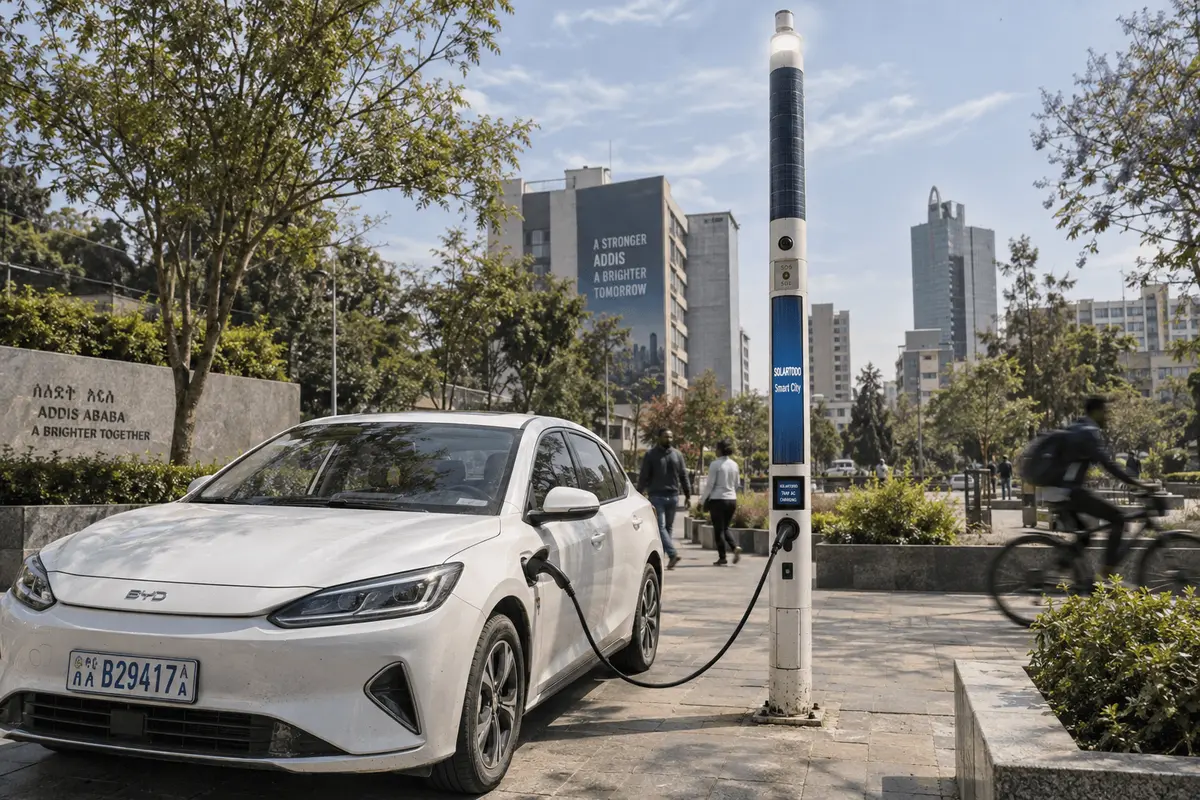
Addis Ababa Night-Safety Retrofit Decision: Smart Streetlight Configuration for 22m Urban Corridors
Summary
Addis Ababa’s 2,300m highland setting, 95.1% urban electricity access, and World Bank-reported 52% street-lighting gaps make a 178-unit, 6m flush Smart Streetlight corridor a technically defensible retrofit profile.
Key Takeaways
A 178-unit Addis Ababa Smart Streetlight package at 22m spacing would cover about 3.9km of dense urban corridor with flush lighting, EV, WiFi, camera, and sensor functions.
- Approximately 178 units at 22m spacing would fit about 3,916m of corridor, with each 6m pole using a constant Ø315mm seamless cylindrical body.
- Each pole would use a 100W COB luminaire delivering 15,000lm at 4000K, aligning with the 150lm/W performance tier used for modern outdoor luminaires.
- The Addis Ababa profile favors flush modules because the World Bank reported 52% of assessed street sections lacked street lighting and 50% had poor sidewalk pavement.
- Ethiopia’s LV distribution reference of 230/400V and 50Hz supports grid charging interfaces, while 15kV and 33kV feeders shape municipal utility coordination.
- The CIGS wrap provides about 173W per pole, while the LFP battery stores 3,000Wh for sensing, communications, display, and emergency loads.
- Addis Ababa’s roughly 2,300m altitude and June-September heavy-rain season require sealed housings, anti-vandal glass, drainage-safe foundations, and corrosion-controlled galvanizing.
- Integrated connectivity is relevant because ITU reported Africa still had a 14% mobile broadband coverage gap in 2024, while Ethio telecom has launched 5G in Addis Ababa.
Market Context for Addis Ababa
Addis Ababa’s smart-pole demand is driven by high-altitude urban growth, night-safety gaps, 230/400V low-voltage supply, and 15kV-to-33kV distribution upgrades. Addis Ababa is an inland highland capital at roughly 2,300m elevation, so equipment faces cool nights, strong UV exposure, seasonal rain, and less salt-air corrosion than coastal cities. The city’s climate is defined less by extreme heat and more by altitude, rainfall concentration, drainage, and dust during dry months. For a Smart Streetlight, this pushes the design toward sealed flush modules, protected glass, galvanized steel, and a stable cylindrical enclosure rather than exposed arms and accessory boxes.
According to the World Bank (2024), Ethiopia’s total electricity access was 56.6%, while urban electricity access reached 95.1%, creating a city profile where grid-backed smart lighting is practical but reliability engineering remains important. World Bank states, “Ethiopia has the third largest energy access deficit in Sub-Saharan Africa,” which is why backup storage should not be treated as decorative. In Addis Ababa, the battery and MPPT are not a full off-grid streetlight system; they are resilience components for sensors, communications, SOS, and low-power auxiliary operation.
Street infrastructure is a stronger driver than pure energy generation. According to the World Bank (2020), a sidewalk safety assessment in Addis Ababa found 52% of assessed street sections lacked street lighting, 79% lacked adequate crossings, and 50% of sidewalk pavement was poor to very poor. That public-context statistic makes night visibility, pedestrian monitoring, emergency calling, and digital wayfinding more relevant than highway-scale lux output. It also supports a 6m urban pole class rather than a 12m-plus traffic or highway pole.
Grid interface planning should follow Ethiopian utility practice rather than a generic global template. According to Ethiopia’s National Distribution Code (2017 draft, published by the Ethiopian Energy Authority), LV nominal voltage is 230V phase-to-neutral and 400V phase-to-phase, with MV levels including 15kV and 33kV. Ethiopian Electric Power also describes Addis Ababa distribution rehabilitation that converts overloaded 15kV areas toward 33kV supply. For SOLARTODO, this means the 7kW EV charger should be specified around local LV service protection, metering, earthing, and utility approval.
Telecom and municipal digital services add another requirement. According to ITU (2024), Africa’s largest mobile broadband issue is coverage gap, with 14% of the population still outside mobile broadband coverage. Ethio telecom has announced 5G service in Addis Ababa and other Ethiopian cities, so smart poles should be 5G-ready but not dependent on 5G alone. Dual-mode WiFi 6 plus 5G internal antennas gives the city a migration path from corridor WiFi and monitoring to future small-cell coordination.
Recommended Technical Configuration
A typical 178-unit deployment in Addis Ababa should use SOLARTODO’s Ø315mm seamless cylindrical Smart Streetlight because dense corridors reward flush, vandal-resistant integration. The recommended product fit is the SOLARTODO Smart Streetlight [cyl_219] premium cylindrical configuration, adapted here as a 6m Ø315mm constant-diameter pole. This size is appropriate for urban streets, sidewalks, mixed-use corridors, transit approaches, and civic streets where pedestrian safety and compact equipment matter more than highway-height throw distance. It is not recommended for highways, which require 12m-plus traffic poles, or for parks, which normally use 6-8m garden lighting without EV charging and public communications.
A typical deployment of this scale would consist of approximately 178 units at 22m spacing. At that spacing, the corridor coverage is about 3.9km before allowances for intersections, driveways, utility conflicts, drainage channels, and preserved streetscape zones. The 22m spacing is tighter than the generic 25-50m range because Addis Ababa’s pedestrian-safety context, older dense streets, and visibility gaps justify a more continuous lighting and monitoring grid. Final photometric spacing should be verified with Dialux or equivalent lux modeling against the target road and sidewalk class.
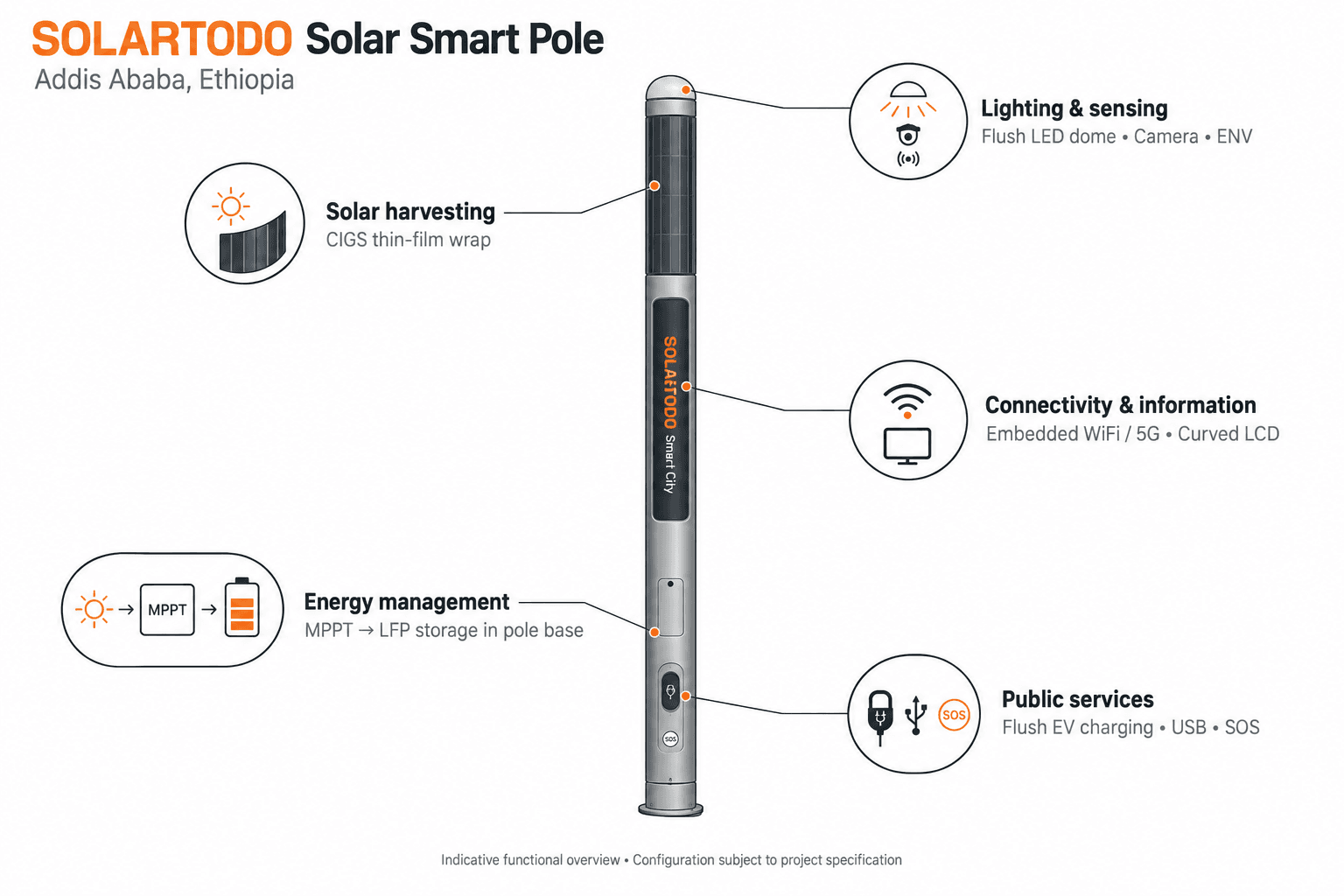
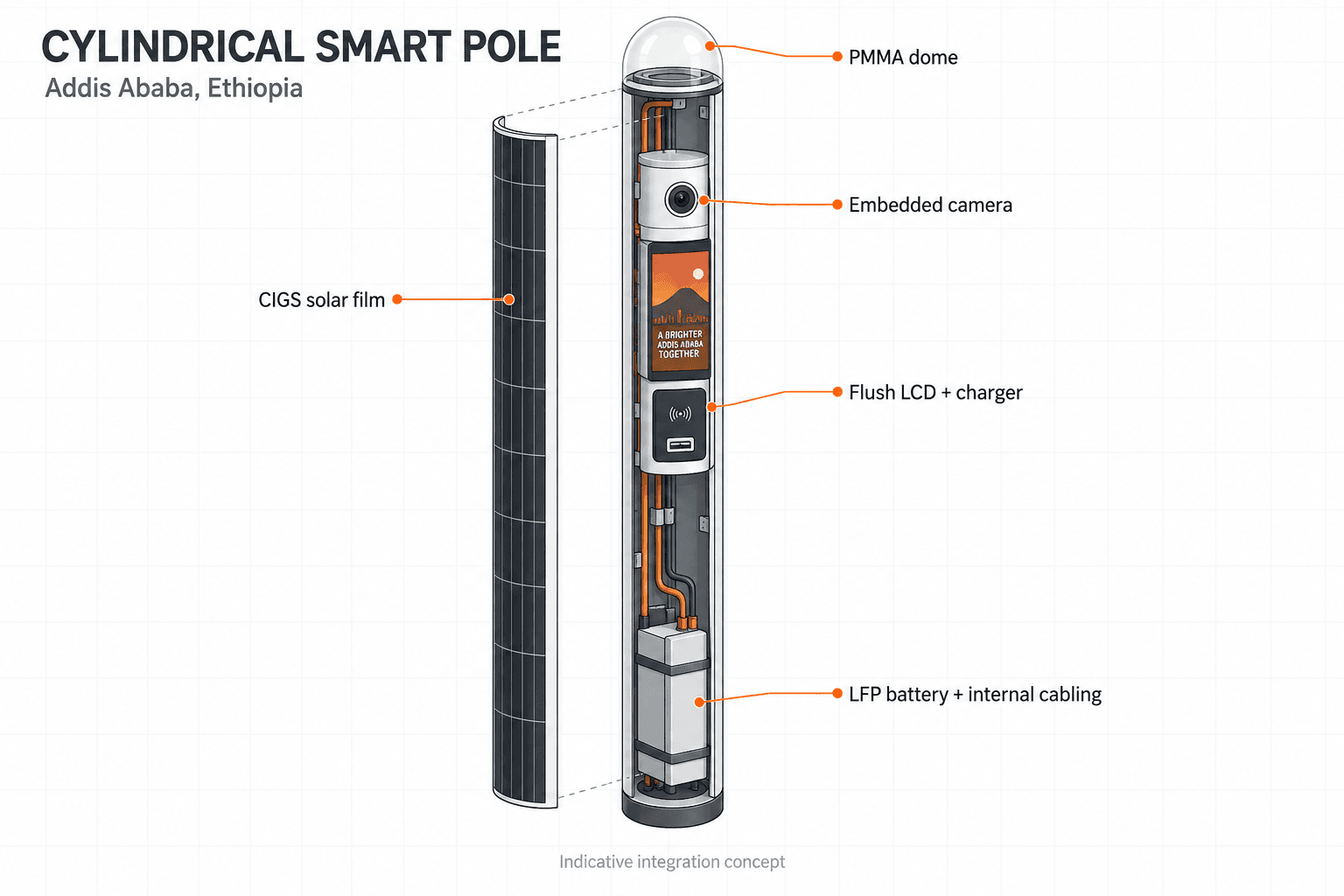
The correct configuration is the flush cylindrical form, not a side-arm smart pole. The Addis Ababa specification should use 178 units of 6m seamless cylindrical Ø315mm poles with 5mm wall thickness, hot-dip galvanizing, matte white RAL9003 finish, integrated top lighting, CIGS wrap, camera window, WiFi 6 plus 5G antennas, SOS button, intercom grille, vertical LCD, USB-A, Qi charging, and embedded 7kW dual-outlet EV charging. SOLARTODO should present this as a recommended configuration, not as a completed project claim.
The design choice is especially important for municipal acceptance. External speaker columns, camera domes, tilted rigid panels, separate EV bollards, and side boxes create collision, vandalism, dust, water-ingress, and streetscape-permit issues. A monolithic Ø315mm cylinder keeps the visual envelope stable from top to bottom. That makes the product easier to place beside sidewalks, bus stops, intersections, and commercial frontages where Addis Ababa’s right-of-way is already contested.
Technical Specifications
The Addis Ababa specification is a 6m, Ø315mm, 5mm-wall Smart Streetlight with 100W lighting, 173W CIGS wrap, 3,000Wh LFP storage, and flush EV charging. IEC states, “IEC 60598-1:2014 specifies general requirements for luminaires,” including mechanical construction, electrical construction, marking, and photobiological safety. The SOLARTODO configuration should therefore be documented under IEC 60598 for luminaire safety and GB/T 37024 for smart multi-function pole service and operation logic.
- Product: SOLARTODO Smart Streetlight, seamless cylindrical premium form for urban street class.
- Quantity: approximately 178 units, presented as a typical N-unit deployment profile, not a past installation.
- Pole: 6m seamless cylindrical Ø315mm pole, constant diameter top-to-bottom, 5mm wall, hot-dip galvanized steel.
- Finish: matte white RAL9003 for high visibility, civic streetscape compatibility, and heat-reflective surface behavior.
- Integration rule: one monolithic cylinder; no side arms, no luminaire outriggers, no public-address speaker columns, no external boxes, and no widened EV base.
- Luminaire: Ø315mm internal COB flood behind PMMA top window segment, 100W, 15,000lm, 4000K.
- Solar skin: 360° CIGS flexible thin-film wrap from 6.5m to 5.3m, about 173W total, dark blue-black semi-transparent film laminated flush to the pole skin.
- Battery: internal LFP 3,000Wh battery with MPPT inside the pole base.
- Camera: flush turret camera behind Ø10cm dark anti-vandal glass, 4MP IR with 30m night range, no protruding dome.
- Sensor: 4-parameter ENV sensor for temperature, humidity, wind speed, and noise, flush-integrated on the dome top.
- Connectivity: embedded dual-mode WiFi 6 plus 5G with internal antennas.
- Emergency: flush SOS button plus two-way audio intercom through pinhole speaker grille only.
- EV charging: embedded 7kW dual-outlet charger with Type 2 plus Type 1 flush flip-caps, 5m coiled Type 2 cable, and flush touchscreen at 1.5m.
- Display: 2,000mm x approximately 170mm curved LCD, bent to Ø315mm radius, front-face portrait orientation, flush inset.
- Display content: strictly “SOLARTODO Smart City” text stacked vertically, SOLARTODO uppercase top and Smart City title case bottom, white sans-serif on deep blue.
- Extras: flush USB-A plus Qi wireless charging pad.
- Spacing: 22m nominal spacing, subject to photometric simulation, driveway breaks, utility clearances, and foundation conflicts.
- Standards: IEC 60598 and GB/T 37024.
Implementation Approach
A 178-unit Addis Ababa rollout should proceed in 5 phases: survey, utility approval, CKD logistics, civil installation, and commissioning. The first phase is a corridor survey that confirms sidewalk width, existing utility ducts, drainage inlets, turning radii, building setbacks, telecom signal quality, and night-safety priority points. Because Addis Ababa includes dense commercial streets and older road sections, the survey should also mark locations where a flush pole avoids conflict with pedestrians, shopfronts, and transit queues. The photometric plan should validate the 22m spacing before procurement locks in foundations.
The second phase is power and communications approval. The 7kW EV charger requires coordination with the relevant Ethiopian utility authority, local low-voltage service rules, protection devices, earthing, and metering. The 230/400V, 50Hz supply profile is compatible with the charger concept, but each site still needs feeder-capacity checks. Where 15kV-to-33kV distribution rehabilitation affects a corridor, procurement should coordinate with utility upgrade windows instead of trenching twice.
The third phase is manufacturing and logistics. A CKD or semi-knocked-down shipping plan can reduce packaging volume while protecting the CIGS skin, curved LCD, PMMA window, anti-vandal glass, and touchscreen. Addis Ababa is inland, so the logistics constraint is not salt air; it is inland transport, customs clearance, highland road handling, and avoiding impact damage to flush surfaces. Packaging should include vertical supports for the 6m cylinders and marked no-clamp zones around LCD, camera, solar film, and charger interfaces.
The fourth phase is civil installation. Foundations should handle 6m pole overturning loads, cable entry, drainage protection, and maintenance access without widening the visible base. In rainy-season areas, the foundation top should shed water away from the flush charger and touchscreen zone. For sidewalks, crews should maintain accessible walking clearances and use temporary safety lighting during cutover.
The fifth phase is commissioning. Each pole should be tested for luminaire output, WiFi 6 signal, 5G readiness, camera view, SOS audio, EV charging interlock, LCD content lock, MPPT input, battery state-of-health, grounding continuity, and cloud-controller registration. The acceptance checklist should record pole ID, GPS coordinate, serial numbers, firmware version, insulation test, charger function, camera privacy mask if required, and night lux readings. SOLARTODO can support this with a corridor-level commissioning file linked to the Smart Streetlight product page.
Expected Performance & ROI
The 178-unit system would deliver about 2.67 million lumens of 4000K lighting while adding corridor data, emergency calling, EV top-up, and WiFi services. The direct lighting load is 17.8kW if all 178 luminaires operate at 100W. At 12 hours per night, the lighting-only energy use is about 213.6kWh per night before dimming schedules, sensor loads, EV charging, and network equipment. Adaptive dimming can reduce annual lighting energy, but the actual saving depends on curfew rules, traffic patterns, and municipal lighting standards.
According to IEA 4E SSL (2020), roadway and outdoor luminaires have a Tier 2 efficacy reference of 150lm/W and Tier 3 at 170lm/W. This Addis Ababa configuration uses 15,000lm at 100W, or 150lm/W, so it fits a high-performance outdoor LED specification without overstating savings. Compared with older discharge lighting or poorly controlled fixtures, the ROI comes from reduced energy use, fewer maintenance visits, integrated communications, EV service enablement, safety visibility, and avoided separate poles for cameras, displays, WiFi, and chargers.
According to the World Bank and ESMAP Global Solar Atlas (2023), Ethiopia’s solar resource dataset includes long-term GHI and PVOUT layers for planning. National-level Ethiopia factsheets report average theoretical GHI around 5.850kWh/m²/day, but Addis Ababa’s highland cloud and rainy season mean the 173W CIGS wrap should be treated as auxiliary generation, not the primary source for EV charging. This is why SOLARTODO’s recommended configuration keeps grid service and a 3,000Wh LFP battery instead of pretending the cylindrical solar skin can support daily 7kW EV charging loads alone.
Lifecycle value should be evaluated per corridor, not per lamp head only. A single pole combines lighting, camera, environmental sensing, WiFi, SOS, display, USB/Qi charging, EV access, and smart control. If those were procured as separate assets, the city would need more foundations, more permits, more cables, more maintenance points, and more streetscape clutter. For Addis Ababa, the strongest ROI argument is integrated public-realm infrastructure under constrained sidewalks, not an isolated solar payback claim.
Results and Impact
A 178-unit recommendation would create a 3.9km smart corridor model with 17.8kW lighting load and 534kWh of distributed battery storage. The expected impact should be stated as a projection: improved night visibility, better emergency access, EV top-up availability, corridor connectivity, and reduced accessory clutter. It should not be written as “SOLARTODO deployed” or “the project delivered,” because no completed Addis Ababa deployment evidence was provided. The technically defensible claim is that this configuration fits Addis Ababa’s dense, highland, grid-backed, pedestrian-safety-focused infrastructure profile.
The public benefit case is strongest where street lighting, sidewalks, crossings, and transport access overlap. According to the World Bank (2020), Addis Ababa sidewalk conditions show gaps in crossings, pavement, lighting, and facade connectivity; smart poles cannot solve every sidewalk issue, but they can consolidate safety-relevant equipment. A flush camera, SOS button, and 100W top luminaire are especially relevant near transit stops, commercial streets, civic buildings, and walk-heavy corridors. The LCD should remain limited to the required “SOLARTODO Smart City” text in this specification and should not be positioned as an advertising screen.
Comparison Table
The Addis Ababa fit favors the Ø315mm cylindrical Smart Streetlight over 12m hybrid or grid poles because a 6m flush form suits sidewalks and dense corridors. The table compares SOLARTODO form variants against the Addis Ababa requirement and explains why the selected configuration is the most consistent option.
| Option | Typical height | Integration style | Addis Ababa fit | Key constraint |
|---|---|---|---|---|
| Ø315mm cylindrical Smart Streetlight | 6m | Constant-diameter cylinder, flush modules, CIGS wrap | Best fit for 22m urban corridor spacing and sidewalks | EV charging must use grid service; CIGS is auxiliary |
| 12m grid smart pole | 12m | Octagonal tapered steel with integrated lower EV cabinet | Better for wide arterials and flagship boulevards | Too visually heavy for dense sidewalk corridors |
| 12m wind-solar hybrid pole | 12m | Wind-solar hybrid with A-frame panels and battery | Useful where self-power is prioritized | Exposed panels and turbines add visual and maintenance complexity |
| Standard modular smart pole | 6-12m | Octagonal pole with modular accessories | Flexible for mixed municipal budgets | External modules can add clutter and vandalism exposure |
| Conventional LED-only pole | 6-10m | Lighting only | Lower system complexity | Requires separate poles or boxes for camera, WiFi, SOS, display, and EV |
Pricing & Quotation
SOLARTODO’s pricing route for Addis Ababa should be quoted in 3 tiers without publishing unit prices in this technical market guide. SOLARTODO offers three pricing tiers for this product line: FOB Supply (equipment ex-works China), CIF Delivered (including ocean freight and insurance), and EPC Turnkey (fully installed, commissioned, with 1-year warranty). Volume discounts are available for large-scale deployments. Configure your system online for an instant estimate, or request a custom quotation from our engineering team at [email protected].
For Addis Ababa, the quotation should specify whether the buyer wants equipment-only supply, CIF delivery to the nominated port and inland logistics handover point, or full EPC including foundations, cabling, utility coordination, commissioning, and maintenance training. EPC pricing depends on trenching length, local civil rates, transformer or feeder capacity, traffic management, import duties, and whether installation occurs during rainy-season months. Buyers can also contact us for a corridor bill of quantities and acceptance checklist.
Frequently Asked Questions
The 10 FAQs below answer Addis Ababa buyer questions on 178 units, 6m poles, 22m spacing, 7kW EV charging, maintenance, ROI, warranty, and installation.
Q1: Why is a 6m Smart Streetlight recommended instead of a 12m smart pole in Addis Ababa? A 6m pole is better for pedestrian-scale corridors, sidewalks, transit approaches, and commercial streets. The recommended 178-unit layout uses 22m spacing, which prioritizes continuous visibility and compact placement. A 12m pole is more suitable for wide arterials or highway-style lighting, while this Addis Ababa profile focuses on dense urban streets and integrated public-realm functions.
Q2: Does the 173W CIGS solar wrap power the 7kW EV charger? No. The 173W CIGS wrap is auxiliary generation for low-power subsystems and battery support, not a primary EV charging source. A 7kW charger requires grid service, protection, metering, and utility approval. The 3,000Wh LFP battery supports resilience for lighting controls, sensors, communications, SOS, and selected backup functions.
Q3: What deployment timeline should an Addis Ababa buyer expect? A typical 178-unit corridor should be planned in phases: 2-4 weeks for survey and photometric design, 3-6 weeks for utility and permit coordination, manufacturing lead time after approved drawings, then staged civil installation and commissioning. Timeline varies with rainy-season access, foundation complexity, customs clearance, and whether the scope is FOB, CIF, or EPC turnkey.
Q4: What maintenance is required for the flush cylindrical pole? Maintenance should include quarterly visual inspection, lens and glass cleaning after dusty periods, charger-cap and cable checks, annual grounding tests, battery health review, firmware updates, and camera/SOS function tests. Because all modules are flush-integrated, there are fewer exposed brackets and boxes, but technicians still need safe access procedures for the top luminaire, dome sensor, and internal components.
Q5: How should ROI be calculated for Addis Ababa? ROI should include energy savings, lower maintenance visits, avoided separate infrastructure, EV service value, safety-lighting improvement, and connectivity benefits. The 178 luminaires create a 17.8kW lighting load at full output, so adaptive dimming can materially affect operating cost. The strongest business case is integrated corridor infrastructure, not solar-only payback.
Q6: How does this compare with conventional LED streetlights? A conventional LED pole provides lighting only, while this Smart Streetlight combines 100W lighting, 4MP IR camera, WiFi 6, 5G-ready antennas, SOS intercom, curved LCD, USB/Qi charging, EV charging, CIGS wrap, and smart control. That consolidation reduces street clutter and civil works but requires more careful commissioning and maintenance governance.
Q7: Can SOLARTODO provide EPC pricing for Ethiopia? Yes, SOLARTODO can quote FOB Supply, CIF Delivered, or EPC Turnkey. For Addis Ababa, EPC pricing depends on foundations, trenching, utility service capacity, traffic management, inland logistics, installation labor, and commissioning scope. This guide intentionally avoids public unit prices because a 178-unit configuration can change materially after site survey and electrical design.
Q8: What warranty should be specified for procurement? The pricing framework includes EPC Turnkey with a 1-year warranty, but buyers can request extended warranty terms for luminaires, battery, charger, display, controller, and structural components. Procurement documents should separate workmanship warranty, corrosion warranty, LED lumen maintenance, battery cycle coverage, and response time for critical SOS or EV charging faults.
Q9: What standards are relevant to the Addis Ababa configuration? The technical specification references IEC 60598 for luminaire safety and GB/T 37024 for smart multi-function pole service and operation management. Ethiopian electrical coordination should also reflect 230/400V LV service, 50Hz operation, and local utility requirements. Project drawings should include grounding, protection, isolation, and commissioning records for every pole ID.
Q10: Is the display intended for advertising or video? No. In this configuration, the 2,000mm x approximately 170mm curved LCD is limited strictly to “SOLARTODO Smart City” text stacked vertically, with white sans-serif text on deep blue. The specification excludes imagery, video, and advertising. This keeps power draw, content governance, and municipal approval simpler for a technical corridor deployment.
References
The reference base uses 8 sources covering Ethiopia electricity access, Addis Ababa sidewalks, distribution voltages, telecom coverage, solar resource, LED performance, and luminaire standards.
- World Bank (2024): Ethiopia country data reports 56.6% total electricity access and 95.1% urban electricity access.
- World Bank (2024): Energizing Ethiopia program states Ethiopia has one of Sub-Saharan Africa’s largest electricity access deficits and supports network strengthening.
- World Bank (2020): Addis Ababa sidewalk safety reporting found 52% of assessed street sections lacked street lighting, 79% lacked adequate crossings, and 50% had poor or very poor sidewalk pavement.
- Ethiopian Electric Power (2024): Addis Ababa High Voltage Transmission Distribution Rehabilitation and Upgrading project describes conversion of overloaded 15kV areas toward 33kV service.
- Ethiopia National Distribution Code (2017 draft): Distribution nominal voltages include 230V phase-to-neutral, 400V phase-to-phase, 15kV, 33kV, 45kV, and 66kV.
- ITU (2024): Facts and Figures 2024 reports that 14% of Africa’s population remained outside mobile broadband network coverage.
- World Bank / ESMAP / Solargis (2023): Global Solar Atlas Ethiopia dataset provides long-term GHI, PVOUT, DIF, DNI, GTI, and optimum tilt solar-resource layers.
- IEC (2014): IEC 60598-1:2014 specifies general luminaire requirements covering classification, marking, mechanical construction, electrical construction, and photobiological safety.
Equipment Deployed
- 178 units × 6m seamless cylindrical Ø315mm Smart Streetlight pole, constant diameter top-to-bottom, 5mm wall, hot-dip galvanized steel, matte white RAL9003
- 100W internal COB top luminaire, 15,000lm, 4000K, Ø315mm PMMA top window segment
- 360° CIGS flexible thin-film solar wrap, approximately 173W total, laminated flush from 6.5m to 5.3m
- LFP 3,000Wh battery inside pole base with MPPT controller
- Flush 4MP IR turret camera behind Ø10cm dark anti-vandal glass, 30m IR range
- Embedded WiFi 6 plus 5G internal antennas, LoRaWAN/4G smart controller and cloud platform compatibility
- Embedded 7kW dual-outlet EV charger, Type 2 plus Type 1 flush flip-caps, 5m coiled Type 2 cable, flush touchscreen at 1.5m
- Flush SOS button and two-way audio intercom through pinhole speaker grille only
- 2,000mm × approximately 170mm curved LCD, flush inset, SOLARTODO Smart City text only
- USB-A and Qi wireless charging pad, both flush-integrated