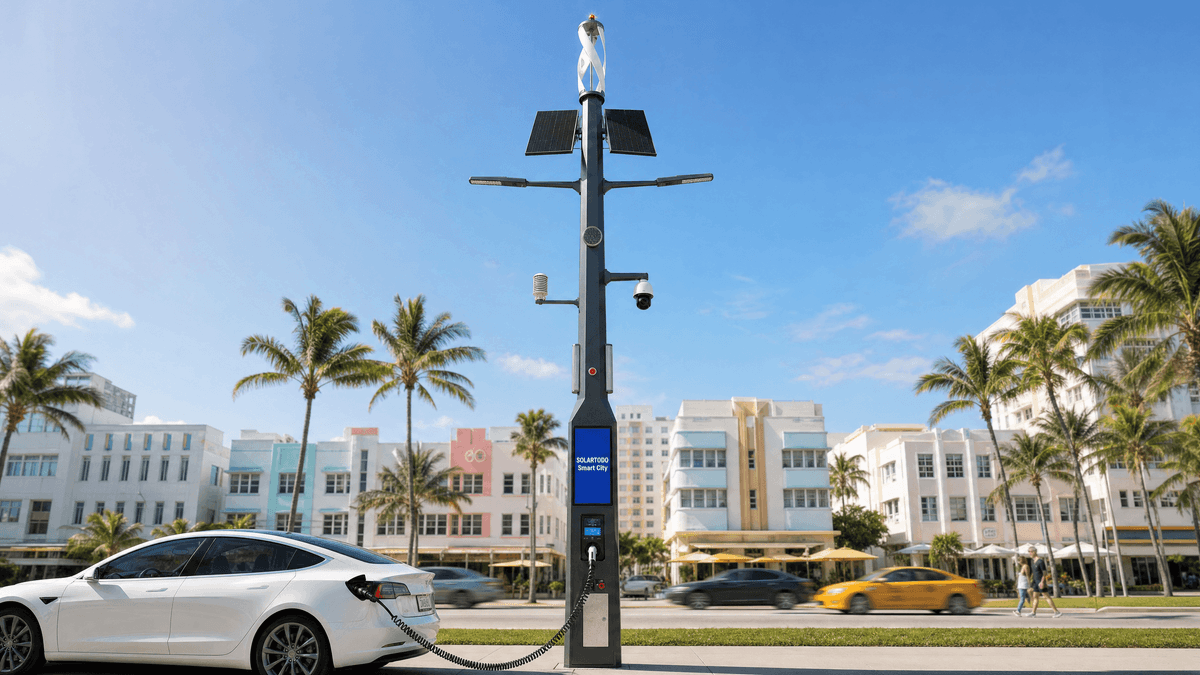
Addis Ababa Smart Streetlight Market Analysis: 149-Unit Hybrid 12m Configuration Guide for Urban Corridors
Summary
Addis Ababa’s dense urban corridors, growing EV demand, and mixed grid reliability make a typical 149-unit smart streetlight rollout technically suited to 12m hybrid poles at 32m spacing, with 11kW AC charging, 5kWh LFP storage, and 2×80W LED luminaires compliant with IEC 60598 and IEC 62196-2.
Key Takeaways
A 149-unit Addis Ababa smart streetlight scheme would typically fit arterial and collector roads where 32m spacing yields coverage of roughly 4.8km.
- Addis Ababa’s population exceeds 5 million, which supports higher demand for multi-function poles carrying lighting, CCTV, WiFi 6, SOS, and EV charging in one 12m structure.
- According to the World Bank (2023), Ethiopia’s urbanization rate remains above 4% annually, so corridor infrastructure must scale faster than conventional single-function poles.
- A recommended configuration is approximately 149 hybrid 12m octagonal tapered steel poles, each with a 400W Gorlov-type VAWT, 2×100W solar panels, and 5kWh LFP battery backup.
- Each pole would carry 2×80W LED luminaires at 150 lm/W and 4000K, delivering about 24,000 lumens total per pole for urban street lighting class applications.
- The lower 2.2m of each pole would function as an integrated 11kW AC EV charging cabinet with Type 2 connector, OCPP 1.6J, 5m coiled cable, and E-stop.
- At 32m spacing, a 149-pole layout would cover approximately 4,768m of roadway, equal to about 4.8km of continuous urban corridor.
- A typical unit would include a 360° PTZ dome camera with 20x zoom and IR 100m, plus a 30W IP audio column, SOS intercom, WiFi 6, 5G gateway, and LoRaWAN backhaul.
- According to IEA (2024), efficient LED street lighting can reduce electricity use by 50% or more versus legacy systems, improving payback when paired with smart controls and mixed self-power support.
Market Context for Addis Ababa
Addis Ababa combines a population above 5 million, high corridor traffic, and elevation near 2,300m, making hybrid smart streetlights more suitable than basic 6-8m park poles for primary urban streets.
Addis Ababa is Ethiopia’s political and commercial center, with a metropolitan population commonly estimated above 5 million. According to the World Bank (2023), Ethiopia is one of Africa’s fastest-urbanizing countries, with urban population growth above 4% per year. That matters for street infrastructure because collector and arterial roads face rising pressure from traffic, informal commercial activity, pedestrian demand, and public safety requirements within the same right-of-way.
Climate and elevation also affect equipment selection. Addis Ababa sits near coordinates 9.02, 38.75 at an elevation around 2,300m above sea level, with a subtropical highland climate and strong seasonal rainfall. According to NASA POWER (2024), the area receives strong solar resource through much of the year, while the rainy season reduces consistency during some months. This supports a hybrid wind-solar pole with battery and grid backup rather than a solar-only streetlight.
Grid conditions are another design driver. Ethiopia’s electricity access and generation base have improved, but local distribution reliability still varies by district and feeder. According to the International Energy Agency (2024), Ethiopia continues to expand grid access while balancing demand growth and network constraints. For smart streetlight procurement, that means the product should not rely on grid power alone when cameras, displays, WiFi, and EV charging are attached to the same pole.
Telecom and public-safety demand also support a multi-function design. According to the ITU (2023), digital infrastructure expansion in African capitals is increasing demand for dense urban wireless nodes, surveillance, and public information systems. A standard lighting pole with only a luminaire does not solve those needs. A 12m class smart streetlight can support lighting, communications, safety, and charging in one streetscape asset.
Two authority statements are especially relevant here. The IEA states, "LEDs can reduce electricity consumption for lighting by more than 50% compared with conventional technologies." IEC states, "IEC 60598 specifies general requirements and tests for luminaires," which is directly relevant for municipal procurement and compliance review.
For Addis Ababa, the correct size class is the 12m urban street smart pole rather than a 6-8m garden light or a highway mast. The city’s road profile includes major corridors, BRT-adjacent streets, mixed-use commercial avenues, and civic districts where 25-50m pole spacing is typical. Based on that profile, SOLAR TODO’s hybrid 12m Smart Streetlight is the closest technical fit.
Recommended Technical Configuration
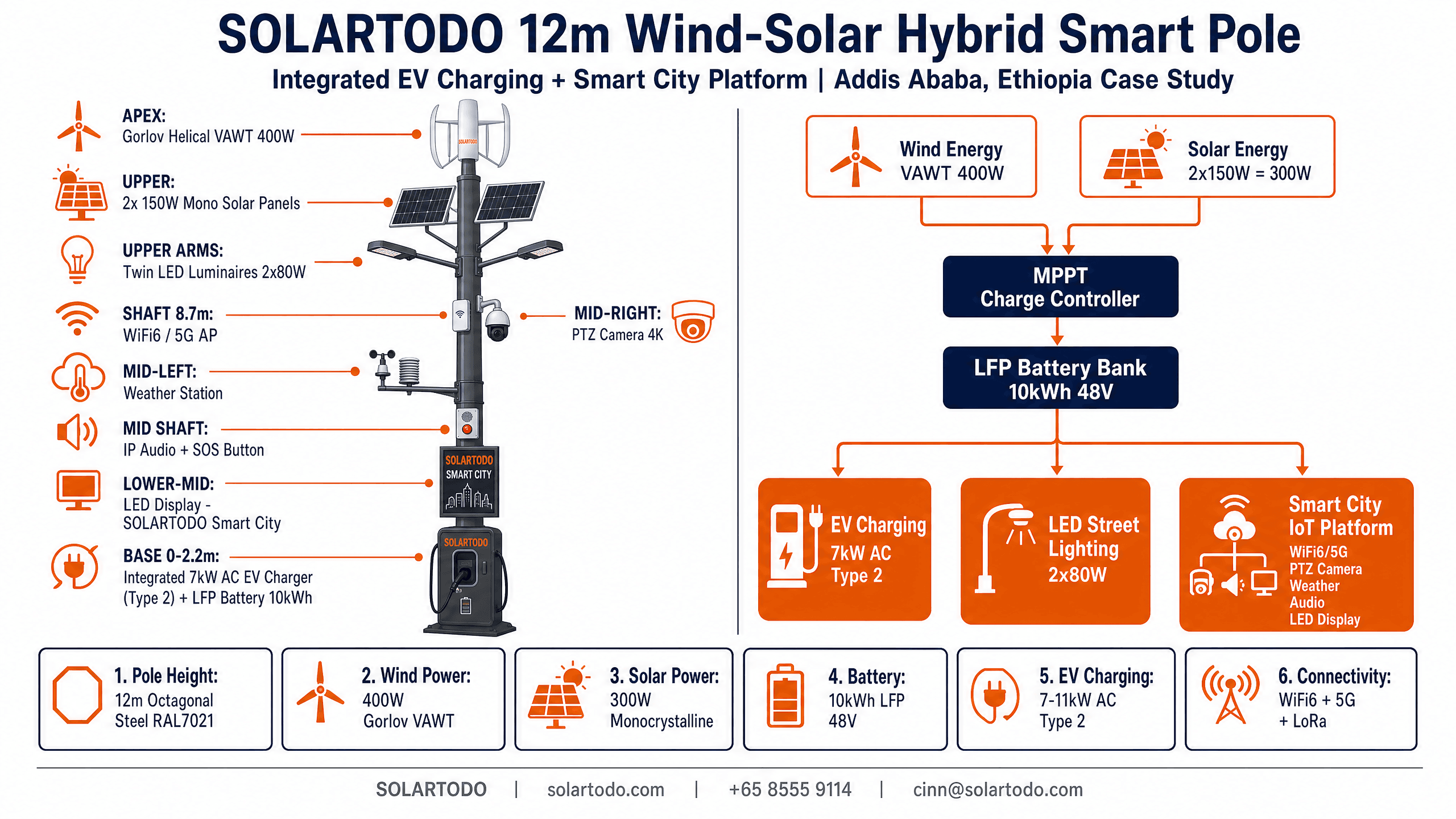
For Addis Ababa’s arterial road profile, a typical 149-unit deployment would use 12m hybrid smart streetlights at 32m spacing with integrated 11kW charging, 5kWh storage, and dual 80W LED heads.
A typical 149-unit deployment of this scale would consist of hybrid 12m octagonal tapered steel smart poles fabricated for urban corridors rather than highways or park paths. The specified pole geometry is base diameter 45cm tapering to 15cm at the top, which is appropriate for carrying lighting, communications, audio, and charging hardware on a single shaft. The finish would be charcoal RAL7021 powder coat, which suits civic and commercial districts where visual consistency matters.
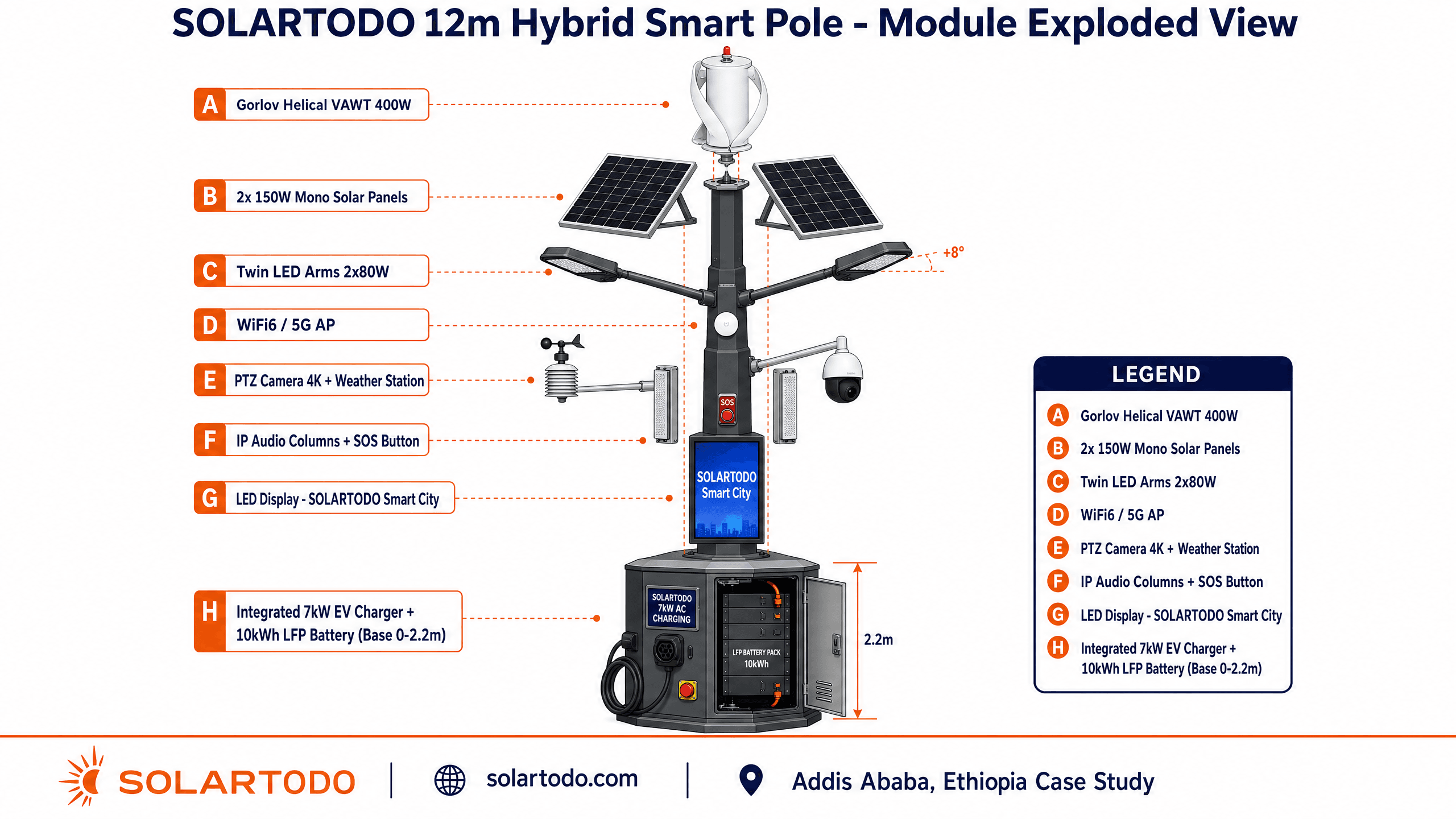
The key configuration point is the integrated charger structure. In this recommended Addis Ababa setup, the lower 2.2m of the pole is the EV charging cabinet itself, welded as one continuous steel structure rather than mounted beside the pole as a separate pedestal. That reduces streetscape clutter, shortens cable runs inside the assembly, and simplifies alignment on constrained sidewalks.
The self-power package is also specific. Each pole would use one Gorlov-type helical vertical-axis wind turbine with 3 twisted white aluminum blades, turbine size about 70cm diameter by 100cm height, and rated output of 400W. Solar support would come from 2×100W deep-black monocrystalline panels mounted mid-pole on symmetric east-west A-frame brackets at 15° tilt, with a 5kWh LFP battery and MPPT controller housed inside the base.
This is not a fully off-grid recommendation. Addis Ababa’s weather pattern includes cloudier wet-season periods, and the integrated 11kW charger can create intermittent high demand. For that reason, the technically correct recommendation is a hybrid system with wind, solar, battery, and backup grid tie. That architecture keeps critical functions such as LED lighting, PTZ surveillance, SOS, and communications active even when local generation is temporarily low.
On the lighting side, each pole would carry twin symmetric 1.5m arms with +8° upward tilt and 2×80W LED luminaires rated at 150 lm/W and 4000K. That gives roughly 24,000 lumens per pole, which is suitable for urban corridors where road lighting and sidewalk spill light must be balanced. The twin-arm arrangement also helps on wider carriageways and median-adjacent installations.
For smart-city functions, each unit would include a 15cm mini white PTZ dome camera with 360° rotation, 20x zoom, and IR range up to 100m mounted on a 40cm L-bracket. A 4-parameter environmental sensor at the top would monitor temperature, humidity, wind speed, and noise. A slim IP audio column sized about 10cm by 50cm and rated 30W/93dB would support public address and emergency messaging.
The communications package would include dual-mode WiFi 6 and a 5G gateway with GbE uplink and LoRaWAN support, mounted flush on the flat pole face at 8.7m. The LED advertising screen would be a P5 portrait display sized 1280×2560mm with brightness above 5,000 cd/m², limited in this configuration to the content line “SOLARTODO Smart City” in white sans-serif on deep blue. For buyers comparing integrated urban furniture, this makes SOLAR TODO relevant where a city wants one pole to carry lighting, safety, digital signage, and EV service.
Technical Specifications
The Addis Ababa-fit specification is a 12m hybrid Smart Streetlight with 149-unit typical quantity, 32m spacing, and integrated 11kW AC charging inside the lower 2.2m pole body.
- Quantity basis: approximately 149 units for a corridor program of about 4.8km at 32m spacing
- Pole type: 12m octagonal tapered steel smart pole
- Pole geometry: base Ø45cm to top Ø15cm
- Finish: charcoal RAL7021 powder coat
- Power architecture: wind-solar hybrid self-power with backup grid tie
- Wind turbine: Gorlov-type helical VAWT, 3 twisted white aluminum blades, Ø70×100cm, 400W, red aviation LED
- Solar array: 2×100W monocrystalline deep-black panels on symmetric east-west A-frame brackets
- Panel tilt: 15°
- Battery: LFP 5kWh inside pole base
- Charge control: MPPT controller integrated in base compartment
- Luminaire arms: twin symmetric arms, 1.5m each, +8° upward tilt
- LED lighting: 2×80W LED, 150 lm/W, 4000K
- Approximate luminous flux: 24,000 lm per pole
- Camera: 15cm mini white PTZ dome, 360°, 20x zoom, IR 100m, mounted on 40cm L-bracket
- Environmental sensing: 4-parameter sensor for temperature, humidity, wind speed, and noise
- Public address: 1× IP audio column, Ø10×50cm, 30W, 93dB, TCP/IP networked
- Emergency module: one-press SOS button, dual-way audio intercom, visual LED indicator
- EV charging: integrated 11kW single-gun AC charger, Type 2, OCPP 1.6J
- Charging cable: 5m coiled cable
- Charger interface: touchscreen, E-stop, maintenance door
- Display: P5 vertical LED screen, 1280×2560mm portrait, >5000 cd/m²
- Communications: WiFi 6 + 5G gateway with GbE uplink and LoRaWAN
- Mounting detail: communications housing flush on flat pole face at 8.7m
- User amenities: Qi wireless phone charging pad + USB-A
- Typical spacing: 32m
- Applicable standards: IEC 60598, GB/T 37024, IEC 62196-2
Implementation Approach
A 149-unit Addis Ababa rollout would typically be delivered in 4 phases over roughly 6-10 months, from corridor survey and utility approvals to pole erection, commissioning, and software onboarding.
Phase 1 is corridor definition and utility coordination. For a 149-pole program at 32m spacing, planners would first confirm lane width, sidewalk offset, underground utility conflicts, and transformer proximity over about 4.8km of streets. Addis Ababa installations should also check drainage and pavement edge conditions because seasonal rain can affect base design and cable entry points.
Phase 2 is detailed engineering and factory production. Pole shaft fabrication, charger compartment integration, LED bracket welding, and coating would proceed against approved shop drawings and standards such as IEC 60598 and IEC 62196-2. Communications, PTZ camera, display, and audio devices would be pre-integrated as much as possible to reduce field work at 12m height.
Phase 3 is civil works and erection. Typical foundations would be cast after geotechnical review and anchor-bolt verification, then poles would be erected by crane in planned traffic windows. Because the charger is built into the lower 2.2m of the pole, base alignment and conduit entry are more critical than for a standard lighting pole.
Phase 4 is energization, software setup, and acceptance testing. LED dimming schedules, PTZ camera presets, SOS response routing, OCPP charger connectivity, and WiFi/5G links would be tested before handover. A municipal buyer would normally require burn-in tests, insulation checks, earthing verification, and charger communication validation before final acceptance.
Expected Performance & ROI
For Addis Ababa corridors, a hybrid 12m Smart Streetlight can reasonably target 50%+ lighting energy reduction versus legacy fixtures while adding non-lighting functions that reduce separate pole and cabinet costs.
According to the IEA (2024), LED lighting commonly cuts electricity consumption by more than 50% compared with older lamp technologies. In this configuration, each pole uses 160W of LED load for lighting, but smart controls can dim output during low-traffic hours. If compared with legacy sodium or metal-halide installations in the 250-400W class, the energy savings can be material even before considering maintenance reductions.
Battery and hybrid generation add resilience rather than full energy autonomy. The 5kWh LFP battery, 400W VAWT, and 200W solar array can support lighting, communications, and emergency functions during outages or low-grid periods, while the grid tie remains available for charging and high-demand events. For Addis Ababa, that is a stronger fit than a solar-only pole because EV charging at 11kW creates demand spikes far above the renewable trickle input.
Maintenance economics also matter. According to NREL (2023), LED street lighting typically reduces maintenance frequency because luminaire life is longer than conventional lamp systems and controls improve fault visibility. A multi-function pole can also reduce the need for separate CCTV columns, PA speakers, WiFi masts, and standalone EV chargers, which lowers civil duplication across a corridor.
A realistic payback model depends on local tariff, charger utilization, communications lease revenue, and avoided infrastructure duplication. For municipal or PPP buyers, simple payback could fall in the medium-term range when 4 revenue or cost centers are counted together: lighting energy savings, reduced maintenance dispatches, EV charging income, and avoided installation of separate smart-city hardware. Buyers should model ROI over a 10-15 year asset life rather than on lighting energy alone.
Results and Impact
For Addis Ababa, the main impact of a 149-unit Smart Streetlight program would be corridor consolidation: about 4.8km of roadway served by one pole platform carrying lighting, safety, connectivity, and charging.
The operational result would likely be better than a conventional lighting-only upgrade because each 12m pole supports several municipal functions at once. Instead of deploying separate structures for CCTV, public address, WiFi, digital display, and EV service, the city can use one coordinated asset line at 32m spacing. That matters in denser districts where sidewalk width and visual clutter are recurring constraints.
The public-safety impact would come from 360° PTZ coverage, IR range up to 100m, one-touch SOS, and TCP/IP audio broadcast on every unit. The resilience impact would come from the hybrid power stack: 400W wind, 200W solar, 5kWh LFP storage, and backup grid connection. For SOLAR TODO buyers, the practical value is not only lower lighting energy but also a cleaner urban hardware layout.
Comparison Table
This comparison shows why a 12m hybrid Smart Streetlight is a better fit for Addis Ababa arterials than a standard modular pole or a basic lighting-only solution.
| Metric | Recommended Addis Ababa Hybrid 12m | Standard Modular Smart Pole 8-10m | Conventional LED Streetlight |
|---|---|---|---|
| Pole height | 12m | 8-10m | 8-12m |
| Power architecture | Hybrid wind + solar + 5kWh battery + grid backup | Usually grid only | Grid only |
| Lighting load | 2×80W LED | 80-150W LED | 150-400W legacy/retrofit |
| Luminous efficacy | 150 lm/W | up to 150 lm/W | often lower |
| EV charging | Integrated 11kW Type 2 | Optional 7-11kW, often separate cabinet | None |
| Camera | PTZ 360°, 20x, IR 100m | Optional fixed/PTZ | Usually none |
| Public safety | SOS + dual-way intercom + 30W IP audio | Optional | None |
| Display | P5 1280×2560mm, >5000 cd/m² | Optional smaller display | None |
| Communications | WiFi 6 + 5G + LoRaWAN | Optional | None |
| Typical spacing | 32m | 25-40m | 25-40m |
| Best fit in Addis Ababa | Arterials, civic roads, mixed-use corridors | Secondary streets | Lighting-only upgrades |
Pricing & Quotation
SOLAR TODO offers three pricing tiers for this product line: FOB Supply (equipment ex-works China), CIF Delivered (including ocean freight and insurance), and EPC Turnkey (fully installed, commissioned, with 1-year warranty). Volume discounts are available for large-scale deployments. Configure your system online for an instant estimate, or request a custom quotation from our engineering team at [email protected].
For Addis Ababa buyers, quotation accuracy depends on 5 main inputs: pole quantity, foundation scope, grid connection distance, charger back-office requirements, and local import/tax structure. A 149-unit corridor package should also specify whether trenching, utility meters, and civil reinstatement are included. For product details, buyers can review the Smart Streetlight product page or contact us for a corridor-specific BoQ.
Frequently Asked Questions
This FAQ answers the most common Addis Ababa buyer questions on 12m hybrid Smart Streetlight configuration, installation scope, ROI, maintenance, and procurement structure.
Q1: Why is a 12m hybrid pole recommended for Addis Ababa instead of a smaller 6-8m smart pole?
A 12m pole is better suited to arterial and collector roads where wider carriageways need broader light distribution and better camera sightlines. In this configuration, the pole also carries a 400W wind turbine, 2×100W solar panels, a 5kWh battery, and an 11kW charger. A 6-8m class is more suitable for parks or pedestrian zones, not major urban corridors.
Q2: What does “integrated EV charging” mean in this specification?
It means the lower 2.2m of the pole body is the charger cabinet itself, not a separate charging pedestal placed next to the pole. The charger is an 11kW single-gun AC unit with Type 2 connector, OCPP 1.6J, 5m coiled cable, touchscreen, E-stop, and maintenance door. This reduces sidewalk clutter and keeps the streetscape cleaner.
Q3: Can the hybrid power system run the EV charger fully off-grid?
No, not continuously at full 11kW output. The 400W wind turbine, 200W solar array, and 5kWh LFP battery mainly support lighting, communications, and resilience functions. The charger should be treated as grid-backed, with hybrid generation helping auxiliary loads and outage tolerance. That is the technically correct approach for Addis Ababa’s mixed weather and urban charging profile.
Q4: How long would a typical 149-unit deployment take?
A realistic program would often take about 6-10 months, depending on utility approvals, civil scope, customs clearance, and software integration. The sequence usually includes survey, engineering, fabrication, shipping, foundations, erection, energization, and acceptance testing. If trenching and transformer upgrades are extensive, the schedule can extend beyond 10 months.
Q5: What maintenance should buyers expect each year?
Annual maintenance would usually include charger inspection, cable and connector checks, LED driver review, PTZ lens cleaning, battery health diagnostics, fastener torque checks, and communications testing. The wind turbine should also receive periodic blade and bearing inspection. A practical maintenance plan is quarterly visual inspection plus one deeper electrical and mechanical service cycle every 12 months.
Q6: What ROI model is most realistic for this type of smart streetlight?
The strongest ROI model combines 4 value streams: reduced lighting energy use, lower maintenance dispatches, EV charging revenue, and avoided installation of separate CCTV, WiFi, PA, and emergency columns. Payback based only on lighting savings is usually too conservative for a multi-function pole. Buyers should model a 10-15 year asset horizon with local tariff and utilization assumptions.
Q7: How does this compare with a conventional LED-only streetlight?
A conventional LED pole mainly addresses illumination, while this 12m hybrid Smart Streetlight adds charging, surveillance, public address, SOS, WiFi 6, 5G gateway, display, and environmental sensing. It also includes 5kWh battery storage and hybrid generation support. The capital scope is broader, but it can replace several separate roadside assets with one coordinated structure.
Q8: What standards are relevant for municipal procurement in Addis Ababa?
The key standards in this configuration are IEC 60598 for luminaires, IEC 62196-2 for EV connector interface, and GB/T 37024 for smart multifunction poles. Buyers may also request local earthing, civil, and utility compliance documents during approval. For charger networking, OCPP 1.6J should be specified in the procurement package to avoid software lock-in.
Q9: Is EPC pricing available, or is supply-only the normal route?
Both structures are possible. SOLAR TODO lists FOB Supply, CIF Delivered, and EPC Turnkey options, so buyers can choose between equipment-only procurement and a full installed package. In Ethiopia, the choice often depends on whether the municipal authority wants one contractor for civil, electrical, and commissioning scope or prefers to split lots.
Q10: What warranty terms should buyers request?
The standard quotation framework includes a 1-year warranty for EPC Turnkey supply, but buyers often request separate component warranty schedules for LEDs, charger electronics, battery, display, and communications devices. For a 149-unit package, it is good practice to define warranty response time, spare parts coverage, and exclusions in the contract before shipment.
References
- World Bank (2023): Ethiopia urbanization indicators and city growth trends showing sustained urban population growth above 4% annually.
- International Energy Agency (2024): Africa Energy Outlook and lighting efficiency findings, including LED electricity savings of 50% or more versus conventional technologies.
- NASA POWER (2024): Solar resource and climate data for Addis Ababa region relevant to hybrid wind-solar support design.
- ITU (2023): Digital infrastructure and connectivity development guidance relevant to urban WiFi, 5G, and smart-city communications layers.
- IEC (2023): IEC 60598 general requirements and tests for luminaires used in municipal lighting procurement.
- IEC (2022): IEC 62196-2 dimensional compatibility and interchangeability requirements for AC charging accessories and Type 2 interfaces.
- NREL (2023): Street lighting and connected infrastructure guidance on LED efficiency, controls, and maintenance benefits.
- GB/T (2019): GB/T 37024 technical framework for multifunction smart poles and integrated urban roadside equipment.
SOLAR TODO recommends validating corridor width, utility access, and charger utilization assumptions before finalizing any Addis Ababa Smart Streetlight BoQ. For specification review, buyers can compare options on the Smart Streetlight page or contact us for a project-specific technical checklist.
Equipment Deployed
- 149 × 12m octagonal tapered steel smart pole, base Ø45cm to top Ø15cm, charcoal RAL7021 powder coat
- Integrated lower 2.2m pole-as-charger structure with 11kW single-gun AC EV charger, Type 2, OCPP 1.6J
- 1 × Gorlov-type helical VAWT per pole, 3 twisted white aluminum blades, Ø70×100cm, 400W, red aviation LED
- 2 × 100W monocrystalline deep-black solar panels per pole on east-west A-frame brackets at 15° tilt
- 1 × 5kWh LFP battery with MPPT controller inside pole base
- 2 × 80W LED luminaires per pole, 150 lm/W, 4000K, mounted on twin 1.5m arms with +8° upward tilt
- 1 × mini PTZ dome camera per pole, 360°, 20x zoom, IR 100m, mounted on 40cm L-bracket
- 1 × 4-parameter environmental sensor per pole for temperature, humidity, wind speed, and noise
- 1 × IP audio column speaker per pole, Ø10×50cm, 30W, 93dB, TCP/IP networked
- 1 × SOS emergency button with dual-way audio intercom and visual LED indicator per pole
- 1 × P5 vertical LED display per pole, 1280×2560mm portrait, >5000 cd/m²
- 1 × dual-mode WiFi 6 + 5G gateway with GbE uplink and LoRaWAN, flush-mounted at 8.7m
- 1 × Qi wireless phone charging pad + USB-A user charging module per pole