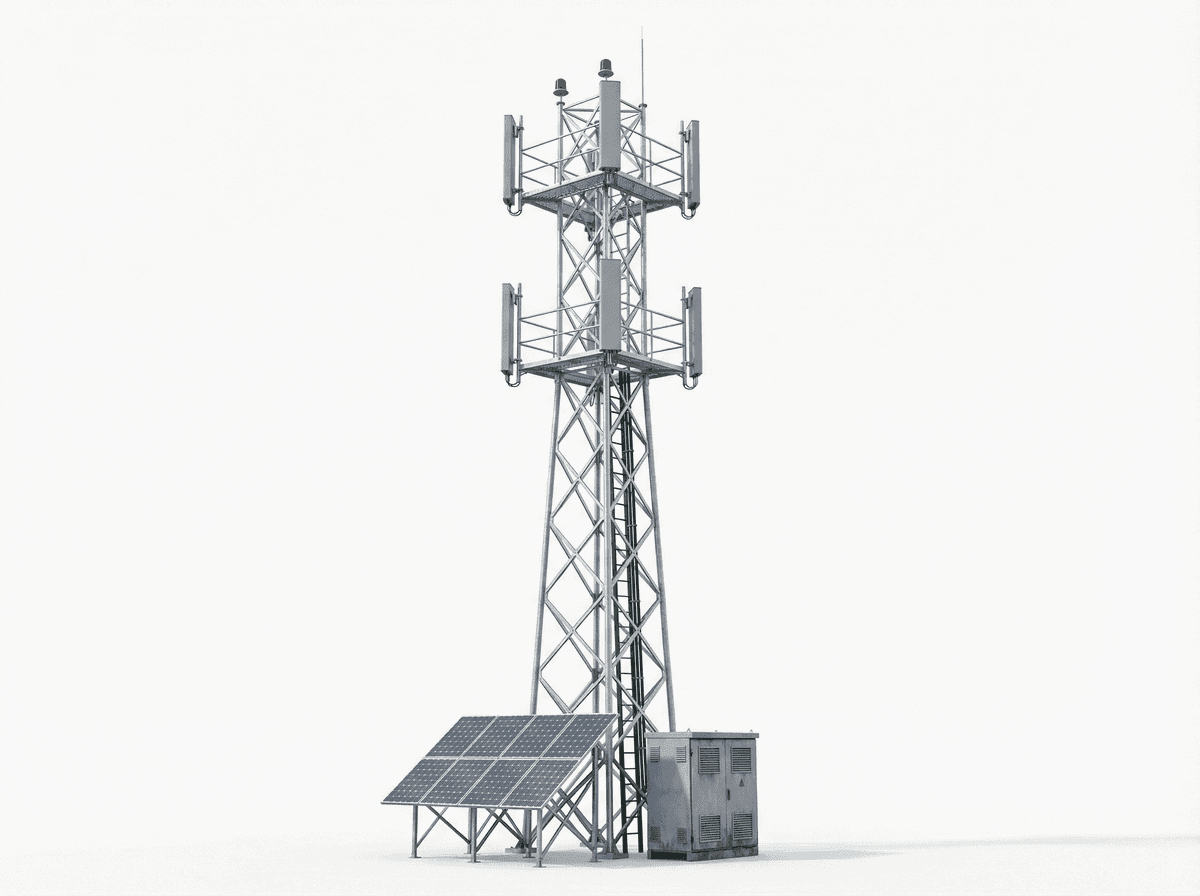
50m Solar-Powered Off-Grid Lattice Tower - 5kW Solar + 30kWh Battery, 9 Antennas, 50 m/s Wind Rated
Key Features
- 50-meter self-supporting lattice structure engineered from Q345/Q420 hot-rolled angle steel, rated for 50 m/s design wind speed
- 3 dedicated antenna platforms accommodating up to 9 panel antennas (4G/5G) and multiple microwave dishes for multi-tenant sharing
- Integrated 5kW monocrystalline solar PV array with MPPT charge controller for maximum energy harvesting efficiency
- 30kWh LiFePO4 battery energy storage system providing up to 3 days of autonomous off-grid operation
- Comprehensive lightning protection system with air terminal, down conductor, and grounding resistance < 4 ohms, compliant with TIA-222-H / EN 1993-3-1
- Hot-dip galvanized corrosion protection with 30-year design life; optional CCTV security monitoring and anti-climbing barrier at 3m
The SOLARTODO 50m Solar-Powered Off-Grid Tower features a 5kW solar PV array and a 30kWh battery, designed for remote communication networks. Priced between $85,000 and $115,000, it is certified by IEC and TÜV, ensuring high standards of safety and efficiency. This robust structure supports up to 9 antennas and withstands wind speeds of 50 m/s.
Description
50m Solar-Powered Off-Grid Tower
The 50m Solar-Powered Off-Grid Tower is a robust self-supporting lattice structure engineered from Q345/Q420 hot-rolled angle steel, designed to support up to 9 antennas across 3 platforms while withstanding wind speeds up to 50 m/s. Integrated with a 5kW solar PV array and a 30kWh battery energy storage system, this telecom tower provides reliable, autonomous operation for up to 3 days without grid connection, making it the optimal solution for remote and off-grid communication networks.
Structural Engineering and Design
The foundation of the 50m Solar-Powered Off-Grid Tower lies in its exceptional structural integrity, utilizing a self-supporting angular steel framework. Constructed primarily from Q345 and Q420 hot-rolled angle steel, the tower offers the highest load capacity among all tower types, ensuring maximum stability and durability. The bolted connections facilitate secure assembly and structural resilience, allowing the tower to withstand extreme environmental conditions, including design wind speeds of up to 50 m/s. This robust construction is essential for supporting heavy telecommunication equipment, including multiple microwave dishes and up to 9 panel antennas distributed across 3 dedicated platforms.
The lattice design not only provides superior strength but also minimizes wind resistance, reducing the overall structural load. The tower's foundation typically consists of a concrete stub or mat foundation, with a 4-leg base that ensures optimal weight distribution and stability. For taller configurations, guy anchors can be integrated to further enhance structural support. The design life of the steel structure, when properly maintained, extends from 30 to 50 years, ensuring a long-term return on investment for telecommunication operators. The tower complies with stringent international standards, including TIA-222-H (US), EN 1993-3-1 (EU), and GB 50135 (China), guaranteeing its reliability and safety in diverse global deployments.
Integrated Renewable Energy System
A defining feature of the 50m Solar-Powered Off-Grid Tower is its fully integrated renewable energy system, designed to provide continuous, reliable power in remote locations without access to the electrical grid. The system incorporates a high-efficiency 5kW solar photovoltaic (PV) array, typically mounted on a dedicated bracket near the base of the tower to optimize sun exposure and facilitate easy maintenance. This solar array is paired with a robust 30kWh battery energy storage system, utilizing advanced lithium iron phosphate (LiFePO4) technology for superior cycle life, safety, and performance in extreme temperatures.
The energy system is engineered to provide up to 3 days of autonomy, ensuring uninterrupted operation of critical telecommunication equipment even during prolonged periods of low solar irradiance or inclement weather. This off-grid capability significantly reduces operational costs associated with diesel generator fuel and maintenance, while also minimizing the environmental footprint of the telecom network. The integration of a sophisticated Maximum Power Point Tracking (MPPT) charge controller ensures optimal energy harvesting from the solar array, maximizing the efficiency and reliability of the entire power system.
Telecommunication Capabilities and Equipment
The 50m Solar-Powered Off-Grid Tower is designed to accommodate a wide range of telecommunication equipment, making it a versatile solution for modern network deployments. The tower features 3 dedicated antenna platforms, capable of supporting up to 9 panel antennas for 4G and 5G networks, as well as multiple microwave dishes for backhaul connectivity. This high antenna capacity makes the tower ideal for multi-tenant sharing, allowing multiple operators to co-locate their equipment on a single structure, thereby reducing infrastructure costs and environmental impact.
In addition to primary communication antennas, the tower is equipped to support essential auxiliary systems, including GPS antennas for network synchronization and aviation warning lights to comply with aviation safety regulations. The tower's design facilitates efficient cable management, with dedicated cable trays running the length of the structure to protect and organize power and data cables. The internal climbing ladder, constructed from durable fiberglass reinforced plastic (FRP) poles, provides safe and convenient access for maintenance personnel, while an optional external ladder with a steel safety rail offers an alternative climbing solution.
Safety and Security Features
Safety and security are paramount in the design of the 50m Solar-Powered Off-Grid Tower. The structure incorporates a comprehensive lightning protection system, comprising an air terminal at the pinnacle, a dedicated down conductor, and a robust grounding system with a resistance of less than 4 ohms. This system effectively dissipates lightning strikes, protecting sensitive electronic equipment and ensuring the continuous operation of the communication network.
To prevent unauthorized access and vandalism, the tower features a security barrier installed at a height of 3 meters, effectively deterring climbing by unauthorized individuals. Optional CCTV monitoring systems can be integrated to provide real-time surveillance of the site, further enhancing security. The hot-dip galvanized finish of the steel components provides exceptional corrosion resistance, protecting the structure from environmental degradation and extending its operational lifespan, even in harsh coastal or industrial environments.
Application Scenario: Remote Connectivity in the MENA Region
A prominent solar farm operator in the Middle East and North Africa (MENA) region recently deployed a network of 50m Solar-Powered Off-Grid Towers to establish reliable communication across their expansive, remote facilities. The integration of the 5kW solar array and 30kWh battery storage system proved critical in this off-grid environment, providing continuous power for essential SCADA (Supervisory Control and Data Acquisition) systems and security cameras without the need for costly and logistically challenging diesel fuel deliveries. This deployment not only ensured uninterrupted operational monitoring but also aligned with the operator's commitment to sustainable, zero-emission infrastructure.
Comparative Advantage
When compared to conventional diesel-powered telecom towers, the 50m Solar-Powered Off-Grid Tower offers significant operational and environmental advantages. The integrated solar and battery system reduces operational expenditure (OPEX) by up to 80% compared to traditional diesel generators, primarily through the elimination of fuel costs and the substantial reduction in maintenance requirements. Furthermore, the transition to renewable energy eliminates greenhouse gas emissions and noise pollution, making the solar-powered tower a superior choice for environmentally sensitive areas and sustainable network expansion.
Frequently Asked Questions (FAQ)
What is the maximum wind speed the tower can withstand? The 50m Solar-Powered Off-Grid Tower is engineered to withstand extreme environmental conditions, with a design wind speed capacity of up to 50 meters per second (m/s). This robust structural integrity ensures the safety and stability of the tower and its mounted equipment during severe weather events, complying with stringent international standards such as TIA-222-H.
How long can the tower operate without sunlight? The integrated energy system features a 30kWh battery storage capacity, designed to provide up to 3 days of autonomy. This ensures that the telecommunication equipment remains fully operational during prolonged periods of low solar irradiance, inclement weather, or during the night, providing reliable, uninterrupted service in off-grid locations.
Can multiple operators share the same tower? Yes, the lattice structure and high load capacity of the 50m tower make it ideal for multi-tenant sharing. With 3 dedicated antenna platforms capable of supporting up to 9 panel antennas and multiple microwave dishes, several telecommunication operators can co-locate their equipment on a single tower, significantly reducing infrastructure costs.
What maintenance is required for the solar power system? The solar power system requires minimal maintenance compared to traditional diesel generators. Routine maintenance typically involves periodic cleaning of the solar panels to ensure optimal energy harvesting, inspection of the battery connections, and monitoring of the charge controller's performance. The use of advanced LiFePO4 batteries ensures a long cycle life with minimal degradation.
Is the tower protected against lightning strikes? Absolutely. The tower is equipped with a comprehensive lightning protection system that includes an air terminal at the top, a dedicated down conductor, and a robust grounding system designed to maintain a resistance of less than 4 ohms. This system effectively safely dissipates lightning strikes, protecting the sensitive telecommunication equipment from electrical damage.
Technical Specifications
| Tower Height | 50m |
| Tower Type | Lattice (Self-Supporting) |
| Primary Material | Q345/Q420 Hot-Rolled Angle Steel |
| Antenna Platforms | 3levels |
| Antenna Capacity | 9antennas |
| Design Wind Speed | 50m/s |
| Estimated Tip Load Capacity | 800kg |
| Foundation Type | Reinforced Concrete Mat / Stub, 4-Leg Base |
| Corrosion Protection | Hot-Dip Galvanized (ISO 1461) |
| Design Life | 30years |
| Solar PV Capacity | 5kW |
| Battery Storage Capacity | 30kWh |
| Battery Technology | LiFePO4 (Lithium Iron Phosphate) |
| Autonomy (No Solar) | 3days |
| Charge Controller | MPPT |
| Lightning Protection Grounding Resistance | < 4ohm |
| Climbing System | Internal FRP Ladder + Safety Rail |
| Anti-Climbing Barrier Height | 3m |
| Standards Compliance | TIA-222-H / EN 1993-3-1 / GB 50135 |
| Application | Off-Grid Telecom / Remote Site |
Price Breakdown
| Item | Quantity | Unit Price | Subtotal |
|---|---|---|---|
| Q345 Steel Angle Structure (approx. 18 tons) | 18 tons | $1,800 | $32,400 |
| Hot-Dip Galvanizing (18 tons) | 18 tons | $400 | $7,200 |
| Antenna Platform (steel, 3 levels) | 3 pcs | $2,500 | $7,500 |
| Internal Climbing Ladder (FRP, 50m) | 50 m | $120 | $6,000 |
| Cable Tray System (50m) | 50 m | $50 | $2,500 |
| Lightning Protection System | 1 pcs | $3,000 | $3,000 |
| Aircraft Warning Light Set | 1 pcs | $2,500 | $2,500 |
| Concrete Foundation (approx. 80 m³) | 80 m³ | $300 | $24,000 |
| 5kW Monocrystalline Solar PV Array | 1 pcs | $4,500 | $4,500 |
| 30kWh LiFePO4 Battery Storage Cabinet | 1 pcs | $9,000 | $9,000 |
| MPPT Charge Controller & Power Management Unit | 1 pcs | $1,800 | $1,800 |
| Steel Structure Installation (18 tons) | 18 tons | $800 | $14,400 |
| Engineering, Design & Certification Package | 1 pcs | $5,000 | $5,000 |
| Total Price Range | $85,000 - $115,000 | ||
Frequently Asked Questions
What is the maximum wind speed the tower can withstand?
How long can the tower operate without sunlight?
Can multiple operators share the same tower?
What maintenance is required for the solar power system?
Is the tower protected against lightning strikes?
What foundation type is required for a 50m lattice tower?
Certifications & Standards



Data Sources & References
- •NREL PVWatts Calculator 2025 (solar yield estimation)
- •GSMA Tower Infrastructure Report 2024 (off-grid telecom deployment data)
- •IEC 62305:2010 Lightning Protection Standard
- •TIA-222-H:2017 Structural Standard for Antenna Supporting Structures
- •EN 1993-3-1:2006 Eurocode 3 - Towers, Masts and Chimneys
- •SOLARTODO Engineering Design Manual v3.2 (2025)
Interested in this solution?
Contact us for a customized quote based on your specific requirements.
Contact Us