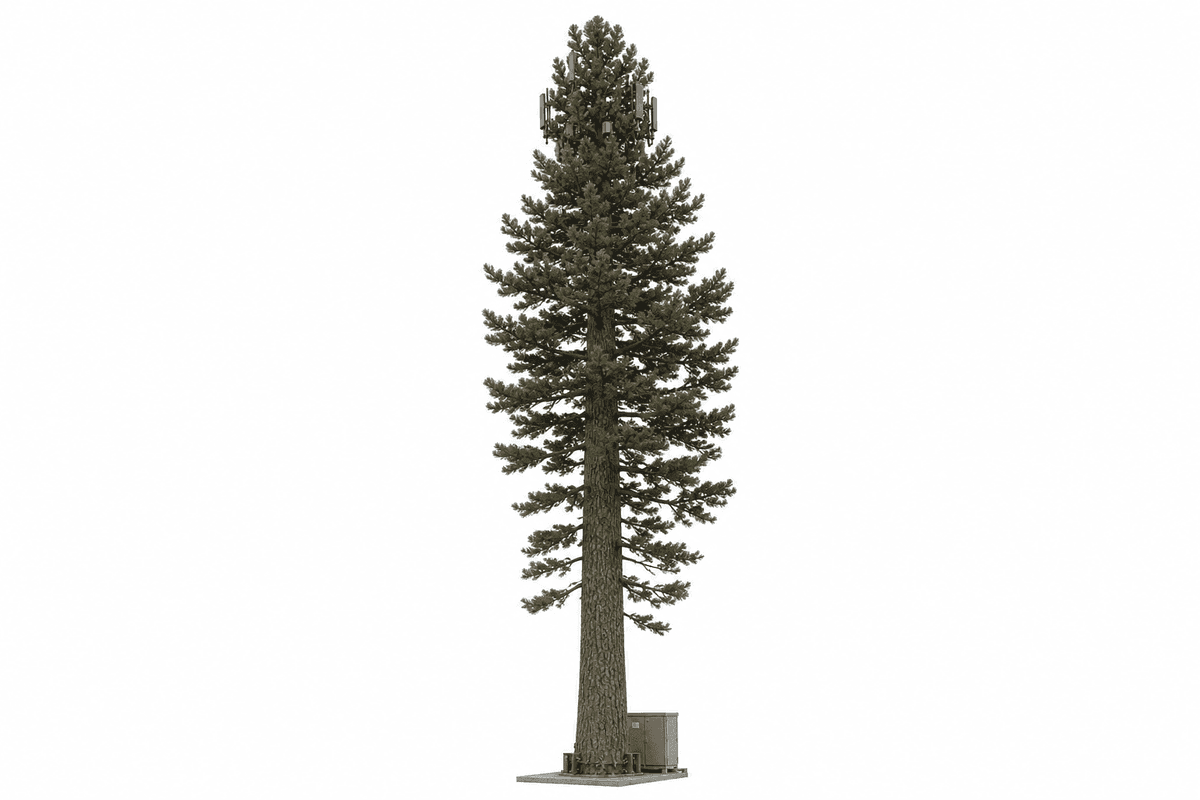
45m Monopine Highway Scenic Area - Camouflaged Telecom Tower
Key Features
- 45 m camouflaged monopine tower with 3 antenna platforms and capacity for 9 concealed antennas
- Designed for 50 m/s wind speed under TIA-222-H and EN 1993-3-1 structural principles
- EPC turnkey budget range of $125,000-$170,000 with 1-year warranty support included
- Visual-impact mitigation typically 50-70% better than a conventional exposed 45 m tower in scenic corridors
- 30-year design life with grounding resistance target below 4 ohms and anti-climbing barrier at 3 m
The 45m Monopine Highway Scenic Area is a camouflaged pine tree telecom tower with a steel monopole core, 3 antenna platforms, capacity for 9 antennas, and 50 m/s wind design. It is engineered for highway scenic corridors, heritage-sensitive zones, and visually constrained 4G/5G deployments where RF performance and landscape integration must be balanced.
Description
The 45m Monopine Highway Scenic Area is a camouflaged pine tree telecom tower engineered for visually sensitive road corridors, tourism districts, and landscaped transport infrastructure where a conventional 45 m galvanized monopole would create unacceptable visual impact. This configuration uses a steel monopole core with pine-tree cladding, supports 3 antenna platforms and up to 9 antennas, and is designed for 50 m/s wind speed with a 30-year design life under TIA-222-H and EN 1993-3-1 structural principles. For B2B buyers evaluating 4G/5G roadside coverage, this model combines concealment, structural reliability, and EPC bankability in a $125,000-$170,000 turnkey range.
For highway authorities, towercos, and mobile network operators, the commercial case is straightforward: scenic-area approvals can delay a standard tower by 6-18 months, while a stealth monopine can materially improve permit acceptance where visual regulations are strict. The premium for camouflage structures is typically 30-50% above a standard monopole, consistent with current stealth tower market practice and telecom siting trends cited across industry analyses from IEA, IRENA, and BloombergNEF on digital infrastructure growth and energy-efficient network densification. In practical terms, a 45 m monopine often preserves coverage objectives across 2-4 km highway stretches while reducing objections from municipalities, tourism boards, and nearby property owners.
Product Positioning for Highway Scenic Deployments
This variant is optimized for highway scenic applications where the objective is to conceal 4G, 5G, microwave, GPS, and aviation warning systems within an artificial conifer profile. The tower height of 45 m provides line-of-sight advantages over lower 20-30 m decorative poles, while the monopole footprint remains significantly smaller than a lattice alternative, typically reducing the visible ground occupation to a compact fenced compound of roughly 25-64 m2 depending on shelter, power, and access requirements. The artificial pine branch geometry is designed to be RF-transparent, allowing panel antennas to remain hidden while maintaining acceptable attenuation levels for common cellular bands.
A conventional galvanized monopole of similar height may be lower in capex by approximately 30-40%, but in scenic corridors it frequently incurs higher non-technical cost through planning disputes, redesign cycles, and mitigation obligations. Compared with a standard exposed tower, a 45 m monopine can reduce perceived visual intrusion by an estimated 50-70% in landscaped settings, based on common planning authority criteria used in transport and heritage review processes. For project developers, that reduction does not directly appear on a bill of materials, yet it can save thousands of dollars in reapplication, consultant time, and delayed revenue from postponed tenant activation.
System Architecture
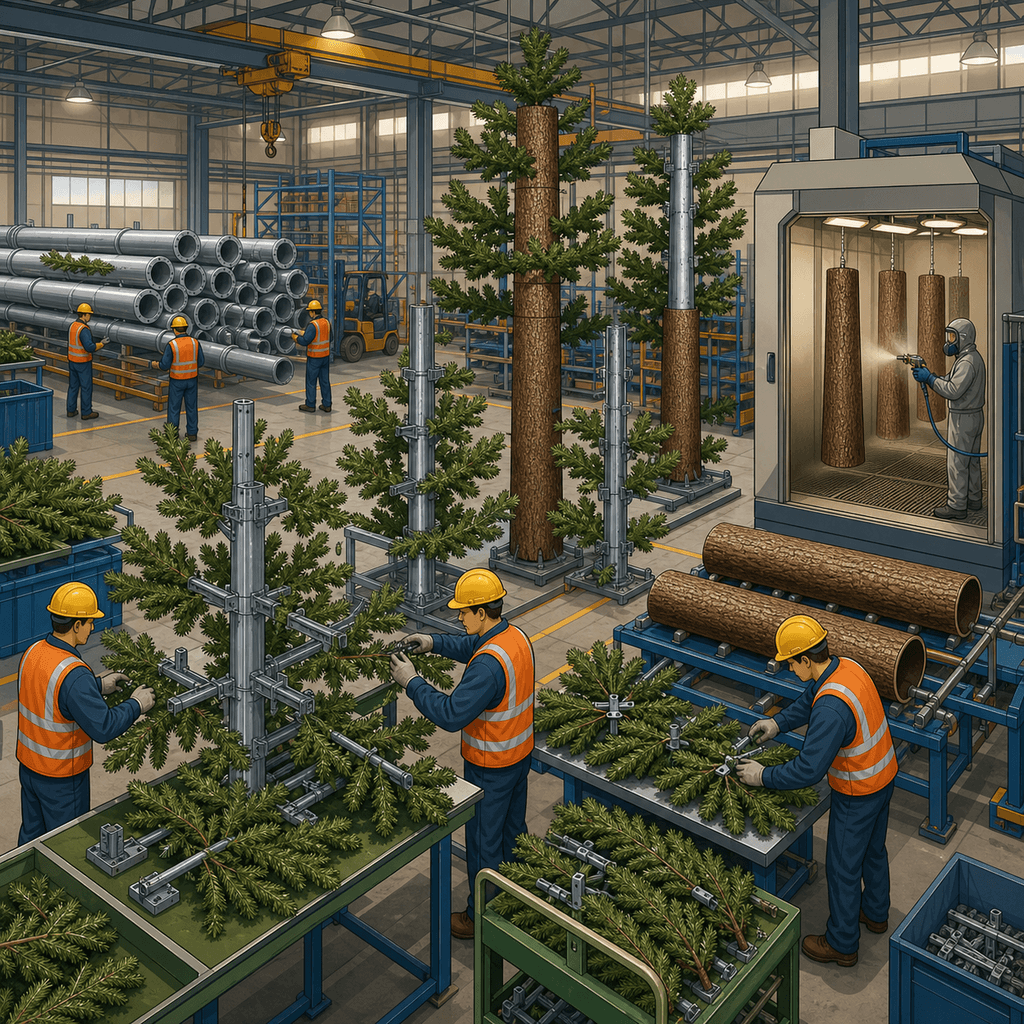
The structural system consists of 1 steel monopole shaft, external bark-texture cladding, synthetic pine branch assemblies, 3 antenna support levels, internal or protected climbing access, and a foundation sized for local geotechnical conditions and the 50 m/s design wind case. The steel core is typically fabricated from high-strength tubular sections comparable to Q355 class material, with hot-dip galvanizing for corrosion resistance and a cladding interface designed to preserve maintenance access. The concealed antenna arrangement generally supports 9 antennas total, for example 3 sectors x 3 antennas per sector, suitable for multi-band LTE and 5G NR deployment.
The RF package can include 6-9 panel antennas, 1-3 microwave dishes, 1 GPS unit, and 1 aviation obstruction light set depending on jurisdiction and airspace rules. Cable routing is usually integrated through internal trays or protected risers, reducing exposed cable clutter by approximately 80-90% versus ad hoc external mounting. Lightning protection includes 1 air terminal, dedicated down conductor paths, and a grounding network designed to achieve less than 4 ohms earth resistance, consistent with telecom best practice and the grounding expectations commonly referenced in IEEE and national telecom standards.
Technical Specifications
From a structural engineering perspective, the 45 m monopine sits in the upper-middle range of stealth monopole applications, where the key challenge is balancing elevated wind area from branches and cladding against the need for hidden RF apertures. The tower is designed for 3 antenna platforms, each capable of supporting sectorized equipment loads, feeder management, and maintenance access. Depending on final loading, a realistic total appurtenance and auxiliary load envelope for this class is approximately 1,200-1,800 kg, which should be verified during project-specific structural calculation and tenant loading review.
For corrosion protection, the steel core is specified as hot-dip galvanized, while external camouflage components use weather-resistant synthetic materials selected for UV exposure, precipitation, and temperature cycling. In many highway environments, annual temperature swings can exceed 35-45°C, and UV degradation becomes a major lifecycle issue if low-grade polymers are used. SOLARTODO therefore recommends a maintenance inspection interval of 12 months and a detailed cladding integrity review every 3-5 years to preserve both concealment quality and attachment safety over the 30-year design life.
The applicable design references include TIA-222-H for antenna supporting structures, EN 1993-3-1 for steel towers and masts, and local code overlays for seismicity, foundation design, and obstacle lighting. Buyers operating in cross-border projects should also align with utility earthing practice, transport setback regulations, and operator-specific loading criteria. For technical teams comparing standards, TIA-222-H is commonly preferred in North America, while EN 1993 frameworks are prevalent in Europe, the Middle East, and many international EPC specifications.
Why Monopine Towers Are Used in Scenic Road Corridors
Highway scenic areas create a conflict between digital coverage and landscape preservation. A 45 m exposed tower can be visible from 1-3 km away depending on terrain, whereas a pine-form camouflage tower blends more effectively into tree lines, slopes, and median-edge landscaping. In tourism-driven districts where annual visitor traffic may exceed 500,000-2,000,000 people, authorities frequently prioritize visual continuity because roadside infrastructure has a measurable effect on destination perception, adjacent land value, and public consultation outcomes.
From a network planning standpoint, a 45 m monopine supports macro-layer coverage more efficiently than deploying multiple 12-20 m decorative poles. One macro stealth site may replace 2-4 lower-height infill assets depending on topography and spectrum band, potentially reducing total civil interfaces, power connections, and maintenance visits. According to broader infrastructure efficiency themes discussed by IEA and IRENA, consolidation of assets can improve lifecycle resource use, especially where access roads, trenching, and utility coordination are expensive or environmentally sensitive.
Applications
Typical use cases include highway rest areas, scenic bypasses, heritage approach roads, national park perimeter corridors, resort access highways, and municipal gateway zones. In these locations, the tower can host 4G LTE, 5G NR, private microwave backhaul, traffic monitoring communications, and emergency services support. A common deployment model is 3-sector cellular coverage with 6 main antennas and 3 reserve positions, enabling future tenant expansion without immediate structural modification.
One representative scenario involved a road infrastructure operator in a MENA tourism corridor evaluating a 42-48 m stealth telecom solution to cover a 7 km scenic expressway segment with low roadside clutter. By selecting a monopine rather than a conventional lattice tower, the operator secured planning consent in roughly 4 months instead of an estimated 9 months, while maintaining macro coverage and reducing the number of planned small roadside poles from 6 units to 3 units. This type of deployment logic is increasingly relevant as roadside digitalization expands to include CCTV, emergency call systems, and connected transport applications.
For buyers reviewing adjacent solutions, you can View all Telecom Tower products to compare monopoles, camouflage towers, and other support structures. If your project requires exact loading, terrain category, or tenant configuration, Configure your system online to define height, antenna count, access method, and wind region. For engineering background on tower structures, grounding, and infrastructure selection, Learn about topic and Learn about topic through the SOLARTODO knowledge center.
Performance, Safety, and Compliance
The tower is designed to accommodate concealed telecom equipment without compromising essential safety systems. Standard protection scope includes 1 lightning air terminal, 1 grounding network, anti-climbing protection beginning around 3 m above grade, and maintenance access using a ladder and safety rail system. Where required by local aviation rules, 1 aircraft warning light set is installed near the top section. Grounding resistance should be verified during commissioning and maintained at below 4 ohms, particularly in dry or rocky roadside soils where additional rods or enhancement compounds may be necessary.
Because camouflage branches increase effective wind area, engineering review should include branch density, ice loading where applicable, and serviceability criteria for antenna alignment. At 50 m/s design wind speed, lateral deflection and dynamic response become critical for microwave path stability and long-term connection integrity. Procurement managers should request project-specific structural calculations, foundation reaction data, and corrosion schedules before final approval. These are standard deliverables in professional EPC workflows and are essential for insurer, authority, and operator acceptance.
Foundation, Installation, and Maintenance Considerations
Foundation type is typically a reinforced concrete spread footing or pile-supported block, selected after geotechnical testing and overturning analysis. For a 45 m stealth monopole with concealed appurtenances, a concrete volume in the range of 35-60 m3 is common, although exact quantities depend on soil bearing capacity, groundwater, seismicity, and setback constraints. Using the industry reference of roughly $300/m3 for concrete foundation works as a benchmark, foundation cost is meaningful but still secondary to the custom steel and camouflage package in total capex.
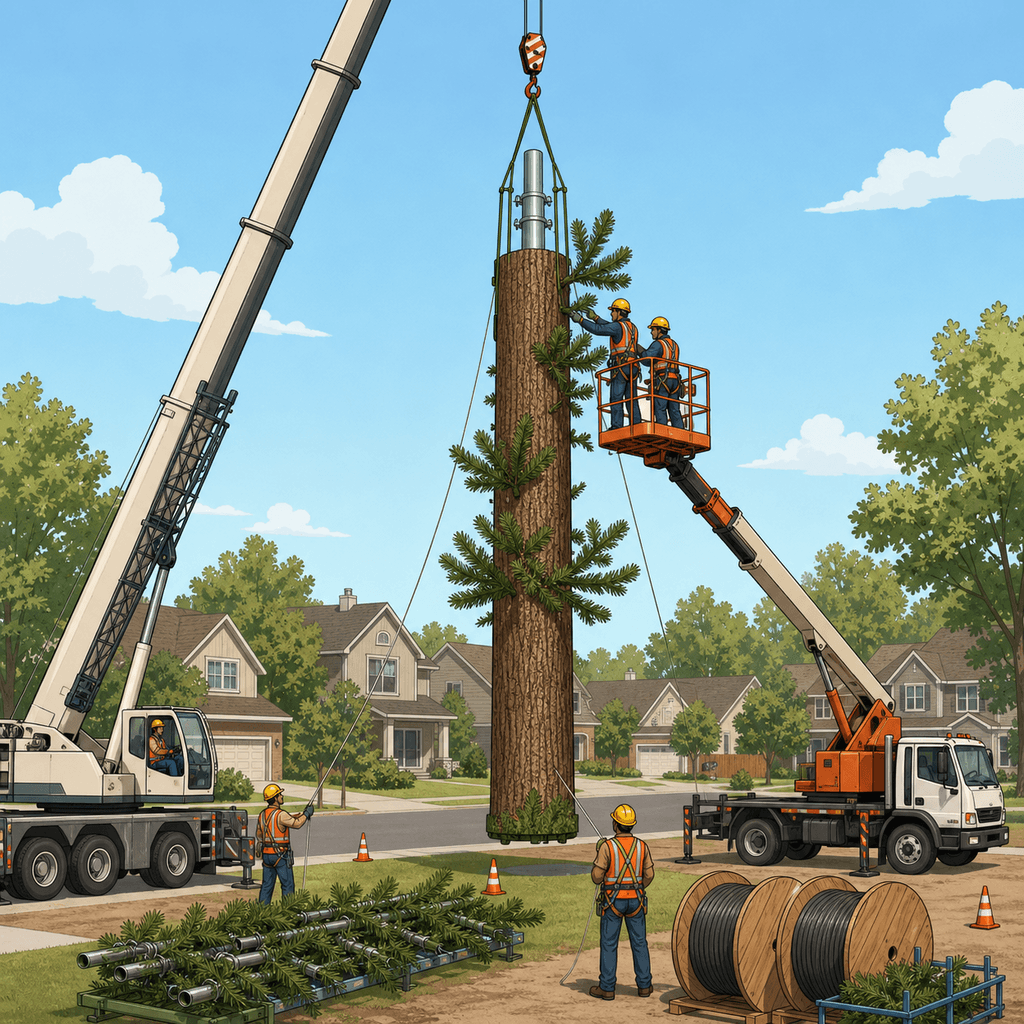
Installation usually requires 1 crane mobilization, 1-2 lifting days, and 7-21 total site days depending on access, weather, utility readiness, and permitting sequence. In scenic corridors, logistics planning matters because lane closures, traffic management, and restricted work windows can add 5-15% to construction cost if not coordinated early. Annual O&M generally includes visual inspection, bolt torque checks, grounding verification, branch attachment review, and coating assessment. Compared with a standard monopole, the monopine adds cladding and foliage maintenance, but it may reduce community-related retrofit demands over the asset life.
EPC Investment Analysis and Pricing Structure
For B2B procurement, the most useful way to evaluate this product is by separating equipment cost, delivered cost, and turnkey EPC cost. SOLARTODO offers FOB Supply, CIF Delivered, and EPC Turnkey structures for this 45 m monopine. EPC scope typically includes engineering, procurement, civil construction, tower erection, installation, commissioning, and 1-year warranty support. On larger programs, optional scope can also include permitting assistance, traffic management planning, CCTV integration, and remote site power packages.
| Pricing Tier | Scope | Price Range (USD) |
|---|---|---|
| FOB Supply | Equipment only, ex-works China | $77,500 - $115,600 |
| CIF Delivered | Equipment + ocean freight + insurance | $99,109 - $147,832 |
| EPC Turnkey | Engineering, procurement, construction, commissioning, 1-year warranty | $125,000 - $170,000 |
For multi-site rollouts, the following volume discounts are typically available on equipment and selected EPC packages, subject to final engineering standardization and destination. A 50+ unit program can reduce average pricing by 5%, a 100+ unit program by 10%, and a 250+ unit framework by 15%. These reductions are most achievable where branch geometry, platform loading, and foundation assumptions are standardized across the portfolio.
| Volume | Discount |
|---|---|
| 50+ units | 5% |
| 100+ units | 10% |
| 250+ units | 15% |
ROI should be assessed against the alternative of a standard visible tower plus approval delays, redesign costs, or lower-height multi-pole deployment. If a conventional tower saves $35,000-$50,000 in capex but delays service launch by 6 months, the lost lease revenue or operator service value can outweigh the initial saving. For example, if one scenic macro site supports tenant or service value equivalent to $2,500-$4,500 per month, accelerated approval and earlier activation can recover $15,000-$27,000 in the first 6 months alone. In corridors where a single 45 m monopine replaces 2 smaller poles, annual maintenance and utility interface savings may reach $3,000-$8,000, leading to an indicative premium payback period of roughly 4-7 years depending on local revenue and permitting conditions.
Standard payment terms are 30% T/T deposit + 70% against B/L for supply contracts, or 100% L/C at sight for qualified transactions. For programs above $1,000,000, staged financing and project-based commercial structures can be discussed. To receive a project-specific commercial offer, loading calculation, and EPC scope matrix, Request a custom quotation or contact [email protected] directly.
Procurement Guidance for Engineers and Buyers
When issuing an RFQ for a 45 m monopine, buyers should specify at least 10 key inputs: height, wind speed, seismic zone, terrain category, antenna count, dish size, feeder/cable load, access preference, grounding target, and finish requirements. Omitting even 2-3 of these parameters can create substantial pricing variance because stealth branch density, shaft diameter, and foundation reactions are load-sensitive. A disciplined RFQ package reduces technical clarification cycles and can shorten bid comparison by 2-4 weeks.
SOLARTODO supports documentation packages suitable for operators, EPCs, and public-sector buyers, including GA drawings, loading assumptions, material schedules, and commercial breakdowns. Buyers comparing alternatives can also review broader infrastructure references through the SOLARTODO knowledge center. For projects spanning multiple scenic sites, standardization of 3 platform levels, 9 antenna positions, and a common 50 m/s wind class can materially improve procurement efficiency and manufacturing lead time consistency.
Data References and Industry Context
This product category aligns with structural and infrastructure themes addressed by TIA-222-H, EN 1993-3-1, and grounding practices commonly associated with IEEE guidance for telecom and utility installations. Broader demand context is supported by digital infrastructure expansion and network energy optimization trends discussed by IEA, IRENA, BloombergNEF, Wood Mackenzie, and NREL publications on resilient infrastructure, electrification, and distributed asset planning. While those organizations do not certify this specific tower, their data helps frame why concealed roadside telecom assets are becoming more common in 2025-2026 network programs.
In summary, the 45 m Monopine Highway Scenic Area is best suited for projects where visual compliance, macro coverage, and permitability are as important as structural strength. It provides 45 m of concealed elevation, 3 platform levels, 9 antenna capacity, 50 m/s wind design, and a realistic turnkey budget of $125,000-$170,000. For operators and public agencies balancing connectivity with landscape protection, this is a practical, standards-based stealth tower solution rather than a decorative compromise.
Technical Specifications
| Tower Height | 45m |
| Tower Type | camouflage_monopine |
| Material | steel_with_cladding |
| Antenna Platforms | 3levels |
| Antenna Capacity | 9antennas |
| Design Wind Speed | 50m/s |
| Total Tip Load | 1500kg |
| Foundation Type | reinforced concrete spread footing |
| Corrosion Protection | Hot-dip galvanized |
| Design Life | 30years |
| Camouflage Type | pine_tree |
| Application | highway_scenic |
| Standards | TIA-222-H / EN 1993-3-1 |
Price Breakdown
| Item | Quantity | Unit Price | Subtotal |
|---|---|---|---|
| 45m steel monopole core with bark cladding | 1 pcs | $62,000 | $62,000 |
| Artificial pine branch camouflage system | 1 pcs | $18,500 | $18,500 |
| Antenna platform assemblies | 3 pcs | $800 | $2,400 |
| Climbing ladder with safety rail | 45 pcs | $15 | $675 |
| Cable tray system | 45 pcs | $10 | $450 |
| Lightning protection system | 1 pcs | $500 | $500 |
| Aircraft warning light set | 1 pcs | $300 | $300 |
| Concrete foundation works | 45 pcs | $300 | $13,500 |
| Installation & Commissioning | 1 pcs | $18,500 | $18,500 |
| Engineering & QC | 1 pcs | $9,500 | $9,500 |
| 1-Year Warranty & Support | 1 pcs | $4,200 | $4,200 |
| Total Price Range | $125,000 - $170,000 | ||
Frequently Asked Questions
What makes a 45m monopine different from a standard telecom monopole?
How many antennas can this tower support?
What is included in the EPC turnkey price?
What standards and safety features apply to this tower?
What warranty and payment terms are available?
Certifications & Standards


Data Sources & References
- •TIA-222-H Antenna Supporting Structures Standard
- •EN 1993-3-1 Eurocode 3 Towers, Masts and Chimneys
- •IEA digital infrastructure and energy efficiency outlooks 2025
- •IRENA infrastructure and electrification reports 2025
- •BloombergNEF telecom and infrastructure market references 2025
- •Wood Mackenzie network infrastructure market analysis 2025
- •NREL resilient infrastructure and asset planning references 2025
Interested in this solution?
Contact us for a customized quote based on your specific requirements.
Contact Us