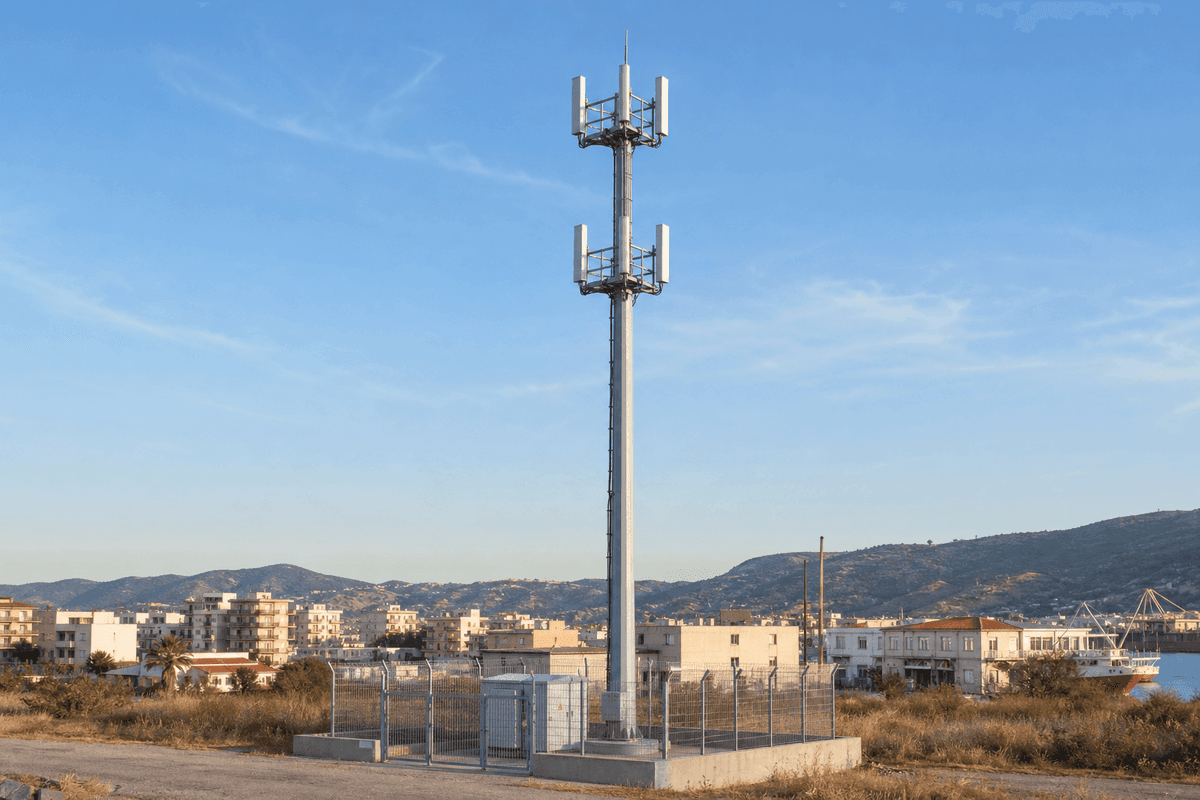
25m Monopole Urban 4G/5G Telecom Tower - Compact Steel Infrastructure for 5G Densification
Key Features
- 25-meter tapered steel monopole with only 3-meter diameter foundation footprint, enabling deployment in the most constrained urban infill sites and reducing required land area by over 85% versus conventional lattice towers
- Supports 2 antenna platforms and up to 6 × 4G/5G panel antennas at 120-degree azimuthal spacing for full 360-degree sector coverage, with optional microwave dish integration for multi-operator sharing
- Engineered to withstand sustained wind speeds of 45 m/s, fully compliant with TIA-222-H (US), EN 1993-3-1 (EU), and GB 50135 (China) structural standards with third-party verified safety factors
- Full hot-dip galvanized corrosion protection (ISO 1461, minimum 85-micron zinc coating) on all steel components, delivering a certified design life of 30 to 50 years with minimal maintenance
- Integrated IEC 62305-compliant lightning protection system with less than 4 ohm grounding resistance, ICAO-compliant aviation warning light, and anti-climbing security barrier at 3 m height
The SOLAR TODO 25m Monopole Urban 4G/5G is a hot-dip galvanized tapered steel tower with 2 antenna platforms, 6-antenna capacity, 45 m/s wind resistance, and a 3m concrete pad footprint, compliant with TIA-222-H and EN 1993-3-1, priced from $18,000 to $28,000.
Description
The 25m Monopole Urban 4G/5G Telecom Tower by SOLAR TODO is a premium, space-efficient infrastructure solution engineered specifically for dense urban and suburban environments. Featuring a robust tapered steel tube structure with a minimal 3-meter foundation footprint, this 25-meter monopole supports up to two antenna platforms and six 4G/5G panel antennas while withstanding wind speeds up to 45 m/s. Designed to meet stringent TIA-222-H and EN 1993-3-1 standards, it offers a 30-to-50-year design life, making it the ideal choice for rapid 5G network densification where land availability is severely restricted.
Structural Engineering and Material Excellence
The core architecture of the 25m Monopole Urban 4G/5G relies on high-strength Q345 and Q355 steel alloys, meticulously formed into tapered tubular sections that progressively narrow from a wide base diameter to a slender apex. This geometric tapering is not merely aesthetic — it is a deliberate structural strategy that optimizes the distribution of bending moments along the pole height, concentrating material where stresses are greatest and reducing weight where loads are lower. The result is a structure that delivers exceptional stiffness-to-weight performance, enabling a total tower weight of approximately 3.5 metric tons while maintaining the rigidity required for precision antenna alignment.
The individual tubular sections are joined using two complementary connection methods: flanged connections secured with high-tensile M30 bolts for the primary structural joints, and slip-joint connections for rapid field assembly of upper sections. Both methods are engineered to transmit full bending, shear, and torsional loads without reliance on field welding, ensuring consistent quality regardless of site conditions. The entire steel structure undergoes a rigorous hot-dip galvanizing process conforming to ISO 1461, applying a minimum 85-micron zinc coating that provides superior corrosion resistance even in harsh coastal or industrial atmospheres. This surface treatment, combined with the inherent durability of the steel alloy, guarantees a reliable design life of 30 to 50 years with minimal maintenance requirements.
In terms of load-bearing capacity, the 25-meter monopole is optimized to securely host up to two distinct antenna platforms positioned at strategic heights along the pole. These platforms are engineered to accommodate a total of six heavy-duty 4G/5G panel antennas, with each platform capable of supporting up to three antennas at 120-degree azimuthal spacing for full 360-degree sector coverage. Optional microwave communication dishes can also be integrated on dedicated mounting brackets, enabling the same structure to serve as a combined cellular and backhaul node. The structural design strictly adheres to international engineering codes, including the American TIA-222-H, the European EN 1993-3-1, and the Chinese GB 50135 standards, ensuring that the tower can safely endure extreme weather conditions, including sustained wind speeds of up to 45 meters per second.
Urban Optimization and Installation Efficiency
One of the most significant advantages of the 25m Monopole Urban 4G/5G is its exceptionally small spatial footprint. Unlike traditional lattice towers that require expansive land areas of 10 to 20 square meters or more, this monopole design necessitates a concrete pad foundation of merely 3 meters in diameter, typically excavated to a depth of 4 to 6 meters and anchored with a precision-set bolt circle. This compact foundation profile is crucial for urban infill projects, allowing network operators to deploy essential 5G infrastructure in highly congested city centers, narrow street corridors, roadside medians, and restricted commercial zones where real estate is at a premium and zoning approvals are difficult to obtain.
Furthermore, the streamlined design of the monopole significantly accelerates the installation process. The prefabricated tubular sections are efficiently transported on standard flatbed trucks and rapidly assembled on-site using a mobile crane in as little as one to two working days. This efficiency reduces total deployment time by approximately 40% compared to conventional lattice tower construction, which requires multi-day bolted assembly of hundreds of individual angle members. The reduction in on-site construction time directly minimizes disruption to urban traffic, local businesses, and residential communities, a critical factor in obtaining municipal permits and maintaining positive community relations.
A notable real-world application scenario illustrates these advantages clearly. A major telecommunications operator in the MENA region deployed a network of 45 SOLAR TODO 25m monopoles across a densely populated capital city as part of a large-scale 5G network densification initiative. Each tower was installed within a two-day window per site, with the compact concrete pad foundations pre-cast off-site to further accelerate the schedule. The rapid installation capabilities allowed the operator to complete the entire 5G densification project three months ahead of the original schedule, significantly accelerating their commercial 5G service launch and delivering a measurable competitive advantage in the market.
When compared to a conventional three-legged lattice tower of equivalent height, the 25m Monopole Urban 4G/5G reduces the required land area by over 85%, from approximately 25 square meters to just 7 square meters including the security perimeter. This land savings translates directly into reduced site lease costs, which can represent a saving of $3,000 to $8,000 per year per site over the tower's operational life, yielding a cumulative financial benefit that substantially offsets the initial capital investment.
Safety, Security, and Accessibility Systems
Safety and security are paramount in the design of the 25m Monopole Urban 4G/5G, given its deployment in densely populated urban environments where public safety and equipment reliability are non-negotiable. To protect the valuable telecommunications equipment and ensure uninterrupted service, the tower is equipped with a comprehensive lightning protection system conforming to IEC 62305. This system includes a top-mounted stainless steel air terminal, a dedicated copper down conductor routed along the exterior of the pole, and a robust grounding network consisting of a buried copper ring electrode and vertical ground rods. The system is engineered to maintain an electrical resistance of less than 4 ohms, effectively dissipating lightning strike energy safely into the earth and protecting all connected electronic equipment from transient overvoltage damage.
Additionally, the apex of the tower features a dual-circuit aviation warning light complying with ICAO Annex 14 and local civil aviation authority requirements. This warning light is essential for alerting low-flying aircraft, helicopters, and drones operating in urban airspace, and is typically equipped with an automatic daylight sensor for energy-efficient operation. The warning light circuit is connected to the tower's main power supply with a dedicated circuit breaker and surge protection device, ensuring reliable operation independent of the antenna equipment power systems.
For maintenance accessibility, the tower offers flexible climbing solutions tailored to operator preferences and local safety regulations. The standard configuration includes an external hot-dip galvanized steel ladder with a continuous safety rail running the full height of the tower, providing a secure fall-arrest system for maintenance technicians. An alternative internal FRP ladder system is available for operators who prefer a more aesthetically discreet solution. At the base, a robust anti-climbing security barrier is installed at a height of 3 meters from the ground, constructed from heavy-gauge galvanized steel mesh panels that effectively prevent unauthorized access while allowing visual inspection of the base area. Operators can also specify an integrated CCTV monitoring system with IP cameras and remote access capabilities for enhanced site security and real-time surveillance.
Market Context and 5G Densification
The global telecommunications industry is undergoing a profound transformation driven by the rapid rollout of 5G networks. Unlike 4G LTE, which relied on a relatively sparse network of macro towers, 5G's higher frequency bands — particularly sub-6 GHz and mmWave — require a significantly denser network of smaller, more numerous cell sites to achieve adequate coverage and capacity. Industry analysts project that the number of cell sites globally will need to increase by 50 to 100% over the next decade to support 5G densification requirements, with urban environments representing the most critical and challenging deployment areas.
The 25m Monopole Urban 4G/5G is precisely engineered to address this market demand. Its combination of sufficient height for effective 5G signal propagation, minimal footprint for urban site acquisition, rapid installation for accelerated network rollout, and multi-operator sharing capability for cost efficiency makes it the optimal infrastructure choice for mobile network operators, tower companies, and municipal authorities investing in smart city connectivity infrastructure. SOLAR TODO's proven manufacturing expertise and global supply chain ensure consistent product quality and competitive lead times, supporting operators' aggressive 5G deployment schedules worldwide.
Technical Specifications
| Tower Height | 25m |
| Tower Type | Monopole (Tapered Tubular Steel) |
| Material | High-Strength Steel Q345/Q355 |
| Antenna Platforms | 2levels |
| Antenna Capacity | 6antennas |
| Design Wind Speed | 45m/s |
| Total Tip Load | 800kg |
| Foundation Type | Concrete Pad with Anchor Bolts (~3m diameter, 4-6m deep) |
| Corrosion Protection | Hot-Dip Galvanized, min. 85 micron (ISO 1461) |
| Lightning Protection Grounding Resistance | <4ohm |
| Design Life | 30-50years |
| Standards Compliance | TIA-222-H / EN 1993-3-1 / GB 50135 |
| Application | Urban Infill / 5G Densification |
| Anti-Climbing Barrier Height | 3m |
| Climbing System | External Ladder + Safety Rail (or Internal FRP Ladder) |
Price Breakdown
| Item | Quantity | Unit Price | Subtotal |
|---|---|---|---|
| Steel Tube (Q355) - Tapered Monopole Sections | 3.5 tons | $2,200 | $7,700 |
| Hot-Dip Galvanizing Treatment (ISO 1461) | 3.5 tons | $400 | $1,400 |
| Antenna Platform (Steel, Galvanized) | 2 pcs | $2,500 | $5,000 |
| External Climbing Ladder + Safety Rail | 25 m | $80 | $2,000 |
| Cable Tray System | 25 m | $50 | $1,250 |
| Lightning Protection System (Air Terminal + Down Conductor + Grounding) | 1 set | $3,000 | $3,000 |
| Aircraft Warning Light (ICAO Annex 14 Compliant) | 1 set | $2,500 | $2,500 |
| Concrete Pad Foundation (incl. anchor bolts, ~15 m³) | 15 m³ | $300 | $4,500 |
| Installation (Steel Structure) | 3.5 tons | $800 | $2,800 |
| Total Price Range | $18,000 - $28,000 | ||
Frequently Asked Questions
What is the primary advantage of a monopole tower over a lattice tower for urban deployments?
How does the tower withstand high wind speeds of 45 m/s?
What kind of maintenance is required for the steel structure over its service life?
Can the tower accommodate future equipment upgrades as 5G technology evolves?
What safety features are included for maintenance personnel accessing the tower?
Certifications & Standards



Data Sources & References
- •TIA-222-H: Structural Standard for Antenna Supporting Structures and Antennas (2017)
- •EN 1993-3-1: Eurocode 3 - Design of Steel Structures - Towers, Masts and Chimneys (2006)
- •GB 50135-2019: Standard for Design of High-Rising Structures
- •GSMA Intelligence: 5G Network Densification Trends Report 2025
- •ISO 1461:2009 - Hot Dip Galvanized Coatings on Fabricated Iron and Steel Articles
- •IEC 62305: Protection Against Lightning (2010)
Interested in this solution?
Contact us for a customized quote based on your specific requirements.
Contact Us