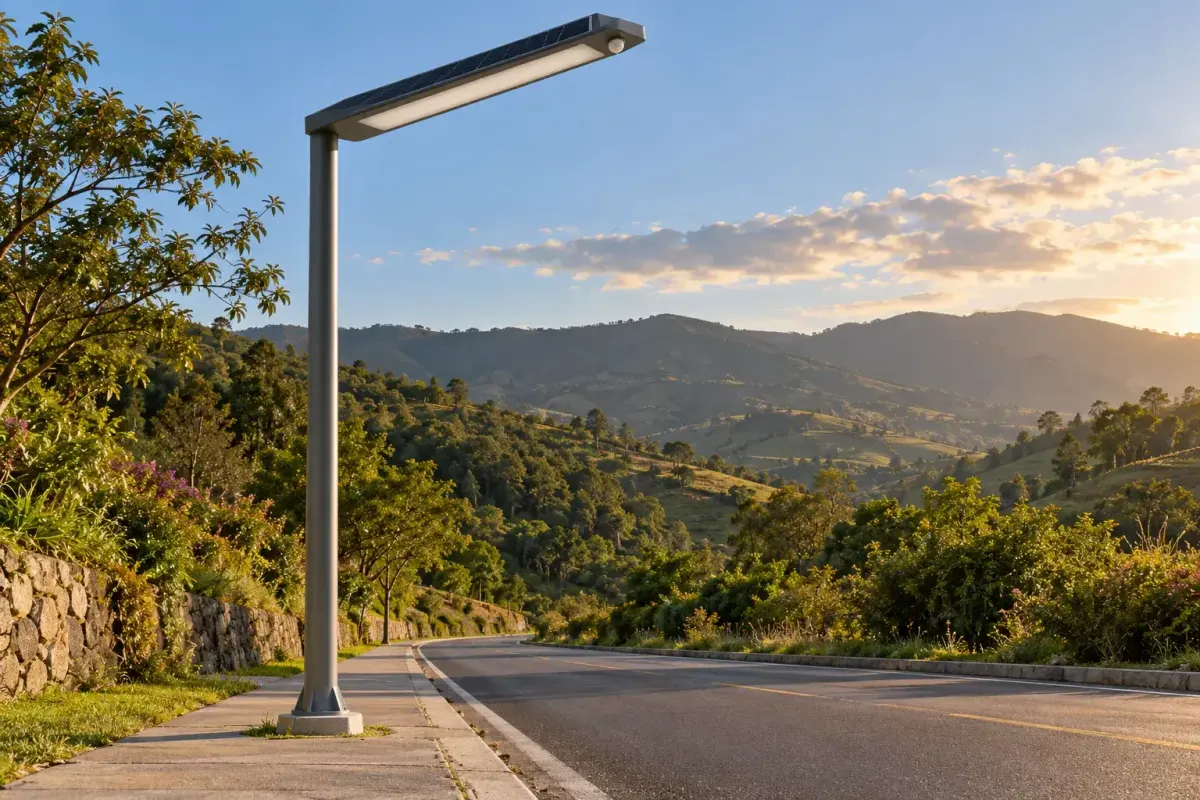
5.8m All-in-One Solar Streetlight 46W - Integrated LFP Solar Lighting
Key Features
- 5.8 m aluminum-alloy pole with 1 integrated solar lighting head.
- 46 W nominal LED output; estimated 7,820 lm assumes 170 lm/W luminaire efficacy.
- 92 Wp TOPCon panel and 414 Wh LiFePO4 battery with protective BMS.
- 7-day autonomy target requires emergency dimming; illustrative maximum average LED load is 3.55 W over 84 hours.
- Indicative EPC pricing of $183–$306 per point includes commissioning and a 1-year warranty.
The 5.8m All-in-One Solar Streetlight 46W integrates a 92 Wp panel, 414 Wh LFP battery, and aluminum-alloy pole. Indicative EPC pricing is $183–$306 per point; 7-day autonomy requires a defined low-output schedule rather than continuous 46 W operation.
Description
The 5.8m All-in-One Solar Streetlight 46W combines a 92 Wp solar panel, a 414 Wh LiFePO4 battery, and a 46 W LED light engine on a 5.8 m aluminum-alloy pole. Designed for temperate-climate projects, it has indicative EPC turnkey pricing of $183–$306 per lighting point; its stated 7-day autonomy requires an engineered reduced-output schedule rather than continuous full-power operation.
System Architecture
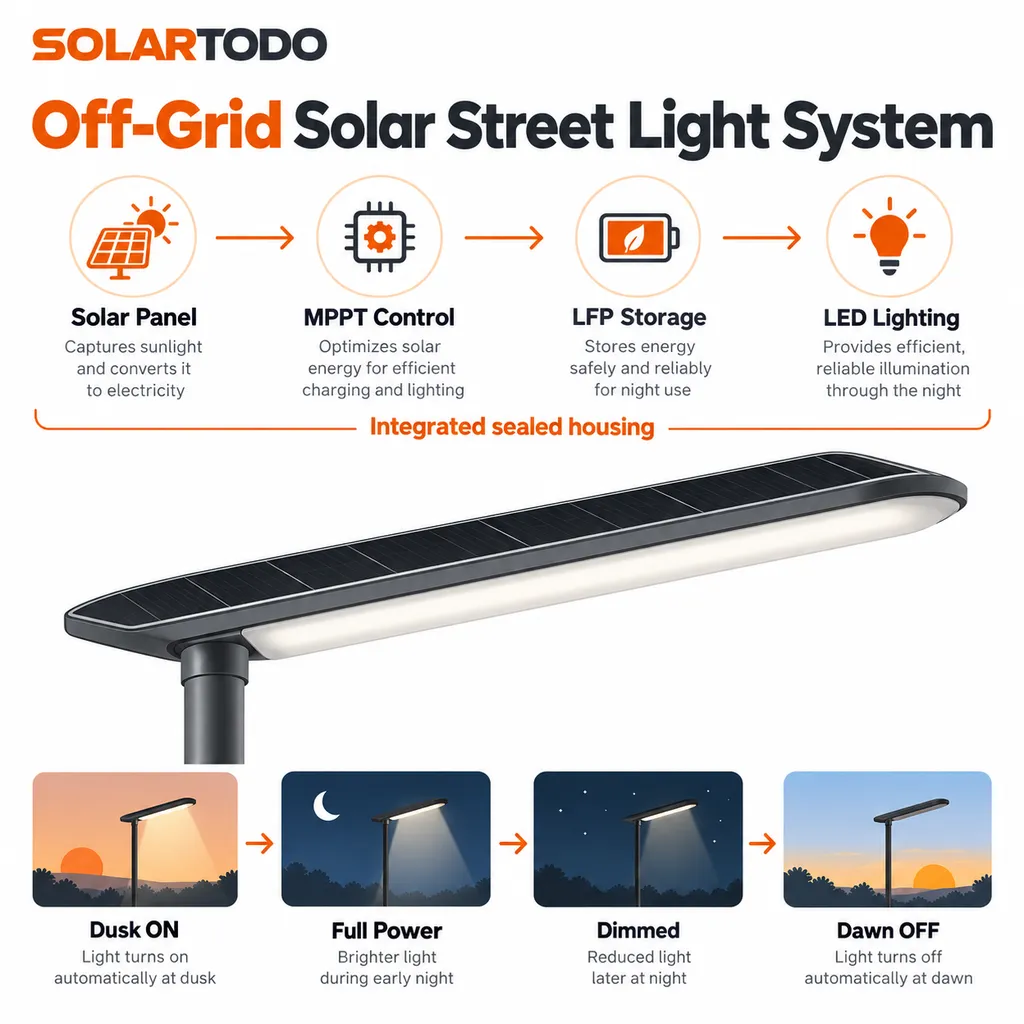
The all-in-one head integrates 4 principal electrical functions: photovoltaic generation, battery storage, charge control, and LED illumination. This arrangement reduces external connections and eliminates a separate ground-level battery enclosure. The 5.8 m pole supports the integrated assembly, while the battery remains accessible through a service compartment whose opening method, gasket replacement procedure, and spare-parts availability should be confirmed before ordering.
The specified 92 Wp monocrystalline TOPCon panel charges the 414 Wh LFP battery through an MPPT controller. Product-line targets include 19–23% module efficiency and controller conversion efficiency above 98% under defined conditions; neither value establishes daily system yield. Panel orientation, shading, operating temperature, wiring losses, battery charging losses, and the nighttime load determine usable lighting energy.
Technical Specifications
The configuration below identifies the supplied design inputs for 1 lighting point and separates them from performance values requiring test reports. LED power is the nominal lighting rating; panel capacity is expressed in Wp, and battery capacity is nominal stored energy in Wh. These quantities describe different functions and should never be added together as a single system power rating.
| Parameter | Configuration or engineering status |
|---|---|
| Pole height | 5.8 m |
| Nominal LED power | 46 W |
| Solar panel | 92 Wp monocrystalline TOPCon |
| Battery | 414 Wh LiFePO4, with BMS |
| Construction | 1 integrated panel/battery/controller/LED head |
| Pole material | Aluminum alloy; grade and thickness to be specified |
| Lighting schedule | Up to 12 h/night with programmed dimming |
| Autonomy | 7-day design target, conditional on reduced load |
| Estimated initial flux | 7,820 lm at an assumed luminaire efficacy of 170 lm/W |
| Ingress protection | IP66 target; model-specific report required |
| Wind resistance | Site-specific structural calculation required; no verified km/h rating supplied |
| Operating temperature | Lower design target −20°C; upper limit and charging range require confirmation |
| Included EPC warranty | 1 year under the stated commercial tier |
The calculated 7,820 lm figure is a screening estimate, obtained from 46 W × 170 lm/W, rather than a measured output declaration. A supplier photometric file must establish delivered luminaire lumens, distribution, glare, and maintained illuminance. Roadway and streetlight safety requirements are addressed by IEC 60598-2-3; referencing this standard does not demonstrate that this particular assembly has been tested.
Battery Capacity and Seven-Day Autonomy
At continuous nominal output, the LED consumes 46 W × 12 h = 552 Wh per night, exceeding the battery's entire 414 Wh nameplate capacity. Even before losses, the theoretical runtime is only 9 h. With illustrative assumptions of 80% usable battery capacity and 90% discharge-path efficiency, delivered energy becomes 298.08 Wh, supporting approximately 6.48 h at 46 W.
For 7 nights of 12 h operation without useful solar charging, the same 298.08 Wh budget permits only 3.55 W average LED power, approximately 7.7% of nominal output. This estimate excludes controller standby consumption, telecommunications demand, aging, and cold-temperature derating. Consequently, the 7-day claim must be tied to a documented emergency dimming profile and tested battery conditions.
A controller can prioritize 1 brighter period after dusk, dim through low-traffic hours, and raise output briefly after motion detection. However, traffic frequency changes total consumption, and repeated 46 W boost events can exhaust an emergency reserve. Buyers should obtain separate normal-night and low-state-of-charge schedules, including minimum output, sensor timeout, battery cutoff voltage, and recovery behavior after charging resumes.
LFP product-line guidance indicates 2,000+ deep cycles under specified test conditions; actual life depends on depth of discharge, cell temperature, charge rate, and storage state. Low-temperature protection should inhibit charging below the battery manufacturer's permitted threshold, even if discharge remains possible at −20°C. System verification should address the operating sequence described by IEC 62124:2004, rather than infer autonomy from battery chemistry alone.
Solar Yield and Seasonal Sizing
For a transparent first estimate, assume 4 peak-sun-hours daily and a combined harvest-to-usable-energy factor of 75%. The 92 Wp panel then provides approximately 276 Wh/day, calculated as 92 × 4 × 0.75. This supports an average 23 W lighting load across 12 h under those assumptions, with no additional margin for restoring a depleted battery after cloudy weather.
At 2 peak-sun-hours, the same calculation falls to 138 Wh/day, allowing only 11.5 W average over 12 h. Winter shading, dirt accumulation, and panel orientation can reduce this further. A 46 W nameplate therefore describes available maximum output, while the sustainable nighttime schedule must follow the site's least favorable design month and its required minimum lighting level.
Use 12 monthly irradiance estimates and a sequential battery-energy model when selecting the operating profile. NREL's PVWatts calculator provides a recognized starting point for photovoltaic resource and production screening, but it models grid-connected PV and does not itself validate stand-alone battery autonomy. Its annual output should not be presented as proof of 7-night lighting availability.
Lighting Design and Conventional Alternatives
At a 5.8 m mounting height, pole spacing cannot be specified from wattage alone. Designers need road width, setback, mounting angle, pavement reflectance, pedestrian activity, and a verified intensity distribution. A DIALux or equivalent calculation should report maintained average illuminance, minimum illuminance, uniformity, and glare against the applicable project criteria before selecting 1 final pole layout.
Compared with an assumed conventional 100 W fixture operating for 12 h nightly, continuous 46 W operation reduces nominal lighting energy by 54%, from 438 to 201.48 kWh/year. This arithmetic excludes ballast losses and does not establish equal illumination. It also exceeds this configuration's illustrative daily solar-energy budget, so a practical dimmed solar schedule requires a separate photometric assessment.
An illustrative 18 W average dimmed profile consumes 78.84 kWh/year, or 82% less energy than that assumed 100 W baseline. Controls can reduce demand, but the saving depends on occupancy and minimum lighting requirements. The U.S. Department of Energy's roadway lighting research discusses adaptive lighting; it does not certify an 82% saving for this product.
Applications
The 5.8 m configuration is a candidate for pedestrian routes, residential access roads, parking edges, and solar-farm service tracks where the required lighting calculation supports its output. It can avoid feeder trenching between lighting points, although each pole still requires a suitable foundation. High-speed roads, continuously busy intersections, and shaded corridors may require larger storage, separate panels, or another supply architecture.
Representative scenario — 50-point temperate solar-farm access route: assume 50 lights, 4 peak-sun-hours, 75% harvest-to-usable-energy efficiency, and 18 W average illumination for 12 h nightly. Each light uses 216 Wh/night against an estimated 276 Wh/day harvest. The resulting 60 Wh/day nominal surplus is preliminary, not a verified winter charging margin or a customer operating result.
For that 50-point scenario, a 414 Wh battery with the previously stated usable-energy assumptions supplies about 1.38 nights at 216 Wh/night without charging. Seven-night reserve operation therefore requires substantially lower output. Engineers should compare 2 schedules—normal service and emergency reserve—and reject any low-output profile that fails the site's minimum lighting requirement.
Cloud Monitoring
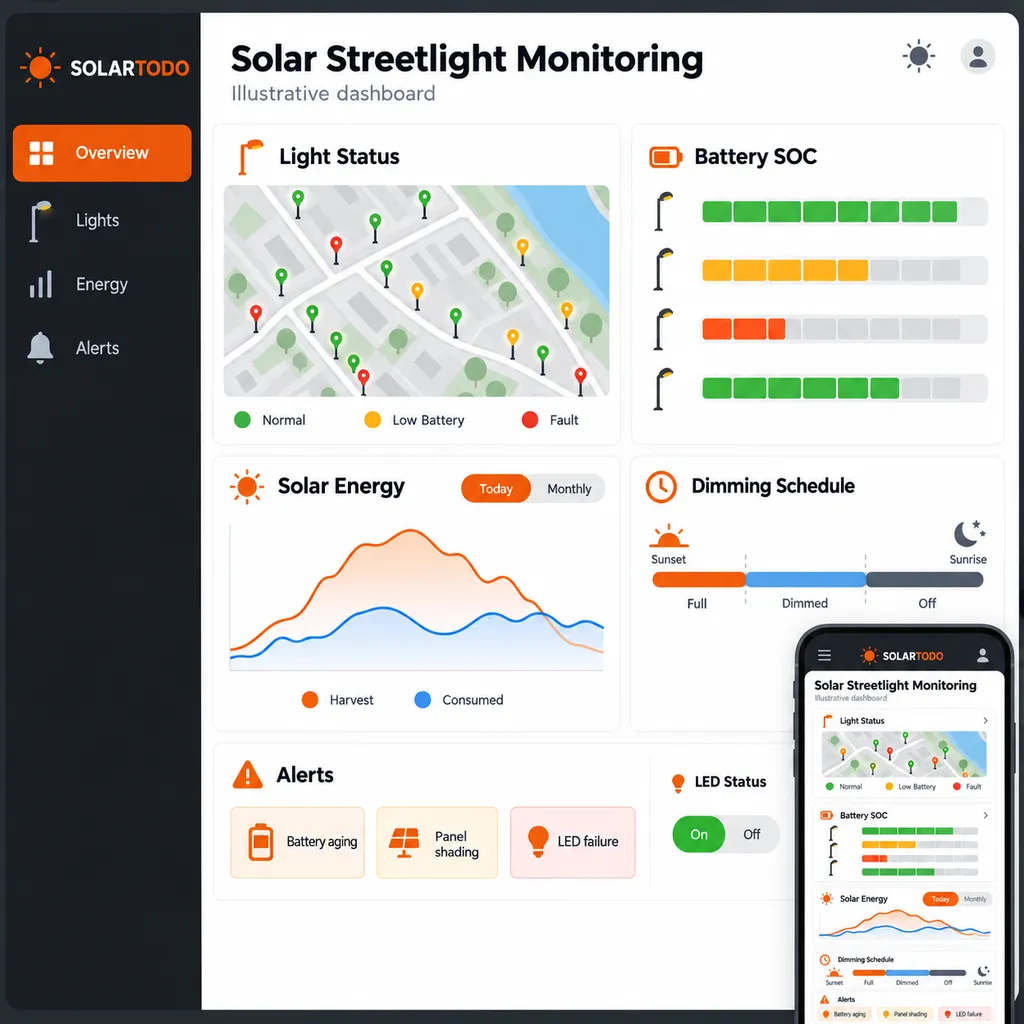
Optional 4G or LoRa connectivity can support battery-state reporting, operating schedules, fault notifications, and fleet grouping. These functions require a specified communications controller and compatible platform; they are not confirmed inclusions in the base price. Even a continuous 1 W auxiliary load consumes 24 Wh/day, so communication hardware must be included in both energy sizing and the quotation.
For a 50-light installation, request an asset register linking each pole to its location, controller identifier, commissioning date, and programmed schedule. Connectivity acceptance should cover local network availability, alarm delivery, remote setting changes, and behavior during communications loss. At least 1 locally stored lighting schedule should remain executable when the cloud connection is unavailable.
Installation, Structure, and Maintenance
The product-line installation target of approximately 30 min per pole applies to mechanical and electrical assembly after foundations, lifting arrangements, and access are ready. It excludes excavation, concrete curing, soil remediation, and traffic management. At 5.8 m height, the foundation and base connection require checks for local wind loading, soil capacity, panel projected area, and pole geometry.
Aluminum-alloy construction reduces handling weight relative to an otherwise comparable steel design, but no verified pole mass or wind rating is supplied for this 5.8 m variant. Confirm alloy, wall thickness, surface finish, anchor pattern, and galvanic isolation between dissimilar metals. Coastal sites need a specific corrosion assessment; aluminum alone does not establish a salt-spray performance class.
An IP66 enclosure target addresses dust and water ingress under defined testing, while IP67 is a different declared protection level and should not be substituted without evidence. IEC 60529 defines the IP classification framework. Procurement should request the report for the actual housing, seals, cable entries, and service-cover arrangement, plus at least 1 post-service sealing inspection procedure.
Schedule an initial inspection after 3 months, then set cleaning and inspection intervals from local dust and weather conditions. Product-line targets of 50,000+ LED operating hours and a 25-year panel design life are component planning figures, not equivalent system warranties. Batteries, seals, drivers, and sensors can require replacement sooner, particularly when thermal management or maintenance access is inadequate.
EPC Investment Analysis and Pricing Structure
For 1 lighting point, EPC means engineering, procurement, construction, commissioning, and the specified warranty service. Engineering covers energy budgeting, lighting layout, and structural coordination; procurement covers equipment and quality checks. Construction and commissioning cover the agreed footing, pole assembly, controller programming, and handover tests. The quoted $183–$306 range remains subject to the project's confirmed scope and location.
| Pricing tier | Indicative USD per lighting point | Commercial scope |
|---|---|---|
| FOB Supply | $113–$208 | Equipment; named China port and delivery basis to be confirmed |
| CIF Delivered | $127–$234 | Equipment, ocean freight, and insurance to the named destination port |
| EPC Turnkey | $183–$306 | Agreed installation, commissioning, and 1-year warranty |
FOB and ex-works are 2 different delivery terms, so the equipment tier must identify which contractual basis applies. CIF does not automatically include import duties, destination handling, or inland delivery. These allowances are especially important for a 5.8 m aluminum pole, because packaging dimensions and shipment volume can materially change the delivered cost per lighting point.
| Order quantity | Proposed volume discount | Illustrative EPC range after discount |
|---|---|---|
| 50–99 pcs | 5% | $173.85–$290.70 |
| 100–249 pcs | 10% | $164.70–$275.40 |
| 250+ pcs | 15% | $155.55–$260.10 |
These 3 discount bands are commercial planning assumptions subject to written quotation, identical configuration, and shipment consolidation. They are not cumulative and may apply differently to freight, taxes, or local civil works. The discounted figures are arithmetic illustrations from the published EPC range, rather than separate guaranteed minimum prices for every installation location.
An illustrative single-point EPC budget totals $299.60: integrated head $70, aluminum pole $127.60, foundation allowance $50, engineering and quality control $12, installation and commissioning $28, and 1-year support $12. The head uses the supplied 60 W-class industry reference as a provisional proxy, while the pole uses $22/m × 5.8 m. This is an estimating allocation, not a verified factory quotation.
The 92 Wp panel, 414 Wh battery, MPPT controller, and 46 W LED are included within that integrated-head allowance and must not be charged again as separate complete components. The $50 foundation allowance assumes straightforward civil works; unsuitable soil, larger wind loads, access equipment, or permits can increase actual EPC cost beyond the advertised range.
For a simple payback illustration, assume an existing 100 W grid light consumes 438 kWh/year, electricity costs $0.15/kWh, and solar maintenance costs $10/year. Avoided grid electricity is $65.70/year, giving $55.70/year net operating savings before battery replacement, financing, and taxes. Applying the $183–$306 EPC range gives approximately 3.3–5.5 years simple payback, conditional on acceptable lighting service.
At an electricity price of $0.10/kWh, the same assumptions produce $33.80 annual net savings and approximately 5.4–9.1 years payback. Against an assumed $400 new grid-connected installation, initial capital avoidance would instead be $94–$217 per point. These are alternative comparison cases; buyers should use actual trenching quotations and lifecycle costs, consistent with DOE exterior-lighting purchasing guidance.
Payment options are 30% T/T deposit plus 70% against B/L, or 100% L/C at sight, subject to contract. Financing may be considered for projects above $1,000,000, subject to lender approval. The stated EPC tier includes 1 year of warranty; the template's 3-year system and 5-year pole terms require an explicit written extension and are not automatically included.
Procurement and Configuration
For the 46 W variant, prepare a procurement schedule covering the destination, quantity, mounting conditions, normal lighting profile, emergency minimum output, and required reports. View all Solar Street Light products to compare integrated and alternative configurations, or Configure your system online using the 5.8 m mounting height as the initial design input.
Before releasing an order for 50 or more units, request a sample, photometric file, battery specification, inspection checklist, and the proposed autonomy test method. Learn about solar streetlight energy sizing for further background, then Request a custom quotation or email [email protected]. SOLARTODO should confirm the final 92 Wp/414 Wh configuration, delivery basis, warranty, and acceptance criteria in the signed offer.
Technical Specifications
| Pole Height | 5.8m |
| LED Power | 46W |
| Luminous Flux | 7820 estimated at 170 lm/W; measured luminaire output requires verificationlm |
| Solar Panel | 92; monocrystalline TOPConWp |
| Battery Capacity | 414; LiFePO4 / LFPWh |
| Autonomy | 7-day target with engineered emergency dimming; not continuous 46 W operation |
| Pole Material | Aluminum alloy; grade, thickness and finish require confirmation |
| Wind Resistance | Not specified; site-specific structural verification requiredkm/h |
| Operating Temperature | −20°C lower design target; upper limit and battery charging limits require confirmation |
| Lighting Hours | 12; dusk-to-dawn with an energy-budgeted dimming scheduleh/day |
| Warranty | 1 year included in EPC tier; 3-year system and 5-year pole terms require written confirmation |
| System Type | All-in-one integrated panel, battery, controller and LED |
| Climate | Temperate; winter solar-resource assessment required |
| Ingress Protection | IP66 target; model-specific test report required |
| Controller | MPPT; product-line efficiency target above 98% under defined conditions |
| Remote Monitoring | Optional 4G or LoRa; hardware, service fees and energy demand require quotation |
Price Breakdown
| Item | Quantity | Unit Price | Subtotal |
|---|---|---|---|
| Integrated 46 W lighting head with 92 Wp panel, 414 Wh LFP battery and controller; provisional 60 W-class reference-price allowance | 1 pcs | $70 | $70 |
| 5.8 m aluminum-alloy pole; estimated at $22 per meter | 1 pcs | $128 | $128 |
| Foundation and anchor assembly allowance; straightforward site conditions | 1 pcs | $50 | $50 |
| Engineering and quality control | 1 pcs | $12 | $12 |
| Installation and commissioning | 1 pcs | $28 | $28 |
| 1-year warranty and support allowance | 1 pcs | $12 | $12 |
| Total Price Range | $183 - $306 | ||
Frequently Asked Questions
Can the 414 Wh battery operate the light at 46 W for 7 rainy days?
What does the $183–$306 EPC price include?
Is the 92 Wp panel sufficient for dusk-to-dawn lighting?
Are IEC certification and IP66 protection verified for this model?
Can 4G or LoRa monitoring be added to a 50-light project?
Certifications & Standards

Data Sources & References
- •SOLARTODO user-supplied configuration, pricing tiers, component reference prices, and product-line technical guidance; model-specific test reports not supplied.
- •IEC 60598-2-3: Luminaires for road and street lighting — https://webstore.iec.ch/en/publication/2568
- •IEC 62124:2004: Photovoltaic stand-alone systems — Design verification — https://products.iec.ch/view/pub/6483
- •IEC 60529: Degrees of protection provided by enclosures — https://webstore.iec.ch/en/publication/2447
- •NREL PVWatts Calculator: grid-connected PV production screening; not a stand-alone autonomy validation — https://pvwatts.nrel.gov/?print=
- •U.S. Department of Energy: Roadway Lighting Research — https://www.energy.gov/cmei/ssl/roadway-lighting-research
- •U.S. Department of Energy: Purchasing Energy-Efficient Exterior Lighting — https://www.energy.gov/cmei/femp/purchasing-energy-efficient-exterior-lighting
- •Illustrative engineering calculations: 80% usable battery capacity, 90% discharge-path efficiency, 75% PV harvest-to-usable-energy factor, and stated tariff assumptions; not measured product results.
Interested in this solution?
Contact us for a customized quote based on your specific requirements.
Contact Us