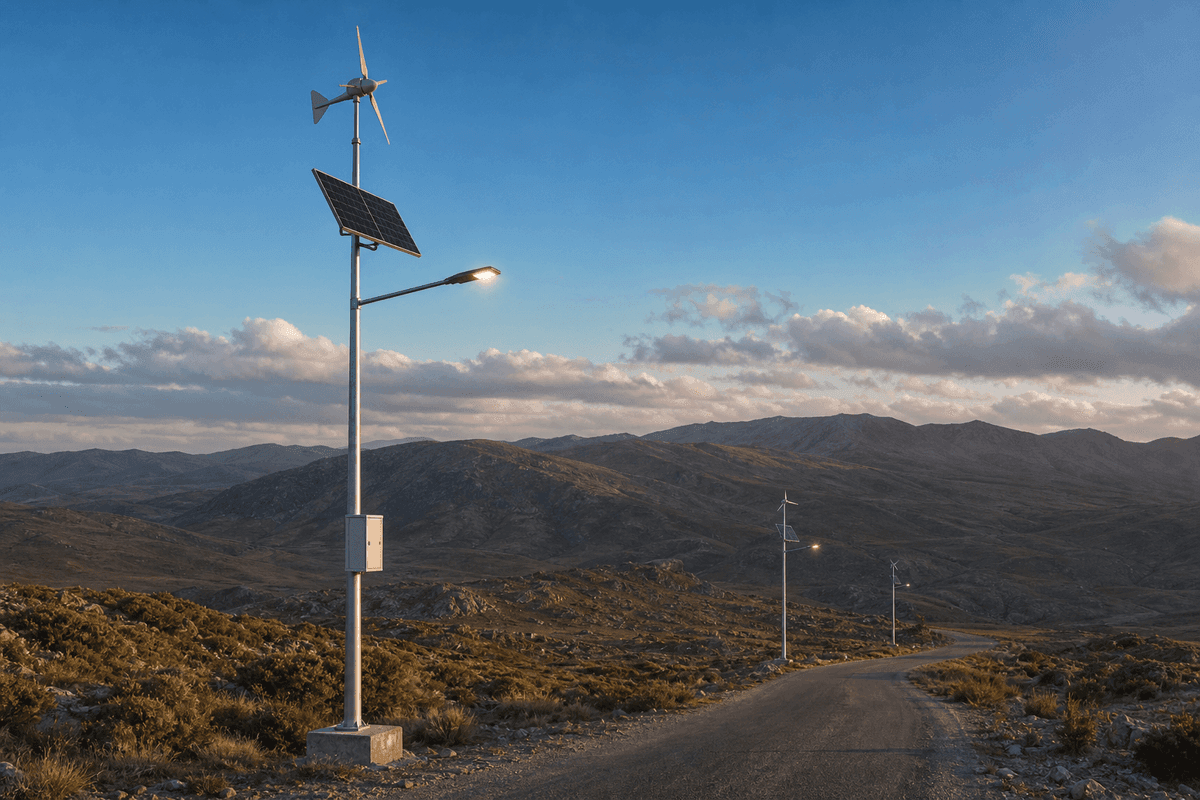
10m Wind-Solar Hybrid 100W - Highland Extreme Reliability
Key Features
- Dual-source charging: 150Wp TOPCon solar panel + 100W vertical axis wind turbine for 250W peak power
- Extended 6-day autonomy with 800Wh LiFePO4 battery (2000+ cycles, 5-7 year lifespan)
- High-efficacy 100W LED delivering 17,000+ lumens at >170 lm/W with 50,000-hour L70 lifespan
- Highland-rated structural integrity: 10m galvanized steel pole withstands >150 km/h wind speeds
- Smart MPPT controller with >98% efficiency, PIR motion dimming, and optional 4G/LoRa remote management
The SOLARTODO 10m Wind-Solar Hybrid 100W system combines a 100W vertical axis wind turbine with a 150Wp solar panel, achieving over 22% efficiency. Priced between $1,200 and $1,650, it meets IEC standards for safety and performance. Ideal for highland and coastal regions, it ensures reliable off-grid lighting solutions.
Description
SOLARTODO 10m Wind-Solar Hybrid 100W: A Technical Deep Dive
1. Introduction: Redefining Off-Grid Lighting Reliability
The SOLARTODO 10m Wind-Solar Hybrid 100W represents a paradigm shift in autonomous public lighting, engineered for environments where energy reliability is non-negotiable. This system integrates a 100W Vertical Axis Wind Turbine (VAWT) with a 150Wp high-efficiency solar panel, creating a dual-source charging solution that ensures consistent operation even through extended periods of low solar irradiance. Designed specifically for highland, coastal, and other high-wind regions, this 10-meter luminaire system delivers a powerful 100W LED output with an exceptional 6-day autonomy, setting a new benchmark for performance and resilience in the solar streetlight industry. Its design and components adhere to rigorous international standards, including IEC 62124 for photovoltaic systems and IEC 60598 for luminaires, ensuring safety, durability, and performance.
2. The Hybrid Engine: Synergistic Power Generation
The core innovation of this model is its hybrid power generation system, which intelligently combines two complementary renewable energy sources. The system features a 150Wp monocrystalline TOPCon (Tunnel Oxide Passivated Contact) solar panel, which achieves a conversion efficiency of over 22%, significantly higher than the industry average of 19-21%. This panel technology, compliant with IEC 61215 standards for crystalline silicon terrestrial PV modules, offers superior performance in low-light conditions and a minimal power degradation rate of less than 0.4% per year over its 25-year lifespan.
Complementing the solar asset is a 100W vertical axis wind turbine. The VAWT design offers several advantages over traditional horizontal-axis turbines, including a lower cut-in wind speed (typically 2.5-3 m/s), omnidirectional wind capture, and quieter operation (<40 dB at 12 m/s). This allows the system to generate substantial power during overcast days, at night, and in winter months when solar generation is reduced. The combined 250W peak charging capacity from both sources provides a diversified energy input, dramatically increasing the system's energy security and enabling the extended 6-day autonomy, a critical requirement for mission-critical infrastructure in regions with unpredictable weather patterns.
3. Advanced Energy Storage: The LiFePO4 Advantage
Energy storage is managed by a robust 800Wh Lithium Iron Phosphate (LiFePO4 or LFP) battery pack, a technology chosen for its superior safety, thermal stability, and cycle life compared to traditional lead-acid or even other lithium-ion chemistries. The battery is rated for over 2,000 deep discharge cycles to 80% depth of discharge (DOD), translating to a reliable operational lifespan of over 5-7 years. This is a significant improvement over lead-acid batteries, which typically last only 500-800 cycles.
The integrated Battery Management System (BMS) is a critical component that ensures both safety and longevity. It provides comprehensive protection against over-charging, over-discharging, short circuits, and thermal runaway. For the specified highland climate configuration, the BMS includes a low-temperature protection feature, which prevents charging below 0°C (32°F) to avoid lithium plating and irreversible capacity loss, a common failure mode for lithium batteries in cold environments. The battery's high energy density of approximately 140 Wh/kg allows for a compact and pole-integrated design, minimizing visual impact and risk of vandalism.
4. Intelligent Control and Remote Management
At the heart of the system is an advanced Maximum Power Point Tracking (MPPT) controller, which optimizes the energy harvest from both the solar panel and the wind turbine. With a tracking efficiency exceeding 98%, the MPPT controller can boost energy yield by up to 30% compared to simpler PWM (Pulse Width Modulation) controllers, especially in partially shaded or overcast conditions. The controller manages the entire energy flow, from the generators to the battery and finally to the LED load.
This intelligence extends to its lighting control capabilities. The system employs a dual-mode smart dimming strategy to conserve energy. A built-in Passive Infrared (PIR) motion sensor can detect pedestrians or vehicles, switching the luminaire from a default 30-40% brightness to 100% output, and then dimming back down after a preset period of inactivity. This adaptive lighting alone can reduce energy consumption by over 60%. Additionally, a time-based dimming schedule can be programmed for further optimization, for instance, running at 70% for the first 5 hours after dusk and 30% for the remainder of the night. Optional 4G or LoRaWAN connectivity modules enable remote monitoring and control, allowing operators to track system status, receive fault alerts, and adjust lighting profiles from a central management platform, in accordance with emerging smart city standards like TALQ.
5. High-Efficacy Illumination and Optical Design
The luminaire itself is a high-performance 100W LED module featuring premium chips from industry-leading manufacturers such as Bridgelux, Cree, or Lumileds. These components deliver an exceptional luminous efficacy of over 170 lumens per watt, producing a total output of more than 17,000 lumens. This high efficiency ensures that the 100W power draw provides illumination levels equivalent to older 250W metal halide lamps, resulting in significant energy savings. The LEDs have a rated L70 lifespan of over 50,000 hours, meaning they will maintain at least 70% of their initial brightness after more than 11 years of 12-hour nightly operation.
The optical design utilizes specialized lenses to distribute light in a precise rectangular pattern (Type II or Type III distribution), maximizing uniformity and illuminance on the target road surface while minimizing light pollution and glare, a key consideration for compliance with IDA (International Dark-Sky Association) guidelines. The luminaire housing is constructed from die-cast aluminum for superior thermal management and is sealed to an IP66 rating, providing complete protection against dust and high-pressure water jets, as defined by the IEC 60529 standard.
6. Structural Integrity for Extreme Environments
The entire system is supported by a 10-meter pole constructed from Q235 steel, which undergoes a hot-dip galvanization process in accordance with ASTM A123 standards. This process applies a protective zinc coating of at least 85 microns, providing excellent corrosion resistance for a lifespan of over 20 years, even in moderately corrosive environments. For the specified highland climate, the pole and all mounting hardware are engineered to withstand wind speeds exceeding 150 km/h (equivalent to a Category 1 hurricane), ensuring structural stability in the most demanding conditions. All external plastics and cable insulation are formulated with UV-resistant additives to prevent degradation from prolonged exposure to high-altitude solar radiation.
Frequently Asked Questions (FAQ)
1. What is the primary advantage of a wind-solar hybrid system over a standard solar-only streetlight?
The primary advantage is enhanced energy reliability. The wind turbine complements the solar panel by generating power during cloudy days, at night, and in winter, when solar output is low. This dual-source charging extends the system's autonomy, making it ideal for critical applications in regions with inconsistent sunshine. For this model, it enables a 6-day autonomy, ensuring continuous operation through prolonged adverse weather.
2. How does the system perform in low-wind or no-wind conditions?
The system is designed for redundancy. During periods of low wind, the 150W high-efficiency solar panel serves as the primary charging source. The 800Wh LiFePO4 battery stores enough energy to power the 100W LED for multiple nights without any charging input. The system's 6-day autonomy is calculated based on a worst-case scenario, ensuring reliable illumination even with several consecutive days of both low sun and low wind.
3. What maintenance is required for the wind turbine and solar panel?
Maintenance is minimal. The vertical axis wind turbine has a direct-drive design with no gearbox and few moving parts, requiring only an annual inspection of bearings and electrical connections. The solar panel surface is largely self-cleaning with rainfall, but may require occasional cleaning in dusty environments to maintain its 22% efficiency. The entire system is designed for a service life of over 20 years with minimal intervention.
4. Can the lighting schedule be customized?
Yes, the intelligent MPPT controller allows for extensive customization. The default setting is dusk-to-dawn operation with motion-adaptive dimming. However, users can program a multi-stage time-based dimming profile (e.g., 100% for 4 hours, 50% for 6 hours). With the optional 4G/LoRa remote management module, these profiles can be adjusted on-the-fly from a central software platform without needing to physically access the pole.
5. What is the wind resistance rating of the 10m pole?
The 10-meter hot-dip galvanized steel pole is engineered to withstand sustained wind speeds of over 150 km/h. This high rating is crucial for its designated application in highland and coastal areas, which frequently experience strong winds. The structural design and foundation are calculated according to local wind load requirements and soil conditions, ensuring the system remains stable and secure throughout its operational lifespan.
References
[1] IEC 62124:2021 - Photovoltaic (PV) stand-alone systems - Design verification [2] IEC 60598-2-3:2022 - Luminaires - Part 2-3: Particular requirements - Luminaires for road and street lighting [3] IEC 61215:2021 - Terrestrial photovoltaic (PV) modules - Design qualification and type approval [4] IEC 60529:1989+A2:2013 - Degrees of protection provided by enclosures (IP Code) [5] ASTM A123 / A123M - 17 - Standard Specification for Zinc (Hot-Dip Galvanized) Coatings on Iron and Steel Products
Technical Specifications
| Pole Height | 10m |
| LED Power | 100W |
| Luminous Flux | 17000lm |
| Luminous Efficacy | 170lm/W |
| Solar Panel Power | 150Wp |
| Solar Panel Efficiency | 22% |
| Wind Turbine Power | 100W |
| Cut-in Wind Speed | 2.5m/s |
| Battery Capacity | 800Wh |
| Battery Type | LiFePO4 |
| Battery Cycle Life | 2000cycles |
| Autonomy | 6days |
| MPPT Efficiency | 98% |
| Pole Material | Hot-Dip Galvanized Steel |
| Wind Resistance | 150km/h |
| Operating Temperature | -20 to +60°C |
| IP Rating | IP66/IP67 |
| LED Lifespan (L70) | 50000hours |
| Lighting Hours | 12h/day |
| System Warranty | 3years |
| Pole Warranty | 5years |
Price Breakdown
| Item | Quantity | Unit Price | Subtotal |
|---|---|---|---|
| Monocrystalline TOPCon Solar Panel (150Wp) | 1 pcs | $42 | $42 |
| Vertical Axis Wind Turbine (100W) | 1 pcs | $250 | $250 |
| LiFePO4 Battery Pack (800Wh) | 1 pcs | $96 | $96 |
| LED Module with Premium Chips (100W) | 1 pcs | $180 | $180 |
| MPPT Controller with Smart Dimming | 1 pcs | $75 | $75 |
| Hot-Dip Galvanized Steel Pole (10m) | 1 pcs | $350 | $350 |
| Foundation and Mounting Hardware | 1 pcs | $80 | $80 |
| Total Price Range | $1,200 - $1,650 | ||
Frequently Asked Questions
What is the primary advantage of a wind-solar hybrid system over a standard solar-only streetlight?
How does the system perform in low-wind or no-wind conditions?
What maintenance is required for the wind turbine and solar panel?
Can the lighting schedule be customized?
What is the wind resistance rating of the 10m pole?
Certifications & Standards




Data Sources & References
- •IEC 62124:2021 - PV Stand-alone Systems Design Verification
- •IEC 60598-2-3:2022 - Luminaires for Road and Street Lighting
- •IEC 61215:2021 - Terrestrial PV Modules Design Qualification
- •ASTM A123/A123M-17 - Hot-Dip Galvanized Coatings
- •Industry pricing data 2025
Interested in this solution?
Contact us for a customized quote based on your specific requirements.
Contact Us