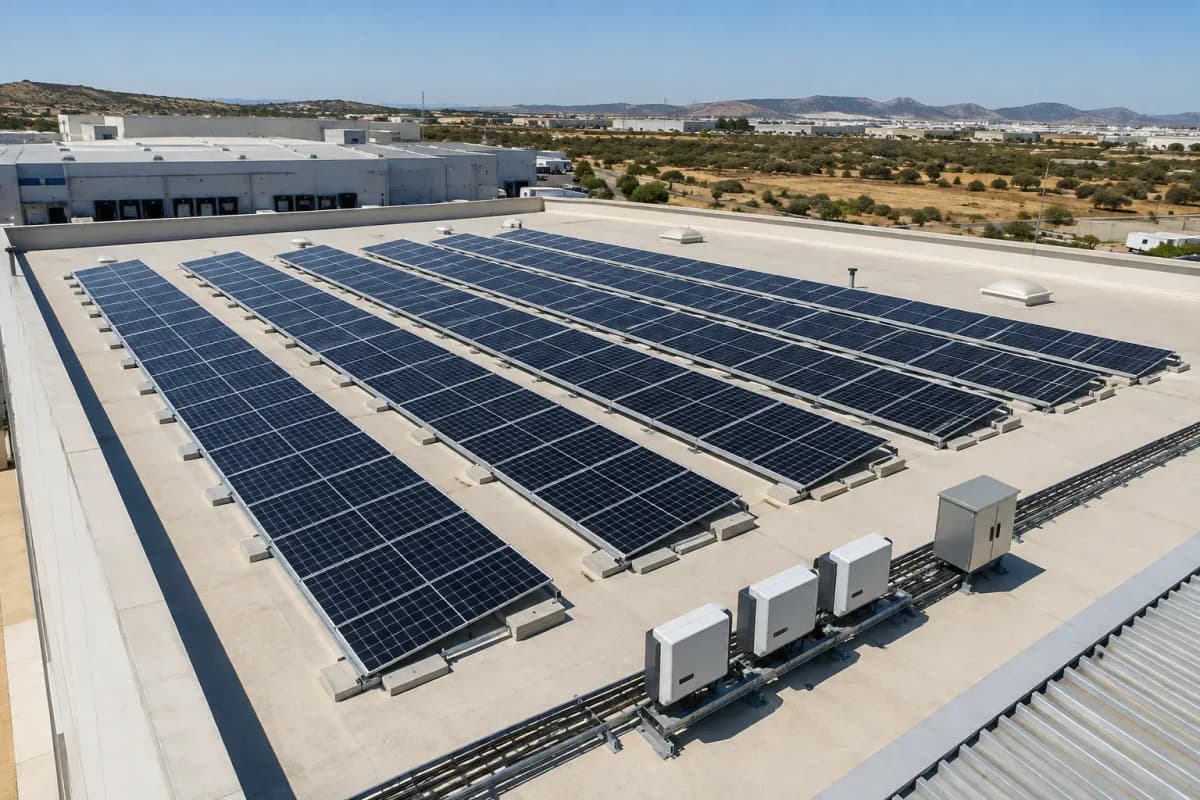
78kW Commercial Rooftop HJT Fixed - High-Efficiency PV System
Key Features
- 78 kWp commercial rooftop PV system using approximately 112 x 700 W HJT bifacial modules
- 25.8% module efficiency with about -0.24%/°C temperature coefficient for hot-roof performance
- 126.4 MWh estimated annual generation at 18.5% representative capacity factor
- USD 38,632-59,328 EPC turnkey range with 1-year workmanship support
- Approximately 56.9 tons/year CO2 offset at 0.45 kg CO2 per kWh displaced
The 78kW Commercial Rooftop HJT Fixed system is a 78 kWp grid-tied rooftop PV package using 25.8% heterojunction modules, 10° fixed tilt mounting, string inverters, and IEC-aligned electrical architecture. EPC turnkey pricing is USD 38,632-59,328, with estimated annual generation of 126.4 MWh in a representative high-irradiance commercial rooftop scenario.
Description
The 78kW Commercial Rooftop HJT Fixed system is a 78 kWp commercial solar PV package designed for factories, logistics roofs, retail centers, schools, and light-industrial buildings with approximately 430 m² of usable roof allocation. It combines 25.8% HJT module efficiency, a 10° fixed array, bifacial cell architecture up to 90-95% bifaciality, and EPC turnkey delivery from USD 38,632 to USD 59,328.
SOLARTODO specifies this 78 kW class rooftop system for buyers who need a compact, bankable, and procurement-ready PV plant below the 100 kW threshold common in many commercial interconnection programs. For adjacent capacities and technologies, buyers can View all Solar PV System products or Configure your system online with 1 project location, 1 utility tariff, and 1 roof constraint set.
System Architecture
The 78 kWp DC array is normally built with 112 high-power HJT bifacial modules at approximately 700 W each, producing 78.4 kWp before final string sizing corrections. A typical commercial design uses 2 string inverters at 40 kW AC each, giving an inverter loading ratio close to 0.98-1.10 depending on local clipping policy, transformer capacity, and the authority having jurisdiction.
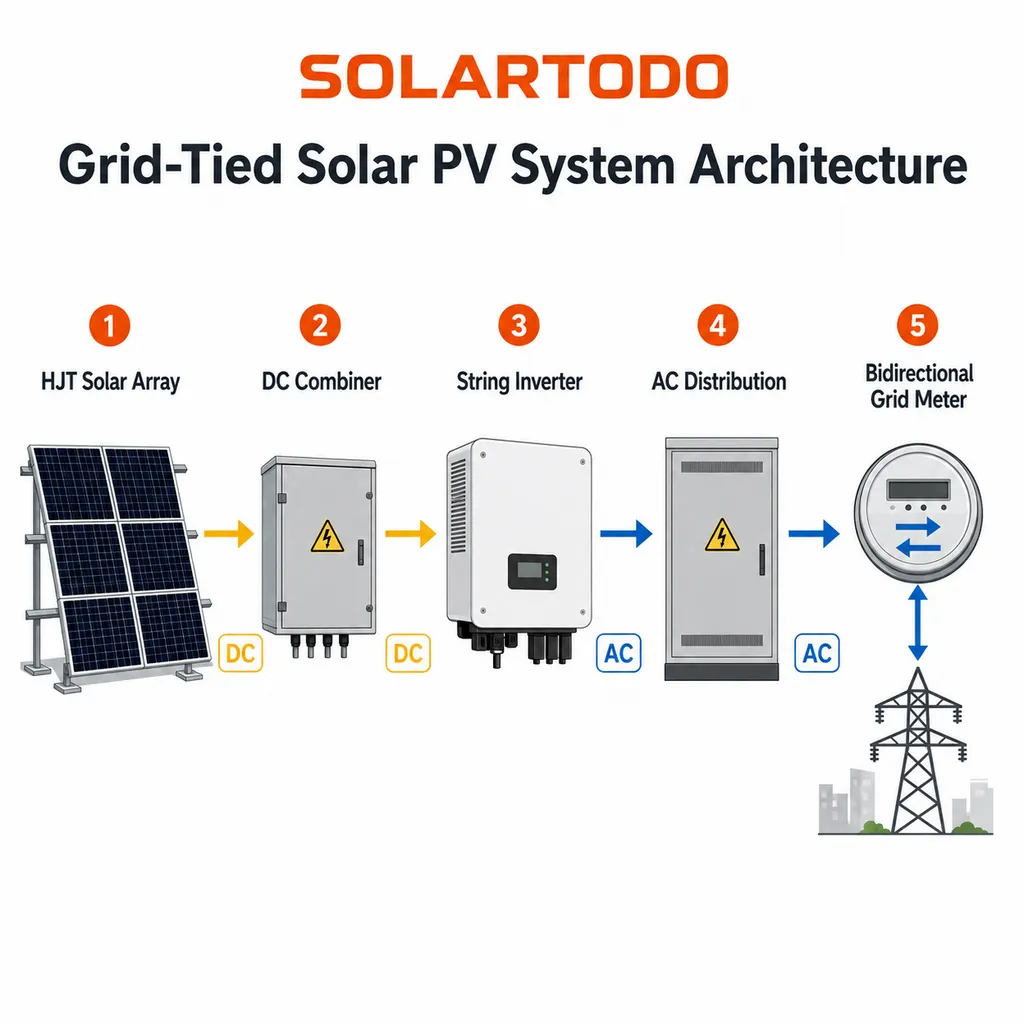
The DC side uses module strings, UV-rated PV cable, DC isolators, surge protective devices, and rooftop cable management with at least 1 dedicated maintenance pathway per array block. The AC side includes inverter output protection, AC distribution, revenue-grade metering where required, grounding, lightning protection coordination, and grid interface documentation aligned with IEEE 1547-2018 interconnection principles for distributed energy resources.
HJT, or heterojunction, combines crystalline silicon wafers with thin amorphous silicon passivation layers, reducing carrier recombination and improving hot-weather output. Compared with conventional PERC modules at about 21-23% efficiency and a typical temperature coefficient near -0.35%/°C, this HJT design uses 25.8% module efficiency and about -0.24%/°C, reducing heat-related power loss by roughly 31% per °C differential.
Technical Specifications
The system capacity is 78 kWp DC, the array type is fixed rooftop, and the default tilt angle is 10° for low-wind rooftop loading and practical self-cleaning. Based on 25.8% module efficiency, the active module surface is about 302 m², while a complete commercial rooftop layout should reserve approximately 430 m² after 1-2 m access corridors, fire setbacks, parapet shading, and inverter service clearances.
| Parameter | Baseline Value | Engineering Note |
|---|---|---|
| DC capacity | 78 kWp | Final nameplate may be 78.4 kWp with 112 x 700 W modules |
| Module technology | HJT bifacial | 24-26% mass-production class efficiency |
| Module efficiency | 25.8% | Used for area and yield assumptions |
| Array type | Fixed rooftop | Lowest moving-part count for 25+ year operation |
| Tilt angle | 10° | Typical for commercial flat roofs and ballast systems |
| Estimated annual output | 126.4 MWh | Representative 18.5% capacity factor scenario |
| CO2 offset | 56.9 t/year | Calculated at 0.45 kg CO2/kWh displaced electricity |
| Warranty basis | 25 yr panel, 10 yr inverter | EPC includes 1 yr workmanship support |
Module qualification should reference IEC 61215-2:2021 for terrestrial PV design qualification and type approval, which defines test procedures for long-term outdoor exposure in open-air climates. Safety qualification should reference IEC 61730-1:2023 and IEC 61730-2:2023, which address construction requirements and test sequences for fire, electric shock, and mechanical hazards in terrestrial flat-plate modules.
Inverter anti-islanding design should reference IEC 62116:2014 where applicable, because utility-interactive PV inverters need repeatable islanding-prevention testing before grid connection. In 60 Hz jurisdictions, IEEE 1547-2018 and IEEE 1547.2-2023 are commonly used to define interconnection behavior, abnormal voltage response, frequency response, power quality, interoperability, and commissioning test expectations for DER assets.
Representative MENA Commercial Rooftop Scenario
For a representative MENA commercial rooftop scenario, the 78 kWp system is modeled at 18.5% capacity factor, 14% total system losses, 10° tilt, and 25 years of PV production. Annual AC generation is estimated at 126.4 MWh, using the capacity factor relationship described by NREL ATB and the PVWatts methodology for translating DC module capacity into hourly AC energy.
At an electricity tariff of USD 0.14/kWh, 126.4 MWh/year can offset about USD 17,696/year before O&M, metering charges, and demand-charge rules. With annual O&M estimated at USD 13.1/kW-year from IRENA 2024 utility-scale PV cost data, the 78 kWp system has an indicative annual O&M allowance of USD 1,022 and a net simple savings basis of about USD 16,674/year.
Using an EPC midpoint of USD 48,440, the simple payback is about 2.9 years in the representative scenario, while a lower-tariff site at USD 0.08/kWh would move payback toward 4.6-5.2 years. The resulting indicative LCOE is about USD 0.034/kWh, assuming 25 years of output, 0.4% annual degradation, and standard commercial O&M, which is aligned with IRENA's 2024 solar PV LCOE range of USD 0.032-0.122/kWh.
EPC Investment Analysis and Pricing Structure
SOLARTODO defines EPC as engineering, procurement, construction, commissioning, grid-document support, quality control, and 1 year of workmanship or service warranty for 1 commercial rooftop project. The EPC scope includes structural layout coordination, electrical single-line design, module and inverter procurement, mounting installation, DC/AC cabling, inverter commissioning, monitoring activation, and turnover documentation for the owner or facility team.
| Pricing Tier | Scope | Price Range USD |
|---|---|---|
| FOB Supply | Equipment only, ex-works China | 23,952-40,343 |
| CIF Delivered | Equipment plus ocean freight and insurance | 26,426-44,510 |
| EPC Turnkey | Fully installed, commissioned, and 1 yr warranty | 38,632-59,328 |
| Volume Commitment | Indicative Discount | Procurement Note |
|---|---|---|
| 50+ systems | 5% | Applies to repeated 78 kW-class bill of materials |
| 100+ systems | 10% | Requires consolidated shipment planning over 1-2 quarters |
| 250+ systems | 15% | Requires framework agreement and batch QC release |
The ROI case depends on 3 primary numbers: installed EPC cost, annual kWh production, and avoided tariff value. At the USD 48,440 representative EPC cost and USD 16,674/year net savings, the simple payback is 2.9 years; compared with diesel generation at USD 0.22-0.35/kWh fuel-linked cost, the PV LCOE of about USD 0.034/kWh can reduce energy cost by 84-90% for daytime self-consumption energy.
Payment terms are 30% T/T deposit plus 70% against bill of lading for supply contracts, or 100% irrevocable L/C at sight for approved bank instruments. Project financing can be discussed for portfolios above USD 5,000K, subject to 1 credit review, 1 project pipeline schedule, site documentation, and export compliance review; procurement teams can contact [email protected] or Request a custom quotation.
Components and Performance Rationale
HJT modules are selected because their low-temperature coefficient directly improves rooftop yield in high ambient temperatures. At a 45°C cell temperature, a -0.24%/°C coefficient causes about 4.8% power reduction from the 25°C STC reference, while a conventional -0.35%/°C module would lose about 7.0%, creating a 2.2 percentage-point output advantage during hot operating hours.
The bifacial cell structure can provide rear-side contribution when roof reflectance and row spacing support it, although rooftop bifacial gain is normally lower than open-field gain. For conservative procurement, SOLARTODO treats the 90-95% bifaciality rating as a module capability and models bankable commercial rooftop output using direct front-side irradiance plus only validated albedo assumptions from the site survey.
Fixed mounting is selected because it eliminates tracker motors, controllers, bearings, and row-drive maintenance while keeping tilt at 10° for wind control and drainage. Compared with a single-axis tracker at about USD 0.12/W mounting cost, a fixed system at about USD 0.08/W can reduce mounting hardware cost by roughly 33% before roof-specific ballast, rails, anchors, and structural engineering.
Cloud Monitoring
The monitoring package connects 2 commercial string inverters to a web dashboard through Ethernet, Wi-Fi, or 4G gateway options, depending on site network policy. Standard telemetry includes DC voltage, DC current, AC output, inverter temperature, alarm state, daily kWh, monthly kWh, and estimated CO2 reduction, with 15-minute or 5-minute intervals selected during commissioning.
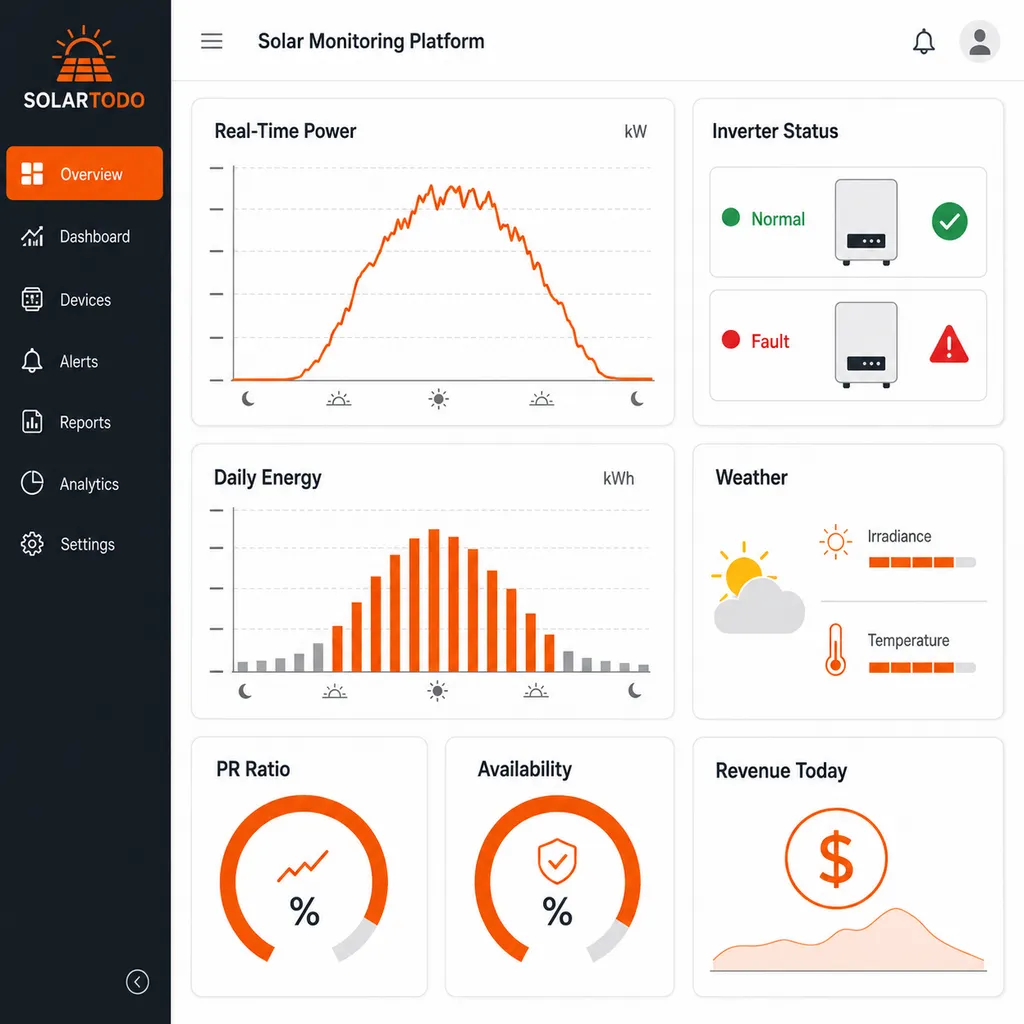
Cloud monitoring supports procurement and O&M governance because 1 operations team can compare inverter-level production against expected irradiance curves and identify string faults, soiling deviations, or grid curtailment events within 1 reporting day. For buyers building 10-site or 100-site rooftop portfolios, consistent monitoring data reduces manual inspection cost and supports warranty claims with timestamped electrical evidence.
Applications
Commercial rooftop PV is most suitable where daytime load exceeds at least 60-70% of PV output, because self-consumption usually produces higher value than exported energy. Typical applications include 1-shift and 2-shift factories, refrigerated warehouses, supermarkets, schools, vehicle depots, water-pumping facilities, office parks, and industrial parks with stable 400 V or medium-voltage electrical infrastructure.
The 78 kWp size is practical for roof owners who want meaningful energy offset without the complexity of a 500 kW central-inverter plant. It can also be replicated as 5, 10, or 50 standardized units across a property portfolio, allowing consistent module procurement, spare inverter policy, roof-loading assumptions, and monitoring dashboards across multiple sites.
Standards, Data Sources, and Buyer Notes
NREL PVWatts Version 8 documentation identifies roof-mounted arrays, tilt, losses, DC/AC ratio, inverter efficiency, albedo, and bifaciality as explicit modeling inputs, making it suitable for early-stage feasibility estimates. IRENA's 2025 Renewable Power Generation Costs in 2024 report states a global utility-scale solar PV LCOE of USD 0.043/kWh and total installed cost of USD 691/kW in 2024, while IEA's 2026 Global Energy Review reports solar PV additions above 600 GW in 2025.
Procurement teams should request 6 document sets before issuing a purchase order: module datasheets, inverter datasheets, IEC/UL certificates, warranty terms, packing lists, and project-specific single-line diagrams. Engineering teams should confirm 4 site variables before final yield acceptance: roof load capacity, shading horizon, grid export limit, and utility metering rules.
For broader technical context, buyers can Learn about topic in SOLARTODO's solar knowledge base or compare PV economics against storage and smart-infrastructure loads in the same resource center. The recommended next step is a 1-site feasibility package with roof drawings, 12 months of utility bills, interval-load data if available, and the target commercial operation date.
Technical Specifications
| System Capacity | 78kWp |
| Module Type | HJT bifacial |
| Module Efficiency | 25.8% |
| Array Configuration | Fixed commercial rooftop |
| Tilt Angle | 10degrees |
| Estimated Annual Generation | 126.4MWh/year |
| Capacity Factor | 18.5% |
| System Area | 430m² |
| CO2 Offset | 56.9tons/year |
| Payback Period | 2.9years |
| LCOE | 0.034USD/kWh |
| Warranty | 25yr panels, 10yr inverter, 1yr EPC support |
Price Breakdown
| Item | Quantity | Unit Price | Subtotal |
|---|---|---|---|
| 700W HJT Bifacial Solar Modules | 112 pcs | $153 | $17,160 |
| 40kW Commercial String Inverters | 2 pcs | $3,200 | $6,400 |
| Fixed Rooftop Mounting System | 1 pcs | $6,240 | $6,240 |
| DC Cables, Connectors, and Combiner Protection | 1 pcs | $1,560 | $1,560 |
| AC Distribution and Protection Infrastructure | 1 pcs | $2,340 | $2,340 |
| Cloud Monitoring Gateway and Platform Setup | 1 pcs | $500 | $500 |
| Grid Connection Documentation and Metering Support | 1 pcs | $2,000 | $2,000 |
| Installation and Commissioning Labor | 1 pcs | $6,240 | $6,240 |
| Engineering, Structural Review, and QC | 1 pcs | $3,500 | $3,500 |
| 1-Year Warranty and Support Allowance | 1 pcs | $2,500 | $2,500 |
| Total Price Range | $38,632 - $59,328 | ||
Frequently Asked Questions
What does the EPC turnkey price include for the 78kW Commercial Rooftop HJT Fixed system?
How much roof area is required for a 78 kWp HJT rooftop PV system?
Why use HJT modules instead of conventional PERC or standard TOPCon modules?
What annual generation should buyers expect from this 78 kW system?
Which standards are relevant for procurement and grid approval?
Certifications & Standards


Data Sources & References
- •NREL PVWatts Version 8 documentation: https://developer.nlr.gov/docs/solar/pvwatts/v8/
- •NREL ATB 2024 PV AC-DC capacity factor reference: https://atb.nrel.gov/electricity/2024/pv-ac-dc
- •IRENA Renewable Power Generation Costs in 2024: https://www.irena.org/Digital-Report/Renewable-Power-Generation-Costs-in-2024
- •IEA Global Energy Review 2026 solar PV and wind: https://www.iea.org/reports/global-energy-review-2026/technology-solar-pv-and-wind
- •IEC 61215-2:2021 photovoltaic module design qualification: https://webstore.iec.ch/en/publication/61350
- •IEC 61730-1:2023 photovoltaic module safety qualification: https://webstore.iec.ch/en/publication/59803
- •IEEE 1547-2018 distributed energy resource interconnection: https://standards.ieee.org/ieee/1547/10906/
Interested in this solution?
Contact us for a customized quote based on your specific requirements.
Contact Us