
8m Campus/Park Environmental Smart Streetlight - 5-in-1 Integrated Intelligence Hub
Key Features
- 8-meter hot-dip galvanized steel pole with 25-year design life and >150 km/h wind resistance
- 80W LED luminaire with 170 lm/W efficacy achieving up to 60% energy savings
- 4K AI-powered PTZ camera with 20x optical zoom and 50m IR night vision
- Professional environmental sensor suite monitoring 7 parameters (PM2.5, PM10, O3, NO2, noise, temperature, humidity)
- Wi-Fi 6 access point supporting 500+ concurrent users with public USB charging
Description
The SOLARTODO 8m Campus/Park Environmental smart streetlight is an integrated infrastructure solution designed to bring intelligence, safety, and connectivity to modern urban and educational environments. This 8-meter multi-function pole is engineered not just for illumination but as a central hub for data collection, public services, and environmental monitoring. It represents a paradigm shift from single-purpose lighting to a versatile, data-driven asset for smart city management. The system's modular design allows for a tailored configuration of up to five distinct modules, including a high-efficacy LED luminaire, a 4K AI-powered surveillance camera, a professional-grade environmental sensor suite, a high-capacity Wi-Fi 6 access point, and convenient public USB charging stations. This specific configuration is optimized for the unique demands of university campuses, corporate parks, and public recreational areas where safety, environmental quality, and digital access are paramount.
Built upon a foundation of robust engineering, the pole structure is fabricated from high-quality hot-dip galvanized steel, ensuring a design life of over 25 years and resilience against wind speeds exceeding 150 km/h, compliant with EN 40 standards for lighting columns. The 80-watt LED module delivers an exceptional luminous efficacy of 170-190 lm/W, adhering to IEC 62722-2-1 performance requirements for LED luminaires. This efficiency, combined with intelligent dimming controls, can achieve energy savings of up to 60% compared to traditional lighting systems. The integration of advanced environmental sensors provides real-time, hyperlocal data on critical air quality and atmospheric parameters, including PM2.5, PM10, Ozone (O3), and Nitrogen Dioxide (NO2), as well as ambient noise, temperature, and humidity. This data empowers campus administrators and city planners to make informed decisions that enhance public health and well-being, aligning with guidelines from the World Health Organization (WHO) and the U.S. Environmental Protection Agency (EPA).
The system's intelligence is driven by an edge computing unit that processes data locally from the integrated modules. This approach enables real-time analytics, such as vehicle and pedestrian traffic monitoring from the 4K AI camera, and immediate alerting based on environmental sensor thresholds. The camera itself is a powerful surveillance tool, featuring 360-degree pan-tilt-zoom (PTZ) capabilities with 20x optical zoom and infrared night vision effective up to 50 meters. This provides comprehensive security coverage, with AI algorithms capable of object detection, classification, and event-based recording, significantly reducing the need for constant manual monitoring and complying with data privacy standards like GDPR through on-premise processing.
Connectivity is a cornerstone of the 8m Campus/Park model. A carrier-grade Wi-Fi 6 (IEEE 802.11ax) access point provides high-speed internet access for over 500 concurrent users, supporting the digital needs of students, employees, and visitors. For sensor data backhaul and system management, the pole utilizes a combination of 4G/5G cellular communication for high-bandwidth needs and LoRaWAN (Long Range Wide Area Network) for low-power, long-range transmission from the environmental sensors. This hybrid communication architecture ensures reliable, cost-effective data flow to a central management platform. The integrated smart Power Distribution Unit (PDU) allows for remote monitoring and control of each module's power consumption, facilitating proactive maintenance and precise energy auditing, a key feature for achieving sustainability certifications like those outlined in ISO 50001 for energy management.
Technical Specifications
| Pole Height | 8m |
| Pole Material | Hot-Dip Galvanized Steel |
| Wall Thickness | 4mm |
| Wind Resistance | >150km/h |
| Design Life | 25years |
| LED Power | 80W |
| Luminous Efficacy | 170lm/W |
| Color Temperature | 3000-6500K |
| Optical Distribution | Type III |
| Camera Resolution | 4K (3840x2160) |
| Optical Zoom | 20x |
| IR Night Vision Range | 50m |
| Environmental Parameters Monitored | 7 (PM2.5, PM10, O3, NO2, Noise, Temp, Humidity) |
| Wi-Fi Standard | IEEE 802.11ax (Wi-Fi 6) |
| Wi-Fi Concurrent Users | 500+ |
| Communication | 4G/5G + LoRaWAN |
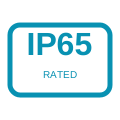
| IP Rating | IP66 |
| Operating Temperature | -40 to +55°C |
| Power Supply | AC 220/380V |
| Energy Saving | 60% |
| Integrated Modules | 5-in-1 |
Price Breakdown
| Item | Quantity | Unit Price | Subtotal |
|---|---|---|---|
| Hot-Dip Galvanized Steel Pole (8m) | 1 pcs | $960 | $960 |
| LED Luminaire Module (80W) | 1 pcs | $240 | $240 |
| 4K AI PTZ Camera | 1 pcs | $1,500 | $1,500 |
| Environmental Sensor Suite (7 Parameters) | 1 pcs | $1,200 | $1,200 |
| Wi-Fi 6 Access Point | 1 pcs | $400 | $400 |
| USB Charging Station (Dual Port) | 1 pcs | $150 | $150 |
| Smart Controller & Edge Computing Unit | 1 pcs | $500 | $500 |
| Reinforced Concrete Foundation | 1 pcs | $800 | $800 |
| Professional Installation & Commissioning | 1 pcs | $1,500 | $1,500 |
| System Integration & Testing | 1 pcs | $800 | $800 |
| Communication Modules (4G/5G + LoRaWAN) | 1 pcs | $600 | $600 |
| Cables, Connectors & Accessories | 1 pcs | $350 | $350 |
| Total Price Range | $9,000 - $12,000 | ||
Frequently Asked Questions
What is the typical maintenance schedule for the environmental sensors?
How is the data from the various modules collected and managed?
Can the system withstand harsh weather conditions?
How does the AI in the camera improve security operations?
What is the process for installing the 8m smart streetlight?
Certifications & Standards



Data Sources & References
- •IEC 60598 Luminaire Safety Standards 2025
- •IEC 62722-2-1 LED Luminaire Performance Requirements 2024
- •EN 40 Lighting Columns Structural Standards
- •EN 50556 Smart Pole Infrastructure Guidelines 2023
- •World Health Organization Air Quality Guidelines 2024
- •U.S. EPA Environmental Monitoring Standards 2025
- •IEEE 802.11ax Wi-Fi 6 Specifications 2024
- •ISO 50001 Energy Management Systems 2025
Project Cases


Interested in this solution?
Contact us for a customized quote based on your specific requirements.
Contact Us