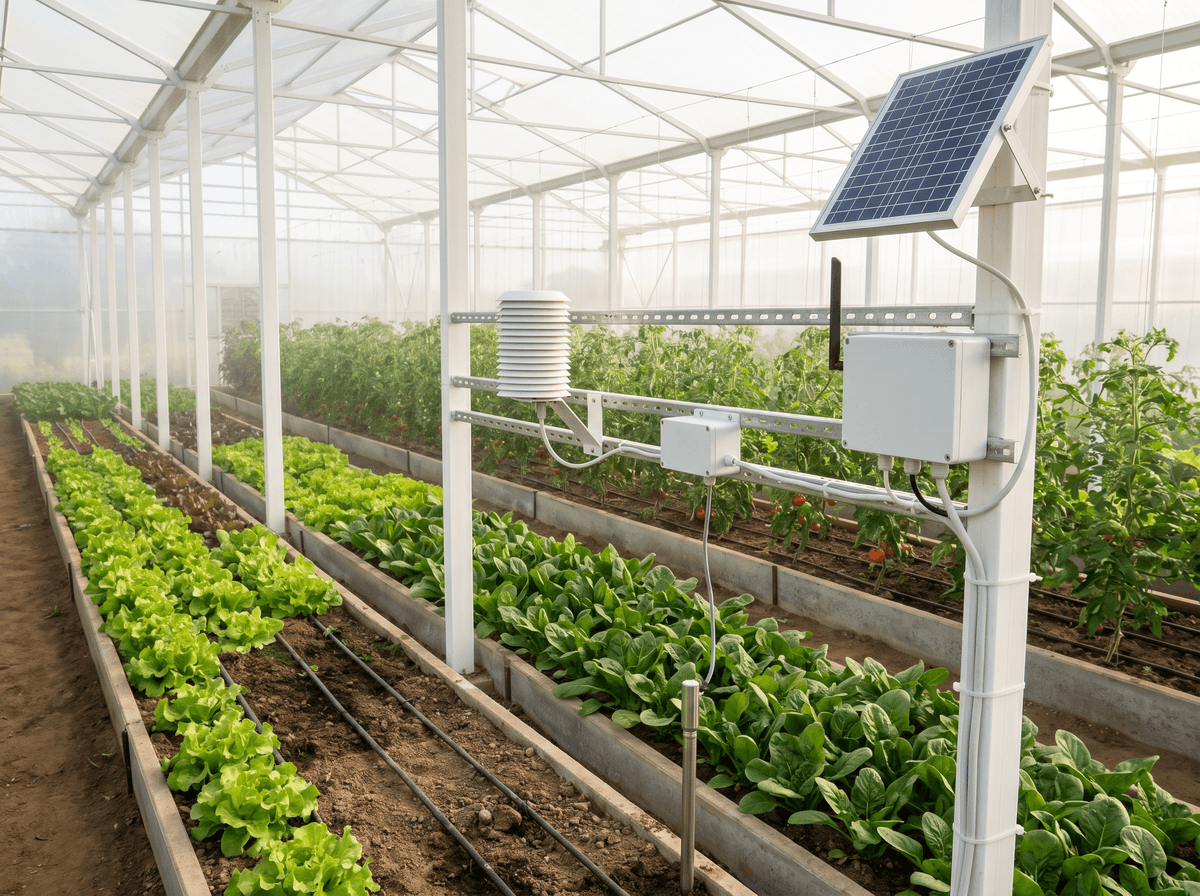
Vegetable Greenhouse IoT 1ha - Professional Weather, Soil and Pest Monitoring
Key Features
- Covers 1 hectare or 10,000 m² of vegetable greenhouse area with 25 total monitoring devices
- Includes 1 professional 10-parameter weather station for microclimate tracking at 10-minute intervals
- Deploys 20 comprehensive 7-parameter soil sensors for moisture, temperature, EC, pH, and salinity zoning
- Uses 2 AI smart pest traps with cloud analytics and SMS, email, and app push alerts
- EPC turnkey pricing ranges from USD 2,800 to USD 3,700 with 2-year hardware warranty
Vegetable Greenhouse IoT 1ha is a grid-powered smart agriculture monitoring system for 10,000 m² vegetable greenhouse sites, integrating 25 sensors across professional weather, comprehensive 7-parameter soil sensing, and AI smart pest trapping. The system uses WiFi/Ethernet communication, 10-minute configurable data intervals, standard cloud analytics, REST API access, and fertigation integration for EPC turnkey deployment at USD 2,800-3,700.
Description
The Vegetable Greenhouse IoT 1ha system is a 10,000 m² smart agriculture monitoring package designed for intensive vegetable production under protected cultivation, combining 25 sensors, professional 10-parameter weather monitoring, comprehensive 7-parameter soil sensing, and AI smart pest traps in 1 integrated platform. It operates on grid power, communicates through WiFi and Ethernet, uploads data at 10-minute intervals, and supports fertigation integration, SMS/Email/App alerts, and REST API connectivity for greenhouse operators, EPC contractors, and agricultural project developers.
For 1 hectare greenhouse operations, microclimate variation of only 1.0-2.0°C, soil moisture deviation of 5-10% VWC, or delayed pest detection by 24-48 hours can materially affect yield, crop quality, and input consumption. This system is engineered to reduce those blind spots by providing continuous measurement of weather, root-zone, and pest activity data in a single architecture, helping operators standardize irrigation, fertigation, and crop protection decisions with auditable digital records compatible with modern precision agriculture workflows.
System Overview
This configuration is optimized for vegetable greenhouse applications such as tomato, cucumber, pepper, leafy greens, eggplant, and nursery seedlings across 1 hectare of protected cultivation. The package typically includes 1 professional weather station, 20 comprehensive soil sensor nodes, 2 AI smart pest traps, 1 industrial edge gateway/network controller, and 1 cloud platform subscription set, totaling 25 field devices. The design target is stable environmental visibility across 10,000 m², with sensor density calibrated for practical EPC budgets rather than research-grade overinstrumentation.
Compared with conventional greenhouse management based on 1 handheld meter, 1 manual scouting round per day, and irrigation timing by operator experience, an IoT-based approach can reduce unnecessary irrigation events by 10-25%, shorten pest response time by 1-3 days, and improve data consistency from 0 manual records to 144 time-stamped records per day at a 10-minute interval. These improvements align with precision agriculture findings published by NREL, IEA, and IRENA, which consistently identify digital monitoring as a key enabler for resource efficiency and climate-resilient food production systems.
Monitoring Functions
The professional weather module typically measures 10 parameters, including air temperature, relative humidity, barometric pressure, wind speed, wind direction, rainfall, solar radiation, PAR or light intensity, dew point calculation, and optional greenhouse-specific ambient references. In greenhouse operations, not every parameter drives direct control, but a 10-parameter set improves interpretation of disease pressure, evapotranspiration trends, ventilation efficiency, and external weather influence. Typical sensor accuracy depends on the component, with temperature often within ±0.3°C, humidity within ±3% RH, and pressure within ±1 hPa.
The comprehensive soil sensing layer is designed around 7 parameters per node, commonly including volumetric water content, soil temperature, EC, pH, salinity proxy, TDS proxy, and dielectric or nutrient-related indicators depending on the probe model selected. For a 1 hectare vegetable greenhouse, 20 installed soil probes allow zoning by crop row, irrigation loop, substrate block, or management compartment. This is especially relevant in drip-irrigated production, where a difference of 0.2-0.5 mS/cm EC or 0.3-0.8 pH can affect nutrient uptake and fertigation efficiency over a crop cycle of 90-180 days.
The AI smart pest monitoring section uses 2 intelligent traps with image capture and cloud-side classification support for common flying insect pressure monitoring. Instead of relying only on weekly sticky card checks, the AI trap architecture can create a digital pest trendline with 6-24 images per day depending on configuration. In vegetable greenhouse environments, this helps identify pressure buildup from whitefly, leaf miner, fungus gnat, aphid flights, or other region-specific pests before visible crop damage expands across 500-2,000 m² blocks.
System Architecture
At the field layer, the system aggregates weather, soil, and pest devices into a local network using WiFi/Ethernet infrastructure with industrial-grade controllers suited for greenhouse service conditions. Data is typically sampled every 10 minutes, buffered locally for resilience, and synchronized to the standard cloud platform for dashboards, alarms, and historical analysis. Grid power eliminates the performance constraints of small solar kits in shaded greenhouse conditions and supports higher device uptime, typically targeting >99% communication availability when local networking is correctly installed.
The architecture also supports fertigation integration, which is a key requirement in commercial vegetable production. Sensor data can be used to trigger operator alerts or interface with supervisory control layers through REST API, allowing EC, moisture, and environmental thresholds to inform irrigation duration, nutrient dosing, or valve scheduling. While the standard package is primarily monitoring-focused, it is designed to fit into broader digital agriculture stacks used by EPC firms and greenhouse integrators.

Technical Specifications
The configured coverage is 1 hectare or 10,000 square meters, with 25 total sensors/devices across weather, soil, and pest categories. Communication is WiFi + Ethernet, power supply is grid, cloud tier is standard, and alerting is available through SMS, email, and app push. The standard data interval is 10 minutes, but the platform can be configured for shorter intervals such as 5 minutes or longer intervals such as 30 minutes depending on bandwidth, analytics, and storage policy.
From an engineering standpoint, the system is intended for greenhouse operators seeking a practical balance between capex and agronomic visibility. A 1 hectare site does not always require 50-100 research sensors, but it usually needs more than 5 basic points to capture actionable variability. With 20 soil nodes, 2 AI pest traps, and 1 professional weather station, this design supports zoning, benchmarking, and exception-based management while remaining within the EPC turnkey budget range of USD 2,800-3,700.
The hardware and software framework is selected with reference to widely recognized practices from IEC environmental testing approaches, IEEE communication reliability concepts, and digital agriculture deployment lessons reported by NREL and IEA. While greenhouse IoT systems are application-specific and not governed by a single universal agriculture standard, good engineering practice still requires stable enclosure protection, calibrated sensing, surge protection, and structured data retention for at least 12 months of operational review.
Cloud Monitoring and Data Management
The standard cloud platform provides centralized dashboards, trend charts, threshold alarms, user permissions, and historical exports for all 25 connected devices. Operators can view temperature, humidity, soil moisture, EC, pH, and pest counts from desktop or mobile interfaces, with alarm channels configured to 3 standard outputs: SMS, email, and app push. For many greenhouse teams, this replaces fragmented spreadsheets with a single source of truth containing 144 records per day per channel at the default 10-minute interval.
Cloud analytics are particularly useful for correlating 3 operational layers: weather shifts, root-zone changes, and pest activity. For example, a rise in humidity from 78% to 92% RH combined with leaf wetness risk and reduced ventilation can be linked to disease pressure, while a simultaneous EC increase from 2.2 to 3.0 mS/cm may indicate over-concentrated fertigation. These multi-variable relationships are difficult to identify using manual spot checks performed only 1-2 times per day.
The platform includes REST API access, enabling data export to farm ERP, SCADA, BI dashboards, or third-party agronomy tools. This is relevant for multi-site operators managing 5-50 greenhouse blocks and for EPC contractors delivering integrated automation packages. Buyers evaluating digital agriculture ROI can also review related guidance through Learn about topic and compare deployment options across the broader View all Smart Agriculture IoT Monitoring System products portfolio.

Application Scenario
A vegetable grower operating 1 hectare of greenhouse tomatoes in a hot, water-constrained MENA location deployed a configuration comparable to this package with 1 professional weather station, 18-20 soil probes, and 2 smart pest traps. Before deployment, irrigation was scheduled by fixed timer 4 times per day, pest scouting was conducted every 3 days, and nutrient adjustments were made after visible plant stress. After 1 full 120-day crop cycle, the operator reported approximately 14% lower irrigation water use, 9% lower fertilizer over-application, and earlier whitefly detection by roughly 48 hours.
In that scenario, the financial benefit came less from labor reduction and more from avoiding quality losses on export-grade produce. On a greenhouse producing vegetables worth USD 15,000-40,000 per cycle, preventing even 5-8% quality downgrade can justify the digital monitoring investment. This use case is consistent with efficiency and resilience trends noted by IRENA, IEA, and BloombergNEF, which increasingly recognize digital monitoring as a multiplier for water, energy, and input productivity in controlled-environment agriculture.
Performance Advantages vs Conventional Monitoring
A conventional alternative for a 1 hectare greenhouse often consists of 1 analog thermometer, 1 handheld soil meter, and manual pest card inspections once or twice per week. That setup may cost less upfront, often under USD 500, but it usually produces fewer than 10-20 meaningful data points per week and depends heavily on operator consistency. By contrast, this IoT system can generate more than 3,600 data records per day across all channels combined, creating a much stronger basis for irrigation tuning, disease prevention, and traceability.
In practical terms, the system can reduce response time to abnormal conditions from 24 hours to 10 minutes, shrink unnoticed irrigation drift from several days to less than 1 shift, and improve documentation for GAP-oriented operations requiring digital records. Compared with conventional scouting alone, AI pest traps can identify trend changes with daily image evidence, which is materially better for integrated pest management than weekly visual estimates. For buyers comparing alternatives, Configure your system online can help map sensor density and cloud level to agronomic risk.
Installation, Commissioning, and O&M
A standard EPC deployment for 1 hectare typically requires 1-2 technicians, 1 site visit, and 1 day for installation plus commissioning under normal access conditions. Installation scope generally includes weather station mounting, soil probe placement at representative depths, pest trap positioning, gateway/network setup, cloud onboarding, threshold configuration, and basic operator training. The package includes 2 years hardware warranty and 1 year cloud warranty/support, with replacement and calibration procedures defined during handover.
Routine operation and maintenance are modest but important. Soil probes should be inspected every 30-90 days, pest trap adhesive or capture media should be serviced according to insect pressure, and weather sensors should be checked for dust or condensation effects at least every 3 months. For greenhouse operators seeking better uptime, maintaining a spare inventory of 1-2 critical probes and reviewing alarm logs weekly can prevent data gaps from extending beyond 24 hours.
EPC Investment Analysis and Pricing Structure
For B2B buyers, the EPC model covers 5 core phases: engineering, procurement, construction, commissioning, and warranty support. Engineering includes site layout review, sensor point planning, network design, and fertigation interface definition. Procurement covers the 25-device hardware package and cloud activation. Construction includes installation labor, wiring, mounting, and network setup. Commissioning includes calibration checks, dashboard setup, and training. Warranty support includes 2 years hardware and 1 year cloud under standard terms.
Pricing Tiers
| Tier | Scope | Price Range (USD) |
|---|---|---|
| FOB Supply | Equipment only, ex-works China | 1,736 - 2,516 |
| CIF Delivered | Equipment + ocean freight + insurance | 1,811 - 2,624 |
| EPC Turnkey | Installed, commissioned, 1-year service support | 2,800 - 3,700 |
Volume Discounts
| Order Volume | Discount |
|---|---|
| 50+ systems | 5% |
| 100+ systems | 10% |
| 250+ systems | 15% |
ROI Analysis
For a 1 hectare vegetable greenhouse, annual savings typically come from 3 categories: water reduction, fertilizer optimization, and crop loss avoidance. If annual irrigation and nutrient input costs are USD 4,000-8,000, a conservative 10-15% savings yields USD 400-1,200 per year. If improved pest detection and climate response prevent only USD 600-1,500 in crop quality losses annually, total benefit may reach USD 1,000-2,700 per year. Against an EPC investment of USD 2,800-3,700, indicative simple payback is often 1.3-3.7 years, depending on crop value, management discipline, and local labor/input costs.
Compared with a conventional manual monitoring approach costing USD 300-800 initially but offering limited traceability and slower intervention, the IoT system has a higher capex but significantly lower decision latency and higher agronomic precision. For export-oriented or water-scarce operations, the business case is generally stronger because a single avoided production issue can offset 20-50% of the system cost. Detailed project-specific ROI, including labor, yield, and utility assumptions, is available via Request a custom quotation or by emailing [email protected].
Payment Terms
Standard payment terms are 30% T/T in advance + 70% against B/L, or 100% L/C at sight for qualified transactions. For portfolios above USD 1,000,000, structured financing support may be available subject to project profile, jurisdiction, and credit review. These terms are intended for distributors, EPC contractors, developers, and institutional agricultural buyers requiring predictable procurement workflows.
Why This Configuration Fits 1ha Vegetable Greenhouses
A 1 hectare greenhouse is large enough that microclimate and root-zone variability become economically important, but not so large that a highly complex automation stack is always justified. This 25-device design provides enough density to monitor representative zones, enough connectivity to support digital management, and enough integration to connect with fertigation workflows without pushing the project into a much higher capex class. For many buyers, it is the practical midpoint between a 5-sensor starter kit and a 50-sensor research deployment.
The system is also suitable for phased digitalization. A buyer can begin with monitoring, review 3-6 months of data, and later expand into automated control, additional pest analytics, water quality sensing, or storage monitoring. Organizations planning that path can review broader deployment strategies through Learn about topic and compare adjacent solutions in the SOLARTODO smart agriculture range.
Technical and Procurement Summary
In summary, the Vegetable Greenhouse IoT 1ha package delivers professional weather, comprehensive soil, and AI pest monitoring across 10,000 m² with 25 sensors/devices, WiFi/Ethernet communications, grid power, 10-minute data intervals, and standard cloud analytics. It is priced at USD 1,736-2,516 FOB, USD 1,811-2,624 CIF, and USD 2,800-3,700 EPC turnkey, making it suitable for cost-sensitive but performance-oriented greenhouse projects. Buyers needing tailored sensor counts, fertigation interfaces, or multi-block rollouts can Configure your system online or Request a custom quotation for a site-specific proposal.
Inline references: NREL digital agriculture and sensor deployment guidance; IEA energy-water-food nexus reporting; IRENA resource efficiency and climate resilience analysis; IEC environmental and equipment testing frameworks; IEEE communication and interoperability practices; BloombergNEF agri-infrastructure digitalization market observations.
Technical Specifications
| Coverage Area | 1ha |
| Greenhouse Area | 10000m² |
| Monitoring Types | weather, soil, pest |
| Weather Monitoring Level | professional |
| Soil Monitoring Type | comprehensive |
| Pest Monitoring Type | smart_trap |
| Total Sensors | 25sensors |
| Application | vegetable_greenhouse |
| Communication | wifi_ethernet |
| Power Supply | grid |
| Data Interval | 10min |
| Cloud Platform | standard |
| Alert Channels | SMS + Email + App Push |
| API Access | REST API included |
| Fertigation Integration | true |
| Warranty | 2 years hardware, 1 year cloud |
Price Breakdown
| Item | Quantity | Unit Price | Subtotal |
|---|---|---|---|
| Professional Weather Station (installed) | 1 pcs | $1,200 | $1,200 |
| Comprehensive 7-parameter Soil Sensor (installed) | 4 pcs | $350 | $1,400 |
| AI Smart Pest Trap (installed) | 2 pcs | $450 | $900 |
| Industrial Gateway and Network Integration (installed) | 1 pcs | $110 | $110 |
| Cloud Platform Standard Subscription (installed) | 25 pcs | $12 | $300 |
| Installation, Commissioning and Training (installed) | 1 pcs | $500 | $500 |
| Total Price Range | $2,800 - $3,700 | ||
Frequently Asked Questions
What is included in the Vegetable Greenhouse IoT 1ha package?
How does this system improve greenhouse operations compared with manual monitoring?
Can the system integrate with fertigation or greenhouse control platforms?
What are the EPC price, warranty, and payment terms?
Is this configuration suitable for all vegetable greenhouse crops?
Certifications & Standards


Data Sources & References
- •NREL precision agriculture and sensor systems publications
- •IEA energy-water-food nexus reports
- •IRENA climate resilience and resource efficiency reports
- •IEC environmental and equipment testing frameworks
- •IEEE IoT communication and interoperability guidance
- •BloombergNEF digital infrastructure market observations
Interested in this solution?
Contact us for a customized quote based on your specific requirements.
Contact Us