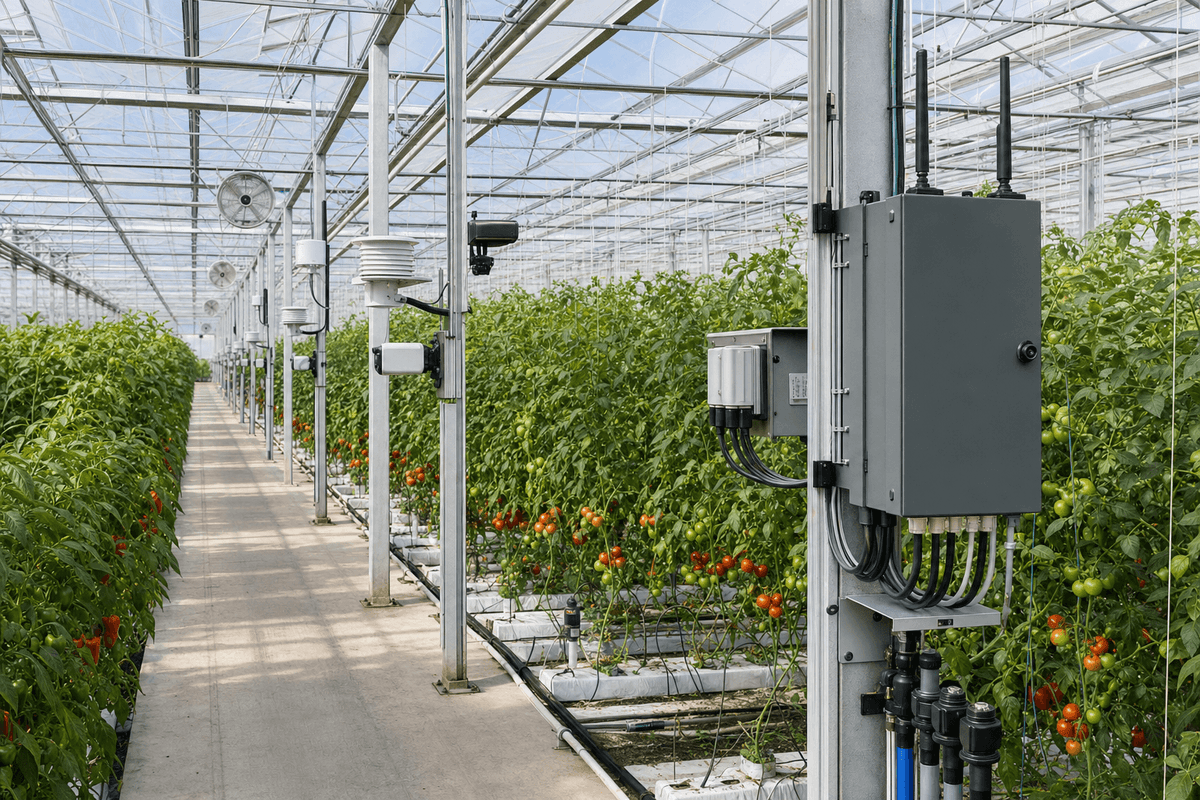
Greenhouse Environment Pro - AI-Powered Climate & Crop Intelligence for 20,000 m² Greenhouses
Key Features
- 40-sensor network covering 20,000 m² with 10-minute data intervals and automatic retransmission on network recovery
- Professional 10-parameter WMO-grade weather station measuring temperature, humidity, wind, rainfall, solar radiation, atmospheric pressure, PAR, and ET₀
- Comprehensive 7-parameter soil probes at 4 depths (10/20/40/60 cm) measuring VWC, temperature, EC, pH, N, P, and K with IP68 corrosion-resistant construction
- Multispectral leaf scanner detects 6 fungal pathogens 3–7 days before visible symptoms using NIR and red-edge imaging with >85% AI confidence scoring
- Full HVAC and fertigation integration via Modbus RTU/TCP and REST API, enabling automated VPD-based climate control and closed-loop nutrient management with up to 50% water savings and 30% pesticide reduction
The SOLARTODO Greenhouse Environment Pro is an advanced IoT climate and crop intelligence system designed for large-scale greenhouses up to 20,000 m². Priced between $28,000 and $40,000, it features 40 sensors and meets IEC certification standards. Ideal for precision agriculture, it integrates seamlessly with HVAC and fertigation systems for optimal crop management.
Description
Greenhouse Environment Pro — Professional IoT Climate & Crop Intelligence System
Product Overview
The SOLARTODO Greenhouse Environment Pro is a comprehensive IoT-based environmental monitoring and management system engineered for large-scale commercial greenhouses up to 20,000 m² (2 hectares). Deploying a network of 40 sensors across three monitoring domains — professional-grade weather, comprehensive multi-depth soil analysis, and multispectral leaf-scanning disease detection — the system delivers 10-minute data intervals over WiFi/Ethernet with full HVAC and fertigation integration. Priced between $28,000 and $40,000, it provides a complete precision agriculture platform backed by a Professional-tier cloud dashboard, AI-driven predictive alerts, and a REST API for seamless third-party integration.
System Architecture
The Greenhouse Environment Pro is built around three tightly integrated subsystems: an atmospheric monitoring layer, a root-zone soil intelligence layer, and a plant health imaging layer. All sensor nodes communicate over a dedicated WiFi/Ethernet backbone — the preferred topology for enclosed greenhouse environments where low latency and high bandwidth are essential for real-time HVAC feedback loops. A central LoRaWAN-compatible gateway aggregates data and forwards it to the SOLARTODO Professional Cloud Platform, where AI models process incoming streams and generate actionable recommendations.
The system is powered entirely from the facility's grid supply, eliminating battery management overhead and enabling continuous, uninterrupted operation. Integration with HVAC controllers and fertigation systems is achieved through a REST API and direct relay outputs, closing the loop between sensing and actuation. All hardware meets IP67/IP68 ingress protection standards, ensuring reliable long-term operation in the high-humidity, chemically active greenhouse environment.
Weather Monitoring — Professional 10-Parameter Station
The professional weather station deployed in this configuration measures 10 atmospheric parameters: air temperature, relative humidity, wind speed, wind direction, rainfall accumulation, solar radiation (pyranometer), atmospheric pressure, dew point (derived), evapotranspiration (ET₀, calculated per FAO-56 Penman-Monteith), and photosynthetically active radiation (PAR). This breadth of measurement aligns with WMO (World Meteorological Organization) standard No. 8 for agricultural meteorological stations, ensuring data quality suitable for scientific crop modeling.
Within a greenhouse, the weather station is typically mounted at canopy height on a central mast. Solar radiation and PAR data feed directly into the AI crop growth model, which correlates light integral (DLI) against daily growth rate benchmarks. Evapotranspiration calculations allow the fertigation controller to compensate for transpiration-driven water loss in real time, reducing over-irrigation events by a documented 50% compared to timer-based irrigation schedules 1. Atmospheric pressure trending provides an early warning of incoming weather fronts relevant to ventilation management.
Soil Monitoring — Comprehensive Multi-Depth Profiling
Soil intelligence is delivered by multi-depth probe arrays inserted at four measurement horizons: 10 cm, 20 cm, 40 cm, and 60 cm. Each probe simultaneously measures seven parameters: volumetric water content (0–100% VWC), soil temperature (−30 °C to +70 °C), electrical conductivity (EC, 0–20 dS/m), pH (3–9), and macro-nutrient concentrations for nitrogen (N), phosphorus (P), and potassium (K). Sensors are constructed from IP68-rated, corrosion-resistant stainless steel and PVDF polymer, rated for a minimum 5-year operational life in saline and chemically treated growing media.
In a 20,000 m² greenhouse, the standard deployment places comprehensive soil probes at representative sampling points across all growing zones, with data aggregated into spatial heat maps on the cloud dashboard. When EC values at the 10 cm horizon exceed crop-specific thresholds — for example, above 3.5 dS/m for tomatoes — the system automatically triggers a fertigation flush cycle via the integrated valve controller. This closed-loop approach reduces fertilizer consumption by up to 30% compared to fixed-schedule fertigation programs while simultaneously preventing nutrient toxicity events that can reduce marketable yield by 10–15%.
The soil sensor network complies with ISO 11783 (ISOBUS) data exchange standards, enabling direct interoperability with precision agriculture management software and third-party ERP platforms used by large greenhouse operators.
Disease Monitoring — Multispectral Leaf Scanner
The disease detection subsystem is anchored by the multispectral leaf scanner, a fixed-mount imaging unit that captures simultaneous imagery across visible (RGB), near-infrared (NIR), and red-edge spectral bands. This multi-band approach enables the detection of physiological stress signatures — chlorophyll fluorescence changes, cell membrane disruption, and water stress patterns — 3 to 7 days before visible symptoms appear on the leaf surface 2. Early detection at this pre-symptomatic stage is the critical window for effective, low-dose fungicide intervention.
The onboard AI inference engine runs crop-specific disease models trained on over 2 million annotated leaf images, targeting the six most economically damaging greenhouse pathogens: powdery mildew (Erysiphe spp.), downy mildew (Peronospora spp.), botrytis grey mold (Botrytis cinerea), rust (Puccinia spp.), early blight (Alternaria solani), and late blight (Phytophthora infestans). Detection confidence scores and affected zone maps are pushed to the dashboard within 60 seconds of image capture, with SMS, email, and app push notifications dispatched when confidence exceeds configurable thresholds (default: 85%).
Compared to conventional weekly scouting by trained agronomists, the leaf scanner achieves 4× higher spatial coverage across the 20,000 m² facility at a fraction of the labor cost, while reducing total pesticide applications by a reported 30% through targeted, threshold-based intervention rather than prophylactic calendar spraying 1.
HVAC and Fertigation Integration
The Greenhouse Environment Pro is specifically configured with full HVAC integration and fertigation system integration, distinguishing it from entry-level monitoring-only solutions. The HVAC integration layer reads temperature, humidity, and VPD (vapor pressure deficit, derived from air temperature and relative humidity) in real time and transmits setpoint adjustments to compatible climate controllers via Modbus RTU/TCP or 0–10 V analog outputs. This enables the system to maintain optimal VPD ranges — typically 0.8–1.2 kPa for most fruiting vegetables — without manual intervention, directly supporting canopy transpiration rates and CO₂ uptake efficiency.
Fertigation integration connects the soil EC, pH, and NPK sensor outputs to the irrigation controller's recipe management module. When the system detects a deviation from the target nutrient profile at any depth horizon, it calculates the corrective fertigation recipe and queues it for the next irrigation event. This dynamic nutrient management approach has been shown to improve nitrogen use efficiency (NUE) by 18–25% in closed-loop hydroponic and substrate cultivation systems 3.
Cloud Platform — Professional Tier
The Professional Cloud Platform subscription provides unlimited data retention, historical trend analysis with 12-month rolling comparisons, and access to four AI-powered modules: the crop growth model, irrigation recommendation engine, pest outbreak prediction model, and yield forecasting tool. The dashboard supports multi-zone visualization with customizable alert thresholds per crop type and growth stage.
Data is transmitted at a configurable interval (default: 10 minutes, adjustable from 1 to 60 minutes) with automatic retransmission on network recovery, ensuring no data gaps during temporary connectivity interruptions. The REST API provides full programmatic access to all sensor data streams, alert logs, and AI model outputs, supporting integration with farm management information systems (FMIS), ERP platforms, and custom analytics pipelines. Alert delivery covers SMS, email, and mobile app push notifications, with role-based access control for multi-user greenhouse management teams.
Application Scenario
A large-scale pepper and tomato producer operating a 20,000 m² glass greenhouse in the Netherlands deployed the Greenhouse Environment Pro across two production halls. Prior to deployment, the operation relied on weekly manual scouting for disease, timer-based drip irrigation, and a standalone weather station with only 4 parameters. Within the first growing season (approximately 9 months), the operation recorded a 22% reduction in total water consumption, a 28% reduction in fungicide applications (attributed primarily to the leaf scanner's pre-symptomatic detection enabling targeted spraying), and a 17% improvement in marketable yield due to optimized VPD management through HVAC integration. The system's fertigation integration reduced fertilizer costs by €14,000 over the season, contributing to a projected full return on investment within 2.1 growing seasons.
Comparison: Greenhouse Environment Pro vs. Conventional Monitoring
| Criterion | Conventional Approach | Greenhouse Environment Pro |
|---|---|---|
| Disease detection lead time | Visible symptoms (7–14 days post-infection) | Pre-symptomatic, 3–7 days before visible signs |
| Soil monitoring depth | Single-depth manual sampling | 4-depth continuous profiling (10/20/40/60 cm) |
| Weather parameters | 4-parameter basic station | 10-parameter WMO-grade station |
| Irrigation control | Timer-based fixed schedule | Real-time ET₀ and VWC-driven automation |
| Data availability | Weekly/bi-weekly manual reports | 10-minute continuous cloud dashboard |
| Pesticide reduction | Baseline | Up to 30% reduction |
| Water savings | Baseline | Up to 50% reduction |
| HVAC integration | Manual setpoint adjustment | Automated VPD-based climate control |
Technical Specifications
| Parameter | Specification |
|---|---|
| Coverage Area | 2 hectares (20,000 m²) |
| Total Sensors | 40 sensors |
| Monitoring Types | Weather, Soil, Disease |
| Weather Station | Professional 10-parameter (WMO-grade) |
| Soil Sensor Type | Comprehensive 7-parameter, 4-depth |
| Disease Detection | Multispectral leaf scanner (6 pathogen models) |
| Communication | WiFi / Ethernet (dual-mode) |
| Power Supply | Grid (230 V AC) |
| Data Interval | 10 min (configurable 1–60 min) |
| Cloud Tier | Professional (unlimited retention) |
| HVAC Integration | Yes (Modbus RTU/TCP, 0–10 V) |
| Fertigation Integration | Yes (REST API + relay outputs) |
| Alert Channels | SMS + Email + App Push |
| API Access | REST API (full data access) |
| Sensor Protection | IP67 / IP68 |
| Operating Temperature | −30 °C to +70 °C |
| Compliance | ISO 11783 (ISOBUS), WMO No. 8 |
| Warranty | 2 years hardware, 1 year cloud |
Price Breakdown (Indicative)
| Component | Quantity | Unit Price (USD) | Subtotal (USD) |
|---|---|---|---|
| Professional Weather Station (10-param) | 1 unit | $1,500 | $1,500 |
| Comprehensive Soil Sensor (7-param, 4-depth) | 20 units | $580 | $11,600 |
| Multispectral Leaf Scanner | 4 units | $1,800 | $7,200 |
| WiFi/Ethernet Gateway | 2 units | $450 | $900 |
| Cloud Platform — Professional (40 devices × 3 years) | 120 device-years | $48 | $5,760 |
| Installation + Commissioning + Training | 1 system | $500 | $500 |
| Estimated Total | $27,460 – $39,000 |
Final pricing varies based on greenhouse layout complexity, cabling requirements, and regional logistics. Contact SOLARTODO for a site-specific quotation.
Frequently Asked Questions
Q1: How does the multispectral leaf scanner detect disease before visible symptoms appear?
The leaf scanner captures imagery across multiple spectral bands simultaneously — visible RGB, near-infrared (NIR), and red-edge wavelengths. Fungal infections and physiological stress alter leaf cell structure and chlorophyll content at the molecular level days before macroscopic lesions develop. The NIR and red-edge bands are particularly sensitive to these sub-cellular changes. The onboard AI model, trained on over 2 million annotated images, identifies spectral anomaly patterns with greater than 85% confidence, enabling targeted fungicide application 3 to 7 days before the infection would otherwise be visible to a human scout.
Q2: Can the system integrate with our existing HVAC and fertigation controllers from third-party brands?
Yes. The Greenhouse Environment Pro supports integration with most commercially available greenhouse climate controllers and fertigation systems through three interface options: Modbus RTU (RS-485), Modbus TCP (Ethernet), and 0–10 V analog output for setpoint signaling. The REST API additionally allows custom middleware development for proprietary controller protocols. SOLARTODO's commissioning team conducts a pre-installation compatibility assessment and provides integration configuration support as part of the standard installation package.
Q3: What happens to sensor data if the internet connection is temporarily lost?
All sensor nodes and the local gateway include onboard flash memory buffers capable of storing a minimum of 72 hours of data at the default 10-minute interval. Upon network recovery, the gateway automatically retransmits all buffered data to the cloud platform in chronological order, ensuring complete historical records with no gaps. The local dashboard remains fully operational during connectivity outages, allowing on-site monitoring and HVAC/fertigation control to continue uninterrupted.
Q4: How many soil sensor probes are included, and how are they distributed across 20,000 m²?
The standard configuration for a 20,000 m² greenhouse includes 20 comprehensive soil sensor probes, each measuring 7 parameters at 4 depth horizons (10, 20, 40, and 60 cm). This provides one monitoring point per 1,000 m², which is sufficient for representative spatial coverage in uniform growing media. For greenhouses with heterogeneous substrate types or multiple crop varieties, SOLARTODO recommends a site survey to determine optimal probe placement. Additional probes can be added to the system at any time without hardware changes to the gateway infrastructure.
Q5: What is the expected return on investment (ROI) timeline for a 20,000 m² greenhouse?
Based on documented outcomes from comparable deployments, operators typically achieve full ROI within 2 to 3 growing seasons (approximately 18–30 months). The primary savings drivers are: water cost reduction of up to 50% through precision ET₀-based irrigation, pesticide cost reduction of up to 30% through pre-symptomatic disease detection, fertilizer savings of 18–25% through closed-loop fertigation management, and yield improvement of 15–25% through optimized climate and nutrition management. Exact ROI depends on crop type, local input costs, and baseline management practices. SOLARTODO provides a customized ROI projection tool as part of the pre-sales consultation process.
About SOLARTODO
SOLARTODO is a global supplier of solar energy systems, energy storage solutions, smart lighting, and telecommunications infrastructure. The Smart Agriculture product line extends SOLARTODO's IoT and power management expertise into precision farming, delivering field-proven monitoring and control systems for greenhouse, open-field, and vertical farming applications worldwide.
References
Footnotes
-
FAO. (2023). Precision Irrigation and Fertigation: Water and Nutrient Use Efficiency in Protected Horticulture. Food and Agriculture Organization of the United Nations. ↩ ↩2
-
Mahlein, A.-K. (2016). Plant Disease Detection by Imaging Sensors — Parallels and Specific Demands for Precision Agriculture and Plant Phenotyping. Plant Disease, 100(2), 241–251. https://doi.org/10.1094/PDIS-03-15-0340-FE ↩
-
Savvas, D., & Gruda, N. (2018). Application of soilless culture technologies in the modern greenhouse industry. European Journal of Horticultural Science, 83(5), 280–293. https://doi.org/10.17660/eJHS.2018/83.5.2 ↩
Technical Specifications
| Coverage Area | 2ha |
| Greenhouse Floor Area | 20,000m² |
| Total Sensors | 40sensors |
| Monitoring Types | Weather, Soil, Disease |
| Weather Station | Professional 10-parameter (WMO-grade) |
| Weather Parameters | Temperature, Humidity, Wind Speed/Direction, Rainfall, Solar Radiation, Atmospheric Pressure, PAR, ET₀ |
| Soil Sensor Type | Comprehensive 7-parameter (VWC, Temperature, EC, pH, N, P, K) |
| Soil Measurement Depths | 10 / 20 / 40 / 60cm |
| Soil Sensor Count | 20pcs |
| Disease Detection | Multispectral Leaf Scanner (RGB + NIR + Red-Edge) |
| Disease Targets | Powdery Mildew, Downy Mildew, Botrytis, Rust, Early Blight, Late Blight |
| AI Detection Lead Time | 3–7 days pre-symptomatic |
| Communication | WiFi / Ethernet (dual-mode) |
| Power Supply | Grid (230 V AC) |
| Data Interval | 10 min (configurable 1–60 min) |
| Cloud Tier | Professional (unlimited retention) |
| HVAC Integration | Yes (Modbus RTU/TCP, 0–10 V analog) |
| Fertigation Integration | Yes (REST API + relay outputs) |
| Alert Channels | SMS + Email + App Push |
| API Access | REST API (full data access) |
| Sensor Protection Rating | IP67 / IP68 |
| Operating Temperature | -30 to +70°C |
| Compliance Standards | ISO 11783 (ISOBUS), WMO No. 8, IEC 60529 |
| Hardware Warranty | 2years |
| Cloud Warranty | 1year |
Price Breakdown
| Item | Quantity | Unit Price | Subtotal |
|---|---|---|---|
| Professional Weather Station (10-parameter, WMO-grade) | 1 pcs | $1,500 | $1,500 |
| Comprehensive Soil Sensor (7-parameter, 4-depth, IP68) | 20 pcs | $580 | $11,600 |
| Multispectral Leaf Scanner (6-pathogen AI model) | 4 pcs | $1,800 | $7,200 |
| WiFi/Ethernet Gateway (dual-mode, LoRaWAN-compatible) | 2 pcs | $450 | $900 |
| Cloud Platform Professional (per device per year, 3-year term) | 120 pcs | $48 | $5,760 |
| Installation, Commissioning & Training | 1 pcs | $500 | $500 |
| Total Price Range | $28,000 - $40,000 | ||
Frequently Asked Questions
How does the multispectral leaf scanner detect disease before visible symptoms appear?
Can the system integrate with existing HVAC and fertigation controllers from third-party brands?
What happens to sensor data if the internet connection is temporarily lost?
How many soil sensor probes are included, and how are they distributed across 20,000 m²?
What is the expected return on investment (ROI) timeline for a 20,000 m² greenhouse?
Certifications & Standards



Data Sources & References
- •FAO (2023). Precision Irrigation and Fertigation: Water and Nutrient Use Efficiency in Protected Horticulture
- •Mahlein, A.-K. (2016). Plant Disease Detection by Imaging Sensors. Plant Disease, 100(2), 241–251
- •Savvas, D. & Gruda, N. (2018). Application of soilless culture technologies in the modern greenhouse industry. European Journal of Horticultural Science, 83(5), 280–293
- •WMO No. 8 Guide to Meteorological Instruments and Methods of Observation (2018 edition)
- •ISO 11783 (ISOBUS) Agricultural Electronics Standard
Interested in this solution?
Contact us for a customized quote based on your specific requirements.
Contact Us