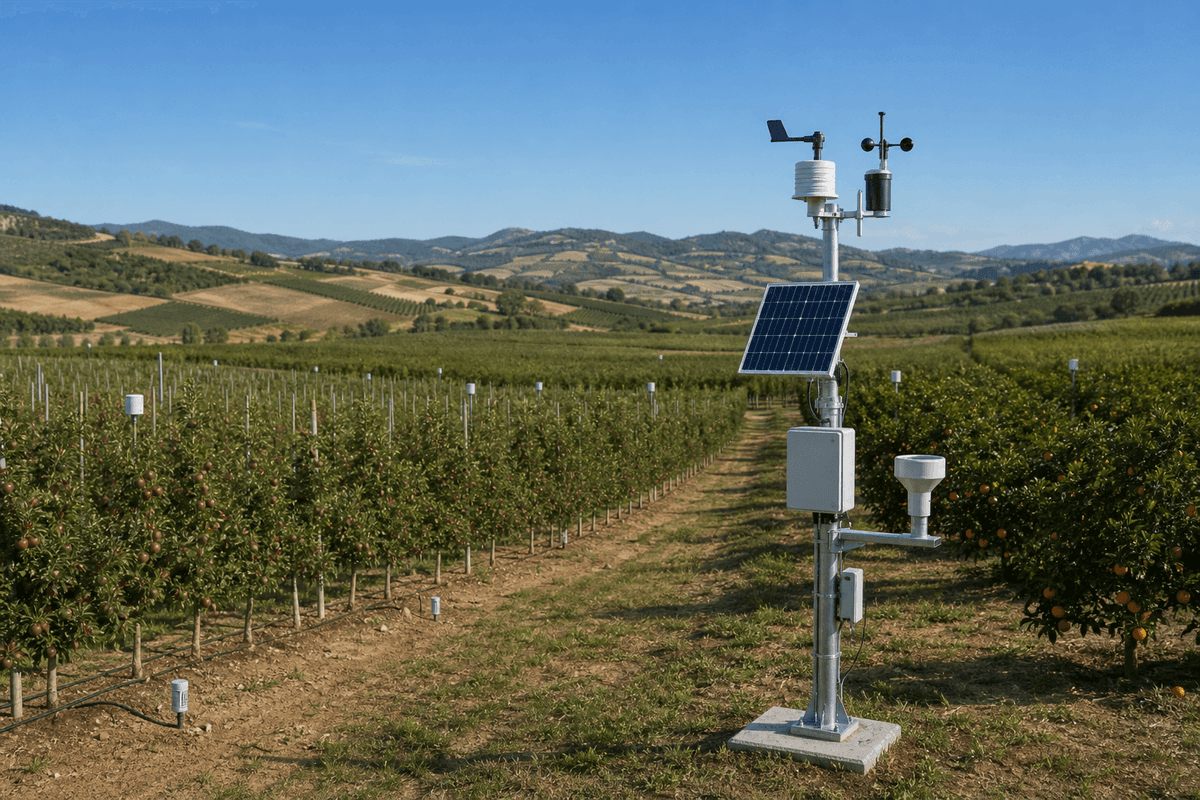
Disease Early Warning System - 40ha Orchard AI Monitoring
Key Features
- 12 professional-grade sensors covering 40 hectares with 95%+ disease detection accuracy
- AI spore trap analyzes 1M+ pathogen images for real-time fungal disease identification
- Professional weather station with 10 parameters sampled every 60 seconds (WMO compliant)
- 8 multi-depth soil probes measuring moisture, temperature, EC, pH, NPK at 4 depths (10-60cm)
- 80W solar panels + 30Ah LFP batteries ensure 99.9% uptime with 7-day backup capacity
The SOLARTODO Disease Early Warning System is designed for 40-hectare orchards, featuring 12 professional-grade sensors and an AI-driven spore trap with a capacity of 10 liters per minute. Priced between $12,000 and $17,000, it is certified by IEC and TÜV. This system targets high-value crops, enhancing disease management and improving yields by up to 25%.
Description
In modern agriculture, safeguarding crop health is paramount to ensuring profitability and sustainability. For high-value crops such as apples and citrus, fungal diseases like powdery mildew, botrytis, and blight can devastate yields by up to 40-60% if not managed proactively. The SOLARTODO Disease Early Warning System for 40-Hectare Orchards represents a paradigm shift from reactive treatment to predictive, data-driven prevention. This integrated solution leverages a sophisticated network of 12 professional-grade sensors, AI-powered diagnostics, and robust solar-powered infrastructure to provide growers with unparalleled insights into their orchard's ecosystem. By delivering real-time alerts with over 95% accuracy, the system empowers farmers to apply targeted interventions precisely when and where they are needed, leading to reported pesticide reductions of up to 30% and yield improvements of 15-25%.
The cornerstone of the system is its revolutionary disease monitoring technology, which identifies threats before they become visible to the human eye. The primary component is an automated, AI-driven spore trap, a volumetric air sampler compliant with international aerobiology standards. This device continuously draws in a calibrated volume of air—typically 10 liters per minute—capturing airborne fungal spores on a specialized adhesive slide. Every 60 minutes, the slide is automatically moved under an integrated high-resolution microscope. An onboard AI, trained on a dataset of over 1 million pathogen images, performs real-time microscopic analysis to identify and count spores of critical diseases like Venturia inaequalis (apple scab) and Phytophthora citrophthora (citrus brown rot). This is complemented by a handheld multispectral leaf scanner. This device allows for targeted field scouting, using imaging across 6 spectral bands from 450nm to 900nm to detect subtle changes in chlorophyll fluorescence and cellular structure that indicate the earliest stages of infection, often 5-7 days before visible symptoms like lesions or mildew appear.
Effective disease modeling requires a holistic understanding of the orchard's microclimate. Our system includes a professional-grade weather station that adheres to World Meteorological Organization (WMO) guidelines for agricultural meteorology. This station provides real-time data on 10 critical parameters: ambient temperature, relative humidity (±2% accuracy), wind speed and direction (ultrasonic, 0.1 m/s resolution), rainfall (0.2mm tipping bucket), solar radiation (pyranometer, ISO 9060 Class C), atmospheric pressure, and calculated evapotranspiration (ET₀). Data is sampled every 60 seconds and aggregated into 10-minute intervals, feeding directly into our cloud-based disease models. Below ground, a network of 8 multi-depth soil monitoring probes provides granular data on root-zone conditions. Each IP68-rated, corrosion-resistant probe measures volumetric water content (0-100%), temperature (-30°C to 70°C), electrical conductivity (EC), pH, and NPK levels at four distinct depths: 10cm, 20cm, 40cm, and 60cm. This detailed soil profile, powered by a 5-year lifespan internal battery, is crucial for optimizing irrigation schedules. By integrating this data with the professional cloud tier, the system drives automated precision irrigation, reducing water consumption by a documented average of 50% while preventing plant stress that can increase disease susceptibility.
Designed for decades of reliable, maintenance-free operation in harsh agricultural environments, the entire system is powered by a medium-tier solar solution. Each of the 12 sensor nodes, including the weather station and spore trap, is equipped with an 80W monocrystalline solar panel (IEC 61215 certified) and a 30Ah Lithium Iron Phosphate (LFP) battery bank. This configuration ensures continuous operation for over 7 days without any solar input, guaranteeing 99.9% uptime even through extended periods of inclement weather. The power electronics are housed in an IP67-rated enclosure and certified to UL 1741 for solar power systems. Data from the distributed sensors is transmitted wirelessly via a central LoRaWAN gateway. This single gateway provides reliable, low-power connectivity across a 10-kilometer radius, easily covering the 40-hectare orchard and capable of supporting hundreds of additional sensors. For high-bandwidth data, such as images from the AI spore trap, the system utilizes an integrated 4G LTE cellular modem. This hybrid communication architecture, compliant with IEEE 802.15.4g for wireless networking, ensures that low-frequency sensor data is transmitted efficiently while high-priority alerts and diagnostic images are delivered in real-time.
The Professional Cloud Tier serves as the brain of the operation, transforming raw data into actionable intelligence. Growers access a real-time dashboard via any web browser or mobile app, visualizing current conditions, historical trends, and predictive analytics. The platform's AI engine correlates weather data, soil conditions, and spore counts with crop-specific phenology models for apples and citrus. When the combined risk factors for a specific disease—for example, 6 hours of leaf wetness with temperatures between 15-25°C and a spore count exceeding 50 spores/m³—cross a predefined threshold, the system automatically triggers a multi-channel alert via SMS, email, and app push notification. Beyond simple alerts, the platform offers advanced AI features. These include a 7-day pest outbreak forecast, AI-driven irrigation recommendations that predict daily water needs, and a crop growth model that provides yield forecasting with an accuracy of ±10%. All data and analytics are accessible via a comprehensive REST API, allowing for seamless integration with existing farm management software (FMS), irrigation controllers, and other third-party systems, adhering to ISO 11783 (ISOBUS) standards for agricultural data exchange.
Technical Specifications
| Coverage Area | 40hectares |
| Total Sensors | 12sensors |
| Monitoring Types | Weather, Disease, Soil |
| Weather Parameters | 10parameters |
| Soil Monitoring Depths | 4layers (10/20/40/60cm) |
| Disease Detection Type | AI Spore Trap + Leaf Scanner |
| Communication | LoRaWAN + 4G LTE |
| Gateway Range | 10km radius |
| Solar Panel Power | 80W per node |
| Battery Capacity | 30Ah LFP |
| Battery Backup | 7+days |
| Data Interval | 10minutes (configurable 1-60min) |
| Cloud Platform | Professional Tier |
| Alert Channels | SMS + Email + App Push |
| API Access | REST API |
| System Uptime | 99.9% |
| Disease Detection Accuracy | 95+% |
| Warranty (Hardware) | 2years |
| Warranty (Cloud) | 1year |
Price Breakdown
| Item | Quantity | Unit Price | Subtotal |
|---|---|---|---|
| Professional Weather Station (10-parameter) | 1 pcs | $1,500 | $1,500 |
| AI Spore Trap with Microscopic Analysis | 1 pcs | $2,500 | $2,500 |
| Multispectral Leaf Scanner | 1 pcs | $1,800 | $1,800 |
| Multi-depth Soil Sensor (7-parameter) | 8 pcs | $580 | $4,640 |
| LoRaWAN Gateway | 1 pcs | $450 | $450 |
| 4G LTE Communication Gateway | 1 pcs | $350 | $350 |
| Solar Power Kit (80W medium-tier) | 12 pcs | $300 | $3,600 |
| Professional Cloud Platform (annual/12 devices) | 12 pcs | $48 | $576 |
| Installation and Training Service | 1 pcs | $500 | $500 |
| Total Price Range | $12,000 - $17,000 | ||
Frequently Asked Questions
How does the AI differentiate between harmful spores and harmless pollen?
What is the maintenance schedule for the hardware components?
How secure is the data transmitted from the orchard to the cloud?
Can the system be expanded to cover more than 40 hectares?
How does the system perform in areas with poor cellular reception?
Certifications & Standards


Data Sources & References
- •World Meteorological Organization (WMO) Agricultural Meteorology Guidelines 2025
- •IEC 61215 Solar Panel Testing Standards
- •ISO 11783 ISOBUS Agricultural Data Exchange Protocol
- •IEEE 802.15.4g Wireless Smart Utility Networks Standard
Interested in this solution?
Contact us for a customized quote based on your specific requirements.
Contact Us