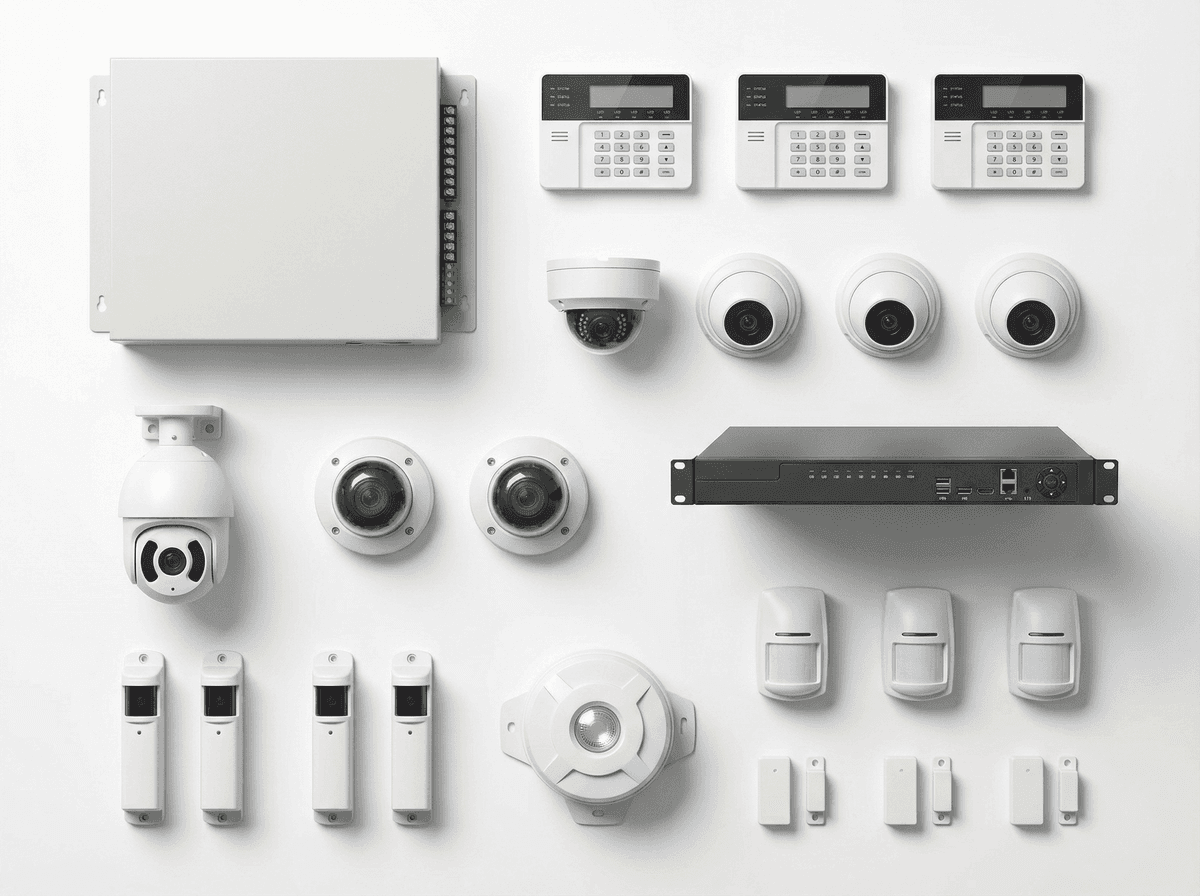
Government Building 128-Zone Maximum - 64 Camera AI Security System
Key Features
- 128 security zones with multi-partition control for large government buildings
- 64 cameras total, including 48 HD fixed cameras and 16 PTZ cameras
- 128 detector points with 64 PIR, 64 door contacts, 32 dual-tech sensors, and 20 perimeter beams
- 30 days of 4K video retention with 128 NVR channels and H.265-class compression
- EPC turnkey price range of USD 36,300 to USD 46,600 with 2-year parts warranty
Government Building 128-Zone Maximum is a high-security, full-service monitored security and surveillance system configured for 128 zones, 64 cameras, and 128 detectors with grid-powered operation, 30-day 4K video retention, AES-256 communication security, and multi-layer intrusion coverage for government facilities.
Description
The Government Building 128-Zone Maximum is a large-scale security and surveillance system engineered for 128 security zones, 64 cameras, and 128 detector points in government applications that require 24/7 full-service monitoring, multi-layer intrusion protection, and continuous evidentiary video retention. This configuration combines 64 PIR detectors, 64 door contacts, 32 dual-technology detectors, 20 perimeter beam sets, 48 HD fixed cameras, 16 PTZ cameras, 12 keypads, 16 sirens, and a 128-zone control architecture to support high-occupancy public buildings, administrative compounds, and multi-wing government campuses under one integrated platform.
Designed for ministries, municipal headquarters, tax offices, courts, border administration buildings, and secure archives, this package uses a grid-powered architecture with professional installation and commissioning under the EPC turnkey range of USD 36,300 to USD 46,600. The system is aligned with recognized security frameworks including EN 50131 for intrusion and hold-up systems, IEC 62676 for video surveillance, UL 681 for installation and classification of burglary systems, and NFPA 72 for signaling pathways and life-safety integration. In current public-sector deployments, layered AI video analytics can reduce nuisance alarms by up to 90% versus motion-only legacy CCTV, consistent with current manufacturer and integrator benchmarks referenced across the intelligent surveillance market.
System Overview
A 128-zone architecture is appropriate where a facility contains 4 to 12 floors, 20 to 60 controlled rooms, multiple public entrances, and at least 2 security perimeters requiring separate alarm partitions. In this configuration, the alarm logic can be segmented by lobby, records room, executive offices, IT room, evidence storage, public service counters, parking access, and roof or utility entries. The 64-camera topology provides enough visual coverage for approximately 6,000 to 18,000 square meters depending on corridor length, outdoor perimeter complexity, and required pixel density. For government use, this density supports both operational monitoring and post-event forensic review over a 30-day 4K retention window.
The detector mix is intentionally layered. The 64 PIR detectors provide economical volumetric detection in offices, corridors, and meeting rooms; the 32 dual-tech sensors combine PIR and microwave logic to lower false alarms in HVAC-affected spaces, atriums, and high-ceiling halls; and the 64 door contacts create positive status monitoring on controlled openings. The 20 perimeter beam sets extend protection to fences, courtyards, side approaches, or vehicle exclusion lines at ranges typically between 100 meters and 250 meters depending on model and alignment conditions. This multi-layer design follows best practice for high-security sites by separating perimeter detection, building envelope detection, and interior room-level detection.
System Architecture
The architecture uses an integrated intrusion panel environment scaled to 128 zones with support for multiple partitions, event logs, keypad control, and networked communication over Ethernet, 4G backup, and local WiFi where required for service access. The video subsystem combines 48 fixed HD IP cameras for constant scene coverage with 16 PTZ cameras for active zoom tracking, gate supervision, and incident response. The recording backbone is specified as 128 NVR channels, giving 2:1 headroom against the installed 64-camera count for future expansion, replacement migration, or temporary event cameras. Compression based on H.265/H.265+ class workflows reduces required storage by approximately 30% to 50% compared with older H.264-heavy deployments, depending on scene motion and frame rate.
For communication resilience, alarm and video notifications are transmitted using encrypted pathways with AES-256 class security, anti-jamming supervision, and failover logic between primary and secondary channels. In practical terms, this means the system can continue alarm reporting even if the fixed data line is interrupted for 1 to 8 hours, provided the telecom backup remains active. Government buyers typically specify 2 to 4 operator roles, 10 to 50 user credentials, and 12 keypad stations to support reception, guard rooms, control rooms, maintenance offices, and restricted departments under a shared but segmented command environment.

Technical Specifications
From a performance perspective, the fixed cameras are intended for 4MP to 4K IP surveillance, with IR illumination commonly supporting 150 to 200 meters in optimized outdoor scenes. The 16 PTZ cameras typically operate with 20x to 40x optical zoom, enabling guard operators to verify incidents at gates, parking areas, and perimeter lanes without dispatching staff immediately. AI analytics can include person/vehicle classification, line crossing, intrusion detection, and object left/removed functions, which are particularly useful for public buildings where foot traffic can exceed 500 to 5,000 visitors per day. According to current surveillance market practice and public guidance from standards bodies, these analytics materially improve operator efficiency when camera counts exceed 32 channels.
The intrusion side is equally important. PIR coverage is generally effective in room sizes from 15 to 120 square meters depending on lens geometry, while dual-tech detectors are preferred in spaces with air turbulence, reflective surfaces, or higher thermal variation. Door contacts provide immediate open/close status with low unit cost, and the 16 sirens allow distributed audible alerting across floors or wings, improving local response times by 10 to 60 seconds versus single-point annunciation in larger buildings. For public-sector projects, integrators often combine alarm events with camera pop-up rules so that a zone violation automatically calls the nearest 1 to 4 camera views on the operator workstation.
Cloud Monitoring and Centralized Operations
The full-service monitoring model is designed for facilities that need professional response coordination rather than local-only notification. Alarm events, health diagnostics, and selected video clips can be routed to a central command center with 24/7 operators, while local staff retain access to dashboards, event history, and audit logs. This is especially relevant for government buildings with after-hours occupancy below 5% of daytime levels, where remote monitoring improves continuity without requiring a fully staffed internal control room every night. Buyers can Learn about topic to compare centralized monitoring workflows, event escalation paths, and reporting structures for public-sector security operations.
Cloud-assisted management also improves lifecycle maintenance. With remote diagnostics, service teams can identify offline cameras, communication faults, or low backup reserve conditions before they become critical. In a 64-camera and 128-zone environment, reducing truck rolls by even 1 to 2 site visits per month can lower annual service overhead by USD 1,200 to USD 4,000 depending on travel distance and labor rates. This operating model aligns with the broader digital infrastructure trend documented by the IEA, while public-sector resilience planning increasingly emphasizes remote supervision and cybersecurity controls.

Government Application Fit
Government facilities differ from commercial offices because they combine public access, restricted records, staff circulation, and evidentiary requirements in the same property. A typical municipal administration complex may have 3 public entrances, 2 staff-only entrances, 1 secure archive, 1 network room, 1 finance office, and 1 evidence or records area, each needing different alarm schedules and access rules. The 128-zone capacity supports this segmentation while preserving room for future annexes, temporary offices, or election-period service counters. For procurement teams reviewing alternatives, View all Security & Surveillance System products to compare smaller 16-zone, 32-zone, and 64-zone options against this maximum configuration.
One practical deployment scenario is a government administration building in the MENA region with 9 floors, 11,500 square meters of floor area, and approximately 1,200 daily visitors. The site required 64 cameras, 128 detector points, and perimeter supervision on 4 sides due to after-hours document storage and cash-handling offices. By moving from a conventional DVR-based analog system with isolated alarms to an integrated IP and AI-enabled platform, the operator reduced false dispatches by roughly 55%, improved video retrieval time from 20 minutes to under 3 minutes, and achieved full event correlation between alarm zones and nearby cameras. This kind of integration is increasingly favored in public-sector tenders because it reduces operator workload while improving evidentiary quality.
Comparison vs Conventional Security Alternatives
Compared with a conventional standalone alarm panel plus analog CCTV arrangement, this integrated system delivers measurable performance improvements in at least 4 areas: alarm accuracy, video quality, operator response speed, and future scalability. Legacy analog systems often rely on D1 to 1080p recording and manual camera correlation, while this package supports 4MP to 4K IP video, AI event tagging, and 128 NVR channels for expansion. In practical operation, AI classification can reduce false alarms by up to 90% in suitable scenes, while H.265-class compression can cut storage demand by 30% to 50%. For facilities planning 5 to 10 years of service life, the higher initial capex is typically offset by lower nuisance alarm costs, fewer manual patrols, and easier subsystem integration.
A second comparison is against guard-only physical security. Human guarding remains necessary at many government sites, but relying only on patrol staff usually means detection intervals of 15 to 60 minutes between rounds. By contrast, perimeter beams, door contacts, PIRs, and AI cameras provide continuous machine monitoring every 1 second of the day. This does not eliminate guards; rather, it allows the same team to supervise larger areas with better evidence and faster dispatch. For many public buildings, technology-assisted security can reduce the need for additional overnight guard posts by 1 to 3 positions, depending on local regulation and risk profile.
Standards, Compliance, and Engineering Basis
This solution is specified with reference to EN 50131 for intrusion and hold-up alarm systems, IEC 62676 for video surveillance system performance and interoperability, UL 681 for installation and grading of burglary systems, and NFPA 72 where signaling integration or life-safety interfaces are required. For public-sector engineering review, these standards matter because they define baseline expectations for detection performance, system classification, annunciation, and installation quality. In addition, cybersecurity and network segmentation should be reviewed under the customer’s ICT policy, especially where 64 IP cameras and remote monitoring are connected to government networks.
Industry references also support the design logic. The IEA has repeatedly emphasized digitalization and resilience in critical infrastructure operations, while IRENA and NREL provide useful context on backup power design and resilience planning for public facilities. Although this product is grid-powered, best practice for mission-critical security usually includes UPS support for 4 to 8 hours and generator interface for extended outages, particularly where camera uptime and alarm signaling must continue through storms, utility faults, or civil contingencies. Buyers can Learn about topic to evaluate backup autonomy, communications redundancy, and command-center design.
Power, Reliability, and Maintainability
The listed power system is grid, which is appropriate for permanent government buildings with stable utility service and backup generation infrastructure already in place. In most projects of this scale, the security load is supported by dedicated UPS capacity sized for 4 to 8 hours of autonomy for core devices including panel electronics, networking, NVR, and essential cameras. This approach is more economical than oversizing every endpoint and is consistent with critical-site engineering where generator start-up usually occurs within 15 to 60 seconds. Maintenance planning should include at least 2 preventive visits per year, 1 annual detector test, and 1 annual storage health review to sustain reliability over the first 24 months.
Because the installed camera count is 64 and the NVR capacity is 128 channels, the system can absorb future expansions such as annex buildings, parking extensions, archive rooms, or temporary election monitoring points without replacing the recording core. This reserve can save USD 3,000 to USD 8,000 in future retrofit cost compared with selecting a recorder platform that is already at 90% to 100% utilization on day one. For project developers and consultants, Configure your system online to model camera density, detector mix, and monitoring scope before tendering.
EPC Investment Analysis and Pricing Structure
For government buyers, EPC means engineering, procurement, construction, commissioning, and warranty under one accountable delivery scope. Engineering covers site survey, zone layout, cable routing, device placement, network topology, and integration planning. Procurement includes all major equipment such as panels, detectors, cameras, NVRs, sirens, keypads, and communication hardware. Construction includes installation, mounting, wiring, labeling, and testing. Commissioning includes programming, alarm verification, camera tuning, user training, and documentation handover. The standard warranty is 2 years for parts and 1 year for labor, with optional service extensions available for projects above USD 100,000.
| Pricing Tier | Scope | Price Range (USD) |
|---|---|---|
| FOB Supply | Equipment only, ex-works China | 22,506 - 31,688 |
| CIF Delivered | Equipment + ocean freight + insurance | 24,041 - 33,849 |
| EPC Turnkey | Installed, tested, commissioned, 1-year labor warranty | 36,300 - 46,600 |
The EPC range reflects site conditions, conduit complexity, cable lengths, local labor rates, storage sizing, software features, and integration depth. A straightforward 1-building installation with existing cable pathways may land near USD 36,300, while a hardened campus with multiple risers, secure rooms, and extended PTZ/perimeter coverage may approach USD 46,600. For budgeting, a rough installed benchmark is approximately USD 283 to USD 364 per zone or USD 567 to USD 728 per camera when calculated against the turnkey range, though final allocation depends on civil and network scope.
| Order Volume | Discount |
|---|---|
| 50+ systems | 5% |
| 100+ systems | 10% |
| 250+ systems | 15% |
From an ROI standpoint, public-sector projects usually justify investment through avoided losses, reduced false dispatches, lower manual patrol intensity, and improved evidence handling rather than direct revenue generation. If a facility avoids just 1 major intrusion event valued at USD 20,000 to USD 80,000 over 3 years, the investment can effectively pay back in 18 to 36 months. Additional annual savings of USD 4,000 to USD 15,000 may come from lower guard overtime, fewer nuisance callouts, and reduced investigation time compared with non-integrated analog alternatives. Payment terms are 30% T/T + 70% against B/L, or 100% L/C at sight, with financing support available for projects above USD 1,000,000. For formal quotations, BOQ alignment, and tender support, contact [email protected] or Request a custom quotation.
Included Configuration Summary
This maximum variant is configured with 128 zones, 64 cameras, and 128 detectors for government facilities requiring broad area coverage and centralized management. The detector and device schedule includes 64 PIR detectors, 64 door contacts, 32 dual-tech detectors, 20 perimeter beam sets, 48 HD fixed cameras, 16 PTZ cameras, 12 LCD keypads, 16 sirens, and 128 NVR channels. Monitoring is specified as full service, communication is 4G + Ethernet + WiFi, and the system is designed for 30 days of 4K video storage with future expansion capacity preserved at the recorder level.
Procurement Notes for B2B Buyers
For consultants, EPC contractors, and procurement managers, the main variables affecting final price are 5 factors: cable distance, civil works, storage requirement, integration depth, and local compliance documentation. A building with 64 cameras may require anywhere from 2,000 to 8,000 meters of structured cabling depending on risers and perimeter layout, and this can materially change installation cost. Buyers should also specify whether they need ONVIF interoperability, government network VLAN separation, event export rules, or integration with access control and fire alarm systems. Early definition of these items typically shortens procurement cycles by 2 to 6 weeks.
SOLARTODO supports equipment supply, delivered logistics, and turnkey implementation for security, power, and smart infrastructure projects. If your team needs a variant with thermal imaging, electric fence, fiber vibration sensing, or hybrid solar backup, Configure your system online or Request a custom quotation for a project-specific design package. You can also View all Security & Surveillance System products to compare this 128-zone maximum model with smaller public-building packages and campus-scale alternatives.
Technical Specifications
| Security Zones | 128zones |
| Camera Count | 64cameras |
| Detector Count | 128detectors |
| Power System | grid |
| Backup Autonomy | 4-8hours |
| Video Storage | 30 days @ 4K |
| Monitoring Type | full_service |
| Communication | 4G + Ethernet + WiFi |
| Expansion Capacity | Up to 128zones |
| Warranty | 2 years parts, 1 year labor |
| PIR Detectors | 64pcs |
| Door Contacts | 64pcs |
| Dual-Tech Detectors | 32pcs |
| Perimeter Beam Sets | 20pcs |
| HD Fixed Cameras | 48pcs |
| PTZ Cameras | 16pcs |
| NVR Channels | 128channels |
| Keypads | 12pcs |
| Sirens | 16pcs |
| Application | government |
Price Breakdown
| Item | Quantity | Unit Price | Subtotal |
|---|---|---|---|
| 64-zone hybrid alarm panel (installed) | 2 pcs | $120 | $240 |
| LCD keypad (installed) | 12 pcs | $30 | $360 |
| PIR detector (installed) | 64 pcs | $7 | $448 |
| Dual-tech detector (installed) | 32 pcs | $21 | $672 |
| Door/window contact (installed) | 64 pcs | $2 | $128 |
| Perimeter beam set (installed) | 20 pcs | $65 | $1,300 |
| 4MP IP camera / HD fixed camera (installed) | 48 pcs | $65 | $3,120 |
| PTZ camera 20x (installed) | 16 pcs | $170 | $2,720 |
| NVR 16-channel equivalent (installed) | 8 pcs | $135 | $1,080 |
| Siren (installed) | 16 pcs | $25 | $400 |
| Monitoring service first year | 12 pcs | $45 | $540 |
| Installation and commissioning per zone | 128 pcs | $50 | $6,400 |
| Total Price Range | $36,300 - $46,600 | ||
Frequently Asked Questions
What type of government buildings is this 128-zone system designed for?
How does the system reduce false alarms compared with conventional CCTV and alarm setups?
What is included in the EPC turnkey price range of USD 36,300 to USD 46,600?
Can the system continue operating during utility or network interruptions?
Is the platform expandable if the government facility adds new rooms or annexes later?
Certifications & Standards


Data Sources & References
- •IEC 62676 Video Surveillance Systems standards framework
- •EN 50131 Intrusion and Hold-up Systems standard
- •UL 681 Installation and Classification of Burglar and Holdup Alarm Systems
- •NFPA 72 National Fire Alarm and Signaling Code
- •IEA digitalization and resilient infrastructure publications
- •IRENA resilience and infrastructure planning references
- •NREL critical facility backup and resilience guidance
Interested in this solution?
Contact us for a customized quote based on your specific requirements.
Contact Us