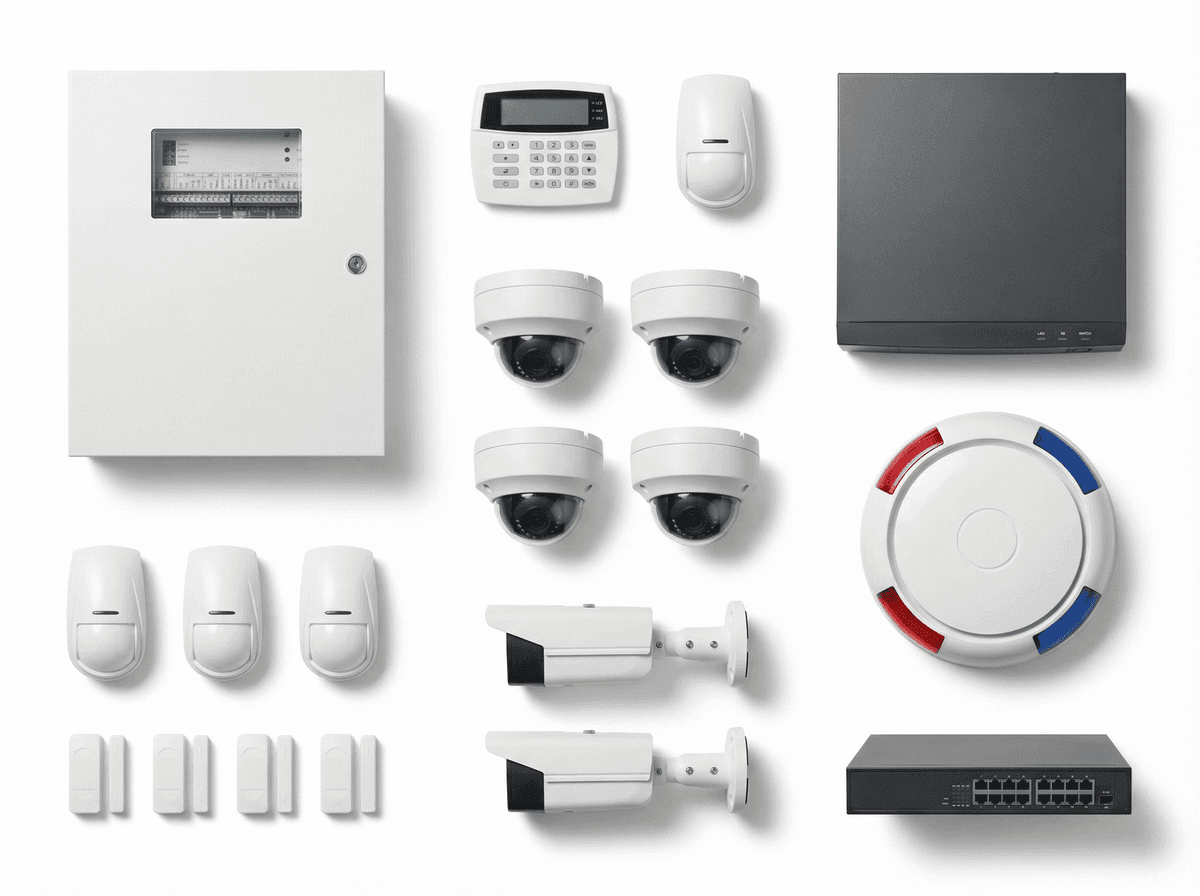
Gas Station Chain 32-Zone Cloud - Multi-Site AI Security
Key Features
- 32 security zones with 64-zone panel capacity for 32 future expansion points
- 16 HD IP cameras with 1 x 32-channel NVR and 30 days of 4K video retention
- 48 field detection devices including 16 PIR, 16 door contacts, 8 glass-break, and 8 gas detectors
- 4G + Ethernet + WiFi communications with AES-256-class encrypted cloud event transmission
- EPC turnkey price range of USD 6,200-8,000 per station with 2-year parts and 1-year labor warranty
Gas Station Chain 32-Zone Cloud is a 32-zone, 16-camera, cloud-managed security and surveillance system for fuel retail networks, combining 64-zone hybrid intrusion control, 30-day 4K video retention, 4G plus Ethernet communications, and premium central monitoring. Designed for grid-powered gas stations, it supports 16 PIRs, 16 door contacts, 8 glass-break sensors, 8 gas detectors, and 16 HD IP cameras with standards-aligned architecture referencing EN 50131, IEC 62676, UL 681, and NFPA 72.
Description
The Gas Station Chain 32-Zone Cloud is a cloud-connected security and surveillance package engineered for 32 protected zones, 16 HD IP cameras, 32 primary detector points, and premium multi-site monitoring across fuel retail portfolios. The standard configuration uses 1 hybrid 64-zone control panel, 16 PIR detectors, 16 door contacts, 8 glass-break detectors, 8 gas detectors, 16 cameras, 1 32-channel NVR, 4 LCD keypads, and 4 sirens, with 30 days of 4K video retention and 4G + Ethernet + WiFi communications for resilient operation at grid-powered gas station sites.
For chain operators managing 5 to 500 forecourts, the design objective is to reduce security response time, standardize site visibility, and improve incident evidence quality at 24/7 retail environments with hazardous fuel-handling areas. The system architecture aligns with EN 50131 for intrusion systems, IEC 62676 for video surveillance, UL 681 for installation practices, and NFPA 72 principles for alarm signaling integration, while deployment planning can be supported alongside broader smart-infrastructure strategies documented by IEA, IRENA, NREL, IEC, NFPA, and BloombergNEF sources used by professional buyers in 2024-2025.
Product Positioning for Gas Station Chains
A typical fuel station has 6 to 12 critical risk points including forecourt dispensers, cashier zones, convenience store entrances, tank fill points, back-office doors, perimeter gates, and delivery interfaces. This package expands that baseline into 32 alarm zones and 16 video channels so operators can assign separate logic for retail, perimeter, stockroom, office, and hazardous utility spaces across a single site, while central security teams can manage dozens of stations from 1 cloud dashboard. Buyers evaluating alternatives can also View all Security & Surveillance System products to compare smaller 8-zone or larger 64-zone options.
Compared with a conventional DVR-only CCTV setup using 8 analog cameras and no integrated intrusion detection, this cloud package can reduce false dispatches by up to 90% when AI person/vehicle filtering and alarm verification workflows are enabled, based on current analytics performance benchmarks commonly referenced in modern surveillance deployments. It also improves event traceability because a drive-off, forced door, broken storefront glass, or gas leak can be correlated across 3 evidence layers: alarm logs, recorded video, and cloud notifications within seconds rather than minutes.
System Architecture
The platform is centered on 1 hybrid intrusion panel rated for up to 64 zones, giving the supplied 32-zone configuration room for 32 additional zones for future expansion such as smoke, vibration, beam sensors, or freezer-room contacts. The standard detector mix includes 16 PIR sensors for indoor motion, 16 magnetic door contacts for access points, 8 glass-break detectors for storefront glazing, and 8 gas detectors for fuel-related utility and enclosed-risk areas. In practical gas station layouts, those 48 field devices are typically distributed across 4 functional areas: retail interior, cashier/back office, perimeter/service rooms, and fuel infrastructure support spaces.
The video subsystem uses 16 HD IP cameras connected to 1 NVR with 32 channels, allowing the operator to add 16 more cameras later without replacing the recorder. For sites requiring detailed transaction review, the NVR can be configured to record forecourt, POS counter, entrance, canopy, and loading activity using H.265/H.265+ compression, which supports approximately 30 days of retention at 4K-class recording profiles depending on frame rate, bitrate, and storage sizing. This architecture is particularly relevant for chain owners who need evidence retention for insurance claims, theft investigations, and compliance audits across monthly, quarterly, and annual review cycles.

Technical Specifications
The supplied package is optimized for grid-powered operation and premium monitoring, with communication redundancy through Ethernet, 4G backup, and WiFi connectivity. In standard EPC execution, the system integrates 4 keypads for local arming/disarming, 4 sirens for audible alerting, and encrypted event transmission using AES-256-class data protection practices typical of enterprise alarm communication pathways. For chain deployments above 20 sites, centralized user-role management can be segmented by region, station, or business unit so that a head office can control permissions at 3 to 5 levels without exposing all locations to all users.
Camera placement for a 16-channel gas station build generally follows a repeatable template: 4 cameras for forecourt lanes, 2 cameras for canopy overviews, 2 cameras for store entrances, 2 cameras for cashier/POS areas, 2 cameras for perimeter sides, 2 cameras for back-of-house/service zones, and 2 cameras for tank fill or loading areas. Where local code requires hazardous-zone hardware, explosion-protected camera housings can be specified for Zone 1 or Zone 2 classified areas, while standard indoor/outdoor IP cameras remain suitable for non-hazardous retail and perimeter positions. Buyers can Configure your system online for site-specific camera maps, storage days, and communication options.
Cloud Monitoring and Multi-Site Management
Cloud management is the defining feature for chain operators with 10, 50, or 200 stations spread over multiple cities or countries. Instead of checking each NVR locally, the operator receives alarm events, health status, online/offline reports, and selected video verification through 1 centralized portal with mobile and desktop access. Premium monitoring typically includes 24/7 event supervision, escalation matrices, and exception reporting for communication loss, power anomalies, and detector tamper events, reducing the operational burden on local station staff by several hours per week per site.
For gas station chains, cloud workflows are especially valuable for 3 recurring incident types: drive-offs, after-hours intrusion, and staff-safety events. License plate snapshots from entry/exit cameras can be linked with event time stamps, while intrusion alarms from a back-office door or convenience-store glazing can trigger immediate clip retrieval and operator review. This improves response quality compared with conventional standalone CCTV because the central team can see who entered, which zone triggered, and what happened in the previous 30 to 120 seconds without waiting for manual footage export.

Detection Logic, AI Analytics, and False Alarm Control
False alarms are a major cost driver in retail security, especially when a chain operates 100+ stations and each unnecessary dispatch costs labor, fuel, and response fees. By combining 16 PIR detectors, 16 door contacts, 8 glass-break sensors, and 16 cameras, the system supports multi-condition verification such as “door forced + motion confirmed + human detected on video.” In field practice, this layered logic can reduce nuisance alarms by up to 90% compared with single-sensor legacy systems, particularly at sites exposed to vibration, headlights, HVAC turbulence, or reflective storefront glass.
The AI video layer supports person/vehicle classification, intrusion zones, line crossing, and object left/removed analytics. At a forecourt, that means a vehicle entering a restricted service lane can be flagged within 1 to 3 seconds, while a person crossing into a closed cashier zone after hours can generate an alarm clip and push notification almost immediately. As edge AI processing becomes more common in 2025, operators also benefit from lower upstream bandwidth use because some filtering occurs at the camera or recorder level rather than sending every event to the cloud, a trend consistent with wider smart-infrastructure digitization noted by IEA 2024 and BloombergNEF 2025 market commentary.
Application Scenario
A regional fuel retailer in the MENA market deployed a configuration equivalent to this 32-zone / 16-camera package across 18 stations with 1 central security desk and 2 regional maintenance teams. Before deployment, the operator relied on mixed analog CCTV and local-only alarms, resulting in an average incident review time of 25 minutes and poor evidence quality in more than 30% of nighttime cases. After migration to cloud-monitored IP surveillance with integrated intrusion zones, average review time fell to under 6 minutes, verified false dispatches dropped by approximately 55%, and management gained standardized reporting across all 18 sites.
That scenario is representative because gas station chains often have identical risk patterns but inconsistent legacy hardware. Standardizing on 1 panel family, 1 cloud platform, 1 camera protocol set, and 1 maintenance workflow lowers spare-part complexity and training time. For developers planning broader site modernization, related design guidance is available through SOLARTODO knowledge resources, including Learn about topic for surveillance architecture, communications resilience, and integrated smart-site infrastructure.
Compliance, Standards, and Engineering Basis
Professional buyers usually require standards alignment before issuing tenders above $50,000 or multi-site framework agreements above $500,000. This package references EN 50131 for intrusion alarm system design classes, IEC 62676 for CCTV performance and operational considerations, UL 681 for installation and classification practices, and NFPA 72 for alarm signaling concepts relevant to integrated notification workflows. Where combustible vapor risk exists near dispensers or tank areas, final equipment selection should also be checked against local hazardous-area rules and electrical codes for Class I or equivalent zone-rated environments.
From a planning perspective, authoritative industry references support the value of digital monitoring and resilient infrastructure in distributed assets. NREL publications on remote asset monitoring emphasize reduced truck rolls and improved fault visibility; IRENA reports highlight digitalization as a cost-control lever in distributed energy and infrastructure systems; and IEA analyses repeatedly show that operational efficiency gains compound across networked sites. For buyers, the practical implication is clear: a standardized cloud security stack across 50 stations usually delivers lower lifecycle cost than maintaining 5 to 7 incompatible local systems from different vendors.
Installation Scope and Site Integration
A typical EPC installation for 1 gas station includes panel mounting, detector wiring, camera mounting, NVR setup, network commissioning, user creation, mobile app enrollment, and functional testing across all 32 configured zones. The supplied architecture is suitable for integration with POS exception monitoring, access control relays, generator alarms, and selected building-management contacts where required. On a standard forecourt with 1 convenience store, 1 cashier area, 2 to 4 fuel islands, and 2 back-office rooms, installation usually takes 2 to 4 working days depending on conduit availability, trenching needs, and hazardous-area camera scope.
Because the package is based on a 64-zone-capable panel and 32-channel NVR, future expansion is straightforward. Operators can add 16 more cameras, additional beam sensors, smoke points, panic buttons, or freezer alarms without replacing the main controller. This protects capital expenditure over a typical 5 to 7 year refresh horizon and compares favorably with fixed-capacity low-cost kits that often require full replacement once the original 8 or 16 channels are exhausted. For site-specific engineering support or chain-level rollouts, buyers can Request a custom quotation.
EPC Investment Analysis and Pricing Structure
For B2B projects, EPC scope means engineering, procurement, construction, commissioning, and warranty delivered as one package. Engineering includes site survey, point list, cable routing, camera placement, storage sizing, and cloud account structure. Procurement covers the panel, 48 detector devices, 16 cameras, 1 NVR, 4 keypads, 4 sirens, accessories, and network materials. Construction includes installation labor, cable works, device mounting, labeling, and testing. Commissioning includes zone programming, video retention setup, user training, and handover documents. Standard warranty is 2 years parts and 1 year labor.
| Pricing Tier | Scope | Price Range (USD) |
|---|---|---|
| FOB Supply | Equipment only, ex-works China | $3,844 - $5,440 |
| CIF Delivered | Equipment + ocean freight + insurance | $4,106 - $5,811 |
| EPC Turnkey | Installed, commissioned, 1-year labor warranty | $6,200 - $8,000 |
| Volume Order | Discount |
|---|---|
| 50+ systems | 5% |
| 100+ systems | 10% |
| 250+ systems | 15% |
Using the EPC range of $6,200 to $8,000, a chain deploying 100 stations would budget approximately $620,000 to $800,000 before volume discounts, or roughly $558,000 to $720,000 after a 10% discount. Compared with maintaining fragmented local systems that often require 2 to 4 separate service vendors, centralized cloud monitoring can reduce annual service coordination and incident response overhead by an estimated $900 to $1,500 per site per year, depending on labor rates and dispatch practices. At $1,200 annual savings on a $7,100 midpoint EPC investment, indicative simple payback is about 5.9 years, excluding avoided theft loss, reduced false dispatch fees, and insurance benefits, which can shorten effective payback to 3 to 5 years in higher-risk markets.
Payment terms are typically 30% T/T deposit + 70% against B/L for supply contracts, or 100% L/C at sight for qualified buyers. For project portfolios above $1,000K, financing support may be discussed subject to jurisdiction, credit profile, and project structure. Commercial contact: [email protected].
Price Breakdown Reference
The EPC installed pricing below uses the provided reference rates and reflects a realistic core bill for the configured scope. Actual project totals vary by site layout, hazardous-zone hardware, cable distance, storage capacity, and local labor. In most projects, the calculated component subtotal represents 70% to 85% of the final EPC value, with the balance covering engineering, accessories, commissioning, travel, and project management.
Why This Configuration Fits Gas Station Chains
Gas station operators need more than cameras; they need synchronized alarms, verified video, and centralized oversight across 24-hour retail environments with fuel safety considerations. This package combines 32 zones, 16 cameras, 30-day storage, and premium monitoring in a format that scales from 1 station to 250+ stations while preserving expansion headroom through a 64-zone panel and 32-channel NVR. For additional technical reading on integrated site security, communications resilience, and surveillance design, buyers can also Learn about topic.
In summary, the Gas Station Chain 32-Zone Cloud package is designed for operators who require measurable security performance, standards-aware engineering, and predictable multi-site rollout economics. It delivers stronger incident verification than conventional standalone CCTV, lower lifecycle complexity than mixed-vendor legacy systems, and a clear commercial structure from FOB $3,844 up to EPC $8,000 per site. For procurement teams comparing bids, the most important differentiators are the 64-zone expansion capacity, 16-camera baseline, cloud monitoring workflow, and the ability to standardize security governance across every station in the network.
Technical Specifications
| Security Zones | 32zones |
| Camera Count | 16cameras |
| Detector Count | 32detectors |
| Power System | grid |
| Backup Autonomy | 4-8hours |
| Video Storage | 30days @ 4K |
| Monitoring Type | premium |
| Communication | 4G + Ethernet + WiFi |
| Expansion Capacity | 64zones |
| Warranty | 2 years parts, 1 year labor |
| PIR Sensors | 16pcs |
| Door Contacts | 16pcs |
| Glass Break Detectors | 8pcs |
| Gas Detectors | 8pcs |
| NVR Channels | 32channels |
| Keypads | 4pcs |
| Sirens | 4pcs |
| Application | gas_station |
Price Breakdown
| Item | Quantity | Unit Price | Subtotal |
|---|---|---|---|
| 64-zone hybrid alarm panel (installed) | 1 pcs | $120 | $120 |
| LCD keypad (installed) | 4 pcs | $30 | $120 |
| PIR detector (installed) | 16 pcs | $7 | $112 |
| Door/window contact (installed) | 16 pcs | $2 | $32 |
| Glass break detector (installed) | 8 pcs | $8 | $64 |
| Gas detector (installed) | 8 pcs | $6 | $48 |
| 4MP IP camera (installed) | 16 pcs | $65 | $1,040 |
| 32-channel NVR (installed) | 1 pcs | $270 | $270 |
| Siren (installed) | 4 pcs | $18 | $72 |
| Installation labor by zone (installed) | 32 pcs | $50 | $1,600 |
| Monitoring service annualized reference | 12 pcs | $45 | $540 |
| Total Price Range | $6,200 - $8,000 | ||
Frequently Asked Questions
Is this system suitable for a single gas station or only for chains?
Can the system be expanded beyond the standard 32-zone and 16-camera configuration?
How does cloud monitoring improve operations compared with a conventional local CCTV system?
What is included in the EPC turnkey price, and what warranty is provided?
What payment terms are available for international B2B orders?
Certifications & Standards


Data Sources & References
- •IEC 62676 Video Surveillance Systems standards
- •EN 50131 Intrusion and Hold-Up Systems standards
- •UL 681 Installation and Classification of Burglar and Holdup Alarm Systems
- •NFPA 72 National Fire Alarm and Signaling Code
- •NREL remote monitoring and distributed asset operations publications 2024-2025
- •IRENA digitalization and infrastructure optimization reports 2024-2025
- •IEA energy system digitalization and operational efficiency references 2024-2025
- •BloombergNEF smart infrastructure and edge AI market commentary 2025
Interested in this solution?
Contact us for a customized quote based on your specific requirements.
Contact Us