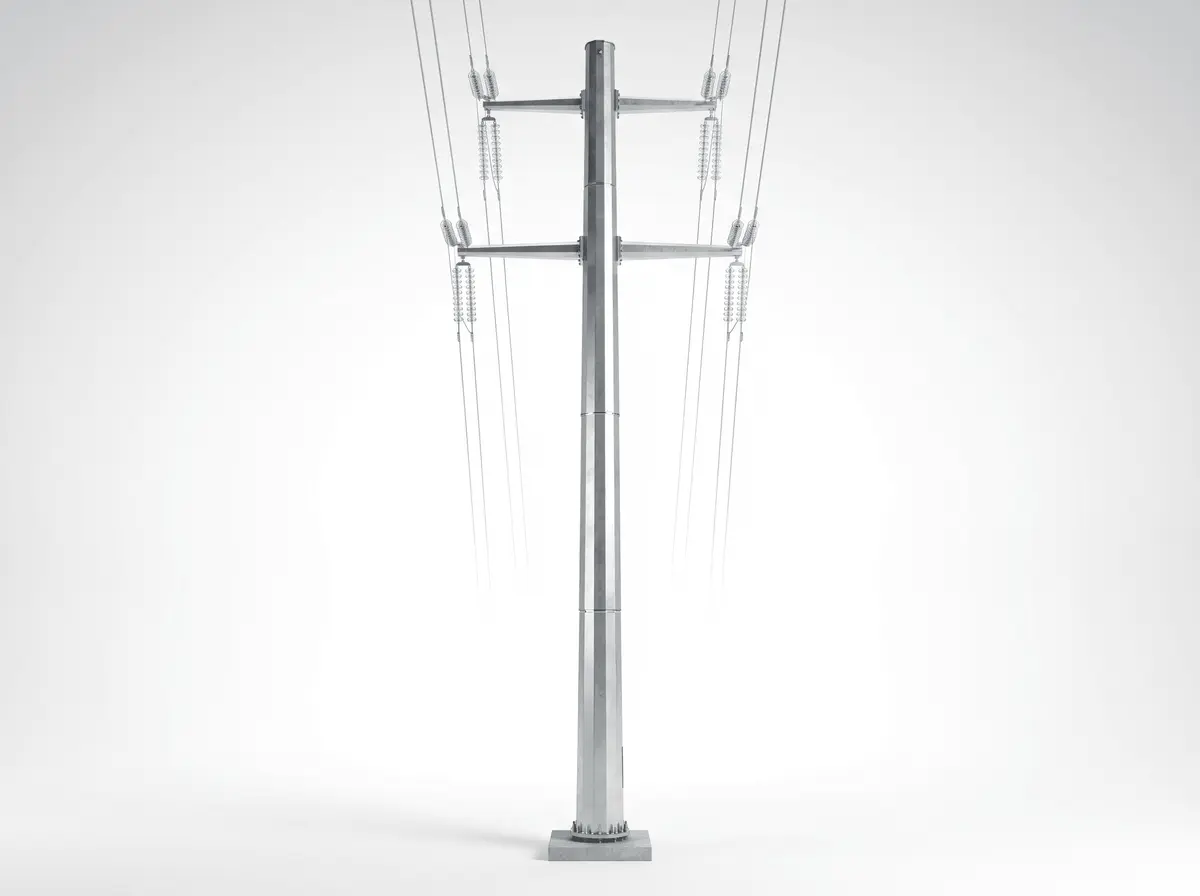
25m 66kV Octagonal Double Circuit Pole Slip-Joint - Urban Distribution Steel Monopole
Key Features
- 25m hot-dip galvanized octagonal steel monopole for 66kV suburban distribution duty
- Double-circuit configuration supports 2 circuits on 1 pole with a 150m design span
- Slip-joint section connection enables 2-3 transportable shaft sections and faster erection
- Designed to Class B wind / 15mm ice loading with grounding targets below 10 ohms
- 50-year design life with EPC turnkey pricing from $12,000 to $18,000 per unit
The 25m 66kV Octagonal Double Circuit Pole Slip-Joint is a hot-dip galvanized 8-sided steel monopole engineered for 2-circuit suburban distribution lines with a 150m design span and 50-year service life. Designed to IEC 60826 and GB 50545 load criteria, it provides a compact right-of-way solution with faster installation and lower visual impact than conventional lattice structures.
Description
The 25m 66kV Octagonal Double Circuit Pole Slip-Joint is a 25-meter, 66kV, 2-circuit steel monopole for suburban and urban-edge distribution corridors where land use, visual impact, and installation speed matter. Built in an 8-sided octagonal hot-dip galvanized steel profile with a slip-joint connection, it is configured for a 150m design span, Class B wind / 15mm ice loading, and a 50-year design life under proper inspection and maintenance. For utilities, EPC contractors, and industrial developers, this pole type reduces footprint by roughly 70-85% versus conventional 66kV lattice towers while maintaining line clearance, structural reliability, and standardized fabrication in line with IEC 60826, GB 50545, and ASCE 10-15 guidance.
Product Overview
This monopole belongs to the Power Transmission Tower/Pole product line and is optimized for suburban 66kV distribution where route widths are often constrained to 6-12m road reserves or utility easements. The pole uses hot-dip galvanized steel with typical zinc coating control aligned with common utility practice for 50 years of corrosion resistance in C3-C4 environments, subject to site-specific atmospheric exposure. The double-circuit arrangement supports 6 phase conductors on one structure, reducing the number of structures per kilometer by approximately 35-50% in corridor-constrained projects compared with single-circuit alternatives. Buyers can View all Power Transmission Tower/Pole products or Configure your system online for route-specific loading checks.
Why Octagonal Steel Monopoles Are Used at 66kV
At the 66kV class, utilities increasingly prefer monopoles for urban and suburban feeders because they combine a smaller base footprint, cleaner streetscape, and shorter erection windows than lattice structures. A typical octagonal monopole foundation occupies only a few square meters of above-ground area, while a comparable lattice tower may require a much larger four-leg footprint and wider work zone, often increasing civil interference by 2-4 times. According to deployment trends referenced by IRENA and urban grid modernization studies from the IEA, compact line supports are favored where population density exceeds 1,000 persons/km² and permitting schedules are tight. In practical EPC terms, monopole erection can reduce on-site steel assembly hours by about 20-40% compared with multi-member lattice erection, depending on crane access and section count.
Structural Configuration and Slip-Joint Design
The pole body uses an octagonal polygonal shaft fabricated from steel plate sections formed and welded into tapered segments. In this variant, the section connection is a slip-joint, meaning one tapered section nests into the next over a calculated overlap length, commonly designed as a proportion of diameter and wall thickness to transfer axial, bending, and torsional loads without a large external flange. For a 25m structure, slip-joint construction can reduce visible connection hardware and improve appearance compared with flanged alternatives, while also simplifying transport by splitting the shaft into manageable lengths such as 2-3 sections. The engineering basis follows structural loading methods consistent with IEC 60826 for overhead line design and utility monopole practice under wind, broken-wire, and maintenance conditions.
Electrical Duty and Line Hardware Arrangement
This pole is intended for 66kV distribution duty with 2 circuits, typically carrying 6 phase conductors and optionally 1 OPGW or shield wire at the top. Conductor selection is project-dependent, but ACSR remains common because of its balance of tensile strength and thermal rating; IEEE 738 is widely used for conductor current-temperature calculations and sag-tension studies. For a 150m span, utilities often pair the structure with polymer long-rod insulators or porcelain strings sized for local pollution class and lightning performance. Composite polymer insulators can reduce hardware dead load by approximately 30-50% versus porcelain, and they are often preferred in vandal-prone or coastal corridors because of lower breakage risk and easier handling.
Technical Specifications
The standard engineering envelope for this product is built around a 25m shaft height, 66kV system voltage, 2 circuits, and a 150m nominal span under suburban route conditions. Design checks normally cover wind speeds in meters per second, radial ice up to 15mm, conductor tension, unbalanced load, and at least 1 broken-wire contingency as required by utility criteria. Grounding is generally designed for footing resistance below 10 ohms, with enhanced measures targeting below 4 ohms in high-lightning-density regions. Additional route-specific customization is available through Request a custom quotation and technical references at Learn about topic.

Materials, Corrosion Protection, and Service Life
The shaft material is specified as steel_octagonal, typically using utility-grade structural steel plate with galvanizing suitable for outdoor power infrastructure. Hot-dip galvanizing remains the standard corrosion-control method because it provides sacrificial zinc protection and durable coverage on both external and internal surfaces when process control is maintained. In many utility environments, galvanized monopoles are designed for 50 years of service life with periodic inspection intervals of 1-5 years depending on contamination, coastal salinity, and pollution severity. Compared with painted carbon steel systems, full galvanizing can significantly reduce maintenance interventions over a 20-year period, especially where annual humidity exceeds 70% or chloride exposure is elevated.
Foundation and Geotechnical Considerations
Foundation selection depends on soil bearing capacity, groundwater level, frost depth, and overturning moment from the 25m shaft and conductor loads. For typical suburban 66kV monopole installations, reinforced concrete pad-and-pier or drilled shaft solutions are common, with concrete volumes often in the range of several cubic meters depending on geotechnical data and local code factors. Where soil is weak or highly saturated, pile-supported foundations may be more economical despite higher unit civil rates, especially if allowable bearing pressure drops below roughly 150 kPa. Utility buyers should provide soil reports, line angle data, and conductor parameters during bid review so that foundation optimization can reduce concrete and excavation costs by 5-15%.
Performance Compared with Conventional Lattice Towers
Compared with a conventional 66kV lattice tower, this 25m octagonal monopole typically offers a smaller visual profile, fewer individual steel members, and lower theft or vandalism exposure because there are fewer climbable angles and bolted lattice panels. In suburban corridors, the right-of-way appearance can improve significantly, and installation time can be shortened by 1-2 days per structure where crane access is available. Lattice towers may still remain advantageous for very large angle deviations or heavy multi-bundle transmission loads, but for straight-run and moderate-angle 66kV distribution routes, monopoles often reduce total corridor obstruction and local stakeholder objections. This is consistent with broader transmission modernization trends discussed by the IEA, IRENA, and engineering adoption examples such as the UK T-pylon concept introduced in 2021 for visual-impact reduction at higher voltages.
Application Scenario
A suburban industrial park developer in the MENA region used a similar 66kV, double-circuit, 25m monopole configuration to connect a new manufacturing cluster and logistics zone across a 4.5km feeder corridor with road crossings every 300-500m. Because municipal planning restricted wide tower bases near traffic lanes, octagonal monopoles were selected to maintain clearances while minimizing curbside occupation and shortening erection windows during night work. The EPC contractor reported a route construction schedule approximately 28% faster than the lattice-based concept study, largely due to fewer loose members, simpler staging, and reduced restoration work after foundation installation. Buyers planning comparable projects can Configure your system online for preliminary layout assumptions.
Installation Workflow and Site Execution
A standard installation sequence includes survey verification, excavation, foundation casting, curing, anchor or base preparation as applicable, pole section lifting, slip-joint assembly, crossarm or bracket installation, insulator fitting, conductor stringing, grounding, and final commissioning. For a single 25m monopole, steel erection itself may be completed within 1 day under favorable access conditions, while civil curing and line stringing extend the total site cycle to several days depending on utility sequencing. Installation labor cost is commonly benchmarked by tonnage and crane time; using the provided reference of $200/ton for installation labor, monopole projects can remain cost-efficient because total fabricated steel mass is concentrated into fewer major lifts. Detailed engineering packages should include erection tolerances, plumbness checks, and conductor attachment elevations.
Grid Reliability, Grounding, and Communications Integration
For modern 66kV feeders, structures increasingly support not only power conductors but also communications and grid monitoring infrastructure. An optional OPGW top wire can combine lightning shielding with fiber communication for SCADA, protection, and utility telecom backhaul, reducing the need for separate communications routes. Grounding design should target less than 10 ohms under standard conditions and less than 4 ohms in high lightning areas, in line with common utility practice for improved surge dissipation. Industry references from NREL and grid digitalization studies cited by the IEA indicate that better line visibility and communications can reduce fault-location time by measurable margins, often improving restoration performance by 10-30% in distribution networks with remote monitoring.
Applications
This product is suitable for 66kV suburban feeders, industrial park interconnections, utility road-reserve lines, peri-urban substations, renewable plant evacuation links, and mixed-use development corridors where aesthetics and compact land use are required. Common deployment environments include medium-density residential edges, commercial districts, airport approach-adjacent utility zones, and logistics parks with route lengths from 1km to over 20km. Because the structure supports 2 circuits, it is particularly useful where redundancy or staged load growth is planned, allowing one route to carry both existing and future feeder capacity within the same corridor envelope. Additional project guidance is available at Learn about topic and through Request a custom quotation.

Standards and Compliance Framework
The primary structural design references for this product are IEC 60826 for overhead line loading and GB 50545 for transmission line structural design practice, with conductor thermal checks commonly referenced to IEEE 738. Depending on destination market, additional compliance may include utility-specific mechanical loading combinations, galvanizing thickness requirements, weld inspection procedures, and dimensional tolerances. For export projects, documentation packages typically include material certificates, galvanizing records, weld quality reports, and factory inspection data for 100% traceability of major sections. Where local authorities require it, design review can also be aligned with ASCE 10-15 methodology for lattice and tubular support structures.
Procurement Scope and Customization Options
Standard supply can include the pole shaft, connection sections, crossarm or bracket assemblies, climbing or maintenance provisions if specified, earthing lug details, and base or embedded interface components depending on foundation concept. Optional items include composite insulators, porcelain insulators, conductor hardware, OPGW fittings, anti-climbing devices, aviation markers, and route-specific corrosion upgrades. Custom engineering is recommended when line angles exceed typical straight-run assumptions, when wind speeds exceed standard Class B envelopes, or when pollution severity requires upgraded creepage distances at 66kV. For multi-structure tenders above 50 units, route optimization and section standardization can reduce fabrication complexity and improve procurement efficiency by 5-12%.
EPC Investment Analysis and Pricing Structure
For B2B buyers, SOLARTODO offers 3 commercial pathways: FOB Supply, CIF Delivered, and EPC Turnkey. EPC scope includes engineering, procurement, construction, commissioning, and a 1-year warranty, covering detailed drawings, manufacturing, galvanizing, logistics coordination, civil and erection works, line hardware installation support, grounding, final inspection, and energization assistance. This structure is intended to reduce interface risk between steel supply, civil contractor, and utility acceptance teams, which can otherwise add 5-10% hidden project cost through delays and rework.
Pricing Table
| Tier | Scope | Price Range (USD) |
|---|---|---|
| FOB Supply | Equipment only, ex-works China | $7,440 - $12,240 |
| CIF Delivered | Equipment + ocean freight + insurance | $9,514 - $15,653 |
| EPC Turnkey | Installed + commissioned + 1-year warranty | $12,000 - $18,000 |
Volume Discount Table
| Order Volume | Discount |
|---|---|
| 50+ units | 5% |
| 100+ units | 10% |
| 250+ units | 15% |
For ROI analysis, the monopole option can outperform conventional lattice support in suburban corridors by reducing land occupation, shortening installation schedules, and lowering restoration scope after civil works. If a developer avoids even $1,500-$3,000 per site in additional land, traffic management, or reinstatement cost, the lifecycle economics become favorable within the first project phase rather than over many years. Compared with wider-footprint alternatives, annual maintenance access and inspection costs may also decline by 5-10% because there are fewer members, bolts, and corrosion-prone joints to inspect. On multi-kilometer feeder projects, this can produce an effective payback advantage within 1-3 years when route constraints are severe.
Payment terms are typically 30% T/T deposit and 70% against B/L, or 100% L/C at sight for qualified transactions. Financing support can be discussed for projects above $1,000K total contract value. For commercial proposals, BOQ reviews, and route-specific EPC analysis, contact [email protected].
Buying Guidance for Engineers and Procurement Teams
When comparing quotations, buyers should request at least 6 technical checkpoints: steel grade, galvanizing standard, design wind speed, ice thickness, broken-wire case, and foundation assumptions. A low initial price can become misleading if the quotation excludes hardware, grounding, or shop documentation needed for utility approval. For projects with more than 10 structures, it is also important to verify section transport lengths, crane requirements, and whether the supplier includes erection method statements and as-built documentation. SOLARTODO supports early-stage specification alignment, and buyers can View all Power Transmission Tower/Pole products to compare configurations before final tendering.
Conclusion
The 25m 66kV Octagonal Double Circuit Pole Slip-Joint is a practical solution for utilities and EPC firms that need a compact, structurally robust, and visually cleaner support for 66kV suburban distribution lines. With 2 circuits, a 150m design span, hot-dip galvanized 8-sided steel construction, and design references including IEC 60826, GB 50545, and IEEE 738, it addresses both electrical performance and route-development constraints. For pricing, customization, and project engineering support, use the SOLARTODO channels to Configure your system online or Request a custom quotation.
Inline data references: IEC 60826 overhead line loading standard; IEEE 738 conductor temperature-current relationships; ASCE 10-15 design of lattice/tubular structures; NREL grid modernization and transmission integration references; IEA electricity grid and infrastructure outlooks; IRENA power system flexibility and transmission expansion studies.
Technical Specifications
| Tower Height | 25m |
| Voltage Rating | 66kV |
| Tower Type | distribution |
| Material | steel_octagonal |
| Number of Circuits | 2 |
| Conductor Bundle | 1×ACSR |
| Design Span | 150m |
| Wind/Ice Load | Class B / 15mm ice |
| Foundation | reinforced concrete |
| Connection Type | slip_joint |
| Application | suburban_66kv |
| Design Life | 50years |
| Standards | IEC 60826 / GB 50545 |
Price Breakdown
| Item | Quantity | Unit Price | Subtotal |
|---|---|---|---|
| Hot-dip galvanized steel tube monopole shaft | 1 pcs | $6,300 | $6,300 |
| Composite insulator set | 6 pcs | $150 | $900 |
| ACSR conductor allocation | 1 pcs | $450 | $450 |
| Grounding system | 1 pcs | $500 | $500 |
| Concrete foundation materials | 1 pcs | $1,750 | $1,750 |
| Installation & Commissioning | 1 pcs | $1,450 | $1,450 |
| Engineering & QC | 1 pcs | $900 | $900 |
| 1-Year Warranty & Support | 1 pcs | $450 | $450 |
| Total Price Range | $12,000 - $18,000 | ||
Frequently Asked Questions
What applications is this 25m 66kV double-circuit monopole best suited for?
How does the slip-joint connection differ from a flanged monopole connection?
Which standards are typically used for design and verification?
What is included in the EPC turnkey price, and what warranty is provided?
Can this pole be customized for different spans, wind zones, or grounding targets?
Certifications & Standards


Data Sources & References
- •IEC 60826 Overhead Transmission Lines Design Criteria
- •IEEE 738 Standard for Calculating the Current-Temperature Relationship of Bare Overhead Conductors
- •ASCE 10-15 Design of Latticed Steel Transmission Structures
- •NREL grid integration and transmission modernization references
- •IEA electricity grid and transmission infrastructure outlook references
- •IRENA transmission expansion and power system flexibility references
Interested in this solution?
Contact us for a customized quote based on your specific requirements.
Contact Us