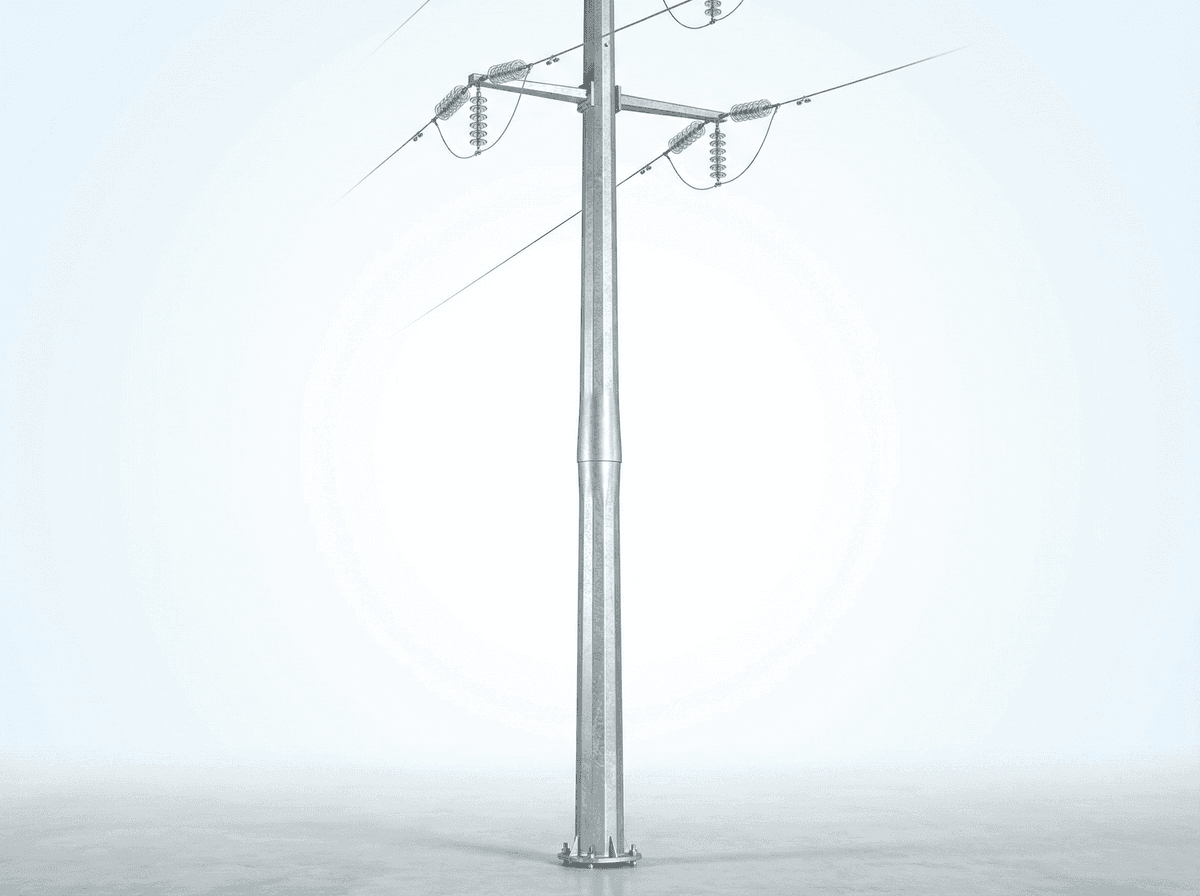
18m 10kV Tapered Monopole Urban Aesthetic Slip-Joint - Double-Circuit Steel Distribution Pole
Key Features
- 18m tapered steel monopole designed for 10kV double-circuit distribution with a 100m nominal span
- Slip-joint shaft connection reduces transport section length and supports 1-day pole erection after foundation readiness
- Hot-dip galvanized steel construction targets a 50-year design life with grounding resistance below 10 ohms standard
- Urban aesthetic single-shaft profile can reduce footprint by 50% to 70% versus conventional lattice alternatives
- EPC turnkey pricing ranges from $6,000 to $9,000 per installed unit with 5%, 10%, and 15% volume discounts
The 18m 10kV Tapered Monopole Urban Aesthetic Slip-Joint is a double-circuit steel tubular distribution pole engineered for 10kV urban feeders with a 100m design span, hot-dip galvanized tapered profile, and 50-year design life. It is optimized for compact right-of-way corridors, reduced visual impact, IEC 60826 load compliance, and EPC turnkey delivery from $6,000 to $9,000 per installed unit.
Description
The 18m 10kV Tapered Monopole Urban Aesthetic Slip-Joint is a steel tubular distribution pole designed for 10kV urban and suburban overhead feeder networks requiring 18m structure height, 2 circuits, and a typical 100m design span. Built in a tapered monopole format with a slip-joint connection, this model combines compact land occupation, lower visual clutter, and standardized erection methodology for municipalities, utilities, industrial parks, and EPC contractors that need reliable medium-voltage infrastructure with a 50-year design life.
Compared with conventional lattice distribution structures of similar 10kV duty, a tubular monopole typically reduces the footprint by 50% to 70% and can lower visible structural complexity by more than 30% in dense streetscapes, depending on cross-arm arrangement and local clearance rules. For city-center projects where every 1m² of right-of-way matters, the tapered steel profile supports cleaner architectural integration, easier camouflage, and faster corridor permitting. Buyers can also View all Power Transmission Tower/Pole products or Configure your system online to compare 10kV, 35kV, and 110kV pole options.
Product Overview
This variant is configured as a distribution-class tubular monopole using hot-dip galvanized steel, generally based on Q460 or equivalent structural tube grades for optimized strength-to-weight ratio. In practical utility deployment, an 18m pole height suits 10kV road corridors, mixed-use urban blocks, industrial estates, campus grids, and municipal utility upgrades where conductor clearance, traffic interface, and façade aesthetics must be balanced within a compact profile. The slip-joint connection simplifies transport for 2 or 3 major shaft sections and reduces on-site flange exposure, which is often preferred in architectural districts.
The pole is designed around standard medium-voltage loading principles including conductor tension, wind pressure, accidental broken-wire condition, and ice loading up to 15mm, consistent with the supplied design template and with methodologies referenced in IEC 60826, ASCE 10-15, and GB 50545. In urban distribution planning, conductor thermal performance is usually coordinated with IEEE 738 ampacity principles, while utility asset life assumptions of 40 to 50 years remain common in international T&D planning literature from IEA, IRENA, and national grid operators. For B2B buyers, that means the structure is not just a pole body; it is a load-bearing node in a 10kV network engineered for mechanical, electrical, and civil compatibility.
Why Urban Aesthetic Monopoles Are Selected
Urban utilities increasingly replace multi-member poles and angle towers with tubular monopoles because city corridors often have only 3m to 8m of available roadside utility strip and require lower visual density. A tapered monopole can carry 2 circuits in a single shaft while maintaining a cleaner skyline and reducing climbing points, unauthorized access surfaces, and maintenance interfaces. According to IRENA and IEA grid modernization discussions, distribution reinforcement in growing cities is one of the highest-priority infrastructure categories over the next 10 to 20 years, especially where electrification, EV charging, and digital utility communication are expanding.
Aesthetic value is not only visual. A single-shaft tubular pole can reduce foundation plan area by roughly 20% to 40% compared with broader lattice bases in similar low- to medium-voltage applications, subject to geotechnical conditions and overturning demand. In urban redevelopment projects, that smaller footprint can preserve sidewalks, drainage alignments, and underground utility corridors. If your team is evaluating structural forms, Learn about topic for broader transmission and distribution design guidance, or Request a custom quotation for route-specific loading checks.
System Architecture
The standard system architecture for this 18m pole includes the tapered steel shaft, slip-joint spigot interface, top-mounted or side-mounted cross-arm arrangement for 2 circuits, insulator strings or line-post insulators, grounding set, anchor bolts, and reinforced concrete foundation. Depending on utility specification, the line can use ACSR conductor in 1×, 2×, or compact urban arrangements, with optional OPGW or separate earth wire where communication and lightning shielding are required. Typical footing resistance targets are <10 ohms under standard conditions and <4 ohms in high-lightning zones.
For a 100m span at 10kV, the pole is commonly engineered for urban feeder conductors such as ACSR or AAAC classes selected by local ampacity and sag criteria. Composite polymer insulators are often preferred over porcelain in vandal-prone or pollution-prone districts because they reduce weight and can improve contamination performance, while porcelain remains viable for utilities prioritizing long-established maintenance practice. The design also accounts for serviceability margins under wind classes aligned to regional codes, with final values customized for local basic wind speed such as 25m/s, 30m/s, or 35m/s.

Technical Specifications
From a procurement perspective, the key value of this product lies in standardized geometry and predictable fabrication. The tapered shaft is manufactured from steel plate or tube sections, formed and welded to controlled tolerances, then hot-dip galvanized to achieve long-term corrosion resistance typically consistent with utility outdoor service expectations of 25 to 50 years depending on environment and maintenance. Pole mass varies by final loading case, but a typical 18m 10kV double-circuit urban monopole may fall in the range of approximately 1.6 to 2.4 tons, which aligns with reference installed steel tube economics near $1,500/ton.
The slip-joint connection is selected for 2 principal reasons: reduced transport length constraints and simplified field assembly. Instead of a heavy full-flange connection at every shaft transition, the upper section telescopes into the lower section with engineered overlap length, allowing rapid erection by mobile crane in 1 lifting sequence or 2 staged lifts depending on street access. In constrained downtown areas where lane closure windows may be only 4 to 8 hours, this installation logic can materially reduce traffic disruption compared with more segmented or wider-base alternatives.
Mechanical and Electrical Design Basis
This product is engineered for 10kV distribution duty, but the real design envelope depends on conductor choice, line angle, terrain category, and local weather map. Mechanical design follows recognized international practice under IEC 60826 for overhead line loading and strength coordination, while conductor thermal evaluation often references IEEE 738. Utilities that specify Chinese design practice may require compliance with GB 50545, and projects in international EPC frameworks often also reference ASCE 10-15 for steel support structures. These standards provide the basis for checking wind, ice, broken conductor, and maintenance loading scenarios across 1 full life cycle of 50 years.
At 10kV, electrical clearances are lower than sub-transmission classes such as 35kV or 110kV, enabling a more compact top arrangement. That compactness is one reason urban monopoles are attractive: they can maintain statutory phase-to-phase and phase-to-ground distances while still fitting municipal visual-control requirements. Optional accessories include anti-climbing devices, cable downlead guards, bird diverters, danger signage, and fiber-ready pathways where smart-grid communication is planned. For projects integrating utility telecom, OPGW at roughly $8,000/km installed can consolidate lightning shielding and data backhaul into a single line component.
Materials, Corrosion Protection, and Service Life
The structural body uses galvanized steel because steel remains the dominant medium-voltage support material for long-life overhead networks and offers high recyclability above 90% by mass in most end-of-life steel recovery chains. Hot-dip galvanizing forms a zinc layer that protects the substrate in outdoor exposure and is widely accepted across utility specifications. In coastal or industrial atmospheres with chloride or sulfur exposure, buyers may request thicker zinc coating, duplex paint systems, or inspection intervals every 3 to 5 years rather than every 5 to 10 years.
The expected design life is 50 years, provided foundation drainage, galvanizing integrity, and grounding continuity are maintained. This aligns with common utility asset assumptions and with broad infrastructure life-cycle expectations discussed by NREL, IEA, and IRENA in grid modernization and resilience studies. In practical terms, annual visual inspection plus torque and grounding checks at 1- to 3-year intervals can materially reduce long-term failure risk. Compared with untreated steel or lower-protection fabricated supports, galvanized monopoles can reduce corrosion-driven maintenance events by a significant margin over the first 15 to 20 years.
Urban Deployment Advantages
A primary advantage of this model is land efficiency. Because the pole uses a single tubular shaft rather than a 4-leg lattice footprint, it can be installed in median strips, sidewalks, industrial roads, and utility easements where available width may be under 2.5m. This is important for city utilities upgrading from aging concrete or wood poles that no longer satisfy modern loading or circuit-density requirements. The smooth profile also supports urban design objectives in commercial districts, transport hubs, and municipal redevelopment corridors.
Compared with conventional concrete poles of similar 18m class, a steel tapered monopole can offer better adaptability for custom bracket geometry, easier integration of 2 circuits, and more predictable factory quality control. Compared with lattice towers, it typically requires fewer exposed members and fewer bolted field connections, which can reduce visible clutter and simplify anti-corrosion inspection. Depending on local design basis, project teams may see corridor acceptance improve enough to shorten approval schedules by 10% to 20%, especially where city planners prioritize streetscape quality.
Application Scenario
A municipal distribution operator in the MENA region upgraded a 4.2km urban feeder serving mixed residential and retail loads using 42 units of 18m 10kV tapered monopoles in place of older concrete poles and improvised steel structures. The route included 2 intersections, 1 school frontage, and a commercial boulevard with only 3.5m average roadside utility width. By selecting double-circuit monopoles with slip-joint erection, the contractor completed structural installation in 19 days, reduced occupied ground area by an estimated 35%, and improved nighttime clearance for buses and delivery vehicles.
In that scenario, composite insulators and upgraded grounding were chosen because local lightning density required footing resistance below 4 ohms at critical nodes. The operator also reserved the top pathway for future communication integration, avoiding a second civil intervention within the next 5 years. This type of deployment is increasingly relevant as utilities combine feeder reinforcement, smart-grid communications, and urban beautification in a single capex package. For route-specific engineering support, buyers can Request a custom quotation.
Applications
Typical applications include 10kV city feeder lines, ring-main distribution corridors, industrial park overhead networks, campus utility systems, suburban arterial-road electrification, and municipal replacement of aging wood, concrete, or lattice supports. The structure is particularly suitable where 2 circuits must be carried within a narrow right-of-way and where planners require a modern appearance. It also fits smart-city projects that integrate lighting, surveillance, telecom, or utility sensors on shared corridor infrastructure, subject to structural verification of each additional load.
For developers comparing alternatives, this product sits between low-cost conventional poles and higher-cost custom architectural supports. It delivers a practical balance of appearance, standardized fabrication, and utility-grade mechanical reliability. Buyers evaluating broader portfolio options can View all Power Transmission Tower/Pole products and Learn about topic to review design considerations for urban distribution structures.

Installation and Foundation Considerations
Foundation selection depends on soil bearing capacity, groundwater level, frost depth, and overturning moment from wind and conductor tension. For many urban 18m 10kV monopoles, a reinforced concrete spread footing in the range of 2.5m³ to 4.5m³ is sufficient, with installed concrete economics around $350/m³. Weak soils, reclaimed land, or utility-congested corridors may require pile solutions at approximately $800/meter installed. Final civil design should always be confirmed by geotechnical report and local code review.
On-site installation typically includes excavation, rebar cage placement, anchor bolt setting, concrete pour, curing, pole erection, conductor hardware fitting, grounding installation, and final alignment. For a standard urban crew with crane access, one pole can often be erected in 1 day after foundation readiness, though traffic management may extend total site occupation to 2 or 3 days. Installation labor reference is around $200/ton, but downtown night work, police escort, or restricted crane windows can increase this by 15% to 30%.
EPC Investment Analysis and Pricing Structure
For B2B buyers, EPC scope should be evaluated as a full life-cycle package rather than only a pole-body price. A complete EPC turnkey offer generally includes 5 major elements: engineering, procurement, civil construction, erection, and commissioning, plus a 1-year workmanship and commissioning warranty. Engineering covers route survey interface, structural calculations, foundation drawings, and hardware selection. Procurement covers the pole, insulators, steelwork, anchor bolts, grounding, and optional conductor accessories. Construction covers civil works, erection, stringing interface, and testing.
The standard commercial ranges for this product are summarized below. FOB supply covers equipment manufactured in China without ocean freight. CIF adds freight and insurance to the destination port. EPC turnkey includes supply, installation, commissioning, and 1-year warranty support.
| Pricing Tier | Scope | Price Range (USD) |
|---|---|---|
| FOB Supply | Equipment only, ex-works China | $3,720 - $6,120 |
| CIF Delivered | Equipment + ocean freight + insurance | $4,757 - $7,826 |
| EPC Turnkey | Fully installed + commissioned + 1-year warranty | $6,000 - $9,000 |
For program buyers and utilities, volume economics become material above 50 units because galvanizing batches, transport consolidation, and repeated foundation templates reduce per-unit overhead. Typical volume discounts are shown below and can be combined with framework agreements for scheduled call-offs over 6 to 12 months.
| Order Volume | Discount |
|---|---|
| 50+ units | 5% |
| 100+ units | 10% |
| 250+ units | 15% |
From an ROI perspective, the payback logic is usually driven by avoided maintenance, reduced permitting friction, and longer service life rather than direct energy generation. Compared with lower-grade or visually intrusive alternatives, an urban monopole can reduce repainting, structural intervention, and corridor modification costs by an estimated $120 to $260 per pole per year over the first 10 years, depending on local labor rates. Against a conventional urban lattice or custom fabricated aesthetic support, the installed cost can be 10% to 25% lower while still delivering a 50-year design life. On that basis, incremental payback versus a more expensive architectural support may fall in the range of 4 to 7 years, especially for municipal programs exceeding 100 poles.
Standard payment terms are 30% T/T deposit and 70% against B/L, or 100% L/C at sight for qualified orders. Financing support can be discussed for projects above $1,000K. For commercial proposals, technical clarifications, and EPC schedules, contact [email protected] or Request a custom quotation.
Quality Assurance and Compliance
Quality control typically includes steel chemistry verification, weld inspection, dimensional checks, galvanizing thickness control, trial fit-up of slip-joint sections, and packing inspection before shipment. Depending on project requirement, documentation may include mill certificates, welding reports, galvanizing reports, and factory acceptance records. While this product is a structural line support rather than a PV module or inverter, its engineering references are grounded in recognized standards such as IEC 60826, IEEE 738, ASCE 10-15, and GB 50545.
Industry context also supports the shift toward modernized grid assets. IEA grid investment analysis, IRENA transmission expansion reports, NREL resilience publications, and market intelligence from BloombergNEF and Wood Mackenzie all indicate continued spending growth in distribution reinforcement, digitalization, and urban network reliability over the next 5 to 15 years. For procurement teams, that means standardized monopole platforms are increasingly favored because they align with repeatable engineering, scalable sourcing, and lower corridor impact.
Procurement Guidance
When specifying an 18m 10kV urban monopole, buyers should confirm at least 8 parameters before RFQ release: basic wind speed, ice thickness, conductor type, conductor size, line angle, terrain category, soil bearing capacity, and grounding target. Additional items such as anti-climbing devices, color finish, bracket style, and communication attachments should also be frozen before final fabrication. Early definition can prevent redesign cycles that add 2 to 6 weeks to lead time.
SOLARTODO supports direct supply, CIF delivery, and EPC coordination for urban distribution projects across utility, industrial, and municipal sectors. To compare alternatives or start a route-specific design review, Configure your system online, View all Power Transmission Tower/Pole products, or Request a custom quotation.
Technical Specifications
| Tower Height | 18m |
| Voltage Rating | 10kV |
| Tower Type | distribution |
| Material | steel_tapered_monopole |
| Pole Profile | tapered tubular monopole |
| Connection Type | slip_joint |
| Number of Circuits | 2circuits |
| Conductor Bundle | 1×ACSRper phase |
| Design Span | 100m |
| Wind/Ice Load | Class B / 15mm ice |
| Foundation | reinforced concrete spread footing or pile foundation |
| Grounding Resistance | <10ohm |
| High Lightning Grounding Target | <4ohm |
| Insulator Options | porcelain or composite polymer |
| Ground Wire Option | OPGW optional |
| Application | urban_aesthetic |
| Design Life | 50years |
| Standards | IEC 60826 / GB 50545 / IEEE 738 / ASCE 10-15 |
Price Breakdown
| Item | Quantity | Unit Price | Subtotal |
|---|---|---|---|
| Hot-dip galvanized steel tapered monopole shaft (installed) | 2 pcs | $1,500 | $3,000 |
| Composite insulators (installed) | 6 pcs | $150 | $900 |
| Grounding system with rods and connectors (installed) | 1 pcs | $500 | $500 |
| Concrete foundation 3.5m3 (installed) | 1 pcs | $1,225 | $1,225 |
| Anchor bolts and embedded steel set (installed) | 1 pcs | $280 | $280 |
| Cross-arm and hardware fittings (installed) | 1 pcs | $420 | $420 |
| Installation labor and crane interface (installed) | 1 pcs | $450 | $450 |
| Testing, commissioning, and documentation (installed) | 1 pcs | $225 | $225 |
| Total Price Range | $6,000 - $9,000 | ||
Frequently Asked Questions
What is the main advantage of this 18m 10kV tapered monopole over a conventional lattice pole?
Can this pole be customized for local wind, conductor, and foundation conditions?
What does the EPC turnkey price include, and what warranty is provided?
Which insulator and grounding options are recommended for urban 10kV projects?
What are the standard payment terms and financing options?
Certifications & Standards


Data Sources & References
- •IEC 60826 Overhead transmission lines - Design criteria
- •IEEE 738 Standard for Calculating the Current-Temperature Relationship of Bare Overhead Conductors
- •ASCE 10-15 Design of Latticed Steel Transmission Structures
- •IEA Electricity Grids and Secure Energy Transitions
- •IRENA Electricity Grids and Renewables
- •NREL grid resilience and transmission infrastructure publications
- •BloombergNEF global power and grid investment analysis
- •Wood Mackenzie transmission and distribution market insights
Interested in this solution?
Contact us for a customized quote based on your specific requirements.
Contact Us