AI Wrong-Way Driving Detection for Urban Enforcement

SOLARTODO Editorial Team
Solar Energy & Infrastructure Expert Team
Watch the video
TL;DR
AI systems for wrong-way driving and motor lane intrusion detection are now practical for city enforcement because they exceed 95% detection accuracy and reach 98% license plate recognition. With solar-powered poles, LFP battery backup, and EPC delivery options, cities can run 24/7 monitoring, reduce manual patrol workload, and often target payback within 24-48 months after a 3-5 site pilot.
AI wrong-way driving and motor lane intrusion detection systems now exceed 95% accuracy, with license plate recognition reaching 98% and speed capture up to 320 km/h. For urban enforcement, these systems reduce manual patrol demand, support 24/7 evidence capture, and improve violation response time by up to 50%.
Summary
AI wrong-way driving and motor lane intrusion detection systems now exceed 95% accuracy, with license plate recognition reaching 98% and speed capture up to 320 km/h. For urban enforcement, these systems reduce manual patrol demand, support 24/7 evidence capture, and improve violation response time by up to 50%.
Key Takeaways
- Deploy AI cameras with >95% wrong-way detection accuracy and >93% motor lane intrusion accuracy to automate 24/7 urban enforcement at intersections, ramps, and bus corridors.
- Use 98% license plate recognition and blockchain-secured evidence chains to strengthen legal defensibility and reduce disputed citations in high-volume corridors.
- Prioritize motorcycle-heavy roads where two-wheelers exceed 60% of traffic, because intrusion and wrong-way violations are more frequent in mixed-lane urban networks.
- Size edge processing and storage for 30-90 days of video retention, with event clips of 10-30 seconds per violation for audit, review, and court submission.
- Select solar-powered poles with LFP battery backup for 24/7 uptime in off-grid or weak-grid areas, reducing dependence on utility connections and civil works.
- Start with a 3-5 intersection pilot over 1-3 months, then expand to 50-100 intersections in 3-9 months after validating false-positive rates and enforcement workflow.
- Compare FOB, CIF, and EPC turnkey pricing, and apply volume discounts of 5% at 50+ units, 10% at 100+, and 15% at 250+ for city-scale procurement.
- Calculate ROI from lower patrol labor, faster incident response, and higher citation efficiency, with many urban projects targeting payback within 24-48 months depending on violation density.
Why cities deploy AI wrong-way and motor lane intrusion detection
AI enforcement systems with >95% detection accuracy and 98% plate recognition give cities a practical way to monitor 24/7 violations that manual patrols cannot cover consistently.
Wrong-way driving and motor lane intrusion create a high-risk enforcement gap in dense urban traffic. The problem is not only crash risk. It also affects bus lane reliability, emergency access, motorcycle safety, and junction throughput. In many mixed-traffic cities, two-wheelers account for more than 60% of daily traffic, which increases the frequency of lane misuse and directional violations.
For transport agencies, the main issue is continuous observation. A patrol team can cover a corridor for limited hours, but violations occur across 24 hours, 7 days per week. AI video analytics closes that gap by detecting direction vectors, lane boundaries, object classes, and plate numbers in real time. According to the product performance data used in this category, wrong-way riding detection exceeds 95%, while restricted-zone and motor-lane intrusion detection exceed 93%.
This matters for enforcement economics. A city can shift from labor-heavy observation to event-based review, where operators validate only flagged incidents. According to the smart traffic deployment benchmarks in this category, emergency and transit priority systems can reduce response time by up to 50%, and coordinated traffic control can reduce stops by up to 40%. While those figures are not violation-specific, they show that AI-based traffic systems can deliver measurable operational gains beyond citation issuance.
The International Energy Agency states, "Digitalization can make energy and infrastructure systems more connected, intelligent, efficient, reliable and sustainable." That principle applies directly to urban enforcement, where connected cameras, edge computing, and secure evidence management reduce manual delay and improve compliance.
SOLAR TODO addresses this use case with solar-integrated smart traffic poles, AI detection for more than 45 traffic object and violation types, LFP battery storage for 24/7 operation, and end-to-end encrypted evidence workflows. For municipalities in weak-grid or off-grid zones, that reduces the need for trenching, transformer coordination, and unstable utility feeds.
How the AI detection stack works in urban enforcement
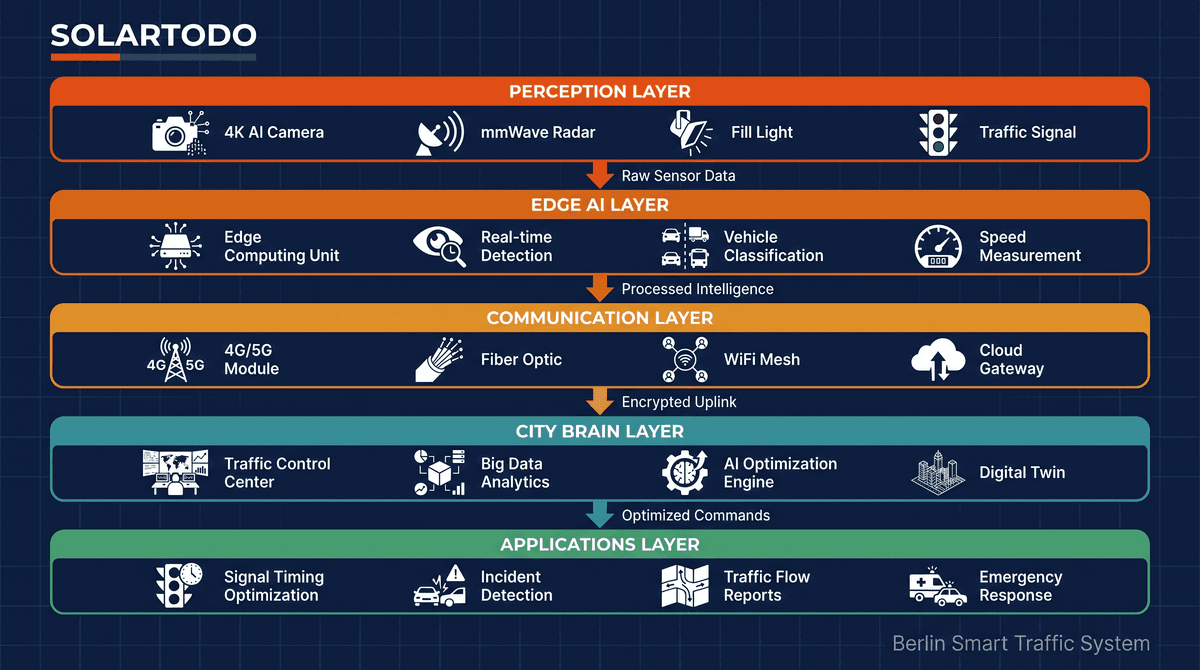
AI wrong-way and lane intrusion detection combines object classification, lane geometry, direction tracking, and evidence packaging, typically processing events in less than 1 second at the edge for practical roadside deployment.
At the camera layer, the system captures high-resolution video streams from fixed roadside poles or gantries. The AI model first identifies road users by class: sedan, SUV, bus, truck, bicycle, pedestrian, motorcycle, and e-bike. In this product category, the system supports more than 45 detection classes, which is useful in cities where motorcycles, delivery bikes, and buses share constrained lane space.
The second layer is scene understanding. Operators define virtual lane boundaries, directional arrows, stop lines, and restricted zones. The model then compares each tracked object against allowed movement logic. If a motorcycle enters a car-only lane, or if a vehicle travels against the permitted direction for a defined distance threshold, the system creates an event. Thresholds are usually configured by meters, seconds, and angle deviation to reduce false alarms from U-turns, parking maneuvers, or obstacle avoidance.
Core detection functions
The core enforcement engine generally includes:
- Wrong-way movement detection based on trajectory direction and lane rule mapping
- Motor lane intrusion detection based on lane segmentation and object type classification
- License plate recognition with 98% accuracy under compliant installation conditions
- Speed measurement up to 320 km/h for corridors that combine intrusion and overspeed enforcement
- Event clip generation with timestamp, lane ID, plate image, and metadata package
- Secure transmission using end-to-end encryption and zero-trust access control
Accuracy depends on camera angle, illumination, lane marking quality, and training data quality. For this category, wrong-way riding exceeds 95% and motor lane intrusion exceeds 93%. Helmet non-compliance reaches 97.7% mAP with 92.7% F1, which indicates the AI stack is already tuned for motorcycle-dominant traffic environments.
Evidence integrity and legal workflow
For enforcement, detection accuracy alone is not enough. Cities need evidence that can survive review, appeal, and court procedures. That is why many deployments package each event with plate crops, full-frame images, video clips, GPS or pole ID, timestamp, lane rule, and operator log. SOLAR TODO also supports blockchain-secured evidence chains, which help prove that files were not altered after capture.
According to IEEE (2018), interoperable distributed systems depend on clear interface and data exchange rules. In traffic enforcement, that translates into reliable transfer between camera, edge processor, central platform, and citation system. GDPR-compliant data handling is also relevant where personal data retention, access logs, and deletion periods must be documented.
The U.S. Department of Transportation states, "Intelligent transportation systems can improve safety, mobility, and environmental performance." For enforcement agencies, the practical reading is simple: detection must support a measurable safety outcome, not just more cameras.
Technical architecture, power design, and deployment planning
A practical urban enforcement node uses 1-3 AI cameras, edge computing, encrypted networking, and 24/7 power backup, with solar plus LFP storage reducing grid dependency in difficult sites.
A standard roadside node usually includes a pole or gantry, camera brackets, AI cameras, an edge processor, communication equipment, surge protection, and a cabinet rated for outdoor service. In hot or dusty regions, enclosure protection of IP54 to IP65 is common, depending on cabinet exposure and maintenance access. Network options normally include fiber, 4G, or 5G, with 20-100 Mbps backhaul selected by camera count and video retention policy.
For power, urban projects often face one of three conditions: stable grid, weak grid, or no grid. This is where SOLAR TODO has a practical advantage. Solar panels mounted on the pole top can charge LFP batteries and support 24/7 operation without continuous grid electricity. That matters on medians, highways, peri-urban corridors, and developing-market roads where utility extension adds months of delay.
Sample deployment scenario (illustrative)
A sample deployment scenario for one urban intersection may include:
- 2-4 AI cameras covering 2-8 lanes
- 1 edge processor handling 20-60 FPS analytics
- 1 solar array sized for local irradiance and load, typically paired with LFP storage for overnight autonomy
- 30-90 days of event and audit retention depending on regulation
- 10-30 second evidence clips per violation
- 1 central dashboard connection for review, export, and citation workflow
According to NREL (2024), solar resource modeling can predict site-specific generation with strong planning value when local irradiance and system losses are known. For traffic poles, this supports battery autonomy calculations and helps avoid under-sizing in rainy seasons.
Deployment phases
A phased rollout reduces procurement risk and improves model tuning:
- Phase 1, 1-3 months: pilot at 3-5 intersections or ramps
- Phase 2, 3-9 months: expand to 50-100 intersections after validation
- Phase 3, 9-18 months: city-wide platform with digital twin and broader enforcement analytics
This approach lets agencies measure false positives, plate-read quality, day-night performance, and legal acceptance before full expansion. It also gives procurement teams time to compare civil works cost for grid-fed poles versus solar-integrated poles.
Use cases, performance benchmarks, and operational ROI
Cities use AI enforcement to cut manual patrol demand, improve lane discipline, and build auditable evidence pipelines, with many projects targeting 24-48 month payback from labor and enforcement efficiency gains.
Wrong-way and motor lane intrusion detection is most useful in five settings: one-way urban streets, tunnel approaches, bus rapid transit corridors, elevated ramps, and mixed-traffic arterials with heavy motorcycle flow. In these locations, a single violation can trigger queue disruption, side-impact risk, or emergency access blockage within seconds.
Operational value comes from selective review. Instead of watching 12 hours of video, staff review only event packages. That reduces labor hours per valid citation and improves consistency across shifts. In corridors with repeat violations, agencies can also use heat maps by hour, lane, and vehicle class to redesign markings, barriers, or signal timing.
According to the smart traffic deployment results in this category, London reported travel time reductions of 10% to 30%, Pittsburgh reported 25% lower travel time and 20% lower emissions, and green-wave coordination can cut stops by 40%. These are network-management results rather than direct enforcement metrics, but they show the wider value of AI traffic platforms when detection data feeds signal and corridor planning.
Comparison table: manual enforcement vs AI enforcement
| Metric | Manual patrol | Conventional CCTV review | AI enforcement with SOLAR TODO |
|---|---|---|---|
| Coverage hours | 4-12 hours/day typical | 24/7 recording, delayed review | 24/7 real-time detection |
| Wrong-way detection | Officer dependent | Low unless reviewed manually | >95% |
| Motor lane intrusion detection | Officer dependent | Moderate with manual review | >93% |
| License plate capture | Manual note or handheld | Variable by angle/light | 98% |
| Evidence packaging | Manual compilation | Partial, often fragmented | Automated clip + metadata |
| Power requirement | Patrol fuel/labor | Usually grid-dependent | Grid or solar + LFP |
| Scalability | Low | Medium | High across 50-100+ sites |
| Audit trail | Manual logs | Basic archive | Encrypted, blockchain-secured option |
EPC Investment Analysis and Pricing Structure
EPC turnkey delivery for AI traffic enforcement typically includes site survey, pole and foundation design, equipment supply, solar and battery sizing where required, installation, commissioning, software setup, operator training, and acceptance testing.
For procurement, three pricing layers are standard:
- FOB Supply: equipment only, ex-factory or port basis; suitable when the buyer manages freight, customs, civil works, and installation
- CIF Delivered: equipment plus freight and insurance to destination port; suitable when the buyer manages inland logistics and installation
- EPC Turnkey: full Engineering, Procurement, and Construction scope including installation, integration, testing, and handover
Volume pricing guidance for city projects:
- 50+ units: 5% discount
- 100+ units: 10% discount
- 250+ units: 15% discount
Payment terms commonly follow:
- 30% T/T deposit + 70% against B/L
- or 100% L/C at sight
For large projects above $1,000K, financing is available subject to project profile, jurisdiction, and credit review. For quotation and EPC discussion, contact [email protected] or call +6585559114.
ROI should be calculated against the local cost of patrol labor, violation frequency, incident response delay, and civil works. In many urban cases, payback is modeled at 24-48 months when violation density is high and utility connection cost is avoided through solar-powered poles. SOLAR TODO can support offline quotation based on lane count, camera count, pole height, storage days, and communication method.
How to specify and select the right system
The right specification starts with lane geometry, violation type, and evidence requirements, because a 2-lane one-way street needs a different camera angle and storage plan than an 8-lane bus corridor.
Procurement teams should first define the enforcement objective. If the main issue is wrong-way entry at ramps, the system needs strong directional tracking and plate capture at high approach speed. If the issue is motor lane intrusion in dense city traffic, the model must classify motorcycles, e-bikes, buses, and passenger cars accurately under occlusion and night glare.
A practical specification checklist includes:
- Detection accuracy target: >95% for wrong-way, >93% for lane intrusion
- Plate recognition target: 98%
- Speed capture requirement: up to 320 km/h if combined enforcement is planned
- Camera count per site: 1-4 depending on lane width and angle
- Retention period: 30, 60, or 90 days
- Power mode: grid, hybrid, or solar + LFP backup
- Cybersecurity: end-to-end encryption, zero-trust access, audit logs
- Compliance needs: local privacy law, evidence retention rule, and export format
According to IEC (2021) and IEC (2023), equipment selection should follow relevant safety and construction requirements for electrical systems and outdoor installations. According to UL (2023), battery systems and associated equipment should be evaluated for safety in stationary applications. These references matter when a project includes solar generation, battery storage, and roadside power cabinets.
SOLAR TODO is suitable when the buyer needs one supplier for solar-powered smart traffic poles, AI analytics, and export support. That is especially useful in Latin America, the Middle East, Africa, and Southeast Asia, where weak-grid sites and long corridor deployments are common.
FAQ
AI wrong-way and motor lane intrusion projects usually succeed when agencies answer 10 core questions on accuracy, cost, installation, evidence, and maintenance before issuing a tender.
Q: What is wrong-way driving and motor lane intrusion detection in an AI traffic system? A: It is an automated video analytics function that detects vehicles moving against the permitted direction or entering restricted lanes. The system uses AI object recognition, lane mapping, and trajectory tracking to flag violations in real time. In this category, wrong-way detection exceeds 95% and motor lane intrusion exceeds 93% under proper installation conditions.
Q: How accurate are AI models for urban wrong-way and lane intrusion enforcement? A: Accuracy depends on camera placement, lighting, lane markings, and model training data. For the smart traffic category here, wrong-way riding detection is above 95%, restricted-zone and motor lane intrusion are above 93%, and license plate recognition reaches 98%. A pilot at 3-5 sites is the normal way to verify local false-positive rates.
Q: How does the system distinguish a real violation from a legal turn or avoidance maneuver? A: The software applies rule logic based on lane direction, object path, time in zone, and travel angle. A brief deviation of 1-2 seconds may be ignored if it matches a legal turn pocket or obstacle avoidance pattern. This reduces false alarms compared with simple motion detection.
Q: What equipment is required for a complete roadside deployment? A: A standard node includes 1-4 AI cameras, an edge processor, communication device, cabinet, pole or gantry, surge protection, and software platform access. Many projects also include 30-90 days of storage and a 10-30 second violation clip package. SOLAR TODO can also add pole-top solar modules and LFP battery backup.
Q: Can the system work without a stable grid connection? A: Yes, it can operate off-grid or on weak-grid sites when designed with solar generation and LFP battery storage. This is useful on medians, peri-urban roads, and remote ramps where utility extension is slow or expensive. SOLAR TODO uses solar-integrated smart traffic poles to support 24/7 operation in these conditions.
Q: How long does installation and commissioning usually take? A: A pilot phase usually takes 1-3 months for 3-5 intersections, including survey, civil works, installation, calibration, and training. Expansion to 50-100 intersections commonly takes 3-9 months depending on pole works, permits, and network access. City-wide deployment may take 9-18 months.
Q: What is included in EPC turnkey delivery for this type of project? A: EPC covers engineering, procurement, construction, installation, testing, software setup, and handover. It may also include solar and battery sizing, communication integration, operator training, and acceptance testing. Buyers choosing FOB or CIF receive less site support and usually manage local installation themselves.
Q: What are the typical pricing and payment terms? A: Pricing is usually quoted as FOB Supply, CIF Delivered, or EPC Turnkey depending on scope. Volume discounts commonly follow 5% at 50+ units, 10% at 100+, and 15% at 250+. Payment terms are often 30% T/T plus 70% against B/L, or 100% L/C at sight.
Q: What kind of ROI can a city expect from AI enforcement? A: ROI usually comes from lower patrol labor, higher citation efficiency, fewer manual video review hours, and avoided grid-connection cost at difficult sites. Many urban projects model payback in 24-48 months when violation density is high. The exact result depends on staffing cost, legal framework, and the number of enforceable events per day.
Q: How is evidence stored and protected for legal enforcement? A: Each event can include full-frame images, plate crops, video clips, timestamps, lane IDs, and operator logs. Systems with encrypted transmission and blockchain-secured evidence chains add stronger auditability. Data retention is usually set at 30, 60, or 90 days based on local enforcement and privacy rules.
Q: What maintenance is required after commissioning? A: Routine maintenance includes lens cleaning, alignment checks, cabinet inspection, battery health review, firmware updates, and network diagnostics. Most agencies schedule preventive inspection every 3-6 months, with AI model review after major road marking changes. Solar-powered sites also need periodic panel cleaning based on dust conditions.
Q: When should a city choose SOLAR TODO for this application? A: SOLAR TODO is a practical choice when the project needs AI enforcement, solar-powered smart traffic poles, export supply, and optional EPC coordination from one source. This is especially relevant in regions with weak grid access or long corridor deployments. Large projects above $1,000K can also discuss financing support.
References
Authoritative standards and agency references support specification, safety, interoperability, and energy planning for AI traffic enforcement projects with solar-powered infrastructure.
- NREL (2024): PVWatts Calculator methodology and solar resource modeling used to estimate site generation and battery-support planning for solar-powered roadside systems.
- IEEE (2018): IEEE 1547-2018, standard for interconnection and interoperability of distributed energy resources with electric power systems interfaces.
- IEC (2021): IEC 61215-1:2021, photovoltaic module design qualification and type approval requirements relevant to solar-powered traffic poles.
- IEC (2023): IEC 61730-1:2023, photovoltaic module safety qualification requirements for construction and testing.
- IEA (2023): Reports on digitalization and energy systems, explaining how connected infrastructure improves efficiency, reliability, and system visibility.
- U.S. Department of Transportation ITS Joint Program Office (2024): Intelligent Transportation Systems program materials on safety, mobility, and operational benefits of connected traffic technologies.
- UL (2023): UL 9540, safety standard for energy storage systems and equipment applicable to stationary battery-supported roadside deployments.
Conclusion
AI wrong-way driving and motor lane intrusion detection now delivers >95% detection accuracy, 98% plate recognition, and 24/7 enforceable evidence capture, making it a practical urban safety and compliance tool.
For cities managing motorcycle-heavy corridors, bus lanes, ramps, or weak-grid sites, SOLAR TODO offers a workable combination of AI analytics, solar-powered poles, and EPC support. The bottom line is clear: start with a 3-5 site pilot, validate false positives, and scale to 50-100 intersections when payback within 24-48 months is realistic.
About SOLARTODO
SOLARTODO is a global integrated solution provider specializing in solar power generation systems, energy-storage products, smart street-lighting and solar street-lighting, intelligent security & IoT linkage systems, power transmission towers, telecom communication towers, and smart-agriculture solutions for worldwide B2B customers.
About the Author

SOLARTODO Editorial Team
Solar Energy & Infrastructure Expert Team
SOLAR TODO is a professional supplier of solar energy, energy storage, smart lighting, smart agriculture, security systems, communication towers, and power tower equipment.
Our technical team has over 15 years of experience in renewable energy and infrastructure, providing high-quality products and solutions to B2B customers worldwide.
Expertise: PV system design, energy storage optimization, smart lighting integration, smart agriculture monitoring, security system integration, communication and power tower supply.
Cite This Article
SOLARTODO Editorial Team. (2026). AI Wrong-Way Driving Detection for Urban Enforcement. SOLARTODO. Retrieved from https://solartodo.com/knowledge/wrong-way-driving-and-motor-lane-intrusion-detection-ai-models-with-95-accuracy-for-urban-enforcement
@article{solartodo_wrong_way_driving_and_motor_lane_intrusion_detection_ai_models_with_95_accuracy_for_urban_enforcement,
  title = {AI Wrong-Way Driving Detection for Urban Enforcement},
  author = {SOLARTODO Editorial Team},
  journal = {SOLARTODO Knowledge Base},
  year = {2026},
  url = {https://solartodo.com/knowledge/wrong-way-driving-and-motor-lane-intrusion-detection-ai-models-with-95-accuracy-for-urban-enforcement},
  note = {Accessed: 2026-09-19}
}
Published: May 4, 2026 | Available at: https://solartodo.com/knowledge/wrong-way-driving-and-motor-lane-intrusion-detection-ai-models-with-95-accuracy-for-urban-enforcement
Subscribe to Our Newsletter
Get the latest solar energy news and insights delivered to your inbox.
View All Articles