Energy Storage Procurement Scope: Battery, Thermal,…

Cinn Song
Founder & Chief Solutions Architect
TL;DR
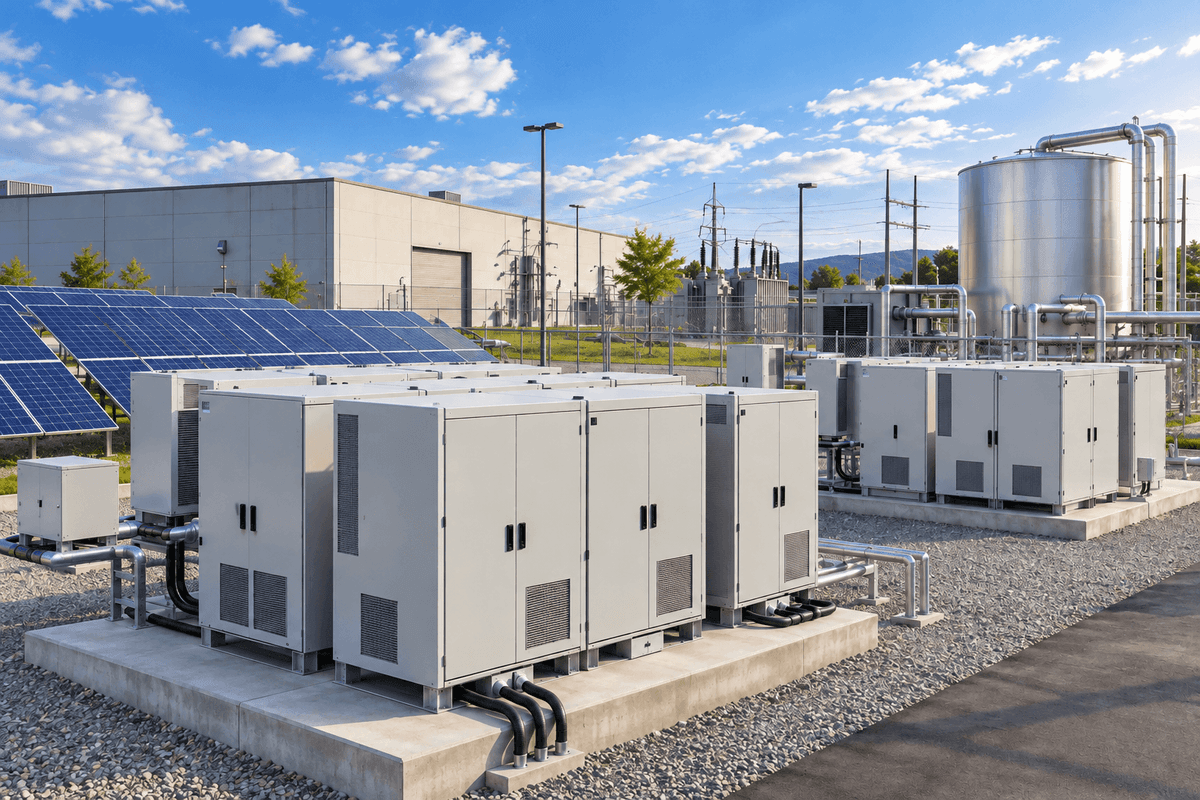
Require bidders to identify storage technology and scope whenever an RFP could mix battery storage, thermal storage, generation-paired systems, standalone grid-connected systems, BTM bill reduction, or FOM revenue applications.
Energy-storage procurements should require technology and scope separation whenever broad storage wording could mix electrochemical batteries, thermal storage, hybrid generation-plus-storage, or standalone grid-connected storage.
Key Takeaways
- Hybrid generation-plus-storage RFPs should ask whether the storage is electrochemical battery storage paired with a defined generation source.
- Standalone grid-connected storage RFPs should state whether generation equipment is excluded from the base scope.
- Behind-the-meter and front-of-meter procurements should separate bill-reduction use cases from power-sale revenue use cases.
- Thermal or long-duration storage procurements should require bidders to identify whether energy is stored chemically or as heat.
- Dispatch-sensitive procurements should ask bidders to describe automatic, manual, schedule-based, or time-series operating assumptions.
- Safety and validation requirements should be requested as evidence from bidders and local project authorities, not inferred from general guidance.
Summary
Procurements should require bidders to state whether the proposed scope is electrochemical battery storage, thermal energy storage, or standalone grid-connected storage whenever the solicitation uses broad “energy storage” language, compares different storage technologies, or ties storage to bill reduction, grid revenue, safety validation, dispatch control, or long-duration grid service. SAM separates electrochemical battery models from thermal energy storage models, and it also separates storage paired with power generation from standalone grid-connected batteries. DOE’s storage work also treats safety, reliability, performance validation, grid-scale deployment, and long-duration storage as material topics for evaluation. SAM battery storage help DOE Office of Electricity energy storage
1. Hybrid generation-plus-storage procurements
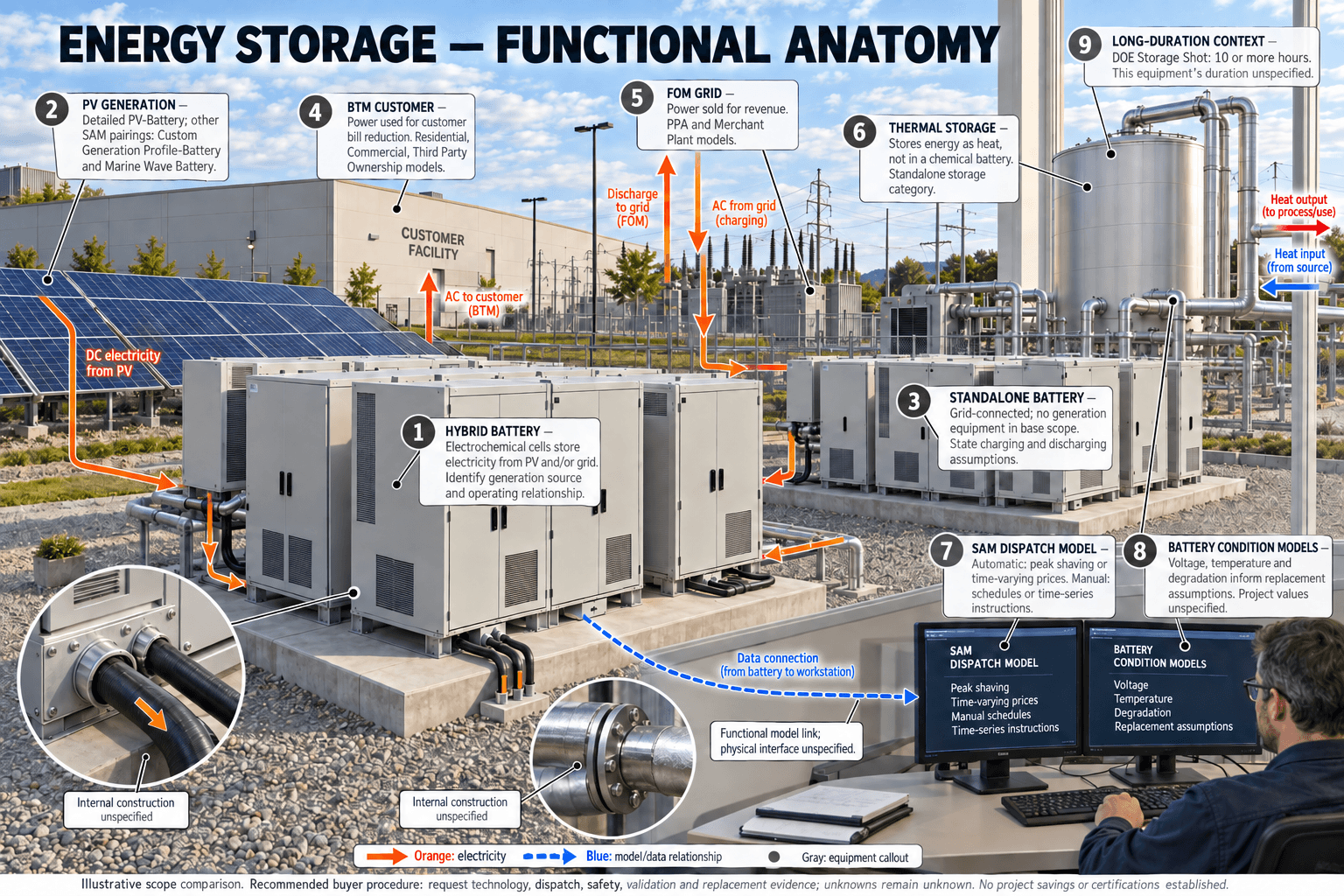
Require bidders to distinguish scope when the procurement combines storage with a generation asset, such as PV plus storage or another generation profile plus storage. SAM identifies Detailed PV-Battery, Custom Generation Profile-Battery, and Marine Wave Battery as configurations that combine battery storage with a power generation system. SAM battery storage help
The specification should ask whether the storage is an electrochemical battery connected to an on-site power generation system, because SAM’s battery model is for electrochemical cells storing electricity from the grid and/or an on-site generation system. SAM battery storage help
Recommended buyer language: “Bidder shall identify whether the storage scope is electrochemical battery storage paired with generation, standalone electrochemical storage, or another storage technology. If paired with generation, bidder shall state the generation source and operating relationship.” This is a procurement recommendation, not a country-specific purchasing requirement.
2. Standalone grid-connected storage procurements
A standalone storage RFP should explicitly say whether it is asking for a grid-connected battery with no power generation equipment, because SAM treats “Standalone battery” as a separate configuration for a grid-connected battery without generation equipment. SAM battery storage help
This distinction matters when bidders might otherwise assume a hybrid system, include PV or other generation equipment, or omit grid interconnection responsibilities. The supplied sources do not provide country-specific interconnection rules, certification obligations, stock status, pricing, or project savings; those items are unknown from these documents and should be requested from bidders or local authorities.
Recommended buyer language: “If the offer is standalone grid-connected storage, bidder shall exclude generation equipment from the base scope unless listed as an option, and shall describe grid charging and discharging assumptions.”
3. Behind-the-meter and front-of-meter procurements
Require a clear storage category in procurements where the business case depends on whether power is used behind the meter or sold in front-of-meter applications. SAM maps distributed financial models, including residential, commercial, and third-party ownership, to behind-the-meter storage where system power reduces a customer electricity bill. It maps PPA and Merchant Plant financial models to front-of-meter storage where system power is sold to generate revenue. SAM battery storage help
For commercial buyers, the RFP should therefore separate “customer bill reduction” use cases from “sale of power or merchant/PPA revenue” use cases. This does not prove any product will reduce bills or earn revenue; it only supports the need to define the financial and operating application before comparing bids.
Recommended buyer language: “Bidder shall state whether the proposed storage application is behind-the-meter or front-of-meter, and shall align dispatch assumptions with that application.”
4. Thermal or long-duration storage procurements
Any procurement that mentions heat storage, thermal storage, long-duration storage, or technology-neutral storage should require bidders to distinguish electrochemical batteries from thermal storage. SAM says thermal energy storage models are for standalone storage systems that store energy as heat rather than in a chemical battery. SAM battery storage help
DOE’s Office of Electricity describes work on cost-effective long-duration energy storage and research into safe, low-cost, earth-abundant elements. It also identifies the Long-Duration Storage Shot as focused on grid-scale storage systems that deliver 10 or more hours. DOE Office of Electricity energy storage
The supplied sources do not say which technology is best for every long-duration case. A defensible specification can require technology identification, operating duration, validation evidence, and safety documentation while leaving the technology choice open.
5. Safety, dispatch, validation, and degradation-sensitive procurements
Require technology separation when the procurement evaluates dispatch controls, battery degradation, replacement timing, safety, or performance validation. SAM says its battery storage model includes automatic dispatch controller options for peak shaving and time-varying price response, manual dispatch options using schedules or time-series instructions, and detailed voltage, temperature, and degradation models used to determine when battery replacements are required. SAM battery storage help
DOE’s storage work includes tools for reliability, safety, analysis, and performance validation. DOE also identifies safety considerations that include codes and standards, permitting, insurance, and all phases of project execution. DOE Office of Electricity energy storage
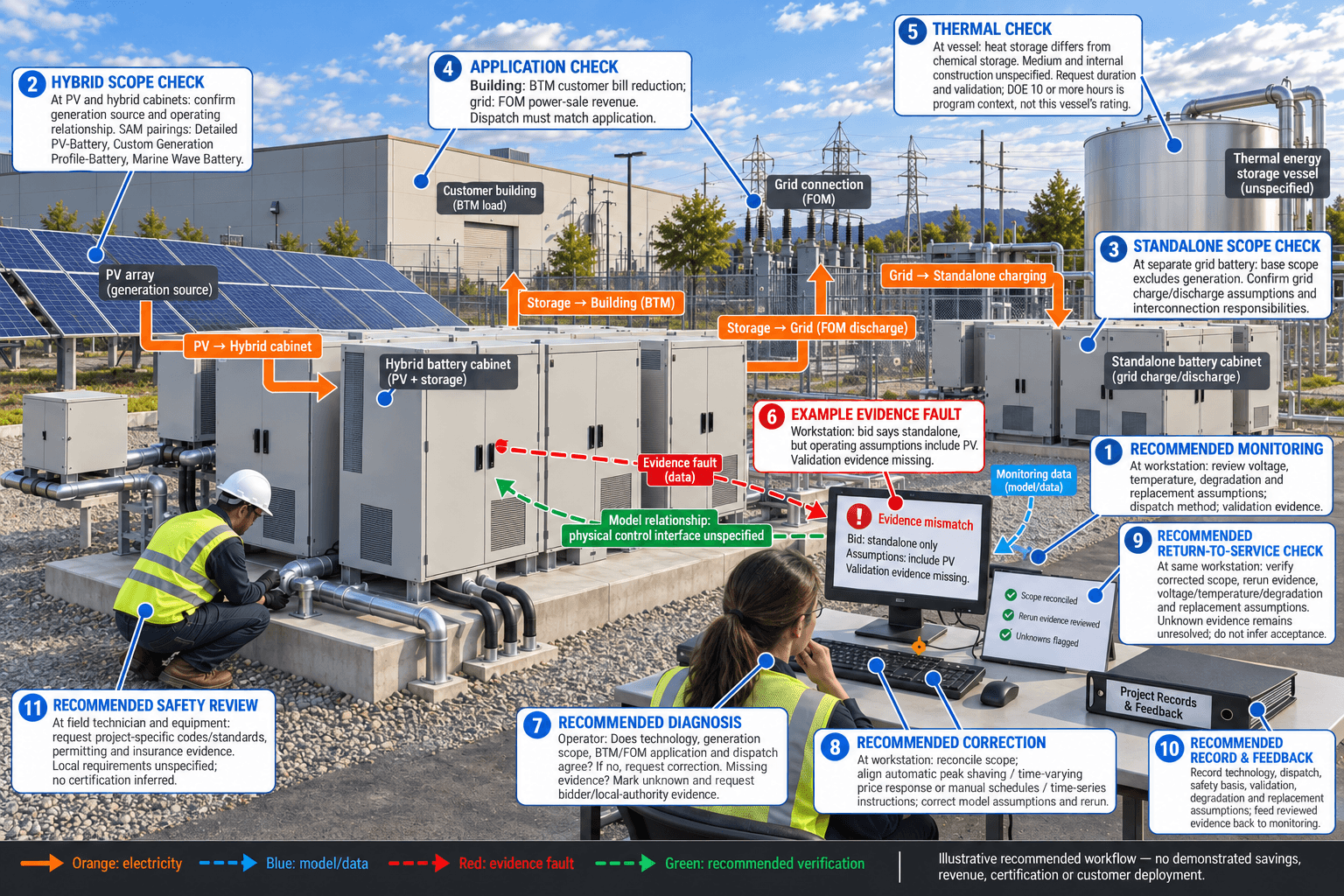
Recommended buyer language: “Bidder shall identify storage technology type, dispatch method, safety basis, validation evidence, degradation assumptions, and replacement assumptions. Where evidence is not available, bidder shall mark it as unknown rather than estimating unsupported values.”
FAQ
Should every energy-storage RFP define the storage technology type?
Recommended, yes, when the term “energy storage” could include electrochemical batteries, thermal storage, or standalone grid-connected storage.
When is standalone storage a separate scope?
When the storage is a grid-connected battery with no power generation equipment, matching SAM’s standalone battery configuration.
Why separate thermal storage from battery storage?
SAM describes thermal storage as storing energy as heat rather than in a chemical battery, so the scope and evidence should not be mixed.
Should BTM and FOM projects use the same specification?
No. SAM links behind-the-meter storage to reducing customer electricity bills and front-of-meter storage to selling power for revenue.
Can these sources prove project savings?
No. The supplied sources support scope distinctions and modeling categories, not specific savings for a buyer or country.
Should bidders state dispatch assumptions?
Yes. SAM identifies automatic and manual dispatch options, including peak shaving, time-varying prices, schedules, and time-series instructions.
Do the sources mandate a U.S. purchasing rule?
No. DOE provides U.S. Office of Electricity program context, but these recommendations should be adapted to the buyer’s country and project rules.
What if bidder evidence is missing?
Treat it as unknown and request project-specific evidence instead of inferring certifications, deployments, prices, savings, or performance.
Procurement paths
About the Author

Cinn Song
Founder & Chief Solutions Architect
Cinn Song founded SOLARTODO LIMITED and leads its smart-city infrastructure engineering — from solar, storage and integrated smart poles to the company's push into physical-AI city edge nodes: pole-mounted edge computing, vertical LLMs for smart cities, drone-based O&M with autonomous battery swapping, robotic maintenance, and high-speed counter-UAS interception. Since 2010, he has directed turnkey EPC + BOT delivery across 50+ countries, including telecom monopole supply for national grid operators, off-grid solar street-lighting for African municipalities, and integrated smart-pole programs for Gulf smart cities.
Cite This Article
Cinn Song. (2026). Energy Storage Procurement Scope: Battery, Thermal,…. SOLARTODO. Retrieved from https://solartodo.com/knowledge/which-energy-storage-procurements-should-require-bidders-to-distinguish-electrochemical-battery-storage-from-thermal
@article{solartodo_which_energy_storage_procurements_should_require_bidders_to_distinguish_electrochemical_battery_storage_from_thermal,
  title = {Energy Storage Procurement Scope: Battery, Thermal,…},
  author = {Cinn Song},
  journal = {SOLARTODO Knowledge Base},
  year = {2026},
  url = {https://solartodo.com/knowledge/which-energy-storage-procurements-should-require-bidders-to-distinguish-electrochemical-battery-storage-from-thermal},
  note = {Accessed: 2026-10-06}
}
Published: October 6, 2026 | Available at: https://solartodo.com/knowledge/which-energy-storage-procurements-should-require-bidders-to-distinguish-electrochemical-battery-storage-from-thermal
Subscribe to Our Newsletter
Get the latest solar energy news and insights delivered to your inbox.
View All Articles