Warsaw Smart Streetlight Market Analysis: 10m Multi-Function Pole Configuration Guide
Summary
Warsaw’s 1.86 million residents, dense arterial corridors, and expanding EV and digital infrastructure support a typical smart-street deployment of approximately 233 poles at 28 m spacing. A recommended configuration uses 10 m grid-powered AC poles with integrated 11 kW Type 2 charging, twin 80 W LED heads, and 5G/WiFi 6 connectivity.
Key Takeaways
- A typical Warsaw boulevard deployment would use approximately 233 units over about 6.5 km at 28 m spacing, equal to roughly 36 poles/km.
- The recommended pole class is 10 m octagonal tapered steel, powered by 220/380 V AC, which fits urban collector and boulevard lighting better than park-scale 6-8 m poles.
- Each pole would combine 2 × 80 W LED luminaires at 150 lm/W and 4000 K, giving 160 W connected lighting load per pole before auxiliary devices.
- The EV module should be the lower 2.2 m of the pole itself, with an integrated 11 kW single-gun AC charger, Type 2 connector, and OCPP 1.6J support.
- The communications stack would include WiFi 6, a 5G gateway, GbE uplink, and LoRaWAN, with the radio housing mounted at 8.7 m and color-matched to the pole.
- Public safety hardware can be consolidated into one structure: 25x zoom PTZ camera, IR 150 m, 12-parameter environmental sensor, SOS intercom, and 2 × 30 W IP audio columns.
- Warsaw’s public charging market is expanding; according to the European Alternative Fuels Observatory (2024), Poland continues to add public charging points, which supports mixed lighting-plus-charging street assets in high-demand districts.
- According to the IEA (2024), LEDs typically reduce electricity use by around 50% or more versus legacy street lighting, improving lifecycle economics when paired with centralized monitoring and fault detection.
Market Context for Warsaw
Warsaw combines a 1.86 million city population with a metropolitan role in transport, administration, and telecom, making multi-function street infrastructure more relevant here than in lower-density Polish municipalities. According to Statistics Poland (GUS) (2024), Warsaw remains the country’s largest city, and according to the City of Warsaw’s strategic planning documents, the capital continues to prioritize low-emission mobility, digital public services, and public-space modernization. Those factors point to demand for poles that do more than lighting alone.
Street infrastructure in Warsaw also operates under a cold-winter climate, with freeze-thaw cycles, wind exposure, and road-salt corrosion that affect coating selection, enclosure sealing, and maintenance intervals. According to the Polish Institute of Meteorology and Water Management and climate summaries referenced by the World Bank Climate Knowledge Portal (2021), Warsaw has winter sub-zero periods and summer heat events, so an outdoor smart pole should be specified with corrosion-resistant steel finishing, sealed access doors, and stable electronics performance across a broad temperature band. For this reason, a steel urban pole with integrated devices is a better fit than decorative park lighting columns.
Power availability also supports a grid-powered Smart Streetlight profile. Poland’s low-voltage public-space supply commonly uses 230/400 V systems aligned with European practice, and Warsaw’s urban roads already have established lighting circuits and utility corridors. According to IEC low-voltage system conventions and common EU distribution practice, a 220/380 V AC pole configuration is technically compatible with municipal lighting feeders after local utility and design verification. That makes the grid-powered SOLAR TODO configuration more practical than an off-grid form for dense central districts.
Telecom density is another factor. According to the Office of Electronic Communications of Poland (UKE) (2024), mobile broadband and urban small-cell densification continue to expand in major Polish cities. ITU states, "5G networks will require denser infrastructure in urban areas to deliver high capacity and low latency." In Warsaw, that means a street pole that supports 5G gateway, WiFi 6, and surveillance hardware can reduce the number of separate roadside assets on constrained sidewalks.
EV charging demand is also relevant in Warsaw’s mixed-use districts, office clusters, and curbside parking corridors. According to the European Alternative Fuels Observatory (2024), Poland’s public charging network continues to grow, while ACEA (2024) reports steady electrification growth across the EU vehicle market. A pole that combines lighting and 11 kW AC charging is therefore suited to areas where dwell times of 1-4 hours are realistic, such as commercial streets, municipal parking edges, and civic corridors rather than expressways.
For Warsaw, the correct size class is an urban street Smart Streetlight, not a highway mast and not a garden pole. The product brief defines a typical density of 25-50 m spacing and 30-50 poles per km, which aligns well with Warsaw boulevard and collector-road geometry. Based on that profile, a 10 m octagonal tapered steel configuration is the most appropriate technical recommendation for premium urban streetscape applications.
Recommended Technical Configuration
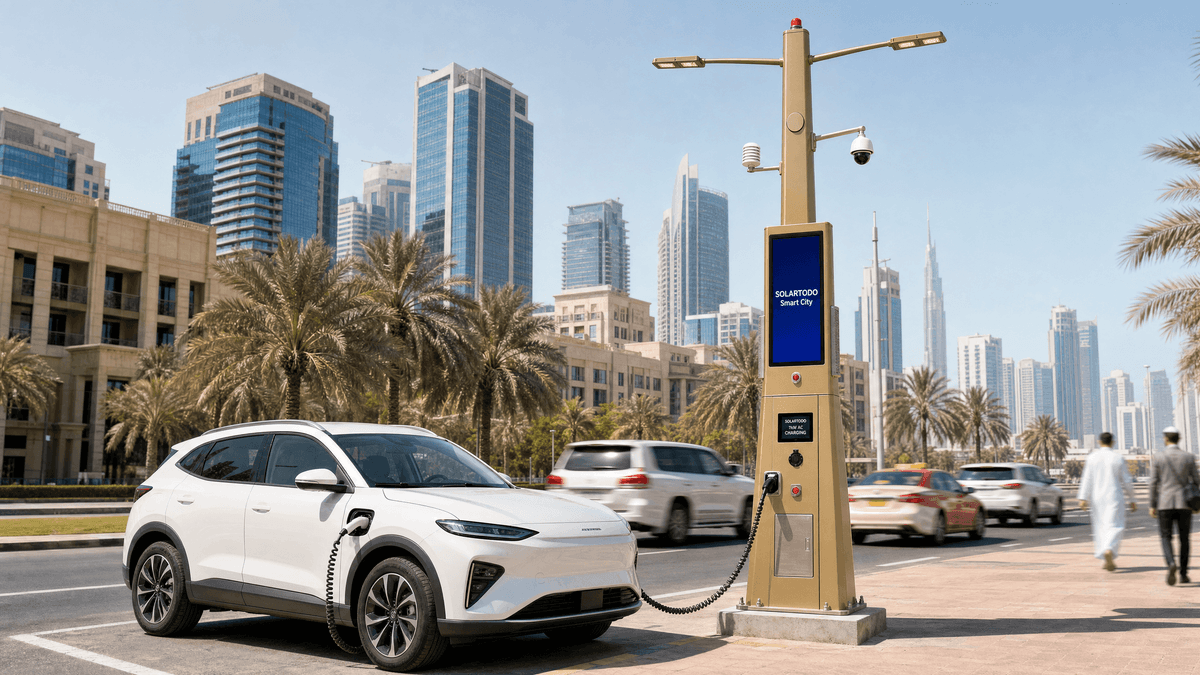
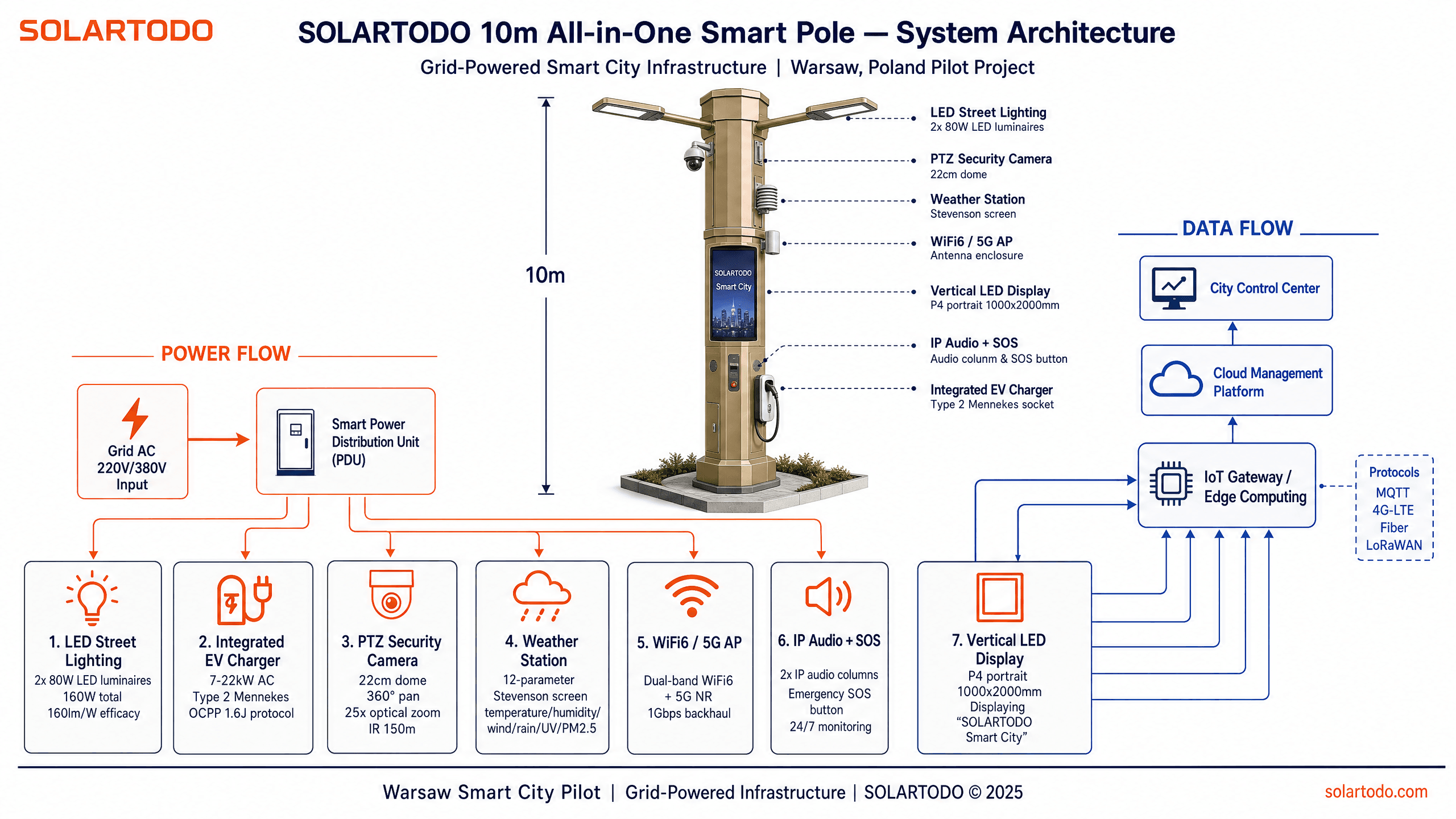
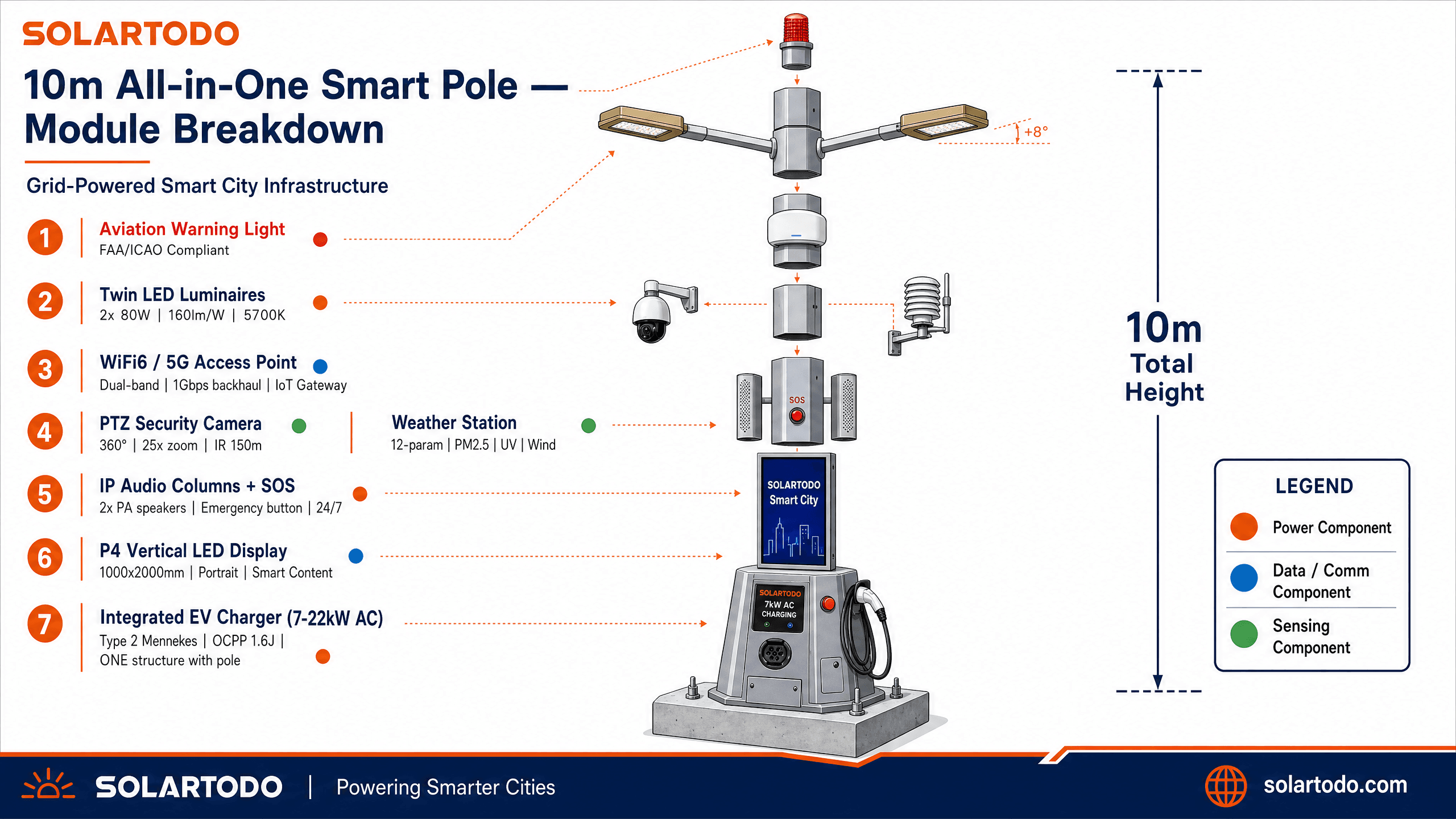
A typical Warsaw deployment of this profile would use approximately 233 integrated 10 m smart poles across about 6.5 km of boulevard or collector-road frontage, combining lighting, charging, surveillance, sensing, and communications in one steel structure.
The recommended configuration is the project-specific grid-powered AC variant adapted for Warsaw’s dense urban conditions. Each unit would use a 10 m octagonal tapered steel smart pole with a base diameter of 45 cm reducing to 15 cm at the top. Finish would be champagne gold RAL1036 pearl gold brushed, which suits premium civic or commercial districts where urban design review matters as much as electrical performance.
The most important structural point is the charger integration. The lower 2.2 m of the pole is the EV charging cabinet itself, welded as one continuous steel structure with the upper shaft, not a separate charger placed beside the pole. That matters in Warsaw because sidewalks in central districts often have constrained clear width, utility conflicts, and visual clutter. A monolithic pole-plus-charger design reduces foundation count and simplifies curbside asset planning.
Lighting should use twin symmetric 1.5 m arms with +8° upward tilt, carrying 2 × 80 W SOLAR TODO LED luminaires at 150 lm/W and 4000 K. The twin-head arrangement is better suited to Warsaw boulevards and median-adjacent layouts than a single-head arrangement because it improves lateral coverage while keeping pole count near 36 poles/km at 28 m spacing. According to the IEA (2024), LED street lighting can cut energy use by 50-70% relative to legacy sodium systems, depending on dimming and baseline equipment.
For safety and enforcement support, each pole would carry a 22 cm white PTZ dome camera with 360° rotation, 25x zoom, and IR 150 m, mounted on a 50 cm L-bracket outrigger. This is suitable for intersections, curbside parking management, and public-space incident review. IEEE notes that urban surveillance systems perform best when communications, power, and mounting are standardized across the network, which is easier to achieve when the camera is specified as part of the pole package rather than as a later retrofit.
Environmental monitoring is also justified in Warsaw because winter smog episodes and traffic-related air quality remain public concerns. The recommended top-mounted package is a 12-parameter environmental sensor covering full meteorology plus air quality, rain, CO, NO2, and O3. The World Health Organization states, "Air pollution is one of the biggest environmental threats to human health," which supports integrating real-time sensing on traffic corridors where municipal operations teams need localized data rather than citywide averages alone.
Public communication hardware would include 2 × IP audio columns sized Ø10 × 50 cm, each rated 30 W / 93 dB, mounted flush against opposite flat faces of the pole and color-matched to the shaft. This arrangement works for emergency announcements, scheduled public messaging, and event-day crowd guidance. It also preserves a cleaner profile than horn speakers or crossarms, which is useful in Warsaw districts with architectural review constraints.
The EV charging module should be an integrated 11 kW single-gun AC charger with Type 2, OCPP 1.6J, 5 m coiled cable, 8-inch touchscreen at 1.5 m, red mushroom emergency stop, and stainless maintenance door. For Warsaw, this is a practical curbside charging level because it matches common AC charging behavior in Europe and avoids the transformer and thermal demands of DC fast charging on every pole. IEC 62196-2 compatibility is essential for procurement.
A vertical P5 LED display sized 1280 × 2560 mm can be included for municipal information or branding, with content limited here to “SOLARTODO Smart City” in white sans-serif on deep blue. Communications hardware would include dual-mode WiFi 6 + 5G gateway, GbE uplink, and LoRaWAN, mounted flush on the flat pole face at 8.7 m. SOLAR TODO can therefore position the Smart Streetlight as a consolidated roadside node rather than only a luminaire column. For Warsaw buyers comparing asset classes, that consolidation is the main technical advantage.
Technical Specifications
The Warsaw-recommended Smart Streetlight specification is a 10 m, 220/380 V AC integrated pole with 160 W LED load, 11 kW AC charging, 25x PTZ surveillance, and compliance with IEC 60598, GB/T 37024, and IEC 62196-2.
- Pole type: 10 m octagonal tapered steel smart pole
- Pole diameter: base Ø45 cm to top Ø15 cm
- Surface finish: RAL1036 pearl gold brushed, champagne gold appearance
- Power supply: grid-powered AC 220/380 V
- Integrated charger structure: lower 2.2 m of pole is the EV charging cabinet, welded as one continuous steel structure
- Luminaire arms: twin symmetric 1.5 m arms, +8° upward tilt
- LED luminaires: 2 × 80 W SOLAR TODO LED, 150 lm/W, 4000 K
- Total nominal lighting load: 160 W per pole, excluding accessories
- Camera: 22 cm white PTZ dome, 360° rotation, 25x zoom, IR 150 m
- Camera bracket: 50 cm L-bracket outrigger
- Environmental sensor: 12-parameter package for meteorology, air quality, rain, CO/NO2/O3
- Public address: 2 × symmetric IP audio columns, Ø10 × 50 cm, 30 W / 93 dB
- Emergency system: one-press SOS button, dual-way audio intercom, visual LED indicator
- EV charger: integrated 11 kW single-gun AC, Type 2, OCPP 1.6J
- Charging cable: 5 m coiled Type 2 cable
- User interface: 8-inch touchscreen at 1.5 m height
- Safety hardware: red mushroom E-stop, stainless maintenance door
- LED display: P5 vertical screen, 1280 × 2560 mm, >5000 cd/m²
- Display content constraint: “SOLARTODO Smart City” text only, white sans-serif on deep blue
- Communications: WiFi 6 + 5G gateway, GbE uplink + LoRaWAN
- Gateway mounting height: 8.7 m, flush on flat pole face, color-matched housing
- Extra charging port: none
- Recommended spacing: 28 m
- Applicable standards: IEC 60598, GB/T 37024, IEC 62196-2
Implementation Approach
A typical Warsaw rollout would be executed in 4 phases over roughly 6-12 months, covering survey, utility coordination, civil works, pole installation, and software commissioning for approximately 233 units.
Phase 1 would cover corridor survey, photometric design, and utility checks. At 28 m spacing, a 6.5 km corridor requires careful review of underground utilities, parking bays, tram interfaces, and pedestrian clearances. For Warsaw, design teams should confirm feeder capacity for the combined 160 W lighting load plus diversified 11 kW charging demand, because not every charger will operate at full power simultaneously. Load diversity and charging session assumptions should be documented before procurement.
Phase 2 would cover foundation and conduit design. Because the charger is part of the pole body, the base interface, cable routing, earthing, and service access need to be resolved as one assembly rather than as separate lighting and EV packages. This usually reduces street clutter, but it raises the importance of accurate civil drawings and maintenance-door orientation. In cold-weather cities like Warsaw, installers should also account for frost-depth requirements and drainage around the base.
Phase 3 would cover factory acceptance, shipping, and site erection. A CKD or finished-unit supply model can both work, depending on local assembly preference and import planning. Pole erection should be sequenced by feeder zone so lighting circuits, network commissioning, and charger activation can be tested in manageable blocks of 20-40 poles. SOLAR TODO product documentation should be checked against local electrical approvals before energization.
Phase 4 would cover platform integration and operational acceptance. This includes LED dimming schedules, charger OCPP onboarding, camera network setup, SOS testing, and sensor calibration. According to NREL (2023), networked lighting systems create the most value when controls, metering, and maintenance alerts are commissioned at the start rather than added later. For Warsaw, that means the Smart Streetlight should enter service as a managed digital asset, not just as a powered pole.
Expected Performance & ROI
A Warsaw Smart Streetlight corridor of approximately 233 poles could deliver 37.3 kW of nominal LED lighting load and 2.56 MW of nameplate AC charging capacity, while reducing separate roadside asset count by combining at least 6 functions per pole.
For lighting energy, the direct connected LED load is 233 × 160 W = 37.28 kW. If operated for about 4,100 hours/year, annual lighting consumption would be roughly 152,848 kWh/year before dimming. Compared with legacy 250 W HPS equivalents delivering similar roadway coverage, the reduction can be substantial. According to the IEA (2024), LEDs often cut street-light electricity use by 50% or more, and networked dimming can improve that further during off-peak hours.
Maintenance economics also improve when separate assets are consolidated. Instead of maintaining a lighting pole, standalone charger, separate speaker mast, separate environmental node, and separate camera post, Warsaw operators would service one integrated structure with one foundation and one power/service point. According to NREL (2023), connected outdoor lighting systems reduce maintenance dispatches through fault visibility and remote diagnostics. That does not eliminate field work, but it can shorten outage duration and reduce routine night patrols.
EV charging ROI depends more on utilization than on hardware count. An 11 kW AC charger is suitable where average dwell time is measured in hours, not minutes. In Warsaw office, retail, and civic corridors, utilization could be strongest in mixed-use districts with daytime parking turnover and evening residential demand. A prudent procurement model would therefore evaluate charger activation in phases, using the same pole body and enabling OCPP billing where utilization data supports it.
In lifecycle terms, the strongest business case is usually not energy alone. It comes from combining lighting modernization, curbside charging, traffic observation, public safety audio, and telecom-ready mounting into one capex line. That reduces foundation duplication and can lower permit complexity. SOLAR TODO should therefore be assessed against the cost of multiple separate asset classes, not only against a conventional streetlight column.
Results and Impact
For Warsaw, the practical impact of this Smart Streetlight format is fewer roadside structures, higher digital functionality per meter of sidewalk, and a clearer path to phased EV charging on existing lighting corridors.
A typical 233-unit corridor would create a repeatable urban asset standard: 10 m lighting height, 11 kW curbside AC charging, 25x PTZ surveillance, air-quality sensing, public address, SOS, and telecom support in one pole. That is useful in Warsaw because streetscape quality, winter maintenance, and underground utility congestion all favor consolidated infrastructure. For procurement teams, the main question is not whether each function is available individually; it is whether a single integrated pole reduces total street complexity over a 10-15 year operating period.
Comparison Table
The table below compares a Warsaw-recommended SOLAR TODO Smart Streetlight against a conventional separated-asset approach using one lighting pole plus standalone devices.
| Metric | SOLAR TODO Smart Streetlight (Recommended) | Conventional Separate Assets |
|---|---|---|
| Pole height | 10 m | 8-10 m lighting pole only |
| Pole spacing | 28 m | 28-35 m typical |
| Lighting power per pole | 2 × 80 W = 160 W | 150-250 W typical |
| Charger format | Integrated 11 kW AC Type 2 | Separate pedestal charger |
| Charger structure | Lower 2.2 m of pole body | Independent cabinet/foundation |
| Camera | PTZ, 25x, IR 150 m | Often separate camera mast |
| Environmental sensing | 12 parameters | Usually separate sensor node or none |
| Public address | 2 × 30 W IP columns | Separate speaker installation |
| Communications | WiFi 6 + 5G + LoRaWAN + GbE | Often fragmented by vendor |
| Foundations per service point | 1 | 2-5 depending on scope |
| Streetscape clutter | Lower | Higher |
| Standards basis | IEC 60598, GB/T 37024, IEC 62196-2 | Varies by package |
Pricing & Quotation
SOLAR TODO offers three pricing tiers for this product line: FOB Supply (equipment ex-works China), CIF Delivered (including ocean freight and insurance), and EPC Turnkey (fully installed, commissioned, with 1-year warranty). Volume discounts are available for large-scale deployments. Configure your system online for an instant estimate, or request a custom quotation from our engineering team at [email protected].
For Warsaw tenders, quotation quality depends on 4 inputs: corridor length in km, target spacing in m, charger concurrency assumptions, and local civil scope. Buyers comparing bids should request a single-line electrical diagram, foundation interface drawing, luminaire photometry, and OCPP compliance statement. Product details for the line are available on the Smart Streetlight product page, and project-specific design support can be requested via contact us.
Frequently Asked Questions
This FAQ answers the most common Warsaw procurement questions, including 10 m pole sizing, 11 kW charging, maintenance, standards, and typical rollout timing for a 233-unit urban corridor.
Q1: Why is a 10 m Smart Streetlight recommended for Warsaw instead of a 6-8 m pole? A 10 m pole fits Warsaw boulevards and collector roads better because it supports wider carriageways, twin 1.5 m arms, and multi-device mounting without overcrowding the top section. The product brief also places smart urban street deployments at 25-50 m spacing, which aligns more closely with a 10 m road-lighting class than with park-scale poles.
Q2: Is the EV charger separate from the pole or part of the same structure? The recommended configuration uses an integrated design where the lower 2.2 m of the pole is the charger cabinet itself. It is welded to the upper shaft as one steel structure, not installed as a separate charger beside the pole. This matters for Warsaw sidewalks because it reduces clutter and avoids an extra roadside foundation.
Q3: What charging standard is specified for Warsaw? The charger is an 11 kW single-gun AC unit with Type 2 connector and OCPP 1.6J support, which matches common European AC charging practice. Compliance with IEC 62196-2 is specified. This is appropriate for curbside dwell times of 1-4 hours, not for ultra-fast turnover use cases that require DC charging hardware.
Q4: How long would a typical 233-pole deployment take? A realistic program is usually 6-12 months, depending on utility approvals, civil permits, winter conditions, and whether installation is phased. Survey and design may take 6-10 weeks, civil works 8-16 weeks, and commissioning another 4-8 weeks. Warsaw schedules should also allow time for feeder coordination and streetscape approvals.
Q5: What energy savings can be expected from the lighting system? Each pole uses 2 × 80 W LED luminaires for a 160 W lighting load. Compared with older 250 W HPS streetlights, LED systems often cut electricity use by 50% or more, especially when dimming is enabled. Actual savings depend on the baseline fixture, operating hours, and whether auxiliary devices are metered separately.
Q6: What maintenance regime is typical for this type of Smart Streetlight? Most operators plan annual structural and electrical inspection, quarterly cleaning of camera and display surfaces, and periodic charger cable checks. Networked alerts can reduce manual fault patrols because luminaire, charger, and communications status are visible remotely. In Warsaw, winter road salt and freeze-thaw cycles make coating inspection and door-seal checks especially important.
Q7: How does this compare with installing separate poles, chargers, and cameras? The main benefit is consolidation. One 10 m asset carries lighting, 11 kW charging, PTZ surveillance, audio, SOS, sensing, and communications. A conventional layout may need 2-5 separate roadside devices and foundations to deliver the same functions. That can increase sidewalk clutter, utility conflicts, and permit complexity even if individual devices are cheaper in isolation.
Q8: What should EPC buyers ask for in a quotation? At minimum, ask for pole drawings, foundation loads, luminaire photometry, charger certification, OCPP statement, network architecture, and standards compliance for IEC 60598 and IEC 62196-2. Buyers should also request a bill of materials and identify which scope is local: trenching, feeder upgrades, civil reinstatement, and traffic management often change total installed cost more than hardware alone.
Q9: What warranty terms are typical for this product category? Warranty terms vary by commercial package, but buyers commonly separate structural steel, LED driver/luminaire, charger electronics, and communications modules into different coverage periods. The quotation section here references 1-year warranty for EPC Turnkey scope. For Warsaw tenders, it is sensible to request explicit warranty matrices by subsystem and spare-parts lead times.
Q10: Can the communications package support future smart-city applications? Yes. The specified stack includes WiFi 6, 5G gateway, GbE uplink, and LoRaWAN, which supports lighting control, charger data, environmental telemetry, and future edge devices. In Warsaw, that can help avoid duplicate mounting structures later. Final compatibility still depends on municipal IT policy, SIM/network strategy, and cybersecurity requirements.
References
- Statistics Poland (GUS) (2024): Warsaw population and demographic statistics for Poland’s capital city.
- City of Warsaw (2023): Strategic and mobility planning documents covering low-emission transport, public-space modernization, and digital city services.
- International Energy Agency (IEA) (2024): LED lighting efficiency and street-lighting energy reduction benchmarks.
- European Alternative Fuels Observatory (EAFO) (2024): Poland public EV charging market data and infrastructure growth trends.
- International Telecommunication Union (ITU) (2023): Urban 5G densification requirements and communications infrastructure guidance.
- IEC (2023): IEC 60598 luminaires standard and IEC 62196-2 plug, socket-outlet, vehicle connector requirements.
- National Renewable Energy Laboratory (NREL) (2023): Networked outdoor lighting controls, maintenance visibility, and smart-city lighting integration guidance.
Equipment Deployed
- 10 m octagonal tapered steel smart pole, base Ø45 cm to top Ø15 cm, RAL1036 pearl gold brushed finish
- Grid-powered AC 220/380 V supply configuration
- Integrated EV charging cabinet formed by lower 2.2 m of pole body, welded as one structure
- Twin symmetric 1.5 m luminaire arms with +8° upward tilt
- 2 × 80 W SOLAR TODO LED luminaires, 150 lm/W, 4000 K
- 22 cm white PTZ dome camera, 360° rotation, 25x zoom, IR 150 m
- 50 cm L-bracket outrigger for PTZ camera
- 12-parameter environmental sensor with meteorology, air quality, rain, CO, NO2, O3
- 2 × IP audio columns, Ø10 × 50 cm, 30 W / 93 dB
- One-press SOS button with dual-way audio intercom and visual LED indicator
- Integrated 11 kW single-gun AC charger, Type 2, OCPP 1.6J
- 5 m coiled Type 2 charging cable
- 8-inch touchscreen mounted at 1.5 m height
- Red mushroom emergency stop and stainless maintenance door
- P5 vertical LED display, 1280 × 2560 mm, >5000 cd/m²
- WiFi 6 + 5G gateway with GbE uplink and LoRaWAN mounted at 8.7 m